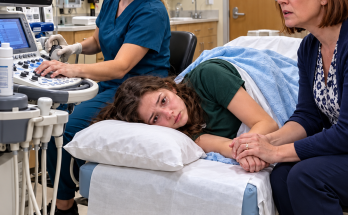

My husband, Marcus, drugged me every night under the excuse that it would help me study more efficiently, but one night I only pretended to swallow the pill and lay still in bed. He believed I was asleep. At 2:47 AM, he entered the room wearing gloves, carrying a camera and a black notebook. There was no tenderness in the way he touched me. He lifted my eyelid and whispered: “Her memory still hasn’t returned.”
“Lucy… sweetie, don’t sign anything. Don’t close your eyes again. They’re coming for you.” The name hit my chest like a struck bell. Lucy. Not Valerie. Lucy. Marcus rushed toward the monitor and pulled the cord free. The screen cut to black, but the woman’s voice had already sunk into me. I didn’t need her full face; my body already knew her. My breath, my hands, the part of me that had survived beneath the medication for two years. “Who was that?” I asked, though I already feared the answer. Eleanor went pale. “Marcus, this is out of control.” He turned to me with a cold, clinical fury, as though I were not a waking woman but a failed experiment. “Don’t listen to anything, Valerie. Your brain is mixing up stimuli.” “My name is Lucy.” His jaw tightened. “Your name is whatever I say it is as long as you keep breathing in my house.”
Something in me fractured at that moment. For two years I believed him because he sounded like authority. Because he used precise language to hide cruelty. Because he stroked my hair after drugging me and told me he loved me while taking my days away.
I sat up on the gurney. Marcus stepped closer. “Lie down.” “No.”
Eleanor clutched the documents tightly. “Marcus, that video call could trace us. We have to leave.” “We leave when she signs.”
He forced my hand forward. The pen was still between my fingers. Beneath the folder were notarized pages, my photo, fingerprints, a forged signature, and a line I could barely process: “Full transfer of financial rights of Lucy Archer Sanders.”
Sanders. The name cracked something open. An old house in Georgetown. A broken fountain. A woman laughing as she chased me with a towel. “Lucy Sanders, if you step in the mud with those shoes, your grandfather will have a heart attack.”
My mother. The woman on the screen. Not dead. They had buried me alive.
Marcus pressed the pen down. “Sign.” “No.” He squeezed until my fingers cracked. “Sign, or the next dose won’t leave anything left to recover.”
Eleanor trembled. “Don’t kill her here.” I looked at her. “Here? So somewhere else is fine?” She lowered her gaze. She wasn’t innocent. Neither of them was. But beneath her fear I saw something older—guilt that still bled.
Marcus opened a drawer and took out a syringe. “Last chance, love.” The word turned my stomach.
I faked weakness, letting my head fall aside as if I were fading. “I’m dizzy,” I whispered. He almost smiled. He trusted himself too much. He came closer with the syringe.
The moment he leaned in, I grabbed the metal tray and smashed it into his face.
The impact rang out hollow. He stumbled back, shouting. The syringe shattered. Eleanor screamed. I tried to run, but my legs gave out. Two years of sedation did not disappear in one night. I collapsed, striking my shoulder.
Marcus wiped blood from his brow. “You bitch.” I crawled toward the red folder. He grabbed my ankle like a chain. I kicked—once, twice, and on the third strike hit his injured arm. He let go. I pulled the folder to my chest.
Then a voice came from a hidden speaker in the wall. “Don’t let Marcus know you remember.”
We froze. It played again, followed by another: “If you are hearing this, it’s because you managed to wake up. The camera in the smoke detector wasn’t just recording you. It was also recording what he did.”
Marcus and I both stared. The voice was mine—but slower, exhausted, as if recorded between gaps.
“I found a connection behind the desk. I sent a copy to an email I don’t remember creating. If I forget again, let the truth wait for me outside.”
Eleanor whispered: “It can’t be.”
Marcus ran toward the console—but a loud bang hit the front door. Then another. Voices followed. “Police! Open the door!”
His expression shifted completely. No longer doctor, no longer husband—just cornered prey.
He pulled a gun from a hidden drawer. “Walk.” “Marcus, no,” Eleanor said.
He didn’t look at her. “You’ve ruined enough, Mom.” “I did everything for you.” “You did everything for the inheritance.”
He dragged me into the hidden hallway. I clutched the folder as footsteps and crashing sounds echoed behind us.
The hallway led to a garage. A black SUV idled in the rain. He shoved me against the door. “Get in.” “I’m not signing anything.”
He struck me—precise, controlled. I tasted blood. The folder dropped into the rain. “I don’t need you to sign it awake,” he said.
A voice came from the garage entrance. “That’s why you never should have studied neurology, Marcus. You learned how to turn off brains, but not how to understand souls.”
A woman stood there, soaked, scars cutting across her face and neck, leaning on a cane—but her gaze was unbroken.
My mother. The name still missing, but my body knew it. “Mom,” I said.
She cried without stepping forward. “Lucy.”
Marcus grabbed me, pressing the gun to my side. “One more step and I kill her.”
My mother raised her hands. “You’ve already killed her so many nights. I won’t let you do it one more time.” “You don’t understand. She was going to lose everything. I gave her stability.” “You gave her a prison with clean sheets.” “And what did you give her? A dangerous last name? An inheritance full of enemies? Her father left too much land, too many clinics, too many accounts. Someone was going to take it from her.” “And that someone was you.” “I was smarter.”
My mother looked at me. “Lucy, the blue backpack.”
Everything stopped. A highway at night. Blood on her forehead. My hands on a blue backpack. “Don’t let go of it, honey. Everything is in there.” Headlights. Impact.
I woke in a hospital as Marcus said: “Relax, Valerie. Your husband is here.”
Rage swallowed the memory.
I drove my heel into his foot. He fired upward. My mother smashed the lights with her cane. Darkness fell. I ducked. Another shot burned past my ear.
Flashlights flooded in. “Drop the weapon!” Officers rushed him. He fell.
I ran to my mother. She lay on the floor. “No, no, no…” The bullet had grazed her shoulder. She was alive.
“Don’t show up just to leave again,” I begged. She smiled weakly. “So bossy… just like when you were a little girl.”
Paramedics arrived. I held on tightly.
“My name,” I told her. “Tell me my full name.” She touched my face. “Lucy Archer Sanders. Daughter of Renee Sanders and granddaughter of Julian Archer. You were born on April twelfth. You were afraid of clowns, you hated beets, and you used to say that when you grew up you were going to defend people who couldn’t afford lawyers.”
I broke down. “I don’t remember everything.” “It doesn’t matter. I do. I’ll lend it to you until it comes back.”
Marcus was taken away in cuffs. “Without me, you don’t know who you are.” I looked up. “That’s why I’m going to live. To find out without you.”
Eleanor confessed that morning. Not from remorse, but survival. She revealed the inheritance scheme, the forged identities, the hospital manipulation, the legal takeover.
Marcus had arrived after the crash as a consulting doctor. I had amnesia. My mother was critically injured. They replaced records. Declared her dead. Created Valerie Reed.
For two years, Marcus didn’t heal me—he contained me.
My mother survived because a nurse refused the paperwork. She was moved between hospitals until she could speak again. It took years to find me.
The video call came from persistence, from investigation, from an email I had once sent to myself during brief clarity.
The trial lasted nearly a year. Marcus tried to claim confusion. The recordings destroyed that.
When the courtroom heard: “I’ve spent two years killing Valerie every single night,” silence followed.
I realized then: Valerie wasn’t the victim—she was the survivor who protected Lucy.
“You didn’t love me,” I said in court. “You administered me. You monitored me. You used me as a patient, a signature, and a piece of property. But my memory wasn’t your laboratory. My name wasn’t your diagnosis. And my life wasn’t an inheritance waiting for an owner.”
He looked down.
He was convicted with Eleanor and others involved.
Recovery wasn’t simple. Memories returned in fragments. Some never came back. I learned not to force them.
My mother said: “A house is still a house even if it has locked rooms.”
I returned to Columbia. Writing my name—Lucy Valerie Archer Sanders Reed—felt like assembling shattered glass.
Valerie was not fake. She was survival.
My mother struggled with the name at first. One day she said: “Sometimes I feel that calling you Valerie proves them right.” I said: “No. It gives me all my pieces back.”
She cried. So did I.
Marcus’s house was emptied. The white room remained. The evidence remained. The notebook remained.
“Don’t drink the water.” “Count the cameras.” “Don’t let Marcus know you remember.” And: “If you wake up and you’re scared, don’t hate yourself. Your fear kept you alive.”
I held it like I held myself.
Months later I defended my thesis on control and memory.
When asked what I would say to him, I said: “That enough of it came back.”
That night I lived alone for the first time without fear in the dark.
I wrote one final line before sleep:
“My name is Lucy Valerie. I was erased many times. But I learned to write myself all over again.”
I turned off the light. And for the first time in years, the darkness stayed quiet.