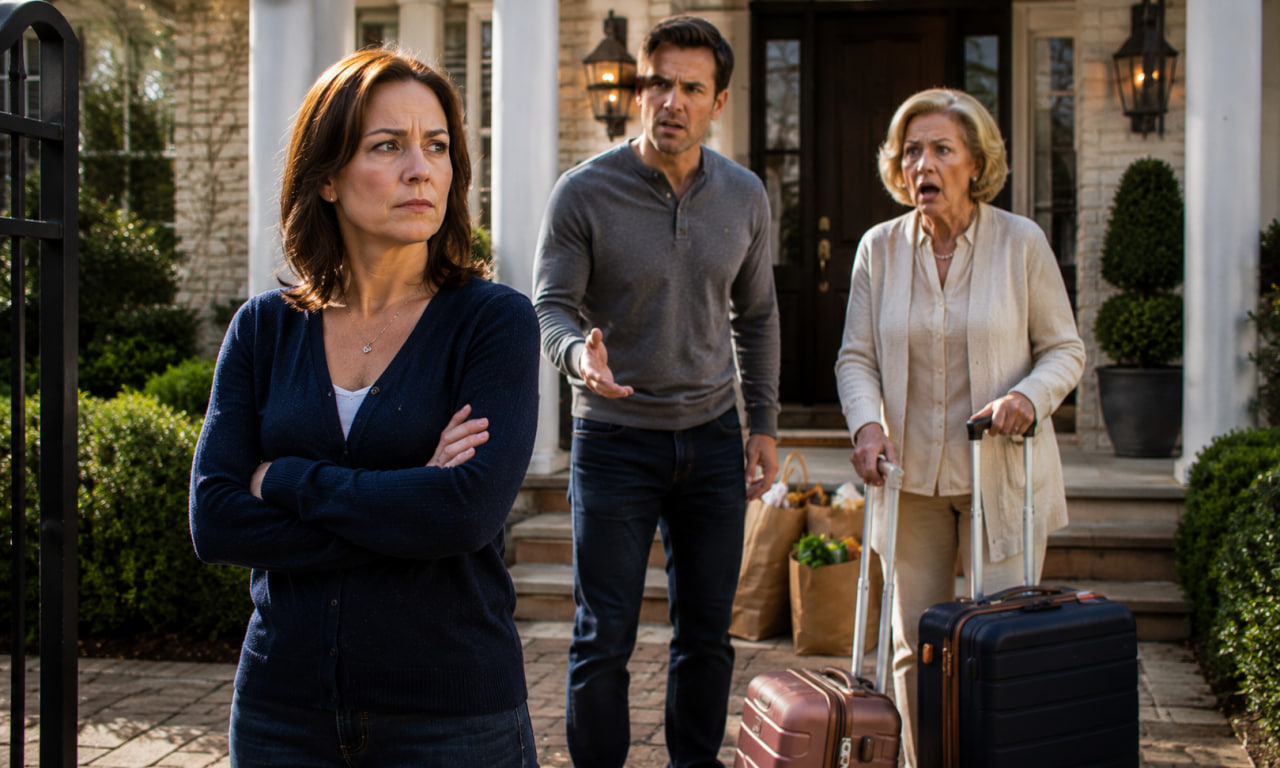
The morning after my husband shoved me into a wall for refusing to let his mother move into my house, he dropped a black makeup bag beside my coffee and said, “Freshen up. Cover that mark and smile.” His mother was coming back at noon with her suitcases, and David expected me to serve lunch while the three of us “made decisions” about my property. I waited until he drove away, then my lawyer unzipped the bag. Beneath the makeup were copies of my tax returns, my missing passport, and paperwork for a $640,000 private loan using my house as collateral. The final page carried a signature that looked almost exactly like mine. Then my lawyer made one call—and learned that a mobile notary was already scheduled to arrive at my home at noon.
Rachel put on a pair of disposable gloves from her briefcase and unzipped the bag.
There was makeup inside, but it was clearly used. It wasn’t a gift.
Beneath the brushes and compacts was a bundle of documents.
The first was a preliminary application for a $640,000 private loan.
The property listed as collateral was my house.
The borrower was Vance Elite Events, a company I had never heard of.
Eleanor was listed as its director.
David was its managing partner.
Attached to the application were copies of my tax returns, my Illinois driver’s license, and a property appraisal ordered three weeks earlier.
Then Rachel unfolded the final page.
It was an owner-consent form.
My name had been printed beneath the signature line.
Above it was a signature resembling mine.
It was close.
But it was not mine.
At the bottom of the bag was my missing passport.
I stared at it.
“He told me I lost that.”
Rachel photographed every document.
“Don’t touch anything.”
“Can they take my house with this?”
“Not with a preliminary application. A lender cannot legally place a lien on your property without verifying your identity and obtaining your notarized signature on the final deed of trust.”
“Then why forge the preliminary form?”
“To make it appear that you had already approved the transaction. They still needed to get you into a final signing.”
I remembered David’s words.
You’ll need it before noon.
“The meeting,” I whispered.
Rachel nodded.
“They don’t want lunch. They want your signature.”
She called the Chicago-based lender listed on the application and asked for its compliance department.
With me beside her confirming my identity and ownership, the lender revealed that a mobile closing had been scheduled at my home for noon.
The company believed I had agreed to secure a $640,000 loan for Vance Elite Events.
The preliminary documents had moved the application forward, but the lender still required me to appear in person, show my ID, and sign the final deed of trust before a notary.
David and Eleanor planned to surprise me with the completed package and pressure me into signing.
The lender immediately froze the application and opened a federal fraud investigation. Rachel also contacted the mobile notary service, which canceled the noon appointment.
By 9:00 a.m., we had learned why David and Eleanor were desperate.
Eleanor had not sold her condo voluntarily.
The bank had foreclosed on it after she used it to secure several business loans.
Her event-planning company had been failing for nearly two years. David had secretly created Vance Elite Events in an attempt to take over its remaining contracts and absorb its debts.
They owed vendors, former employees, private lenders, and the bank more than $500,000.
My house was supposed to rescue them.
While Rachel finalized the emergency petition, I gave a recorded statement to an Evanston police officer and provided the hallway footage.
At 10:06 a.m., a judge granted me temporary exclusive possession of the house.
The order specifically authorized my attorney to have David’s clothing and undisputed personal belongings professionally packed, photographed, and inventoried. Those items could be released during one supervised visit. Furniture and anything disputed would remain inside until our attorneys arranged another collection.
An officer served David at Eleanor’s hotel at 10:32 a.m.
David told the officer that the order was a massive misunderstanding.
He insisted that I was just upset but would withdraw everything once he and Eleanor returned with lunch and explained their financial emergency.
The officer warned him that he could not enter the house and that Eleanor had no right to step onto the property. David was allowed to return at noon only for the supervised collection listed in the court order.
He agreed.
But he still believed he could manipulate me.
At 10:45 a.m., a professional moving crew arrived.
Under Rachel’s supervision, the movers photographed and inventoried David’s clothing, shoes, work files, medication, and toiletries.
There were too many boxes and rolling racks to fit in the entryway, so the movers placed waterproof tarps across the dry section of the back patio while waiting for David.
His suits hung beneath the oak tree.
His shirts were folded in open boxes beside the rose bushes.
Rows of shoes lined the flagstone path.
His golf clubs leaned against the garden wall.
Even the tuxedo he had not worn since our wedding moved gently in the chilly wind.
At 11:40 a.m., a locksmith changed the exterior deadbolts as authorized by the order.
At 11:56, David’s SUV pulled into the driveway.
Eleanor sat in the passenger seat.
Both of her suitcases were in the back.
David was carrying Whole Foods grocery bags because he still expected to talk his way back into the house.
He stepped out of the car, looked toward the backyard, and stopped.
His navy suit hung beneath the oak tree. His shirts filled boxes across the tarps. Every piece of clothing he owned seemed to be spread across the lawn.
His face turned dark red.
“What the hell is this?”
He dropped the groceries and ran toward the side gate.
The supervising police officer blocked his path.
“You need to remain on the driveway until the property owner and her attorney are ready.”
“My clothes are in the yard!”
“They have been packed and inventoried in accordance with the judge’s order.”
David pointed toward the front door.
“This is my home!”
I stepped onto the porch with Rachel beside me.
“No,” I said. “It isn’t.”
Eleanor pushed past him.
“What have you done to my son’s belongings?”
“They’re being released to him under police supervision.”
“You can’t throw him out of his own house.”
Rachel spoke in a measured, professional tone.
“The deed identifies Sarah Caldwell as the sole owner. The property was purchased before the marriage with separate funds and is protected by a valid Illinois prenuptial agreement.”
Eleanor stared at her.
“That can’t be true.”
“It is.”
She looked at David.
“You said the house became marital property when you married her.”
He avoided her eyes.
That was the exact moment Eleanor learned what David had always known.
The house had never belonged to him.
He had lied to his mother for years.
Eleanor turned back to me.
“You let him live here for six years. That gives him squatters rights.”
“It gave him a place to live while we were married. It never gave him ownership.”
David moved toward the porch steps.
“Sarah, withdraw the order so we can talk.”
“You can speak through Rachel.”
“This is a marriage, not a corporate merger.”
“You turned it into a business transaction when you applied for a $640,000 loan against my house.”
The anger vanished from his face.
Eleanor went completely still.
David glanced at her.
Then he noticed the black makeup bag sitting on the porch railing.
“Where did you get that?”
“You put it beside my coffee.”
“That isn’t the bag Mom gave me.”
Eleanor looked toward it.
Her hand moved instinctively toward one of her suitcases in the car. She unzipped an outer pocket and pulled out another black cosmetic case.
The two bags were nearly identical.
David had taken the wrong one from the Marriott.
Eleanor’s face lost all color.
“Give it back,” she said.
“Why?”
“There are personal things inside.”
“My passport is not your personal property.”
David closed his eyes.
Eleanor stared at him in panic.
“You said she had agreed.”
“I said I could persuade her.”
“You said the application was complete!”
“Stop talking.”
The officer made sure his body camera was recording and reminded both of them that they had the right to remain silent.
Eleanor had already begun exposing the scheme.
“What application?” I asked.
She pressed her lips together.
Rachel held up a copy of the loan documents.
“This application.”
Eleanor pointed a trembling finger at David.
“This was his idea.”
David turned on her.
“You begged me to save your company!”
“You said the house was practically yours!”
“I said Sarah might eventually add me to the deed.”
“You said she owed you!”
The driveway became dead silent.
David finally realized how much they had just confessed.
He looked at me pleadingly.
“Sarah, I can explain.”
“Can you explain my forged signature?”
“You agreed to help us.”
“I had never heard of Vance Elite Events until this morning.”
“We were going to tell you.”
“When?”
“At lunch.”
“There was never going to be a lunch.”
“You would have signed if you understood the severity of the situation.”
“You submitted financial documents in my name before even asking me.”
“The preliminary application wasn’t legally binding.”
“You forged my signature.”
“It was only to show the bank you were interested.”
“I wasn’t interested.”
“You would have been once you understood how much my mother stood to lose.”
“She had already lost her condo.”
Eleanor looked at the ground.
David’s silence confirmed it.
“You both lied to me.”
“We were trying to protect the family,” he said.
“No. You were trying to make me responsible for massive debts you concealed from me.”
“We could have repaid the loan.”
“With what?”
“Mom’s business would bounce back.”
“The business has been bleeding money for two years.”
His expression shifted to shock.
He had not expected me to know the details.
Eleanor lifted her chin defensively.
“You have more than enough. Arthur left you everything.”
“My father’s money has nothing to do with your bankruptcy.”
“He never liked David.”
“My father died before I met David.”
Eleanor faltered.
David looked at her sharply.
She had slipped up again.
“How do you know what my father left me?” I asked.
She did not answer.
I looked at David.
“What did you tell her?”
“Nothing she didn’t already know.”
“How would she know anything?”
David rubbed both hands over his face, looking exhausted.
“She saw some of your financial statements.”
“When?”
“During one of her visits.”
I remembered finding my office door open after Eleanor stayed with us over Thanksgiving. She claimed she had been searching for an iPad charger.
“You let her search my office.”
“I didn’t let her.”
“But you didn’t stop her.”
“She wanted to know whether the house had any second mortgages attached to it.”
“Why?”
“Because her company was already drowning.”
The plan had begun much earlier than I ever suspected.
The constant pressure to add David to the deed.
The casual questions about joint checking accounts.
Eleanor asking what the Evanston property would fetch if I put it on the market.
David encouraging me to keep my tax returns in the unlocked downstairs study because it was “more convenient.”
My missing passport.
They had spent months gathering my information while I naively believed we were arguing about symbolic trust in a marriage.
There was nothing symbolic about it.
They wanted the equity in the house.
Eleanor stepped toward the porch.
“My son gave you six years of his prime. He deserves something.”
“He received six years of mine.”
“You never even gave him a family.”
There it was.
The exact same insult she had used for years.
For most of our marriage, Eleanor blamed me because we didn’t have kids. I endured painful appointments, fertility treatments, and her snide remarks while David pretended the medical issue belonged solely to me.
Then, eight months ago, our specialist recommended testing both of us.
David never showed up for his appointment.
He allowed his mother to berate me rather than face the medical possibility that he might be the reason.
This time, Eleanor’s venom did not break me.
It clarified everything.
“You’re right about one thing,” I said, looking down at her. “I’m not giving your son anything else.”
She lunged forward and grabbed my forearm.
The police officer immediately stepped between us.
“Ma’am, let go and step back right now.”
Eleanor released me and began screaming that I was a selfish, vindictive, cold-hearted woman.
The officer warned her that she would be arrested for battery if she couldn’t control herself.
David looked at the fading red mark near my mouth.
For the very first time, genuine shame crossed his face.
“I’m sorry about last night.”
“This morning, you handed me makeup and told me to cover it up.”
“I was angry.”
“You were honest.”
“What does that mean?”
“You cared more about what your mother might see than the fact that you had physically hurt me.”
He looked toward the brick facade of the house.
“Sarah, we can fix this.”
“No.”
“I’ll call and cancel the loan.”
“The lender already froze it.”
His eyes widened in panic.
“You contacted them?”
“My attorney did.”
Eleanor covered her mouth with trembling hands.
David stared at Rachel.
“This was a private family financial matter.”
“Using forged documents to obtain a commercial loan against another person’s property is federal wire fraud, not a family matter,” Rachel said flatly.
“The application was never completed.”
“That will be for the state’s attorney to decide.”
David turned back to me, desperate.
“You’re going to send my mother to prison over some paperwork?”
“No. The two of you made your criminal choices long before I knew that paperwork existed.”
The movers began loading his designated boxes into a rented box truck. The officer handed David a clipboard with the inventory sheet and explained that any remaining property disputes would be handled exclusively through their lawyers.
David barely glanced at it.
He stood on the driveway as his expensive suits disappeared into the truck, one rolling rack at a time.
He had once confidently told me that a man’s possessions proved how far he had come in the world.
Now, surrounded by everything he legally owned being boxed up, he looked smaller and more pathetic than I had ever seen him.
Eleanor’s suitcases remained untouched in the back of his SUV.
She had arrived in Evanston expecting to take over my guest room indefinitely.
Instead, she had absolutely nowhere to go.
I didn’t take pleasure in that.
But I also didn’t offer to rescue her.
The police did not put David or Eleanor in handcuffs that afternoon. They collected copies of the forged documents, took our statements, and referred the suspected bank fraud to the detective division.
What followed was slower than a dramatic TV arrest, but far more devastating for them.
Over the next four months, detectives subpoenaed emails, bank records, and corporate financial statements.
The emails proved that David and Eleanor had been orchestrating the loan fraud for at least seven months.
In one thread, Eleanor wrote:
If Sarah refuses, remind her how much embarrassment a public divorce would cause her in her circles.
David replied:
She won’t let the marriage end over a simple signature. I know how to play her.
In another disturbing message, Eleanor asked whether I suspected anything about my missing passport.
David answered:
No. She thinks she lost it at the airport.
Reading that message hurt more than the loan application itself.
David had watched me frantically tear the house apart looking for my passport. He had actively helped me check dresser drawers, carry-on luggage, and the glove compartment of my car.
He knew exactly where it was the entire time.
The final subpoenaed email erased any lingering doubt I had about his motives.
Eleanor had written:
Once the wire transfer hits, the house won’t matter anymore.
David replied:
It will still matter to me. Eventually, I’m getting my name on that deed.
He hadn’t been acting purely out of misplaced loyalty to rescue his mother.
He wanted my house for himself.
The divorce dragged on for eight months.
David tried to challenge the prenuptial agreement, claiming in court that he had signed it under extreme duress.
The attorney who had advised him years ago produced the signed certificate confirming that David had reviewed the contract independently, understood it fully, and accepted its terms voluntarily four months prior to our wedding day.
He also tried to argue that he had earned equity in the property by paying for routine maintenance.
Rachel simply produced my bank records.
Every major renovation and repair had been paid directly from my separate checking account. David’s occasional grocery runs and utility payments were considered ordinary marital living expenses and granted him zero ownership interest under state law.
His own divorce lawyer eventually told him he had no case and advised him to settle.
The criminal investigation ran on a separate track.
David ultimately pleaded guilty to felony charges connected to the forged loan application and accepted a plea deal that included responsibility for the domestic battery in the hallway. Eleanor faced a slew of additional federal charges related to Vance Elite Events’ finances and the stolen documents taken from my home office.
I never pinpointed the exact moment David stopped looking at me as his wife and started looking at me as a financial asset to be liquidated.
Eventually, I stopped trying to figure it out.
Some questions don’t give you closure.
They only keep you tethered to the person who used you.
On the brisk fall day our divorce was finalized, David waited for me on the steps outside the courthouse.
He looked ten years older than he had eight months prior.
“Sarah.”
I stopped walking, but I kept my distance.
“I wanted to tell you I’m sorry.”
“You’ve said those words before.”
“I mean it this time. For all of it.”
I just looked at him.
He stared down at the concrete.
“I really did love you.”
“I believe you did.”
His head snapped up in surprise, a glimmer of hope in his eyes.
“But love without basic respect isn’t enough,” I continued smoothly. “Love that requires me to shrink myself down so you can feel like a big man isn’t something I want in my life.”
“My mom was desperate. She needed me.”
“And you decided that justified stealing from your wife.”
“I honestly thought I could fix the mess and put the money back.”
“You could have just told me the truth.”
“I knew you’d say no to the loan.”
“Then that should have been the end of the conversation.”
He nodded slowly, his shoulders sagging.
“I finally get that now.”
“You understood it back then, David. You just firmly believed my answer didn’t matter.”
His eyes welled up with tears.
“Do you think there’s any chance we could ever…?”
“No.”
The word slipped out easily.
Not laced with anger.
Not meant to be cruel.
Just the absolute truth.
I turned and walked away toward my car.
One year after Eleanor showed up on my porch with her luggage, I stood in the backyard beneath the large oak tree.
The grass had completely regrown over the spots where the movers’ racks and boxes had flattened it.
Hydrangeas now bloomed brightly beside the flagstone path where David’s shoes had once been lined up in disgrace.
My friends kept asking if I was going to hire a contractor to gut and remodel the entire house. They assumed I needed to erase every physical trace that David had ever lived there.
But the house didn’t need a massive renovation to feel like it belonged to me.
I patched and painted the dented drywall in the hallway.
I bought a new frame for the photograph.
I transformed the downstairs guest room—the one Eleanor had aggressively tried to claim—into a sunlit reading room, adding floor-to-ceiling bookshelves and a mahogany desk that looked out over the garden.
Then, I placed an old, handwritten letter from my dad inside the new frame on the desk.
My father had written it during his final weeks and left it in the care of his estate lawyer. His instructions were very clear: hand it to me on the exact day I closed on my first house.
The lawyer had handed me the envelope right after I signed the final mortgage-free closing papers.
I had read it a dozen times over the years, but only now did the words carry their full weight.
Sarah,
A piece of paper can prove to the county that a house belongs to you, but a deed cannot make you feel safe inside its walls. Only you get to decide who earns a key to your life.
Never confuse keeping the peace with actually having peace.
The people who genuinely love you will never demand that you make yourself smaller just so they can feel powerful.
I hope this home always gives you shelter.
More importantly, I hope you never forget that you have every right to aggressively protect the life you build inside it.
Love always,
Dad
That evening, I walked through every room, turning off the lights before locking the front door.
There was no one screaming on the porch.
No one aggressively twisting the doorknob.
No entitled husband sitting upstairs, waiting for me to cave and apologize for his mistakes.
The house was perfectly quiet.
For six long years, silence in my marriage had meant swallowing my own feelings just to keep David and Eleanor comfortable.
Now, that same silence meant something entirely different.
Safety.
Peace.
Total freedom.
I looked through the kitchen window out into the dark garden, right at the spot where David had once stood among his scattered clothes, screaming that the property belonged to him.
He had been profoundly wrong about a lot more than just the deed.
He thought my endless patience meant I was too weak to ever leave.
He thought a marriage license automatically gave him the right to everything I had built.
He thought a cheap makeup bag could distract me from what he was plotting in the shadows.
Most of all, he thought I would always be far more terrified of losing him than I was of losing myself.
But the house had never been his.
Neither had my future.
And finally, tonight, both were entirely mine.