PART 3
PART 4
I stared at the address for so long that the words began to blur.
The house.
The original deed.
My childhood home.
For twenty-nine years, I had believed that house belonged to my parents.
They had told me so many times.
“This is our house.”
“Our mortgage.”
“Our property.”
“Our responsibility.”
When I was little, I had never questioned it.
When I became an adult, I assumed the same thing.
Even when my parents refinanced the house, I never asked questions.
Even when Dad complained about property taxes, I believed him.
Even when Mom renovated the kitchen, I thought of it as their money and their decision.
But now my grandmother had left me a message telling me to find the original deed.
I looked at Mr. Whitaker when he returned.
“What am I supposed to find?”
“The deed.”
“I understand that. But where?”
He sat across from me.
“Your grandmother kept meticulous records. She believed important documents should exist in more than one place.”
“Did she leave copies?”
“Yes.”
“Where?”
He slid another piece of paper across the desk.
“Your grandmother’s old lake house.”
I stared at him.
“It’s been empty for years.”
“I know.”
“Why would the deed be there?”
“Because she didn’t trust your parents to leave it where it belonged.”
I swallowed.
“Were they trying to take the house?”
Mr. Whitaker shook his head.
“No.”
“Then what?”
He looked at me carefully.
“I think your grandmother was protecting the house from them.”
I drove to the lake house that afternoon.
Caleb wanted to come.
I almost told him no.
Not because I didn’t want him there.
Because some part of me was afraid that once another person saw what I was about to discover, everything would become real.
But he came anyway.
He didn’t ask questions.
He drove.
I sat beside him holding Grandma’s letter.
Halfway there, I finally said, “What if everything I thought about my family is wrong?”
Caleb kept his eyes on the road.
“Then you’ll finally know the truth.”
“And what if I don’t like it?”
“You don’t have to like the truth for it to be better than a lie.”
I looked out the window.
That was exactly what Grandma would have said.
The lake house was dusty and cold.
We unlocked the front door and stepped inside.
Everything smelled like cedar and old books.
Grandma’s furniture was still there.
Her blue armchair.
Her little writing desk.
The porcelain birds she kept above the fireplace.
I hadn’t been inside since her funeral.
For a moment, I couldn’t move.
Then I remembered the letter.
Find the original deed.
We searched the bedroom first.
Nothing.
Then the office.
Nothing.
Finally, Caleb noticed a loose panel behind the bookshelf.
“Was this always here?”
I shook my head.
He pushed it.
The panel moved.
Behind it was a narrow compartment.
Inside sat a metal box.
My heart began pounding.
There was a key taped to the lid.
I recognized the handwriting.
Grandma.
The box contained bank statements, old letters, insurance documents, photographs, and property records.
And beneath everything else was a thick envelope.
I opened it.
The first document was the original deed to my childhood home.
I read the names.
Then I read them again.
The property had originally been purchased by my grandmother.
Not my father.
Not my mother.
Grandma.
She had purchased it before my parents married.
The deed stated that the property was held in her name.
But there was another document.
A transfer agreement.
It had been prepared years later.
Grandma had transferred the house to someone else.
I looked at the name.
Elena Marlowe.
My hands began to shake.
“What?”
Caleb leaned closer.
I couldn’t speak.
The house where I grew up…
The house my parents had always claimed…
had been legally transferred to me when I was eighteen.
I sat down.
“No.”
Caleb read the document.
“It’s real.”
“But I was eighteen.”
“Yes.”
“I didn’t know.”
He looked at the next page.
“This says your parents were appointed custodians until you turned twenty-five.”
I stared at him.
“Twenty-five?”
He nodded.
“And after that?”
“They were supposed to transfer control to you.”
I felt sick.
“Did they?”
Caleb kept reading.
“No.”
There was another document.
A renewal agreement.
Then another.
A refinancing document.
And another.
My parents had continued using the house as collateral.
They had borrowed against it.
They had taken loans.
They had refinanced it.
And in every document, they represented themselves as the legal owners.
I felt something inside me break.
“They stole my house.”
Caleb shook his head.
“Legally, it looks like they misrepresented their ownership.”
I laughed bitterly.
“That’s a nicer way of saying it.”
There was one final envelope.
It was addressed to me.
I opened it.
Grandma’s handwriting filled the page.
Elena,
If you’ve found this, then I was right to worry.
The house was always meant to be yours. I transferred it to you because I wanted you to have one place in this world that nobody could convince you to surrender.
I had to stop reading.
Tears fell onto the paper.
Caleb put his arm around me.
I continued.
Your parents asked me repeatedly to put the house in their names. I refused. Later, they told me you understood that the house was theirs. I knew that wasn’t true. You were eighteen. You trusted them.
That trust is exactly why I waited.
I hoped they would eventually do the right thing.
They didn’t.
The next paragraph made my stomach turn.
They have borrowed against the property. They have used it to finance Natalie’s business. They have used your name in documents you never saw. They have convinced you that you were dependent on them when, in reality, they were depending on you.
I closed my eyes.
Everything suddenly made sense.
Why they had always discouraged me from moving out permanently.
Why Dad became nervous whenever I mentioned selling the house.
Why Mom always insisted that the property was “complicated.”
Why they had told me I couldn’t make decisions about it.
Why they had once laughed when I joked about inheriting it someday.
I hadn’t been waiting to inherit my childhood home.
I already owned it.
They had simply never told me.
The last paragraph was short.
If they ever use your wedding to force you into another sacrifice, don’t fight them with anger. Fight them with facts.
Then:
And remember this: you are not responsible for preserving a family that only survives when you are the one being sacrificed.
I pressed the letter against my chest.
Grandma had known.
She had known all of it.
The next morning, I met with an attorney.
Not Mr. Whitaker.
A separate property attorney recommended by him.
I brought every document.
He reviewed them carefully.
For nearly an hour, he said almost nothing.
Finally, he leaned back.
“Ms. Marlowe, this is serious.”
“I know.”
“Do your parents currently live in the house?”
“Yes.”
“And have they made payments on the loans?”
“Yes.”
“Do you know how much remains?”
I shook my head.
He turned a page.
“Based on these records, approximately $186,000.”
I stared at him.
“And the house is worth?”
He gave me an estimate.
My parents owed less than a quarter of the property’s current value.
But the more important issue wasn’t the debt.
It was how the loans had been obtained.
My signature appeared on several documents.
Except I had never signed them.
The attorney looked at me.
“Do you recognize this signature?”
“No.”
“Have you ever signed anything like this?”
“No.”
He nodded.
“Then we need to preserve everything.”
“What happens now?”
“We notify the lenders that ownership is disputed. We challenge the fraudulent documents. We establish the chain of title. And we determine whether your parents knowingly misrepresented their authority.”
I stared at the papers.
“What about Natalie?”
“That depends on whether she knew.”
I thought about my sister.
The boutique.
The $42,000.
The lies.
I didn’t know whether she had known.
And somehow, that uncertainty hurt more than anger.
Three days later, I went back to my parents’ house.
My childhood house.
Except I couldn’t call it that anymore.
It was mine.
Mom opened the door.
Her face changed when she saw the attorney standing behind me.
“Elena.”
“Can we talk?”
She glanced at the attorney.
“What is this?”
I handed her a copy of the deed.
She didn’t even need to read it.
Her face went white.
Dad appeared behind her.
He saw the paper.
Then he sat down.
Mom whispered, “Your grandmother had no right.”
“She had every right.”
“She was confused.”
“She transferred it to me when I was eighteen.”
“You were a child.”
“I was legally an adult.”
Dad finally spoke.
“Elena, listen to me.”
“No.”
He stopped.
I had never said that to him.
Not like that.
Not without explaining.
Not without apologizing.
“No,” I repeated. “This time you listen.”
I placed the documents on the table.
“You lied about the house.”
Dad looked down.
“You used it as collateral.”
Silence.
“You borrowed money against it.”
Silence.
“You used my name.”
Mom started crying.
“Elena, we were trying to help the family.”
“You used my house to fund Natalie’s business.”
“We needed to help her.”
“And when did anyone ask me?”
Neither answered.
“That is the problem.”
I looked around the living room.
The fireplace where we hung stockings.
The staircase where I used to sit waiting for Dad to come home.
The wall where Mom marked our heights.
Memories were everywhere.
But for the first time, I understood something.
Memories didn’t determine ownership.
Love didn’t excuse fraud.
And family didn’t mean automatic access to everything I possessed.
Dad looked broken.
“We were going to pay it back.”
“When?”
“I don’t know.”
“Before or after you gave my wedding venue to Natalie?”
He closed his eyes.
Mom whispered, “That was different.”
“No.”
I shook my head.
“It was exactly the same.”
I pointed at the papers.
“You saw something that belonged to me.”
“You decided someone else needed it more.”
“You expected me to surrender it.”
“And when I didn’t know about it, you assumed I wouldn’t fight.”
My voice began to shake.
“But you were wrong.”
Dad started crying.
I had never seen him cry before.
“I’m sorry.”
The words hung in the room.
I wanted them to fix something.
They didn’t.
An apology couldn’t return the years.
It couldn’t return the opportunities I had missed.
It couldn’t erase the lies.
But I accepted the words.
Not because they were enough.
Because I didn’t want to become the kind of person who refused to recognize genuine regret.
“What happens now?” Dad asked.
“The attorney will work out the property.”
“And us?”
I looked at him.
“That depends on what you do next.”
The legal process lasted months.
There were meetings.
Documents.
Bank statements.
Questions.
My parents had to explain why they had signed documents they had no authority to sign.
They had to explain why my name appeared on papers I had never seen.
And eventually, the truth became impossible to hide.
Dad admitted he had signed some documents.
Mom admitted she had known.
Natalie admitted she had accepted money from them for her business but had never known it came from my property.
She returned what remained.
She also sold the boutique.
Not because I demanded it.
Because she wanted to make things right.
The wedding was postponed.
Not canceled.
Postponed.
Caleb and I decided we didn’t want to marry while our entire family was drowning in conflict.
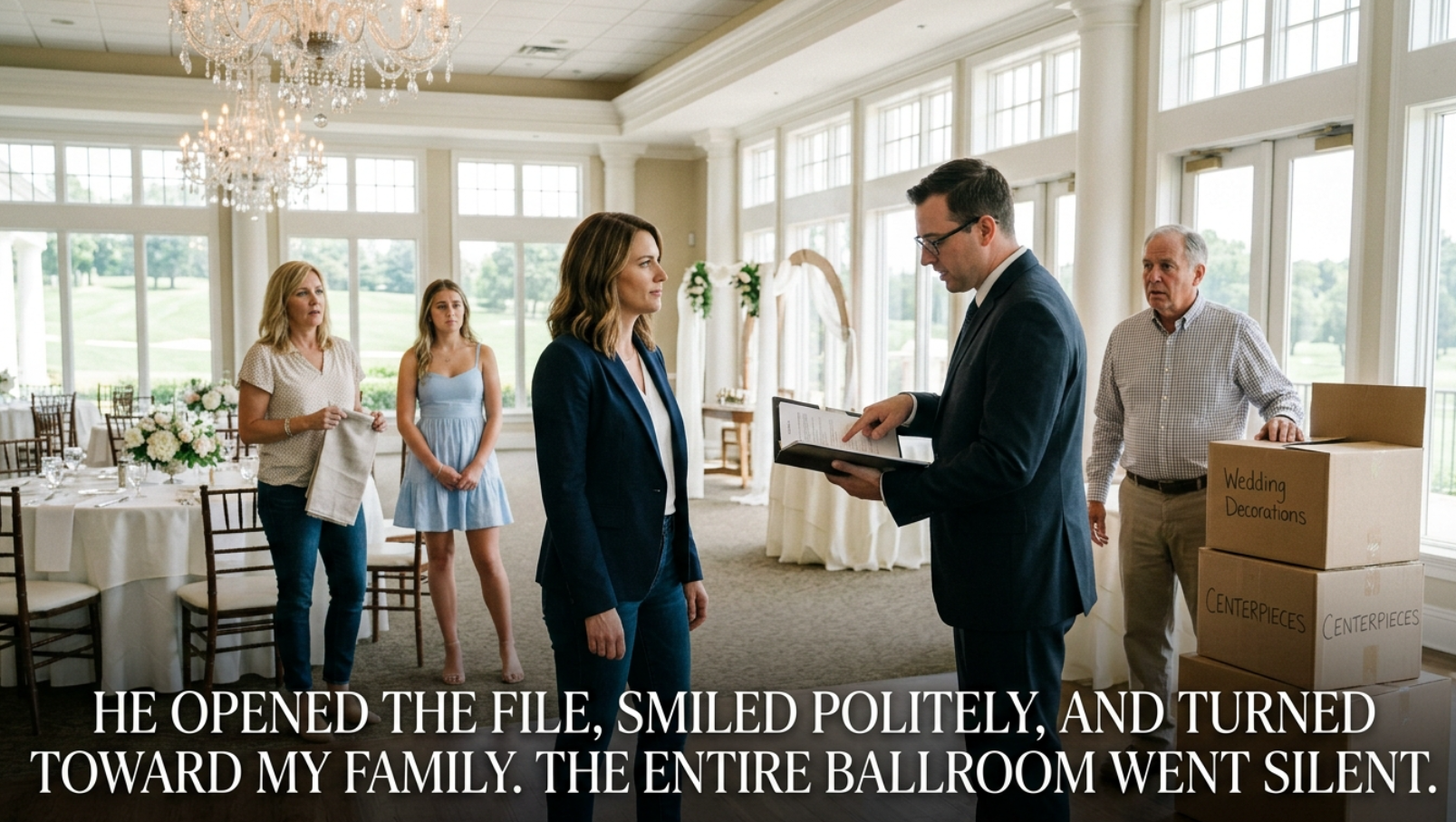
Six months later, we stood beneath the same chandeliers.
The same ballroom.
The same warm lights.
The same ivory candles my grandmother had chosen.
But everything was different.
Natalie was there.
She walked up to me before the ceremony.
“I almost didn’t come.”
“Why?”
“Because I didn’t know if you wanted me here.”
I looked at her.
“I do.”
She started crying.
“I’m sorry.”
“I know.”
“I should have asked you.”
“Yes.”
She nodded.
“I should have questioned Mom.”
“Yes.”
“I was selfish.”
I smiled faintly.
“We all were, in different ways.”
She hugged me.
And this time, I hugged her back because I wanted to.
Not because I felt obligated.
Dad walked me down the aisle.
He asked if I was sure.
I said yes.
But before we stepped into the ballroom, he stopped.
“Elena?”
“Yes?”
“I know I don’t deserve this.”
I waited.
“But thank you.”
I looked at him.
“For what?”
“For letting me walk beside you.”
I squeezed his arm.
“Don’t make me regret it.”
He laughed through his tears.
“I won’t.”
And for once, he didn’t.
My parents eventually moved out of the house.
The property was legally restored to me.
I could have sold it.
For a while, I thought I would.
But one afternoon, Caleb and I stood in the kitchen where I had once done homework at the counter.
I touched the old wooden cabinets.
“What if we renovate it?”
Caleb smiled.
“You want to keep it?”
I looked toward the backyard.
Grandma had planted a magnolia tree there when I was five.
It was enormous now.
“I think I do.”
We renovated the house.
Not extravagantly.
Just enough to make it ours.
I kept the old staircase.
I kept the fireplace.
I kept the magnolia tree.
And in the front hallway, I framed one thing.
Not the deed.
Not the legal documents.
Not the wedding contract.
Grandma’s letter.
The one that began:
You were never practical because you wanted less.
I read it often.
Especially when someone asks me to sacrifice something because it’s “for the family.”
I no longer answer automatically.
I ask questions.
I read contracts.
I protect my boundaries.
And I don’t confuse generosity with surrender.
My mother and I eventually rebuilt a relationship.
It wasn’t the same.
It couldn’t be.
But perhaps that was the point.
We learned to speak honestly.
Dad became quieter.
More humble.
He never again made a financial decision involving me without asking.
Natalie and I became closer than we had ever been.
Not because we forgot what happened.
Because we finally stopped pretending it hadn’t.
And Caleb?
He still teases me about the day I walked into that ballroom and asked one question.
“Whose name is on the contract?”
Sometimes he jokes that he fell in love with me all over again that day.
I tell him that’s ridiculous.
He says it isn’t.
Because he says the woman he loved before that morning was someone who thought being good meant making everyone else comfortable.
But the woman who walked into that ballroom was different.
She finally understood that kindness without boundaries isn’t kindness.
It’s disappearance.
A year after our wedding, Natalie came over for dinner.
She brought flowers.
She placed them on the table.
Then she looked at me.
“You know what Grandma would say?”
“What?”
She smiled.
“She’d say you finally stopped being practical.”
I laughed.
“Maybe.”
Natalie sat down.
“What would you call yourself now?”
I thought about it.
Then I looked around the house.
My house.
The home my grandmother had protected.
The home my parents had almost taken.
The home I had nearly surrendered without even knowing it was mine.
“Honest,” I said.
Natalie nodded.
“I like that.”
Later that night, after everyone left, Caleb and I stood on the porch.
The magnolia tree moved gently in the wind.
He slipped his arm around me.
“You happy?”
I looked at the house.
At the lights.
At the life we had built.
“Yes.”
He kissed my forehead.
“Good.”
I smiled.
For years, I had believed my grandmother’s greatest gift was the house.
Or the wedding money.
Or the account she had secretly protected.
It wasn’t.
Her greatest gift was teaching me that I was allowed to keep something simply because it belonged to me.
I didn’t have to justify it.
I didn’t have to apologize for it.
I didn’t have to give it away because someone else wanted it more.
And most importantly, I didn’t have to destroy my family to protect myself.
I only had to stop destroying myself to keep my family together.
That Tuesday morning, my mother had called and calmly told me that my wedding venue had been “given” to my sister.
She thought she was taking something from me.
She didn’t realize she was giving me something instead.
She gave me the moment when I finally stopped asking permission to matter.
And standing beneath the magnolia tree that my grandmother planted decades earlier, I understood the final lesson she had left for me.
Sometimes the family you love will ask you to surrender everything just to prove that you love them.
You don’t have to.
Real love doesn’t require you to disappear.
And for the first time in my life, I didn’t feel guilty for choosing myself.
I felt free.