
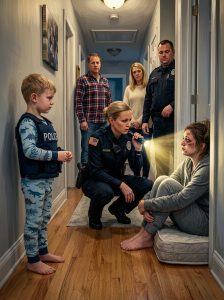
The Whisper Behind the Perfect Door: How a 9-Year-Old Boy Uncovered a Secret That Shattered an Entire Neighborhood
It was a stormy Thursday night when nine-year-old Caleb Miller picked up the phone and dialed 911 with trembling hands and a voice barely above a whisper.
Lightning flashed outside his bedroom window, illuminating the walls decorated with superhero posters, while rain pounded the roof in heavy, rhythmic drumming that matched his rapid heartbeat.

“My parents… they’re doing something in the back room,” Caleb whispered, his words catching in his throat, the fear in his tone unmistakable even to a trained dispatcher on the other end.
The dispatcher paused, unsure whether the call was real or a child’s nightmare, but the trembling voice and hurried breathing made her sit upright, alert and attentive.
“Sweetheart… what room?” Denise asked carefully, her voice steady but gentle, trying to coax more information without frightening the young boy any further.
“The back bedroom… the one Mom says I must never go into,” he murmured, clutching his blanket tightly, eyes wide, scanning the dark corners of the room as shadows danced across the floor.
A dull thud echoed somewhere behind him, causing Caleb to flinch, his breath quickening as he whispered, “I heard someone crying… not a child, a woman.”
The dispatcher’s heart sank as she instructed him to stay put, telling him officers were already on their way, while she kept the line open, listening intently.
Minutes later, Officers Marcus Hill and Jenna Cole pulled up to the Miller residence, a modest beige ranch house with a well-tended lawn that seemed peaceful and ordinary from the outside.
The porch light cast a cozy glow, a basketball rested beside the driveway, and a cartoon decal clung stubbornly to Caleb’s bedroom window, betraying the presence of a small, innocent child inside.
Caleb opened the door before the officers could knock, barefoot and dressed in dinosaur pajamas, his pale face framed by disheveled brown hair that stuck to his forehead.
“My dad said… if I ever called the police, he would ruin everything,” Caleb whispered, voice quivering as tears brimmed in his wide, fearful eyes.
Officer Cole knelt beside him, voice calm but firm. “You did the right thing, Caleb. You’re safe now. No one is going to hurt you tonight.”
A man’s voice called from the hallway, controlled but tense. “Caleb? What’s happening here?” It belonged to Richard Miller, father of the boy, standing rigid in jeans and a gray sweatshirt.
Behind him, Allison Miller crossed her arms tightly over her robe, lips pressed together, eyes flickering with a strange mixture of fear and defiance.
Officers remained calm. “Your son called 911. We need to ensure everyone in this house is safe,” Officer Hill explained carefully, aware that any sudden move could escalate the situation.
Allison laughed shakily. “He has nightmares. He imagines things,” she said, though the tremor in her voice betrayed a hint of uncertainty.
Then came a faint cry from the rear of the house, unmistakably a woman’s voice, small and trembling, cutting through the patter of the storm outside.
Richard froze. His composure cracked. Hill reacted immediately, instructing him to step aside, while Officer Cole reached for her radio to call for backup.
Richard lunged toward the back bedroom, attempting to block access. Hill grabbed his arm forcefully, twisting it behind his back, immobilizing him, while Cole rushed past Allison, who screamed, “No, don’t open it!”
The bedroom door bore a padlock fastened from the outside, old and rusted, yet sturdy enough to hold back whatever—or whoever—was inside for weeks, maybe months.
With a decisive strike from her baton, Cole broke the lock. The door swung open, revealing a room that reeked of bleach, sweat, and something far darker, a sense of fear lingering like a heavy fog.
Inside, a young woman lay on a bare mattress against the wall, bruises encircling her wrists, one ankle chained to a radiator pipe, duct tape covering her mouth, eyes wide with terror.
On the floor lay her driver’s license. The name read Hannah Price. Missing for three weeks, her disappearance had already haunted local news and social media feeds alike.
Caleb stood in the doorway, crying quietly, whispering, “I knew she wasn’t a monster… I knew she needed help,” his small hands clutching the doorframe, trembling violently.
Cole froze as she noticed dozens of small marks carved into the radiator pipe, each representing a day, stretching back nearly four years, a grim record of imprisonment.
Caleb tugged gently at Cole’s sleeve. “There’s another phone in the closet. My dad uses it when the crying gets loud,” he whispered, eyes darting nervously toward the shadows.
The closet door opened slowly, revealing a black duffel bag stuffed with women’s IDs, burner phones, stained clothing, and a photograph that made even the officers recoil in shock.
Richard Miller stopped struggling, his face pale, eyes darting between the officers and the evidence. Allison broke into tears, the truth crashing into their fabricated world of control.
Caleb pressed his small hands to his ears before whispering words that detectives would later call “the moment the entire case exploded,” the revelation echoing far beyond the walls of that quiet street.
Across Akron, neighbors shared whispers of disbelief, social media feeds exploded with outrage, and the story became viral almost immediately, forcing everyone to question the nature of perfection and trust.
The police department released a statement confirming the rescue, emphasizing that no child or adult should ever feel unsafe in their own home, highlighting the bravery of a small boy whose voice saved a life.
Experts weighed in online, discussing warning signs of abuse, the importance of listening to children, and the hidden horrors that often lurk behind seemingly ordinary facades, igniting debates across forums and news platforms.
Social media hashtags began trending nationwide, spreading awareness about domestic captivity and inspiring viral campaigns dedicated to encouraging children and neighbors to speak up about suspicious behavior.
Community meetings were organized to educate families about recognizing subtle cries for help, and online petitions demanded stricter monitoring of missing persons cases and the systems meant to protect vulnerable individuals.
The narrative sparked fierce debate: some condemned law enforcement for not detecting the abuse sooner, while others highlighted the systemic failures that allow predators to hide behind “perfect” family images for years.
Even psychologists and child advocacy groups shared their perspectives, explaining how manipulation, intimidation, and threats can silence children, yet courage and timely intervention can reverse even long-term captivity.
Local reporters interviewed Caleb, carefully protecting his identity, praising his bravery, and recounting how a single 911 call changed the course of many lives, making him an unexpected hero.
Hannah Price, now safe, received therapy and support, her story becoming a symbol of resilience, while authorities continued investigating the extent of the Miller family’s crimes, uncovering disturbing evidence of long-term manipulation.
Neighbors admitted that they had suspected nothing, reinforcing the chilling lesson that appearances can be dangerously deceiving, that evil often hides behind the mundane and the ordinary.
The case sparked debates nationwide: social media users dissected every element of the story, theorizing motives, criticizing systemic failures, and sharing personal experiences to raise awareness.
Online communities emerged, some dedicating themselves to missing persons, others to child protection, yet all fueled by the narrative of a brave nine-year-old who refused to be silenced.
Every conversation referenced the power of a child’s voice, the importance of vigilance, and the undeniable truth that even the smallest action can disrupt years of abuse.
Experts cautioned families and social media audiences alike: the Miller case was not an isolated incident, and vigilance must extend beyond obvious danger to the subtle, everyday signs of abuse.
Caleb’s story became part of school curriculums, community workshops, and viral media campaigns, demonstrating the profound impact one young boy’s courage could have on society at large.
The photograph found in the closet sparked an investigation into other potential victims, leading authorities to uncover patterns that suggested years of careful planning, deceit, and hidden violence.
Law enforcement officials commended Caleb publicly, reinforcing the importance of teaching children how to seek help, and how listening to their fears can prevent further tragedies.
Social media debates continued, with some questioning parenting standards, societal responsibilities, and even the role of neighborhood awareness, amplifying the story far beyond Akron into national headlines.
Mental health professionals weighed in, offering guidance on trauma recovery, the psychological impact of long-term confinement, and strategies for reintegration into society for survivors of captivity.
The case inspired fictional adaptations, awareness campaigns, and documentaries, emphasizing the shocking reality that terror can exist unnoticed, but heroism often emerges from the most unexpected sources.
Caleb’s actions prompted policymakers to reevaluate child protection laws, online resources for at-risk children, and community outreach programs, ensuring future children might be protected from similar hidden horrors.
Even today, the story circulates across online platforms, cited in discussions about courage, vigilance, and the enduring power of truth, proving that no secret can remain hidden when someone dares to speak out.
The Whisper Behind the Perfect Door reminds the world that heroism does not depend on age, that bravery can emerge from innocence, and that one small voice can shatter years of darkness.
To Be Continued… The Shocking Secrets Behind the Perfect Door
Detectives stood frozen, staring at the photograph Caleb had pointed to, their hearts pounding as realization hit them.
It wasn’t just Hannah Price—this was evidence of a larger, darker web of control and abuse meticulously hidden for years.
Caleb whispered, “There are more… I think he’s done this before. Mom hides them in the garage sometimes. They don’t see the sun for days.”
The officers exchanged glances, understanding instantly the weight of what the child was revealing. Every detail suggested a level of planning and cruelty that was almost incomprehensible.
Allison Miller’s tears became louder, her sobs mixing with Caleb’s quiet whimpers, as the room filled with the tension of years of lies finally unraveling.
“You’re safe now,” Cole reassured Hannah, pulling the chains from her ankle and wiping away her tears. The young woman’s eyes told stories words never could.
Richard Miller’s face turned pale as the officers began cataloging the evidence, each item in the closet, every ID, and every phone a testament to crimes long hidden.
“Did he hurt anyone else?” Caleb whispered, shivering. His voice barely audible over the rain against the windows. The officers shook their heads.
“Yes,” Hill replied gravely, “and we’re going to find every person he kept trapped. Because of you, Caleb, they’ll all get a chance at freedom.”
Social media erupted within minutes. Hashtags #CalebTheHero and #WhisperBehindTheDoor trended nationwide, igniting fierce debate about child safety, vigilance, and hidden domestic abuse.
Users shared the story relentlessly, creating viral threads, videos, and discussions dissecting every detail of the night, the bravery of a single nine-year-old, and the horror of the hidden reality.
Some commenters debated law enforcement’s prior failures, while others focused on the importance of teaching children to recognize danger, proving the story was more than just shocking—it was instructional.
“You cannot imagine the courage it took,” one user wrote. “A child, alone, saving a life. We all need to listen more carefully to the small voices around us.”
Psychologists chimed in online, explaining how manipulation, fear, and coercion can silence children, yet one act of bravery can dismantle years of abuse.
Local communities held emergency meetings, discussing new protocols to protect children, recognizing warning signs, and offering immediate assistance to anyone reporting suspicious behavior.
News outlets covered Caleb’s bravery, making him an anonymous hero for countless children who may be silently suffering behind closed doors.
Hannah Price’s story, now shared widely, became a symbol of resilience and hope, while the investigation continued, uncovering additional victims and providing closure to families who had feared the worst.
“Every date carved into that radiator tells a story,” Officer Cole later said in a statement. “Every mark represents the strength it took for someone to survive. And now, justice will follow.”
Online debates intensified, questioning societal responsibilities, neighborhood awareness, and how seemingly “perfect” families can hide unimaginable horrors behind closed doors.
Some users shared personal experiences, others created campaigns for missing persons awareness, and hashtags like #SpeakUp and #ChildSafety surged across platforms.
Celebrities and influencers amplified the story, encouraging discussions on child abuse prevention, resilience, and the importance of timely intervention in critical situations.
Comment sections flooded with: “What if no one listened?” “How many more are trapped?” “How do we protect children better?” The story created an unprecedented level of public engagement.
Activists called for policy changes, demanding stricter oversight of missing person cases, and more resources for children in dangerous domestic situations.
The night Caleb called 911 became a pivotal teaching moment for communities nationwide: courage, vigilance, and action can save lives, even when darkness seems overwhelming.
The photograph in the closet, the duffel bags of IDs, the burner phones—each piece of evidence was shared cautiously, but enough to ignite national discourse on domestic captivity and vigilance.
Caleb’s name was never fully revealed publicly, protecting him, but online forums celebrated him as a hero, emphasizing that age does not define the power to act.
Hannah Price’s survival became a rallying point, sparking viral campaigns encouraging anyone to report suspicious behavior and reminding the world that speaking up can change lives.
The case prompted schools to review child safety programs, social media campaigns to educate the public, and law enforcement agencies to rethink protocols regarding missing persons.
“Even the smallest voice can shatter the darkest secrets,” one viral post read, encapsulating the lesson of the night: that innocence, bravery, and truth are formidable forces.
Readers were encouraged to share the story, raising awareness, fostering conversations, and inspiring vigilance in communities where silence might otherwise allow hidden horrors to persist.
For those following the story: Type YES and press Like to unlock the full Part 3 and final resolution, including the ultimate fate of the perpetrators and how Caleb’s courage reshaped lives forever.
The whispers behind the perfect door had been heard, but only through the bravery of one child did the truth finally emerge, sparking a movement of awareness and vigilance.
Will you be the next voice to stand up for the voiceless? Share the story, discuss it with your friends, and let the world know that even the smallest hero can change everything.