When fifty motorcycles rolled into a quiet neighborhood and surrounded a child’s birthday party, every parent grabbed their kid before anyone asked what was really happening.
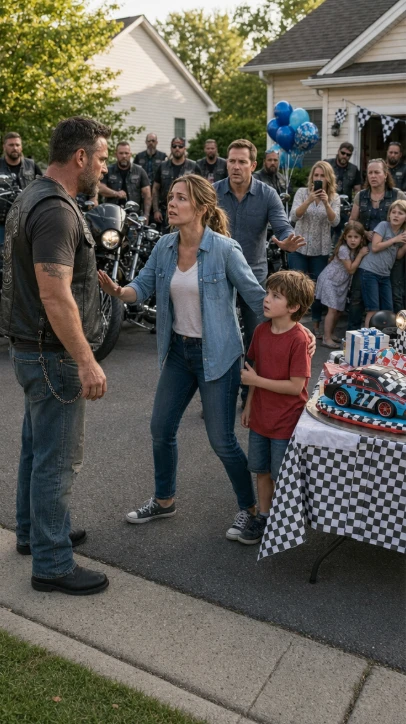
It was a Saturday afternoon in late May, just after 2:00 p.m., in a small Ohio town called Fairview Ridge. The kind of place where kids still ride scooters without helmets and mothers set up folding tables in driveways for birthday parties.
Blue balloons were tied to a mailbox.
A banner that read Happy 8th Birthday, Tyler sagged slightly above the garage door.
There were paper plates stacked neatly beside a cake shaped like a race car.
And no guests.
Not one.
I saw it before I heard the whispers.
The mother stood near the driveway pretending to check her phone. Over and over. Refreshing nothing. Smiling at nobody. The boy sat on the curb in a red t-shirt two sizes too big, kicking gravel with his sneakers, glancing down the street every time a car passed.
The kind of waiting that slowly turns into embarrassment.
I recognized it because I’d lived it once.
Around 2:17 p.m., someone inside the house turned the music off.
The silence landed hard.
That’s when we turned the corner.
Fifty engines.
Low. Heavy. Unified.
The sound alone made curtains shift along the block.
Mothers froze mid-sentence. Fathers stepped forward instinctively. One man pulled his daughter behind him as if we were a storm rolling in.
Leather vests.
Boots.
Chrome reflecting sunlight like flashing signals.
We didn’t slow down.
We didn’t wave.
We rode straight toward that driveway.
And when we stopped, forming a wide circle around the birthday table, the panic was instant.
Phones came out.
Someone shouted, “Call the police!”
From the outside, it looked like an ambush.
Fifty bikers surrounding a child’s birthday party.
No one knew why.
Not yet.
Part 2
The engines cut off almost at once.
The silence that followed was worse than the noise.
You could hear the wind tugging at the balloons.
You could hear a plastic cup roll across the driveway.
And you could hear one parent whisper, “This isn’t safe.”
I swung my leg off my bike slowly.
No sudden moves.
No shouting.
But that didn’t matter.
All they saw were men in black vests stepping forward in formation.
A father near the sidewalk raised his voice. “What are you doing here?”
No one answered immediately.
Because none of this was about them.
It was about the boy still sitting on the curb, staring at the ground like he wanted to disappear.
His mother looked pale now. Protective. Confused.
“You need to leave,” she said, voice trembling but firm. “This is a children’s party.”
I nodded once.
“I know.”
That only made it worse.
“What do you want?” someone demanded.
They assumed we were targeting someone.
Debt.
Trouble.
Retaliation.
That’s how people fill in blanks when fifty bikers show up uninvited.
I walked toward the birthday table.
Slow. Visible hands.
Every eye tracked me.
A man stepped between me and the cake.
“Back off.”
I stopped two feet away.
“Is this Tyler’s party?” I asked.
The mother hesitated before answering. “Yes.”
Her eyes searched my face for threat.
I didn’t give her one.
Instead, I looked at the empty driveway again.
At the untouched stack of presents.
At the race car cake beginning to sag under the afternoon heat.
“Where are the other kids?” one of our guys asked quietly.
The question hung there like an accusation.
No one answered.
But everyone knew.
Parents in small towns talk.
And kids repeat what they hear.
Tyler’s father was in prison.
Two years into a five-year sentence.
House fire incident.
Negligence, they called it.
No one invited the kid with the dad behind bars.
That’s how fast childhood becomes collateral damage.
One of the mothers nearby muttered, “We don’t need trouble here.”
Trouble.
That word again.
I could feel the tension tightening.
A couple of our younger guys shifted their weight, sensing the hostility.
Someone had already called the police.
I could hear sirens faintly in the distance.
Tyler finally looked up at us.
Not afraid.
Just confused.
Like he couldn’t decide if we were about to ruin the worst day of his life—or change it.
I reached into my vest pocket slowly.
And every parent stiffened.
Hands went to phones.
To car keys.
To their children’s shoulders.
But I didn’t pull out anything dangerous.
I pulled out my phone.
Typed three words.
“He’s alone. Confirmed.”
I didn’t say who I sent it to.
Didn’t explain.
I just stood there in the middle of that driveway, surrounded by fear that didn’t belong to me.
And waited.
Because what happened next would decide whether we were remembered as villains—
Or something else entirely.
The sirens got louder.
That’s when the real tension hit.
Because now it wasn’t just worried parents and fifty leather vests in a driveway.
Now it was law enforcement rolling into a child’s birthday party with half the neighborhood already convinced something criminal was happening.
Two patrol cars turned onto the block at 2:26 p.m.
Red and blue washed across chrome.
Across balloons.
Across a race car cake that still hadn’t been touched.
The officers stepped out cautious, hands near their belts. They didn’t shout. They didn’t rush.
But they were ready.
“What’s going on here?” one of them asked.
Before I could answer, three parents started talking at once.
“They surrounded the house.”
“They showed up out of nowhere.”
“This is a kid’s party!”
I stood still.
Hands visible.
Heart steady.
Because escalation wasn’t the plan.
Never was.
The officer looked at me directly. “Sir?”
I glanced at Tyler.
Still on the curb.
Still alone.
“Is this your party?” I asked him gently.
He nodded once.
“Where are your friends?”
He shrugged.
That shrug carried more weight than the engines had.
His mother inhaled sharply, like she wanted to interrupt but couldn’t find the words.
The officer’s tone softened just slightly. “Why are you here?”
I didn’t answer right away.
Instead, I stepped back from the cake.
Gave space.
Let everyone see I wasn’t reaching for anything.
And then I did something that confused all of them.
I took off my vest.
Slowly.
Deliberately.
And folded it over my bike seat.
A few of my guys followed my lead.
No speeches.
No signals.
Just quiet motion.
The officer frowned. “What are you doing?”
“Waiting,” I said.
For what, he didn’t ask.
But I could see the question in his eyes.
My phone buzzed once in my pocket.
I didn’t check it immediately.
Didn’t want the crowd to think I was calling reinforcements in some aggressive way.
I waited until the officer nodded slightly.
Then I looked down.
One message.
“Confirmed. Ten years ago. 417 Maple. Fire rescue.”
I swallowed.
I remembered that night.
Smoke thick as walls.
Heat so intense it felt alive.
I had been trapped on the second floor of my house with flames closing in.
And a man who didn’t know me had come back inside.
Twice.
I looked up at Tyler again.
Same last name.
Same eyes.
The officer shifted his stance.
The crowd was restless now.
Fear morphing into anger.
A father stepped forward again. “If you’re not leaving, we will.”
That was the tipping point.
Fifty of us.
Dozens of civilians.
Two patrol cars.
One wrong move and this whole thing would turn into the story everyone already believed.
I stepped forward, just enough to be heard.
“I’m not here for trouble,” I said.
No yelling.
No bravado.
Just steady.
“But we’re not leaving.”
The silence after that felt like standing on thin ice.
And then—
From the end of the street—
Another sound.
Not sirens.
Not shouting.
Engines.
More engines.
They didn’t roar in.
They rolled slow.
Orderly.
Disciplined.
Twenty more bikes turning the corner like a second wave of thunder that chose not to strike.
Helmets off.
No shouting.
No aggressive revving.
Just presence.
Parents stiffened again.
One mother pulled her child behind her legs.
The officers straightened.
But something was different this time.
Because the men stepping off those bikes weren’t posturing.
They weren’t scanning for enemies.
They were carrying things.
Pizza boxes.
Gift bags.
A giant wrapped present that took two guys to lift.
One of the officers blinked, confused.
“What is this?” he asked.
I finally stepped toward Tyler’s mother.
Slowly.
“Your husband,” I said quietly, “once pulled me out of a burning house.”
Her face changed.
Confusion to disbelief.
“What?”
“Ten years ago. 417 Maple Street. I was unconscious on the stairs.”
The crowd had gone still.
The new riders formed a loose line along the sidewalk, not blocking anyone. Not threatening anyone.
Just standing there.
Like a guardrail made of denim and leather.
“I owe him my life,” I continued. “And nobody told your son happy birthday.”
Tyler was staring at the pizzas now.
At the balloons strapped to one of the bikes.
At a man twice his size holding a gift bag decorated with cartoon dinosaurs.
The officer lowered his hand from his belt.
The angry father near the cake stopped talking.
Because suddenly this didn’t look like intimidation.
It looked like something else.
Something no one expected.
I turned toward my guys.
“Helmets off,” I said.
All at once.
Fifty heads uncovered.
Faces visible.
Not shadows.
Not stereotypes.
Just men.
One by one, they stepped forward.
Not surrounding the house anymore.
Forming a half-circle behind Tyler instead.
Like a wall.
But facing outward.
Protecting.
Not threatening.
The shift was subtle.
But you could feel it.
Power moved.
Fear drained.
The street that had braced for conflict was now holding its breath for something entirely different.
Tyler stood up slowly.
“Are… are you here for me?” he asked.
I knelt down so we were eye level.
“Yes, sir,” I said.
And for the first time that afternoon—
The panic disappeared.
Replaced by something much quieter.
Much heavier.
Understanding.
Tyler didn’t move for a second.
Like he wasn’t sure if this was real.
Fifty grown men standing behind him in a loose half-circle. Not blocking him in. Not closing around him. Just there.
Waiting.
“For me?” he repeated.
“Yes, sir,” I said again. “For you.”
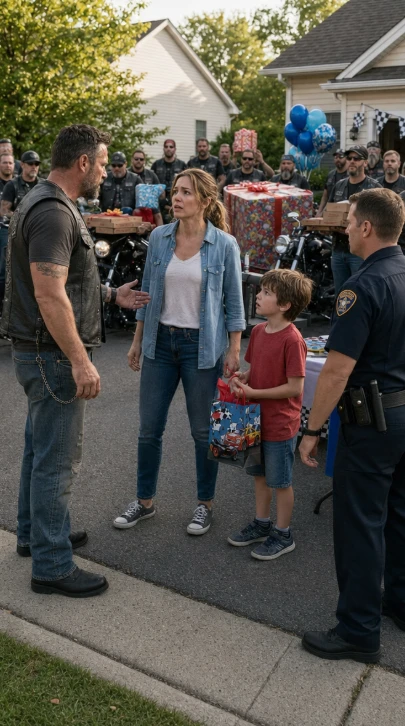
One of our guys stepped forward and set three pizza boxes on the folding table. Another placed a stack of wrapped gifts beside the untouched race car cake. Someone tied an extra balloon to the mailbox.
No noise.
No spectacle.
Just quiet correction of a day that had gone wrong.
Tyler’s mother covered her mouth with her hand. She had been bracing for conflict fifteen minutes ago. Now she looked like she didn’t know where to put her gratitude.
“I don’t understand,” she whispered.
I stood up slowly.
“Ten years ago,” I said, “your husband ran back into a burning house that wasn’t his.”
Her eyes sharpened.
“He pulled me out.”
The crowd shifted.
Not dramatically. Just enough.
Some of the fathers who had stepped forward earlier took half a step back.
“He didn’t have to,” I continued. “But he did.”
417 Maple Street. I still remember the heat. The way the smoke felt alive. I remember waking up outside on wet grass, coughing, seeing a man kneeling beside me with soot on his face and blood on his sleeve.
That man had been Tyler’s father.
“He saved my life,” I said quietly. “We don’t forget that.”
The police officers exchanged glances. Their posture relaxed. One of them actually smiled a little.
Tyler looked between me and his mom. “Dad did that?”
She nodded slowly, tears sliding down without drama. “Yes, baby.”
The mother who had called 911 earlier stepped forward awkwardly. “We… we didn’t know.”
Of course they didn’t.
Small towns remember headlines. Not context.
They remember convictions. Not details.
They remember who went to prison. Not who once ran into fire.
One of my younger guys—big shoulders, shaved head, probably the most intimidating one there—pulled a bright green gift bag from behind his leg and handed it to Tyler.
“Open it,” he said gently.
Tyler ripped into the paper like any eight-year-old would.
It was a remote-control car.
His eyes went wide.
And just like that, the energy shifted completely.
Parents who had been shielding their kids now nudged them forward.
“Go say happy birthday.”
Within minutes, the driveway that had felt like a standoff turned into a real party.
Kids gathered around the bikes. Not touching without permission, but staring in awe. One of our guys lifted a little girl onto his seat so she could take a photo. Another explained how a throttle works.
The race car cake finally got cut.
Tyler insisted I take the first slice.
I didn’t.
“That’s yours,” I said.
He thought about it, then nodded seriously like he understood something bigger than frosting.
When it was time to sing, it wasn’t quiet.
Fifty rough voices joined in, off-key and unapologetic.
The neighbors listened.
And something softened in the air.
After the candles were blown out, I stepped aside and let the day belong to him.
I didn’t make a speech.
Didn’t tell the story again.
The police officers left first. No arrests. No warnings.
Just nods.
About an hour later, we started our engines again.
Slowly.
One by one.
Not revving. Not dramatic.
Just leaving.
Tyler ran toward me before I pulled out.
“Are you gonna tell my dad?” he asked.
“I already did,” I said.
His father didn’t have a phone, but we had ways. Letters. Visits. Messages passed along through people who still believed in balance.
“He’ll know you had a good birthday,” I added.
Tyler stood in the driveway waving as we rolled away.
In my mirror, I saw something I won’t forget.
Parents who had panicked earlier were standing beside Tyler’s mother now.
Not apologizing out loud.
But present.
And sometimes that’s enough.
People will always see leather before they see intent.
They’ll always hear engines before they hear reasons.
But every once in a while, if you stay steady long enough, they get to see the rest.
Fifty bikes didn’t surround that house to intimidate anyone.
We surrounded it because one kid was sitting alone on a curb, learning too early what judgment feels like.
And his father once carried me out of fire.
We don’t forget that.
My sister shoved me down the staircase when I was eight months pregnant. “Say sorry for upsetting her,” my mother ordered while I was bleeding. “You know how much pressure she’s under because of the divorce.” I apologized. Then I placed a single phone call. They had no clue what I was going to do next…
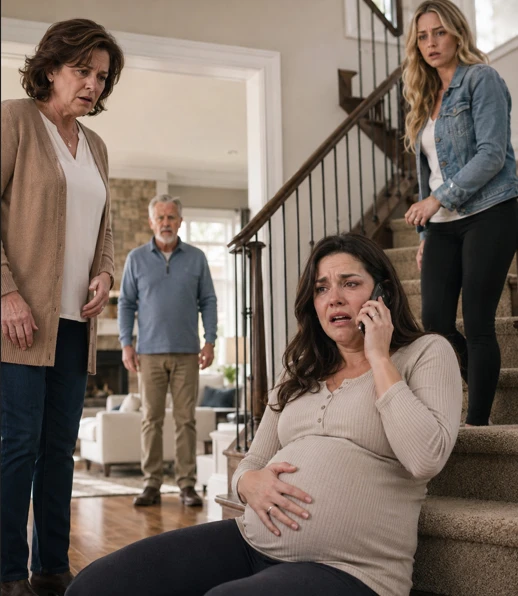
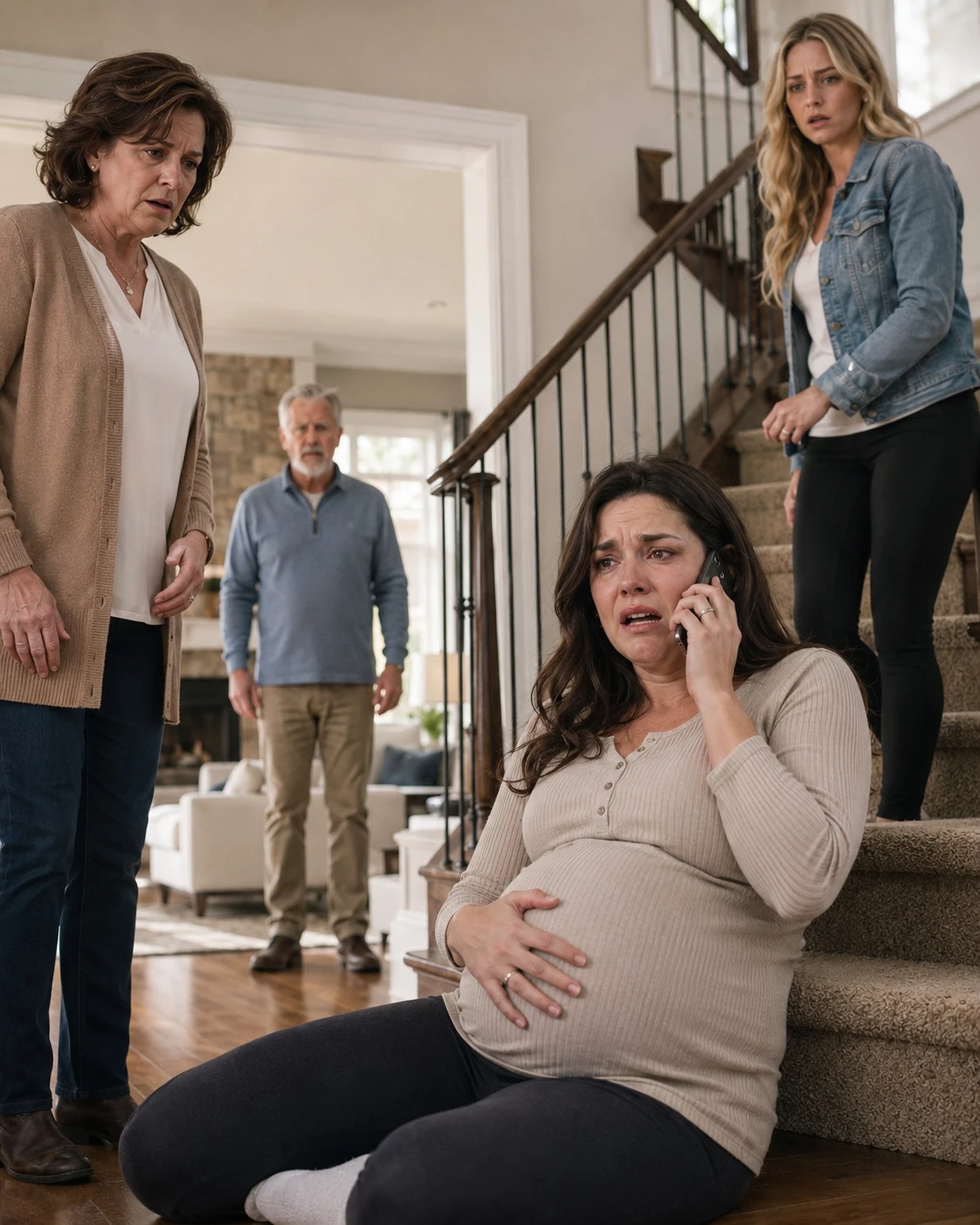
Pain ripped through Emma Whitaker’s back so suddenly that for one impossible second she did not understand what had happened.
One moment she was standing near the top of the staircase in her parents’ house in Willow Creek, Ohio, one hand on the smooth wooden banister, the other resting over the wide curve of her eight-month pregnant belly. The next, the world had tilted violently forward, and her body was no longer her own. Her balance was gone. Her feet were gone. The only thing left was instinct.
She remembered the carpet first.
That was the strange part, the detail her mind grabbed as gravity took command of her body. Not the sound of Khloe’s sharp breath behind her. Not the sting of her sister’s hands against her upper back. Not even the first burst of terror that flashed through her chest when she realized she was falling.
The carpet.
Beige, with tiny brown flecks, the kind of carpet her mother had chosen fifteen years earlier because she said it would “hide dirt.” Diane Whitaker had always cared about surfaces. Clean counters. Polished silver. Family photos arranged by season. A living room no one was allowed to actually live in. A hallway sprayed with vanilla room freshener before guests arrived. A staircase carpet ugly enough to survive children, shoes, holiday traffic, spilled wine, and whatever else a home might want to confess if anyone cared to look closely.
Emma saw those brown flecks rushing toward her face as she pitched forward.
Her hands flew around her belly.
She did not try to catch herself. That realization would come later, when doctors asked how she had landed, when police asked what she remembered, when Marcus asked in a voice so shattered she could barely answer. In that first fraction of a second, there had been no conscious thought about her own bones, her own skull, her own skin.
Only the baby.
Protect the baby.
The first impact slammed through her knees and hips.
The second cracked pain up her spine like lightning.
The third knocked the breath from her lungs.
She hit step after step, her body twisting in ways that did not feel human. Her shoulder struck the wall. Her ankle caught underneath her and folded with a sickening inward snap. Her elbow burned as skin scraped open. Her head struck something hard enough to scatter white sparks across her vision. Still her arms stayed locked around her stomach, as if she could become a shield strong enough to stand between her daughter and the violent world.
By the time she landed at the bottom, she was on her side, one leg bent wrong beneath her, cheek pressed against the carpet runner where it met the hardwood floor of the entry hall. For a moment she could hear nothing except a high thin ringing inside her skull.
Then the house returned.
The television murmuring from the living room, where her father had been watching a college football replay with the volume too low to count as interest and too high to count as background. A glass clinking somewhere in the kitchen. A refrigerator hum. Her own breath dragging in and out of her throat like it had to fight through broken glass.
And above her, from the top of the stairs, her sister’s voice.
“Oh my God,” Khloe said.
For a second, just one, there was fear in it.
Emma tried to move. Pain exploded from her ankle, up her calf, into her hip. She stopped immediately, freezing so completely that even breathing felt dangerous. Something deep inside her abdomen tightened with a force that stole all thought from her mind. It was not ordinary pain. It was not the dull pressure of late pregnancy or the lightning twinges her doctor had told her were normal as ligaments stretched and organs shifted.
This was sharper.
Lower.
Wrong.
Her hand slid down her belly, searching for movement.
“Please,” she whispered.
The word came out barely louder than air.
Please.
Not again.
That was the thought beneath all thoughts. It rose from the same dark place where her first two miscarriages lived. Nine weeks. Thirteen weeks. Two quiet exam rooms. Two doctors using gentle voices. Two times her body had gone from carrying a future to carrying grief before Emma even understood how quickly a life could disappear.
Not again.
Not this baby.
Not this little girl who had kicked hard at the ultrasound wand as if offended by the intrusion. Not the daughter Marcus already spoke to every night, his face pressed against Emma’s belly, telling her about baseball and pancakes and the crooked maple tree in the backyard. Not Luna, whose name they had whispered in bed three weeks earlier as if saying it too loudly might tempt fate.
Emma opened her eyes.
Her vision blurred, then steadied.
There was blood on her maternity jeans.
At first it was not much. That almost made it worse. If there had been a dramatic spill, a theatrical flood like something from a movie, perhaps the people around her would have moved. Perhaps the house would have erupted into action. But this was smaller and darker, a spreading wetness blooming through pale denim along the inside of her thigh.
Enough.
Emma knew enough.
Her heart began to pound so hard it made the floor seem to pulse beneath her cheek.
“The baby,” she said.
No one answered.
She lifted her head with a groan and looked upward.
Khloe stood near the top landing, one arm still half extended, fingers spread wide as if she had not yet decided whether to pretend she had reached to help or had never touched Emma at all. Her cream sweater hung perfectly off one shoulder. Her long blond hair fell in smooth waves around her face. Her manicure was new, pale pink with a tiny rhinestone on each ring finger. She looked like a woman posing for a holiday card about sisters who borrowed each other’s clothes and laughed over coffee.
Except her eyes.
Her eyes were hard, bright, calculating.
The fear Emma had heard in her voice vanished almost as quickly as it had appeared.
“Stop being so dramatic, Emma,” Khloe snapped. “You practically threw yourself down those stairs.”
Emma stared at her.
The words did not make sense at first. They entered the hallway like smoke, poisonous and familiar. She had heard variations of that sentence her whole life.
Stop being dramatic.
You’re overreacting.
You know how Khloe gets.
Why did you make her angry?
She didn’t mean it.
You’re stronger than she is.
Just apologize and move on.
Her hand tightened over her belly.
Another cramp clenched inside her, so fierce and low that the hallway narrowed to a tunnel. Emma made a sound she did not recognize, small and animal.
“Mom,” she called.
Her voice cracked.
“Mom!”
In the kitchen, something clinked again. Then came footsteps. Slow, irritated footsteps, not hurried ones.
Diane Whitaker appeared in the hallway holding a dish towel. She had been preparing lunch, or pretending to. The whole point of the visit had been lunch. A family lunch, she’d called it, as though those words had ever meant anything peaceful in the Whitaker household. Diane’s hair was still stiff from her morning salon appointment, blond curls arranged into a smooth helmet around a face that had perfected disappointment long before Emma was born.
“What on earth is all this noise?” Diane demanded.
Then she saw Emma.
She saw her daughter twisted at the bottom of the stairs, hand around her belly, ankle turned at an angle no ankle should make, blood spreading over her jeans.
And she sighed.
Not a scream. Not a gasp. Not a mother’s horrified cry.
A sigh.
It was the same sound Diane made when a casserole burned, when the mail included an unexpected bill, when her husband forgot to wipe his shoes before stepping onto her kitchen tile. A sound of inconvenience. A sound that said Emma had once again created a problem Diane would be expected to manage.
“She’s being dramatic again,” Khloe said, beginning to descend the stairs with careful little steps. “I barely touched her.”
“You pushed me,” Emma said.
Her voice was hoarse and thin, but the words were clear.
Khloe stopped two steps above her. Her expression shifted, hurt sliding into place like a curtain being pulled across a window.
“I did not.”
“You pushed me.”
“Emma.” Diane’s tone sharpened. “Enough.”
“There’s blood,” Emma said.
She tried to push herself up on one elbow and nearly blacked out. Pain ripped through her shoulder. Her stomach cramped again, and this time a wave of nausea rose with it.
“Mom,” she said, no longer caring that she sounded frightened, no longer caring that Khloe could hear it. “I need to go to the hospital. The baby—”
“You’re fine,” her father called from the living room.
Robert Whitaker did not even appear in the doorway.
The television still murmured behind him. A commentator laughed softly about a missed tackle. Somewhere in the absurd distance between the living room and the hall, a crowd roared through speakers.
Emma’s mouth went dry.
“Dad,” she called. “I’m bleeding.”
There was a pause.
Then Robert said, “Khloe’s going through enough right now. She doesn’t need you making a scene.”
The sentence landed harder than the stairs.
For one second Emma was not thirty-two years old, not a wife, not almost a mother. She was nine, standing in the downstairs bathroom with a split lip and blood on her chin after Khloe had thrown a hairbrush at her because Emma had been invited to a birthday party Khloe wasn’t. Diane had leaned over her then too, dabbing too hard with a wet washcloth, muttering that Emma needed to learn not to provoke her sister.
She was sixteen, staring at the word loser scratched deep into the side of her first car while Khloe sobbed in the driveway about feeling excluded, and Robert told Emma she should apologize because refusing to lend the car had been selfish.
She was twenty-two, standing in a bank lobby, humiliated and shaking, after discovering Khloe had forged her signature and drained nearly four thousand dollars from an account Emma had built with summer jobs and campus work. Diane had called it a mistake. Robert had called it family business. Khloe had called Emma heartless for making her cry.
All of it lived in that hallway.
All of it stood over Emma while she bled.
Diane crouched beside her at last, but not close enough to touch the blood. She leaned in, and Emma smelled wine on her breath. White wine, sharp and sour, though it was barely past noon.
“Apologize to your sister,” Diane said softly.
Emma blinked.
For a moment she honestly believed she had misheard.
“What?”
“Apologize,” Diane repeated, more firmly now. “For making her angry.”
Emma stared at her mother’s face. The carefully lined eyes. The lipstick. The faint crease between her brows that appeared whenever she was about to recast cruelty as Emma’s responsibility.
“I fell down the stairs.”
“You escalated things,” Diane said. “Khloe is fragile right now.”
Fragile.
The word floated above them, obscene in its softness.
Khloe had cheated on her husband, Trevor, with his younger brother. She had drained their accounts before the divorce papers were finalized. She had broken a vase over the kitchen floor and told everyone Trevor had done it. She had called Emma at two in the morning for weeks, crying that the world was punishing her for being “too loving.” And because Khloe could make devastation look like theater, Diane and Robert had once again arranged the family around her feelings.
Fragile.
Emma was the one on the floor.
Emma was the one with blood soaking through her jeans.
Emma was the one whose baby might already be in danger.
“She pushed me,” Emma said. “Because I wouldn’t give her my credit card.”
Khloe let out a bitter little laugh. “Oh my God. You are unbelievable.”
Diane’s eyes flicked toward her younger daughter, then back to Emma.
“Khloe needed help,” she said.
“She wanted to go to Vegas.”
“She needed a break.”
“She threatened me.”
“You were cruel.”
“No,” Emma said. “I said no.”
The word no seemed to change the temperature in the hallway.
Khloe’s mouth tightened.
Diane’s face hardened.
Robert finally appeared in the living room doorway. He was a broad man in his late sixties, gray hair cut short, reading glasses hanging from the collar of his polo shirt. His face was already arranged into irritation, as if the scene before him was less an emergency than a family argument he had been unfairly pulled into.
“Emma,” he said, “don’t make this worse.”
Something almost broke loose inside her then. A laugh, maybe. Or a scream.
“How could it be worse?” she whispered.
Robert looked away from the blood.
That was what she would remember later. He did not miss it. He chose not to look at it.
“You know how your sister is when she’s upset,” he said.
“Yes,” Emma said. “I do.”
Khloe crossed her arms. “I didn’t push you. You lost your balance. Pregnant women are clumsy.”
Emma looked up at her sister.
There was an old rhythm to this. Khloe made the strike, then rewrote the impact. Diane supplied the emotional excuse. Robert demanded quiet. Emma apologized. Everyone moved on, carrying a version of events so false it became family law through repetition.
But this time, something inside Emma resisted.
Not because she felt strong. She did not. Her ankle throbbed. Her head hurt. Her abdomen kept tightening in waves that frightened her more than any broken bone could. A cold sweat had broken across her neck. She could feel blood spreading, slow but real, beneath her.
She was terrified.
But terror had burned through something that obedience never could.
Her daughter was involved.
This was not about Khloe stealing attention or money or peace. This was not about ruined holidays or scratched cars or poisonous gossip. This was not even about Emma’s long history of swallowing pain to keep her parents comfortable.
A life inside her was at risk.
And suddenly the family script looked as ugly and flimsy as the carpet beneath her face.
“I need an ambulance,” Emma said.
Diane’s lips pressed together. “Apologize first.”
Emma stared at her.
“We do not do conflict in this family,” Diane said. “You know better than to escalate Khloe when she’s already under pressure.”
Khloe sniffed, as if on cue.
Robert folded his arms. “Your mother is right. Say you’re sorry. Then we’ll figure out what to do.”
“We’ll figure out what to do?” Emma repeated.
Her voice was faint, but something in it made Robert’s face shift.
“I’m bleeding while eight months pregnant, and you want to figure out what to do?”
Diane lowered her voice. “Don’t use that tone with your father.”
The absurdity of it hollowed Emma out.
For a moment she thought she might simply leave her body. Drift above the hallway. Watch these three people perform the same ritual they had perfected over decades while her daughter fought for life inside her. Perhaps that would be easier. Perhaps that was what she had always done in smaller ways: floated somewhere safer while her family demanded that she rewrite pain into politeness.
But then the baby moved.
Or Emma thought she did.
A tiny shift under her palm. A faint internal press. Maybe real. Maybe imagined. It was enough.
Emma drew in a shaky breath.
“I’m sorry,” she said.
Khloe’s expression changed immediately.
Triumph rose in her eyes before she remembered to hide it.
“For what?” Khloe asked.
Diane did not stop her.
Robert did not stop her.
Emma felt a clarity so cold it seemed to run alongside the pain.
“For making you angry,” she said, forcing every word through clenched teeth. “And for being selfish with my credit card.”
Diane’s shoulders dropped in relief, as if the emergency had passed.
“There,” she said, reaching down to pat Emma’s hair. The gesture was gentle enough to look maternal from a distance and empty enough to feel like nothing at all. “Now we can move past this.”
That was when Emma reached for her phone.
It was in the pocket of her cardigan. Her fingers shook so badly that for one terrifying second she could not grip it. The screen was smeared by her thumb as she unlocked it. Marcus’s contact sat pinned at the top under a photo of him in the nursery, hair dusted with pale green paint, smiling like the unfinished room behind him was the most miraculous place on earth.
He answered on the second ring.
“Hey, baby,” Marcus said, warm and easy. “How’s lunch?”
Emma closed her eyes.
For one heartbeat she wanted to collapse into the safety of his voice. To sob. To say she was scared. To let him carry all the words because she was tired of being brave before she had even begun.
Instead she opened her eyes and looked at her mother.
“I need you to record this call,” Emma said.
Marcus went silent.
The silence lasted less than one second, but when he spoke again, his voice had changed.
“Emma,” he said carefully. “What happened?”
“Record this call,” she repeated. “Then call 911 to my parents’ house on your other phone.”
Diane’s hand froze above Emma’s shoulder.
Robert took one step forward.
Khloe’s face went blank.
“I’m recording,” Marcus said. “Tell me.”
Emma swallowed through the metallic taste in her mouth.
“I’m eight months pregnant,” she said loudly enough for the hallway to hear. “I’m bleeding, and I just fell down the stairs.”
“Jesus,” Marcus breathed.
“I was pushed down the stairs by Khloe,” Emma continued. “Mom and Dad are refusing to call an ambulance until I apologize to her, which I have just done. Are you recording?”
“Yes,” Marcus said. His voice was no longer warm. It was controlled, hard, dangerous in a way Emma had never heard from him before. “I’m recording. I’m calling 911 now.”
“Good.”
Diane stood fully upright. Her face had gone pale beneath her makeup.
“You’re recording?” she whispered.
“My husband is,” Emma said.
Robert’s anger flared fast, but there was fear beneath it now. “Emma, now listen here—”
“And the doorbell camera probably caught it too,” Emma said.
There was no doorbell camera.
Marcus had talked about installing one after Khloe keyed Emma’s car for the second time, but they had never gotten around to it. Life had become fertility appointments, then cautious pregnancy, then nursery planning, then the endless list of things two people convince themselves they still have time to do before a baby arrives.
But Emma said it, and the effect was immediate.
Khloe’s mouth fell open.
Diane looked toward the front door.
Robert’s face lost color.
“The one Marcus installed after Khloe damaged my car,” Emma added.
Khloe stepped down one more stair. “Tell him I didn’t push you.”
“But you did.”
“No, I didn’t.”
“You did,” Emma said quietly. “And if anything happens to my baby, Khloe, everyone is going to know exactly what you did.”
Khloe’s expression cracked.
For the first time in Emma’s life, her sister looked not wounded, not dramatic, not furious, but afraid of consequence.
The sirens came before anyone could answer.
They were faint at first, far enough away to be mistaken for traffic. Then louder. Closer. Cutting through the manicured silence of the Whitaker house.
Marcus must have made the call the second he heard bleeding and pregnant. Maybe even before Emma finished speaking. He had always been like that in emergencies. Not loud. Not theatrical. Capable. Steady. The kind of man who checked smoke alarms without mentioning it, who kept jumper cables and bottled water in the trunk, who remembered what doctors said after appointments because Emma was too busy trying not to cry.
The sirens grew louder.
Diane’s eyes darted toward the hallway mirror, as if she could somehow check whether the family still looked respectable.
Robert muttered, “This is ridiculous. Family doesn’t involve police.”
Emma looked at him.
“Family doesn’t push pregnant women down the stairs,” she said.
The front door burst open moments later.
Two EMTs entered first, then a third behind them with a stretcher. Their presence changed the hallway instantly. They brought with them the smell of cold air and rain-damp uniforms, the snap of latex gloves, the authority of people who did not care about family dynamics when blood and injury were on the floor.
“Emma Whitaker?” one asked.
“Emma Bennett,” Marcus’s voice answered from the doorway.
He had arrived so quickly he must have broken every speed limit between their house and Willow Creek.
Emma turned her head toward him.
He stood just inside the entry, chest heaving, dark hair windblown, one hand still gripping his phone. For half a second his eyes swept the scene: Emma on the floor, the blood, the twisted ankle, Diane near the wall, Robert blocking half the living room doorway, Khloe on the stairs with tearless panic forming in her face.
Something in Marcus went still.
It was not the stillness of shock.
It was the stillness of a man placing every feeling behind glass so he could do what needed to be done.
He crossed to Emma, knelt just outside the EMTs’ space, and reached for her hand without interfering.
“I’m here,” he said.
Only then did Emma cry.
Not loudly. She did not have the breath for it. Tears slipped sideways into her hairline while the EMTs worked around her.
“How many weeks pregnant?” one asked.
“Thirty-two,” Emma said.
“Any loss of consciousness?”
“I don’t know.”
“Where are you bleeding from?”
“I don’t know. My jeans. The baby—”
“We’re going to take care of you.”
“Was there trauma to the abdomen?”
“I fell. I don’t know.”
“Did you feel fetal movement after the fall?”
Emma’s throat tightened.
“I think so.”
One EMT gently palpated her abdomen. Another wrapped a blood pressure cuff around her arm. A third examined her ankle and asked if she could feel her toes. She could, though everything below her knee felt distant, wrong, swallowed by pain. When they shifted her slightly, agony shot up through her spine, and she squeezed Marcus’s fingers so hard he winced but did not pull away.
Diane moved forward.
“I’m her mother,” she said. Her voice had changed completely. It now carried worry, breathless and public. “I can ride with her.”
Marcus lifted his head.
“No,” he said.
Diane blinked. “Excuse me?”
“No.”
Robert bristled. “You don’t get to decide that.”
Marcus stood.
He was not much taller than Robert, but in that moment he seemed larger because every part of him was focused. His voice remained low. That made it worse.
“Step back from my wife.”
Robert opened his mouth.
Marcus took one step forward.
“I said step back.”
The EMTs did not pause, but Emma saw one of them glance toward Marcus, then toward the family. Assessing. Recording in memory. Outsiders were watching now. That had always been the Whitakers’ greatest fear. Not harm. Not cruelty. Witnesses.
Khloe began to cry then. Real tears or manufactured ones, Emma could not tell.
“I didn’t do anything,” she said. “She tripped. She’s always been jealous of me. She’s trying to ruin my life.”
An EMT looked down at Emma.
“Did someone push you?” he asked.
Emma looked straight at Khloe.
“Yes,” she said.
Marcus’s jaw flexed.
Diane made a tiny sound. “Emma—”
Marcus turned. “Do not speak to her.”
The EMT near Emma’s belly frowned at the monitor strapped across her abdomen. He exchanged a glance with the other.
“We need to move now,” he said. “Possible placental abruption.”
The words sliced clean through every voice in the hallway.
Placental abruption.
Emma knew the phrase. Pregnant women learn dangers the way sailors learn weather. She knew it meant the placenta could be separating from the uterine wall. She knew it could starve the baby of oxygen. She knew it could hemorrhage. She knew it could kill.
“No,” she whispered.
Marcus was back beside her instantly.
“Look at me,” he said.
But she could not look away from the EMT.
“Is she okay?”
“We need to get you to the hospital,” he said.
That was not an answer.
They loaded her onto the stretcher with careful speed. Pain became enormous, nearly white. Her ankle screamed when they moved it. Her shoulder sent hot pain down her arm. Every movement pulled at her abdomen, and each pull made fear rush through her like cold water.
As they wheeled her toward the door, Diane grabbed her coat.
“We’ll follow,” she said.
“No,” Emma said.
Her voice was weak, but every person in the hallway heard it.
Diane froze.
“You can’t keep us away,” Robert said.
“I can,” Marcus said. “And I will.”
Khloe stood near the banister, one hand at her throat. Her tears had stopped. Her eyes were locked on the stretcher.
As Emma passed, she reached out and caught Khloe’s wrist.
It cost her more pain than she expected, but she held on for one second. Up close, Khloe looked younger. Not innocent. Never innocent. Just young in the terrible way of people who have lived too long without consequences and suddenly find the world has edges.
“If my baby dies,” Emma whispered, “I will make sure your name is attached to what you did for the rest of your life.”
Khloe’s lips parted.
Emma let go.
The ambulance swallowed her into light and motion.
The ride to Mercy General fractured into pieces. Siren overhead. Rain streaking the rear windows. A paramedic calling vitals into a radio. Marcus in the front for the first few minutes, then beside her when the EMT allowed it, his hand braced against the stretcher rail. He kept telling her to breathe. She tried. Each breath caught on pain. Each cramp made her fear she was losing Luna in real time.
“I’m sorry,” Emma whispered.
Marcus bent closer. “No.”
“I shouldn’t have gone there.”
“Emma, no.”
“I knew she was angry.”
“Do not do that.” His voice broke. “Do not apologize for being attacked.”
Tears spilled down her temples.
“I’m scared.”
“I know.” He pressed his forehead briefly against her hand. “I know, baby. I’m right here.”
The ambulance hit a bump, and Emma cried out.
The paramedic checked the monitor again.
“Stay with me, Emma,” he said.
But she was with another memory now. A dim exam room three years earlier, her paper gown scratchy against her thighs, Marcus sitting too straight in a chair that was too small for him. The doctor had searched for a heartbeat that was not there. The silence had grown bigger than the room. Later, Diane had told her, “At least it was early,” as if grief came with a calendar and became invalid before a certain week.
Then another memory. Thirteen weeks. A name they had not meant to choose yet. A tiny pair of yellow socks hidden in a drawer. Blood in a bathroom. Marcus crying against the tiled floor because he thought she was asleep and did not know she could hear him.
Then Luna.
Luna at twenty weeks, turning away from the ultrasound wand. Luna at twenty-four weeks, making Emma’s stomach jump during a thunderstorm. Luna at twenty-eight weeks, hiccuping every night around ten. Luna at thirty weeks, responding to Marcus’s voice with one hard kick beneath his palm.
Luna, who had made hope dangerous again.
At the hospital, the world accelerated.
Automatic doors opened. Shoes squeaked. Someone shouted for obstetrics. A nurse cut away Emma’s cardigan and maternity jeans. Another placed an IV. A doctor asked questions Emma could not answer quickly enough.
“How many stairs?”
“I don’t know.”
“Did you strike your abdomen?”
“I don’t know.”
“When did the bleeding start?”
“After.”
“Any complications in the pregnancy?”
“Prior losses,” Marcus answered. “Two miscarriages. This pregnancy has been stable.”
The doctor’s face tightened with concentration, not pity.
A monitor was placed against Emma’s belly. The room seemed to hold its breath.
For a few seconds there was only static and movement.
Then a heartbeat.
Fast. Fragile. There.
Emma sobbed once.
Marcus closed his eyes.
Then the heartbeat dipped.
The doctor’s posture changed.
People moved around Emma with the disciplined urgency of professionals trying not to show panic. Words flew above her: decelerations, bleeding, abruption, OR, consent, fetal distress. Each word became a door opening into terror.
A woman in blue scrubs leaned into Emma’s line of sight.
“My name is Dr. Patel,” she said. “Emma, we believe there may be a placental abruption. Your baby is showing signs of distress. We may need to deliver her immediately by emergency C-section. Do you understand?”
Emma tried to answer. Her mouth would not form words.
Marcus squeezed her hand. “Emma.”
She nodded.
Dr. Patel’s eyes softened. “We’re going to move fast.”
“Is Luna going to live?” Emma asked.
No one answered fast enough.
That told her everything and nothing.
“We’re doing everything we can,” Dr. Patel said.
The operating room was too bright.
That was Emma’s first thought when they wheeled her in. Bright enough to erase shadows. Bright enough to make every surface look cold and clean and merciless. The ceiling lights reflected in stainless steel. The air smelled sharp. People introduced themselves behind masks, their names slipping away as soon as Emma heard them.
She trembled so violently that her teeth chattered.
An anesthesiologist spoke close to her ear, calm and patient. “You’re doing great. You’re going to feel pressure, not pain.”
Pressure.
It was such a small word for being opened.
Marcus appeared beside her in scrubs and a cap, his eyes above the mask red-rimmed but steady.
“I’m here,” he said again.
He had said it in the hallway. In the ambulance. In triage. Now under surgical lights, with a curtain raised between Emma’s face and the terrible miracle of what was happening to her body, he said it like a promise he would keep even if the world ended on the other side of that blue sheet.
Emma turned her face toward him.
“If she—”
“No,” Marcus said.
“Marcus.”
“No.” Tears filled his eyes. “She’s going to hear your voice. You hear me? She’s going to know her mother fought for her.”
Emma wanted to believe him.
There was pressure, then tugging. Movement without pain and yet more intimate than pain. She could hear metal instruments, low voices, commands. A nurse counted something. Dr. Patel said, “Almost there.”
Then the room changed.
It was subtle at first. A shift in attention. The sound of suction. A quick exchange Emma could not make out. Marcus’s grip tightened.
Silence.
For one second there was silence.
In that second, Emma’s whole life narrowed to the absence of a sound.
Then came a cry.
Thin. Outraged. Alive.
Emma’s body collapsed into relief so violently that she thought she might dissolve.
Marcus made a sound like a sob punched out of his chest.
“She’s crying,” Emma said.
“She’s crying,” he repeated, crying himself now. “Emma, she’s here.”
A nurse lifted something small and pink over the curtain for one fleeting second. A tiny face. Dark hair plastered to the scalp. Mouth open in fury. A body too small and too real.
Then Luna was gone to the warmer.
“She’s early,” someone said. “Four pounds, two ounces.”
“She’s breathing,” someone else said.
The words saved Emma and terrified her at once.
“Can I see her?” Emma asked.
“NICU team is assessing her,” the nurse said. “We’ll bring you as soon as we can.”
Soon.
Everything had become soon. Maybe. We’re trying. We’ll see. Words adults used when certainty would be a lie.
Emma kept listening for Luna’s cry long after it stopped.
When she woke properly in recovery, the room was dim.
For a moment she did not know where she was. She felt hollowed out, stitched together, bruised from the inside. Her throat was dry. Her abdomen hurt in a deep surgical way that made even shallow breathing feel like work. Her head throbbed. Her ankle was wrapped and elevated. Machines beeped near her. A curtain hung half-drawn. Rain tapped softly at the window.
Marcus sat in a chair beside her bed, asleep in a position no body should tolerate, neck bent, one hand resting on the blanket near her thigh as though he had fallen asleep reaching for her. His face looked older than it had that morning.
The morning.
Had it only been that morning?
Emma moved her fingers.
Marcus woke instantly.
“Hey,” he said, standing so fast the chair skidded softly behind him. “Hey, you’re awake.”
“The baby,” Emma whispered.
“She’s okay.” His voice broke on the words. “She’s in the NICU, but she’s okay. She needed oxygen at first, but she’s breathing better. Dr. Patel said she’s stable.”
Emma closed her eyes, and tears slid down her face.
“Stable.”
“Yes.”
“Can I see her?”
“As soon as they clear you.”
“What happened?”
Marcus swallowed.
“The fall caused a partial placental abruption. They said getting you here fast made the difference.”
Emma looked at him.
He did not say what they both understood.
If he had not answered the phone.
If he had not called 911.
If Emma had waited for Diane and Robert to decide she deserved help.
If Khloe had had time to turn the whole thing into a misunderstanding.
Luna might not have survived.
Emma might not have either.
“What about me?” she asked, because Marcus’s face told her there was more.
His eyes moved over her as if cataloging injuries hurt him physically.
“Eight stitches on your scalp. Sprained ankle. They’re checking whether there’s a small fracture. Bruised ribs. Deep bruising along your back and shoulder. The C-section went well, considering.”
Considering.
The word would follow them for weeks.
Considering how early she was.
Considering the trauma.
Considering the abruption.
Considering what could have happened.
Emma let out a breath.
“My phone?”
“I turned it off.”
“They called?”
His expression darkened. “Your mother left nine voicemails. Your father left four. Khloe sent seventeen texts before I blocked her number.”
“Did you listen?”
“No.”
“Good.”
He hesitated, then reached into the pocket of his jacket and took out a business card.
“An officer came by. The EMTs filed an incident report because you said you were pushed and because of what they saw at the house. A hospital social worker will come talk to you too. They can take your statement when you’re ready.”
Ready.
Emma looked at the card.
Officer Sofia Ramirez, Willow Creek Police Department.
She had spent her whole life ready for Khloe in all the wrong ways. Ready to dodge. Ready to apologize. Ready to predict the emotional weather of someone who made storms and blamed everyone for rain. Ready to smooth over. Ready to swallow. Ready to perform peace at the expense of truth.
Now readiness meant something else.
It meant opening the door she had spent years holding shut.
“Tomorrow,” Emma said.
Marcus studied her face.
“Tomorrow,” he repeated.
They took her to see Luna that night.
A nurse named Marcy arrived with a wheelchair, a soft voice, and the practical tenderness of someone who had shepherded many stunned mothers through their first NICU visits. Marcus helped Emma sit up. The pain was immediate and enormous. Her abdomen pulled. Her ribs protested. Her head swam. For a moment she thought she might vomit.
“Slow,” Marcy said. “You just had major surgery and trauma. We move like turtles tonight.”
Emma almost laughed. It came out as a breath.
The hallway to the NICU felt too long.
Every sound seemed sharpened by exhaustion: wheels over tile, distant monitors, an elevator chime, Marcus’s quiet breathing behind her. The hospital at night had its own secret life, softer but never sleeping. Nurses moved like ghosts with purpose. Families whispered in corners. Machines kept time for bodies that could not yet be trusted to keep it alone.
The NICU doors opened after Marcy entered a code.
Inside, the light was dimmer than Emma expected. Not dark. Never dark. But muted, hushed, reverent. Incubators glowed softly. Monitors blinked. Tiny babies slept beneath clear plastic, each one surrounded by tubes, wires, blankets, names written in careful marker on white boards.
Luna Bennett lay in the third bay on the left.
Emma knew her before anyone pointed.
She was impossibly small.
That was the first pain. Not the stitches or the ankle or the bruises. The sight of her daughter, who should still have been tucked safely inside her, now lying under hospital light with a cap over her dark hair and leads on her chest. Her hands were balled into fists. Her legs were thin and tucked close. A tiny oxygen cannula rested near her nose.
She looked fragile.
She also looked furious.
Emma rolled close in the wheelchair and placed her palm against the side of the incubator.
“Hi,” she whispered.
Luna opened one eye.
Marcus laughed softly through tears.
“She knows your voice,” he said.
Emma cried because she believed him, and because she did not, and because belief itself felt like too much.
“There you are,” she whispered.
Not hello. Not welcome.
There you are.
As if Luna had been traveling toward her through every loss and fear, every appointment, every night Emma woke to check for blood, every cautious purchase hidden in closets because hope felt safer when wrapped in tissue paper and denial. As if this tiny child had been somewhere all along, fighting through the dark toward them.
“I’m sorry,” Emma said.
Marcy adjusted a wire and looked up.
“Don’t start with that, Mama.”
Emma blinked.
Mama.
The word struck her somewhere deeper than pain.
Marcy smiled. “She’s here. You’re here. That’s tonight’s miracle.”
Marcus placed a hand on Emma’s shoulder.
They stayed as long as the nurses allowed.
The next morning, Officer Ramirez came to the hospital.
She was in her mid-thirties, with dark hair pulled into a neat bun and the calm expression of someone who had learned not to let other people’s chaos rush her. She introduced herself, asked permission to sit, and waited until Emma adjusted the bed enough to breathe comfortably.
Marcus stood near the window, arms folded, jaw tight.
“You can stay,” Emma told him.
“Only if you want me to.”
“I do.”
Officer Ramirez opened a notebook.
“I know this is soon,” she said. “But the sooner we document, the better. We can stop anytime.”
Emma nodded.
“I want to do it now.”
The officer began with ordinary questions. Name. Address. Date of birth. Relationship to everyone present. Time of incident. How many stairs. Where Khloe stood. Where Diane stood. When Robert entered the hallway. Whether there had been alcohol. Whether Emma had argued. Whether Khloe touched her with one hand or two.
Some answers came easily.
Others made her shake.
Khloe had followed her to the stairs after demanding the credit card. Khloe had said Emma owed her. Khloe had said Trevor had ruined her life. Khloe had said Emma had no idea what real suffering was because she had Marcus and a house and a “miracle baby everyone had to worship.”
Then she had said the thing Emma had not told Marcus yet.
“You think because you finally managed to stay pregnant this time—”
Emma stopped.
Marcus turned from the window.
Officer Ramirez looked up. “Take your time.”
Emma stared at the blanket over her legs. The hospital blanket was thin, white, tucked too tight around her knees.
“She knew about the miscarriages,” Emma said. “She used to say I was too sensitive about them. But on the stairs she said that. That I finally managed to stay pregnant this time.”
Marcus’s face went white with rage.
Emma did not look at him. If she did, she would lose the thread.
“I turned around,” she continued. “I said, ‘What did you just say?’ She smiled. Then she pushed me.”
“With both hands?” Officer Ramirez asked.
“Yes.”
“Where?”
“Upper back. Between my shoulder blades.”
“Hard?”
“Hard enough that I couldn’t catch myself.”
Officer Ramirez wrote.
“And after you landed?”
Emma told her.
She told her about the blood. About asking for an ambulance. About Diane demanding an apology. About Robert saying Khloe was going through enough. About Khloe claiming pregnant women were clumsy. About the apology extracted while Emma lay injured on the floor.
Officer Ramirez’s pen paused.
“She required you to apologize before anyone called for help?”
“Yes.”
“And no one at the residence called 911?”
“No. My husband did.”
The officer looked toward Marcus.
“I recorded the call,” Marcus said. “I can send it to you.”
“We’ll collect that.”
Emma heard herself laugh softly. It surprised her.
Officer Ramirez’s expression remained gentle but focused. “What is it?”
“My whole life,” Emma said, “I was told not to tell people things. Not outside the family. I guess this feels strange.”
“Truth often does when silence has been enforced for a long time,” Officer Ramirez said.
The sentence opened something.
Emma looked at her properly then.
“Can I tell you about before?”
“Yes,” Officer Ramirez said. “Please do.”
So Emma did.
She told her about childhood without trying to make it sound better than it was. The ceramic horse thrown at her when she was eleven. The split lip at nine. The way Diane would say sisters fight and Robert would call Emma dramatic. She told her about the car, the forged bank withdrawal, the college savings gone and no report filed because Diane cried that Khloe would never recover from criminal charges. She told her about Christmas three years earlier, when Khloe slapped Emma so hard her mouth bled and Robert told Emma to stop embarrassing everyone by leaving early.
She told her what she had never put in one place before: that Khloe’s violence was not a surprise.
It was an escalation.
Officer Ramirez listened.
When Emma finished, the room felt different. Not lighter. Not exactly. More exposed, like furniture had been moved and dust revealed beneath it.
“Do you have records of any prior incidents?” the officer asked.
Emma closed her eyes.
“Yes.”
Marcus looked at her.
She felt his gaze, the shock in it.
“How much documentation?” Officer Ramirez asked.
“Five years.”
Marcus’s voice was quiet. “Emma.”
“I didn’t tell you everything.”
He swallowed. “Okay.”
There was pain in his face, but not accusation. That almost made it worse.
“I have screenshots. Photos. Some videos. Audio after arguments. Dates. A timeline.”
Officer Ramirez nodded. “That could be important.”
“I didn’t think of it as evidence,” Emma said. “Not really. I thought of it as proof I wasn’t crazy.”
Officer Ramirez’s expression softened.
“Sometimes those are the same thing.”
After the officer left, Marcus remained silent for a long time.
Emma looked at him, exhausted suddenly beyond words.
“Say it,” she whispered.
He sat beside the bed very carefully, as if he were afraid sudden movement might hurt her.
“I’m not angry that you documented,” he said.
Emma waited.
“I’m devastated that you had to.”
She looked away.
“I was ashamed.”
“Of what?”
“Of still going back. Of knowing she was dangerous and still showing up for lunch. Of being thirty-two years old and still hoping my parents would act like parents.”
Marcus took her hand.
“Emma, people don’t walk out of families like that in one clean moment. They get trained inside them.”
She began to cry again, silently.
“I almost got Luna killed.”
“No,” he said, voice firm. “Khloe pushed you. Your parents delayed help. You called me. You saved her.”
“I apologized.”
“You survived long enough to get help.”
She looked at him.
He lifted her bruised knuckles to his mouth.
“That apology got recorded,” he said. “The script finally worked against them.”
The fallout began quickly.
By afternoon, family members were calling. Cousins. Aunts. An uncle from Cincinnati who had never called Emma for anything except birthdays but apparently had heard enough to become alarmed. Emma let all of them go to voicemail until Sarah Monroe, her cousin on Diane’s side, called three times in a row.
Marcus raised an eyebrow.
“Sarah might actually care,” Emma said.
She answered.
Sarah did not say hello.
“Emma, oh my God. Is it true?”
Emma looked toward the NICU door visible down the hallway through the half-open room door.
“Which part?”
“That Khloe pushed you down the stairs. That the baby came early. That police were at Aunt Diane’s house this morning.”
“Yes.”
Sarah made a sound somewhere between a gasp and a sob.
“Is the baby alive?”
Emma closed her eyes.
“Yes. Her name is Luna. She’s in the NICU.”
“Oh, Emma.”
For once, there was no doubt in the voice on the other end. No hesitation. No careful family diplomacy. Just horror.
“We had no idea it was this bad,” Sarah said.
Emma almost laughed.
“No idea?”
“I know Khloe was difficult, but—”
“Sarah,” Emma interrupted, not harshly but because she had no room left for soft phrasing. “She’s been violent for years.”
Silence.
Then Sarah said, “She always said you exaggerated.”
“I know.”
“She said you were jealous of her.”
“I know.”
“She said you liked making her look unstable.”
Emma stared at the ceiling.
“I know what she said.”
Sarah cried quietly.
“I’m sorry,” she said. “I should have questioned it.”
“Yes,” Emma said.
The honesty startled both of them.
After a moment, Sarah whispered, “You’re right.”
Emma let the silence sit.
It was uncomfortable, but not unbearable. That was new. She had spent so many years rushing to relieve other people’s discomfort that allowing Sarah to sit in guilt felt almost cruel. But it was not cruel. It was simply not rescuing.
“I can’t manage the family right now,” Emma said.
“I know. I’m sorry. I just wanted you to know I believe you.”
Those three words nearly undid her.
I believe you.
How small a sentence. How enormous when it arrives after decades of being told your reality is a burden.
“Thank you,” Emma said.
That evening, Diane and Robert appeared at the hospital with flowers.
They should not have been able to get upstairs, but Diane had always been persuasive with receptionists, especially when tears served her. She entered carrying a bouquet of lilies and pale roses wrapped in crinkling cellophane. Robert followed with his hands in his jacket pockets, face set in the same grim mask he wore at funerals and parent-teacher meetings.
Marcus stood before they crossed the threshold.
“No,” he said.
Diane stopped. “Marcus, please. We just want to see our daughter.”
“I’m not your daughter right now,” Emma said from the bed.
The words came out before she knew she would say them.
Diane looked as if Emma had slapped her.
“What?”
“I am a patient recovering from emergency surgery caused by violence in your house.”
Diane’s mouth trembled. “Sweetheart—”
“Don’t.”
Robert stepped forward. “This has gone far enough.”
Marcus turned on him. “You watched your pregnant daughter bleed at the bottom of the stairs and didn’t call an ambulance. You do not get to decide what has gone far enough.”
Robert flushed. “You don’t understand this family.”
“No,” Marcus said. “I do. That’s the problem.”
Diane began to cry, holding the flowers tighter. “Khloe is beside herself. The police came to the house. She’s terrified. She says everything happened so fast and Emma misunderstood—”
“Stop,” Emma said.
Diane’s eyes widened.
“Do not come into my hospital room and tell me what Khloe feels.”
“She’s your sister.”
“She pushed me down the stairs.”
“She didn’t mean to hurt the baby.”
There it was.
Not denial exactly. Worse. A hierarchy of harm. As if hurting Emma might be negotiable, explainable, expected, but hurting the baby crossed some line even Diane could recognize. Emma felt something inside her go still.
“But she did hurt the baby,” Emma said. “Luna is in the NICU because of what Khloe did.”
Diane’s eyes filled again. “Luna?”
“That’s her name.”
Diane took one step closer. “Please let us see her.”
“No,” Marcus said.
Robert’s jaw tightened. “We’re her grandparents.”
Emma looked at him.
“You were her grandparents when I was on the floor too.”
The room went silent.
Diane looked down at the bouquet. Robert looked away.
Marcus picked up a folder from the bedside table. Inside were copies of medical notes, forms, discharge instructions already accumulating faster than Emma could process. He removed several pages and placed them on the tray table one by one.
“Emergency C-section at thirty-two weeks,” he said. “Partial placental abruption. Neonatal intensive care admission. Maternal head laceration requiring stitches. Sprained ankle. Bruised ribs. Significant trauma.”
He looked from Diane to Robert.
“These are not feelings. These are facts.”
Diane sank into the chair near the door without being invited.
“We panicked,” she whispered.
Emma stared at her.
“No,” she said. “You performed.”
Diane flinched.
“You performed concern when strangers arrived. You performed motherhood when you got to this hospital. But when there were no witnesses, you asked me to apologize.”
Diane’s face crumpled.
Robert said, “Your mother was trying to keep everyone calm.”
“Everyone?” Emma asked. “Or Khloe?”
No answer.
Marcus opened the door wider.
“You need to leave.”
Diane looked at Emma as if waiting for her to overrule him.
For most of her life, Emma would have. Not because she wanted to, but because Diane’s sadness had always been treated like a household emergency. If Diane cried, Emma softened. If Robert grew stern, Emma backed down. If Khloe raged, Emma absorbed. It had seemed easier than the alternative.
Now Luna lay behind NICU doors, and ease had lost all moral value.
“Leave,” Emma said.
Diane stood slowly.
The flowers remained on the table.
After they were gone, Marcus picked them up and dropped them in the trash.
Neither of them spoke about it.
Two days later, Khloe was arrested.
Emma was sitting beside Luna’s incubator when Marcus received the call from Officer Ramirez. He listened quietly, one hand resting against the back of Emma’s wheelchair. She watched his face change in small increments.
“What?” she asked when he hung up.
“They arrested Khloe this morning.”
Emma looked at Luna.
Her daughter slept beneath a tiny striped blanket, mouth slightly open, hands near her face as if dreaming of boxing.
“What charges?”
“Assault. Reckless endangerment. Child endangerment. The prosecutor will explain more once they review everything.”
Emma nodded.
She expected to feel relief. Instead she felt a strange hollow ache. Not regret. Not sympathy exactly. Something older and more complicated.
Khloe in handcuffs.
Khloe, who had once held Emma’s hand on the first day of kindergarten because Emma was scared of the classroom. Khloe, who had taught her how to curl ribbon with scissors before becoming the kind of girl who would cut people with anything sharp. Khloe, whose cruelty had grown so gradually inside the family that everyone learned to walk around it the way people walk around a cracked foundation, pretending the house is stable because admitting otherwise means moving out.
Marcus lowered himself into the chair beside Emma.
“You okay?”
“No.”
He nodded.
“Do you want to talk about it?”
“I don’t know.”
They sat in the NICU quiet.
Finally Emma said, “I keep thinking I should feel happy.”
“Why?”
“Because she’s finally facing consequences.”
“Consequences don’t make what happened disappear.”
Emma looked at him.
He looked tired enough to break but still there, still steady.
“I don’t want to become cruel,” she said.
“You’re not.”
“How do you know?”
“Because you’re worried about it.”
That made her smile weakly.
An hour later, Khloe called from an unknown number and left a voicemail.
Emma did not listen immediately. She waited until she was back in her hospital room, Luna stable for the evening, Marcus beside her. Then she pressed play on speaker.
Khloe’s voice filled the room, high and shaking.
“You’re ruining my life, Emma. I hope you know that. I hope you’re proud of yourself. I was upset. I was angry. You know how to push my buttons, and you did it on purpose. You’ve always done this. You take everything from me and then act innocent. Mom is crying so hard she can barely breathe. Dad had to talk to lawyers because of you. I hope Marcus knows who you really are. I hope he knows you would send your own sister to jail just to win.”
The message ended.
Emma stared at the phone.
Marcus reached for it, but she picked it up first and saved the voicemail.
“Evidence,” she said.
Her voice did not shake.
The next weeks became a life divided between recovery and war.
Luna stayed in the NICU.
Emma learned that premature babies live in tiny increments. One gram gained. One milliliter more taken from a bottle. One fewer alarm overnight. One day without oxygen support. One more hour maintaining temperature outside the incubator. Victory did not arrive in grand announcements. It arrived in numbers on whiteboards, in nurses’ smiles, in doctors saying cautious things that sounded almost like hope.
At the same time, Emma’s body healed badly, then slowly.
Her ankle turned purple and yellow. Her ribs hurt when she laughed, coughed, or tried to shift in bed. The C-section incision pulled with every movement. Milk came in painfully, and pumping became a ritual of exhaustion and determination. Every three hours she attached herself to a machine and watched bottles fill drop by drop because it was the one thing her battered body could still do for Luna.
At night, when Marcus went home for showers or clean clothes, Emma sat near Luna and thought about families.
She had once believed abuse looked obvious from the outside. Screaming. Broken furniture. Doors slammed hard enough to shake walls. Bruises hidden under sleeves. But what had nearly killed her daughter had been quieter for most of its life. It had looked like holiday dinners where everyone avoided certain topics. It had looked like Diane smoothing tablecloths after Khloe stormed out. It had looked like Robert telling Emma to be mature because Khloe was “sensitive.” It had looked like apologies extracted not because they were deserved, but because they were efficient.
It had looked like peace.
That was the part Emma could not stop turning over.
How many cruel things had been protected by the word peace? How many violent people had been shielded by families that valued quiet more than safety? How many children learned to call fear loyalty because adults taught them that naming harm was worse than causing it?
A social worker named Denise came to see her on the tenth day.
Denise had silver-streaked hair, kind eyes, and the directness of someone who had spent years speaking with people in crisis and knew softness did not require vagueness. She sat beside Emma in the NICU family room while Marcus warmed a bottle under a nurse’s supervision.
“I’ve read the incident summary,” Denise said. “And some of the prior history you gave police.”
Emma stiffened.
Denise noticed.
“I’m not here to judge you,” she said. “I’m here to help you understand what support you may need.”
Emma folded her hands around a paper cup of coffee she had no intention of drinking.
“I don’t even know what to call it,” she admitted.
“What happened at the stairs was assault,” Denise said. “What happened afterward was coercive neglect.”
Emma blinked.
The phrase struck like a key sliding into a lock she had not known existed.
“Coercive neglect?”
“Yes. Refusing or delaying necessary care in order to force compliance, preserve control, or protect someone else from consequences.”
Emma looked through the glass wall toward the NICU bays.
“That’s a real thing?”
“It is.”
Emma absorbed that.
For years she had collected incidents like stones in her pockets, heavy but unnamed. Khloe hit. Diane minimized. Robert enforced silence. Emma apologized. The family reset. Each event seemed too small when isolated, too complicated when explained, too old when remembered. Now Denise had given her language that arranged the stones into a wall.
“I thought if I could just get people to see the pattern,” Emma said, “maybe it would make sense.”
Denise’s voice softened. “It already makes sense to everyone except the people invested in denying it.”
Emma looked down.
Something in her loosened painfully.
There would be many sentences from therapy and court and sleepless nights that stayed with her, but that one became a handhold.
It already makes sense.
She did not have to persuade the people who benefited from misunderstanding her.
She only had to stop giving their misunderstanding power over her life.
When Emma was discharged, leaving Luna behind felt like being split open again.
She cried in the passenger seat while Marcus drove home from the hospital for the first time without their daughter. Her body hurt too much for full sobs, so the grief came in small broken sounds. Marcus kept one hand on the wheel and one on her knee whenever traffic allowed.
At the house, the nursery was waiting.
The walls were pale green. The crib stood assembled beneath the window. A moon-shaped nightlight sat on the dresser. Tiny clothes were folded in drawers. A framed print of a fox sleeping under stars hung above the changing table. Marcus had painted the room at twenty weeks, after the anatomy scan, when hope became just strong enough to require a color.
Emma stood in the doorway with her hospital bag in one hand.
The emptiness was unbearable.
Marcus came up behind her and wrapped his arms gently around her shoulders, careful of every bruise.
“She’s coming home,” he said.
Emma nodded because she could not speak.
But Luna did not come home for seven more weeks.
During that time, the legal case grew.
Officer Ramirez collected Emma’s documentation. The phone recording. Khloe’s threatening text from an hour before the fall. Photos of the staircase. EMT reports. Medical records. Prior texts. Videos. Audio. The timeline Emma had built over five years in a hidden folder titled Receipts because calling it evidence had once felt too dramatic.
The prosecutor assigned to the case was Laura Benton.
Emma met her in a county office with gray carpet, framed certificates, and a view of a parking lot full of rain puddles. Marcus sat beside her. Emma’s ankle was still in a brace. Her incision ached from the walk inside. She felt older than she had two months earlier.
Laura Benton looked to be in her forties, with sharp eyes and a calm, clipped manner that did not waste words. She spread several papers across the table.
“You have a strong case,” she said.
Emma almost laughed.
A strong case. Such a clean phrase for the worst day of her life.
Laura tapped one printed screenshot.
“This text matters.”
Emma looked down.
Give me your card or I’ll make you regret it.
Khloe had sent it at 10:42 that morning. Emma had ignored it because she was in the bathroom rubbing lotion over her belly, trying to gather patience for lunch. Less than an hour later she was at the bottom of the stairs.
“She’ll say it wasn’t literal,” Emma said.
“She can try.” Laura turned another page. “But combined with the fall, your statement, the recorded call, the EMT observations, and the medical consequences, it helps establish intent and context.”
“What about my parents?”
Laura’s expression changed slightly.
“They may face scrutiny for delaying care, but the primary criminal case is against your sister. Their statements may help us or hurt them, depending on whether they continue minimizing.”
Emma gave a short humorless laugh. “They will.”
Laura studied her.
“Intrafamily cases are difficult,” she said. “Pressure tends to increase as court dates approach. Relatives may ask you to reconsider. They may frame prosecution as betrayal. They may try to make you responsible for everyone’s pain.”
“They already have.”
“Do you have support?”
Emma looked at Marcus.
“Yes.”
Laura nodded.
“I need to ask directly. Are you willing to testify?”
Emma did not hesitate.
“Yes.”
The answer did not come from anger alone. Anger was there, but it had become disciplined. Beneath it was something larger: a refusal to let Luna’s first story become another secret kept for family comfort.
Laura leaned back.
“Then we proceed.”
Khloe’s attorney requested a plea discussion within a month.
Emma was not surprised. Khloe had never liked consequences she could not talk her way out of. The proposed deal came wrapped in language designed to sound compassionate: counseling, suspended sentence, probation, family mediation, restitution, acknowledgment of emotional distress. Laura explained it carefully, without pushing.
“She would avoid prison,” Laura said.
“No,” Emma replied.
Marcus glanced at her but said nothing.
Laura folded her hands. “You understand trials carry risk.”
“I understand.”
“If she takes a plea with prison time, it may spare you testimony.”
“No deal that lets her avoid prison.”
Laura watched her for a moment. “You’re certain?”
Emma thought of Luna’s tiny hand around her finger. Of the blood on the carpet. Of Diane asking for an apology. Of Robert saying Khloe had been through enough. Of Khloe’s voice on the voicemail: You’re ruining my life.
“Yes,” Emma said. “I’m certain.”
After the meeting, Marcus helped her into the car.
Once inside, with the doors closed against the cold afternoon, he asked, “Are you okay?”
Emma stared through the windshield.
“I keep waiting for guilt to hit.”
“And?”
“It does. But not the way I expected.”
“What do you mean?”
Emma watched raindrops slide down the glass.
“I feel guilty that part of me still misses the sister I wish she had been.”
Marcus was quiet.
“I know she doesn’t exist,” Emma said. “Not really. But I keep thinking about what it would have been like. A normal sister. Someone who would have been at the hospital with us for the right reasons. Someone who would send Luna Christmas presents and tell embarrassing stories about me and actually love me without needing to win.”
Her voice broke.
Marcus reached for her hand.
“That’s grief,” he said. “Not guilt.”
Emma looked at him.
“You can grieve what you never had,” he said.
For some reason, that was the sentence that made her cry.
Luna came home on a cold, bright morning in November.
She weighed six pounds, one ounce. She still looked tiny in the car seat, swallowed by straps and blankets, but the nurses cheered as if she had graduated from college. Marcy hugged Emma carefully. Dr. Patel came by on her lunch break to squeeze Marcus’s shoulder. Denise gave them a folder of resources and a look that said she knew the hardest parts were not all medical.
When Marcus carried the car seat through their front door, Emma followed slowly, one hand on the wall for balance.
The house had never felt so quiet.
Then Luna sneezed.
The sound was small, indignant, unmistakably alive.
Emma laughed so hard her ribs complained.
Marcus set the car seat in the living room and crouched before it like a pilgrim at a shrine.
“Welcome home, Luna Mae Bennett,” he said.
Emma stood behind him with tears on her face.
This was the moment she had almost lost. Not just birth. Not just survival. This ordinary impossible thing: a baby home. A tiny hat slipping sideways. A bottle waiting on the counter. A laundry basket full of blankets. A father whispering nonsense in the living room. A mother learning that joy could return to rooms that had held fear.
For several weeks, they lived small.
Feedings every three hours. Pediatric appointments. Pump parts sterilized in the kitchen. Sleep in fragments. Marcus becoming expert at swaddling. Emma moving through the house like someone relearning gravity. Luna making soft goat-like noises in her bassinet. The world narrowed, and for the first time in Emma’s life, narrowing felt protective.
Then the trial date arrived.
The courthouse in Willow Creek was built of pale stone and civic confidence, with tall windows and flags snapping in the winter wind. Emma had driven past it all her life without imagining that one day she would climb those steps to testify against her sister. Marcus carried Luna in a front wrap against his chest, her small face tucked beneath his coat. Sarah walked beside Emma. Laura met them near security.
Khloe sat at the defense table when Emma entered the courtroom.
She had changed her hair.
Darker blond now, shoulder-length, smoothed into a modest curve. She wore a gray sweater, navy skirt, low heels, and glasses Emma knew she did not need. The effect was deliberate: softened, humbled, wronged but dignified. Diane had probably helped choose it. Diane always understood costume.
Diane and Robert sat behind Khloe.
They did not look at Emma at first.
Then Diane did, and her face collapsed into that practiced tremble. Robert’s expression was colder. He looked at Emma not with fear, not remorse, but accusation. As if she had dragged the family into public shame rather than survived what the family had created in private.
Emma felt the old reflex rise.
Explain. Soften. Make them understand you didn’t want this.
Then Luna stirred against Marcus’s chest.
The reflex died.
The trial began with statements that made Emma’s life sound both recognizable and foreign. Laura spoke of violence, pregnancy, delay, medical emergency, pattern. Khloe’s attorney spoke of family tensions, misunderstanding, tragic accident, a woman under severe emotional distress after divorce, a sisterly argument twisted by panic and pain.
Emma listened.
She had expected to feel enraged by the defense version. Instead she felt strangely bored. She had heard it all before, in prettier variations, around dining tables and in hallway whispers. Khloe suffered. Emma misunderstood. Diane hoped for peace. Robert wanted privacy. The family was complicated. The truth was somewhere in the middle.
But some truths are not in the middle.
Some truths are at the bottom of the stairs.
When Emma took the stand, the courtroom seemed both huge and airless.
She swore to tell the truth, and the act nearly made her smile. Truth had been treated as dangerous in her family for so long that being legally required to speak it felt almost radical.
Laura guided her gently through the day.
The lunch. The credit card demand. The Vegas trip. Khloe’s anger. The threatening text. The insult about staying pregnant. The push. The fall. The blood. The apology. The call to Marcus. The ambulance. Luna’s emergency delivery.
Emma’s voice shook at first. Then steadied.
She avoided looking at Khloe until Laura asked, “Do you see the person who pushed you in the courtroom today?”
Emma turned.
Khloe stared back through unnecessary glasses.
“Yes,” Emma said. “My sister, Khloe Whitaker.”
Khloe’s attorney rose for cross-examination.
His name was Martin Voss, and he had the careful sympathetic tone of a man who knew aggression would look bad against a postpartum mother. He smiled slightly, as if they were reasonable people sorting through unfortunate confusion.
“Mrs. Bennett,” he said, “you were thirty-two weeks pregnant at the time of the fall?”
“Yes.”
“And pregnancy can affect balance, can it not?”
“Yes.”
“You were upset?”
“Yes.”
“You were arguing with my client?”
“She was arguing with me.”
He nodded as if she had conceded something.
“You turned on the stairs, correct?”
“I turned before I started down. She was on the landing behind me.”
“And in your pain and fear, it is possible that what felt like a push was actually you losing your balance after a heated exchange?”
“No.”
“Trauma can affect memory.”
“Yes.”
“So you admit your memory may not be perfect?”
“My memory is clear about her hands on my back.”
Voss shifted.
“You have had a difficult relationship with your sister for many years.”
“Yes.”
“You resent her.”
“I fear her.”
A faint ripple moved through the courtroom.
Voss paused, then smiled thinly.
“You documented her for years, did you not?”
“Yes.”
“That suggests you were already building a case against her.”
“No. It suggests I needed proof of what she did.”
“You never filed police reports for those earlier incidents.”
“No.”
“Why not?”
Emma looked at Diane and Robert.
“Because my parents taught me that protecting Khloe from consequences mattered more than protecting myself.”
Diane began to cry.
Voss objected to the narrative. The judge told Emma to answer only the question asked. But the sentence had already landed.
Then Laura played the call.
Emma had thought she was prepared.
She was not.
Her own voice filled the courtroom.
I’m eight months pregnant. I’m bleeding, and I just fell down the stairs. I was pushed down the stairs by Khloe, and Mom and Dad are refusing to call an ambulance until I apologized to her, which I’ve just done.
The recording preserved something memory could not: the thinness of her voice, the pain beneath her breath, the terrible calm of a woman who had learned that panic would not save her unless she made it useful.
When it ended, the courtroom was silent.
Emma did not look at Diane.
She looked at the judge.
One by one, witnesses built the case outside the family’s language.
The EMT testified that Emma was visibly injured, bleeding, and in distress when they arrived. He testified that family members appeared tense and defensive, that no one at the residence had called 911, and that Emma reported being pushed while still on the floor.
A second EMT testified about the medical urgency and the concern for placental abruption.
Dr. Patel explained the trauma-related partial abruption in clinical detail. She described fetal distress, emergency delivery, risks to mother and infant. Her voice remained steady, but once, when she mentioned how time-sensitive the intervention had been, her eyes flicked toward Diane and Robert with something like restrained anger.
Denise testified briefly about Emma’s statements regarding family pressure and delayed assistance.
Then came the prior evidence.
Laura did not present every piece. She did not need to. She selected enough to show pattern without drowning the jury in history.
A video of Khloe keying Emma’s car in a driveway while laughing.
Texts demanding money and threatening retaliation.
Audio of Diane saying, “Just apologize so we can have Christmas,” after Khloe slapped Emma.
A message from Robert: You know your sister can’t regulate herself when stressed. Be the bigger person.
Another from Khloe: You always make me do things I regret.
Emma watched the jurors listen.
It was a strange thing, seeing strangers respond appropriately to events her family had dismissed for years. A woman in the second row frowned when Khloe’s voicemail played. A man with silver hair shook his head slightly at Robert’s text. Another juror looked toward Emma when Diane’s voice on audio urged peace over accountability.
For so long Emma had believed that if outsiders knew everything, they might say what her parents said. That she exaggerated. That family was complicated. That sisters fought. That she should have been kinder, quieter, easier.
Instead the outsiders looked horrified.
That horror healed something.
Not entirely.
But enough.
Then Khloe testified.
She cried before saying her own name.
Emma almost admired the timing.
Khloe told the court she loved her sister. She said Emma had always misunderstood her. She said the divorce from Trevor had destroyed her emotionally. She admitted asking for the credit card but framed it as desperate vulnerability, not entitlement. She said Emma had turned suddenly on the stairs, that Khloe reached out, that everything happened in a blur. She said she never meant for anyone to get hurt.
Never meant.
Emma had heard those words so often they had lost meaning.
Khloe dabbed her eyes with a tissue.
“I would never hurt a baby,” she said.
Emma felt Marcus tense beside her.
Laura stood for cross-examination.
She did not raise her voice. She did not need to.
“Ms. Whitaker, did you send this text to your sister at 10:42 a.m.?”
Khloe looked at the screen.
“I was upset.”
“That was not my question. Did you send it?”
“Yes.”
Laura read it aloud.
“Give me your card or I’ll make you regret it.”
Khloe shifted.
“What did you mean by regret?”
“I don’t know. It was just something people say.”
“Do you often threaten your sister casually?”
“No.”
Laura moved to the next exhibit.
“Is this you damaging Mrs. Bennett’s car?”
Khloe’s mouth tightened. “That was years ago.”
“Is it you?”
“Yes, but—”
“Thank you.”
The pattern continued. Laura walked her through each piece. Not dramatically. Precisely. With the patience of someone building a structure brick by brick until the defendant found herself inside it.
Finally Laura asked, “When your sister was at the bottom of the stairs, bleeding, did you say, ‘Pregnant women are clumsy’?”
Khloe looked toward Diane.
Diane lowered her eyes.
“I don’t remember.”
“You don’t deny it.”
“I was in shock.”
“Were you in shock when you told her to say you had not pushed her?”
Khloe’s face flushed.
“I didn’t want her lying.”
Laura let the silence breathe.
“Lying about what?”
Khloe’s jaw tightened.
“About me.”
“About you pushing her?”
“I didn’t push her.”
Laura lifted a page.
“Then why, in your voicemail after arrest, did you say, ‘You know how to push my buttons, and you did it on purpose’?”
Khloe looked down.
“I meant emotionally.”
“Emotionally enough to what?”
Khloe’s mask slipped then.
Not completely. Just enough.
She exhaled sharply, irritated now, tears gone.
“She always does this,” Khloe said. “She always knows how to make me look bad.”
There it was.
Not fear for Luna. Not remorse. Not horror at what had happened.
Make me look bad.
Laura paused.
Then she said, “No further questions.”
The jury deliberated for less than four hours.
Emma spent most of that time in a small waiting area with Marcus, Sarah, and Luna. Luna slept through nearly all of it, which seemed both merciful and absurd. The world might be deciding whether her aunt would be held legally responsible for nearly killing her before birth, and Luna, unimpressed by adult drama, wanted only milk and sleep.
When the courtroom reconvened, Emma’s hands went cold.
Marcus held Luna in one arm and Emma’s hand in the other.
The foreperson stood.
Guilty of assault on a pregnant woman.
Guilty of reckless endangerment.
Guilty of child endangerment.
Khloe made a sound like someone had struck her.
Diane sobbed.
Robert stared straight ahead.
Emma did not cry. The verdict entered her not as triumph but as fact. A formal acknowledgment of reality. A public refusal to participate in the family lie.
Khloe turned around.
Her face was white. Her eyes were wide with something that looked almost childlike in its disbelief. For once, tears had not changed the ending. For once, Diane’s grief had not redirected the room. For once, Robert’s anger had not frightened everyone into silence.
For once, Emma had not saved her.
At sentencing, the judge spoke for several minutes.
He called the act appalling. He noted Emma’s vulnerability, Luna’s premature birth, the delay in seeking help, and the long pattern of intimidation and enabling revealed through evidence. He said family bonds do not lessen accountability. He said pregnancy is not merely a physical condition but a state of profound dependence on the safety of others. He said the court could not ignore the calculated pressure placed on Emma even after she was injured.
Khloe received eighteen months in prison, followed by probation, mandatory counseling, and a no-contact order unless Emma requested otherwise.
Emma did not request otherwise.
When the bailiff led Khloe away, Diane cried out her name.
Khloe looked back once, not at Diane, but at Emma.
The expression on her face was not hatred exactly.
It was betrayal.
Emma understood then that Khloe truly believed Emma had broken the rules. Not the law. Not morality. The rules of their family. The oldest rules. Khloe acts. Emma absorbs. Diane explains. Robert enforces quiet. No one outside gets to know.
Emma held her gaze until she disappeared through the side door.
Outside the courtroom, Robert cornered her near the elevators.
Marcus moved immediately, but Emma touched his arm.
“I’ve got it,” she said.
Robert’s face was red. His voice shook with anger held barely under control.
“Are you happy now?”
Emma looked at him.
The old child inside her rose up fast, desperate and well-trained. Explain you are not happy. Explain you never wanted this. Explain you are still good. Explain until he stops looking at you like you are cruel.
But another part of her stood taller.
“No,” Emma said. “Happy would have been a sister who didn’t push me down the stairs. Happy would have been parents who called an ambulance. Happy would have been bringing Luna home on time instead of watching her through plastic walls.”
Robert’s mouth tightened.
“You destroyed this family.”
Emma almost smiled.
“No,” she said. “I finally stopped helping you lie about it.”
The elevator doors opened.
She stepped inside with Marcus and Luna.
Robert did not follow.
For four months, Emma did not speak to her parents.
Silence from them felt different than silence imposed by them. It had space in it. Air. Choice. Some days it was peaceful. Some days it ached. There were mornings Emma woke with the old impulse to call Diane about something ordinary: Luna rolling over, a pediatrician appointment, a recipe question. Then memory returned, and she let the impulse pass through without obeying it.
Therapy helped.
Dr. Elise Halpern had an office with blue chairs, plants Emma suspected were fake, and a box of tissues placed exactly where patients could reach without asking. She was neither overly warm nor clinically distant, which Emma appreciated. She did not gasp at family stories. She did not rush to reassure. She asked questions that made Emma uncomfortable in useful ways.
“What does apology feel like in your body?” Dr. Halpern asked one afternoon.
Emma frowned. “What do you mean?”
“When you apologize automatically. Where do you feel it?”
Emma thought.
“My chest,” she said. “And my hands. Like I’m reaching for something falling.”
“What is falling?”
“Peace.”
Dr. Halpern nodded.
“And what happens if you don’t catch it?”
Emma looked down.
“Someone gets angry.”
“And what did anger mean in your family?”
“Danger.”
The room was quiet.
Then Dr. Halpern asked, “What does not apologizing feel like?”
Emma breathed out.
“Like dropping something fragile on purpose.”
“Even if the fragile thing is someone else’s control over you?”
Emma said nothing.
That question stayed with her for days.
She noticed apologies everywhere after that. Sorry when a cashier made a mistake. Sorry when Marcus stepped around her in the kitchen. Sorry when Luna cried in a waiting room. Sorry when her own pain slowed the household down. Sorry as reflex. Sorry as offering. Sorry as proof that she was not difficult, not demanding, not Khloe.
She began practicing.
Not dramatic refusals. Small ones.
Instead of “Sorry, can you hand me the bottle?” she said, “Can you hand me the bottle?”
Instead of apologizing when Luna cried at the pediatrician, she said, “She’s having a hard moment.”
Instead of telling Marcus she was sorry for needing help with the laundry, she said, “Thank you for doing that.”
Each change felt tiny.
Each one also felt like betrayal at first.
But not of Marcus. Not of Luna.
Of the old system.
That was how Emma began to understand that healing was not one brave courtroom speech. It was language, repeated daily, until the body learned a new script.
Marcus adjusted to fatherhood with a devotion that both comforted and grieved her.
He woke for feedings even when he had work early. He learned Luna’s tired cry, hungry cry, and angry-about-existing cry. He carried her around the house at two in the morning, murmuring weather reports and baseball scores because he had once read that babies liked hearing voices regardless of content. He sent Emma photos from the living room when she napped: Luna asleep on his chest, Luna staring suspiciously at a ceiling fan, Luna wearing socks too big for her feet.
Sometimes Emma watched them and felt a fierce sorrow for her own childhood.
Not because Robert had never loved her. That was the complication. He had. In flashes. He had taught her to ride a bike. He had cried at her college graduation. Diane had made Halloween costumes, packed lunches, sat through piano recitals. The good memories existed. They made everything harder.
But good moments do not erase a pattern that teaches one child she is less worthy of protection than another child is of excuse.
Loving Luna made old explanations impossible.
Emma would hold her daughter’s small body against her chest and try to imagine saying, “Apologize for making your sister hurt you.” She would try to imagine watching Luna bleed and worrying first about someone else’s feelings. The thought was so grotesque that it answered questions Emma had carried for decades.
Motherhood did not make her understand Diane better.
It made her understand Diane less.
The first letter from Khloe arrived in January.
It came in a plain envelope forwarded inside a larger envelope from Diane. Marcus brought in the mail and stopped at the kitchen counter when he saw the handwriting.
Emma was feeding Luna a bottle.
“What is it?” she asked.
Marcus held up the envelope.
Her stomach tightened before she could read the name.
“From Khloe?”
“Looks like it.”
Emma stared.
Luna sucked noisily, unconcerned.
“Do you want me to throw it away?” Marcus asked.
“No.”
“Do you want to read it?”
“No.”
He waited.
Emma took the bottle from Luna’s mouth to burp her, buying time. Luna protested with a tiny squawk.
“I want to keep it,” Emma said finally.
Marcus raised an eyebrow.
“As evidence,” she said. “And as a reminder.”
So they started a box.
Not because Emma wanted to live inside the case forever. Not because she wanted to rehearse pain. But because the Whitaker family had survived for generations by letting time blur the hard outlines of harm. She knew how it worked. The years would soften the story if she let them. People would begin saying it was complicated. They would call the fall an accident. They would say Khloe had served her time and Emma should move on. They would use Luna’s survival as proof that the damage was not serious.
Emma kept the letters so the record would not depend on anyone’s comfort.
The first few remained unopened.
Then one day, after a therapy session about avoidance, Emma read one.
Khloe’s handwriting filled six pages.
She wrote about prison being terrifying. About how she was learning humility. About how their childhood had hurt both of them. About how Emma had always been Mom and Dad’s favorite because she was “easy.” About how Khloe had suffered too, though no one wanted to see it. About how one mistake should not erase sisterhood.
Near the end, she wrote: I hope someday you stop weaponizing the worst moment of my life against me.
Emma read that sentence three times.
The worst moment of my life.
Not Luna’s. Not Emma’s. Hers.
There was a time that sentence would have worked. Emma could feel the faint outline of the old pathway in her mind: Maybe I am being cruel. Maybe prison changed her. Maybe she was in pain. Maybe I am holding too tightly to anger.
But the thought could not take root anymore.
Emma folded the letter and returned it to the envelope.
Healing, she realized, was not becoming immune to manipulation. It was recognizing the taste before swallowing.
In spring, Diane called.
Emma knew because her phone lit up while she was sitting on the floor with Luna, who had just discovered that rolling under the coffee table created thrilling adult panic. Emma watched the name appear and let it ring. Then Diane called again.
Marcus looked over from the couch.
“You want me to answer?”
“No.”
On the third call, Emma picked up.
Diane’s voice was smaller than Emma remembered.
“Hi, sweetheart.”
Emma closed her eyes briefly.
“Diane.”
The use of her name landed hard. Emma heard it in the silence.
“I suppose I deserve that,” Diane said softly.
Emma said nothing.
Diane inhaled.
“We would like to see Luna.”
There it was.
Not, I’m sorry. Not, I have been thinking about what I did. Not, You deserved protection. Luna. The baby. The granddaughter. The part of Emma’s life Diane could frame as separate from the daughter she had failed.
Emma looked at Luna, who had one sock in her hand and appeared deeply proud of removing it.
“No.”
Diane began to cry.
Emma let her.
“I understand you’re angry,” Diane said.
“No, you don’t.”
“I’m trying.”
“You want access to my child.”
“She’s our granddaughter.”
“She is my daughter.”
Diane’s breathing shook over the phone.
“We made mistakes.”
Emma nearly laughed.
Mistakes.
A scorched casserole was a mistake. Forgetting an appointment was a mistake. Using salt instead of sugar was a mistake.
Watching your pregnant daughter bleed and demanding an apology was not a mistake. It was a revelation.
“You enabled abuse,” Emma said.
Diane began crying harder.
“That is such an ugly word.”
“Yes.”
“I don’t know how to fix this.”
Emma looked at Luna again.
That was the question, wasn’t it? Could anything be fixed? Did allowing contact mean weakness? Did refusing it mean bitterness? Boundaries, Dr. Halpern had said, were not punishments. They were conditions for safety. Sometimes safety required absence. Sometimes it required controlled access. The point was not what looked merciful to outsiders. The point was what protected the vulnerable.
“You can come once,” Emma said.
Diane went silent.
“For one hour. Marcus will be here. You will not be alone with Luna. You will not talk about Khloe. You will not ask me to forgive. You will not cry to manipulate me. If Dad comes, same rules.”
“Emma—”
“I’m not finished.”
Diane stopped.
“The first time either of you suggests that Luna should ignore her own pain to keep someone else comfortable, you are done. The first time you minimize what happened, you are done. The first time you make me manage your feelings in front of my daughter, you are done.”
Diane whispered, “We understand.”
Emma did not believe her.
But she believed the rules were clear.
They came on a Sunday afternoon carrying gifts.
A knitted blanket. A stuffed rabbit. A picture book about woodland animals. Diane looked older, thinner somehow, though only months had passed. Robert looked smaller in a way Emma had not expected, as if certainty had been one of the things holding his shoulders broad.
They stood on the porch until Marcus opened the door.
Emma held Luna on her hip.
Diane saw the baby and covered her mouth.
“Oh,” she whispered.
Luna stared at her grandparents with grave suspicion.
“This is Luna,” Emma said.
Diane’s eyes filled. Robert blinked quickly and looked away.
The visit was awkward in the way of people walking through a room where the floor may collapse.
Diane complimented the nursery. Robert asked about Luna’s weight. Marcus answered some questions when Emma did not feel like speaking. Luna chewed the stuffed rabbit’s ear. Diane cried once but stopped herself quickly when Emma looked at her.
Halfway through the hour, Robert asked if he could hold Luna.
Emma froze.
Marcus watched her, letting the decision remain hers.
Luna was sleepy, warm against her chest. Emma looked at her father’s hands. Those hands had lifted her onto his shoulders at parades. Those hands had fixed leaky faucets and carved Thanksgiving turkey. Those hands had also remained useless while she bled.
People, Emma had learned, could be tender and cowardly. Loving and harmful. Capable of care in one moment and betrayal in another. The presence of gentleness did not erase the absence of protection when it mattered.
“You can hold her here,” Emma said. “On the couch. Sitting down.”
Robert nodded.
He sat. Emma placed Luna carefully in his arms.
His face changed.
Not dramatically. Not enough for forgiveness. But something in him softened into awe as Luna blinked up at him, then grabbed one of his fingers.
“She’s strong,” Robert said.
“She had to be,” Emma replied.
He flinched.
Good, Emma thought, though not cruelly.
Let the truth touch him.
Diane sat beside Emma, twisting the edge of the blanket in her lap.
“We were trying to keep the peace,” she said quietly.
Emma kept her eyes on Luna.
“No,” she said. “You were trying to keep Khloe calm. Those are not the same thing.”
Diane wiped beneath one eye.
“I don’t know how we let it get so bad.”
Emma turned to her.
“Yes, you do.”
Diane looked stricken.
“You chose the easiest answer every time,” Emma said. “Khloe was loud. I was trained to be quiet. So you made quietness my job.”
Robert looked down at Luna.
No one defended themselves.
That was new.
The hour ended without disaster.
At the door, Diane touched the frame as if needing support.
“I don’t know if you’ll ever forgive us,” she said.
The old Emma would have rushed to comfort. Maybe someday. We’ll see. I love you. It’s okay.
But Luna was in Marcus’s arms now, awake and watching.
Emma would not teach her daughter that someone else’s discomfort required her surrender.
“I don’t know either,” Emma said.
Then she closed the door.
Time moved.
Not smoothly. Never that. But forward.
Luna learned to sit, then crawl, then pull herself up on the coffee table with the fierce determination of a climber approaching Everest. She gained weight. Her cheeks filled out. Her hair grew in dark curls that sprang loose after baths. She developed preferences with alarming certainty: bananas yes, peas no, the blue cup acceptable, the yellow cup offensive, Marcus’s singing hilarious, Emma’s sneezes suspicious.
The legal case ended, but its echoes continued.
Medical bills arrived. Insurance argued. Marcus spent hours on the phone using a tone so polite it made Emma fear for the person on the other end. Emma returned to work part-time from home, editing grant proposals while Luna napped and waking at night from dreams of falling. In the dreams, the stairs stretched longer than they had been. Khloe stood at the top, arm extended. Diane’s voice echoed from below: Apologize. Robert’s voice from another room: Don’t make this worse.
At first Emma woke sweating, hand pressed to her abdomen though Luna slept in a crib across the hall.
Then the dreams changed.
Slowly.
Sometimes Marcus reached her before impact. Sometimes Officer Ramirez stood at the bottom with a notebook. Sometimes Dr. Patel waited under bright surgical lights. And sometimes, strangest of all, Emma did not fall. She turned on the landing, placed one hand on the banister, and said no before Khloe could touch her.
Dr. Halpern said the mind rehearses power after surviving powerlessness.
Emma liked that.
On Luna’s first birthday, they held a small party.
Not the kind Diane would have thrown. No rented hall. No balloon arch ordered three months in advance. No guest list built around obligation. Just Sarah, two friends from the NICU parents group, Marcus’s coworker David and his wife, a carrot cake, a lopsided banner, and Luna in a tiny gold crown she tolerated for eleven seconds before throwing it to the floor.
Emma watched from the kitchen doorway while Luna smashed frosting into her hair.
Everyone laughed.
Marcus took photos. Sarah cried quietly when she thought no one saw. The other NICU mother, Jenna, squeezed Emma’s hand and said, “Can you believe they’re one?”
Emma could not.
One year since the fall. One year since the sirens. One year since surgical lights and that first thin cry. One year since Emma crossed a line inside herself and refused to go back.
That evening, after the dishes were washed and Luna finally asleep, Emma and Marcus sat on the back steps with two glasses of cheap champagne and the baby monitor between them. The air smelled like cut grass and candle smoke. Fireflies blinked near the fence.
“You’ve been quiet,” Marcus said.
Emma leaned her head against his shoulder.
“I was thinking about the stairs.”
His arm wrapped around her.
“I used to replay that day and stop at the push,” she said. “Like that was the whole thing.”
“It wasn’t.”
“No.” She watched a firefly blink out, then reappear. “The push was one second. The family response was thirty years.”
Marcus said nothing, but his hand tightened around hers.
“What do you remember most?” she asked.
He was quiet for a while.
“You apologizing,” he said.
Emma closed her eyes.
“I hate that.”
“I know.”
“I hear it sometimes. My own voice.”
“You were surviving.”
“I know that now.” She breathed in slowly. “But it still makes me sad. That even then, bleeding and scared, I knew the script.”
“So did they.”
Emma looked at him.
Marcus lifted his glass slightly toward the dark yard.
“But you broke it.”
The baby monitor crackled. Luna sighed in her sleep, a tiny staticky sound from inside the house.
Emma smiled faintly.
“Sometimes I still feel like the villain.”
“To who?”
“My parents. Khloe. The old family.”
“And?”
She thought about it.
Villain was a word families used when someone stopped cooperating with their preferred version of reality. Villain was the person who called police. The person who saved voicemails. The person who set conditions at the door. The person who refused to confuse forgiveness with access. The person who let outsiders see what had been carefully hidden.
Maybe she was the villain in their story.
But in Luna’s story, she wanted to be something else.
A door that locked against danger.
A voice that believed pain.
A mother who did not ask her child to bleed quietly for anyone’s comfort.
“I’d rather be the villain in their story,” Emma said, “than the victim in my own.”
Marcus touched his glass to hers.
“To that.”
They drank quietly under the summer sky.
Khloe was released after serving most of her sentence.
Emma learned it from Sarah, not from her parents. Khloe had moved to Kentucky with a man she met through a prison ministry program. She was, according to Diane, “trying to rebuild her life.” She wanted closure. She wanted to apologize in person. She wanted to meet Luna someday.
Emma said no.
Diane cried.
Emma still said no.
Khloe sent one final letter six months after her release. This one came directly, not through Diane, and the handwriting on the envelope made Emma pause at the mailbox.
She opened it standing in the kitchen while Luna stacked wooden blocks nearby.
The letter was shorter than the others.
Khloe wrote that she had forgiven Emma.
Emma laughed out loud.
Luna looked up, delighted by the sound, and clapped.
Khloe wrote that prison had taught her not to carry bitterness. She wrote that family wounds could heal if both people were willing to own their part. She wrote that she prayed Emma would one day release the anger that kept her trapped.
Emma folded the letter once.
Then twice.
For a moment she considered adding it to the box.
Instead she tore it in half, then quarters, then dropped the pieces into the trash beneath coffee grounds and banana peel.
Not every piece of evidence needed saving.
Some things only needed to be discarded.
When Luna was two, she fell in the backyard.
She was running too fast over uneven grass, laughing at Marcus, who had been pretending to chase her with exaggerated monster steps. Her little sneaker caught on a root near the maple tree, and she went forward onto her hands and knees.
For half a second, there was silence.
Luna looked at Emma.
Emma was already moving.
She knelt in the grass, heart thudding harder than the scraped knee required.
“You fell,” Emma said gently. “Are you hurt?”
Luna’s face crumpled.
Emma gathered her carefully. “I’ve got you.”
Marcus crouched beside them, monster act gone, fatherhood fully present.
“Little scrape,” he said. “We can fix that.”
Luna cried against Emma’s shoulder.
“I sorry,” she hiccuped.
Emma went still.
Marcus looked at her.
The words were toddler reflex, maybe copied from daycare, maybe from hearing adults apologize in ordinary ways. But they entered Emma like a bell.
She pulled back enough to see Luna’s face.
“You do not have to say sorry for being hurt,” Emma said.
Luna sniffed.
“Hurt,” she said.
“Yes. You got hurt. We help when someone is hurt.”
Marcus’s eyes softened.
They cleaned the scrape. Applied a bandage with cartoon stars. Gave Luna a choice between water and milk. She chose milk, then demanded the blue cup. Within minutes she was running again, bandage flashing under the afternoon sun.
Emma stood near the porch watching her.
That, she thought, is the cycle breaking.
Not only in courtrooms. Not only in dramatic refusals. In small corrections. In language offered early enough to become instinct. You do not have to apologize for pain. You do not have to earn care by being convenient. You do not owe silence to someone who harmed you. You are allowed to say no before danger teaches you how.
Diane and Robert remained at the edge of Emma’s life.
They visited occasionally, always invited, never assumed. They followed rules because Marcus watched them and because Emma had become someone they no longer knew how to pressure. Diane stopped saying keep the peace. Robert apologized once more, not grandly, not enough to erase anything, but with a rough honesty that surprised Emma.
It happened after Luna fell asleep in his lap during a visit.
Robert sat in the rocking chair, one hand resting lightly on Luna’s back. His face in the lamplight looked older than Emma remembered from childhood, lined by something heavier than age.
“I don’t know how I didn’t see it,” he said.
Emma was folding tiny shirts on the couch.
She looked up.
He stared at Luna.
“When you were little. When Khloe would get going. Your mother and I always thought…” He stopped. Swallowed. “No. That’s not true. We didn’t think. We just wanted it quiet.”
Emma folded another shirt.
“You saw it,” she said.
He closed his eyes briefly.
“Yes.”
There was no relief in hearing him admit it. Not exactly. But there was something. A record corrected. A lie retired.
“I’m sorry,” he said.
Emma did not say it was okay.
Because it was not.
She said, “Thank you for saying that.”
That was all she could give.
It was more than she once thought possible.
The box of evidence stayed in the hall closet.
Years later, Emma would sometimes take it down, not to torture herself but to remember accurately. The mind has a mercy that can become dangerous. It smooths. It edits. It tries to make the past livable by making it less clear. But Emma had learned that clarity could also be mercy. Not the soft kind. The kind that keeps doors locked when memory weakens.
Inside the box were screenshots, printed reports, medical records, copies of statements, unopened letters, the hospital bracelet Luna had worn in the NICU, and a photograph Marcus took of the nursery the night before Luna came home. Emma kept that photograph on top.
Not because it was evidence of harm.
Because it was evidence of what came after.
The pale green room. The crib. The moon nightlight. A safe place prepared for a child who survived the moment everyone else thought could be rewritten.
As Luna grew, the story became something Emma would one day have to tell her.
Not all at once. Not when she was too young. But eventually. Children deserve truth shaped for their age, not lies shaped for adult comfort. Emma and Marcus talked about it often. How to explain family harm without making Luna feel born from fear. How to tell her she had been brave before she knew what bravery was. How to teach boundaries without teaching paranoia.
“When she asks why we don’t see Aunt Khloe,” Marcus said one night, “what do we say?”
Emma watched Luna sleep through the baby monitor, now older, sprawled sideways in her toddler bed with one foot hanging off the mattress.
“We say Aunt Khloe hurt Mommy and Luna before Luna was born,” Emma said. “And in our family, when someone is unsafe, we don’t pretend they’re safe just because they’re related.”
Marcus nodded slowly.
“That’s good.”
Emma smiled faintly.
“It took me thirty-three years to learn. Might as well save her some time.”
The dreams faded.
Not disappeared. Trauma rarely exits with ceremony. But the stairs came less often. When they did, Emma knew where she was upon waking. She knew the room. Marcus breathing beside her. Luna asleep down the hall. Morning light behind curtains. Her body safe in a bed no one had demanded she earn.
Sometimes, just before fully waking, she heard Luna’s newborn cry from the operating room. Thin. Furious. Alive.
That cry became the sound her mind used to pull her out of falling.
It was a rope thrown backward through time.
Emma did not become fearless.
That was another myth she discarded. People imagined that after a great boundary, after court, after survival, a woman emerges transformed into someone who never doubts, never trembles, never misses those who hurt her. Emma still trembled sometimes when Diane called. She still felt a pang on certain holidays. She still grieved the sister she never had. She still sometimes heard Robert’s voice asking if she was happy now.
But fear was no longer a command.
Grief was no longer an instruction.
Love was no longer access.
Those distinctions became the architecture of her new life.
Years after the fall, on Luna’s fourth birthday, the house filled with children.
There were paper crowns, cupcakes, balloons, a sprinkler in the backyard, and a chaos of tiny shoes by the back door. Luna ran through it all in a purple dress and muddy socks, curls flying, cheeks flushed with joy. She had Marcus’s stubborn chin and Emma’s serious eyes, though her seriousness never lasted long before laughter broke through.
Diane and Robert came for one hour in the morning before the party officially began. That had been Emma’s condition. They brought a gift, watched Luna open it, and left without protest. Diane hugged Emma at the door and did not cry. Robert squeezed Marcus’s hand and said thank you for having us. Progress, Emma had learned, was sometimes small and insufficient but real.
During the party, a little boy grabbed a toy truck from Luna.
Luna stared at him.
The boy shouted, “Mine!”
Luna shouted back, “I was using it!”
Emma, across the yard, turned.
The boy’s mother rushed over, embarrassed. “Luna, sweetie, maybe let him have a turn?”
Luna looked at Emma.
There it was again. The question every child asks before words fully form: What am I allowed to protect?
Emma walked over and crouched.
“You were using it,” she said.
Luna nodded.
“You can say, ‘I’m not done yet. You can have it when I’m finished.’”
Luna turned to the boy.
“I’m not done yet,” she said with great dignity. “You can have it when I’m finished.”
The boy frowned, then accepted a different toy with the fickle grace of preschoolers.
The other mother apologized.
Emma smiled. “They’re learning.”
But inside, something bright opened.
Luna had not apologized for wanting what she was already holding.
A tiny thing.
A massive thing.
That evening, after the party ended and the house looked as if joy had exploded across every surface, Emma found herself standing at the bottom of the stairs.
Not the stairs from her parents’ house. Their own stairs. Warm wood. White risers. A basket of laundry waiting on the third step because real homes are never as tidy as Diane Whitaker once demanded they appear.
Luna sat halfway up, supervised by Marcus, turning around carefully the way they had taught her.
“Feet first,” Marcus said.
“I know, Daddy,” Luna said with the weary patience of someone burdened by expert knowledge.
Emma smiled.
For a moment the past brushed near.
Beige carpet. Brown flecks. Pain. Blood. Khloe above her. Diane’s sigh. Robert’s voice from another room.
Then Luna laughed.
The present returned fully.
Emma looked at her daughter on the stairs, safe and stubborn and alive. She looked at Marcus holding out one hand, not because Luna could not do it, but because support was there if needed. She looked at the laundry basket, the scattered toys, the ordinary mess of a home where no one valued appearances more than a person.
This, she thought again.
This is what survival became.
Not a courtroom victory frozen in time. Not a perfect family remade from broken pieces. Not forgiveness handed out like a prize for waiting long enough.
This.
A child learning stairs without fear.
A husband whose steadiness never required her silence.
A mother who had learned to answer pain with care, not correction.
A house where truth could be spoken at normal volume.
Later that night, after Luna was asleep and Marcus was loading the dishwasher, Emma opened the hall closet and took down the evidence box.
She had not looked inside for months.
Marcus saw it and dried his hands on a towel.
“You okay?”
“Yes.”
She meant it.
At the kitchen table, she opened the lid.
The old documents looked smaller than she remembered. Police reports. Medical notes. Printed screenshots. The threatening text. The voicemail transcript. Khloe’s unopened letters. Luna’s NICU bracelet. The nursery photograph.
Emma touched the photograph first.
Then she took out one of the printed reports and read only the first line before putting it back.
She did not need to reopen every wound to honor what happened.
She only needed to remember enough not to betray herself.
At the bottom of the box was the card from Officer Ramirez, edges slightly bent. Emma smiled at it. There had been so many people who helped build the bridge out: Marcus, Officer Ramirez, Laura Benton, Dr. Patel, Denise, Dr. Halpern, Sarah, the NICU nurses. Proof that family can be the people who run toward truth with you, not only the people who share your blood and demand you carry their lies.
Emma closed the box.
“What brought that on?” Marcus asked gently.
She looked toward the stairs, where one of Luna’s paper crowns from the party sat abandoned on the banister.
“I wanted to see if it still felt like the end of the story,” she said.
“And?”
Emma smiled.
“No. It feels like the receipt for the beginning.”
Marcus came over and kissed the top of her head.
She put the box back in the closet.
The next morning, Luna woke before sunrise and climbed into their bed with the stuffed rabbit Diane had given her years ago. Emma had allowed Luna to keep it. Objects were not guilty of the failures of those who gifted them. Luna curled between them, one foot pressed into Marcus’s ribs, one hand on Emma’s cheek.
“Mommy,” she whispered.
“What, baby?”
“I had a dream.”
Emma brushed curls from her forehead.
“Good dream or bad dream?”
“Big stairs,” Luna said sleepily.
Emma’s heart paused.
Marcus opened his eyes.
“What happened on the stairs?” Emma asked, keeping her voice calm.
“I climbed them,” Luna murmured. “All by myself.”
Emma breathed.
“Oh,” she said softly. “That sounds brave.”
Luna’s eyes were already closing again.
“I wasn’t scared,” she whispered.
Emma lay awake long after Luna fell back asleep.
Morning light slowly filled the room. Marcus’s hand found hers beneath the blanket. He did not ask what she was thinking. He knew.
There had been a time Emma believed surviving meant enduring whatever family did and still calling it love. She had believed strength meant absorbing the blow without making others uncomfortable. She had believed loyalty required silence, that apology could purchase safety, that peace was worth almost any personal cost.
Now she knew better.
Sometimes surviving means making a record.
Sometimes it means calling 911 on the people who raised you.
Sometimes it means telling the truth under oath while your mother cries behind your attacker.
Sometimes it means refusing letters, setting rules, closing doors, keeping boxes, and letting love be measured not by blood but by behavior.
And sometimes survival becomes so ordinary that it looks nothing like battle from the outside.
Breakfast dishes.
Tiny socks.
A child’s laugh from the stairs.
A hand reaching not to push, but to help.
A home where no one has to bleed quietly to keep someone else comfortable.
If that made Emma the villain in the story her parents told themselves, so be it.
She had been called worse by people who believed a pregnant woman at the bottom of the stairs should apologize for inconveniencing the person who pushed her.
She would take villain.
She knew what victim cost.
And down the hall, in a bedroom painted soft green under a moon-shaped nightlight, Luna slept without knowing the full weight of the world she had survived before she ever opened her eyes.
That was the point.
That was the victory.
Not that Luna would never be hurt. No mother can promise that. Not that life would be fair. Emma knew too much to believe in fairness as anything but something people built with their own hands, one choice at a time.
The victory was that Luna would know what to do with hurt.
She would know pain deserved care.
She would know no was a complete word.
She would know love did not require surrendering safety.
She would know family was not a courtroom where she had to prove her wounds before someone believed her.
She would know that peace built on silence is only fear wearing good manners.
Emma turned carefully in bed and looked at her daughter between them.
Luna’s mouth was open. Her curls were wild. One hand still rested against Emma’s cheek, warm and trusting.
Emma covered that tiny hand with her own.
The scar from the C-section had faded but remained. The ankle ached before rain. A small line near her scalp hid beneath her hair. Her body remembered the fall in ways time had not erased.
But it also remembered something else.
The first cry.
Thin. Furious. Alive.
A sound that split the world in two: before and after.
Emma had lived in the after ever since.
And in the after, she had learned that the opposite of falling was not standing still.
It was rising with the truth in your hands and refusing to put it down.
THE END.