It was just past noon in a small Midwestern town, the kind with one main street, two stoplights, and a diner that still served meatloaf on Thursdays.
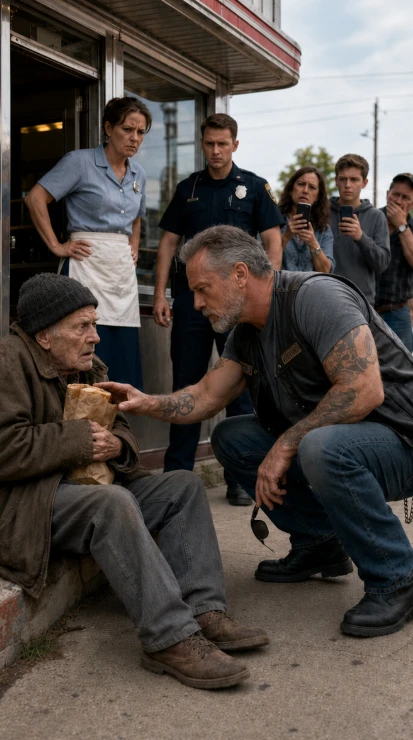
The old man sat on the curb outside the diner’s front window.
Seventy-eight, maybe older. White hair thin as smoke. A wool cap pulled low despite the warmth. His coat was too big for him — donated, probably — sleeves swallowing his wrists. His hands trembled as he held a paper bag folded at the top.
He wasn’t shouting.
He wasn’t grabbing anyone.
He just sat there.
But someone had complained.
The diner manager stepped outside first, apron still tied around her waist. “You can’t sit here,” she said sharply. “You’re bothering customers.”
“I’m not asking anyone,” the old man murmured. His voice was soft and almost embarrassed by itself.
“You’re blocking the entrance.”
He shifted, slowly, like his bones resisted.
A couple walking out wrinkled their noses. One man muttered, “There’s shelters for that.”
A teenager laughed and took a photo.
The old man’s hands tightened around the paper bag. Inside it was half a sandwich. Bread dry at the edges. He had found it in a trash bin behind the grocery store.
“I’ll move,” he said.
But before he could stand, a pickup truck honked impatiently.
Someone shouted, “Get a job!”
The old man flinched — not from fear, but from a lifetime of learning how to shrink.
And then the rumble came.
Low. Controlled. Familiar.
Heads turned.
A motorcycle rolled slowly to the curb.
The engine cut.
Boots hit pavement.
No one knew yet whether this was about to get worse.
He looked exactly like the kind of man small towns whisper about.
Mid-50s. Broad chest. Sleeveless leather jacket. Arms covered in faded tattoos that looked older than some of the cars on the street. A short gray beard. Dark sunglasses that hid his eyes.
He didn’t hurry.
He didn’t posture.
He just walked toward the old man.
The diner manager stiffened. “We don’t need more trouble.”
The biker didn’t respond.
He stopped directly in front of the old man and looked down at him.
The silence stretched.
The old man blinked up, confused.
“Sir, you can’t loiter here,” the manager snapped, assuming they were together.
The biker slowly removed his sunglasses.
His eyes were steady. Not angry.
But unreadable.
“You with him?” someone asked.
He didn’t answer.
Instead, he crouched down.
The movement was slow — deliberate — and it made people tense.
One man near the door muttered, “This is escalating.”
The biker reached toward the paper bag.
The old man instinctively pulled it closer, like a child protecting the last cookie on a plate.
Gasps.
“Hey!” someone barked. “Don’t touch him!”
The biker paused — hand hovering.
The entire sidewalk felt like it was holding its breath.
From across the street, a woman whispered, “Call the cops.”
The biker finally spoke.
“Is that all you’ve eaten today?”
His voice was low. Calm.
The old man hesitated. “Yes, sir.”
The word sir landed strangely.
The biker didn’t flinch.
He reached into his own saddlebag.
The movement looked suspicious. Heavy leather. Zipper sound. Something metallic shifting inside.
Two men stepped forward instinctively.
“You got a problem?” one demanded.
The biker didn’t look at him.
He pulled out—
A folded paper takeout box.
Still warm.
He opened it slowly.
A burger. Fries. Unwrapped but untouched.
He set it gently on the curb between them.
The old man stared.
The crowd didn’t relax.
It didn’t look like kindness.
It looked like control.
Like territory being claimed.
“Move along,” someone muttered.
The biker sat down.
Right there on the curb.
Leather against concrete.
He picked up the fries.
Took one bite.
And waited.
Now it was confusing.
Why was he eating?
Why was he sitting there like it was his spot?
The diner manager’s face hardened. “You can’t just—”
He didn’t look at her.
He broke the burger in half.
Held out one side.
The old man’s hands shook harder now.
“You don’t have to,” he whispered.
The biker nodded once.
“I know.”
Still, he didn’t explain.
Didn’t smile.
Didn’t try to soften the moment.
The crowd misread it.
They saw intimidation.
They saw a biker staking ground in front of a business.
One man pulled out his phone.
“Yeah,” he said into it. “We’ve got a situation outside Miller’s Diner.”
The tension rose like heat off asphalt.
Because now it wasn’t just about a homeless man.
It was about a biker who refused to leave.
And nobody understood why.
The old man reached for the burger half.
His fingers trembled so badly that the wrapper slipped.
The biker caught it before it fell.
Small movement.
Precise.
Disciplined.
But someone across the sidewalk shouted, “Don’t let him bully you!”
Bullying.
The word echoed strangely in the air.
The old man shook his head weakly. “He’s not—”
But no one was listening to him.
A store employee stepped out with arms crossed. “You’re disturbing customers.”
The biker finally looked up.
“We’re eating.”
“That’s private property.”
He nodded once.
Then he reached into his pocket.
That simple motion made three people step back.
He pulled out his phone.
Dialed.
Put it to his ear.
Didn’t turn away.
“Yeah,” he said quietly. “Main Street. Miller’s.”
Pause.
“They’re about to make this worse.”
He ended the call.
That was it.
No explanation.
The crowd stiffened.
“You calling backup?” someone sneered.
The biker didn’t respond.
The old man’s breathing grew shallow.
He wasn’t used to this much attention.
He was used to invisibility.
And now he was at the center of a storm he never asked for.
A patrol car turned onto Main Street.
Lights not flashing — yet.
But present.
The diner manager exhaled in relief.
“Good,” she said. “Let them handle it.”
The officer stepped out.
Young. Maybe thirty. Clean uniform. Confident stride.
“What’s going on?”
Voices overlapped.
“He’s harassing customers.”
“He’s with that guy.”
“He won’t leave.”
The officer approached the biker.
“You need to move along.”
The biker remained seated.
“I’m eating.”
“With him?” the officer asked.
“Yes.”
The officer looked at the old man.
“You know this guy?”
The old man swallowed. “No, sir.”
There it was again.
Suspicion sharpened.
The officer’s hand rested lightly on his belt.
“You’re creating a disturbance.”
The biker finally stood.
Not aggressively.
But slowly enough to make the movement feel larger.
“I’m sitting on a curb,” he said evenly.
The officer’s tone cooled. “You were asked to leave.”
“And he was asked to disappear,” the biker replied.
The air tightened.
The officer didn’t like that.
“Sir, I’m going to need you to cooperate.”
The biker looked at the old man — still clutching half a burger like it might vanish.
He looked back at the officer.
Then he said, very quietly:
“Give it a minute.”
“Give what a minute?” the officer snapped.
The biker didn’t answer.
He just stood there.
Still.
Waiting.
And somewhere down the road—
A second engine began to hum.
At first, it was just a vibration.
Low. Distant. Almost easy to ignore.
Then it grew clearer — not loud, not aggressive — just steady. Controlled. The kind of sound that doesn’t rush because it doesn’t have to.
The young officer turned his head slightly toward the end of Main Street.
The diner manager stopped talking mid-sentence.
One motorcycle appeared.
Then another.
Then three more behind them.
No revving. No roaring engines meant to intimidate. Just a clean, disciplined roll down the street like a line drawn with purpose.
They parked along the curb in front of Miller’s Diner.
Engines cut almost in unison.
Silence dropped heavy over the sidewalk.
Helmets came off.
Men and one woman — all middle-aged, all wearing sleeveless leather jackets with the same understated patch over the heart. Faded denim. Tattoos that looked weathered, not decorative. Faces serious but not hostile.
They didn’t surround anyone.
They didn’t speak.
They simply walked over and stood behind the first biker.
Even spacing.
Hands relaxed.
Eyes forward.
The officer swallowed once, recalibrating.
“This isn’t a gathering spot,” he said carefully.
No one answered.
The first biker glanced at the old man.
“Eat,” he said quietly.
The old man hesitated — then took a bite.
The smallest action in the world.
And yet it shifted something.
The officer looked at the line of bikers again. “You all together?”
One of them nodded once. “We ride together.”
“That doesn’t give you the right to intimidate business owners.”
The first biker’s voice remained level. “We’re not intimidating anyone.”
It was true.
They weren’t shouting.
They weren’t crowding.
They were simply standing there.
Present.
And somehow that presence made the earlier shouting feel louder by comparison.
The crowd that had been so vocal minutes ago grew quieter now.
The teenager who had been recording lowered his phone.
The man who had yelled “Get a job” suddenly found the sidewalk fascinating.
The diner manager crossed her arms tighter, but her voice lost some of its sharpness. “They’re blocking my storefront.”
The biker turned slightly, measured the space behind him, then stepped half a foot to the side.
The others adjusted automatically.
Not military precision — but close.
Order without chaos.
The officer exhaled slowly.
“You’re making this more complicated than it needs to be,” he said.
The biker looked at him.
“No,” he replied. “It was complicated before we got here.”
The officer glanced at the old man again.
He looked smaller than ever between them all — a frail figure clutching a paper-wrapped burger, chewing slowly like it might be the last thing he tasted for a while.
“Sir,” the officer said to the old man gently now, “do you want assistance getting to a shelter?”
The old man shook his head faintly.
“I wasn’t asking anyone for anything.”
His voice carried differently this time.
Not embarrassed.
Just tired.
The first biker reached into his back pocket.
The officer’s posture tightened slightly — instinct, not aggression.
The biker pulled out a folded paper.
He handed it to the officer.
The officer unfolded it.
A receipt.
From Miller’s Diner.
Two burgers. Two coffees.
Paid in cash.
Ten minutes earlier.
The officer blinked.
“You already paid?”
The biker nodded.
“For the table by the window,” he said. “She told him he couldn’t sit inside.”
The diner manager stiffened.
“He smells,” she snapped defensively. “Customers complained.”
The biker didn’t argue.
He didn’t accuse.
He just looked at the officer.
“We weren’t blocking anything.”
The officer glanced at the window — the empty table visible through the glass.
The weight of the moment shifted again.
Not because of force.
Because of fact.
The officer handed the receipt back slowly.
“You’re saying you intended to eat inside?”
“Yes.”
“With him?”
“Yes.”
The crowd processed that.
The image didn’t match their assumption.
The officer rubbed his jaw, thinking.
No laws broken.
No threats made.
No violence.
Just discomfort.
And discomfort wasn’t illegal.
One of the bikers spoke for the first time.
“Is he allowed to eat if he pays?”
The question hung in the air.
Simple.
Direct.
No moral speech.
The officer looked toward the diner manager.
She hesitated.
Business reputation.
Customer complaints.
Social pressure.
All tangled together.
Finally she said, quieter now, “If he’s with you.”
The old man lowered his gaze again, embarrassed by the condition attached to his dignity.
The first biker extended a hand.
Not dramatic.
Not theatrical.
Just steady.
“Let’s eat inside,” he said.
The old man looked at the hand like it belonged to another world.
Then he took it.
Slowly.
The bikers parted just enough to create a path.
Not blocking.
Not crowding.
Just clearing space.
And for the first time since the shouting started, no one said a word.
Power had shifted.
Without a single raised fist.
Inside the diner, the noise level dropped as they entered.
Not because anyone was told to be quiet.
Because everyone chose to.
The old man sat at the table by the window.
Across from the biker.
Sunlight fell across the scratched wood tabletop.
The biker removed his leather jacket and draped it over the back of his chair.
Underneath, just a plain gray T-shirt.
Nothing theatrical.
Nothing symbolic.
Just a man.
They ate in silence at first.
The old man’s hands shook less after the first few bites.
Color returned slowly to his cheeks.
A waitress approached cautiously.
“What can I get you?” she asked.
“Coffee,” the biker said.
“For both of us.”
The old man looked startled. “I don’t have—”
“I know.”
No lecture.
No reassurance.
Just knowing.
Outside the window, people walked by more slowly now.
Curious.
Watching.
But the storm had passed.
The officer remained outside for a moment longer before returning to his car.
He didn’t write a report.
There wasn’t one to write.
Halfway through the meal, the old man spoke.
“I used to work construction,” he said softly. “Thirty years.”
The biker nodded once.
“My hands used to be steady.”
The biker looked down at his own tattooed forearms.
“Mine too,” he replied.
A pause.
Not heavy.
Not dramatic.
Just human.
When the food was gone, the biker stood.
He walked to the counter.
Paid the bill.
Left more cash than necessary.
No tip speech.
No attention drawn.
When he returned to the table, he placed a small folded card near the old man’s hand.
A phone number.
“That’s for a job site outside town,” he said quietly. “They need someone to watch equipment overnight. Light duty.”
The old man blinked.
“You don’t even know me.”
The biker gave a faint shrug.
“I know enough.”
He put his jacket back on.
The old man’s voice cracked slightly. “Why?”
The biker paused by the door.
He looked back once.
“Because no one should be yelled at for being hungry.”
That was all.
He stepped outside.
The other bikers mounted their motorcycles.
Engines started again — low, steady, controlled.
They didn’t rev.
They didn’t linger.
They simply rode away.
Through the diner window, the old man watched the line of motorcycles disappear down Main Street.
No cheers.
No applause.
Just the quiet clink of coffee cups.
The teenager who had laughed earlier avoided eye contact when he passed by the table.
The man who had shouted “Get a job” left quickly, eyes lowered.
The diner manager wiped down a counter twice, though it didn’t need wiping.
The old man unfolded the card again.
His hands still trembled — but for a different reason now.
Outside, the street returned to normal.
Traffic resumed.
Voices rose again.
But something subtle had changed.
A man who had been shrinking all afternoon now sat upright.
And a biker who could have ridden past — who could have ignored it like everyone else — had chosen to sit down instead.
Not to rescue.
Not to perform.
Just to share a meal.
Sometimes dignity doesn’t arrive with applause.
Sometimes it arrives on two wheels, cuts the engine, and takes the seat beside you.
And when the engines fade into the distance, what remains isn’t noise.
It’s the memory of someone refusing to look away.
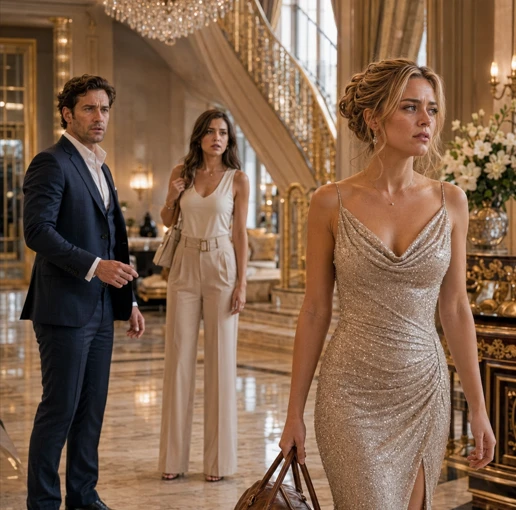
The struggling wife saw his mistress dressed in his shirt, left with only one bag, and the billionaire realized far too late that she could purchase everything he owned.
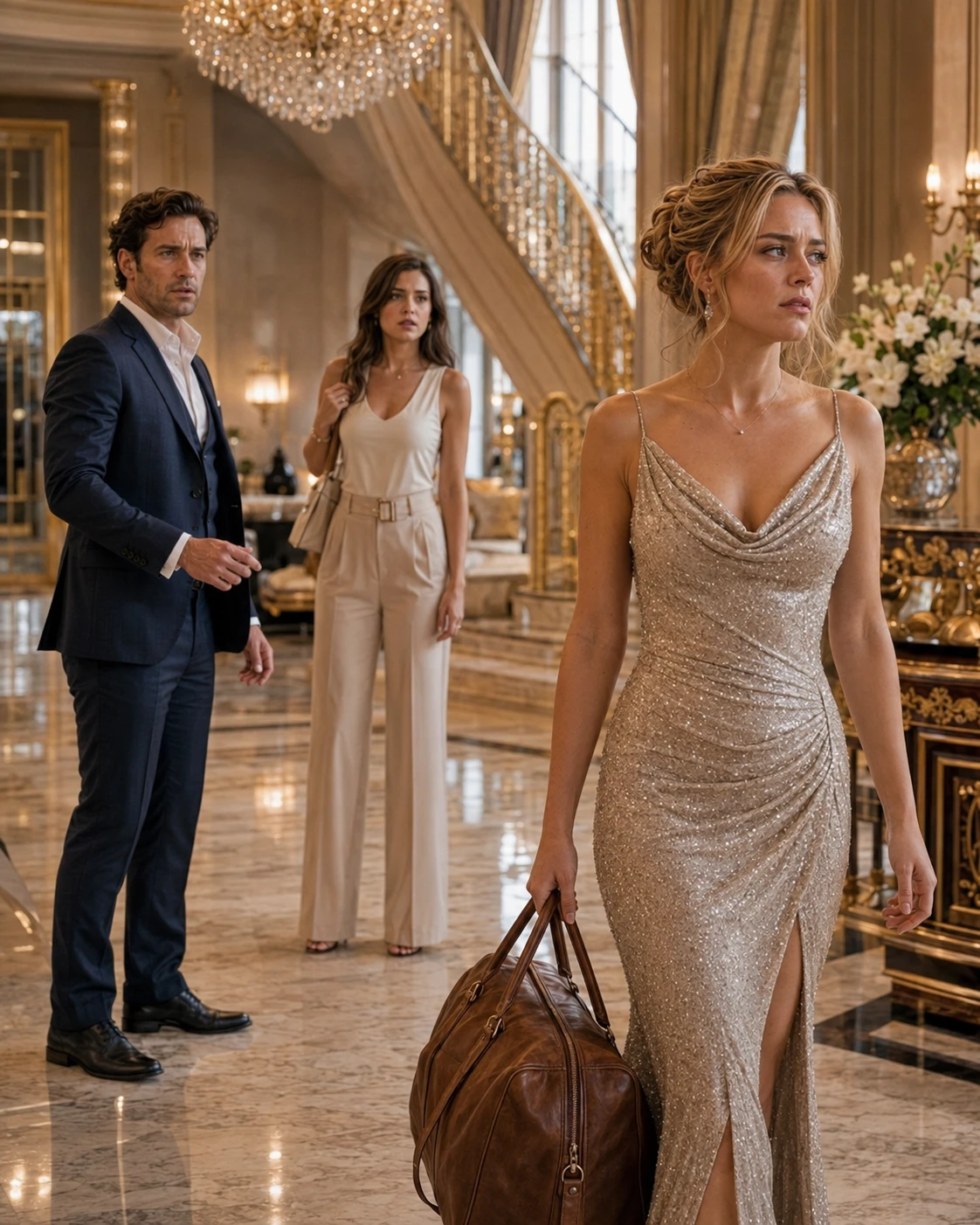
Part 2
Vanessa laughed softly. “Is this supposed to scare him?”
Emily looked at her.
Then she smiled.
Not bitterly.
Not angrily.
Just once.
A small, almost sympathetic smile.
And somehow that smile unsettled Ethan more than screaming ever could.
“No,” Emily said quietly. “Nothing about this is supposed to scare him.”
Then she opened the front door.
The storm swallowed her.
And she was gone.
For several seconds nobody moved.
Rain lashed the windows.
The grandfather clock in the hallway ticked.
Vanessa crossed her arms.
“Well,” she said. “That was dramatic.”
Ethan stared at the closed door.
For reasons he couldn’t explain, a strange discomfort settled in his chest.
Not guilt.
Certainly not regret.
Something else.
Something unfamiliar.
He dismissed it immediately.
By midnight he was drinking whiskey in his office while Vanessa slept upstairs.
By morning he had convinced himself Emily would return.
Women always returned.
Especially women who had once lived in studio apartments and suddenly found themselves married to billionaires.
Especially women who had never earned real money.
Especially women like Emily.
Or so Ethan believed.
Three days later, she still hadn’t called.
A week later, she still hadn’t called.
Two weeks later, his attorney informed him divorce papers had been filed.
Not requested.
Filed.
Aggressively.
With astonishing precision.
Every financial document.
Every property agreement.
Every trust structure.
Every corporate protection clause.
The paperwork was flawless.
Ethan sat behind his mahogany desk and frowned.
“Who prepared this?”
His attorney adjusted his glasses.
“That’s the strange part.”
“What?”
“The legal team handling her case is one of the most expensive firms in New York.”
Ethan laughed.
“Impossible.”
“I’m serious.”
“She can’t afford them.”
The attorney hesitated.
Then said something Ethan would remember for the rest of his life.
“They aren’t billing her.”
Silence.
“What?”
“They’ve represented her family for decades.”
Ethan blinked.
“Her family?”
“Yes.”
For the first time, uncertainty flickered across Ethan’s face.
A tiny crack.
Nothing more.
Yet.
Three thousand miles away, Emily sat inside a private conference room overlooking Boston Harbor.
Floor-to-ceiling windows reflected gray ocean water.
Eight executives sat around the table.
Every one of them stood when she entered.
“Good morning, Dr. Blackwell.”
Emily nodded politely.
“Good morning.”
Nobody called her Mrs. Blackwell here.
Nobody ever had.
On the screen behind her appeared the logo of a company worth nearly two hundred billion dollars.
Aerospace.
Quantum computing.
Defense systems.
Artificial intelligence.
The company had quietly become one of the most powerful technology organizations on earth.
And Emily owned forty-eight percent of it.
Not through marriage.
Not through inheritance alone.
Through patents.
Through decades of work.
Through brilliance.
At thirty-eight years old, Emily Blackwell was considered one of the most influential scientific minds of her generation.
Most people simply didn’t know her face.
She preferred it that way.
A board member cleared his throat.
“Are you certain about acquiring Blackwell Global Capital?”
The room became quiet.
Emily looked at the financial reports.
Then at the company name.
Ethan’s company.
The empire he believed made him untouchable.
“Very certain.”
Another executive hesitated.
“The acquisition will be hostile.”
Emily smiled.
“Only if they resist.”
Back in Los Angeles, Ethan’s month got worse.
Then worse again.
Then catastrophic.
A major investor withdrew.
A merger stalled.
Three international contracts suddenly disappeared.
Banks began requesting additional guarantees.
At first Ethan blamed market conditions.
Then competitors.
Then politics.
Then bad luck.
But eventually patterns emerged.
Every obstacle somehow connected to the same invisible force.
Funding vanished.
Partners changed direction.
Negotiations collapsed.
Entire opportunities evaporated overnight.
One evening his chief financial officer entered his office looking pale.
“Ethan.”
“What now?”
“We have a problem.”
“Join the line.”
“No.”
The CFO swallowed.
“This is serious.”
A folder landed on Ethan’s desk.
He opened it.
Read the first page.
Then the second.
Then the third.
The color drained from his face.
“No.”
The CFO nodded.
“I’m afraid so.”
Ethan read the name again.
Then again.
And again.
Dr. Emily Grace Blackwell.
Controlling shareholder.
Aether Dynamics Holdings.
Estimated net worth: $34.8 billion.
Ethan stared at the numbers.
His mind rejected them.
Thirty-four billion.
Not million.
Billion.
The room felt suddenly smaller.
“She hid this.”
The CFO looked uncomfortable.
“Actually…”
“What?”
“She didn’t.”
“What are you talking about?”
“These records are public.”
Ethan’s eyes lifted.
“The patents. The research publications. The foundation grants. The ownership disclosures.”
The CFO paused.
“Most people in aerospace know exactly who she is.”
A terrible realization began forming.
“Then why didn’t I know?”
Nobody answered.
Because everyone understood the truth.
He never asked.
That night Ethan couldn’t sleep.
He walked through the mansion.
Every room felt different.
Every memory looked different.
The kitchen.
The library.
The terrace.
The garden.
Everywhere he looked he saw things he had never bothered to notice.
The engineering journals stacked beside her bed.
The scientific conferences she attended.
The Nobel Prize winners who called her by her first name.
The military officials who treated her with unusual respect.
The billionaire philanthropists who seemed oddly eager to speak with her.
He had seen every clue.
Ignored every clue.
Because he preferred a simpler story.
The beautiful waitress.
The grateful wife.
The rescued woman.
And now that story was collapsing.
Two weeks later the collapse became public.
Financial media exploded.
Television analysts discussed it nonstop.
Headlines appeared worldwide.
BLACKWELL GLOBAL TARGETED BY MYSTERIOUS BUYER
HOSTILE ACQUISITION UNDERWAY
MARKETS REACT TO MASSIVE TECHNOLOGY TAKEOVER
Ethan spent sixteen straight hours in emergency meetings.
Then seventeen.
Then eighteen.
Every solution failed.
Every defense collapsed.
The buyer already controlled too many positions.
Too many lenders.
Too many strategic partners.
Too many votes.
Finally the identity of the buyer became public.
The boardroom fell silent.
A single name appeared on the screen.
EMILY G. BLACKWELL.
Nobody spoke.
Ethan felt the blood leave his face.
His own wife.
No.
His ex-wife.
The woman he claimed came from nothing.
The woman he said wasn’t enough.
The woman he thought needed him.
She was buying his company.
Piece by piece.
Asset by asset.
Share by share.
And there was absolutely nothing he could do to stop her.
Three days later Ethan requested a meeting.
To his surprise, she agreed.
The meeting took place in New York.
Top floor.
Private conference suite.
When Ethan entered, Emily stood near the windows.
She wore a navy suit.
No diamonds.
No dramatic jewelry.
No attempt to impress anyone.
She looked exactly like herself.
And somehow that confidence terrified him.
“Emily.”
She turned.
“Ethan.”
The silence stretched.
Finally he spoke.
“You planned this.”
“No.”
“You expect me to believe that?”
She folded her hands.
“I didn’t leave intending to buy your company.”
“Then why are you doing it?”
Emily looked out at Manhattan.
Lights glittered below.
“When I left your house, I wanted peace.”
She paused.
“You refused to give it to me.”
Ethan’s jaw tightened.
“I made mistakes.”
“You humiliated me.”
“You could have talked to me.”
Emily laughed softly.
The sound carried no joy.
“Talked?”
“You never listened.”
He took a step forward.
“I’m listening now.”
Her eyes met his.
And for the first time he saw the complete truth.
She was finished.
Completely.
Permanently.
The marriage wasn’t damaged.
It was dead.
“You know what’s funny?” she asked.
“What?”
“You always thought money made you powerful.”
She slid a folder across the table.
Ethan opened it.
His hands began shaking.
The acquisition documents.
Final approval.
Signed.
Completed.
Irreversible.
Emily now controlled everything.
His company.
His board.
His future.
His empire.
Gone.
“Why?” he whispered.
Emily looked at him for a long moment.
Then she said the one thing he never expected.
“Because my grandfather loved you.”
Ethan blinked.
“What?”
“He believed you loved me.”
Confusion crossed his face.
Emily opened her purse.
Removed an old envelope.
The same envelope she had carried from the mansion.
She handed him the letter.
Ethan unfolded the yellow paper.
His eyes moved across the words.
Then stopped.
Then widened.
Then filled with horror.
At the bottom was a legal addendum.
A clause.
One hidden condition attached to the family trust.
A condition Ethan had unknowingly triggered.
If Emily’s spouse is proven to have committed marital betrayal resulting in divorce, control of the Blackwell Strategic Trust shall immediately transfer solely to Emily, including all associated acquisition authorities and reserved holdings.
Ethan stared at the page.
His hands trembled.
“No…”
Emily nodded.
“My grandfather built that clause after my grandmother was betrayed.”
The room spun.
The realization hit him like a freight train.
His affair hadn’t merely destroyed his marriage.
It had activated the very mechanism that allowed Emily to take everything.
Everything.
The trust.
The voting rights.
The acquisition authority.
The billions.
The takeover.
All of it.
His own betrayal had armed the weapon that destroyed him.
A weapon sitting quietly beside him for five years.
Hidden in plain sight.
Waiting.
He sank into a chair.
Speechless.
Broken.
Defeated.
Emily picked up her coat.
Then paused beside him.
For a moment she saw the man she once loved.
The man she had chosen.
The man she had believed in.
And she felt absolutely nothing.
No hatred.
No revenge.
No satisfaction.
Nothing.
Which was somehow worse.
She walked toward the door.
“Emily.”
She stopped.
“What?”
His voice cracked.
For the first time in his life, Ethan Blackwell sounded afraid.
“Did you ever love me?”
Emily stood silently.
Then smiled sadly.
“Enough to leave thirty-four billion dollars untouched for five years.”
The answer shattered him.
Because suddenly he understood.
She had never wanted his money.
Never needed his mansion.
Never cared about his status.
She had chosen him while already possessing more wealth than he could imagine.
And he had thrown that away for a woman wearing his shirt on a couch.
The door opened.
Emily stepped through it.
Then closed it behind her.
Ethan remained alone.
Listening to the silence.
Listening to the sound of an empire ending.
And somewhere high above Manhattan, reflected in the glass of a skyscraper she now owned, Emily Blackwell finally became something she had not been in years.