PART 3
PART 4
For a long time after Marcus was sentenced, I thought freedom would feel different.
I imagined that the moment the judge pronounced his sentence, something inside me would suddenly become whole again.
It didn’t.
Healing was quieter than that.
There were mornings when I woke up safe in my own bedroom and still expected to hear footsteps on the stairs.
There were nights when the sound of a key turning in a lock made my entire body freeze.
Sometimes I couldn’t eat apples.
Sometimes I couldn’t stand the smell of roasted meat.
And sometimes, when the house became too quiet, I could hear the basement again.
Not the real basement.
The one inside my memory.
The scrape of metal.
The sound of Marcus’s boots.
The click of the lock.
His mother’s voice.
The laughter from upstairs.
For months, I hated myself for still being afraid.
Then my therapist told me something I would never forget.
“Surviving something doesn’t mean your body immediately understands that it’s over.”
So I stopped expecting myself to heal on someone else’s schedule.
I learned to sleep with the bedroom door open.
I learned to drink water without feeling guilty.
I learned to eat when I was hungry.
I learned to say no without explaining myself.
And most importantly, I learned that surviving wasn’t the same thing as living.
I wanted to live.
For Hope.
And for myself.
Six months after the trial, I received a letter from the district attorney.
Marcus had appealed his sentence.
The letter explained that his attorneys were claiming the recordings had been illegally obtained.
My hands began shaking.
For a moment, I was back in that basement.
The cage.
The phone.
One percent battery.
The loose floor panel.
Everything.
I called Lena.
“He’s appealing.”
She was silent for a few seconds.
Then she said, “We’re ready.”
I almost laughed.
“We?”
“Yes,” she said. “We.”
That word meant more to me than she knew.
I had spent so long believing I was alone.
Marcus had built his entire system around that belief.
He isolated me.
He took my phone.
He controlled my money.
He lied to everyone.
He told people I was visiting family.
He made sure nobody heard me.
But I wasn’t alone.
I had Lena.
I had the detective.
I had the paramedics.
I had the investigators.
I had people who believed me.
And I had my own voice.
The appeal was denied.
Marcus remained in prison.
His mother received her own sentence for her involvement in the financial crimes and for assisting Marcus in concealing what happened to me.
Victor sold the old house.
I never asked what happened to the property.
I didn’t care.
That place no longer belonged to me.
Neither did Marcus.
My daughter did.
My future did.
And my life did.
Two years after everything happened, I bought a small house on a quiet street.
It wasn’t expensive.
It wasn’t impressive.
There was no enormous dining room.
No polished staircase.
No basement.
That last part was intentional.
When the real estate agent showed me a beautiful house with a finished basement, I immediately said no.
She looked confused.
I simply told her, “I don’t want one.”
She didn’t ask why.
I was grateful.
The house I eventually chose had a small garden in the back.
There was a lemon tree near the fence.
A porch where Hope could draw with sidewalk chalk.
And a kitchen with huge windows that let sunlight pour across the floor every morning.
The first night we slept there, I left every interior door open.
Hope was four years old.
She came into my room holding her stuffed rabbit.
“Mommy?”
“Yes?”
“Can I sleep here?”
I smiled.
“Of course.”
She climbed into bed.
After a few minutes, she whispered:
“Is Daddy coming?”
My heart tightened.
Children ask questions adults aren’t prepared to answer.
I stroked her hair.
“No.”
“Why?”
I thought carefully.
Because he hurt us.
Because he lied.
Because he tried to take away our freedom.
Because he was dangerous.
But Hope was too young to carry all of that yet.
So I said:
“Because some people make choices that mean they can’t be part of our home.”
She was quiet.
Then she asked:
“Are we safe?”
I looked around the room.
The windows were open.
The hallway light was on.
The front door was locked.
And for the first time, I knew the answer without forcing myself to believe it.
“Yes.”
Hope smiled.
“Good.”
Then she fell asleep.
I stayed awake for a while.
Not because I was afraid.
Because I was listening.
There were no footsteps.
No shouting.
No keys.
No cage.
Only the sound of my daughter’s breathing.
And somewhere outside, a dog barked.
I smiled.
That sound would once have terrified me.
Now it sounded like freedom.
Years later, Hope asked me to tell her about the night she was born.
She was old enough to understand more.
We were sitting beneath the lemon tree.
She was thirteen.
“Was I really born that night?”
“Yes.”
“Were you scared?”
I looked at her.
“Very.”
“Did you think we were going to die?”
I didn’t lie.
“Yes.”
She was quiet.
Then she took my hand.
“But we didn’t.”
“No.”
“Because Aunt Lena found you?”
“Because Aunt Lena never stopped looking.”
She thought about that.
Then she asked:
“What did Daddy do?”
I looked toward the garden.
For years, I had avoided saying his name.
But I had finally learned that speaking about something didn’t give it power.
Silence sometimes did.
“He hurt me,” I said.
Hope’s face changed.
“Why?”
“I don’t know.”
“Did you do something wrong?”
The question hit me harder than anything else.
“No.”
I squeezed her hand.
“Never believe someone hurts you because you weren’t good enough.”
She nodded.
“Then why did he do it?”
“Because his choices were his.”
She looked at me for a long moment.
Then she leaned against my shoulder.
“I think you’re brave.”
I smiled.
“No.”
She looked surprised.
“You’re not?”
“I was terrified.”
“That’s what brave means.”
I laughed.
“Maybe.”
She smiled.
Then she pointed toward the garden.
“Mom?”
“Yes?”
“Look.”
She had planted a tiny apple tree.
I stared at it.
An apple tree.
For a moment, I couldn’t breathe.
She saw my expression.
“What’s wrong?”
I shook my head.
“Nothing.”
She frowned.
“Mom.”
I walked over and touched one of the small leaves.
The memory came back.
One rotten apple through steel bars.
One apple meant to humiliate me.
One apple used as a weapon.
And now, years later, my daughter had planted an entire tree.
I looked at her.
“Nothing is wrong.”
I smiled.
“Everything is right.”
She didn’t understand.
Not yet.
But she would.
The first apple appeared the following summer.
It was tiny and imperfect.
Hope picked it carefully.
“Should we eat it?”
I laughed.
“Absolutely.”
We cut it in half.
She took the first bite.
Then she made a face.
“It’s sour.”
I laughed so hard I cried.
She started laughing too.
And standing there beneath that tree, I realized something.
Marcus had once used food to remind me that he controlled whether I lived.
Now my daughter and I were standing in our own garden, eating fruit from a tree we had planted ourselves.
No one was telling us when we could eat.
No one was watching.
No one was counting.
No one was holding a key.
For the first time, something as ordinary as eating an apple felt like freedom.
Years later, I finally returned to the courthouse.
Not for Marcus.
For someone else.
A woman had been rescued from an abusive relationship, and the local support organization had asked me to speak at an event.
I almost refused.
Then I remembered the woman I had been.
The woman who thought nobody would believe her.
The woman who thought her voice didn’t matter.
So I went.
There were dozens of people in the room.
Survivors.
Families.
Counselors.
Police officers.
Doctors.
People who had spent years helping others escape situations like mine.
When I stepped onto the stage, my hands shook.
I looked at the audience.
Then I began.
“I used to think strength meant not being afraid.”
The room became silent.
“I was wrong.”
I took a breath.
“Strength can mean being terrified and still reaching for the phone.”
Someone in the audience began crying.
I continued.
“Strength can mean recording one more conversation when you believe nobody will ever hear it.”
I looked toward the back of the room.
“Strength can mean surviving one more night.”
My voice cracked.
“And sometimes strength is simply believing that tomorrow deserves a chance.”
When I finished, nobody spoke for several seconds.
Then the room filled with applause.
But I wasn’t thinking about applause.
I was thinking about that basement.
That cold floor.
That one-percent battery.
That tiny piece of hope hidden beneath a metal panel.
And I finally understood.
I hadn’t survived because I was stronger than everyone else.
I survived because some part of me refused to believe that the cage was the end of my story.
That part of me had been very small.
But it was still alive.
And sometimes, that’s all you need.
Years later, Marcus sent one final letter.
I almost didn’t open it.
But I did.
He didn’t apologize.
Not really.
He wrote about his regrets.
His loneliness.
His lost career.
His ruined reputation.
He said he had spent years thinking about what happened.
At the bottom, he wrote:
“I hope someday you can forgive me.”
I stared at those words for a long time.
Then I folded the letter.
I didn’t tear it up.
I didn’t burn it.
I didn’t answer it.
Because forgiveness didn’t mean I owed him access to my life.
It didn’t mean forgetting.
It didn’t mean pretending.
And it certainly didn’t mean reopening a door I had fought so hard to close.
I placed the letter in a box.
Then I closed the lid.
That was all.
Some doors don’t need to be slammed.
They simply need to stay closed.
That night, I went outside.
Hope was sitting beneath the apple tree.
She was seventeen now.
Older.
Taller.
Still stubborn.
Still kind.
She looked up.
“Mom.”
“Yes?”
“Come sit with me.”
I sat beside her.
The evening sky was turning orange.
She rested her head against my shoulder.
“You know something?”
“What?”
“I’m glad you survived.”
I looked at her.
My eyes filled with tears.
“Me too.”
She smiled.
Then she reached for my hand.
We sat beneath the tree until the sun disappeared.
And I thought about the woman I had been that night.
Nine months pregnant.
Bleeding.
Starving.
Locked behind steel.
Listening to people laugh upstairs while believing nobody knew she was there.
That woman had thought she was fighting for one more breath.
She didn’t know she was fighting for an entire future.
She didn’t know that her sister was already searching.
She didn’t know that the hidden phone would survive.
She didn’t know the door would eventually open.
She didn’t know her baby would live.
She didn’t know she would someday sit beneath an apple tree with that same baby, now grown nearly as tall as she was.
She didn’t know.
But she kept fighting.
And that’s what mattered.
Because Marcus thought the cage was the end of my life.
It wasn’t.
It was the place where my old life ended.
And the moment that door opened was the moment I began building a new one.
A life where nobody owned my choices.
A life where my daughter knew she was loved.
A life where the doors stayed unlocked because I wanted them open.
A life where an apple was just an apple.
And when the wind moved through the branches above us, I closed my eyes.
For a moment, I could almost hear the basement again.
The metal.
The footsteps.
The lock.
Then I opened my eyes.
There was only sunlight.
Only trees.
Only my daughter.
Only freedom.
And this time, when I heard a door close somewhere inside the house, I didn’t flinch.
I smiled.
Because I knew something Marcus had never understood.
A door can close without becoming a cage.
Sometimes a closed door simply means that the past is finally behind you.
And I had spent years walking toward the light.
I wasn’t going back.
By the Time Marcus Brought the Welder Downstairs, I Understood the Cage Was Never Meant to Open Again
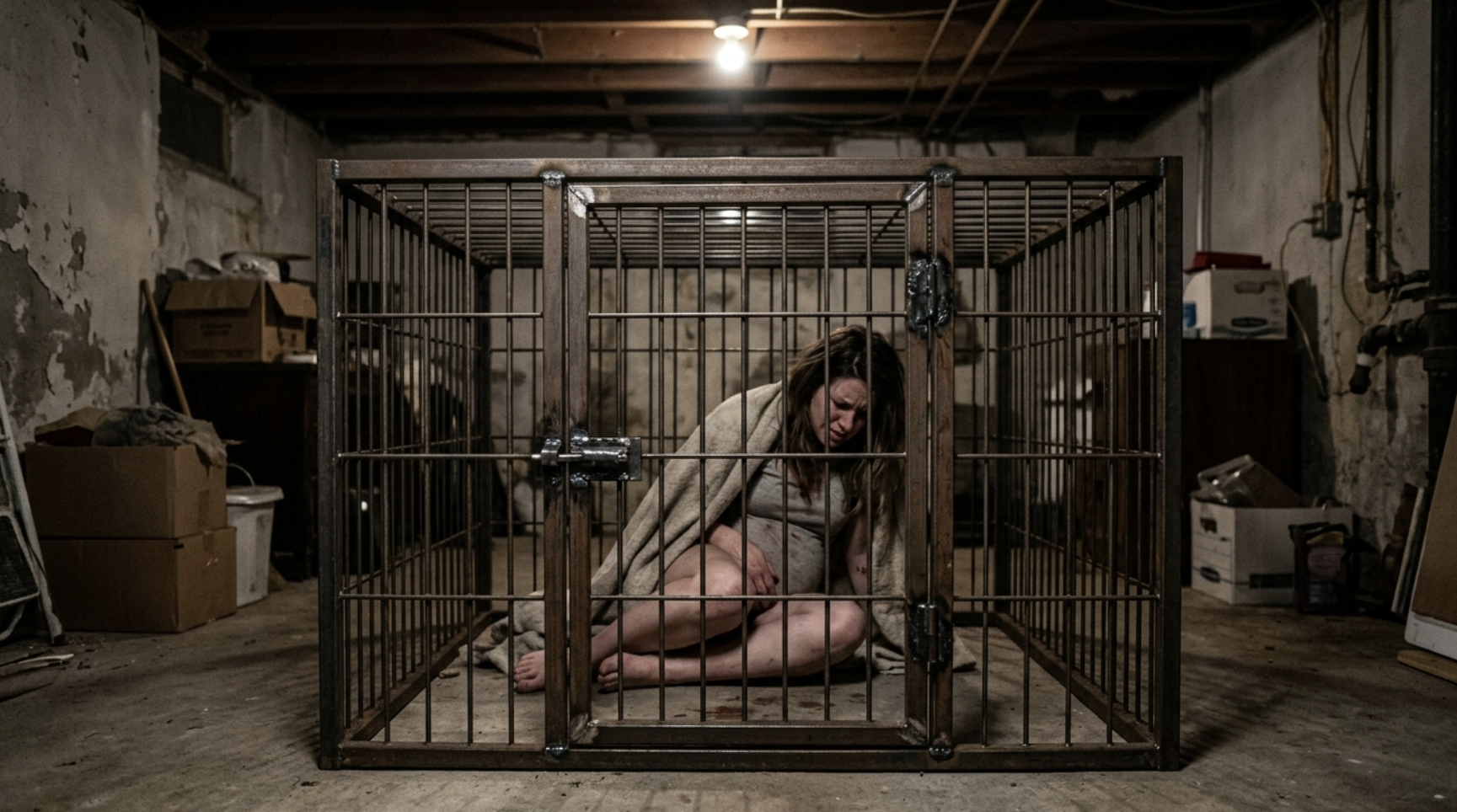
The first spark struck the concrete less than two feet from my bare toes. I jerked backward until the steel bars pressed into my shoulders, one hand covering my stomach while Marcus lowered the dark shield over his face. The baby shifted hard beneath my ribs. I was nine months pregnant, thirsty enough that my tongue felt rough against my teeth, and my husband was kneeling outside the cage with a welding torch. He had not spoken since bringing the machine downstairs. He did not need to. The blue-white flare said more than any threat could have.
“Marcus.” My voice disappeared beneath the hiss of the torch. “What are you doing?” He kept working. The smell of heated metal rolled through the basement, sharp enough to sting my nose. I gripped the bars and forced myself not to cough. Three days earlier, he had told me he only needed time to calm down. Two days earlier, he had said I could come upstairs after I admitted I had been wrong. That morning, he had stopped pretending there was a condition attached to my release. Now he was making certain I understood.
When the flame finally went dark, Marcus lifted his shield. A stripe of sweat crossed one temple, but otherwise he looked almost composed. That was what had frightened me most during our marriage. He rarely looked angry while doing cruel things. Anger might have suggested impulse. Marcus preferred decisions. “You kept testing the door,” he said. “I heard you last night.” I stared at him. “Of course I tested it. I’m locked in a cage.” His mouth tightened as though I had embarrassed myself. “Then you know why I had to make adjustments.”
I looked past him toward the basement stairs. At the top was the ordinary wooden door that opened into our kitchen. I knew every inch of the room above it—the pale stone counters, the shallow bowl where we used to leave our keys, the crooked cabinet Marcus kept promising to fix. Forty feet away stood the refrigerator, full of food I was no longer allowed to choose. Beyond that was the front door. Beyond the front door were neighbors, traffic, delivery drivers, people walking dogs. The distance between me and the rest of the world could have been measured in seconds. Marcus had turned it into something impossible.
“You can’t keep me here.” I heard how weak the sentence sounded. Marcus unplugged the welder and began winding its cable with neat, practiced loops. “I already am.” “I’m due any day.” “I know.” “The baby needs monitoring.” He glanced at my stomach with an expression so flat that I felt colder than I had all night. “You should have thought about consequences before you started making trouble.” The trouble, as he called it, had begun with a bank envelope and a question he had refused to answer.
Two weeks earlier, I had found the envelope inside his suit jacket while looking for a receipt. I was not searching for evidence. I had never thought of myself as a woman who searched her husband’s pockets. The statement showed a transfer large enough to make my hands go still. The destination was a company name I did not recognize. When I asked Marcus about it, he smiled, took the paper from me, and said it was business. When I asked why my name appeared on another document beside it, the smile vanished.
After that, small things that had bothered me for months began arranging themselves into a pattern. Marcus changed passwords he had once shared freely. He took calls outside even when it was raining. He began carrying two phones. Mail disappeared before I saw it. Once, when I entered his office without knocking, he slammed a folder shut so quickly that the edge caught his finger. He bled across the desk and still seemed more concerned about what I might have read. I remembered laughing nervously and asking whether he had become a spy. He had not laughed.
There had been the basement shelves too. Long before the cage, before I understood what the room could become, I had noticed that the back wall seemed wrong. Our basement extended beneath nearly the whole house, yet one section ended several feet sooner than the rooms above suggested it should. Heavy shelving covered that wall from floor to ceiling. When I once tried moving a box to clean behind it, Marcus grabbed my wrist so hard that purple fingerprints appeared by evening. “Never touch my business storage,” he had said. It was the first time he struck me when I asked why.
I should have called Lena then. My sister had disliked Marcus long before I was ready to dislike him myself. She never accused him dramatically. She noticed things. The way he answered questions directed at me. The way he watched my face before I spoke. The way I stopped making plans without checking with him. At Christmas she had followed me into the pantry and asked, quietly, “Do you feel safe at home?” I had been offended. I told her Marcus was intense, not dangerous. I can still remember the disappointment in her eyes—not because I defended him, but because she knew I had rehearsed the answer.
Marcus carried the welding machine toward the stairs. I wrapped both hands around a bar. “Does Lena know where I am?” He stopped. Only for a second, but I saw it. “Why would she?” “She calls every week.” “Not anymore.” My stomach tightened for a reason that had nothing to do with pregnancy. “What did you tell her?” He shifted the machine to his other hand. “That you needed space. That the pregnancy had been stressful. That you went away to rest with relatives.”
“I don’t have relatives I’d stay with.” “Lena doesn’t know every person in your life.” “She knows me.” That made him turn around. He came back down two steps, his expression sharpening. “You keep overestimating how much people pay attention. Everyone has their own problems. Nobody is sitting around studying your schedule.” I wanted to tell him Lena would know. Instead I watched his face and recognized something I had missed during years of arguments: Marcus hated uncertainty. He could tolerate anger, pleading, even hatred. What he could not tolerate was the possibility that another person knew something he did not control.
“So this is about keeping me quiet?” I asked. “This is about you learning when to stop.” “Stop asking about the money?” His eyes changed. Barely. But enough. “Stop touching things that aren’t yours.” “My name was on the paper.” “You misunderstood what you saw.” “Then show it to me again.” He set the welder down with deliberate care. The basement became so quiet I could hear the refrigerator compressor upstairs humming through the ceiling.
Marcus walked to the cage and crouched. His face came level with mine between the bars. “You have a remarkable talent for making a bad situation worse.” “I’m your wife.” “At the moment, you’re a problem I’m handling.” The baby moved again, lower this time, a dragging pressure that made me brace one hand against the floor. Marcus watched me wince without reaching for me. Six months earlier, he had painted the nursery himself. He had spent twenty minutes comparing two shades of yellow. I wondered where that man had gone. Then I wondered whether he had ever existed.
Footsteps sounded above us. Marcus glanced toward the stairs. A moment later his mother appeared in the doorway carrying a tray. She stopped when she saw the welding equipment. Her gaze moved from Marcus to me, then immediately down. On the tray sat a glass of water, half a sandwich, and two prenatal vitamins. Around her neck, catching the basement light, hung the gold chain Marcus had given her years earlier. A small key now rested against her blouse. I had watched her use it twice. It opened the cage’s padlock.
“Please,” I said before pride could stop me. “Call Lena.” Marcus’s mother tightened both hands around the tray. “Eat something.” “Call the police.” “You need to keep your strength.” “Look at me.” She did, finally. Her eyes were wet, but tears were useless when the person crying still held the key. “I’m pregnant,” I said. “You know this is wrong.” She swallowed. “Marcus says you’ve been very upset.” I almost laughed. Instead something inside me went frighteningly still.
“He put me behind steel bars.” I pointed toward the fresh weld marks. “Does that look like treatment for being upset?” She glanced at her son. Marcus did not have to speak. His mother set the tray on the concrete outside the cage. “You should eat before it gets cold.” “How am I supposed to reach it?” Marcus slid the tray through the narrow opening near the bottom. My fingers trembled when I took the water. I wanted to throw it at him. Instead I drank carefully, because anger did not change the fact that my child needed every swallow.
Marcus’s mother touched the key at her throat. The gesture was unconscious, almost protective. I filed it away. I had begun doing that since being locked downstairs—collecting small facts because facts were the only possessions Marcus had not yet taken. The key stayed with her, not him. She came down twice a day when he allowed it. Marcus checked the cage more often at night. The basement window was painted shut and barely wider than my forearm. The old heating pipe rattled just before the furnace started. One section of metal flooring near the back corner shifted when I put weight on it.
That last detail had bothered me since the first night. Most of the cage sat directly on concrete, but Marcus had placed a thin sheet of metal beneath one end years ago, apparently to level the floor. One corner lifted by less than the width of my fingernail. I had worried at it whenever he was upstairs, but the edge cut my fingertips before I could move it. I had stopped after leaving a smear of blood on the floor. Now, while Marcus and his mother argued quietly near the stairs, my eyes returned to that corner.
“You’ve done enough,” his mother whispered. “Not here,” Marcus answered. “She needs a doctor.” “I said not here.” “What happens if the baby comes?” Marcus stared at her until she looked away. “Then we deal with it.” My hand tightened around the plastic cup. His mother’s face seemed to lose color. For the first time, I realized she was frightened of him too. That did not make her innocent. It only explained the shape of her cowardice.
Before leaving, Marcus bent down and collected my empty cup. “I’ll bring more water tonight if you behave.” I hated that word more than any insult he had used. “And if I don’t?” He glanced at my stomach. “Then you make choices for both of you.” His mother flinched. Marcus noticed and smiled faintly, pleased that the message had reached both of us. Then he climbed the stairs, carrying the welder with one hand.
His mother followed, but I called after her. “Tell Lena I love her.” She stopped halfway up. Her fingers closed around the railing. “Please,” I said. “Nothing else. Just tell her.” She remained there long enough that I thought she might turn around. Marcus called her name from the kitchen. Her shoulders rose, then fell. She continued upward. The basement door shut. The lock turned.
I waited until the sound of their footsteps disappeared. Then I crawled toward the rear corner of the cage. My hips hurt from sleeping on concrete. My ankles were swollen. Moving on my knees sent pressure through my abdomen, but I kept going. I slipped one fingernail beneath the loose sheet of metal and pulled. Nothing. I tried again using the edge of the plastic food tray. The panel lifted a fraction. Dust breathed out from beneath it.
Something dark lay underneath.
I froze, listening for movement upstairs. Silence. I pushed the tray edge deeper and levered the metal higher. Pain shot through my fingers. I ignored it. The gap widened enough for me to see a tangle of old electrical wire, two dead insects, and the corner of something rectangular covered in gray dust. Not large. Not a tool. Not part of the floor.
Before I could reach it, footsteps crossed the kitchen directly above me.
I dropped the panel and scrambled away. The metal settled with a tiny click just as the basement lock turned. Marcus opened the door and stood at the top of the stairs holding my handbag—the one he had taken from me the first night. He reached inside, removed my phone, and held it up where I could see it.
“I almost forgot,” he said.
He placed the phone on the concrete and brought his heel down once. The screen cracked. A second strike bent the case. A third broke it completely. Marcus picked up the pieces and dropped them into his pocket. “Now,” he said, looking directly at me, “there is nothing down here that connects you to anyone.”
He walked upstairs and locked the door again.
I waited until I could no longer hear him.
Then I turned toward the loose metal panel.
Marcus was wrong.
Click here to continue reading: PART 2: Each Meal Became a Warning, Until One Rotten Apple Told Me Exactly How Far Marcus Was Willing to Go
He Welded the Cage Shut and Thought I Would Die There—But I Had One Secret Left
Part 1 of 15