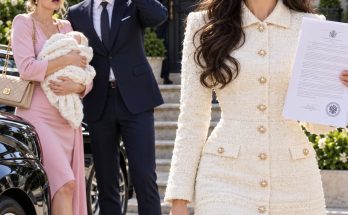
Daniel chose a small private room at Maria Torres’s office for our first meeting.
Neutral ground.
No family photographs.
No Whitmore papers spread across my dining table.
No house carrying Arthur’s memory in every corner.
I understood why.
Mitchell did not come.
Daniel had not agreed to see him yet.
My son accepted that, though the acceptance hurt.
Before I left, he said, “Tell him I’m sorry.”
“For what?”
“I don’t know.”
“Then don’t send an apology without a meaning.”
Mitchell frowned.
“I want him to know I’m not against him.”
“That I can say.”
He nodded.
“That’s enough.”
Daniel arrived five minutes after me.
I knew him immediately.
Not because he looked like Arthur exactly.
He did not.
His hair was lighter. His face narrower. He carried himself more cautiously.
But his eyes were Arthur’s.
Dark.
Observant.
A little skeptical even when relaxed.
For several seconds, we simply looked at one another.
He was fifty-six.
I had spent forty-nine years married to his father and had never once sat across a table from him.
“Eleanor.”
“Daniel.”
Maria remained for introductions, then offered to stay or leave.
Daniel looked at me.
“Stay.”
I agreed.
He sat opposite me.
Arthur’s letter lay between us.
I had brought the original.
Daniel did not touch it at first.
“You knew about me.”
“Yes.”
“All along.”
“Yes.”
His jaw tightened.
“Did you ever tell Arthur to stop contacting me?”
“No.”
“Did you ever tell him not to mention me to Mitchell?”
“No.”
“Did you ask him to choose?”
“No.”
He watched my face.
I let him.
“Why didn’t you tell Mitchell?”
“Cowardice, eventually.”
That surprised him.
“Eventually?”
“At first, I believed it was Arthur’s truth to tell.”
“And later?”
“I knew it had become partly mine because I was helping keep it.”
Daniel looked at the letter.
“That is more honest than he ever was.”
The words hurt.
Again, I let them.
“He loved Mitchell.”
“I know.”
“He also loved you.”
Daniel’s expression hardened.
“Don’t.”
I stopped.
“You don’t get to tell me that.”
“You’re right.”
Silence.
Maria watched quietly.
Daniel leaned back.
“People always want love to excuse everything.”
“I don’t.”
“You just said he loved me.”
“I said it because I believe he did. I did not say he treated you well.”
He studied me.
Then some of the tension left his shoulders.
“That distinction would have helped thirty years ago.”
“Yes.”
He picked up the letter.
His hands were steady.
He read slowly.
Once.
Then again.
When he finished, he placed it down.
“‘All of Arthur’s children.’”
“Yes.”
“So he knew.”
“Yes.”
“He knew the land involved my mother’s money.”
“I believe so.”
“And still never fixed it.”
“No.”
Daniel laughed softly.
“That sounds like him.”
I almost defended Arthur.
Habit moved inside me like an old muscle.
Then I stopped.
Daniel noticed.
“Say it.”
“What?”
“Whatever defense you almost made.”
I thought.
“He was good at postponing painful things.”
Daniel nodded.
“That sounds like him too.”
That was the first moment we shared something that was not adversarial.
Not affection.
Recognition.
A small bridge.
We spent the next hour talking through the Whitmore history.
Maria explained the preliminary accounting.
Daniel did not demand twenty-three percent.
He wanted contribution, growth, expenses, and legal structure properly reviewed.
“If the fair number is less, fine.”
“And if it is more?” I asked.
“Then it’s more.”
“Fair.”
He looked at me.
“You mean that?”
“Yes.”
“Even though the money is in your trust?”
“If part of it came from Helen for you, then the account title doesn’t change the history.”
He stared down.
“My mother would have liked you.”
That sentence nearly undid me.
I had expected anger.
I had prepared for accusation.
I had not prepared for kindness.
“Thank you.”
He shrugged slightly.
“She hated evasive people.”
“That may be why she and Arthur had trouble.”
Daniel laughed.
A real laugh this time.
Arthur’s laugh lived faintly inside it.
I looked away for a moment.
He noticed.
“You miss him.”
“Yes.”
“Even now?”
“Yes.”
“Even knowing he lied?”
“Yes.”
He nodded.
“I hate that I understand that.”
We talked about Chloe.
Only enough.
Daniel had always distrusted her.
Not because he predicted what she would do.
Because she asked too many questions about property and too few about people.
When she returned six months earlier, he immediately suspected money.
“What made you keep the forged release?”
“I thought I might need proof.”
“You were right.”
“I hate being right about that.”
I understood.
Before we finished, I asked whether he would ever consider meeting Mitchell.
Daniel looked toward the window.
“Maybe.”
“He knows it is your choice.”
“Does he?”
“Yes.”
“That’s new for your family.”
The comment was sharp.
Also fair.
“He’s learning too.”
Daniel nodded.
“Maybe.”
I did not push.
That mattered.
Back at home, Mitchell was waiting in the kitchen.
“How was he?”
“Careful.”
“Did he hate me?”
“He barely discussed you.”
Mitchell absorbed that.
“What did you tell him?”
“That you’re not against him.”
He nodded.
“Thank you.”
“He may meet you someday.”
“Okay.”
He did not ask when.
That was progress.
Then he told me Chloe had called.
Not him directly.
Her new attorney had contacted his attorney.
Mitchell had hired one that morning.
Not Sarah.
His own.
He intended to file for legal separation.
The words sat quietly between us.
“You sure?”
“No.”
That answer was more believable than certainty.
“But I know I can’t live with her right now.”
“That is enough to decide today.”
He looked toward the dining room.
“I keep thinking maybe there’s some explanation that changes everything.”
“There may be explanations.”
“Not enough.”
“No.”
He sat.
“I read the transcript.”
I knew which one.
My interview with Chloe had been summarized for him through counsel.
“She admitted she knew who I was before we met.”
“Yes.”
“She said Whitmore wasn’t the only reason.”
“Yes.”
“Do you believe her?”
I thought carefully.
“I believe people can have mixed motives.”
“That’s not an answer.”
“It is the only one I have.”
He leaned back.
“I hate that.”
“So do I.”
“I want one clean thing.”
“There may not be one.”
He looked tired.
“I loved her.”
“I know.”
“I might still.”
“I know.”
“How can that survive this?”
I did not answer.
I had loved Arthur despite secrets.
But Arthur’s failures were not Chloe’s.
Comparing betrayals can become another way to avoid seeing them clearly.
“Love surviving doesn’t tell you what to do,” I said.
He stared at me.
“That’s depressing.”
“It is freeing.”
“How?”
“Because you don’t have to prove you stopped loving someone before you protect yourself from them.”
He looked down.
After a while, he nodded.
The legal developments moved quickly after that.
Sterling agreed to return the full thirty-eight thousand dollars once the bank completed fraud documentation.
Oakmont confirmed in writing that no placement would occur and that my file would be closed.
The real-estate agent destroyed the unauthorized marketing materials and provided copies to Sarah.
Hartwell updated every verification control.
My bank replaced account numbers.
My credit files were locked.
Sarah arranged independent monitoring for large transactions.
None of those actions felt dramatic.
That was their value.
Safety returned through paperwork too.
This time paperwork I understood.
Detective Mendes later called with an update.
The prepaid phones had produced enough evidence to connect Thomas and Chloe to the Hartwell impersonation.
Thomas’s fingerprints appeared on the forged Daniel release.
Chloe’s digital files contained multiple versions of my signature and Mitchell’s.
One folder was labeled SAMPLES.
I felt physically ill hearing that.
Sarah asked what was inside.
Scans of checks.
Birthday cards.
Tax forms.
Christmas notes.
Ordinary documents transformed into a library for copying our handwriting.
Mitchell went pale.
“She saved my birthday cards?”
“Yes,” Mendes said.
“For signatures?”
“That appears possible.”
He stood and walked outside.
I followed several minutes later.
He was sitting beneath the maple tree.
The same tree Arthur had planted when it was barely taller than him.
“I gave her those cards.”
“Yes.”
“She kept them so she could copy my name.”
“Some of them, perhaps.”
He shook his head.
“You always say perhaps.”
“I’m trying to.”
“Why?”
“Because certainty became a weapon in this family.”
He looked at me.
I continued.
“Chloe was certain she knew what was best for me. Thomas was certain Arthur cheated him. Arthur was certain silence protected everyone. I was certain telling you about Daniel would only cause pain.”
Mitchell stared at the grass.
“We were all wrong.”
“About enough things.”
He nodded.
Three days later, prosecutors filed charges.
Not every allegation became a charge.
That surprised Margaret.
“It all seems criminal to me.”
Sarah explained that criminal cases require specific proof tied to specific statutes.
The filed counts involved financial fraud, forgery-related conduct, unlawful use of identifying information, and the cabin entry.
Thomas faced fewer charges.
His role was narrower but documented.
The guardianship planning itself was not illegal.
Researching senior living was not illegal.
Calling lawyers was not illegal.
What crossed lines were the false signatures, deceptive representations, unauthorized financial actions, and property conduct.
I found that distinction important.
It reminded me that the danger had never been “planning for an elderly woman.”
Families plan every day.
The danger was deciding my voice did not matter.
Rachel came to see me once.
She stood on the porch and did not ask to enter.
“I brought something.”
A small cardboard box.
Inside were photographs taken from the storage unit that had been mistakenly mixed with her belongings.
My wedding.
Mitchell’s first day of school.
Arthur asleep in a lawn chair with a newspaper across his chest.
I touched that one.
“He hated when I took pictures of him sleeping.”
Rachel smiled weakly.
“I remember.”
Then her smile disappeared.
“I’m sorry.”
“I know.”
“I should have called you.”
“Yes.”
“I was scared of Chloe.”
“I know.”
“I was scared of Dad.”
“I know.”
“Does knowing make it forgivable?”
“No.”
She nodded.
“Okay.”
I appreciated that she did not ask again.
Before leaving, she said, “I’m cooperating with the investigation.”
“That’s good.”
“Chloe won’t speak to me.”
“That is between you and Chloe.”
Rachel looked surprised.
Perhaps she expected me to become the family judge.
I had no interest in the job.
Too much damage began with people assuming they were entitled to manage everyone else.
A week later, Daniel agreed to meet Mitchell.
I did not attend.
That meeting belonged to them.
Mitchell returned after two hours.
His eyes were red.
“How was it?”
“He looks like Dad.”
“I know.”
“He’s funny.”
“I noticed.”
“He’s angry.”
“I noticed that too.”
Mitchell sat down.
“He asked me if I knew about him.”
“What did you say?”
“The truth.”
“Good.”
“He believed me.”
I smiled.
“That matters.”
“He doesn’t want to be brothers overnight.”
“That sounds sensible.”
“He said maybe coffee again sometime.”
“That sounds hopeful.”
Mitchell nodded.
Then he pulled something from his jacket.
A photocopy.
The old picture of Arthur and Daniel at Whitmore Lake.
Daniel had written something beneath Arthur’s note.
For Mitchell, if you want it.
My son held the page carefully.
“I think I do.”
That evening, we placed the copy in a frame.
Not beside the old family photographs yet.
On a shelf in the study.
A beginning did not need to pretend it had always been there.
Days later, the forensic accountant completed the Whitmore report.
The conclusion was not simple, but it was clear enough.
A portion of the distribution could reasonably be attributed to Helen’s contribution for Daniel.
The negotiated settlement figure was one hundred forty-two thousand dollars.
Daniel accepted.
I approved.
No lawsuit.
No admission of wrongdoing by people long dead.
A written acknowledgement that Helen’s money had contributed to the investment and that Daniel was receiving an equitable share.
When I signed the settlement, Sarah asked if I was certain.
“Yes.”
Mitchell sat beside me.
“It’s the right thing.”
I looked at him.
“Do you mean that?”
“Yes.”
“What about your inheritance?”
He smiled faintly.
“I think I’ve learned not to spend your money while you’re alive.”
I laughed.
It was the best thing he had said in weeks.
Then Sarah handed me another document.
“What’s this?”
“Your revised estate plan.”
I stared at her.
“So soon?”
“You asked.”
I had.
The new plan preserved Mitchell’s inheritance but placed clear safeguards around future incapacity.
Independent review.
No unilateral successor control.
No spouse access without written authority.
Explicit instructions regarding my home.
No sale while I remained capable and wished to live there.
Even then, I hesitated.
Not because I doubted the safeguards.
Because I suddenly hated the idea of my house existing only as an inheritance problem.
Sarah seemed to understand.
“You do not have to decide today.”
I looked through the study window toward the backyard.
Arthur’s maple leaves had begun turning.
For years I had thought estate planning meant arranging what happened after death.
Now I understood another purpose.
It could also protect life before death.
“I’m not done living here,” I said.
“No one said you were.”
For the first time, I believed the sentence because the person saying it had no plan for my house.
Click here to continue reading: PART 15: Months After I Changed the Locks, the House Was Still Mine, My Son Chose His Own Future, and Arthur’s Secret Finally Stopped Governing Ours
I Changed the Locks on My Own House—Then I Saw What Was Inside My Daughter-in-Law’s SUV
Part 14 of 15