The next morning, I shuffled to the front door in my robe to grab the newspaper, coffee in hand.
I opened the door.
And I dropped the mug.
It shattered on the porch. Hot coffee splashed across my bare feet, and I didn’t even feel it.
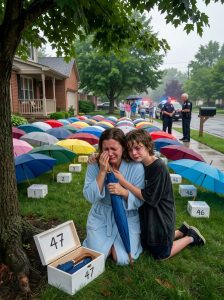
Because our entire front lawn—every inch of grass, from the mailbox to the maple tree—was covered in OPEN UMBRELLAS.
Forty-seven of them. Planted in perfect rows. Every color you can imagine. And under each one sat a small white box with a number painted on it by hand. 1. 2. 3… all the way to 47.
Neighbors were already gathering on the sidewalk, phones out, filming.
My hands were shaking as I walked to Box #1 and knelt down in the wet grass.
I lifted the lid.
Its contents made me scream.
Eli ran up from behind, looked inside, and his face drained of color.
“Oh no, Mom…” he whispered. “We need to call the police!”
Inside the box lay the familiar, polished wooden handle of his father’s blue umbrella, snapped violently in half. Wrapped around it was a torn shred of the blue canopy, heavily stained with a dark, rust-colored substance that looked terrifyingly like dried blood.
Pinned to the ruined fabric was a handwritten note in jagged, thick black marker:
**YOUR SON IS RESPONSIBLE FOR THIS.**
I slammed the lid shut, my heart hammering against my ribs like a trapped bird. I pulled Eli hard against my chest, shielding his eyes, and fumbled for the phone in my pocket. My fingers were slick with rain and nervous sweat as I dialed 911.
Within ten minutes, the quiet morning was shattered by the wail of sirens. Two patrol cars pulled up, lights flashing, casting eerie red and blue shadows over the sea of colorful umbrellas on our lawn.
Officer Davis, a kindly older cop who knew our family from when my husband was sick, ducked under the yellow tape his partner was stringing up. I was trembling on the porch, clutching Eli.
“Stay here, Sarah,” Davis said gently, pulling on a pair of blue latex gloves. He walked over to Box #1 and carefully lifted the lid.
He stared at the contents for a long moment. Then, slowly, he reached in and rubbed a gloved finger against the dark red stain on the fabric. He brought it to his nose.
The tension in his shoulders instantly evaporated. He let out a long, heavy exhale and looked back at us.
“It’s not blood, Sarah,” he called out, his voice softening. “It’s surgical iodine. Betadine.”
He moved to the next umbrella in the row and lifted the lid of Box #2.
He read the note inside, and a small, disbelieving smile broke across his weathered face. “You two better come look at this.”
Still holding Eli’s hand, I stepped gingerly into the wet grass. I looked down into Box #2.
Inside rested a beautiful, framed Polaroid photograph of a tiny newborn baby sleeping peacefully in a hospital bassinet. Tucked into the corner of the frame was another note, written in the same thick black marker, continuing the sentence from the first box:
**…RESPONSIBLE FOR SAVING OUR LIVES.**
Eli and I stared at it, stunned.
Officer Davis opened Box #3. Inside was a piece of shattered glass and a formal, typed police report.
“Hit and run,” Davis murmured, scanning the paper. “Last Tuesday evening. 4th and Elm.”
My breath caught. *The bus stop.*
As we moved through the rows, opening box after box, the terrifying mystery dissolved into a story that brought me to my knees in the wet grass.
Box #4 contained a letter from a woman named Clara. She was the pregnant stranger. She wrote that she had been standing at the bus stop, completely exhausted, hormonally overwhelmed, and soaked in the freezing rain when a young boy silently handed her his massive, bright blue umbrella.
Box #5 explained what happened five minutes after Eli walked away.
A drunk driver had jumped the curb, speeding directly toward the bus shelter. Because the storm was so dark and the rain so heavy, the driver hadn’t seen the shelter at all. But through the torrential downpour, his headlights caught the massive, vibrant flash of Eli’s bright blue umbrella.
The driver swerved at the last possible second.
The car clipped the side of the shelter—shattering the glass and completely destroying the umbrella that Clara had been holding out in front of her—but it missed a direct hit by mere inches. The shock of the impact had sent Clara into premature labor. She was rushed to the hospital covered in the surgical iodine they used to prep her for an emergency C-section, still clutching the broken handle of the umbrella that had saved her life.
Tears were streaming freely down my face as we kept opening the boxes.
Boxes #6 through #46 didn’t contain clues. They contained letters.
While recovering in the maternity ward, Clara had told her story to the nurses. The nurses told the doctors. The doctors told other patients. Word spread through the hospital about the 12-year-old boy who had unknowingly thrown a blue shield over a mother and her unborn child.
Each of those forty boxes contained a handwritten letter of gratitude from the hospital staff—nurses, orderlies, surgeons, and receptionists—thanking Eli for reminding them that pure goodness still exists in the world. They had all chipped in to buy the colorful umbrellas currently blanketing our lawn, creating a massive, blooming garden of protection to replace the single one Eli had lost.
Finally, we reached the maple tree. Box #47.
Why 47?
Eli had told Clara at the bus stop that the umbrella was special because his dad had bought it for him. He had also mentioned, in the innocent over-sharing way children do, that his dad was 47 years old when he passed away.
Clara remembered.
I lifted the lid of the final box. Inside was a brand-new umbrella. It wasn’t just any umbrella. It was a custom-made, heavy-duty canopy in the exact, brilliant shade of blue as the original.
But it was the handle that made a sob tear its way out of my throat.
The wooden handle was masterfully engraved with my late husband’s handwriting—copied perfectly from an old signature Clara’s husband had painstakingly tracked down and duplicated. It read:
*For Eli. My brave boy who protects the world.*
I sank into the grass, pulling the umbrella to my chest, weeping uncontrollably. Eli wrapped his arms around my neck, resting his chin on my shoulder, crying quietly right along with me.
Officer Davis quietly backed away, giving us our space, wiping at his own eyes before walking back to his cruiser to call off the emergency response.
We had lost my husband two years ago. For two years, this house had felt like a place where things were only taken away from us. But sitting there on the front lawn, surrounded by a vibrant sea of forty-seven umbrellas glowing in the overcast morning light, I finally felt the storm breaking.
Eli had given away his most prized possession, the only physical piece of his father’s protection he had left.
And in return, the universe hadn’t just given it back. It had proven to a 12-year-old boy that the love his father left behind was big enough to save a life.