“WHOLE STORY:
The silence in the house was so complete I could hear the rain dripping through a leak in the gutter outside. Brenda’s eyes were glued to the envelope in my hands, her painted lips slightly parted, a flicker of genuine unease finally cracking through her mask of arrogance.
“A reality check?” she repeated, but her voice had lost its sharp edge. It wavered, just a little. “You think I’m scared of some papers you pulled out of a dusty bag? You think I haven’t dealt with entitled brats before?”
I didn’t answer her. I kept my eyes fixed on my father.
“Dad,” I said, my voice carrying the same calm, commanding tone I used to talk down wounded soldiers in the middle of chaos. “You need to come here. You need to stand next to me. Right now.”
He looked up from the floor. His eyes were red-rimmed and hollow. For a long, terrible second, I thought he was going to turn away again. I thought he was going to side with her, the way he had done every day since my mother’s funeral.
But then he did something I didn’t expect. He pushed himself off the wall and walked toward me.
Brenda’s face twisted. “Thomas! What are you doing? Get back here!”
He stopped next to me. He didn’t touch me, but he was there. That was enough.
I tore the seal on the envelope. The sound was sharp, final, like the crack of a rifle in the distance. I pulled out the stack of legal documents, the heavy paper smelling of old ink and lawyers’ offices.
“This is an Irrevocable Living Trust,” I said, holding it up so both of them could see. “Established by my mother, Carol Ann Miller, on March 14th. The night before she died.”
Brenda laughed, but it was brittle, forced. “You expect me to believe that? That woman was on morphine drips and oxygen tanks. She couldn’t even sign her own name on a birthday card.”
“She had a lawyer. Mark Harrison. He’s been holding these documents for years, waiting for the right moment. He knew exactly what kind of person my father would fall for. He said my mother described you perfectly, Brenda, before she even met you. She said, ‘There will be a woman who smiles too wide and loves too fast. She will promise him the world and take everything he has.’”
Brenda’s face drained of color. “You’re lying. You’re making this up.”
I flipped to the signature page. “You see this signature? That’s my mother’s. Witnessed by a notary and a nurse. She was lucid. She was sharp. She was protecting her home from the wolves.”
My father took the paper from my hands. His fingers trembled as he read the words. “She… she left the house to Sarah. She named Sarah the sole beneficiary. She gave me a right of residency.”
“A right of residency,” I repeated. “You can live here, as long as you maintain the property and don’t try to sell it or make structural changes without my written consent. You violated every single term the day you let Brenda gut my bedroom and list this house on the market.”
Brenda snatched the papers from my father’s hands. She scanned them, her eyes darting furiously over the legalese. “This is fake! This is a forgery! Thomas, tell her this is a forgery!”
“It’s not,” my father said, his voice barely a whisper. “That’s Carol’s signature. I’d recognize it anywhere. She always dotted her ‘i’s with a little heart.”
Brenda stared at him. “You knew? You knew about this and you didn’t tell me?”
“I didn’t know!” he yelled, his voice cracking. “I didn’t know she was protecting me from myself! I didn’t know she saw this coming!”
The clock on the mantelpiece ticked loudly in the silence. Brenda’s chest heaved with shallow, panicked breaths.
“So what now?” she spat. “You’re going to throw me out? You think I’ll just walk away quietly? I have rights! I’m his wife! I’m entitled to marital property!”
“You’re entitled to nothing,” I said calmly. “The house was placed in the trust before the marriage. It’s not a marital asset. It never was.”
“We refinanced it! We took out loans! The bank has our names on it!”
“Your names are on a loan,” I corrected. “The trust owns the house. The bank made an error. They will rectify it when I show them these documents. The loan was fraudulent from the start, because you never had the authority to take it out against the property.”
Brenda’s hands shook. She looked at the papers, then at me, then at my father. “You planned this,” she whispered. “You and your dead mother planned this to ruin me.”
“We planned it to protect my father from people like you.”
She snapped.
With a guttural scream, she lunged at me, her manicured hands reaching for my face. I sidestepped her easily, my combat reflexes taking over. I caught her wrist and twisted it just enough to make her gasp.
“Don’t,” I said quietly. “I’m a combat medic. I can break your arm in three places before you hit the ground. And I won’t lose a second of sleep over it.”
She froze. Tears of rage and humiliation streamed down her face. “You think you’ve won,” she hissed. “You think this is over.”
“I know it’s over.”
I released her wrist. She stumbled back, clutching her hand like I had burned her. She looked at my father one last time. “You’re nothing, Thomas. You’re a weak, pathetic old man who couldn’t keep his wife alive and couldn’t keep his daughter home. You deserve to die alone.”
She grabbed her purse and stormed out the front door. The slam echoed through the empty house.
The silence that followed was heavier than any explosion I had ever heard.
I looked at my father. He was standing in the middle of the living room, staring at the blank white walls, his shoulders shaking with silent sobs.
“I’m sorry,” he whispered. “I am so sorry, Sarah.”
I didn’t say anything. I couldn’t. The anger was still there, hot and sharp under my skin. But beneath it, there was something else. Something that felt like exhaustion. Something that felt like grief.
I walked past him and out the front door.
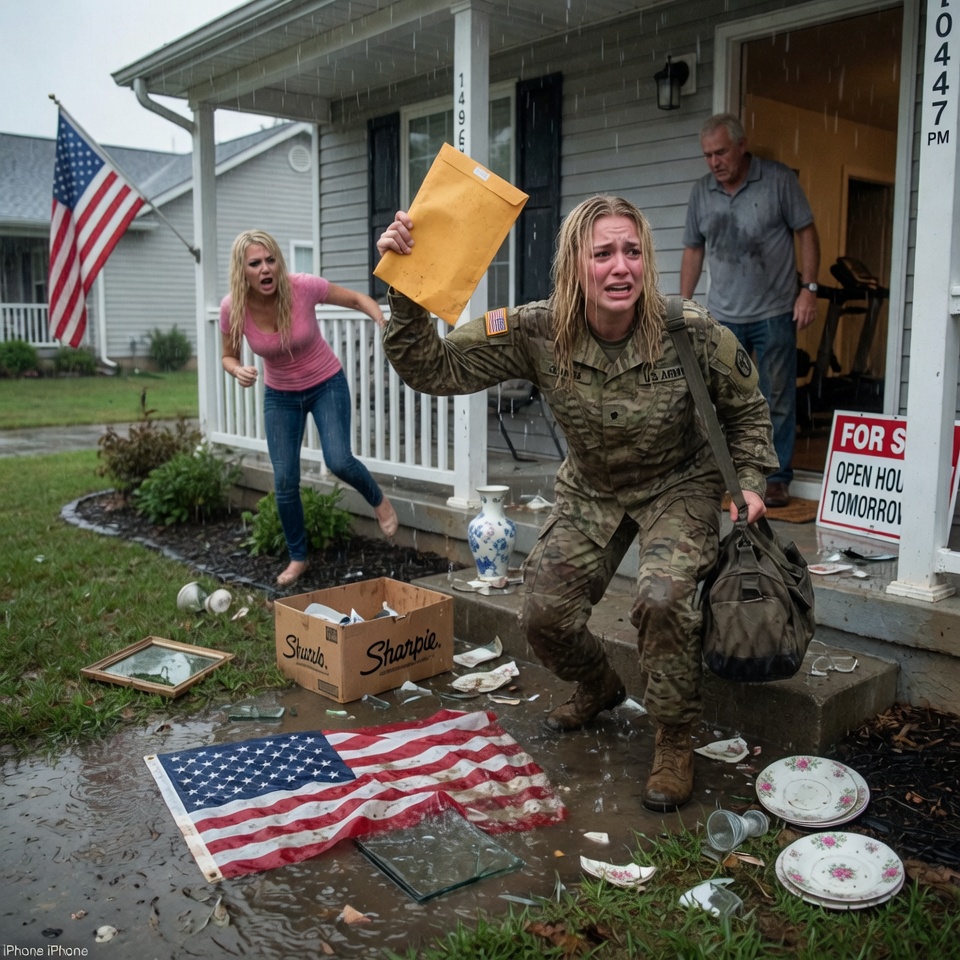
The rain had slowed to a light drizzle. The front lawn was a mess of wet grass and scattered debris. I knelt down and started gathering the pieces of my mother’s china. The porcelain was cold and sharp against my fingers. I didn’t care if I bled. I deserved the pain.
My father came out and knelt beside me. “Let me help.”
“You should have helped before,” I said, but my voice was tired, not angry.
“I know. I was weak. I was scared. She made me feel alive again, and I let her blind me to what she was doing.”
“She was throwing Mom’s things in the mud, Dad. She was erasing her from this house. And you let her.”
He picked up a piece of the broken portrait frame. My mother’s face stared up at us from the shattered glass. She was smiling. She always smiled.
“I didn’t know how to stop her,” he said. “By the time I realized what she was, I was in too deep. She had access to the accounts. She had the deed to the house—or so I thought. She had convinced me I was losing my mind. She made me believe I needed her.”
“You didn’t need her. You needed to remember Mom.”
He looked at me, tears mixing with the rain on his face. “I never forgot her, Sarah. Not for a single second. That’s what made it so hard. Every day I looked at this house and saw her. Every room was full of her. And Brenda knew it. She said I was living in a mausoleum. She said I needed to let go. She said she was helping me.”
“She was helping herself.”
“I know. I know that now.”
We worked in silence, gathering the scattered pieces. I found my mother’s wedding china, shattered into a dozen fragments. I found a photo of her holding me as a baby, the frame bent, the glass cracked.
I held it to my chest and closed my eyes.
I remembered the day she gave me the key. The hospital room was dark, except for the glow of the machines. Her hand was thin and cold in mine.
“Promise me, Sarah,” she had whispered. “Promise me you’ll come home. Promise me you won’t let the wolves win.”
“I promise, Mom.”
“There’s a key in my jewelry box. A safety deposit box at the bank. Don’t open it until you’re twenty-five. Don’t tell your father. He is a good man, Sarah. But he is not a strong man. He will need you to be strong for both of you.”
“Mom, you’re going to be fine. You’re going to get through this.”
She had smiled. That beautiful, tired smile that I still saw in my dreams. “I love you, my little soldier. Come home safe.”
I had carried that key through four years of war. Through sleepless nights and bloody fields. Through the sound of gunfire and the screams of the wounded. It was always in my pocket, a weight that reminded me of who I was and where I came from.
On my twenty-fifth birthday, I opened the safety deposit box. Inside was the trust document, a letter from Mark Harrison, and a handwritten letter from my mother.
I had read the letter a hundred times since then. I knew every word by heart.
*“My Dearest Sarah,*
*If you are reading this, I am gone. Please don’t cry for me. I had a wonderful life because I had you.*
*I know I asked you to carry a heavy burden. I know it wasn’t fair. But you are the strongest person I have ever known, and I needed someone I could trust with everything I loved.*
*Your father will make mistakes. He will fall. But he is your father, and he loves you. Please don’t hate him. Hate is a poison, and you have seen enough poison in the world.*
*Fill this house with laughter. Fill it with love. Don’t let anyone take it from you.*
*I love you more than all the stars in the sky.*
*Mom.”*
I opened my eyes. My father was staring at me, looking lost and broken.
“What do we do now?” he asked.
“We rebuild,” I said. “We put this house back the way it was. We plant the roses. We hang the photos. We make Mom proud.”
“And Brenda?”
“She’s gone. I have a thirty-day eviction notice ready. If she comes back, I’ll have the police remove her. But I don’t think she’ll come back. She knows she lost.”
We finished gathering the debris. The sun was starting to rise, painting the wet lawn in shades of orange and gold. It felt like an omen. A new beginning.
I walked back into the house. It was cold and empty, but it was mine. The walls were bare, but they would be filled again. The rooms were silent, but they would echo with laughter again.
I went upstairs to my old bedroom—or what used to be my bedroom. The home gym equipment was still there, a cruel reminder of how much had been taken from me. But the room still had the same windows. It still had the same view of the backyard where my mother used to garden.
I sat down on the floor, in the exact spot where my bed used to be. I pulled out my mother’s letter and read it one more time.
The tears came. I let them fall.
I had survived the war. I had survived the betrayal. And now, I was going to survive the peace.
The next morning, my father and I started cleaning. We cleared out the home gym equipment and donated it. We painted the walls back to their original color. We found boxes of my mother’s things in the garage and brought them back inside.
It was slow work. It was painful work. But it was healing.
A week later, the mail arrived with a certified letter from Mark Harrison. The county had officially frozen the attempted sale of the property. The title was clear. The house was legally mine.
I handed the letter to my father. He read it in silence, then folded it carefully and placed it on the mantelpiece next to my mother’s photo.
“I’m proud of you, Sarah,” he said. “Your mother would be proud of you.”
“She is,” I said. “I feel her every day.”
Brenda called a few times. My father didn’t answer. She sent a lawyer’s letter, threatening to sue for spousal support. My lawyer sent back a countersuit for property damage and fraud. We never heard from her again.
Months passed. The house slowly transformed back into the home I remembered. My mother’s china was glued back together and displayed in the cabinet. Her photos were hung on the walls. The garden was replanted.
My father and I started having dinner together every night. We talked about the war. We talked about my mother. We talked about the future. It wasn’t easy. There were days when the anger came back, when I looked at him and saw the man who let Brenda destroy everything. But there were also days when we laughed, when we remembered the good times, when the house felt alive again.
One evening, I was sitting on the front porch, watching the sunset. My father came out and sat next to me.
“You know,” he said, “when you first came home, I thought you were going to hate me forever.”
“I did hate you,” I said. “For a while. But I’m too tired to hate, Dad. And Mom told me not to.”
“She always was the wisest of us all.”
We sat in comfortable silence. The neighborhood was quiet. The smell of freshly cut grass hung in the air.
“I’m moving to the guest room,” I said. “The master bedroom is yours. It was always yours and Mom’s. She would want you to have it.”
He looked at me, his eyes glistening. “Thank you, Sarah. For everything.”
“Don’t thank me yet. We still have a long way to go. But we’ll get there.”
I looked at the house. The lights were on in the living room. My mother’s rocking chair was visible through the window. The garden was in full bloom.
For the first time in four years, I felt at peace.
I had come home from the brutality of war craving stillness. I had found a battlefield waiting for me in the place I loved most. But I had won. Not with a weapon, but with a piece of paper. Not with violence, but with the love of a mother who refused to let her daughter be forgotten.
The house was mine. The memories were safe. And I was finally, truly home.
The next morning, I woke to the sound of birds singing outside my window. For a moment, I forgot where I was. The ceiling above me was unfamiliar—painted a stark white instead of the soft lavender my mother had chosen. Then the memories came rushing back: the confrontation, the papers, Brenda’s face, my father’s tears. I took a deep breath and swung my legs over the edge of the bed. There was work to do.
I padded downstairs in my army-issue sweatpants and a worn T-shirt. The house was quiet, the early light filtering through the blinds in long, golden stripes. My father was already up, sitting at the kitchen table with a cup of coffee that had gone cold. He stared at the wall, lost in thought.
“”Couldn’t sleep?”” I asked, pouring myself a cup.
“”Not really,”” he said. “”Every time I close my eyes, I see her face. The way she looked at me before she left. Like I was nothing.””
“”She was the one who was nothing,”” I said, more sharply than I intended. I softened my voice. “”You made a mistake. But you’re still here. We’re still here.””
He nodded slowly, but his eyes were still distant.
I sat down across from him. “”I was thinking about going up to the attic today. There might be some of Mom’s things up there that didn’t get touched.””
“”I haven’t been up there in years,”” he admitted. “”Too many memories.””
“”Maybe it’s time to face them.””
He gave me a weak smile. “”You sound just like her when you say things like that.””
I finished my coffee and headed for the attic stairs. The pull-down ladder creaked under my weight. The air up there was thick and still, heavy with dust and the smell of old wood. I flicked on the single bare bulb, and yellow light spilled over boxes, trunks, and forgotten furniture.
For the next hour, I sorted through the debris of a life interrupted. Christmas decorations, winter coats, boxes of books. And then, buried beneath an old quilt, I found a trunk I didn’t recognize. It was dark wood, with brass corners, and a lock that was already open.
I lifted the lid. The hinges groaned.
Inside, neatly arranged, were my mother’s journals. At least a dozen of them, spanning years. I picked up the top one. The cover was worn, the pages yellowed. I opened it to a random page and read her handwriting—looping, elegant, full of life.
*””Sarah took her first steps today. She wobbled, fell, cried, and then got up and tried again. I’ve never been so proud. She is going to be so strong. Stronger than me. Stronger than Thomas. The world won’t know what hit it.””*
My eyes burned. I sat down on a dusty box and started reading from the beginning.
The journals were a window into a world I had only glimpsed. She wrote about her childhood, meeting my father, the early years of marriage. She wrote about her struggles with infertility, the joy of finally having me, the fear of not being a good mother. She wrote about her diagnosis, the quiet way she faced it, and her determination to leave nothing unsaid.
But one entry, dated just a week before she died, made my breath catch.
*””I have made the arrangements with Mark Harrison. The trust is in place. I’ve seen the way Thomas looks at that woman from the real estate office. He doesn’t even realize he’s being pulled under. I can’t blame him—grief makes us all blind. But I can protect him. I can protect Sarah. I just hope she never has to use this. I hope she never has to be the soldier I’m preparing her to be.””*
I read it three times. She knew. Even before Brenda stepped into our lives, my mother saw the threat. She had seen the pattern, the weakness, the vulnerability. And she had built a fortress out of paper and ink.
I closed the journal and held it against my chest. “”You knew,”” I whispered into the dusty air. “”You knew everything.””
I spent the rest of the morning in the attic, reading entry after entry. I learned about the garden she planted when I was born—the rosebush that still bloomed in the backyard was named after me. I learned about the night before her first surgery, when she held my father’s hand and told him that no matter what happened, he had to keep living.
And I learned about the letter she left for me, the one I had already read. But there was a postscript I hadn’t seen before, tucked into the back of the last journal.
*””If you’re reading this, Sarah, I know you’ve already opened the safety deposit box. But there’s one more thing I need you to know. I left something else for you, something that might help you when the world feels too heavy. It’s in the backyard, beneath the old oak tree. I buried a small metal box the summer you turned ten. Inside is a key—a key to a safe deposit box at a different bank, in a different city. Use it only if you need to. Use it only when you feel like you are losing yourself.*
*I love you more than all the stars in the sky.*
*Mom.””*
I stared at the page. Another key. Another secret.
I carefully placed the journals back in the trunk, closed it, and climbed down the ladder. My father was still at the kitchen table, now reading the newspaper.
“”I need to do something,”” I said. “”I’ll be back.””
He looked up, confused. “”Everything okay?””
“”Yeah. I just need some fresh air.””
I grabbed a shovel from the garage and walked to the backyard. The old oak tree stood at the far end, its branches stretching wide over the lawn. I hadn’t thought about it in years, but I remembered playing under it as a child, pretending it was a castle or a spaceship.
I started digging about three feet from the trunk. The soil was soft from the rain, and it didn’t take long to find the box. It was a small, rusted metal lockbox, sealed tight. I carried it to the porch and sat down, staring at it.
The lock was old, but I managed to pry it open with a screwdriver. Inside, wrapped in a faded cloth, was a brass key and a note.
*””This key opens safe deposit box #714 at First National Bank in Columbus. The box is registered under your name, Sarah. I added you as a joint owner years ago. Inside, you will find everything you need to start over, if you ever want to. I saved a little from every paycheck, every birthday, every holiday. It’s not much, but it’s yours. And it’s secret—from everyone.*
*Fly, my little soldier. Fly high.””*
I clutched the key so hard it bit into my palm.
That evening, after dinner, I told my father about the journals and the key. He listened in silence, his eyes glistening.
“”She never stopped working for this family,”” he said. “”Even when she was gone.””
“”She knew we would need her,”” I said. “”She knew we would need a way forward. But we have to choose to take it.””
We sat together on the porch, watching the fireflies blink in the twilight. I turned the brass key over in my hand.
“”Are you going to go to Columbus?”” he asked.
“”I don’t know yet. Maybe. Not yet. There’s still so much to do here.””
“”Whatever you decide, I’m with you.””
I looked at him and saw, for the first time in years, the father I had loved as a child. The one who used to carry me on his shoulders. The one who stayed up all night waiting for me to come home from prom. The one who cried at my mother’s funeral and promised her he would take care of me.
We still had a long way to go. But we were on the same path now.
The next week, I found myself standing in front of First National Bank in Columbus. The drive had been quiet, the highway stretching out like a ribbon of possibility. I checked in at the front desk, presented my ID and the key, and was led into a small room lined with safe deposit boxes.
The teller inserted the master key, and I inserted mine. The lock clicked open.
Inside was a single envelope. Thick, heavy, official.
I opened it in the privacy of the room. It contained a deed to a small property—a cottage by a lake, about two hours north. And a letter from my mother.
*””I bought this place when you were in high school, Sarah. I always dreamed we could go there together, just the two of us. Sit on the porch, watch the water, talk about everything and nothing. I wanted you to have a place where the war couldn’t find you. A place where you could breathe.*
*It’s yours now. The title is clean. The taxes are paid for ten years. Go there when you need to. Take your father. Take your own children someday. Fill it with love.*
*I will always be with you.*
*Love, Mom.””*
I sat in the quiet room, tears streaming down my face, holding the deed to a dream I never knew she had.
I didn’t know what the future held. There would be more challenges. More grief. More healing. But for the first time in a long time, I felt something I had almost forgotten: hope.
My mother had left me more than a house. She had left me a map.
And I was ready to follow it.
The deed trembled in my hands. I read the letter again, and then a third time, letting each word sink into my bones. The paper smelled faintly of her perfume—lavender and vanilla—a scent I hadn’t encountered in years. It was as if she had sprayed the envelope just before sealing it, knowing I would one day need to smell her again.
I sat in the bank’s small privacy room for a long time, my mother’s handwriting blurring through my tears. The teller knocked once, asking if I needed anything, and I managed to choke out a “”no.”” I folded the deed carefully, placed it back in the envelope, and tucked it into my jacket pocket, right over my heart.
I walked out of the bank into the bright Ohio sun. The parking lot was full of people going about their ordinary lives, and I felt like I was floating outside of time. I got into my truck and sat there, gripping the steering wheel, staring at the address on the deed.
Lakeview Cottage. 1420 Maple Shore Drive.
According to Google Maps, it was a little over two hours northwest of Columbus, near a small town called Millbrook. I had never heard of it. My mother had never mentioned it. And yet, she had bought it when I was in high school—secretly, quietly, building a sanctuary for us that we never got to share.
I started the engine before I could talk myself out of it.
The drive took me through rolling hills and farmland, past fields of corn and soybeans, through small towns with one traffic light and a diner on the corner. The sky was clear, the air warm, and the road stretched out like a promise. I rolled down the window and let the wind hit my face, drying the tears that kept threatening to fall.
The last stretch was a winding gravel road, lined with towering oaks and maples. Their leaves brushed the roof of my truck as I crept along, following the GPS. My heart pounded in my chest. What if it was just a plot of land? What if the cottage had burned down? What if it was a trailer? I didn’t care. Whatever it was, it was hers.
The trees opened up, and I saw it.
A small, white cottage with a wraparound porch, perched on a gentle slope overlooking a wide, shimmering lake. The water sparkled in the afternoon light, and a wooden dock extended out into the blue. Flower boxes hung beneath the windows, overflowing with wildflowers—pinks and purples and yellows. A tire swing hung from a massive oak in the front yard, swaying gently in the breeze.
I pulled over onto the grass and killed the engine. The silence was thick, interrupted only by birds and the distant lapping of water. I sat there for a full minute, not moving, barely breathing.
This was it. This was the dream my mother had kept hidden.
I got out of the truck and walked up to the front door. My legs felt like lead. The steps creaked under my weight. On the porch, tucked beneath a potted fern, I found a small key, just as the note had promised.
I unlocked the door and pushed it open.
The air inside was cool and still, smelling of cedar and dust and something floral. Sunlight streamed through the windows, illuminating dust motes dancing in the air. The cottage was small but cozy: a living room with a stone fireplace, a kitchen with a farmhouse sink and wooden cabinets, a bedroom with a wrought-iron bed, and a screened-in porch overlooking the lake.
Everything was clean, untouched, waiting.
On the kitchen counter sat a basket wrapped in cellophane, with a note attached. I unwrapped it carefully, my hands shaking.
*””Welcome home, Sarah.*
*I stocked the pantry with your favorite things: instant mac and cheese, Oreos, and that spicy tea you loved. The fridge is empty, but the freezer has a few pizzas. I figured you’d need them.*
*The linens are in the hall closet. The bed is made.*
*I’ll be watching from the stars.*
*All my love, Mom.””*
I opened the pantry. There, neatly arranged on the shelves, were boxes of mac and cheese, packages of Oreos, a tin of chai tea. The expiration dates were from six years ago—she had stocked it before she got sick, before she knew she wouldn’t make it. I picked up a box and held it to my chest, feeling the weight of that love. She had planned all of this for me, expecting me to find it, expecting me to survive.
I spent the next hour wandering through the cottage, touching everything. The soft quilt on the bed. The old books on the shelf—dog-eared paperbacks she had read. A framed photo on the nightstand: my mother and me at the county fair when I was twelve, both of us covered in cotton candy sugar, laughing.
I sat on the edge of the bed and let the tears come. They were not sad tears. They were release. They were gratitude.
The sun was beginning to dip toward the horizon, casting the lake in gold and amber. I walked out onto the porch and sat in one of the rocking chairs. The lake was smooth as glass, reflecting the sky. A loon called somewhere in the distance.
I pulled out my phone. No service. Perfect.
I sat there until the stars came out, reminding myself that I had survived. That my mother had prepared me for everything. That I was not alone.
The next morning, I woke to the sound of water lapping against the dock. For a moment, I thought I was still dreaming. I lay in bed, staring at the wooden ceiling, feeling the warm breeze through the open window. I didn’t want to move. I didn’t want this feeling to end.
But my stomach growled, and I remembered the freezer pizzas. I got up, made coffee from a jar I found in the cupboard, and ate breakfast on the porch, watching a pair of ducks paddle by.
I was halfway through my second cup when I heard the crunch of tires on gravel.
I stiffened. No one knew I was here. I set down my mug and walked around the side of the cottage, my heart rate climbing. An old pickup truck was pulling up, and a man in his sixties stepped out, wearing a flannel shirt and a faded baseball cap. He looked friendly enough, but I kept my distance.
“”Morning!”” he called, raising a hand. “”Didn’t expect anyone to be out here. I’m Carl. I live about a mile down the road. I look after the place for the owner.””
“”Actually, I’m the owner now,”” I said, stepping forward. “”Sarah. Carol’s daughter.””
Carl’s face broke into a wide grin. “”Well, I’ll be. Carol’s girl. She told me about you. Said you were off serving our country. She was so proud.””
I felt a lump in my throat. “”You knew her?””
“”Sure did. She came out here every few months, always alone. Said this was her secret hideaway. She’d sit on that porch for hours, just staring at the water. Sometimes she’d read. Sometimes she’d write. She told me she was saving it for you.”” He shook his head, his eyes misty. “”She was a special woman.””
“”She really was.””
We talked for a while. Carl had been a friend of my mother’s, someone she met at a local farmer’s market. He had helped her with the occasional repair, kept an eye on the place. He told me she had put in a new water heater the year before she died, just to make sure everything would work for me.
“”She didn’t want you to have to deal with any nonsense,”” Carl said. “”She wanted it to be perfect for you.””
I thanked him, and he left me with a warm handshake and an invitation to dinner anytime.
I spent the rest of the day cleaning and exploring. I found a trail behind the cottage that led through the woods to a small creek. I found a canoe tucked under the porch. I found a journal in the bedroom nightstand—my mother’s handwriting again, but this one was different. This one was a log of her visits.
*””April 12th. Planted the rosebush by the porch. It’s a climber—will look beautiful in a few years. Sarah would love it.””*
*””June 30th. Carl taught me how to skip stones. I got four skips! I couldn’t wait to tell Sarah, but I knew someday I’d teach her myself.””*” “*””November 2nd. I’m tired today. But I came here anyway. If I die before I can bring Sarah, I want this place to feel like I just stepped out for groceries. I want her to find me here, in every corner.””*
I closed the journal and pressed my hand against the cover. “”I found you, Mom,”” I whispered. “”I found you everywhere.””
That evening, I called my father from the landline I found in the cottage. It was an old rotary phone, but it still worked.
“”Sarah?”” His voice was worried. “”Where are you? I’ve been calling your cell.””
“”I found something, Dad. Something Mom left for me. A cottage by a lake.””
There was a long silence on the line. Then, a shaky breath. “”The one near Millbrook?””
“”You knew?””
“”She talked about it once. When she was sick. She said she had a place she wanted to take you, but she didn’t think she’d make it. I never knew if she actually bought it.””
“”She did. And it’s beautiful. It’s perfect. She left me the deed.””
My father was quiet for a long time. “”You sound… different. Peaceful.””
“”I feel peaceful. For the first time in four years, I feel like I can actually breathe.””
He cleared his throat. “”Can I see it? The cottage?””
I hesitated. Part of me still wanted to hold this place close, to keep it as my own private sanctuary. But then I thought about my mother’s letter—Fill this house with laughter. Fill it with love. Don’t let anyone take it from you.
“”Come this weekend,”” I said. “”Bring a sleeping bag. There’s only one bed.””
We talked for a few more minutes, and when I hung up, I felt something I hadn’t expected: hope for us. For our fractured, broken, healing family.
That night, I built a fire in the stone fireplace and sat on the floor, watching the flames dance. The cottage wrapped around me like a hug. I felt my mother’s presence in every creak and groan, in the way the firelight flickered against the walls, in the scent of pine and lavender.
I fell asleep on the rug, wrapped in a quilt she had sewn, dreaming of her voice.
The next weeks were a blur of painting and planting and repairing. I drove back to the house to pick up boxes of my mother’s things—her cookbooks, her knitting supplies, her collection of seashells—and brought them to the cottage. I hung her photos on the walls. I put her favorite mug in the cupboard. I played her old CDs on the stereo I found in the closet.
My father came the following Saturday. He stood at the edge of the property, staring at the cottage with a look of awe.
“”She built this for you,”” he said softly. “”She built it with her own hands, in a way. Every detail. Every choice.””
“”I know. She left me a journal. She wrote about everything.””
We spent the weekend together, patching a leak in the roof, weeding the garden, and walking along the lake. It was awkward at first, full of silences and unspoken apologies. But on Sunday morning, as we sat on the porch drinking coffee, he finally said what I needed to hear.
“”I failed you, Sarah. I failed your mother. I let a stranger come into our home and tear apart everything she loved. I let her replace your room. I let her throw away your memories. And I stood there, too weak to stop her. I am so, so sorry.””
I looked at him, at the lines on his face, the gray in his hair, the sorrow in his eyes.
“”I know you are,”” I said. “”And I’m trying to forgive you. But it’s going to take time. And I need you to earn it. Not with words, but with actions.””
“”I will,”” he said. “”I promise you, I will.””
I believed him. Not completely, but enough to start.
Over the next few months, the cottage became my healing place. I started seeing a therapist in the nearby town—a retired Army psychologist who understood the ghosts I carried. I started going to a support group for veterans at the local VFW. I started writing in a journal, like my mother had.
I learned that healing wasn’t a straight line. Some days I woke up screaming, trapped in the memory of a field hospital under fire. Some days I couldn’t get out of bed. Some days I drove to the lake and screamed until my throat was raw.
But the cottage held me. Its steady presence, its quiet patience. I would sit on the dock and watch the water, and I could almost feel my mother sitting beside me, her hand on mine.
One afternoon in late autumn, I was walking through the woods behind the cottage when I found a small clearing I hadn’t noticed before. In the center was a bench, handmade, with a small plaque.
*””For Sarah—My greatest adventure. Every star in the sky is a story I’m telling you. Keep looking up. I love you more.””*
I sat down on the bench and stayed there until the sun set, my eyes fixed on the stars emerging one by one.
I kept looking up.
I kept going.
I kept living.
The war was still inside me, but it had a home now—a place where it could rest, where it could be transformed into something else. Something that would become part of the fabric of this new life.
The cottage. The lake. The memory of my mother.
And, slowly, the possibility of a future I had never allowed myself to imagine.
One evening, as I rocked on the porch, I watched a car pull up. It was my father. He got out, holding a small box.
“”What’s that?”” I asked.
He sat down next to me. “”I found it in the back of the closet. It was wedged behind a stack of old blankets. I think your mother hid it there and forgot about it, or maybe she meant for me to find it later.””
I took the box. It was wooden, carved, with a brass latch. I opened it.
Inside was a smaller box—a ring box. And inside that was a vintage ring with a small diamond and a note.
*””For Sarah’s future. For the day she finds someone who makes her feel the way your father made me feel. Use it for the wedding of her dreams.*
*Love, Mom.””*
I stared at the ring, then at my father. “”She planned everything.””
“”She did. She wanted you to have it all. The home, the refuge, the love. She just didn’t get to give it to you herself.””
I slipped the ring onto my finger. It fit perfectly.
“”Maybe someday,”” I said, looking out at the lake. “”Maybe someday I’ll use it.””
My father put his arm around my shoulder. “”She would be so proud of you, Sarah. Not because of the house or the ring. Because of who you are.””
I leaned into him, feeling the weight of our shared grief and our fragile hope.
Together, we watched the stars come out over the water.
I had returned from war. I had found my mother’s treasures. And I had discovered that the most dangerous thing I carried wasn’t a weapon. It was a love so fierce, so deep, that even death could not diminish it.
The cottage was my mother’s final gift. And I would spend the rest of my life honoring it.
But I also knew, deep in my bones, that this was not the end of my journey. There were still secrets to uncover, still wounds to heal, still a future to build.
And somewhere, out there, my mother was watching.
Waiting for me to take the next step.”