My husband stared at his phone after Chloe mentioned the folder containing my signature. I was lying in a hospital bed, waiting for another round of blood tests, when I saw his expression change. Whatever he had expected his sister to say, it certainly wasn’t that his mother had been hiding documents bearing my name.
“What folder, Chloe?” Leo demanded. “And why would Mom be worried about the police finding it?”
There was a long silence before Chloe answered.
“I wasn’t supposed to know about it. Mom kept everything in the bottom drawer of her dresser, but I saw her putting papers there last month. She told me Emily had already agreed to everything.”
“Agreed to what?”
Chloe began crying harder.
“The house, Leo. Mom said Emily signed papers giving you permission to transfer her ownership interest.”
I felt my stomach tighten, although this time the pain had nothing to do with my surgery.
Three years earlier, Leo and I had purchased our home together for $485,000. I contributed $110,000 from an inheritance my grandmother had left me, while Leo covered the remaining down payment and mortgage payments. Both our names appeared on the deed, and we had always considered the property our shared investment.
Agnes had never contributed a dollar toward its purchase, yet she regularly referred to it as her son’s house. Whenever we disagreed, she reminded me that I was fortunate Leo allowed me to live there.
“Leo,” I whispered, “I’ve never signed anything transferring my share of our home.”
He looked at me, then turned back to the phone.
“Chloe, don’t touch those documents. Don’t remove anything from that room. I’m contacting an attorney tomorrow.”
Chloe immediately protested, insisting that their mother had only been trying to protect the family. But when Leo asked how transferring my ownership would accomplish that, she couldn’t provide an explanation.
He ended the call and sat beside my bed.
For several minutes, neither of us spoke.
Finally, I asked the question that had been bothering me since we moved into that house.
“Did your mother ever ask you to put the property entirely in your name?”
Leo lowered his eyes.
“Last year. She said it would simplify things if something happened to me. I told her the house belonged to both of us and refused.”
I remembered that conversation differently. Agnes had spent several weeks complaining that I shouldn’t have equal ownership because Leo earned more money. She eventually stopped mentioning it, and I foolishly believed she had accepted our decision.
Apparently, she had simply stopped discussing her plans where I could hear them.
The following morning, Leo contacted a real estate attorney named Rebecca Hayes. After reviewing our deed and the information Chloe had provided, Rebecca explained that an unsigned or improperly executed document couldn’t simply erase my ownership. However, she warned that someone might have attempted to forge a signature or create paperwork intended for a fraudulent transaction.
She advised us to preserve the security footage, obtain copies of any suspicious documents, and check the county property records before confronting anyone further.
By early afternoon, Rebecca had confirmed that our deed still listed both Leo and me as owners. That should have reassured me, but another discovery made my hands tremble.
Someone had submitted an application for a $95,000 home equity loan using information associated with our property.
The lender had not approved the loan. Its verification department had flagged inconsistencies in the submitted documents and requested additional identification before proceeding.
Rebecca explained that the application alone didn’t establish who was responsible. Nevertheless, the copies she obtained with our authorization contained a signature resembling mine.
I stared at the screen.
The handwriting was close enough to fool someone unfamiliar with my signature, but the final letter curved in the wrong direction.
“That’s not mine,” I said.
Leo leaned forward.
“Who submitted it?”
“The lender is reviewing that question,” Rebecca answered. “For now, we need to secure your information and document everything carefully.”
Later that afternoon, Chloe called again. This time, she sounded less frightened and more desperate.
“Leo, Mom’s attorney says she’s being treated like a criminal over one stupid argument. You need to tell Emily to withdraw her complaint.”
Leo glanced at me before answering.
“Emily isn’t responsible for what Mom did. And we have questions about some financial documents.”
Chloe stopped talking.
Then she whispered something I could barely hear.
“Mom told me the money was supposed to be ours.”
Leo sat upright.
“What money?”
Chloe hesitated before explaining that Agnes had promised to help her purchase a condominium. She had already taken Chloe to view several properties and assured her that the down payment would be available within weeks.
When Leo asked where their mother expected to obtain that money, Chloe said Agnes had described it as money the family was entitled to recover.
I looked at my husband and finally understood why Agnes had become increasingly hostile whenever I discussed my inheritance or our home’s ownership.
But the most disturbing revelation came that evening.
Rebecca called to say the lender had supplied another document for review. It wasn’t merely a loan application. Attached to the file was a notarized authorization supposedly signed by me six weeks earlier.
I had been working at my office on the date listed, and I had never visited the notary identified on the document.
Rebecca paused before continuing.
“Emily, there’s something else you need to see. The application includes a handwritten statement explaining why the funds were needed.”
Leo asked her to read it.
Her next words made my blood run cold.
“It says the money is needed to cover Emily Carter’s anticipated long-term medical care—and the statement is dated three weeks before her emergency surgery.”
PART 4: THEY THOUGHT I WOULD STAY SILENT
The document was dated three weeks before my emergency surgery, yet it claimed I would need expensive long-term medical care. I stared at the words on Rebecca’s screen, struggling to understand why my mother-in-law had been making financial arrangements around an illness nobody could have predicted.
“How could Agnes possibly know I would need surgery?” I asked.
Rebecca shook her head.
“She couldn’t have known about this particular emergency. But that doesn’t mean the statement was innocent. Someone may have invented a medical justification to make the loan application appear legitimate.”
Leo sat beside my hospital bed, his jaw tightening as he examined the copied authorization. He recognized his mother’s handwriting in the explanation attached to the application, although Rebecca reminded him that handwriting alone wasn’t enough to establish who had submitted it.
For years, Agnes had portrayed herself as a helpless widow who depended entirely on her son’s generosity. Now we were looking at documents suggesting that someone had tried to borrow nearly one hundred thousand dollars against a home she didn’t own.
Rebecca advised us not to confront Agnes directly. Instead, she helped us notify the lender of the suspected forgery, request a fraud review, and preserve the records for investigators. She also recommended placing appropriate credit protections on our accounts while the matter was examined.
That afternoon, I received a message from Chloe.
You need to stop this before you destroy our family. Mom only wanted what Leo should have had anyway.
I read it twice before showing Leo.
He looked exhausted.
“She’s still blaming you.”
“Because blaming me is easier than admitting what they did.”
For once, he didn’t disagree.
Two days later, I was discharged from the hospital with strict instructions to rest and return immediately if my symptoms worsened. Leo had arranged a furnished apartment nearby because I refused to return to the house while Agnes and Chloe still had access to it.
He offered to stay with me, but I wasn’t ready to pretend our marriage had recovered simply because he had finally defended me.
“You can help me recover,” I told him, “but that doesn’t erase the years you ignored what was happening.”
He accepted my decision without arguing.
The following morning, Rebecca called with another development. The lender’s internal investigation had identified an email account used to submit the application. The account had been created using Chloe’s name, and several supporting documents appeared to have been uploaded from a device associated with her.
Investigators would still need to establish who had actually controlled the account, but the discovery made Chloe’s earlier phone calls much more significant.
When Leo confronted his sister by telephone, she initially denied knowing anything about the loan.
Then he mentioned the email address.
Her voice changed immediately.
“Mom said it was just paperwork. She told me Emily would never find out because the loan would be repaid before anyone noticed.”
“Repaid with what money?” Leo asked.
Chloe began sobbing.
“She said once I bought the condo, we could refinance later. She promised it wouldn’t hurt anybody.”
I watched Leo close his eyes.
“You were willing to put our home at risk so you could buy yourself an apartment?”
Chloe didn’t answer.
Instead, she begged him not to tell the investigators what she had admitted.
Leo ended the call and immediately documented the conversation for Rebecca. He had finally understood that protecting his family didn’t mean protecting them from the consequences of their own decisions.
By the end of the week, Agnes’s attorney contacted Rebecca about the assault investigation. Agnes wanted to apologize privately and hoped I would describe the skillet incident as a misunderstanding.
I refused.
The security recording showed exactly what had happened, and I wasn’t going to change my account simply because Agnes had begun worrying about the consequences.
That evening, Leo arrived at my apartment carrying groceries and a small envelope. He looked unusually nervous as he placed it on the table.
“Emily, there’s something I need to tell you before you hear it from anyone else.”
I waited.
He explained that Agnes had called him from her attorney’s office earlier that day. She had threatened to reveal a secret about our marriage unless he persuaded me to stop cooperating with the investigations.
I felt my chest tighten.
“What secret?”
Leo opened the envelope and removed a bank statement dated nearly four years earlier.
His voice trembled.
“Before we bought the house, I gave my mother thirty thousand dollars from our joint savings. I never told you, Emily. And now I think that’s where all of this really started.”
PART 5: THE DAY I FINALLY CHOSE MYSELF
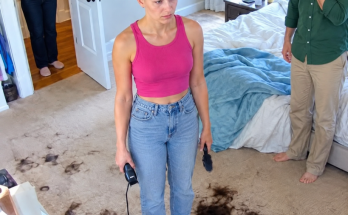
My mother-in-law threw a cast-iron skillet at my head because I wouldn’t cook—forty-eight hours after emergency surgery saved my life. It smashed into the doorframe inches from my face while my sister-in-law blamed me. “Look what you made Mom do!” I clutched my incision, barely able to stand. Neither of them noticed who had come through the front door behind me. Then a familiar voice said, “Mother. Don’t move,” and her face went pale.
Part 2 of 3