

I was mopping the courthouse lobby when my old life came looking for me. The floor was white marble, polished so hard it reflected the fluorescent lights in long, sickly yellow strips. At night, after the lawyers went home to their warm houses and the clerks shut their heavy oak doors, the whole building smelled like lemon cleaner, ancient dust, and stale coffee. I liked it exactly that way. Quiet places suited me. Quiet work suited me even better.
Most people in Livingston County knew me only as Dennis Irwin, the night janitor. I had graying hair, worn steel-toed boots, and I was a man who nodded far more than he ever talked. If they noticed me at all, it was only to step impatiently around my yellow mop bucket. That was perfectly fine.
Seventeen years earlier, men had called me Reaper in unforgiving places that never made the evening news. I had led specialized tactical teams into claustrophobic rooms where the wrong breath could get you killed. I had watched dawn break over shattered desert walls with my finger still rigidly locked around the trigger of a rifle. Then I came home, married Sarah, raised our son, Tyler, and buried that violent man so deep into the earth I thought even God would have trouble finding him again.
My phone buzzed violently in my pocket. Sarah. She never called during my night shift unless something was terribly wrong. I answered, pinning the phone to my ear with my shoulder while wringing out the mop.
“Hey.”
For one agonizing second, all I heard was ragged breathing. Then my wife made a hollow, fractured sound I had only heard once before—the night her mother died.
“Dennis,” she gasped. “It’s Tyler. There’s been a shooting. Mercy General. Dennis, please hurry.”
The heavy wooden mop handle slipped out of my hand and cracked sharply against the marble floor. I do not remember driving to the hospital. I only remember running red lights. I remember the sour smell of my own sudden sweat. I remember gripping the steering wheel so fiercely my knuckles ached. Mercy General sat on a steep hill overlooking the town, a modern fortress of glass and brick filled with bad memories. I burst through the sliding emergency doors still wearing my blue janitor uniform. The sharp antiseptic smell hit me first, biting enough to burn the back of my throat.
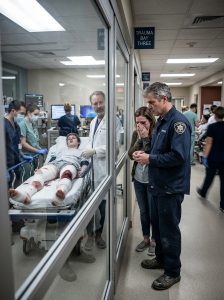
Sarah stood outside Trauma Bay Three. Black mascara had run down her pale cheeks in jagged tracks. Her hands were shaking so violently she had wrapped them around a flimsy paper cup just to give them an anchor. She pointed silently through the glass.
My son was on a gurney. At seventeen, he was six feet tall, all elbows, long legs, and the proud captain of his high school basketball team. Now, his face was as pale as wet paper. Both of his legs were heavily wrapped from thigh to shin. Dark, spreading patches of blood soaked through the thick white gauze.
A doctor stepped out of the bay, peeling off bloody latex gloves. For a second, the sterile hospital faded.
“Harold?”
Dr. Harold Donnelly froze. He had deeper lines in his face than the last time I saw him, but I knew him instantly. I had dragged that man out of a blown-out doorway in Kandahar with jagged shrapnel lodged in both our arms.
“Dennis,” he said quietly, his voice heavy. “Both of his kneecaps are completely destroyed. Not cracked. Destroyed. He needs surgery tonight, and many more after.”
My chest went to absolute zero. “Who shot him?”
Sarah sobbed. “Sheriff Stuart Barnes. Over looking at him wrong.”
Inside the bay, Tyler’s eyes fluttered open. I rushed to his side. His cold hand clamped around my wrist.
“Dad,” he trembled. “He laughed. After he shot me… he laughed.”
The room narrowed to a pinprick. Every hospital sound faded into nothingness. I looked down at my hands, feeling a phantom weight I hadn’t carried in nearly two decades. The buried man inside me opened his eyes, and he was hungry.
Tyler’s first reconstructive surgery lasted nine agonizing hours. I spent it pacing the waiting room, staring at a clock that seemed to tick backward. At dawn, Tyler’s girlfriend Brooke met me in the freezing parking lot. She was barely eighteen, fragile, and shaking violently inside a gray collegiate hoodie that was two sizes too big.
“Mr. Irwin,” she said, her breath pluming in the frigid morning air. “I didn’t catch the actual shooting. It happened too fast. But I got the aftermath.”
She unlocked her phone with trembling fingers. The video was chaotic and shaky. Tyler lay on the unforgiving pavement under the harsh basketball court lights, screaming in agony. Sheriff Barnes stood over him with his service weapon still drawn, his mouth twisted into an ugly, satisfied sneer.
“Shouldn’t have looked at me wrong, boy,” Barnes’s voice hissed through the phone speaker. “Maybe next time you’ll show some respect.”
Then Deputy Thomas Davidson stepped into the frame, nodding eagerly. “Clear self-defense, Sheriff. I saw the whole thing.”
Brooke wiped her red nose. “I gave the video to the deputies. They told me the file corrupted itself. But I kept a hidden backup.”
I looked toward the towering hospital windows, my jaw locked. “Good girl. I’m going to have a little chat with Sheriff Barnes.”
I found him at the Riverside Diner at exactly eight-thirty that morning. He sat comfortably in the corner booth with Davidson and two other deputies, casually eating a plate of eggs and laughing. He was a thick man with a face built entirely for intimidation. I walked straight up to the booth.
“Help you?” Barnes asked, dismissing my faded janitor uniform with a single, arrogant glance.
“You shot my son.”
Barnes chewed slowly, swallowed, and wiped his mouth. “Your boy got aggressive with a sworn peace officer.”
“He is seventeen, and he was holding a basketball.”
Barnes leaned back, a dark smile playing on his lips. “You want to file a formal complaint, Mr. Irwin? The county office is three blocks over. Ask for Carol Lindsay. She’ll gladly hand you the right form.”
I nodded once, perfectly calm. “You’re right. I’ll file a complaint.”
I walked out into the biting cold, climbed into my truck, and pulled an old, heavy burner phone from the glove box. It rang three times before a rough, sleep-gravelly voice answered.
“Who is this?”
“It’s Reaper.”
A long, heavy silence stretched across the line. Then, very softly, “Jesus Christ.”
“I need the team,” I said.
Troy Moses arrived in Montana forty-six hours later in a battered black SUV. Brad Zuniga, call sign Ghost, and Morris Rice, Hammer, stepped out right behind him. We gathered at a secluded hunting cabin thirty miles outside of town. The air smelled of old pine and woodsmoke. I spread a chaotic web of papers, photos, and names across the rustic kitchen table.
“This is not a hit,” I ordered, looking each of my old brothers in the eye. “We are not killing him. Men like Barnes survive by isolating people. I need witnesses protected. I need his financial bloodline severed.”
Brad immediately opened his laptop. For the next six grueling hours, we built a human map. We found county contracts flowing into a shell company tied to Barnes’s mother, heavily backed by the union rep, Carol Lindsay. We finally had the motive.
But just as Morris reached for a powdered donut, Brad’s computer chimed with a harsh, blaring alert from the county dispatch server.
“Guys,” Brad’s voice dropped a full octave, his eyes locked on the glowing screen. “Barnes just requested an unlogged transport vehicle. He’s moving someone out of town. Tonight.”
At ten in the morning, the winter sun barely cut through the thick Montana clouds. I walked into the dusty office of Jack Joseph, a sharp-eyed, chronically exhausted lawyer whose practice sat above a noisy hardware store. I dropped the thick folder of our night’s meticulous intelligence work directly onto his desk.
He flipped through the neatly organized pages, his initial skepticism rapidly evaporating into cold, undeniable shock. “Where on earth did you get this?”
“Public records. Intimidated witnesses. People who are finally done being afraid of the badge.”
“This is a massive civil rights lawsuit,” Jack muttered, his legal mind already racing ahead. “Pattern of abuse. Deep corruption angle. But listen to me carefully: if you go outside the law, Barnes instantly becomes the victim. Your son loses twice.”
“I don’t want Barnes dead,” I replied evenly. “I want him entirely exposed.”
As I turned to leave, my phone buzzed. It was an encrypted message from an unknown number. I opened it to find a blurry still from a security camera: Barnes in full uniform, aggressively twisting a young woman’s arm in a dark bar, with Carol Lindsay calmly watching from a booth in the background. The text beneath it read: Meet me behind the hospital.
I met Olivia Meyer, the fiercely protective nurse from the trauma bay, by the hospital laundry vents after sunset. The alley smelled of harsh bleach and hot steam.
“I’m also a freelance investigative reporter,” she said, handing me a high-capacity flash drive. “Murphy’s Bar. The Elk Lodge. Barnes arrogantly thinks people delete things when he orders them to. Most people just hide the backups. I got tired of washing innocent blood off local kids while grown-ups pretended they didn’t know where it came from.”
The next two days were a calculated whirlwind of careful, dangerous promises. Jack contacted prior victims. Troy coordinated covert private security for the terrified families willing to speak out. Some flatly refused, paralyzed by fear, but seven brave souls finally said yes.
We set the press conference for noon on the imposing courthouse steps.
I stood at the absolute edge of the shivering crowd, wearing a plain coat and a pulled-down ball cap. Invisible again. Jack Joseph commanded the microphones, followed by the victims. Young men with improperly healed broken ribs, shattered jaws, and lingering limps told their harrowing stories into the freezing, biting wind. Finally, Brooke stepped up to the podium, holding a monitor. She played the raw video of Tyler’s shooting. My son’s agonizing screams echoed off the cold courthouse stone for the entire county to hear.
Suddenly, the heavy courthouse doors banged violently open. Sheriff Barnes stormed out like an enraged bull, his face dark red, with Carol Lindsay and Deputy Davidson trailing anxiously behind him.
“This is an illegal witch hunt!” Barnes bellowed over the crowd.
Brooke didn’t even flinch. “You shot Tyler purely because he looked at you.”
Barnes pointed a thick finger at her, his right hand twitching instinctively toward his loaded duty weapon. “That boy got exactly what happens when kids think they can mouth off! Ask his father! Ask that pathetic janitor hiding somewhere!”
Cameras flashed frantically. The whole county watched Barnes’s fingers hover dangerously near his holster before Carol Lindsay desperately yanked him backward into the building.
By sundown, the shocking clip had gone entirely national. But sitting alone in my dark truck outside the hospital, I couldn’t shake Barnes’s venomous words. He desperately wanted me angry. He wanted me to make a mistake.
At 1:17 in the morning, my burner phone illuminated the dark cabin of my truck. A text from Morris.
“Barnes just left Murphy’s. Blind drunk. Heavily armed. Driving. His cruiser is heading straight for your house.”
I beat Sheriff Stuart Barnes to my street by exactly two minutes.
I killed the headlights halfway down the block, parking my battered truck in the deep shadows of a neighbor’s overgrown oak tree. The winter air outside was razor-sharp, biting at my face as I stepped onto the frozen asphalt. My house sat at the dead end of the street, completely dark and agonizingly empty. That was the only thing keeping my heart rate steady.
Tires shrieked in the distance. Barnes’s county cruiser rounded the corner entirely too fast, fishtailing wildly on the black ice. The heavy vehicle jumped the curb, tearing up my frozen front lawn before slamming into a crooked halt in my driveway. The engine hissed and ticked in the freezing night.
Barnes practically fell out of the driver’s seat. He recovered with a heavy, bottle-shaped stagger, his hand resting aggressively on the butt of his service weapon. Even from fifty yards away, I could smell the stale whiskey radiating off him.
From the absolute darkness across the street, Morris emerged, blending into the shadows of a parked van. Troy was already in position near the alleyway. Brad had three high-definition cameras rolling from overlapping angles.
Barnes stomped up my wooden porch steps, his heavy boots echoing like gunshots in the quiet neighborhood. He pounded a massive fist against my front door.
“Irwin! Open up!” he bellowed, his voice thick with alcohol and rage. “You think you can ruin me? You think I don’t know what you are?”
When the locked door didn’t yield, he drew his heavy steel baton and violently smashed the small, decorative window beside the frame. Shards of glass exploded onto the porch, sounding like falling ice.
That was enough. I stepped out from the side of the house, directly into the harsh wash of the amber porch light.
“Sheriff Barnes.”
He spun around, nearly losing his footing. His face was a dark, congested red, his breath pluming in thick white clouds. “You,” he snarled, pointing a thick finger at my chest. “You dug up all these pathetic lies. You made me look weak.”
“You made yourself look exactly like what you are,” I replied, my voice dangerously calm.
His hand moved. The gun cleared its leather holster with a sickening scrape. I lifted one hand, slowly, deliberately showing I was unarmed.
Barnes laughed, a harsh, jagged sound. “I could shoot you right here, janitor. I’ll just say you came at me in the dark. Like your stupid boy. He should’ve kept his eyes down.”
“Say it louder,” I challenged him, stepping one inch closer to the barrel of his gun. “You laughed while he screamed.”
Suddenly, the street exploded in blinding red and blue lights.
State police cruisers converged from both ends of the block, tires screeching as they formed a barricade. Doors flew open.
“Sheriff Barnes! Drop the weapon! Now!” an officer screamed over a megaphone.
Barnes jerked around. He saw the state troopers with their rifles drawn. He saw Morris and Troy stepping fully into the streetlights, hands raised as peaceful witnesses. He looked at the shattered glass at his feet. Slowly, trembling with fury, he lowered his gun. Troopers swarmed the porch, kicking his legs apart and pressing his cheek forcefully into the freezing wood of my deck.
As they hauled him up in handcuffs, he looked over his shoulder at me. He wasn’t afraid. He smiled a crooked, poisoned smile.
“You don’t know what I’ve got,” he whispered.
The next afternoon, Barnes was officially suspended. Deputy Davidson was placed on administrative leave. But any sense of victory vanished when I walked into Jack Joseph’s office. The lawyer looked sick. He slid a faded, photocopied county memo across his desk.
Subject line: Dennis Irwin. My home address. Sarah’s old workplace. Tyler’s high school schedule. At the bottom, in Barnes’s unmistakable handwriting: Use family pressure if needed.
“This is three years old,” Jack said quietly. “It came from a terrified retired records clerk named Marlene Voss. She says Barnes kept private leverage files on citizens he thought might become problems.”
My phone buzzed violently in my pocket. It was Sarah.
“Dennis,” she gasped, her voice vibrating with sheer panic. “There’s someone at the hospital. A woman in a red coat. Carol Lindsay. She was standing outside Tyler’s room… Dennis, she was asking the nurses what pain medications he was on.”
The room tilted. The monster wasn’t dead; it had just changed shape, and it was breathing right down my son’s neck.
I drove to Mercy General like a man possessed, the engine of my truck screaming as I pushed it past the redline. Troy and Olivia pulled into the hospital parking lot seconds behind me.
By the time I sprinted down the sterile white hallway to Trauma Bay Three, Carol Lindsay was already gone. Sarah was standing outside the door, her arms wrapped tightly around herself, shaking with a terrifying, white-hot fury.
Olivia didn’t waste a second. She pulled out her phone, tapping furiously. “Carol didn’t just come here to scare you,” Olivia said, holding up a video file. “She also showed up at Marlene Voss’s house last night. A neighbor’s doorbell camera caught Marlene leaving in the middle of the night with a suitcase. She got into a county sedan driven by Rob Dixon.”
“They’re moving the witnesses,” Troy said, his voice cold.
We tracked Rob’s county gas card. Two hours later, we found Marlene Voss hiding in a bleak, run-down motel just outside the Bozeman city limits. The neon sign buzzed erratically in the freezing wind.
I knocked on the peeling door of Room 12. Marlene cracked it open, the heavy security chain pulling taut. Her eyes were wide, bloodshot, and feral with terror. I didn’t say a word. I just held up Tyler’s high school basketball photo against the glass. After a long, agonizing moment, her trembling fingers undid the chain.
The motel room smelled strongly of stale cigarette smoke and sheer panic. From inside a stained pillowcase, Marlene pulled a thick manila envelope.
“I kept copies,” she whispered, her voice cracking. “Complaints. Edited police reports. Lists of witnesses with their personal pressure points—affairs, tax issues, kids on probation.”
Then, she reached into the envelope and handed me a single, separate sheet of paper.
Dennis Irwin. Navy background unclear. Potential problem if family involved. Wife highly emotional. Son is a visible target.
“When exactly was this written?” I asked, a cold, heavy dread coiling deep in my gut.
“Three years ago,” Marlene whispered, staring at the frayed carpet. “Barnes stopped Tyler near the school parking lot. Pushed him against a cruiser. Sarah came into the station, absolutely furious, to file a formal complaint. Carol Lindsay smiled, took the paperwork, buried it, and immediately opened this file.”
I stopped breathing. I drove all the way back to Livingston in absolute, suffocating silence.
At the hospital, Sarah was waiting for me in the quiet, dim glow of the family chapel down the hall from Tyler’s room. I walked in, holding the file. One look at my face and she knew.
“Three years, Sarah,” I said, the betrayal tasting like ash in my mouth.
“I was trying to keep you from becoming him again!” she cried, tears spilling over her eyelashes. “I filed that complaint, and two days later, a deputy followed Tyler all the way home. Barnes parked his cruiser outside our house in the dark. Tyler begged me not to tell you. He said, ‘Dad will go back to being gone even if he’s standing right here in the living room.’”
The heavy wooden doors of the chapel creaked open. Tyler sat there in a hospital wheelchair, his legs heavily braced, his face pale and exhausted.
“I heard enough,” my son said, his voice weak but unbending. “Dad, I want him in prison. I want him ruined. But I don’t want you to become something I have to be terrified of, too. Please. Promise me.”
I looked at my broken, courageous son, and then at the wife who had silently carried my darkness for years just to keep our family whole. I knelt down in front of his wheelchair. “I promise you. No revenge that costs us ourselves.”
The next morning, the fragile peace shattered. Jack Joseph called me, his voice tighter than a piano wire.
“Dennis, we have a massive problem,” Jack said. “The FBI is flying in. They’re taking over the civil rights investigation.”
“That’s a good thing, Jack.”
“It is,” Jack replied, pausing heavily. “But they asked a very specific question before they boarded their flight. They want to know exactly who those highly trained men operating out of your cabin are.”
I looked out the hospital window at the gray Montana sky. The law was finally waking up to destroy Barnes, but it had just turned its crosshairs directly onto my buried past.
Agent Carla Reeves and Agent Mark Feld met us in Jack’s office. They were sharp, unsmiling, and smelled of cheap federal coffee.
“Mr. Irwin,” Agent Reeves said, “were you part of Naval Special Warfare Development Group?”
I looked at Jack, then at Troy. “Yes. I led men.”
Feld’s pen paused. Reeves leaned forward. “A former special operations commander gathers a team after his son is shot. Evidence appears. The sheriff is arrested at your house. Convenient.”
“Agent Reeves,” I kept my voice perfectly flat. “If I wanted Stuart Barnes dead, we would not be having this conversation. My son asked me not to become the worst thing that happened to him. I am honoring that. We gathered evidence legally. The choice to act on it is yours.”
She studied me for a long time before closing her notebook. “Then help us keep this clean.”
And we did. Davidson flipped first to save himself, admitting Barnes orchestrated the cover-ups. Rob Dixon was indicted for contract fraud. Carol Lindsay’s walls crumbled under the weight of Marlene’s files.
Three months later, the trial of Stuart Barnes began.
I took the stand on the fourth day. The courtroom smelled like old wood and nervous sweat. Barnes sat at the defense table, glaring.
His lawyer, Ellery, tried to paint me as a lethal vigilante. “Isn’t it true that people called you Reaper? That you are trained in psychological pressure and lethal force? Isn’t it true you wanted Sheriff Barnes to suffer?”
“Yes,” I answered loudly. The room went perfectly still.
Jack stood up for redirect. “Mr. Irwin, what did you mean by ‘suffer’?”
I looked directly at the jury. “I meant I wanted him to face consequences. The kind he denied every person he hurt. I wanted him to learn that power does not make pain disappear. It only postpones the bill.”
When I stepped down, Barnes was staring at me, the arrogant smile completely gone from his face.
On the eighth day, the prosecutor played Brooke’s video one last time. Tyler’s screams filled the air. Barnes snapped. He slammed his palm on the table, his face purple.
“He should’ve shown respect!” Barnes roared, shaking off his lawyer. “You let these kids run wild! If he had lowered his eyes when I told him to, he’d still have his knees!”
The courtroom plunged into a horrified, breathless silence. Barnes blinked, suddenly realizing what he had just confessed in front of a judge, a jury, and the world.
But as the judge slammed his gavel to call for order, the heavy oak doors at the back of the courtroom swung violently open. Two US Marshals marched in, holding a fresh warrant, and they weren’t looking at Barnes—they were looking directly at Jack Joseph’s defense table.
The Marshals weren’t there for us. They were there for Carol Lindsay. She had tried to flee the state during the lunch recess, caught at a private airfield with a bag full of High Ridge Security’s embezzled cash.
The jury took only six hours.
When the foreman stood, the word fell like a hammer over and over again. Guilty. Guilty. Guilty. Barnes didn’t move. Men like him expect the world to bend until the very moment it breaks.
Sentencing came six weeks later. Tyler insisted on being there. He walked into the courtroom on forearm crutches, every step a brutal, measured victory. Barnes watched him, the first ugly splinter of true shame cracking across his face.
Tyler gave his statement standing. “You took my future because you wanted me afraid,” my son said, his voice ringing clear. “But I’m still here. You don’t get to be the end of my story.”
The judge gave Barnes eighteen years.
Spring came slowly to Montana. Mud replaced the snow. We learned a new life one inch at a time. Tyler didn’t go to play basketball; he went to the University of Montana for computer science.
On graduation day, the high school gym smelled of floor wax and flowers. When Tyler crossed the stage on his crutches, slow and upright, the applause started politely, then swelled until the entire bleachers were on their feet. Troy, Brad, and Morris cheered from the back wall. Sarah wept, but this time, it was a beautiful sound.
That night, Tyler and I sat on our porch. His old basketball shoes rested beside him.
“Dad,” he asked, watching a moth hit the porch light. “Did Barnes ever apologize? What would you have said if he did?”
“I would have told him no. Late remorse doesn’t erase deliberate cruelty.”
“Will it make me bitter if I don’t forgive him?”
“Not if you build something bigger than him,” I said.
Tyler picked up his worn shoe. “I think I want to coach someday. Kids who got hurt. Kids who think their bodies betrayed them.”
I smiled. “That sounds like a good dream. Are you okay if I go back to being invisible?”
“Mostly,” Tyler looked at me. “Just come home after.”
For seventeen years, I thought peace meant burying the man I used to be. I was wrong. Peace meant choosing when not to use him. Stuart Barnes would spend his eighteen years in a cell, constantly looking over his shoulder for a phantom that would never come. Fear was his only home now.
I went back to the courthouse the next Monday. I put on my gray uniform. I filled the mop bucket. I pushed it across the marble floor, invisible as furniture, quiet as dust. But I was never empty again. Because upstairs, in the halls of power, the monsters had been dragged into the light. And at home, my
If you want more stories like this, or if you’d like to share your thoughts about what you would have done in my situation, I’d love to hear from you. Your perspective helps these stories reach more people, so don’t be shy about commenting or sharing.