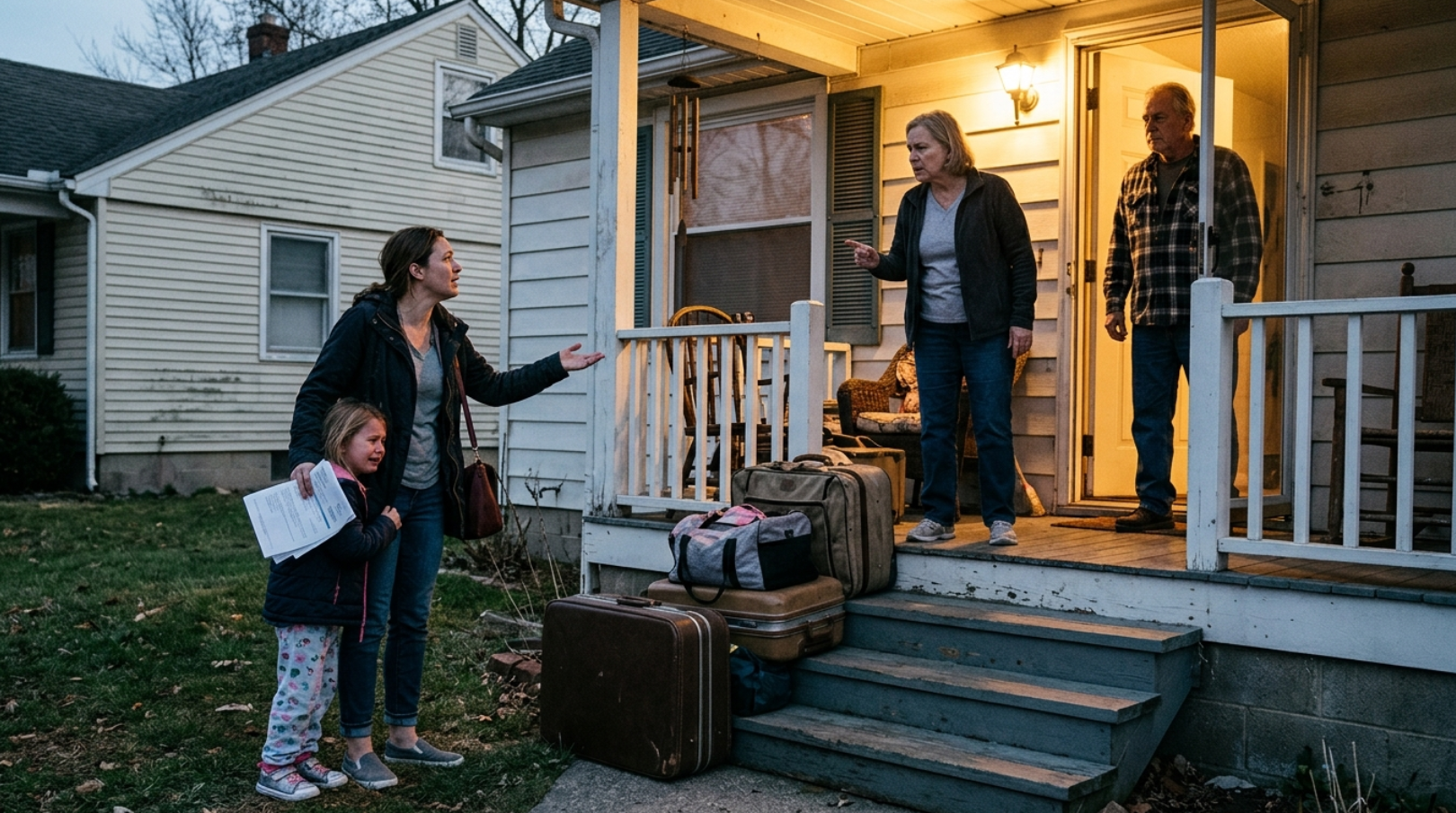
PART 3: The Daughter They Thought Would Always Pay
I glanced at the breakfast dishes scattered across my counter.
The groceries in my refrigerator had come from my paycheck. The coffee in Chloe’s mug had come from my paycheck. The electricity keeping my parents comfortable in a house they had contributed almost nothing toward came from my paycheck.
And the mortgage?
Every single payment came from me.
Yet somehow, I was the selfish one.
“Mom, last night, I brought my seven-year-old daughter home from the hospital. She was exhausted, frightened, and wearing a hospital bracelet. You locked the door.”
Mom crossed her arms.
“We were trying to teach you a lesson.”
“A lesson?”
“Yes! You cannot keep making decisions that affect everyone else without considering the family.”
I actually laughed, although there was nothing funny about what she had said.
“What decision did I make that affected everyone else? I refused to give Chloe two thousand dollars?”
“You embarrassed her.”
“No, Mom. I disappointed her. Those are different things.”
Chloe shot to her feet.
“You have always thought you were better than me because you bought a house and got a boring office job. You act like money makes you superior.”
I looked at her expensive handbag sitting on my kitchen island. It was the same designer bag she had proudly shown off on social media the previous weekend.
“How much did that bag cost?”
Her expression changed.
“That has nothing to do with this.”
“How much did the Nashville trip cost?”
“Stop interrogating me!”
“How much did the new phone cost?”
Dad finally looked up from his tablet.
“Enough. We are not going to stand here and let you insult your sister.”
I turned toward him.
“Dad, I am asking questions about the money she wants me to give her.”
“You don’t need to know what she spends her money on.”
“Apparently, I need to know because I’m expected to pay her rent.”
He stood up and set the tablet down.
“You have a good job. You have savings. Your sister is struggling. Sometimes people who have more need to help people who have less.”
“Then why don’t you help her?”
The question landed harder than I expected.
Dad’s face tightened.
“We’re retired.”
“You have pension income.”
“We have our own expenses.”
“So do I.”
“Your situation is different,” Mom interrupted. “You have a house. You have stability. You should be grateful that we moved in and helped you with Lily.”
I looked at her for a long moment.
“Helped me with Lily?”
“Yes.”
“When was the last time you picked her up from school?”
Mom blinked.
“When was the last time you took her to a medical appointment?”
“That isn’t fair.”
“When was the last time you bought her groceries, helped with her homework, or stayed up with her when she was sick?”
“You are twisting everything,” she snapped.
“No. I’m remembering it clearly for the first time.”
I reached into my purse and took out a small notebook. For months, I had recorded household expenses because I was trying to understand why my savings kept shrinking.
I opened it to the first page.
“Eight months ago, you and Dad moved into my house because your rent had increased. We agreed you would contribute to groceries and utilities.”
Mom waved her hand dismissively.
“We said we’d help when we could.”
“No. We agreed on a contribution.”
I read through the figures.
“Then Dad needed new tires. I paid for them. Mom needed glasses. I paid for those. The water heater needed repairs. I paid for that. You needed prescriptions. I bought those, too.”
I turned another page.
“And Chloe’s rent transfers. Six hundred dollars. Eleven hundred dollars. Eight hundred dollars. Four hundred and fifty dollars. One thousand dollars.”
Chloe folded her arms.
“You said you were happy to help.”
“I was happy to help when I believed you were trying to get back on your feet.”
“I am trying!”
“Then why do you keep taking vacations and buying expensive things before paying your rent?”
Her eyes filled with angry tears.
“Because I deserve to enjoy my life!”
“So do I.”
My voice cracked on those three words.
For the first time that morning, nobody interrupted me.
I swallowed hard.
“I work forty hours a week. I raise Lily alone. I pay a mortgage, insurance, utilities, groceries, school expenses, and medical bills. When my daughter collapsed at school, I didn’t have the luxury of deciding whether I wanted to deal with it. I had to get to the hospital.”
I looked at my mother.
“And while I was sitting beside her hospital bed, you were texting me about Chloe’s rent.”
Mom’s lips pressed together.
“We didn’t know it was that serious.”
“I told you we were in the emergency room.”
“You could have called.”
“I shouldn’t have needed to explain why my sick child mattered more than two thousand dollars.”
Chloe grabbed her handbag.
“You know what? Forget it. I’ll figure something out myself.”
She stormed toward the front door.
But before she reached it, Mom caught her arm.
“No, Chloe. Don’t let her bully you into leaving.”
I stared at them.
It was astonishing.
My sister was a grown woman who had voluntarily spent money she didn’t have. My parents were adults who had chosen to make my home their permanent source of financial support.
And somehow, I was the bully because I had finally said no.
I took a deep breath.
“I came here to pack your belongings.”
Dad’s head snapped toward me.
“Pack whose belongings?”
“Yours. Mom’s. Chloe’s things, too, if she left anything here.”
Mom stared at me as though I had slapped her.
“You’re kicking us out?”
“You locked me and your granddaughter out last night.”
“That was different!”
“How?”
“Because we are your parents!”
“And Lily is your granddaughter.”
Mom went silent.
I continued before she could change the subject.
“This is my house. I bought it before you moved in. I pay the mortgage. My name is on the deed. You have been living here for eight months, and the arrangement is no longer working.”
Dad stepped toward me.
“You wouldn’t dare throw your own parents onto the street.”
I looked him in the eyes.
“I slept in a hotel last night with my sick seven-year-old because you wouldn’t let us inside our own home.”
He had no answer.
“I’m not putting your things on the street,” I continued. “I’m going to handle this properly. You’ll have written notice, and I’ll follow the legal process that applies to our situation. But you cannot continue living here as though you own me.”
Mom’s expression shifted.
For the first time, she looked uncertain.
Then she said something that made me understand just how little she had considered my feelings.
“If you do this, don’t expect us to help you when you get old.”
I looked at the woman who had given birth to me.
“Last night, I learned that I cannot depend on you when my daughter needs me most. I think I’ll manage.”
I picked up my purse and walked out.
Behind me, Chloe shouted that I was destroying the family.
I didn’t turn around.
Because I had finally realized something important.
A family is not destroyed when one person stops paying everyone’s bills.
Sometimes, the truth is simply exposed when the money stops.
And my family had just discovered that I was no longer willing to finance their version of love.
Sarah was waiting at her front door when I arrived.
She took one look at my face and opened her arms.
“How did it go?”
“I told them I wasn’t paying.”
She hugged me tightly.
“Good.”
“I also told them they need to leave my house.”
She pulled back just enough to look at me.
“Good.”
“I think my mother hates me.”
Sarah sighed.
“Maybe she’s angry because you’re no longer doing what she wants. That’s not the same thing as you doing something wrong.”
I wished I could believe that immediately.
Inside, Lily was curled up beneath a fleece blanket, watching cartoons. Her little hospital bracelet was still on her wrist.
When she saw me, she sat up.
“Mommy?”
I crossed the room and kissed her forehead.
“Hi, sweetheart.”
“Are we going home?”
I sat beside her.
“Not quite yet. We’re going to stay with Auntie Sarah for a little while.”
Her eyes filled with tears.
“Did Grandma lock the door again?”
My heart twisted.
“No, baby. We’re staying here because I want you somewhere comfortable while I take care of a few grown-up things.”
She studied my face.
“Are you mad at Grandma?”
I considered lying. I wanted to tell her everything was fine, that adults sometimes made mistakes, and that she didn’t need to worry.
But she had already experienced enough confusion for one night.
“I’m upset about what happened,” I said gently. “But you don’t need to fix it. That’s not your job.”
She nodded slowly.
Then she whispered, “I miss Bunny.”
I closed my eyes.
Her stuffed rabbit had been with her through every nightmare, every thunderstorm, and every difficult day since she was two. It was the one thing she always wanted when she felt afraid.
“I know, sweetheart. I’ll get Bunny back.”
“And my purple night-light?”
“I’ll get that, too.”
She leaned against me.
“Okay.”
A few minutes later, she fell asleep against my shoulder.
I stayed there until Sarah quietly brought me a cup of tea.
“You need to take care of yourself, too,” she said.
I looked down at my daughter.
“I don’t know how to do this without my parents.”
Sarah sat beside me.
“You already are.”
I stared at her.
“What?”
“You’ve been raising Lily, paying your bills, working, and keeping everything together for years. Your parents living in your house didn’t make you capable. You were capable before they arrived.”
She paused.
“And you don’t have to prove that you’re a good daughter by letting people hurt your child.”
That sentence stayed with me long after the tea had gone cold.
The following week was a blur of phone calls, paperwork, and difficult decisions.
I contacted a local attorney who handled landlord-tenant and family property matters. I explained that my parents had moved into my home with my permission, that the arrangement had broken down, and that I needed to regain possession without making a mistake that could create further legal problems.
The attorney listened carefully.
“First, don’t change the locks or remove their belongings yourself,” she advised. “We need to determine what notice is required under Ohio law based on the specific living arrangement. If they refuse to leave, you may need to follow the appropriate legal process.”
I took notes.
For the first time in years, I wasn’t relying on my parents’ opinions about what I owed them. I was learning what my actual rights and responsibilities were.
I also contacted Lily’s pediatrician and arranged her follow-up appointment.
Her exhaustion had frightened me badly, but her doctor explained that we needed to follow the treatment plan and repeat the relevant tests before drawing conclusions about her recovery.
I kept every appointment.
I adjusted my work schedule.
I bought the medications and food the doctor recommended.
And every evening, I sat beside Lily while she colored at Sarah’s kitchen table.
For the first time in months, there was no argument about Chloe’s rent hanging over dinner.
No one complained that I was selfish.
No one reminded me that my sister’s happiness depended on my bank balance.
There was only the sound of Lily telling me about school, Sarah’s dog snoring under the table, and the ordinary peace I hadn’t realized I had lost.
But my parents weren’t finished.
On the fourth day, Mom began calling.
At first, she sounded angry.
“You have made your point. Now stop this nonsense and come home.”
I was sitting in my car outside the medical office after Lily’s follow-up appointment.
“I’m not coming back until I know the situation is safe and settled.”
“This is ridiculous. Your father can’t sleep properly, and I’m getting headaches from all the stress.”
“I’m sorry you’re stressed, Mom.”
“Then fix it!”
I closed my eyes.
There it was again.
The assumption that my job was to make every uncomfortable feeling in the family disappear.
“I’m not paying Chloe’s rent,” I said. “And I’m not pretending last week didn’t happen.”
She hung up.
Dad called an hour later.
His approach was different.
He sounded wounded rather than angry.
“I never thought my own daughter would treat me like a stranger.”
I gripped the steering wheel.
“I didn’t treat you like a stranger, Dad. I asked you to let your sick granddaughter inside.”
“We were angry.”
“You were angry about money.”
“Your mother was upset.”
“And Lily was exhausted.”
He sighed heavily.
“You’re making this sound worse than it was.”
“No, Dad. I’m telling you what happened.”
For several seconds, I heard only his breathing.
Then he said, “If you keep pushing this, you may lose your family.”
I looked through the windshield at the medical building.
“Dad, I nearly lost my daughter to a medical emergency, and you were more worried about Chloe’s rent than getting us inside. I’m not the one who needs to think about what family means.”
I ended the call.
My hands were shaking.
But I didn’t call him back.
Three days later, my parents tried a different strategy.
They arrived at Sarah’s house without warning.
I was helping Lily with a puzzle when the doorbell rang.
Sarah looked through the window and immediately turned toward me.
“It’s your parents.”
Lily’s little hands stopped moving.
I felt her tense beside me.
“Do I have to see them?” she whispered.
“No, sweetheart. You don’t.”
I asked Sarah to take Lily into the kitchen while I answered the door.
Mom stood on the porch wearing her nicest coat. Dad was beside her, holding a paper grocery bag.
For one hopeful second, I wondered whether they had come to apologize.
Then Mom held out the bag.
“We brought some food for Lily.”
I looked inside.
There were apples, crackers, and a box of cookies.
It was a thoughtful gesture on the surface. Under different circumstances, I might have been grateful.
But Mom immediately ruined it.
“Now, can we stop all this nonsense?”
I handed the bag back.
“Did you come to apologize?”
Her eyebrows rose.
“For bringing food?”
“For locking us out.”
Mom’s expression hardened.
“We’ve already discussed that.”
“No. You told me I was making it into a bigger deal than it was.”
“Because you are!”
Dad stepped forward.
“Your mother has been crying every night. You should be ashamed of yourself.”
I stared at him.
“Did either of you ask how Lily was doing?”
Mom blinked.
“Of course we care about Lily.”
“Then ask me how she’s doing.”
Silence.
I waited.
Mom finally said, “Is she better?”
“She has follow-up appointments and treatment to continue. She’s resting.”
“Well, that’s good,” Dad muttered.
I wanted to believe their concern was genuine.
Then Mom continued.
“Now that she’s doing better, there’s no reason to keep punishing us.”
I felt something inside me settle.
They still believed the issue was punishment.
They couldn’t see that I was trying to protect my daughter from being hurt by the same people who had already hurt her.
“I’m not punishing you,” I said. “I’m setting boundaries.”
Mom rolled her eyes.
“That’s what people say when they want to justify being selfish.”
I stepped back from the doorway.
“Please leave. If you need to discuss the house, contact me in writing.”
Dad’s face darkened.
“You would shut the door on us?”
I thought of Lily standing outside my house in the dark, asking whether she could go to bed.
“Yes,” I said quietly. “I would.”
I closed the door.
On the other side, Mom began crying loudly enough for the neighbors to hear.
I stood there for several seconds, feeling the old urge to open it, apologize, and make everything right.
Then I heard Lily laughing in the kitchen because Sarah had somehow put a puzzle piece on her own forehead.
I turned away from the door.
That was where I needed to be.
Two weeks later, the situation took another turn.
My phone rang during my lunch break.
It was Chloe.
I almost let it go to voicemail, but something about the timing made me answer.
“What?”
She sounded furious.
“You need to talk to Mom.”
“About what?”
“She says you won’t let them come home.”
“It’s my house. We need to resolve the living arrangement properly.”
“You can’t just leave them with nowhere to go!”
“I haven’t. They receive income, and I’m following the proper process. They can make their own housing arrangements.”
Chloe made a frustrated noise.
“You’re acting like they never did anything for you.”
“I haven’t forgotten what they’ve done for me. I’ve also stopped pretending that what they did last week was acceptable.”
“Mom says you’re trying to destroy her marriage.”
I stared at the wall beside my desk.
“What does that even mean?”
“She says Dad is blaming her because she was the one who told you to pay my rent.”
I was silent.
For the first time, I wondered whether my parents were finally experiencing the consequences of their own decisions.
Then Chloe said something I hadn’t expected.
“By the way, I need my money back.”
I sat up straight.
“What money?”
“The money you said you’d help me with last month. The two thousand dollars.”
I actually thought I had misheard her.
“I never gave you two thousand dollars last month.”
“You said you would help me when you could!”
“I said I’d look at my budget. I never promised you anything.”
“Well, I made plans based on what you said!”
I pressed my fingers against my forehead.
“Chloe, I cannot be responsible for the plans you make with money you don’t have.”
“You have no idea how hard my life is!”
“Then tell me. Tell me what is actually happening.”
For a moment, she didn’t answer.
When she spoke again, her voice was quieter.
“My landlord has sent me a notice.”
“About the rent?”
“Yes.”
“How much do you owe?”
“That’s not the point.”
“It is if you want me to understand the situation.”
She exhaled sharply.
“I owe two months.”
I closed my eyes.
“How much?”
“Four thousand dollars, plus fees.”
I leaned back in my chair.
There it was.
The real crisis.
Not an unexpected bill. Not a temporary reduction in hours. Not a medical emergency.
Two months of unpaid rent.
“Chloe, what happened to the money you were supposed to use for rent?”
She didn’t answer.
I remembered her shopping posts, her weekend trips, the expensive dinners, and the constant stream of photographs from places that looked far more luxurious than anything I could afford.
“Did you spend it?”
“Don’t judge me!”
“I’m asking you a question.”
“You have always judged me!”
I took a breath.
“I’m not giving you four thousand dollars. But if you want help making a budget, finding a more affordable apartment, or talking to a qualified housing adviser, I’ll help you with that.”
She laughed bitterly.
“So now you’re going to lecture me?”
“No. I’m offering to help you solve the problem without handing you money.”
“I don’t need your help.”
“Okay.”
I expected her to hang up.
Instead, she whispered, “Mom said you’d pay if things got bad enough.”
I stared at the phone.
“What?”
“She said you always give in eventually. She said you just need to be reminded of your responsibilities.”
For a moment, I couldn’t speak.
My mother hadn’t merely expected me to help my sister.
She had taught Chloe to treat my refusal as a temporary obstacle.
Every time I said no, they had assumed they needed to push harder.
Every time I gave in, they learned that my boundaries were negotiable.
“Chloe,” I said slowly, “I’m not your emergency fund.”
She hung up.
I sat at my desk for a long time after the call ended.
Then I opened my banking app and removed the saved payment details I had used for Chloe’s rent transfers.
It was a small action.
But it felt like closing a door that should have been closed years ago.
The following month, Lily was finally beginning to regain some of her energy.
Her follow-up appointments continued, and I kept working with her medical team. She still needed rest, but she was laughing more often and asking to play outside again.
One Saturday morning, we went to a craft store.
She chose a small wooden birdhouse and a packet of blue paint.
“For the backyard,” she explained.
I smiled.
“We’ll have to wait until we can go home.”
She looked down at the birdhouse.
“Do you think the birds will still come?”
“Yes, sweetheart. Birds don’t forget how to find a garden.”
She considered that answer.
Then she asked, “Will Grandma forget us?”
My chest tightened.
“No. But sometimes grown-ups need to learn how to treat each other better.”
“Did Grandma do something bad?”
I knelt beside her.
“What happened that night wasn’t okay. You were sick and tired, and you needed somewhere safe to sleep. You deserved that without having to pay anyone.”
She nodded.
Then she wrapped her arms around my neck.
“I don’t want to sleep outside again.”
“You won’t, baby. I’ll always make sure we have somewhere safe to go.”
I held her for a long time.
And I made myself a promise.
Whatever happened with my parents, I would never again confuse keeping the peace with keeping my child safe.
By the end of the second month, the legal process was moving forward.
My attorney had helped me understand the required notice and next steps based on the arrangement. I followed her advice carefully, kept copies of every communication, and made sure my parents had the information they needed to make their own housing arrangements.
I didn’t want to humiliate them.
I didn’t want them to suffer.
I wanted my house back, and I wanted to stop living in fear of the next demand.
Dad eventually called to tell me they had found a small apartment.
“It’s not what we’re used to,” he said.
“I’m glad you found somewhere.”
“Your mother doesn’t like the neighborhood.”
“I’m sorry to hear that.”
He paused.
“You know, if you had just paid Chloe’s rent, none of this would have happened.”
I looked out the window at Sarah’s backyard.
“No, Dad. If you had opened the door that night, we might have been able to talk about everything differently.”
He sighed.
“Your mother says you owe her an apology.”
“For what?”
“For embarrassing her.”
I closed my eyes.
“I’m sorry she felt embarrassed. But I’m not sorry for protecting Lily.”
Dad said nothing.
Then he hung up.
I wasn’t surprised.
But I was disappointed.
Some part of me had hoped that once the immediate anger faded, my father would recognize what he had done.
Instead, he still wanted me to accept responsibility for his choices.
I had to stop waiting for him to understand before I allowed myself to move forward.
When the day finally came for my parents to leave my house, I didn’t go alone.
Sarah came with me, and my attorney had already explained what I could and could not do during the handover.
The house looked different from the last time I’d seen it.
The living room was cluttered with cardboard boxes. The dining table had been pushed against the wall. Mom’s favorite decorative pillows were piled beside the stairs.
Dad was carrying a box toward the front door when I walked in.
He stopped.
For a moment, neither of us spoke.
Then he looked at Sarah.
“You brought someone?”
“Yes,” I said. “I want the handover to go smoothly.”
He gave a bitter laugh.
“Of course you do. Everything has to be done your way.”
I didn’t respond.
Mom emerged from the kitchen carrying a ceramic bowl.
She stopped when she saw me.
“So you’ve finally come to celebrate.”
“I’m here to collect my house keys and make sure everything is handled properly.”
She laughed without humor.
“Your house. Your house. That’s all I hear anymore.”
I looked around the living room.
“Mom, I bought this house three years before you moved in. I paid for it. I maintained it. I let you stay here because I wanted us to help one another.”
“And we helped you!”
“How?”
“We were here!”
I looked at her sadly.
“Being here isn’t the same as helping.”
Her eyes flashed.
“You think you’re so much better than us now.”
“No. I think I have the right to decide what happens in my home.”
She placed the bowl in a box and turned away.
I walked through the rooms, checking that my belongings were still there. Lily’s bedroom had been left untouched except for a few missing toys.
I found her purple night-light in a cardboard box near the stairs.
But Bunny was nowhere to be seen.
I searched the closet, the bed, and the boxes stacked near the hallway.
Finally, I asked Mom.
“Where is Lily’s stuffed rabbit?”
She looked at me blankly.
“What rabbit?”
“Her favorite one. The little brown bunny she sleeps with.”
“Oh. That old thing.”
My stomach tightened.
“Where is it?”
Mom shrugged.
“I don’t know. I may have put it in the donation bag.”
I stared at her.
“You donated her stuffed animal?”
“It was worn out. She’s seven years old. She doesn’t need baby toys anymore.”
I felt anger rise so quickly that I had to grip the edge of a box.
“Bunny helped her sleep when she was scared.”
Mom looked away.
“Well, I can’t keep track of every little thing.”
For one moment, I wanted to scream.
Instead, I took a slow breath.
“Please tell me which donation center you used.”
She gave me an address.
I wrote it down.
Then I walked out of the house without saying another word.
The donation center was scheduled to close in forty minutes.
I called ahead while Sarah drove.
A kind employee checked the collection area and asked me to describe the stuffed rabbit.
When we arrived, she led me to a shelf near the back.
And there it was.
A small brown rabbit with one floppy ear and a faded blue ribbon around its neck.
I picked it up and pressed it against my chest.
I hadn’t realized how badly I needed that small victory until the employee smiled at me.
“Is this the one?”
“Yes,” I whispered. “It is.”
She placed the rabbit in a clean paper bag.
“You’re lucky we hadn’t sorted that batch yet.”
I thanked her repeatedly.
On the drive back, I called Sarah’s house and asked her to put Lily on the phone.
“Mommy?”
“Guess what I found.”
There was a pause.
Then she gasped.
“BUNNY?”
I laughed through my tears.
“Bunny is coming home, sweetheart.”
She started cheering so loudly that I could hear Sarah laughing in the background.
For the first time in months, I felt something inside me loosen.
My parents had taken away a sense of safety that should never have been conditional.
But they hadn’t taken everything.
I still had my daughter.
I still had my home.
And I was learning that I could rebuild our lives without asking anyone’s permission.
When Lily and I finally returned to our house, she ran into her bedroom and threw herself onto the bed.
Her own bed.
Her own pink blanket.
Her own little night-light glowing beside the dresser.
She hugged Bunny tightly and looked up at me.
“We’re home.”
I sat beside her.
“Yes, baby. We’re home.”
She smiled.
“Can we paint the birdhouse now?”
I laughed.
“Absolutely.”
That afternoon, we sat in the backyard painting a small wooden birdhouse blue. Lily got paint on her fingers, on her shirt, and somehow on the tip of her nose.
For a little while, the world felt wonderfully ordinary.
But when I checked my phone that evening, I saw a message from Chloe.
Mom says you got your house back. I hope you’re happy.
I read it twice.
Then I typed a response.
I am happy that Lily and I are safe. I hope you find a way to make your own life stable, too.
I sent it.
She didn’t reply.
I put the phone away and helped Lily wash the paint from her hands.
That night, she fell asleep holding Bunny.
I sat in the doorway for several minutes, listening to the quiet rhythm of her breathing.
I had spent years believing that love meant giving until there was nothing left.
I had thought a good daughter paid her parents’ bills, a good sister rescued her younger sibling, and a good person swallowed every hurt to keep the family together.
But that wasn’t love.
Love didn’t require a seven-year-old to beg for a bed.
Love didn’t turn a mortgage into a weapon.
Love didn’t make one person’s security depend on another person’s endless sacrifice.
I was still sad about my parents. I still wished they had chosen differently.
But I no longer needed to destroy my peace to protect their pride.
And for the first time in a very long time, I slept through the night.
PART 4: The Price of Being the Family’s Favorite Victim
Three months after we returned home, I received a letter from my mother.
It arrived on a Tuesday afternoon, tucked between a medical bill and a grocery store advertisement.
The envelope was cream-colored, and my name was written in her familiar handwriting.
For a few minutes, I simply stared at it.
I wondered whether she was finally ready to apologize.
Perhaps she had thought about Lily standing on the porch. Perhaps she had remembered the years I spent helping her without expecting anything in return. Perhaps she had realized that a mother should never make her daughter’s access to her own home conditional on a payment to someone else.
I opened the envelope carefully.
Inside was a handwritten letter.
Dear Daughter,
I never imagined that a disagreement about money could destroy our family. Your father and I have been through a very difficult time because of your decision to put us out of your house.
We are living in a small apartment now, and things are not as comfortable as they used to be.
Chloe is struggling, too. She says she has been having trouble sleeping because of what happened.
I hope that one day you will understand that parents sometimes have to make difficult decisions. We were trying to teach you responsibility and remind you that family comes first.
You have always been the strong one. We expected more from you because we knew you could handle it.
I hope you will consider helping us financially again. We are not asking for much, only enough to make things easier.
Your mother.
I read the letter twice.
There wasn’t a single sentence apologizing for what had happened to Lily.
Not one.
Instead, my mother had written a long explanation of how difficult my decision had made their lives.
I folded the letter and placed it on the kitchen table.
Then I sat down and cried.
Not because I wanted to send them money.
Not because I wanted to return to the way things had been.
I cried because some small, stubborn part of me had still hoped my mother would recognize what she had done.
I wanted her to say, I was wrong.
I wanted her to say, Lily deserved better.
I wanted her to say, I’m sorry I made you choose between protecting your child and keeping my approval.
But the apology never came.
That evening, after Lily had gone to bed, I called Sarah.
She listened while I read the letter aloud.
When I finished, she was quiet for a moment.
“Do you want my honest opinion?”
“Yes.”
“She still thinks the problem is that you stopped giving them money. She hasn’t even acknowledged why you stopped.”
I wiped my face.
“I know.”
“Then don’t answer until you know what you want to say.”
I looked at the letter again.
For years, I had responded to my mother’s disappointment by trying harder. I explained myself, apologized for things I hadn’t done, and gave money I couldn’t comfortably spare.
I had treated her approval like a prize I could earn if I just made enough sacrifices.
But I was tired of auditioning for a place in my own family.
The next morning, I wrote a response.
It was only four paragraphs.
I told my parents I hoped they were settling into their new apartment. I told them I was not going to resume paying their expenses or Chloe’s rent. I explained that I was willing to maintain respectful communication, but any future relationship would need to be built on mutual respect rather than financial pressure.
I ended with one sentence.
I love you, but love does not mean I must accept being mistreated.
Then I mailed the letter.
For the first time in my life, I didn’t spend the next several days wondering whether my mother would be angry.
I had finally said what I needed to say.
What she chose to do with it was no longer mine to control.
A month later, Chloe lost her apartment.
I found out from a mutual acquaintance, not from my sister herself.
Her landlord had followed the applicable legal process after months of unpaid rent. Chloe had to move her belongings into a friend’s garage while she searched for another place to live.
When I heard the news, my first reaction was guilt.
I thought about the money I could have transferred.
I thought about the emergency savings sitting in my account.
I thought about how easy it would have been to send a few thousand dollars and tell myself that I had saved my sister from embarrassment.
Then I remembered the way she had stood behind my father while Lily cried.
Just use Zelle.
I remembered her expensive purchases, the trips she had chosen to take, and the repeated assurances that I was simply better at budgeting.
I remembered that I had offered to help her create a budget and find a more affordable living arrangement.
She had refused.
I could feel compassion for her situation without pretending that I was responsible for it.
Still, I sent her a message.
I heard you’re looking for somewhere to live. I hope you find a safe place soon. If you’d like help making a budget or looking at realistic housing options, I’m willing to help with that. I can’t pay your rent or debts.
She responded almost immediately.
You must be enjoying this.
I stared at the screen.
I’m not enjoying seeing you struggle, I wrote. But I cannot keep solving problems you refuse to address.
She didn’t respond.
I put my phone away and went back to making dinner.
That night, Lily asked if she could invite a friend over for a playdate.
I said yes.
We baked cookies, watched a movie, and let the girls build a ridiculous blanket fort in the living room.
At one point, I heard Lily whisper to her friend, “This is my favorite place.”
I stood in the kitchen, listening.
She wasn’t talking about the size of our house or the things we owned.
She was talking about the feeling of being safe.
That was worth protecting.
Six months after the night on the porch, my father called me unexpectedly.
His voice sounded older than I remembered.
“Can we talk?”
I was preparing dinner, so I turned down the stove.
“About what?”
“Your mother isn’t doing well.”
My stomach tightened.
“Is she sick?”
“She’s been having trouble sleeping. She’s worried about money. She’s worried about Chloe.”
I leaned against the counter.
“I’m sorry she’s having a difficult time.”
He sighed.
“That’s all you have to say?”
“What would you like me to say, Dad?”
“That we’re still your parents.”
“I know.”
“Then why are you treating us like strangers?”
I closed my eyes.
“I’m not treating you like strangers. I’m asking you to respect the fact that I can’t support everyone financially.”
“You used to help without making such a fuss.”
“Because I believed we were helping one another. I didn’t understand that you expected me to keep paying no matter what happened.”
He was silent.
Then I heard him say something I had never expected.
“Your mother thinks you hate her.”
I sat down.
“I don’t hate Mom.”
“Then why won’t you come over?”
“Because she hasn’t apologized for locking Lily and me out.”
“She thinks you owe her an apology, too.”
I stared at the table.
“For what?”
“For the way everything happened.”
I felt the familiar pressure building behind my eyes, but this time I didn’t cry.
“Dad, I didn’t lock anyone out. I didn’t make Chloe spend money she didn’t have. I didn’t tell a sick child she couldn’t enter her home unless her mother paid two thousand dollars.”
He said nothing.
My Parents Locked Me and My Sick Daughter Out Over My Sister’s $2,000 Rent—
My Parents Locked Me and My Sick Daughter Out Over My Sister’s $2,000 Rent—But They Never Expected Me to Take Back My House
Part 1 of 2