PART 3
I stared at her.
“You never even called to ask if I had enough formula for my daughter.”
Vivian looked at me, then away.
“I was handling everything behind the scenes.”
“Everything?” I repeated. “I was selling my belongings to pay rent. I was eating crackers for dinner so Maisie could have enough formula. I spent three nights sleeping upright because my injuries hurt too much for me to lie down.”
My voice began to shake.
“And you were handling everything?”
Nobody answered.
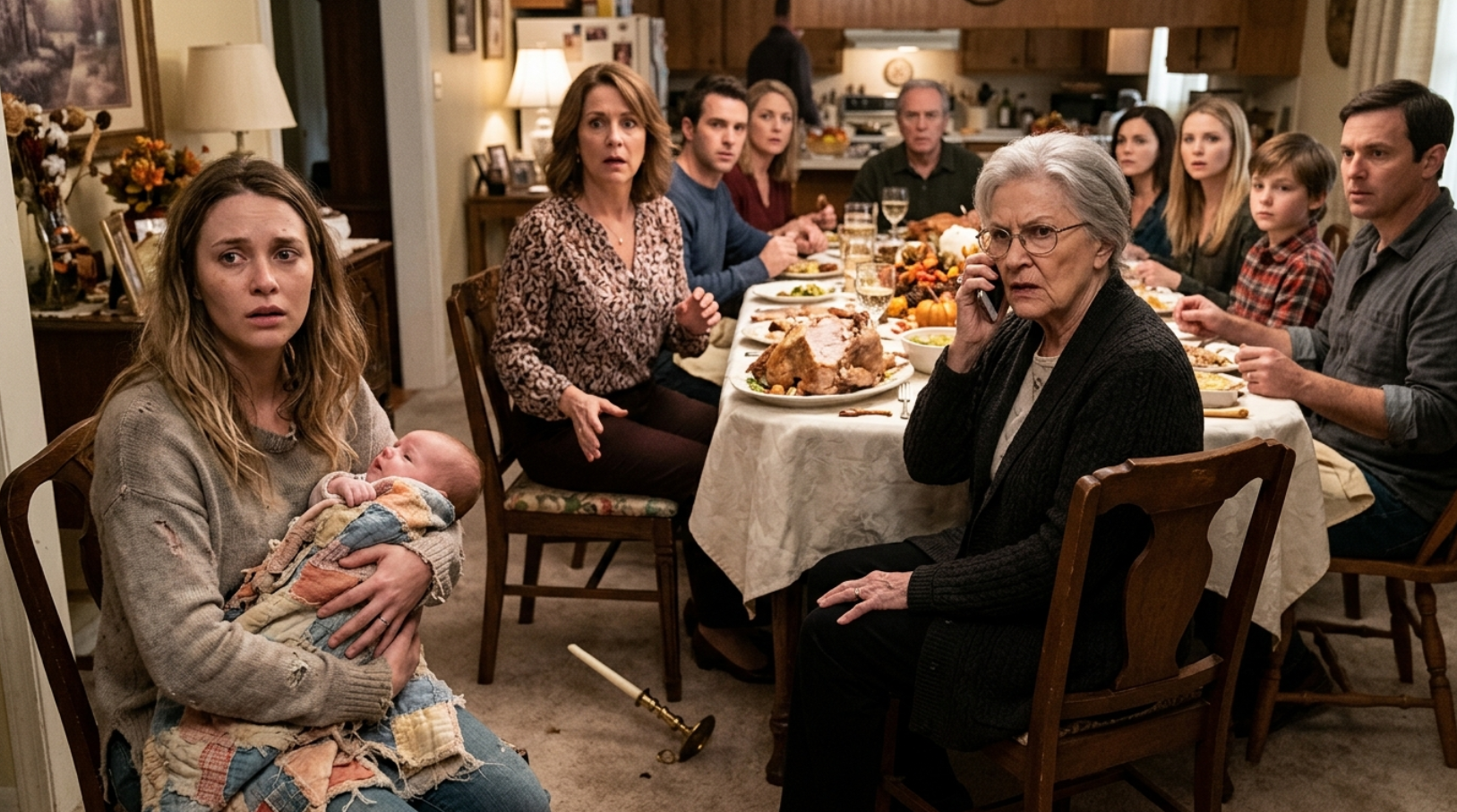
Grandma removed her glasses and slowly cleaned them with a tissue.
“Vivian, I gave you that money because you promised me Natalie would never have to suffer financially after losing Owen. You told me she needed time to heal. You said you would make sure she had a safe home, proper medical treatment, and everything Maisie needed.”
“I did what I thought was best,” Vivian insisted.
“No,” Grandma replied. “You did what was best for you.”
My mother, Laura, stepped forward.
“Mother, please. We don’t know the whole story yet.”
Grandma turned toward her.
“Then let’s hear the whole story.”
Miles opened another folder.
“The account received all three transfers. But there were immediate withdrawals and payments afterward. The funds were used for a mortgage payment, a vehicle purchase, several credit card balances, and transfers to another account.”
Uncle Glenn suddenly became very interested in the floor.
I noticed.
So did Grandma.
“Glenn,” she said, “why are you looking at the carpet?”
“I’m not.”
“Then look at me.”
He raised his eyes.
Miles pulled out a printed transaction summary.
“Some of the funds were transferred to an account jointly held by Vivian and Glenn.”
The room seemed to shrink around us.
I looked at my uncle.
“You knew?”
He rubbed his forehead.
“I knew Vivian had received money from Beatrice. I didn’t know it was supposed to be yours.”
“Then why did the money go into your account?”
“I thought it was a family loan.”
“A family loan?” I repeated.
I could barely believe the words coming out of his mouth.
“My husband is dead. My daughter was a newborn. I was injured and facing eviction. What part of that sounded like an opportunity for your family to borrow money?”
Glenn opened his mouth but said nothing.
Then Grandma asked the question that changed the direction of the entire evening.
“Vivian, did Natalie sign these documents?”
My aunt swallowed.
“She authorized me to help.”
“That wasn’t my question.”
Vivian looked at Miles.
He placed a copy of the authorization on the table.
“Natalie, have you ever seen this document?”
I leaned forward.
The paper carried my name, my address, and a signature dated March 12, only days after Owen’s funeral.
I stared at the signature.
“No.”
“Are you certain?” Miles asked.
“Yes. I was still in the hospital on March 12.”
He nodded and made a note.
“Then we’ll need to establish how this document was created and whether it was lawfully authorized.”
Vivian’s face had turned a frightening shade of white.
My mother sat down.
For the first time that evening, she looked less like a woman trying to calm a family argument and more like someone who had just realized the people she loved might have been hiding something terrible.
Grandma reached for another sheet.
“There is one more thing,” Miles said.
He placed a bank statement beside the authorization.
“The account was opened with identification documents and supporting paperwork. The address listed was Vivian’s home.”
I looked at my aunt.
She couldn’t meet my eyes.
Then I remembered something.
A month after Owen’s funeral, Vivian had visited my apartment. She brought a bag of groceries and asked me to sign several papers.
She told me they were documents for the insurance company and that signing them would help speed up my medical reimbursements.
I had been taking pain medication. Maisie had been crying for hours. I had barely slept.
I remembered signing one page.
But I hadn’t read the entire stack.
“Those papers,” I whispered. “You told me they were for the hospital.”
Vivian’s lips trembled.
“Natalie, you were overwhelmed. I was trying to help.”
“Did you use those papers to open the account?”
She didn’t answer.
“Did you?”
“I never intended for things to turn out this way.”
That was when Grandma stood up.
She was seventy-eight years old, and she had always been the quietest person in our family. She rarely raised her voice. She believed arguments should be settled privately and that family members deserved the chance to correct their mistakes.
But that evening, she looked at Vivian as though she no longer recognized her.
“Intentions do not erase consequences,” she said. “Especially when a baby is involved.”
Maisie stirred against my chest.
I looked down and gently kissed her forehead.
For months, I had told myself I was failing her.
I had blamed myself for not finding better work, for not recovering faster, for not being able to give her the comfortable life Owen and I had planned.
Now I was discovering that someone had taken away the very help that might have kept us safe.
Grandma turned to Miles.
“Secure every record. Contact the banks first thing tomorrow. Find out exactly where every dollar went. And if any document was falsified, I want the appropriate authorities informed.”
Vivian began to cry.
“Beatrice, please. You can’t destroy this family over a misunderstanding.”
Grandma looked at her for a long moment.
“I’m not destroying this family, Vivian. I’m trying to find out who already did.”
Nobody spoke again for several minutes.
Then Paige came down the stairs.
She had been standing halfway up them throughout the argument, listening to everything.
Her eyes were red.
“Grandma,” she said quietly, “there’s something else you need to know.”
Vivian spun around.
“Paige, don’t.”
But Paige kept walking.
She held her phone in both hands, and her fingers were shaking.
“Last spring, Mom told me Natalie had received all the money and was spending it irresponsibly. She said Natalie had refused to get a job and was using Grandma’s generosity to avoid taking responsibility for her life.”
My stomach twisted.
Paige looked directly at me.
“I believed her. I thought you didn’t want anyone contacting you because you were embarrassed about your finances.”
“I was embarrassed,” I whispered. “But not for the reasons she told you.”
Paige wiped her cheeks.
“I know that now.”
She turned her phone toward Miles.
“I saved some messages because I thought Mom was being strange about the money. I didn’t understand what they meant at the time.”
Miles took the phone and read silently.
Then he stopped.
“Mrs. Bennett,” he said to Grandma, “I think you should see this.”
Grandma read the message.
Her expression changed.
It was a message Vivian had sent to Glenn in April.
Beatrice thinks Natalie is receiving the money. Keep her away from the bank statements until I figure out how to cover the transfers.
Below it was Glenn’s reply.
What happens when Natalie asks for the rest?
And Vivian’s response:
She won’t. She doesn’t even know the money exists.
Grandma slowly lowered the phone.
For the first time that evening, she looked genuinely heartbroken.
Not because of the money.
Because the people sitting around her table had known that a young widow and her baby were struggling, and some of them had chosen to believe a lie rather than ask a single question.
“Thank you, Paige,” she said softly.
Vivian reached toward her daughter.
“Sweetheart, you don’t understand what was happening.”
Paige stepped away.
“No, Mom. I think I’m finally beginning to understand.”
That night, Thanksgiving dinner was never served.
Grandma asked Miles to arrange for the records to be preserved, and she made it clear that nobody was to destroy documents, alter accounts, or pressure me into changing my statement.
She did not have anyone arrested in the living room. She did not make threats she couldn’t enforce.
Instead, she made calls, requested an independent review of the transactions, and arranged for me and Maisie to stay somewhere safe.
When the house finally began to empty, I found myself standing near the front door, holding my daughter and wondering how a single evening could change everything I thought I knew about my family.
Grandma came to stand beside me.
“Come home with me tonight,” she said.
I shook my head automatically.
“I don’t want to be a burden.”
Her face crumpled.
“Oh, Natalie.”
She reached up and touched my cheek.
“You lost your husband. You nearly lost your life. You’ve been raising a baby while recovering from injuries, and someone stole the help I sent you. Yet you’re still worried about being a burden?”
I couldn’t answer.
She wrapped her arms around me.
For the first time since Owen died, I allowed myself to cry without trying to hide it.
And for the first time in months, someone held me while I did.
But the investigation was only beginning.
And what Miles discovered over the following two weeks would reveal that the missing $180,000 was only one part of a much larger betrayal.
Three days after Thanksgiving, Miles called Grandma with an update.
I was sitting at her kitchen table, feeding Maisie mashed bananas while sunlight fell across the floor.
For the first time in months, I had slept through most of the night.
Grandma answered the phone and listened without interrupting.
Then her hand tightened around the receiver.
“Are you certain?” she asked.
A pause.
“Send me everything.”
She ended the call and looked at me.
“They found another account.”
I stopped feeding Maisie.
“What do you mean?”
“Your name appears on a second account connected to the original one. The bank is reviewing the records, but there are transactions suggesting the funds were moved more than once.”
My heart began pounding.
“Does that mean all the money is gone?”
“Not necessarily. Miles is tracing it.”
She reached across the table and covered my hand.
“I want you to understand something. Whatever the investigation finds, you are not responsible for what someone else chose to do.”
I nodded, but the fear remained.
The money represented more than a bank balance.
It represented the months I had spent wondering how I would keep a roof over my daughter’s head. It represented the physical therapy sessions I had postponed, the bills I had ignored, and the nights I had sat beside Maisie’s crib calculating how long one can of formula would last.
I had believed I was alone because life had suddenly become cruel.
Now I was discovering that someone had deliberately kept me from help.
And I didn’t know how to process that.
Later that afternoon, my mother arrived at Grandma’s house.
She stood in the doorway holding a small gift bag.
“I brought some clothes for Maisie,” she said.
Grandma invited her inside but did not offer the warm welcome she usually did.
My mother placed the bag on the sofa.
“Natalie, can we talk?”
I hesitated.
Grandma looked at me.
“You may speak with her if you want to. You don’t owe anyone a conversation before you’re ready.”
That mattered more than she realized.
For months, everyone had told me what I should do, what I should forgive, and what I should accept because we were family.
For once, I was allowed to decide.
I sat down.
“What do you want to say, Mom?”
She clasped her hands together.
“I didn’t know Vivian had taken the money.”
“Did you know Grandma sent it?”
“Yes.”
“When did you find out?”
She stared at the carpet.
“Vivian told me in April that Grandma had helped you. She said you were receiving money but didn’t want people discussing it.”
“And when you saw me wearing the same clothes for months? When I told you I couldn’t afford physical therapy? When I asked if I could borrow money for rent?”
Her eyes filled with tears.
“I thought you were refusing help because you were angry with the family.”
“Did you ever ask me?”
“No.”
The answer hurt more than I expected.
I had spent so long blaming myself that I hadn’t fully understood how much I had needed someone simply to ask whether I was okay.
My mother wiped her face.
“I should have called. I should have come to your apartment. I should have looked at my own daughter and realized something wasn’t right.”
“Yes,” I said quietly. “You should have.”
She nodded.
“I don’t expect you to forgive me today.”
For the first time, I believed her.
She wasn’t asking me to forget what had happened. She was admitting that she had failed to notice my suffering.
It wasn’t enough to repair our relationship, but it was a beginning.
Before she left, she turned toward Grandma.
“I want to help Natalie however I can.”
Grandma’s voice remained calm.
“Then start by telling the truth. No protecting Vivian. No hiding information because it might embarrass the family.”
My mother nodded.
“I will.”
The next morning, Miles asked me to come to his office.
He had arranged a meeting with the bank’s fraud department, and he wanted me to confirm several details about the documents.
I brought the hospital discharge papers from March and the small folder where I had kept every bill I could not pay.
The folder was embarrassing.
It contained overdue notices, collection letters, receipts for cheap groceries, and handwritten calculations showing how I had stretched every dollar.
But Miles treated each paper carefully.
“These documents establish the circumstances you were in during the relevant period,” he explained. “They also help us establish which transactions you did not authorize.”
He showed me a series of transfers.
The first $50,000 had arrived on March 14.
The second $75,000 had arrived on March 28.
The third $55,000 had arrived on April 5.
Within days of the first transfer, money had been used to settle a large credit card balance.
The second transfer was followed by payments toward a mortgage and a luxury vehicle.
The third had been divided among several accounts.
“Whose vehicle?” I asked.
Miles checked the record.
“A vehicle registered to Glenn.”
I closed my eyes.
I remembered the photographs Vivian had posted that spring. She and Glenn stood beside a new SUV, smiling beneath a ribbon tied across the hood.
At the time, I had looked at the photograph from my tiny apartment and wondered how other people managed to keep living normally while my own life had fallen apart.
Now I understood why the photograph had hurt so much.
My family had been celebrating purchases funded, at least in part, by money intended to help me survive.
“Can I get the money back?” I asked.
Miles didn’t offer false reassurance.
“Some funds may be recoverable. Others may have been spent. We will pursue the appropriate legal remedies, but I can’t promise a particular outcome yet.”
I appreciated his honesty.
I had already spent too many months believing promises that turned out to be empty.
Before I left, he handed me a copy of a document.
“This is important. The account records show that someone submitted paperwork claiming you had authorized Vivian to manage the funds. You have denied signing that authorization. We are examining the original records and the circumstances under which the documents were submitted.”
I stared at the paper.
“I remember signing something at my apartment,” I said. “But I never agreed to give her control of $180,000.”
“Then tell the investigators exactly what you remember. Don’t guess, and don’t let anyone persuade you to change your recollection.”
I nodded.
For the first time, I understood that standing up for myself did not mean screaming louder than Vivian.
It meant telling the truth, preserving evidence, and refusing to let other people rewrite my life.
That evening, Grandma sat with me on her back porch.
Maisie slept in her stroller beside us.
The air was cold, and the garden lights glowed against the dark.
“Your grandfather would have been furious,” Grandma said.
I smiled faintly.
“Grandpa always said you were the scariest person in the family when you were angry.”
She laughed softly.
“He said that because I never wasted my anger.”
Then her expression became serious.
“I need to tell you something about the money.”
I turned toward her.
“When Owen died, I wanted to give you enough to rebuild your life. I didn’t want you to feel pressured to return to work before you had recovered. I didn’t want you to sell your belongings or choose between rent and medical treatment.”
My eyes filled with tears.
“I could have used that help so badly.”
“I know.”
She took my hand.
“But I also made a mistake. I trusted Vivian to handle everything because she told me she was good with finances. I should have contacted you directly. I should have confirmed that the money reached you.”
“You thought you were helping me.”
“I was trying to help you. But good intentions aren’t enough when we fail to check whether someone is actually safe.”
We sat quietly for a while.
Then Grandma asked me about Owen.
Not about the accident, the bills, or the investigation.
She asked what he had been like before Maisie was born.
So I told her.
I told her how he sang badly in the shower, how he burned toast every Sunday, and how he had spent three weeks assembling a crib because he refused to read the instructions.
I told her how he used to rest his hand on my stomach and talk to Maisie before she was born.
And I told her about the last message he had sent me that morning.
Pick up your favorite pastries tonight. We deserve a treat.
I had never picked them up.
For months, that small unfinished plan had haunted me.
Grandma listened without interrupting.
When I finally stopped talking, she squeezed my hand.
“He would want you to live, Natalie. Not merely survive.”
I looked at Maisie sleeping beside us.
For the first time, I began to believe that might still be possible.
But while I was learning to breathe again, Vivian was preparing a defense.
And she had no idea that her own daughter was about to make a decision that would change the investigation.
Paige called me on a Thursday evening.
She sounded exhausted.
“Natalie, I need to tell you something about Mom.”
I stepped into the hallway so I wouldn’t wake Maisie.
“What happened?”
“She’s been calling relatives. She’s telling everyone that Grandma misunderstood the transfers and that you’re exaggerating what happened because you’re grieving.”
I closed my eyes.
Of course she was.
Vivian had spent months building a story in which I was irresponsible, ungrateful, and unwilling to help myself.
Admitting the truth would mean admitting that she had used that story to justify taking money that wasn’t hers.
“What does everyone believe?” I asked.
“Some believe her. Some don’t. But I have the messages from April, and I gave copies to Miles.”
“Are you sure you’re comfortable doing that? She’s your mother.”
Paige went quiet.
Then she said something I would never forget.
“She is my mother. But you’re my cousin, and you were suffering. I can’t keep pretending those things are unrelated.”
I thanked her.
Before we hung up, she told me that Vivian had asked her to delete the messages.
Paige had refused.
That refusal mattered.
It meant someone in the family had finally decided that loyalty could not require lying.
Over the next several weeks, the investigation continued.
The bank confirmed that the account associated with my name had been opened using documents submitted by Vivian. Investigators examined the authorization, the transaction records, and the messages Paige had preserved.
The findings did not automatically prove every allegation, and Miles cautioned us not to assume the final legal outcome.
But the financial trail was becoming clearer.
Some money had been used for household expenses. Some had gone toward Glenn’s vehicle. Other funds had moved through accounts controlled by Vivian.
A portion had also been used to pay debts that Vivian had never mentioned to Grandma.
When confronted with the records, Vivian claimed she had intended to repay everything.
But she had no written repayment agreement with me, and I had never known the money existed.
The distinction was important.
You cannot repay someone for money they never agreed to lend you and pretend the original decision was harmless.
Meanwhile, my mother began visiting regularly.
At first, I kept our conversations short.
She brought groceries, helped fold laundry, and occasionally watched Maisie while I attended medical appointments.
She didn’t ask me to forgive her.
She simply showed up.
One afternoon, while Maisie was sleeping, my mother found me sorting through Owen’s belongings.
I had kept his old jacket in a box beneath the bed because I couldn’t bear to decide what to do with it.
My mother touched the sleeve.
“He was a good man,” she whispered.
“Yes.”
“I wish I had spent more time getting to know him.”
I continued folding the clothes.
“So do I.”
She sat beside me.
“I know I can’t make up for the months you were alone. But if you let me, I want to be part of Maisie’s life.”
I looked at her.
“Being part of her life means being honest with her. It means showing up when things are difficult. And it means never asking her to hide something wrong just because the person who did it is family.”
My mother nodded.
“I understand.”
“I’m not ready to pretend everything is fine.”
“I don’t expect you to.”
That was the first conversation we had in years that ended without either of us pretending.
Then, in January, Miles called Grandma with an update.
The bank had completed another stage of its review.
A substantial portion of the missing money had been traced to accounts and payments associated with Vivian and Glenn. Some funds might be recoverable through legal proceedings, while others required further investigation.
There was also a new development.
An independent document examiner had identified concerns with the authorization Vivian had submitted.
Miles explained that the signature and supporting paperwork required further examination before any definitive conclusion could be drawn.
But the questions were serious enough that the matter had been referred to the appropriate authorities.
Grandma listened carefully.
“Proceed according to the evidence,” she said. “I don’t want revenge. I want the truth.”
After she ended the call, she sat quietly for several minutes.
Then she looked at me.
“I loved Vivian like a daughter.”
“I know.”
“I still love her. But loving someone doesn’t mean protecting them from the consequences of their choices.”
I thought about that for a long time.
For most of my life, I had believed family loyalty meant forgiving quickly and keeping private problems hidden.
Now I was learning that genuine loyalty sometimes required the opposite.
It required honesty.
It required boundaries.
And sometimes it required allowing someone you loved to face consequences you wished they had never created.
A week later, Vivian contacted me directly.
Her message was brief.
We need to talk. Just you and me.
I showed it to Miles before responding.
He advised me not to meet her alone while the investigation was ongoing.
So I agreed to a conversation at his office, with him present.
Vivian arrived looking tired and older than I remembered.
She wore the same expensive coat she had worn on Thanksgiving, but her confidence was gone.
For a moment, I saw the aunt who had once taught me to bake cookies.
Then I remembered the messages, the transfers, and the months I had spent counting coins.
She sat across from me.
“I want you to know I never wanted you to suffer.”
I waited.
“I thought I could use the money temporarily. Glenn’s business was struggling, and we had debts. I believed I could replace everything before anyone noticed.”
“Why didn’t you ask Grandma for a loan?”
“Because she would have said no.”
The answer was immediate.
And it told me more than any apology could have.
She knew Grandma wouldn’t approve.
She knew the money was intended for me.
She took it anyway.
“And when you realized I was struggling?” I asked.
Vivian lowered her eyes.
“I told myself you would eventually manage.”
“You knew I had a baby.”
“I know.”
“You knew I had lost Owen.”
“Yes.”
“You knew I was injured.”
She began to cry.
“Yes, Natalie.”
I leaned forward.
“Then why did you let me believe I was alone?”
She covered her face.
For a long time, she said nothing.
Finally, she whispered, “Because if you knew about the money, everything would have fallen apart.”
I felt something inside me settle.
Not forgiveness.
Not hatred.
Clarity.
“You weren’t protecting me,” I said. “You were protecting yourself.”
Vivian looked up.
“I know that now.”
I stood.
“I hope you take responsibility for what happened. But I won’t lie for you, and I won’t tell Grandma to stop the investigation.”
She nodded through her tears.
“I understand.”
I left the office without embracing her.
It was the first time I had ever walked away from a family member without trying to make their pain easier to bear.
And although it hurt, I felt stronger for it.
The next chapter would not be decided by Vivian’s promises.
It would be decided by the evidence, the law, and the choices each of us made afterward.
By spring, the case had moved beyond the family.
The relevant authorities were reviewing the records, and the financial investigation had established that the $180,000 Grandma intended for me had not been delivered to me as she believed.
The process was slow.
There were interviews, document requests, bank reviews, and difficult conversations. Miles reminded us repeatedly that recovering the money and determining legal responsibility were separate matters.
Grandma didn’t demand a dramatic public confession.
She didn’t organize another family gathering to humiliate Vivian.
She let the evidence speak.
Meanwhile, she made sure Maisie and I had a safe place to live.
She arranged for my medical needs to be addressed and helped me find a financial adviser who had no connection to anyone in the family.
She also insisted that the remaining funds she personally provided be handled transparently, with records I could review myself.
“I want you to have control over your life,” she told me. “Not dependence on me, and certainly not dependence on anyone who believes your vulnerability gives them permission to make decisions for you.”
I took her advice seriously.
I used part of the support to clear urgent bills and arrange the physical therapy I had postponed. I created a modest budget for Maisie’s needs and kept the rest protected while the legal process continued.
I also began looking for work I could do around childcare.
It wasn’t easy.
Some mornings, my wrist hurt so badly that opening a jar was difficult. Some nights, Maisie woke every two hours, and I wondered how I would manage an interview the following day.
But I kept going.
I found a part-time bookkeeping position with a small local company. The work was flexible, and my accounting background helped me rebuild my confidence.
The first time I received a paycheck, I sat in my car and cried.
It wasn’t a fortune.
It wasn’t enough to erase the previous year.
But it was mine, earned through my own effort, and it represented something I had feared losing forever: the ability to build a future.
I bought Maisie a new blanket.
It was soft, pale yellow, and covered in tiny white stars.
When I wrapped her in it, I thought of the secondhand blanket Grandma had noticed on Thanksgiving.
I didn’t hate that old blanket. It had kept my daughter warm when I had little else.
But the new one reminded me that our circumstances could change.
We were no longer trapped in the worst moment of our lives.
Then, one afternoon, Miles called with the update we had been waiting for.
A settlement and recovery process had resulted in the return of a substantial portion of the funds. Additional proceedings were still necessary to address the remaining losses and determine the consequences for those responsible.
He was careful not to promise more than the records supported.
But for the first time, I could see a path toward financial stability.
Grandma invited me and Maisie to spend a weekend at her home.
On Saturday morning, she took us to a small park near her house.
Maisie had recently learned to stand while holding someone’s hands, and she kept bouncing excitedly whenever Grandma smiled at her.
Watching them together filled me with a warmth I hadn’t felt in a long time.
Grandma sat beside me on a bench.
“I used to believe money could solve almost any practical problem,” she said. “I thought if I sent enough, you would be safe.”
“You tried to help.”
“I did. But I should have checked on you myself. I should have made sure you were receiving what I sent.”
I looked at her.
“You can’t be responsible for every terrible choice another person makes.”
“No,” she agreed. “But I can learn from mine.”
She took my hand.
“I hope you learn something, too.”
“What?”
“That accepting help doesn’t make you weak. And protecting your peace doesn’t make you cruel.”
I thought about how many times I had refused to tell anyone I was struggling because I feared being judged.
I had believed that asking for help meant admitting failure.
Now I understood that surviving a crisis was not a test of how silently I could suffer.
It was a process of learning when to ask, whom to trust, and when to walk away.
Grandma leaned over and kissed Maisie’s head.
“Your husband would be proud of you,” she said.
I looked at my daughter.
“I hope so.”
“He would be. And someday, when she’s old enough to understand, tell her that her mother kept going even when the world became terribly unfair.”
I smiled through my tears.
“I will.”
But there was still one thing left to resolve.
The family had spent months arguing about money, responsibility, and who deserved forgiveness.
I wanted to know whether we could ever sit together again without pretending the past had never happened.
The answer came at a small gathering in June.
Grandma invited a few relatives to her home for lunch. She told everyone beforehand that there would be no discussion of the investigation unless I chose to raise it.
My mother arrived with a homemade pie.
Paige brought flowers.
Glenn did not attend.
Vivian sent a letter.
I didn’t open it immediately.
Instead, I watched my mother help Maisie stack wooden blocks on the living-room floor while Paige laughed at the tower collapsing.
It was a simple scene.
But after everything we had endured, ordinary happiness felt extraordinary.
Eventually, I opened Vivian’s letter.
She wrote that she had been ashamed of her debts and frightened of losing her home. She admitted that she had made decisions to protect her own comfort and had allowed those decisions to harm me.
She did not ask me to tell the authorities to stop their work.
She did not demand immediate forgiveness.
At the end, she wrote:
I cannot ask you to trust me again. I can only accept that I broke your trust and spend the rest of my life deciding what kind of person I will be from now on.
I folded the letter and put it away.
I wasn’t ready to forgive her completely.
Perhaps I never would be.
But I no longer needed to decide her entire future in order to move forward with mine.
I could acknowledge her apology without pretending the damage had disappeared.
I could hope she changed without giving her access to my finances, my private life, or my daughter’s future.
And I could choose peace without calling the past acceptable.
That afternoon, as the sun began to set, Grandma stood beside me near the garden.
“Do you think our family can heal?” she asked.
I looked through the window at my mother and Paige playing with Maisie.
“Some parts of it already are.”
“And the rest?”
I thought carefully before answering.
“The rest will depend on what people do next.”
Grandma smiled.
“That sounds right.”
For the first time, our future felt uncertain in a way that didn’t frighten me.
Not every relationship had been repaired. Not every dollar had been recovered. Not every consequence had been decided.
But I had a home, a job, a daughter who was growing stronger every day, and people who were finally learning to tell the truth.
That was enough to begin again.
One year after that terrible Thanksgiving, Grandma invited everyone to her house again.
I almost declined.
The memory of Vivian dropping the candle, Miles spreading the bank records across the coffee table, and my family staring at me as if my suffering had suddenly become real was still vivid.
But this time, I arrived wearing a navy-blue dress and carrying a homemade apple pie.
Maisie was twenty-one months old.
She toddled through the front door holding my hand, wearing tiny shoes that Grandma had bought for her birthday.
The first thing Grandma did was kneel to greet her.
“My goodness,” she said, laughing as Maisie wrapped her arms around her neck. “Look how much you’ve grown!”
I watched them together, feeling Owen’s absence as sharply as ever.
He should have been there.
He should have been carrying Maisie on his shoulders, stealing pieces of pie before dinner, and making everyone laugh with his terrible jokes.
Grief had not disappeared simply because my life had improved.
But it had changed.
It no longer filled every room.
I could remember Owen without immediately feeling as though I were drowning.
And sometimes, when Maisie laughed, I could almost hear his laughter beside hers.
The family gathered around the table.
My mother sat beside me.
Paige helped Maisie arrange her crayons.
Grandma occupied her usual seat at the head of the table.
Vivian did not attend.
Her legal and financial matters had continued through the appropriate processes, and the family relationships remained complicated. Some relatives had chosen to maintain contact with her; others had not.
I had decided that I would not spend my life organizing my decisions around her.
I could wish her well from a distance.
I could protect my daughter.
And I could refuse to pretend that trust was something people were entitled to receive simply because they shared my last name.
Before dinner, Grandma raised her glass.
“A year ago, we discovered something painful about this family,” she began. “We discovered that money had been sent to help someone who was suffering, but that person never received it.”
The room grew quiet.
“I wish we had discovered the truth sooner. I wish Natalie had not spent those months struggling alone. And I wish we had remembered that love means more than sending money, making promises, or calling ourselves family.”
She looked at me.
“Love means paying attention. It means asking questions. It means having the courage to hear answers we don’t want to hear.”
My mother reached for my hand beneath the table.
Grandma continued.
“Today, I don’t want us to celebrate money recovered or arguments won. I want us to celebrate the things that cannot be transferred between bank accounts: honesty, courage, responsibility, and the chance to begin again.”
She lifted her glass.
“To Natalie and Maisie. To Owen, whose memory remains with us. And to the kind of family we choose to become.”
Everyone raised their glasses.
I looked around the table.
Some things were different forever.
Some relationships would never return to what they had been.
But there was no pretending anymore.
And that, I realized, was a kind of freedom.
After dinner, Grandma handed me a small envelope.
Inside was a letter and a photograph of Owen holding Maisie on the day she was born.
I stared at the photograph, unable to speak.
“I found it among the things you left at my house after the funeral,” Grandma explained. “I thought you might want it.”
I ran my fingers over the photograph.
Owen looked tired and happy, his face glowing with the wonder of becoming a father.
On the back, he had written a few words:
My girls. My whole world.
I pressed the photograph against my chest.
For months, I had thought the most important thing stolen from me was the $180,000.
That money could have changed my circumstances. It could have paid my bills, protected my health, and given Maisie and me the security we desperately needed.
Its disappearance had been a terrible betrayal.
But the deepest wound had been the belief that I had been forgotten.
I had spent months thinking I wasn’t important enough for anyone to notice that I was suffering.
Now I understood that my worth had never depended on how much money I had, how expensive my clothes were, or whether I could provide my daughter with a perfect life.
I had been worthy of love when I was counting coins.
I had been worthy of help when I was selling my wedding ring.
I had been worthy of dignity when I was wearing worn-out shoes and carrying my daughter in a secondhand blanket.
Nothing about my circumstances had changed that.
Later that evening, I carried Maisie to the car while Grandma followed us to the driveway.
She hugged me tightly.
“I’m proud of you,” she whispered.
“I couldn’t have done it without you.”
“You did the hardest part yourself. You kept going.”
I kissed her cheek.
Then I placed Maisie in her car seat, tucked her new star-patterned blanket around her, and closed the door.
As I drove home, I thought about the woman I had been one year earlier.
She had arrived at Thanksgiving believing she had failed at life.
She had thought her worn clothes revealed her weakness, her empty bank account proved her inadequacy, and her inability to provide everything for her daughter meant she was somehow less deserving than everyone around her.
But she had been wrong.
She had survived the loss of her husband, a devastating accident, financial hardship, and a betrayal she never could have imagined.
She had asked questions when silence would have been easier.
She had told the truth when lying might have protected the family.
And she had learned that forgiveness did not require surrendering her boundaries.
When we reached home, Maisie was asleep.
I carried her inside, laid her gently in her crib, and stood beside her for a moment.
The apartment was quiet.
For the first time in a long time, that quiet felt peaceful rather than lonely.
I turned off the light and whispered the words Owen had once written.
“My girls. My whole world.”
Then I went to bed knowing that tomorrow would bring ordinary challenges, unexpected expenses, and moments when grief might return without warning.
Life would never become perfect.
But it would be ours.
And nobody would ever again convince me that struggling meant I deserved less.
Because the greatest thing Grandma gave me was not the money she sent.
It was the chance to discover that I had never been a burden.
I had been a daughter, a wife, a mother, and a human being who deserved help when life became unbearable.
And when the truth finally came to light, I didn’t need revenge to prove my worth.
I needed courage to rebuild, wisdom to establish boundaries, and love to keep moving forward.
That was the real inheritance I carried into the future.
And it was worth more than $180,000.