“Because I was afraid of what would happen if I did. He controlled most of our finances. Every time I questioned him, he said I was ungrateful, that he was the one keeping the family together. After a while, I stopped asking.”
I understood fear.
I had seen people make terrible decisions because they were frightened of losing everything.
But I also understood that fear didn’t erase the damage those decisions caused.
“You let me keep sending money,” I said.
“Yes.”
“You let Dad tell me Grandpa was going to lose the farm.”
“Yes.”
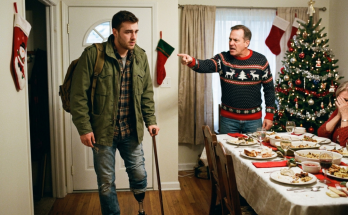
“And when Dad threw me out on Christmas, you stood there.”
She began to cry again.
“I am sorry, Samantha.”
I looked at her for a long moment.
“I hope you are. But I can’t be the person who makes you feel better about what happened.”
She nodded slowly.
For once, she didn’t ask me to forgive her.
I handed the documents to my lawyer that afternoon.
She reviewed them, compared them with the existing records, and explained that some of the new evidence might help establish how my money had been used. She also cautioned me that recovering the funds could take time and that any legal outcome would depend on the evidence, the applicable law, and what the investigation established.
I understood.
I wasn’t looking for a dramatic courtroom confession.
I wanted the truth recorded somewhere my father couldn’t rewrite it.
And I wanted my future back.
The following months were difficult.
My father told relatives that I had turned against him. He claimed I was unstable, bitter about my discharge, and determined to punish the family because I could no longer serve in the Army.
Some people believed him.
An aunt sent me a message saying that family disagreements should stay private. A cousin told me I was embarrassing my mother. Someone else suggested that I should forgive my father because he had raised me.
I stopped answering those messages.
I had spent years believing that keeping the peace was my responsibility.
Now I understood that peace built on one person’s silence was not peace at all.
Meanwhile, the legal review continued.
The records established that substantial amounts had gone into accounts controlled by my father and that some funds had been used for purposes unrelated to Grandpa’s farm. The full amount remained disputed, but the evidence was strong enough for my lawyer to pursue formal recovery options.
My father was given opportunities to explain the transactions.
He changed his story several times.
First, he claimed the money had paid for general family expenses.
Then he said I had voluntarily given it to him.
Later, he argued that he had managed the money on my behalf and that I had no right to demand it back.
But his own messages repeatedly described the transfers as emergency payments intended to save Grandpa’s property.
The contradictions mattered.
My lawyer helped me pursue a civil claim, and the financial records became central to the dispute. I learned that justice rarely arrives in the neat, immediate way it does in movies. There were forms, deadlines, meetings, and long stretches when nothing seemed to happen.
There were also moments when I doubted myself.
Whenever a letter arrived from my father’s attorney, I felt the same old fear.
What if I was wrong?
What if I had misunderstood?
What if I lost what remained of my family?
Then I would remember Christmas.
The gifts I had brought.
The cane in my hand.
My father’s voice telling me to leave the house I had helped support.
And the question Grandpa had asked me.
What money?
I kept going.
In early summer, Mark visited the farm.
He arrived carrying a box of old documents and an expression I had never seen on him before.
“I should have done something sooner,” he said.
We sat on the porch while Grandpa worked in the garden.
Mark explained that he had known Dad was using my money to cover expenses, but he hadn’t understood the full extent of it. He had accepted our father’s explanation that I was helping the household voluntarily.
“I thought you were doing well,” he said. “You were in the Army. You had a steady income. Dad made it sound like you wanted to help.”
“I did want to help.”
“I know. But I should have asked what he was doing with it.”
He opened the box.
Inside were old envelopes, receipts, and handwritten notes. Some were duplicates of documents my mother had found. Others contained dates and amounts that helped fill gaps in the timeline.
There was also a letter from my father to a loan officer discussing the family’s financial position.
My lawyer reviewed it and determined that it was relevant enough to preserve with the other evidence.
After Mark left, I sat on the porch for a long time.
I was grateful that he had come forward.
But I couldn’t pretend that his silence hadn’t hurt me.
People often imagine betrayal as something dramatic: a lie told to your face, a door slammed shut, a cruel sentence delivered in anger.
Sometimes betrayal is quieter.
Sometimes it’s the person who knows something is wrong and decides that asking questions would be inconvenient.
Mark had finally chosen differently.
I hoped that mattered.
I also knew it didn’t erase the past.
By autumn, the case had reached a turning point.
My father, faced with the growing body of documentation, agreed to participate in settlement discussions. He still denied that he had intentionally defrauded me, but he could no longer plausibly maintain that every dollar had gone to the farm.
The negotiations were difficult.
His representatives argued over which transfers counted, which expenses were legitimate, and whether the money should be considered gifts.
My lawyer challenged the unsupported explanations and insisted that the documented evidence be taken seriously.
After several rounds of negotiations, we reached a written settlement that required my father to repay a substantial portion of the funds that could be established through the records, with a defined payment schedule and legal consequences for failing to comply.
It wasn’t every dollar I had sent.
Some transactions could not be fully traced. Others were too old or insufficiently documented to resolve the way I had hoped.
But the agreement was enforceable, and my lawyer explained exactly what it meant.
When I signed the final papers, my hand trembled.
Not because I was afraid of my father anymore.
Because I finally understood how much energy I had spent trying to earn love from people who treated my sacrifices as something they were entitled to.
I walked outside the lawyer’s office and called Grandpa.
“It’s finished,” I told him.
“Finished how?”
“We have an agreement. He’s going to repay part of the money.”
Grandpa was quiet for a moment.
“Good.”
I waited for him to say something more.
Instead, he asked, “What are you going to do now?”
I looked at the street, the people hurrying past, and the sunlight resting on the pavement.
For ten years, nearly every financial decision I made had been shaped by someone else’s emergency.
I had saved little for myself.
I had postponed plans.
I had convinced myself that my future could wait until everyone else was safe.
“I’m going to build a life,” I said.
Grandpa laughed softly.
“Sounds like a fine plan.”
My mother called two weeks later.
She wanted to know whether I would meet her for lunch.
I agreed, choosing a small café halfway between Salem and the farm.
She arrived early and had already ordered tea.
For a while, we talked about ordinary things: the weather, Grandpa’s bees, the repairs being done on the barn.
Then she set down her cup.
“Your father moved out,” she said.
I looked at her.
“Where did he go?”
“To stay with a friend. We’re discussing our own separation. I don’t know what will happen yet.”
I nodded slowly.
She looked exhausted.
“I keep thinking about Christmas,” she said. “About you standing there with your bag. I should have said something.”
“Yes,” I replied. “You should have.”
She swallowed.
“I can’t change it.”
“No. You can’t.”
“I want us to have a relationship again.”
I looked at her hands.
Part of me wanted to say yes immediately. Another part remembered every unanswered question and every time I had been told to stop making things difficult.
“I don’t know what that will look like,” I told her. “I’m not promising everything will go back to the way it was.”
“I understand.”
“If we have a relationship, it has to be different. No more asking me to cover Dad’s debts. No more telling me to keep quiet to protect the family. And I need you to tell me the truth, even when it’s uncomfortable.”
She nodded.
“I can try.”
“Then start there.”
We finished lunch without making promises neither of us could keep.
When we parted, she hugged me.
I let her.
But I didn’t confuse a hug with forgiveness, and I didn’t confuse forgiveness with forgetting.
If we were going to build something new, it would have to be built honestly.
For the first time, I believed that might be possible.
Part 5: The Home That Never Asked Me to Prove My Worth
A year after that Christmas, I stood in the same kitchen where Grandpa had asked me the question that changed my life.
Outside, the clover fields were green again.
The bees moved between the hives, and the barn roof had been repaired. The farmhouse smelled of fresh bread and coffee.
My cane leaned against the wall.
My prosthesis rested comfortably beneath my jeans, though I still had difficult days. Rehabilitation had taught me that recovery wasn’t a straight line. Some mornings were easy; others demanded more patience than I thought I had.
But I was working again.
I had taken on bookkeeping and administrative work for several small businesses in the area, using the skills I’d developed on the farm. I was saving money in my own account, building an emergency fund, and making plans that belonged to me.
I was no longer sending money because someone told me disaster was coming.
If I helped someone, it would be because I chose to, with clear information and boundaries I could live with.
Grandpa had offered me a more permanent place on the farm. We had worked out an arrangement that protected his ownership while allowing me to contribute to the business and plan for my own future.
One evening, he found me reviewing the books at the kitchen table.
“You’re doing that thing again,” he said.
“What thing?”
“Working when everyone else is trying to enjoy dinner.”
I smiled and closed the laptop.
He placed two plates on the table.
“Good. Because I have news.”
I raised an eyebrow.
“What kind of news?”
“The kind that involves pie.”
He brought out an apple pie from the oven, and we ate at the table until the windows turned dark.
Afterward, he handed me a small wooden box.
Inside was a photograph of my grandmother, taken decades earlier in front of the farmhouse. Beside it lay a folded letter in her handwriting.
I opened it carefully.
To the person who needs this place one day:
Home should never be a reward for being useful. It should be the place where you can rest when you have nothing left to prove.
I read the words twice.
Grandpa watched me.
“Your grandmother wrote that when your mother was young. She always believed people needed a place where they could be loved without keeping score.”
I held the letter against my chest.
For years, I had believed love meant sacrifice without limits.
I had believed that if I kept giving, kept helping, and kept forgiving, eventually my family would see how much I mattered.
My grandmother had understood something I had taken far too long to learn.
Love could include sacrifice, but it should never require you to disappear.
That night, I placed the letter in a frame beside my desk.
It became the first thing I saw every morning.
My father never became the man I had once hoped he would be.
He made the payments required by our agreement, though not without complaints. We communicated only when necessary, and I kept those conversations brief and documented.
He sent one letter in which he said that he had made mistakes but believed I had misunderstood his intentions.
I read it.
Then I put it away.
Perhaps he would one day take full responsibility. Perhaps he wouldn’t.
I couldn’t spend another decade waiting for an apology before allowing myself to live.
My relationship with Heather remained distant. She eventually acknowledged that she had defended Dad without knowing the facts, but she struggled to admit how much her silence had hurt me.
Mark and I began speaking more often. We didn’t pretend everything was fine. We talked honestly about what had happened, including the ways his silence had contributed to my isolation.
My mother and I rebuilt our relationship slowly.
She began therapy and took steps to separate her finances from my father’s. She stopped asking me to fix problems she had helped create. When she apologized, she learned not to follow it with an excuse.
Some days, I could feel the old resentment rising.
I let it pass without allowing it to make every decision for me.
Healing, I discovered, wasn’t the same as pretending nothing had happened.
It was learning that what happened no longer had to control every day that followed.
On the second Christmas after I had been thrown out, Grandpa invited several neighbors to the farmhouse for dinner.
There were twelve people around the table.
Nobody cared that I walked more slowly than the others. Nobody asked whether I could still contribute enough to justify my place.
One neighbor brought a casserole. Another brought a homemade cake. A retired teacher told a story that made everyone laugh so hard that Grandpa nearly spilled his coffee.
After dinner, I stood beside the window and watched snow fall across the fields.
Grandpa joined me.
“Thinking about last Christmas?” he asked.
“Yes.”
“Do you wish things had gone differently?”
I considered the question.
I wished I hadn’t been deceived.
I wished my father hadn’t taken advantage of my trust.
I wished my mother had stood beside me when I needed her most.
I wished I could have come home from the Army without having to discover that the family I had supported for years had been using me.
But I also knew that if I had never walked up that frozen road, I might never have learned the truth.
“I wish they hadn’t hurt me,” I said. “But I’m grateful I found my way here.”
Grandpa nodded.
“That’s a good distinction.”
He reached for my shoulder.
“You know, Sam, you never needed to save this farm to deserve a place here.”
“I know.”
“And you never needed to lose part of yourself to become strong.”
I looked at him.
For the first time, I understood that strength wasn’t the ability to endure every injury without complaint.
Sometimes strength was asking for help.
Sometimes it was refusing to pay for someone else’s lies.
And sometimes it was walking away from a table where your presence was treated like a debt.
I leaned against Grandpa’s shoulder for a moment.
Then we returned to dinner.
The room was warm, the people were kind, and there was a place waiting for me.
Not because I had sent money.
Not because I had saved anyone.
Not because I had earned it through sacrifice.
Simply because I was there.
And that was enough.
The End.
My Father Called Me a Burden After 10 Years of Taking My Money—But Grandpa’s One Question Exposed His Biggest Lie Convert to PDF
Part 2 of 2