PART 3: The Money My Father Said Never Existed
I nodded.
Grandpa stood, walked to a small desk near the window, and returned with a battered folder. Inside were property tax receipts, bank statements, insurance documents, and years of farm expenses.
He spread them across the table.
“I paid my bills, Samantha. Every single one. I’ve had difficult seasons, but I’ve never been close to losing this place.”
He pushed a statement toward me.
“Your father hasn’t paid a bill here in years. I stopped asking him for help long before you joined the Army.”
I looked at the document, then at him.
“Why didn’t you tell me?”
“Because I didn’t know you were sending anything.”
My throat tightened.
“Dad said you didn’t want me worrying about the farm. He said you were too proud to accept money directly.”
Walt’s jaw stiffened.
“Your father has always been good at explaining things in ways that make him look necessary.”
He sat back down.
“I thought you were busy serving your country, living your life. I never imagined someone was using my name to take money from you.”
I wanted to cry, but the tears wouldn’t come.
For ten years, I had believed those transfers were proof that I still belonged to my family, even when I was thousands of miles away. Whenever my father called with another emergency, I sent what I could.
I had paid for a roof I wasn’t living under.
I had sacrificed savings for a farm that wasn’t asking for help.
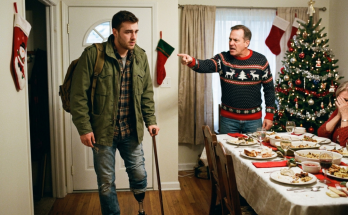
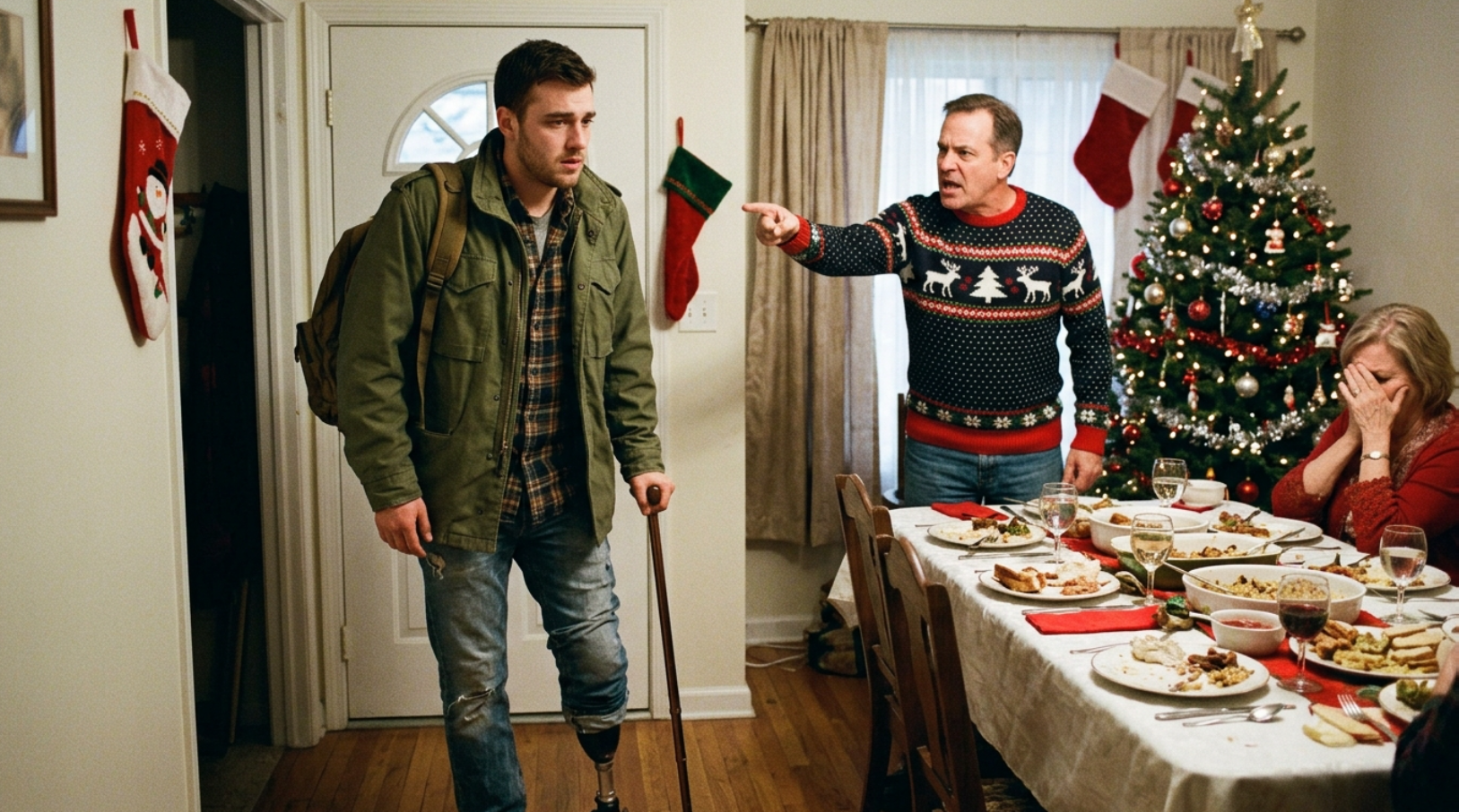
And when I came home injured, the same man who had accepted my money looked me in the eye and called me a burden.
“Grandpa,” I whispered, “I need to know how much he took.”
Walt reached across the table and covered my hand with his.
“Then we’ll find out. But tonight, you’re going to eat something and get some sleep. Whatever your father has done, you don’t have to solve it before sunrise.”
That was the first kindness anyone had offered me since my medical discharge.
It nearly broke me.
The following morning, Walt helped me settle into the small bedroom at the back of the farmhouse.
It had faded blue curtains, a quilt folded neatly over the bed, and a window overlooking the fields. The room wasn’t fancy, but the floor was level, the heater worked, and nobody looked at me as though my missing leg had made me less valuable.
I placed my duffel beside the wardrobe.
Then I sat on the edge of the bed and finally cried.
Not because I had lost my leg. I had already spent months grieving that loss.
I cried because I had spent ten years trying to earn a place in a family that apparently considered my love an opportunity.
When I came downstairs, Grandpa had left breakfast on the table and a yellow notepad beside my coffee.
“Start writing down what you remember,” he said. “Every transfer. Every emergency. Every explanation.”
I spent the next several hours going through my phone and old emails.
My bank account only showed the most recent transactions, but I had kept email confirmations and screenshots from previous years. There were messages from my father asking for money to cover overdue farm taxes, repairs to a barn, veterinary bills, and an emergency loan he claimed was about to become due.
One message from six years earlier made my stomach turn.
Sam, the bank gave us until Friday. If you don’t send the money, your grandfather could lose everything. I know you’re exhausted, sweetheart, but you’re the only one who can save him.
I remembered that day.
I had been sleeping between shifts at a base overseas. I had transferred nearly three thousand dollars before going back to work.
Another message came from my mother.
Your father is trying so hard to keep everything together. Please don’t make things harder for him by asking too many questions.
I read it twice.
My mother had known enough to discourage me from asking questions. I couldn’t yet tell whether she knew where the money was going, but her words no longer sounded innocent.
By noon, I had assembled a rough timeline.
The first transfers had been small. Five hundred dollars here, seven hundred there. Then they grew larger as my military pay increased.
My father had always framed the requests as temporary emergencies. Once the farm was safe, he promised, I could start saving for myself.
But the emergencies never ended.
Neither did the requests.
I calculated the amounts I could verify.
Then I opened a spreadsheet and added everything.
The total was already over $180,000.
I stared at the number until the screen blurred.
Grandpa stood behind me, reading over my shoulder.
“That’s more than I ever spent keeping this farm running,” he said quietly.
“I know.”
He pulled out a chair and sat beside me.
“Sam, I want you to understand something. You didn’t do anything foolish by helping your family. You believed someone you loved was telling you the truth.”
I rubbed my face.
“I should have checked.”
“Perhaps. But the person who lied to you is responsible for the lie. Don’t let him convince you that your kindness was the crime.”
I wrote those words at the top of the notepad.
I didn’t know yet how much money was missing.
I didn’t know what my father had done with it.
But I knew I wasn’t going to send another dollar.
Three days after Christmas, I called my father.
He answered on the fourth ring.
“What is it, Samantha?”
No greeting. No question about where I was staying. No concern about whether I had enough food or whether the cold was making my injury worse.
“I spoke to Grandpa.”
Silence.
Then he laughed.
“Of course you did. You show up there and start stirring things up. I knew this would happen.”
“He says he never received any of the money.”
“Your grandfather doesn’t understand modern finances.”
“He says he never asked me to pay his bills.”
“Because I handled everything!”
“Then show me the records.”
His voice hardened.
“Excuse me?”
“I want the records for every transfer I made. Bank statements, receipts, invoices, anything showing where the money went.”
“You’re accusing your own father of stealing?”
“I’m asking you to account for the money I sent.”
“You have no idea what I’ve done for this family.”
I closed my eyes.
For years, those words would have made me apologize. I would have worried that I was being ungrateful, that I was hurting my parents, that I was forgetting everything they had supposedly sacrificed for me.
Not this time.
“Dad, I have records of the transfers. I have your messages telling me the money was for Grandpa’s farm. Grandpa has his own records, and none of them show that he received anything from me.”
He said nothing.
“I’m giving you seven days to provide an accounting.”
“You don’t give me deadlines.”
“Then consider it a request.”
“You come home after ten years, and suddenly you think you’re some kind of hero because you lost a leg? You think that entitles you to interrogate me?”
The words landed hard, but they no longer had the power to make me surrender.
“No,” I said. “I think ten years of sending money entitles me to ask where it went.”
He hung up.
I sat quietly for a few seconds.
Then I saved the call notes and the messages in a folder.
For the first time in my life, I wasn’t trying to persuade my father to understand me.
I was preparing to prove what he had done.
On the sixth day after Christmas, my sister called.
Heather had always been the family diplomat. She could turn a cruel remark into a misunderstanding and a betrayal into a disagreement that everyone should simply forget.
“Sam, what are you doing?” she asked.
“Having breakfast.”
“Don’t be difficult. Dad says you’re threatening him.”
“I’m asking for financial records.”
“He says you think he stole your money.”
“I sent more than $180,000 because he told me Grandpa was going to lose the farm. Grandpa says he never received it.”
Heather sighed.
“You know Dad has always handled money.”
“That doesn’t answer my question.”
“He took care of everything while you were away. Mom needed things. The house needed repairs. There were expenses.”
“What expenses?”
“I don’t know every detail!”
“Then why are you defending him?”
Her voice rose.
“Because he’s our father!”
“And I’m his daughter.”
The line went quiet.
For a moment, I thought she might finally say something honest.
Instead, she said, “You should have thought about all this before making trouble. Dad has been under a lot of stress.”
I looked out the window.
Grandpa was checking a fence near the lower pasture, moving slowly through the winter grass.
“I’ve spent ten years worrying about everyone except myself,” I told her. “I’m done doing that.”
“You’ve changed.”
“Yes,” I said. “I have.”
I ended the call.
That evening, another message arrived. This time, it was from Mark, my younger brother.
Sam, I think you need to know something. Dad bought a new truck two years ago. He told everyone it was paid for with his business income. But I remember him saying you helped him with a big payment around that time. I didn’t ask questions. I should have.
I stared at the message.
Then another arrived.
There’s more. I found some old bank envelopes in his office when I helped him move furniture last summer. They had your name on them. I don’t know what they contained, but I think you should look into it.
I asked him to keep any messages or information he had and not to confront our father.
For the first time, someone from my family had offered me something more useful than an excuse.
The possibility of the truth.
On the seventh day, my father sent an email.
It contained three sentences.
The money you sent was used for family expenses. You were not forced to send it. I will not provide you with private financial records. Stop contacting me about this.
I read it once.
Then I forwarded it to a lawyer whose office specialized in financial disputes and civil litigation. A veterans’ support organization had helped me find the contact after I explained that I was recently discharged and believed a family member had misused my money.
The lawyer, Ms. Bennett, listened carefully as I explained the transfers, the messages, and Grandpa’s records.
She did not promise that I would recover every dollar.
She did not tell me that my father would be arrested.
Instead, she explained that the next step was to establish exactly where the money went, who controlled the accounts, and whether the records supported a claim of fraud or another financial wrong.
“Keep every message,” she advised. “Don’t delete anything. Don’t threaten him, and don’t access accounts that aren’t yours. We’ll work from the records you lawfully have.”
I agreed.
Over the following weeks, I gave her my bank statements, screenshots, emails, and transfer confirmations.
Grandpa provided documents showing that he had never authorized my father to collect money on his behalf. He also wrote a statement explaining that he had not asked me to finance the farm and had never received the transfers I described.
The picture slowly became clearer.
Some of my money had gone into an account controlled by my father.
Other transfers appeared to have paid credit cards and personal expenses.
A portion could be connected to payments for a vehicle and renovations at my parents’ house.
There were still gaps, and we needed more evidence to establish the full trail. But one thing was certain: the explanation I had been given for years did not match the records we could verify.
I had not been saving Grandpa’s farm.
I had been financing a story.
And my father had built that story around the one thing he knew I would never ignore: the possibility of losing someone I loved.
In February, I received a letter from my father.
For one foolish second, I hoped it might contain an apology.
Instead, he demanded that I stop making what he called false accusations and return to the family home to discuss the matter privately.
He wrote that I was destroying the family over a misunderstanding.
At the bottom, my mother had added a handwritten note.
Please, Sam. Your father is very upset. Whatever happened, we can work this out without involving strangers.
I read her words several times.
I wanted to ask her why she had watched me leave Christmas dinner with a duffel bag and a cane.
I wanted to ask why she had never called to see if I had somewhere safe to sleep.
I wanted to ask whether she had ever wondered where the money went.
But I didn’t reply.
My lawyer advised me to keep communication in writing while we reviewed the available evidence. I followed that advice.
Instead of returning to the house where I had been thrown out, I began building a life at the farm.
My left leg made some jobs difficult. I couldn’t cross the muddy pasture as quickly as Grandpa could, and there were mornings when the cold made my residual limb ache badly enough that I had to sit down.
But the farm had work I could do.
I organized invoices, digitized years of records, tracked supply purchases, and created a proper bookkeeping system for Grandpa’s small business.
He taught me about the soil, the bees, and the seasons. I learned which repairs could wait and which ones couldn’t. I helped prepare orders and discovered that the farm’s financial problems had never been nearly as severe as my father claimed.
One afternoon, Grandpa found me working at the kitchen table.
“You know,” he said, “you don’t have to spend every waking hour making yourself useful.”
I looked up.
“I’m not trying to prove anything.”
He raised an eyebrow.
I laughed despite myself.
“All right. Maybe a little.”
He pulled out a chair.
“Sam, you were valuable before you sent a single dollar. You’re valuable now. The work is good, but you don’t have to earn the right to sit at this table.”
I put down my pen.
That was the moment I understood how different this house was from the one in Salem.
Here, my worth wasn’t calculated by what I could give.
Here, I was allowed to belong.
And for the first time since the Army had told me my old life was over, I began to believe there could be a future that didn’t revolve around what I had lost.
But my father wasn’t finished.
In March, he made a mistake that changed everything.
He sent a message to Grandpa.
It was supposed to be private.
Instead, Grandpa forwarded it to my lawyer.
The message read:
Walt, tell Samantha to stop digging into the money. She has no idea what she’s doing, and this is going to hurt everyone. I handled things the way I thought best. If she keeps pushing, the whole family will suffer.
My lawyer read it twice.
Then she looked at me.
“Did your father ever have written permission to manage your finances?”
“No.”
“Did you ever authorize him to use your money for his personal expenses?”
“No. I believed the money was for Grandpa.”
She nodded.
“Then we’ll continue documenting what we can establish. His message doesn’t prove every part of your claim, but it may be relevant when considered alongside the financial records.”
For months, my father had relied on my distance, my trust, and my fear of breaking the family apart.
Now there were records.
There were dates.
There were statements from the person he claimed to be helping.
And there was a daughter who had finally stopped confusing silence with loyalty.
I thought that would be the hardest part.
I was wrong.
Because the next person who came to the farm wasn’t my father.
It was my mother.
And she arrived carrying a document she said I needed to see before everything went any further.
Part 4: The Secret My Mother Had Kept
I saw her car coming up the gravel drive just after noon.
For several seconds, I stood by the kitchen window, unable to move.
I hadn’t seen my mother since Christmas.
She looked smaller than I remembered as she stepped out of the car, clutching a large brown envelope against her coat. She glanced toward the barn, then the porch, as if expecting someone to come outside and tell her she wasn’t welcome.
Grandpa appeared beside me.
“Do you want me to ask her to leave?”
I shook my head.
“No. I’ll talk to her.”
I opened the door.
“Sam,” she whispered.
“Mom.”
She looked at my cane, then at my face.
“I didn’t know where else to go.”
I stepped aside and let her enter.
She sat at the kitchen table, the same table where Grandpa had first asked me what money I was talking about. Her eyes moved over the papers, the laptop, and the carefully arranged folders.
“You’ve really been doing all this,” she said.
“Yes.”
She swallowed.
“Your father says you’ve hired a lawyer.”
“I have.”
“Sam, this has gone too far.”
I pulled out the chair across from her.
“Then tell me the truth.”
Her fingers tightened around the envelope.
For a long time, she said nothing.
Then she began to cry.
“I knew your father was asking you for money,” she said. “I knew he told you it was for the farm.”
“Did you know Grandpa wasn’t receiving it?”
She closed her eyes.
“I suspected.”
The words struck harder than I expected.
“How long?”
“I don’t know exactly.”
“Years?”
She nodded.
I looked down at my hands.
“Mom, I was overseas. I was trying to keep people alive. I was trying to come home in one piece. Every time Dad said Grandpa was in trouble, I thought I was helping someone who needed me.”
“I know.”
“No, you don’t.” My voice shook. “You don’t know what it feels like to be thousands of miles away and wonder whether your family will still have a home when you get back. You don’t know what it feels like to send money because you can’t be there in person. And you don’t know what it feels like to come home missing part of your leg and discover that the people you sacrificed for don’t even want you in their house.”
She began sobbing harder.
I wanted to comfort her.
That instinct had been trained into me for decades.
But I stayed where I was.
“What is in the envelope?” I asked.
She wiped her face and placed it on the table.
“Your father kept some of the transfer records. I found these when I was cleaning his office. He told me they were private and that I shouldn’t touch them.”
“Why bring them to me now?”
“Because he’s talking about selling the house.”
I frowned.
“What?”
“He says he needs to settle some debts. He wants me to sign documents. He says the money will fix everything, but I don’t understand what he’s doing anymore.”
I opened the envelope.
Inside were photocopies of bank statements, credit card records, loan documents, and a spreadsheet with dates and amounts.
Some of the transfers matched my records.
Others did not.
Several payments appeared to have been used for personal debts and purchases. There were also entries marked with phrases like farm emergency and Walt’s taxes, even though Grandpa’s records showed that the corresponding expenses had never been paid from those accounts.
One document contained a note in my father’s handwriting:
Tell Sam the bank is threatening foreclosure. She’ll send it if she thinks Walt is in danger.
I read it again.
Then I put it down.
My mother covered her mouth.
“I didn’t know he had written that.”
I believed she was frightened. I believed she regretted what had happened.
But regret was not the same as accountability.
“Why didn’t you stop him?”
She stared at the table.
My Father Called Me a Burden After 10 Years of Taking My Money—
My Father Called Me a Burden After 10 Years of Taking My Money—But Grandpa’s One Question Exposed His Biggest Lie Convert to PDF
Part 1 of 2