PART 3
I thanked him, though my voice barely worked.
Then I turned back to my daughter.
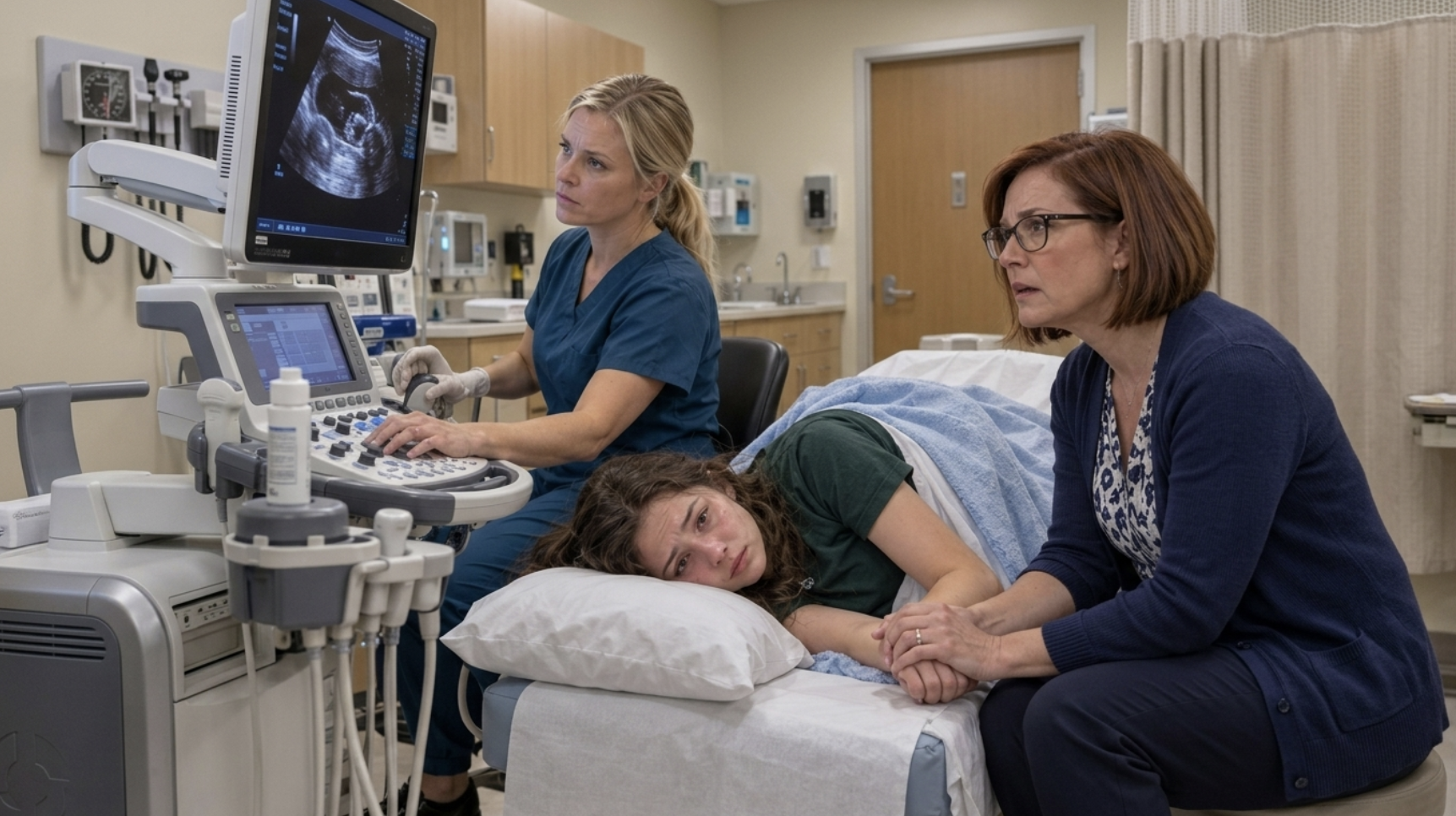
“Sweetheart, I need you to tell me something. When your father took you here five weeks ago, did the doctor explain what was happening?”
She stared at her hands.
“Yes.”
“What did they say?”
For several seconds, she said nothing.
Then she whispered, “They said I needed another scan because they saw something.”
My heart began pounding.
“What kind of something?”
“I don’t remember exactly.”
“That’s okay. Take your time.”
“He was standing beside me when they explained it. They said it might be nothing, but they wanted to look more closely because of where the pain was.”
I looked at the doctor.
He checked the previous notes and explained that the initial examination had identified an abnormality that required further investigation. The available information wasn’t enough to determine precisely what it was, and today’s imaging needed to be reviewed before anyone could draw conclusions.
But one thing was clear.
The earlier medical team had wanted to investigate further.
And my husband had never told me.
I felt as if I were standing on a floor that had suddenly begun to tilt.
“Did your father tell you what the doctor said afterward?” I asked.
My daughter nodded.
“He said the doctor was just being careful. He said hospitals always wanted more tests because they wanted money.”
I closed my eyes.
My husband had always been suspicious of medical expenses. He complained about insurance premiums, prescription costs, and every appointment that interrupted his schedule. I had spent years convincing myself that he was simply practical, the kind of man who worried about bills because he wanted to protect our family.
Now I wondered how many times I had mistaken indifference for responsibility.
“Why didn’t you tell me?” I asked, then immediately regretted the question.
Her face crumpled.
“I wanted to.”
She wiped her cheek with the sleeve of her hoodie.
“I tried calling you that night, but Dad took my phone because I was supposed to be studying. Then he told me that if I made you worry, you’d blame him for taking me to the hospital.”
“Oh, sweetheart.”
“He said you already had too much to deal with. He said you were working extra hours because money was tight, and if I made you think something was wrong, you would panic and make everything worse.”
I reached for her hand.
She let me hold it, but her fingers were cold.
“He said I was being dramatic,” she continued. “When I woke up crying the next morning because it hurt again, he told me I had to stop thinking about it. He said pain gets worse when you keep talking about it.”
I felt tears gathering behind my eyes.
My daughter had been trying to protect me from a problem she was too young to understand, while the person who should have helped her had convinced her that asking for help was selfish.
I wanted to scream.
I wanted to call my husband and demand an explanation that would somehow make this make sense.
Instead, I kissed my daughter’s forehead.
“You should never have had to handle this alone.”
She finally began to cry.
Not loudly. Not dramatically.
She cried the way children cry when they’ve spent too long trying not to.
And I held her until her breathing steadied.
A few minutes later, the doctor returned.
“We’re arranging the next steps now,” he explained. “We need to review the images carefully and consult the appropriate specialist. I don’t want either of you to assume the worst, but I also don’t want you to leave without a clear plan.”
I nodded.
“Whatever she needs, please do it.”
“We will.”
Then he asked whether my daughter felt safe returning home.
The question was gentle, but I understood why he was asking.
I looked at her.
She looked at me.
And after a long pause, she whispered, “I don’t want to go home if Dad is there.”
That was the moment something inside me changed.
Until then, a small part of me had still been searching for a way to excuse my husband. I had imagined misunderstandings, poor judgment, misplaced confidence, and financial anxiety.
But my daughter was afraid to go home.
And whatever explanation my husband eventually offered, that fear was real.
“You don’t have to decide anything this minute,” I told her. “We’ll talk with the hospital team about what happens next. You won’t be left to handle this by yourself.”
The doctor arranged for us to speak with a hospital social worker while the medical team continued its assessment.
Then my phone vibrated again.
This time, a message appeared.
WHERE ARE YOU? THE SCHOOL SAYS YOU PICKED HER UP. CALL ME NOW.
I stared at the screen.
I had signed my daughter out of school, and apparently someone had already informed him.
I typed a reply, deleted it, and placed the phone face down.
I wasn’t ready to speak to him.
Not before I knew more.
Not before my daughter had received the care she needed.
And certainly not while she was still shaking every time his name appeared on my screen.
A moment later, another message arrived.
WHY ARE YOU TAKING HER TO THE HOSPITAL WITHOUT TELLING ME?
I read it twice.
He knew we were at the hospital.
But he didn’t ask whether she was all right.
He didn’t ask what the doctors had found.
He didn’t ask whether she was in pain.
He wanted to know why I hadn’t told him.
I turned the phone off.
For the first time in fifteen years of marriage, I wasn’t worried about how angry my husband might become when he couldn’t reach me.
I was worried about what my daughter had been too frightened to tell me.
And I was beginning to understand that the answer might be much worse than a missed appointment.
The social worker introduced herself as Ms. Reynolds.
She was in her forties, with kind eyes and a calm voice. She didn’t rush us. She explained that her job was to help us understand the support available to our family and make sure my daughter had a safe environment while the medical team investigated her condition.
She asked my daughter whether she wanted me to stay during their conversation.
My daughter immediately reached for my hand.
“Yes,” she said.
So I stayed.
Ms. Reynolds began with simple questions.
How long had the pain been happening?
How often did it occur?
Had it affected school, sleep, or daily activities?
My daughter answered quietly at first. As the questions continued, the story became clearer.
The pain had started months earlier.
At first, it had been occasional. She thought she had pulled a muscle during physical education, and when it didn’t disappear, she assumed it was something teenagers sometimes experienced.
Then it became more frequent.
Some mornings, she struggled to get dressed because bending made it hurt. At school, she had started avoiding the stairs whenever possible. She stopped attending dance practice, something she had loved since she was eight.
I remembered the day she had told me she wanted to quit.
I had been preparing dinner while answering emails from work.
“You’ve worked so hard at dance,” I had said. “Are you sure you want to stop?”
She had shrugged.
“I just don’t like it anymore.”
I had accepted that answer.
Now I wished I had put down my phone and asked her to explain.
There had been other signs, too.
She had stopped sleeping through the night. She sometimes woke up and sat on the edge of her bed, waiting for the pain to settle. She had begun wearing oversized sweatshirts even when the weather was warm because she didn’t want anyone asking why she moved so carefully.
And every time she complained, her father told her the same thing.
You’re fine.
You’re too young to have problems like that.
You spend too much time online reading things that scare you.
Stop trying to get attention.
Ms. Reynolds listened without interrupting.
When my daughter finished, she asked, “What happened after your father took you to the hospital?”
My daughter looked at me.
I squeezed her hand.
“You can tell the truth,” I said. “You don’t have to protect anybody’s feelings.”
She took a shaky breath.
“After we left, Dad told me not to mention the appointment to Mom.”
“Did he explain why?”
“He said Mom would overreact. He said she would accuse him of wasting money and then we’d have another fight.”
My stomach twisted.
“Did he tell you what the doctors had found?”
“He said they hadn’t found anything serious.”
“But you knew they wanted more tests?”
She nodded.
“He said the doctor was probably trying to scare us into paying for more appointments.”
Ms. Reynolds made a note.
“Did you want to come back for the follow-up?”
“Yes.”
“What stopped you?”
My daughter looked down.
“Dad said no.”
The room went very still.
“He said if I kept asking, he would cancel my phone plan and stop driving me to school activities. He said I needed to learn that I couldn’t run the whole family just because I was uncomfortable.”
I felt my grip tighten around her hand.
She noticed.
“Mom, please don’t be angry.”
I turned toward her.
“Angry with you?”
She shook her head.
“I’m sorry I didn’t tell you.”
I moved my chair closer until our knees touched.
“Listen to me. You never need to apologize for being sick. You never need to apologize for asking for help. And you never need to keep a medical problem secret just because somebody tells you it will upset another person.”
She searched my face as if she were trying to decide whether she could believe me.
Then she leaned against my shoulder.
Ms. Reynolds gave us a moment.
When she spoke again, she explained that the hospital would follow its safeguarding procedures and determine what further support was appropriate. She also emphasized that the medical investigation would remain the priority.
I appreciated that she didn’t pretend to know everything already.
There were facts we still needed.
There were questions nobody could answer yet.
And there was a frightened fifteen-year-old who needed adults to take her seriously.
That was enough for now.
Then Ms. Reynolds asked one more question.
“Has anything like this happened before? I mean, have you ever needed medical care and been discouraged from getting it?”
My daughter went rigid.
I felt it before I saw it.
Her hand slipped from mine.
She stared at the floor.
“Sweetheart?” I whispered.
She shook her head.
“It’s okay,” Ms. Reynolds said softly. “You don’t have to answer quickly.”
My daughter swallowed.
Then she looked at me.
“Do you remember when I fell down the stairs last winter?”
Of course I remembered.
She had come downstairs one evening holding the railing, moving slowly and telling me she’d slipped while carrying laundry. Her father had been in the living room watching television.
He had said she was clumsy.
I had asked whether she needed an ice pack, and she had told me she’d already taken care of it.
At the time, I hadn’t seen anything alarming.
“What about it?” I asked.
My daughter pressed her lips together.
“I didn’t fall.”
I stared at her.
“What?”
“I was already hurting. I was going down the stairs, and my leg gave way. I grabbed the railing, but I still fell.”
“Why did you tell me you slipped?”
She looked toward the door.
“Dad told me to.”
I felt a strange numbness spreading through my arms.
“Was he there when it happened?”
She nodded.
“What did he do?”
“He helped me up. Then he said I needed to stop being so careless because you were already stressed about work.”
She paused.
“He told me if I said I was hurt again, you would think he wasn’t taking care of me.”
I couldn’t speak.
My daughter had been falling, hurting, and struggling for months. I had been standing in the same house, loving her, feeding her, asking about her homework, and believing the explanations she had been instructed to give me.
I had thought I knew my child.
I hadn’t realized how much she had learned to hide.
Ms. Reynolds asked a few careful follow-up questions, then explained that they would document the information and help us determine what support was needed.
I barely heard the rest.
My thoughts kept returning to the same question.
How could a father see his child suffering and decide that the bigger problem was the inconvenience of dealing with it?
I didn’t have an answer.
But I knew I couldn’t go back to pretending everything was normal.
It was almost evening when the specialist came to speak with us.
My daughter had undergone further imaging, and the medical team had reviewed the results alongside her earlier records. The specialist explained that there was an abnormal finding that needed additional evaluation. They couldn’t yet say exactly what it meant, and more tests would be necessary before discussing a definitive diagnosis or treatment.
I listened to every word.
I asked questions about the next steps, the urgency, the symptoms we needed to watch for, and whether she would need to stay at the hospital.
The specialist answered patiently.
There was no dramatic declaration. No instant certainty. Just a careful explanation of what they knew, what they didn’t know, and what they needed to do next.
Oddly, that honesty comforted me.
For months, my daughter had been told that nothing was wrong.
Now the doctors were telling us the truth: something needed investigating, and she deserved the chance to find out what it was.
That evening, the hospital arranged the next stage of her care and gave us clear instructions. Because the medical team was concerned about the delay in follow-up and the information we had shared, they also continued coordinating with the safeguarding staff.
I stayed beside my daughter through every conversation.
When a nurse asked whether she wanted something to eat, she shook her head.
When I offered to bring her favorite blanket from home, she hesitated.
Then she asked, “Can we go to Grandma’s instead?”
Her grandmother was my mother, who lived about forty minutes away.
“Of course,” I said. “If the hospital says it’s appropriate for you to leave, we’ll work out somewhere safe for us to stay.”
She looked relieved.
“Can we please not tell Dad where we are?”
I didn’t answer immediately.
I wanted to tell her that we would never have to hide again. I wanted to promise that her father would suddenly understand what he had done, apologize, and become the person she needed him to be.
But promises like that would have been dishonest.
Instead, I said, “We’ll listen to the people helping us, and we’ll make a plan that keeps you safe. You don’t have to handle his reaction yourself.”
She nodded.
Then she fell asleep with her hand wrapped around two of my fingers.
I watched her for a long time.
At fifteen, she was supposed to be worrying about school dances, friends, exams, and whether her favorite singer would announce another tour.
She wasn’t supposed to be wondering whether she was allowed to tell her mother that she was in pain.
I brushed a strand of hair away from her forehead.
“I believe you,” I whispered, even though she was asleep.
“I believe you, sweetheart.”
And for the first time that day, I let myself cry.
My husband finally reached me the next morning.
I had turned my phone back on after speaking with the hospital team, and the screen immediately filled with missed calls and messages.
Twenty-three missed calls.
Several messages demanded to know where we were.
One accused me of embarrassing him by taking our daughter to the hospital without consulting him.
Another said I was encouraging her to become dependent on doctors.
The last message was different.
WE NEED TO TALK ABOUT WHAT YOU’RE TELLING PEOPLE. YOU’RE MAKING THIS MUCH WORSE THAN IT NEEDS TO BE.
I read it twice.
Then the phone rang.
His name appeared.
I stepped into the hallway outside my daughter’s room before answering.
“What?” I said.
“Finally,” he snapped. “Where are you?”
“Our daughter is receiving medical care.”
“I know that. Why didn’t you tell me you were taking her?”
“Because she was frightened to tell you she was still hurting.”
There was a pause.
Then he laughed once, without humor.
“Oh, for heaven’s sake. She’s fifteen. Teenagers exaggerate everything.”
I closed my eyes.
“Did you take her to the hospital five weeks ago?”
Silence.
“Did you?”
“Yes.”
“Why didn’t you tell me?”
“Because I handled it.”
My stomach turned.
“You handled it? The doctor recommended additional imaging. Why wasn’t it done?”
“He said it was probably nothing.”
“The record says they recommended follow-up.”
“Doctors recommend things all the time.”
“She has been in pain for months.”
“She complains about everything!”
His voice echoed through the hallway.
I lowered mine.
“Don’t speak about her like that.”
“Oh, now you’re going to tell me how to parent? You spend half your life at work, and suddenly you think you’re the only one who cares about this child?”
I felt the old reflex rise inside me.
The urge to defend myself.
To explain how many shifts I had covered, how many bills I had paid, how often I had rearranged my schedule to attend school events and take care of the household.
For years, whenever we argued, he redirected the conversation until I was defending myself instead of addressing the original problem.
Not this time.
“Did you tell her not to tell me about the follow-up?”
He exhaled sharply.
“She was already upset. I didn’t want her making you panic over something the doctors hadn’t even diagnosed.”
“So you told her to keep it secret?”
“I told her not to make a big deal out of it.”
“And when she told you the pain was getting worse?”
“She needed to calm down.”
I gripped the phone.
“She was hurting.”
“She always says that!”
The words landed like a slap.
I looked through the open doorway at my daughter, who was sitting up in bed with a book she wasn’t reading.
She was watching me.
She had heard enough to know who was calling.
I stepped farther down the hall.
“You don’t get to decide that her pain isn’t real just because you’re tired of hearing about it.”
My husband went quiet.
Then his voice became colder.
“You need to stop turning this into some accusation against me. I’m her father. I took her to the hospital. I did what I was supposed to do.”
“You didn’t complete the follow-up.”
“I had reasons.”
“What reasons?”
Another pause.
“Money was tight. You know that.”
I stared at the wall.
Money.
Always money.
The mortgage, the car payments, the insurance, the household expenses. We had argued about all of them. But we weren’t destitute. We had insurance, savings, and family who could help if necessary.
If our daughter needed a test, we could have figured it out.
He hadn’t even given me the chance.
“Did you discuss the cost with me?” I asked.
“No.”
“Did you call the doctor to ask whether it could wait?”
“No, but—”
“Did you tell me what was happening so we could decide together?”
“Stop interrogating me!”
I took a breath.
“I’m not interrogating you. I’m asking why you kept our daughter’s medical situation from me.”
“You’re making me sound like some kind of monster.”
“I’m telling you what happened.”
He began talking rapidly, offering excuses, blaming the hospital for being unclear, blaming our daughter for being anxious, blaming me for not noticing the symptoms sooner.
That last accusation nearly broke me.
“If you were paying more attention to her,” he said, “maybe we wouldn’t be in this situation.”
I looked toward the bedroom.
My daughter had lowered her eyes to the book.
I thought of all the times I had asked whether she was okay and accepted her quiet answer.
I thought of the times I had been distracted.
There were things I wished I had noticed sooner. I could admit that without accepting responsibility for his decision to hide the follow-up.
“I wish I had understood how much pain she was in,” I said. “I wish I’d asked better questions. But I didn’t tell her to keep a medical problem secret. I didn’t tell her she was making it up. And I didn’t prevent her from receiving follow-up care.”
“You’re choosing her side over mine.”
I felt something inside me settle.
“This isn’t about choosing sides. It’s about taking care of our daughter.”
“If you keep telling people what happened, you’ll destroy this family.”
I looked through the doorway again.
My daughter was listening.
And suddenly I understood how many years she might have spent hearing some version of that threat.
Don’t tell your mother.
Don’t upset your father.
Don’t make trouble.
Don’t destroy the family.
I spoke slowly, making sure every word was clear.
“Our family is not protected by keeping our child silent.”
Then I ended the call.
My hands were shaking.
But I had never felt more certain of anything in my life.
My mother arrived that afternoon with a bag of clothes, my daughter’s favorite blanket, and enough snacks to feed an entire classroom.
She didn’t ask me to explain everything in the hallway.
She simply hugged me.
Then she went into the room and sat beside her granddaughter.
My daughter looked at her for a moment before bursting into tears.
Grandma wrapped both arms around her.
“Oh, my darling girl,” she whispered. “You don’t have to be brave every minute.”
I stood by the door and watched them.
My mother had always been the person who knew when words weren’t enough. When I was a child, she could tell from the way I set my schoolbag down whether I’d had a difficult day.
I had inherited her habit of noticing small things.
Somewhere along the way, though, I had become so accustomed to managing the demands of work and marriage that I had stopped asking what those small things meant.
I promised myself I wouldn’t make that mistake again.
Once my daughter had settled, my mother joined me outside.
“Tell me everything,” she said.
So I did.
I told her about the first hospital visit, the missing follow-up, the secret, the months of pain, and the way my daughter had reacted whenever her father’s name appeared on the phone.
My mother listened with her lips pressed together.
When I finished, she looked toward the bedroom.
“Has she been afraid of him for a long time?”
I swallowed.
“I don’t know.”
“Then that’s something you need to understand.”
She didn’t tell me to divorce him immediately. She didn’t tell me to forgive him. She didn’t pretend that one conversation could resolve fifteen years of marriage.
She simply reminded me that my daughter needed stability, medical care, and adults who would believe her.
“And you need support, too,” she added.
I sat beside her.
“I keep thinking about every time she said she was fine.”
“Children learn what is safe to tell the adults around them,” my mother said. “Sometimes they tell us what they think we can handle. Sometimes they tell us what they’ve been taught to say.”
I wiped my face.
“I should have known.”
“Maybe there were things you missed. You can learn from that. But don’t confuse missing a sign with deliberately hiding the truth.”
I looked at her.
She took my hand.
“Your job now isn’t to punish yourself for what you didn’t know. Your job is to respond to what you know now.”
Those words stayed with me.
That evening, I made a list.
The specialist appointments.
The questions we needed to ask.
The insurance information.
The school arrangements.
The hospital contact details.
The safeguarding guidance.
And, at the bottom of the page, I wrote one final sentence:
I will not let fear make decisions for my daughter.
I didn’t know what the next weeks would bring.
I didn’t know what the tests would show.
I didn’t know whether my marriage could survive what had happened.
But I knew what had to come first.
My daughter.
Not my husband’s pride.
Not our neighbors’ opinions.
Not the appearance of a perfect family.
My daughter.
“My Husband Hid Our Daughter’s Medical Emergency—Until I Discovered the Truth He Tried to Bury”
Part 1 of 2