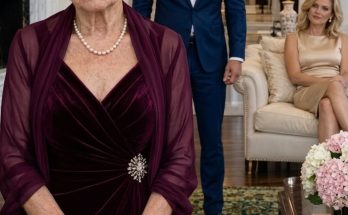
The officers did not leave Linda’s house quickly.
They photographed Sophie’s prepared plate, the jar of peanut satay, the messages telling me not to bring her inhaler, and the evaluator’s paperwork that had been waiting before we arrived.
Rachel placed Sophie’s medical records beside every piece of evidence.
“Her allergy has been documented for years,” she said. “And Linda knew that.”
Linda kept crying.
“I only wanted my granddaughter safe.”
But the private evaluator had stopped taking notes. He was no longer watching me for signs of instability.
He was watching the woman who had prepared an allergen-covered dinner for a six-year-old child and instructed her mother not to bring life-saving medication.
Mark finally stood from the dining chair.
“Mom,” he said, “tell them you didn’t mean it.”
Linda looked at him. “I didn’t mean for anything serious to happen.”
Rachel’s expression hardened.
“Then what did you mean to happen?”
Linda said nothing.
So Rachel played the voicemail again.
After dinner, Sophie will react. Emma will panic, and Mark will look like the stable parent. The evaluator only needs to see chaos.
This time, no one interrupted it.
Mark lowered himself back into the chair. For the first time since I had arrived, he looked frightened.
“You knew about the evaluator,” I said.
He stared at the floor.
“I knew Mom wanted someone there to see how you acted.”
“And you agreed?”
“I thought you would lose your temper.”
I looked at Sophie sitting safely beside Officer Daniels, still holding the apple pie she had made for the people who were willing to endanger her.
“You believed provoking me mattered more than protecting her.”
Mark had no answer.
The officers explained that the custody dispute would be handled by family court, but the evidence involving Sophie’s food and medication would be included in their report. Linda’s house was no longer a place where I would allow my daughter to visit.
Not after that night.
The emergency hearing took place the next morning.
Mark arrived in a navy suit beside his attorney. Linda sat behind him, pale and quiet, looking nothing like the woman who had smiled over the dinner table.
Rachel placed the police report, the prescription records, the screenshots, and the voicemail transcript before the judge.
Mark’s attorney tried to argue that the food had been a misunderstanding.
Then the judge asked a simple question.
“Why was the child’s rescue inhaler specifically excluded from the visit?”
The courtroom went silent.
No one had an answer that could survive the truth.
The judge dismissed Mark’s emergency custody petition within fifteen minutes. She granted me temporary sole legal and physical custody, ordered that any future visitation be supervised, and prohibited Linda from contacting Sophie without court approval.
Mark looked at me as the judge spoke, disbelief slowly turning to panic.
He had entered the courtroom expecting to prove I was dangerous.
Instead, the court had to protect Sophie from his family.
Outside, Mark caught up to me near the courthouse doors.
“Emma,” he said, his voice cracking. “Mom went too far. I didn’t know she would use food.”
“You knew enough to wait there with an evaluator,” I replied.
He reached for my arm. I stepped back.
“You do not get credit for being shocked after the plan fails.”
Sophie waited beside Rachel, holding my hand.
As we walked away, she looked up at me.
“Can I still bake pies?”
I knelt in front of her.
“Yes, sweetheart. You can still bake anything you want.”
But I knew that from then on, every box would need a new label.
Not for Grandma.
Not for family dinner.
For Sophie.
Safe for me.
Part 4: The Father Who Ch Chose His Mother’s Lie
The court order protected Sophie immediately.
Mark could not contact her directly. Any visit had to be supervised, and Linda was not allowed near our daughter without court approval.
For the first week, Mark sent messages through his attorney saying he wanted to “make things right.” Then the messages changed.
He said I had humiliated him.
He said I had brought police to a private family disagreement.
He said I was using Sophie to punish him.
Rachel read every message before I did. “He still doesn’t understand what happened,” she told me.
“He understands,” I said. “He just doesn’t want responsibility.”
The investigation into Linda’s actions continued. The officers confirmed that she had known about Sophie’s allergy, knew Linda had told me not to bring the rescue inhaler, and documented the voicemail describing the plan to provoke an emergency.
Linda claimed she had never intended to hurt Sophie.
But intent did not change the peanut sauce on the child’s plate.
Nor did it change the evaluator waiting in the living room, the custody petition filed hours before dinner, or Mark sitting quietly while everyone expected me to panic.
Three weeks later, Mark asked for a supervised visit.
I agreed because Sophie deserved to see who her father chose to be when there were rules, witnesses, and no grandmother directing the room.
The visit took place at a family services center. Sophie brought a coloring book and sat beside the social worker while Mark walked in carrying a stuffed rabbit.
He looked thinner than I remembered.
“Hi, Soph,” he said.
She did not run to him.
“Hi, Daddy.”
The distance in those two words broke something in his face.
He sat across from her and held out the rabbit. “I got this for you.”
Sophie looked at it, then at him.
“Is Grandma going to be there?”
Mark swallowed. “No.”
“Is there peanut food?”
“No. Never.”
She nodded, but she did not take the rabbit.
“Why did you want me to get sick?” she asked.
The room went silent.
Mark looked toward me, then toward the social worker, as if someone else might save him from having to answer his own daughter.
Finally, he said, “I didn’t want you to get sick.”
“But you knew Grandma was making dinner.”
“Yes.”
“And you knew Mommy was scared?”
His eyes filled.
“Yes.”
Sophie looked down at the coloring book. “Then you should have helped us.”
No attorney could have made that truth clearer.
That evening, Rachel filed for divorce.
Mark did not fight at first. Then Linda convinced him that agreeing would make him “look guilty,” and he changed his mind.
So Rachel prepared every record.
The emergency account he emptied when he left. Messages about his assistant. Linda’s custody scheme. The police report. The supervised-visit notes. Every time he had chosen to defend his mother’s reputation instead of asking whether Sophie was safe.
By the time Mark’s attorney saw the full file, the tone changed again.
He offered a settlement.
Rachel placed it in front of me and said, “You have the final decision.”
I thought about the Uber ride. Sophie holding the pie. The empty pocket where her inhaler should have been.
Then I thought about my daughter asking whether she could still bake.
“I want peace,” I said. “But I want it on paper.”
The settlement gave me primary custody, strict medical safeguards, supervised visitation, and a clear rule that Linda could not contact Sophie unless a court later approved it.
Mark signed two rule that Linda could not contact Sophie unless a court later approved it.
Mark signed two weeks later.
Before he left Rachel’s office, he asked whether Sophie would ever forgive him.
I looked at him.
“That will depend on what you do next,” I said. “Not what you say now.”
Part 5: The Pie Box That Finally Meant Safety
My lawyer called as I rode to my mother-in-law’s “family dinner” warned, “St0p the car. It’s a setup.” She reve:a:led their secret plan. I thought she was overreacting—until I opened my pu:rse and realized my mother-in-law had c0nvinced me to leave my daughter’s res:cue inha:ler behind.
Part 2 of 3