PART 3
Grant glanced at Brooke.
For the first time that morning, neither of them looked annoyed with me.
They looked worried.
I remained seated in the blue plastic chair, my handbag resting neatly on my lap.
Brooke marched toward me.
“Mom, come here. They need you to sign something.”
I looked up at her.
“What do they need me to sign?”
“Some paperwork. Can you please not make this difficult?”
“I haven’t made anything difficult, Brooke. I’ve been sitting here waiting.”
She glanced toward the counter, where Grant was speaking rapidly to the supervisor.
“Fine. Just come over there.”
I stood, straightened my jacket, and followed her.
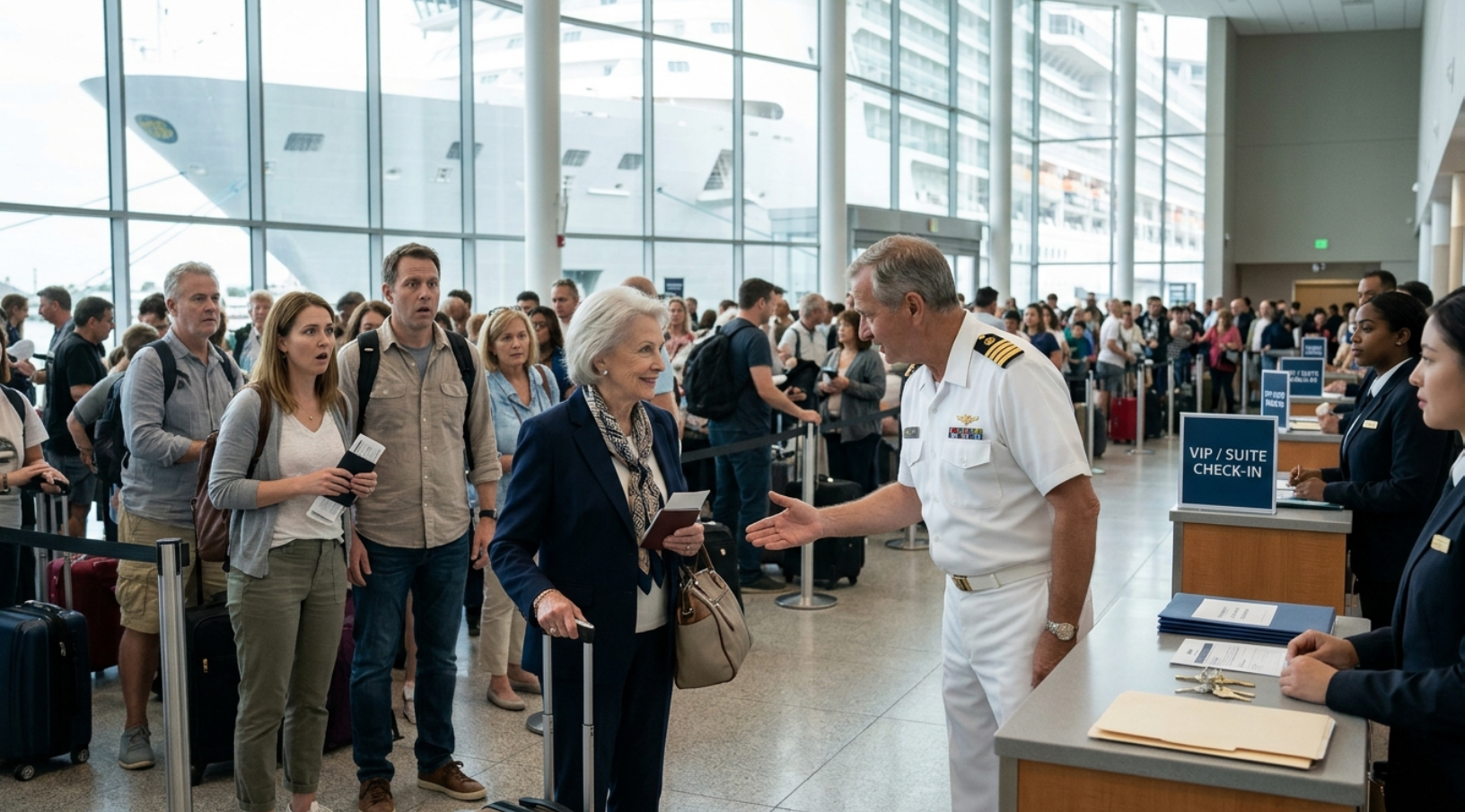
The check-in agent welcomed me politely. She was a young woman with a name tag that read Melissa. Her expression softened when she saw the old brass badge pinned inside my jacket.
“Mrs. Danforth?”
“Yes.”
“Could I please see your identification and retiree documentation?”
I handed them over.
She examined the documents, entered something into her computer, and then paused.
Her eyes moved from the screen to my face.
“Are you Tony Danforth?”
“I am.”
She sat a little straighter.
“My training supervisor mentioned you during orientation. She said you helped develop some of the original hospitality standards our ships still use.”
I smiled.
“Those standards have changed quite a bit since then.”
“Apparently not as much as you’d think.”
Behind her, Grant cleared his throat loudly.
“Can we get this moving? We have three cabins waiting.”
Melissa turned back to the screen.
“Yes, sir. I just need to verify the sponsor’s authorization.”
She printed three documents and arranged them on the counter.
Then she looked directly at me.
“Mrs. Danforth, these forms authorize the listed guests to sail under your retiree companion benefit. Before I can proceed, I need you to confirm that you personally approve all three reservations.”
I picked up the first sheet.
My name appeared at the top.
Below it were the names of Brooke, Grant, Patrice, and Dale, divided among the three balcony staterooms.
The numbers were familiar.
So were the dates.
But at the bottom of each form was a declaration stating that I had reviewed the booking conditions, understood the financial terms, and personally agreed to sponsor the guests.
I had never signed these forms.
I turned the first page over.
“Melissa, who submitted the original reservation?”
She checked the record.
“The booking was made through an authorized travel advisor. The reservation notes indicate that the sponsor had been informed of the arrangement.”
“Which sponsor?”
“You, ma’am.”
I nodded slowly.
“And where is my signature?”
Melissa looked again.
“There isn’t one on the reservation record. That’s why we need your verification here.”
Grant stepped closer.
“Tony, just sign it. We have a ship to catch.”
I looked at him.
“Did you tell your parents these cabins were purchased using my retiree benefit?”
His jaw tightened.
“This isn’t the place for that conversation.”
“Then perhaps you shouldn’t have made it the place where I have to approve the transaction.”
Patrice approached, her expensive sunglasses pushed onto the top of her head.
“What is happening? Why are we standing here?”
Grant immediately changed his tone.
“It’s an administrative problem. Tony just needs to sign a form.”
Patrice looked at me.
“Then sign it, dear. We have reservations for lunch, and Dale gets uncomfortable standing too long.”
I glanced at the woman who had spent months telling people that my entire career consisted of answering telephones.
“Patrice, how much did Grant tell you your cabin cost?”
She blinked.
“What?”
“Your cabin. How much did you pay him?”
Grant interrupted sharply.
“Tony!”
But I continued looking at Patrice.
She hesitated.
“Four thousand one hundred dollars. Why?”
I turned to Melissa.
“Would you please print the original booking summary, including the fare charged to each guest and the applicable companion-benefit terms?”
Melissa hesitated for only a second before nodding.
“I can provide the guest-facing fare breakdown and the relevant reservation information.”
Grant’s face had lost its color.
“You don’t need to do that,” he told her.
“Actually,” I replied, “I believe we do.”
For the first time in months, I wasn’t trying to keep everybody comfortable.
I wasn’t attempting to protect Brooke from embarrassment, Grant from consequences, or Patrice from discovering that the son she praised so enthusiastically had been less than honest with her.
I was simply asking a question.
And questions, I had learned over forty-four years at sea, were often the beginning of a storm.
The printer hummed behind the counter.
Melissa returned with the booking summary.
She placed it in front of Patrice first.
“Your reservation shows a companion fare of $834 per guest before the applicable taxes and fees. The total for two guests is $1,668.”
Patrice stared at the page.
Then she looked at Grant.
“You told us four thousand one hundred dollars.”
Grant folded his arms.
“That included other expenses.”
“What expenses?” Dale asked.
Grant turned toward his father.
“Transportation, arrangements, insurance. There were several things involved.”
“Then where are the receipts?” Dale asked.
Grant’s eyes narrowed.
“This is a family vacation, not an audit.”
Dale took off his glasses and cleaned them with the corner of his shirt.
“I’m a retired accountant, son. You don’t get to tell me an invoice is unnecessary after charging me more than four thousand dollars.”
Patrice slowly lowered the paper.
“You said the cruise line gave you a special industry rate.”
Grant didn’t answer.
“You told everyone you had arranged a discount through your company.”
“Mom, please.”
“No.” Her voice sharpened. “You explained to your father and me that the price was a privilege you had negotiated. You said the company would never offer it to ordinary customers.”
She looked at me.
“And you knew?”
“I suspected there was a discrepancy. I didn’t know the full amount until today.”
That was the truth.
I had seen the numbers. I had recognized the benefit. But I had not known precisely what Grant had told his parents or what he had kept for himself.
Patrice looked back at her son.
“Did you use Tony’s retirement benefit?”
Grant rubbed his forehead.
“The benefit was available. Tony was retired. She wasn’t using it.”
“That’s not what I asked you.”
He said nothing.
The silence grew.
Behind us, hundreds of passengers moved through the terminal. Children dragged suitcases. Couples checked passports. Porters called out luggage numbers. Somewhere in the distance, a ship’s horn sounded, low and deep.
Brooke stood beside Grant, staring at the paperwork as though the words might rearrange themselves if she looked long enough.
Finally, she turned to me.
“Mom, why didn’t you tell me you knew?”
I gave her a tired smile.
“I tried.”
“You never said Grant had done something wrong.”
“I told you the cabins were attached to my benefit. I told you my signature would be required. I told you the paperwork had to be correct.”
“You made it sound like you were upset about being left out.”
“I was upset about being left out. I was also concerned about the reservations. Those things can both be true.”
She looked away.
I could almost see the old argument forming behind her eyes. The Christmases I had missed. The birthdays I had celebrated over telephone lines. The years she had waited for a mother who always seemed to be somewhere else.
I understood those memories.
I had carried them for decades.
But I had finally learned that an apology for the past did not require me to surrender every boundary in the present.
Grant reached for the papers.
“We can discuss the price later. Tony, sign the forms so we can board. The kids have been looking forward to this for months.”
There it was.
The children.
He had discovered the one argument he believed I could never refuse.
He was right about one thing.
I would do almost anything for Lily and Owen.
But I would not sign a declaration that was false simply because someone had placed two children in the middle of an adult problem.
I looked at Melissa.
“What happens if I don’t authorize the reservations?”
She explained that the cruise line would need to resolve the fare discrepancy under the applicable booking rules. Depending on the guests’ choices and the terms of the reservations, they might have to pay the applicable public rate, arrange another eligible fare, or cancel.
“Can they still sail if they pay the required difference?” I asked.
“If inventory and the fare rules permit it, yes. We would need our reservations team to confirm the options.”
“Then please have them explain those options to everyone involved.”
Grant stared at me.
“You’re seriously going to risk the entire vacation over a signature?”
“No, Grant. I’m refusing to pretend that a signature is meaningless.”
“You know how much this cruise cost us?”
“I know what it cost me.”
“You paid a thousand dollars!”
“Actually, I paid $1,043 for my cabin. I also paid for my own transportation, my own meals, and every other expense you insisted was separate.”
“That’s your choice!”
“Yes,” I said quietly. “It was.”
He opened his mouth, then closed it.
I turned back to Melissa.
“I am willing to authorize legitimate reservations once the cruise line has clarified the terms and all the guests understand what they are agreeing to. But I will not sign anything that falsely suggests I approved these arrangements in advance.”
Melissa nodded.
“I understand, Mrs. Danforth. I’ll ask the reservations manager to review the bookings.”
She picked up the telephone.
And for the first time since we’d arrived at the terminal, nobody told me to hurry.
The call lasted nearly twelve minutes.
During those twelve minutes, my family experienced what I had spent much of my career learning to recognize: the uncomfortable space between what people believe they are entitled to and what the facts actually permit.
Grant paced in short, angry lines.
Brooke stood with her arms folded tightly across her chest.
Patrice read the fare summary repeatedly.
Dale asked Melissa two precise questions about the taxes and cancellation terms, then quietly requested copies of the relevant documents.
I sat down again.
My knees had begun to ache.
At seventy-one, I had learned that dignity did not require standing through every uncomfortable moment.
It only required knowing when to stand.
A few minutes later, Melissa hung up.
“The reservations manager would like to speak with the sponsor directly. Would you please come with me?”
She led me to a small desk beside the service counter.
A man wearing a navy uniform approached from the ship’s side of the terminal. His name tag read Hotel Operations.
He introduced himself as Daniel Mercer.
“Mrs. Danforth, thank you for your patience. I’ve reviewed the reservation history. There are some irregularities we need to clarify before we can finalize these companion bookings.”
“What kind of irregularities?”
“The reservations were created under your benefit, but the sponsor verification was never completed. We also have a note suggesting you were aware of the arrangement.”
“I’m aware of it now. I wasn’t aware of the specific bookings when they were made.”
He nodded and made a note.
“Thank you for clarifying. We can work with that.”
Grant immediately moved closer.
“Look, this is being blown out of proportion. Tony is my mother-in-law. We all agreed to take this cruise together.”
Daniel looked at him.
“Did Mrs. Danforth personally authorize the companion bookings before they were made?”
Grant hesitated.
“She knew we were going.”
“That wasn’t my question.”
“No. She didn’t sign anything before the booking.”
“Did you represent to your parents that their cabins had been purchased through an industry discount?”
Grant’s face tightened.
“That’s a private family matter.”
Daniel remained calm.
“I’m not asking about your family relationships. I’m trying to establish whether the guests were given accurate information about the fare arrangement.”
Patrice answered before Grant could.
“Yes. He told us it was an industry discount.”
Daniel looked at the papers.
“Thank you, ma’am.”
Grant swung toward his mother.
“Can you please stop talking?”
Patrice’s expression changed.
For months, she had treated me as an inconvenience. She had praised Grant for his business acumen and dismissed my questions as the interference of an old woman who didn’t understand modern life.
Now she was seeing another side of the story.
“You told me to trust you,” she said.
“I was trying to organize a vacation!”
“You collected money from your parents.”
“I was going to pay for things!”
“Then show us what you paid for.”
Grant looked at Brooke.
“Are you going to let them talk to me like this?”
Brooke didn’t answer.
That silence frightened him more than my refusal had.
Daniel turned back to me.
“Mrs. Danforth, we can separate the issue of your authorization from the issue of what the other guests were told. I want to be clear that you are not obligated to sign an inaccurate declaration just to keep the reservation moving.”
“Thank you.”
“We’ll see what fare options remain available. If the other guests choose to proceed under the correct terms, we’ll explain the costs before asking anyone to commit.”
I nodded.
That was all I had wanted.
Not revenge.
Not humiliation.
Just an honest transaction.
Then Daniel glanced at my jacket.
His eyes settled on the brass badge.
“May I ask where you received that?”
I took it between my fingers.
“Seabritte gave it to me when I retired.”
He looked at it more closely.
Then he looked at my face again.
“Tony Danforth?”
“Yes.”
His expression changed.
“I’m sorry. I didn’t recognize you at first.”
“You weren’t expected to.”
“My training director still references the original hotel-service standards you helped establish. I believe the induction program includes your work on guest recovery and crew welfare.”
I laughed softly.
“Then I hope they also tell people that the standards were written by a team. No director builds a ship’s culture alone.”
Daniel smiled.
“I’ll remember that.”
Behind us, Grant made a small, frustrated noise.
“Can we please stop discussing her career?”
Daniel turned toward him.
“Mr. Hale, your family’s reservations are currently under review. Mrs. Danforth’s professional history is not relevant to whether you can board, but it is certainly not something I would dismiss in this terminal.”
Grant went silent.
And just like that, the man who had spent months telling everyone that nobody remembered who I used to be found himself standing in front of a stranger who remembered the work I had done.
But the greatest surprise of the afternoon had not yet arrived.
It came when Daniel asked the reservations manager to review the original booking notes.
One entry, written in January, had been overlooked.
It read:
“Sponsor requests that all companion fares remain subject to direct confirmation by Mrs. Danforth. Do not substitute third-party authorization.”
Below it was a timestamp from the day Dana had first spoken with Brooke and Grant.
The note had been entered before any of the balcony cabins were finalized.
Daniel read it twice.
Then he looked at Grant.
“Sir, the travel advisor appears to have explained the authorization requirement before these bookings were completed.”
Grant’s mouth opened.
Nothing came out.
Brooke slowly turned toward him.
“You knew?”
He looked at her.
“Brooke, it’s not what you think.”
“Then tell me what it is.”
He lowered his voice.
“We were going to sort it out.”
“When?”
“Later.”
“After we boarded?”
He didn’t answer.
She looked at the three reservation documents on the counter.
Then she looked at me.
For the first time that day, she seemed to notice how tired I was.
My old shoes.
My small suitcase.
The inexpensive cabin confirmation tucked into the side pocket of my handbag.
She seemed to remember that I had arrived in a rideshare because there had been no room for me in their SUV.
“Mom,” she whispered, “did you know they were going to do this?”
“No,” I replied. “I knew there was a problem. I didn’t know how far it went.”
She covered her mouth.
I wanted to reach for her.
I wanted to tell her everything would be all right.
But I didn’t know that yet.
And I was tired of promising comfort before the truth had been spoken.
So I waited.
Twenty minutes later, the reservations manager returned with a revised set of options.
The cruise line could not simply pretend that the original verification had occurred. The sponsor authorization still had to be completed properly, and the guests had to accept the applicable terms.
The manager explained the choices.
Each guest could proceed if an eligible fare was available and the required amount was paid, or they could decline and follow the applicable cancellation provisions.
No one would be forced to sign.
No one would be allowed to use my name as though my approval were automatic.
Patrice and Dale asked to see their full fare breakdown.
Grant objected.
Then Patrice did something I had never seen her do before.
She took a step away from her son.
“From now on,” she said, “you will provide us with an actual invoice before we reimburse you for anything.”
Grant looked stunned.
“Mom, you’re making this worse.”
“No. I’m finally asking questions.”
Dale nodded.
“We’ll resolve the cruise fare separately. But the money we already gave you needs to be accounted for.”
Grant stared at his father.
“You think I stole from you?”
“I think we need to see the records before deciding what happened.”
For once, Dale’s calmness was more powerful than anger.
Brooke had been reading the reservation documents.
Finally, she approached the manager.
“What would it cost for us to keep the cabins if we paid the proper fare?”
The manager explained that the exact price depended on availability and the fare rules. He would confirm the current options before quoting a final amount.
Brooke nodded.
“Please do that.”
Then she turned to me.
“Mom, I need to ask you something.”
“Go ahead.”
“Would you still want us to go on this cruise if everything were handled correctly?”
It was such a simple question.
Yet I could hear the eleven-year-old girl who had once waited beside a window in a red velvet dress.
I could hear the thirteen-year-old who had told me I was a postcard.
I could hear all the years of resentment, disappointment, and missed moments between us.
“Yes,” I said. “I wanted us to have a good week together. I still do.”
“Even after what Grant did?”
I looked at my daughter carefully.
“I can love you and the children without pretending that dishonesty is acceptable. Those things aren’t opposites.”
Her eyes filled with tears.
“I thought you were trying to punish me.”
“I wasn’t.”
“You could have canceled everything before we got here.”
“Yes.”
“Why didn’t you?”
I looked past her, toward the glass doors leading to the ship.
“Because I wanted the children to have their vacation. And because I wanted you to have the chance to make the right decision once you understood what was happening.”
She looked down at the papers.
“I don’t know what to say.”
“You don’t have to say anything right now.”
For several seconds, neither of us spoke.
Then Brooke did something unexpected.
She reached for my hand.
It was not a dramatic embrace.
It did not erase the Christmases I had missed or the years we had spent talking around our pain.
It was only a hand resting in mine.
But I had spent enough years at sea to know that small things could matter more than grand gestures.
Behind us, Daniel returned with an update.
There were still cabin options available, though not necessarily at the original companion rates. The family would need to decide whether to accept the revised terms.
Brooke looked at Grant.
“We’ll pay whatever is required for our own family if the price is reasonable. But we’re not going to keep pretending this was an industry discount.”
Grant’s expression hardened.
“You can’t make that decision without me.”
“Then make it with us,” she replied. “Honestly, for once.”
Patrice and Dale agreed to handle their own booking directly.
The manager gave everyone the figures and the available alternatives.
For the next half hour, the family worked through the choices. Some costs could not be avoided, and the original promotional terms could not simply be restored. Grant was angry about the additional expense. Patrice was angry about the missing explanation. Brooke was embarrassed.
But gradually, the shouting stopped.
Documents were signed only after their contents were understood.
Payments were made by the people who agreed to them.
And when the manager finally turned to me, he asked the question that had brought us all to the counter.
“Mrs. Danforth, are you willing to authorize the companion reservations that remain eligible under the corrected terms?”
I reviewed every page.
I asked two questions.
I checked the guest names.
Then I signed.
Not because Grant had demanded it.
Not because Brooke had cried.
Not because I was afraid of disappointing my grandchildren.
I signed because the paperwork was accurate, the arrangements had been explained, and I was choosing to help.
There is a difference between being used and choosing to give.
I wanted my family to understand that difference.
When the final authorization went through, Melissa smiled.
“Everything is now properly documented, Mrs. Danforth.”
“Thank you.”
Grant took his cabin documents without looking at me.
Patrice did not speak to him.
Dale quietly thanked Melissa and asked for a copy of every receipt.
Brooke stayed beside me.
And somewhere behind us, a boarding announcement echoed through the terminal.
For a moment, I thought the most difficult part of the day was over.
I was wrong.
Because when we finally walked toward the gangway, a crew member hurried down the corridor, looking directly at me.
“Mrs. Danforth?”
I turned.
“Yes?”
“Mr. Maritch has been asking for you. He says he would very much like to welcome you aboard personally.”
I smiled.
“Luca is still working, then.”
The crew member laughed.
“He says he always will be.”
I stepped onto the ship.
And for the first time in years, I did not feel like a woman who had spent her life leaving.
I felt like someone who had finally come home.
But as I reached the entrance to the atrium, I heard Patrice whisper behind me.
“Grant, there’s something else you need to explain.”
I turned just enough to see her holding another page from the reservation file.
Her face had gone completely still.
At the top of the page was the heading:
“Guest Reimbursement Record — $4,100 Received.”
Below it were two lines.
The first showed the actual companion fare paid for her and Dale.
The second showed the amount Grant had recorded as an additional charge.
And beside that second amount was a handwritten note.
Patrice read it aloud.
“‘Additional services and private arrangements.’”
She looked at her son.
“What private arrangements, Grant?”
He said nothing.
And I realized that the truth about the cruise had only just begun to surface.
PART 4
Grant reached for the paper in his mother’s hand.
“Give me that.”
Patrice pulled it away.
“No. Not this time.”
The atrium around us glittered with polished brass, glass elevators, and sunlight pouring through the enormous windows. Passengers laughed as they boarded, unaware that one family was coming apart beside the grand staircase.
Grant lowered his voice.
“I was handling the arrangements. There were additional costs.”
“Then show me the receipts,” Dale said.
“I don’t have everything with me.”
“You collected the money five months ago.”
Grant glanced at Brooke, silently asking her to intervene.
She didn’t.
For the first time in their marriage, she seemed unwilling to rescue him from a situation he had created himself.
Patrice studied the document again.
“You told us Tony had nothing to do with our cabins. You told us you had negotiated a special rate. You made us believe you were doing us a favor.”
“I was doing everyone a favor!” Grant snapped. “Do you have any idea how much work it takes to organize something like this?”
I stood quietly beside my suitcase.
I had organized thousands of embarkations during my career. I had watched families arrive exhausted, couples argue over luggage, and passengers become furious over problems that could have been resolved with a little patience.
But I had never seen a man work so hard to avoid one simple question.
Where had the money gone?
Dale folded the paper.
“Grant, we’re not discussing this anymore today. You will provide us with a complete accounting after the cruise. If there are legitimate expenses, we’ll consider them. If there aren’t, we’ll expect the difference returned.”
Grant’s face reddened.
“You’re treating me like a criminal.”
“No,” his father replied. “I’m treating you like an adult who owes his parents an explanation.”
Patrice looked at me.
“Tony, I owe you an apology.”
I hadn’t expected that.
She removed her sunglasses and held them in one hand.
“I repeated things about your career that I never bothered to verify. I allowed myself to believe that you were simply an inconvenience because that’s what Grant led me to believe.”
She paused.
“And I was unkind to you.”
I could have reminded her of the things she had written online. I could have listed every dismissive remark and every time she had spoken about me as though I were too old to understand the world.
Instead, I said, “Thank you for saying that.”
She seemed surprised that I didn’t demand more.
But an apology wasn’t a magic eraser. It was a beginning.
And beginnings needed time.
That evening, the Seabritte Lumina sailed away from Port Everglades.
The sun sank behind the Florida coastline, leaving a trail of gold across the water.
My cabin was small, exactly as I had expected. There was no balcony, and the windowless walls were decorated in a shade of cream that reminded me of old hotel corridors.
But everything was clean.
The bed was comfortable.
And nobody had told me I didn’t belong there.
I unpacked my suitcase, placed my brass badge on the desk, and sat down.
For a long time, I listened to the gentle hum of the ship.
I had spent twenty-one years living at sea. I knew the sounds of an operating vessel almost as well as I knew the sounds of my own house.
A distant announcement.
The soft vibration of the engines.
Footsteps in the corridor.
The quiet rhythm of a ship carrying thousands of people toward somewhere new.
I thought about Walt, my late husband, who had spent so many years raising Brooke while I worked aboard ships.
He had never accused me of abandoning my career.
But he had sometimes looked lonely when I returned home.
After he died, Brooke told me that I had missed too much of her childhood.
She was right.
I had spent years trying to compensate for that absence with money, gifts, and endless patience.
Whenever she spoke sharply, I swallowed my response.
Whenever Grant dismissed me, I tried harder to be helpful.
I had mistaken self-erasure for love.
That evening, I finally admitted something to myself.
I could regret the years I had missed without allowing the rest of my life to be treated as an apology.
A knock sounded at my door.
When I opened it, Lily stood in the corridor, holding a small paper bag.
“Grandma?”
“Hello, sweetheart.”
She stepped inside and looked around.
“This is your room?”
“Yes.”
She glanced at the walls.
“It’s smaller than ours.”
“It certainly is.”
Her face crumpled.
“I’m sorry.”
I knelt in front of her.
“What are you sorry for?”
“Mom said we couldn’t put you in the family pictures because you had a different cabin. And Dad said you were making everything difficult.”
I took her hands.
“Lily, listen to me. Adults are responsible for their own choices. You don’t have to carry their arguments.”
“But you were sad.”
I smiled gently.
“Sometimes people are sad even when nobody has done anything wrong. And sometimes people need to admit when they’ve made a mistake. Both things happen in families.”
She opened the paper bag.
Inside was a small chocolate cake with a crooked icing flower.
“I asked the kitchen if they could make this for you.”
I laughed.
“You negotiated with the kitchen staff?”
She nodded proudly.
“I told them my grandma used to work on ships, and they said they wanted to meet you.”
I felt my eyes sting.
“That’s the most beautiful cake I’ve ever seen.”
It wasn’t.
But it was the most thoughtful.
Lily hugged me tightly.
“Can I have breakfast with you tomorrow?”
“Of course.”
“And can Owen come?”
“Especially Owen.”
She smiled, relieved.
Then she hesitated.
“Grandma, are you going to leave us again?”
The question landed harder than anything Grant had said all day.
I brushed a strand of hair away from her face.
“No, sweetheart. I’m not going anywhere tonight.”
She nodded, apparently satisfied with that answer.
After she left, I placed the little cake on the desk beside my brass badge.
Two objects.
One representing the career that had taken me across the world.
The other representing the family I had spent so many years trying to reach.
For the first time, I didn’t feel that I had to choose between them.
The following morning, I met Lily and Owen for breakfast.
Owen arrived wearing a T-shirt with a cartoon shark on it and carrying a folded sheet of paper.
“Grandma, I made something.”
He unfolded it across the table.
It was a drawing of a cruise ship with four people standing on the deck. A woman with gray hair stood between two children. The fourth figure was a man with a large smile.
Above the ship, Owen had written:
FAMILY DOESN’T NEED PERFECT CABINS. IT NEEDS EVERYONE.
I stared at the drawing.
“That’s wonderful.”
“I made another version,” he said. “But Mom cried when she saw it, so I thought I’d give you this one.”
Lily nudged him.
“You weren’t supposed to tell her that.”
“I didn’t say why she cried.”
They began arguing about the placement of the cartoon shark.
I laughed so hard that a nearby passenger turned around to see what was happening.
For a few minutes, everything felt simple.
Then Brooke appeared at the entrance to the restaurant.
She stood watching us before approaching the table.
“Can I sit with you?”
“Of course,” I said.
She sat beside Lily.
For a while, she watched the children argue about whether the ship needed a second funnel.
Then she looked at me.
“I owe you an apology, too.”
I put down my coffee.
“I’m listening.”
She took a breath.
“I knew you had worked for Seabritte for years. I knew you’d been a director. I knew you had done important things. But I let myself believe that none of it mattered because I was angry about what I missed.”
I said nothing.
“I spent so much of my life thinking that if you really loved me, you would have chosen to be home. And when I became a mother, I couldn’t understand how you had made the choices you made.”
Her voice trembled.
“I thought you were asking me to forgive you every time you offered to help. And I resented it. Then Grant started saying you were controlling, that you wanted to prove you were better than everyone else, and it was easier to believe him than to admit that I still felt hurt.”
She looked down at her hands.
“I made you pay for the past over and over again.”
I felt a familiar ache in my chest.
“Brooke, I did miss things. I missed your Christmas when you were six. I missed school events. I missed evenings when you needed me.”
“You did.”
“And I’m sorry.”
Her eyes filled.
“But I can’t go back and change those years,” I continued. “I can only be honest about them. I can love you today. I can listen when you’re hurt. But I can’t keep accepting cruelty as the price of being your mother.”
She wiped her cheeks.
“I understand.”
“I hope you do. Because I want a relationship with you that doesn’t depend on one of us feeling guilty all the time.”
Brooke reached across the table.
“I want that, too.”
I took her hand.
We didn’t solve everything over breakfast.
We didn’t pretend that a few tears could repair decades of complicated feelings.
But we made a promise to stop using the past as a weapon and to begin talking honestly about what had happened.
It was more than we had managed in years.
And it was enough for that morning.
The cruise continued through the Caribbean.
We visited turquoise bays, walked through colorful markets, and watched the sunset from the upper deck.
Brooke and I spent one afternoon sitting beneath an awning while the children played nearby.
She asked me about my career.
Not the simplified version she had used when introducing me to friends.
She wanted to know what I had actually done.
So I told her.
I told her about the first ship where I had worked as a young woman in 1977, answering telephones while men twice my age assumed I would never advance beyond the reception desk.
I told her about the first time a passenger complained that a woman shouldn’t be responsible for hotel operations.
I told her about the long hours, the difficult inspections, and the crew members who had worked through illness and exhaustion because thousands of guests depended on them.
I told her about Luca Maritch, whom I had hired when he was a young assistant waiter.
“He was so nervous on his first day,” I said. “He dropped an entire tray of glasses.”
Brooke laughed.
“What happened?”
“I helped him clean it up. Then I told him that the only unforgivable mistake was refusing to learn from the first one.”
“Is that why he remembered you?”
“Partly. He was a good young man. He worked hard, and he treated people with respect. I simply gave him an opportunity.”
Brooke looked toward the water.
“I don’t think I ever understood your job.”
“I didn’t make it easy for you to understand. I was always leaving before I had explained why I was going.”
She turned back to me.
“Do you regret it?”
I thought carefully before answering.
“I regret the pain my absence caused you. I regret the promises I couldn’t keep. But I don’t regret becoming the person I became.”
She nodded slowly.
“I think I can understand that now.”
Then she asked me a question I had waited years to hear.
“What was your favorite part of the job?”
I smiled.
“The people.”
“Not the ships?”
READ CONTINUE PART
My Family Separated Me From Their Cruise—Until the Ship’s Director Called Me “Welcome Home”
Part 1 of 2