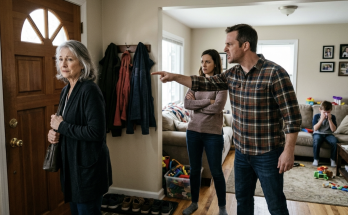
“I can’t change what happened two years ago. I can’t give you back those nights you worked or the boat you sold. And I know an apology doesn’t erase the way you felt sitting at that Easter table.”
He paused.
“But I’m sorry.”
Nate stared at his father for a long moment.
“Thank you for saying that.”
Ronald nodded, looking relieved but not expecting anything more.
Then Nate continued.
“I don’t want you to pay us back. We bought this house because we wanted to build something ourselves. But I need you to understand that being independent doesn’t mean we should be treated differently.”
“I understand,” Ronald whispered.
“And if we ever need help in the future, I hope we can ask without being made to feel ashamed.”
Ronald looked directly at his son.
“You can.”
It wasn’t a perfect reconciliation. Years of pride and disappointment couldn’t disappear in a single afternoon.
But it was a beginning.
Then Ronald turned toward Opal.
“Grandma, I owe you an apology, too.”
Opal raised an eyebrow.
“That will take more than one afternoon, young man.”
A few people laughed, and the tension finally began to ease.
Later, as the family prepared to leave, Judy approached me near the porch.
“I’ve thought about that Easter dinner many times,” she admitted. “I told myself you were the strong ones and the others needed more help. It was easier than admitting that I might have been unfair.”
I nodded.
“I never wanted you to feel that you couldn’t help us. I just wanted you to understand that we had struggles, too.”
She took my hands.
“I understand now.”
She didn’t offer us money, and I didn’t ask for any.
Instead, she asked whether she could come back the following Saturday to help me plant flowers along the porch.
I told her she was welcome.
As I watched everyone drive away, I felt something inside me finally loosen.
For two years, I had carried the memory of that bluebird card like a small stone in my pocket. It reminded me that even people who loved us could overlook our pain.
That day, I finally stopped carrying it.
But the biggest surprise came three weeks later.
Opal called and asked Nate and me to visit her.
When we arrived, she was sitting at her dining table with a small wooden box in front of her.
“I’ve been thinking about Eleanor,” she said. “And I’ve been thinking about the two of you.”
She opened the box and removed an envelope.
Inside was a handwritten letter and a cashier’s check.
Nate frowned.
“Grandma, what is this?”
“Read the letter first.”
The letter explained that Opal had sold a small parcel of land she had inherited years earlier. She had intended to divide the proceeds among her grandchildren eventually, but after watching Nate and me struggle to establish our home, she had changed her plans.
The check was for $20,000.
I immediately pushed it back toward her.
“Opal, we can’t accept this. You’ve worked hard for your money, too.”
She smiled.
“I know exactly how hard I’ve worked for it. That’s why I want to decide what happens to it.”
“But—”
“No buts,” she interrupted gently. “This isn’t payment for what happened at Easter. It isn’t compensation for your hard work, either. And it certainly isn’t a reward for making Ronald feel guilty.”
She reached across the table and took my hand.
“It’s a gift from someone who loves you. You are allowed to receive love without feeling that you have failed to earn it.”
I looked at Nate.
His eyes were wet.
“Grandma, are you sure?”
“Absolutely. I’ve kept enough for myself, and my arrangements for the future are in order. My lawyer helped me make sure of that.”
She smiled mischievously.
“Besides, I want to see what you do with it while I’m still around to enjoy the results.”
We finally accepted.
But we didn’t spend the money on expensive furniture or a newer vehicle.
We used a portion to finish repairing the barn and establish a small workshop where Nate could work on farm machinery without worrying about the weather. We put the remainder into savings for emergencies and future repairs.
The workshop gradually became successful.
Farmers from neighboring communities began bringing their equipment to Nate. Some came because he charged fair prices. Others came because they knew he would tell them honestly whether a machine needed an expensive repair or only a simple adjustment.
Within a year, he had enough customers to reduce his outside shifts.
I continued working at the hospital, but I stopped waiting tables on weekends.
For the first time in years, we could sit down together on Saturday mornings without rushing off to another job.
The house became our favorite place in the world.
We planted apple trees along the fence, restored the old porch swing, and turned the neglected garden into a patchwork of vegetables and flowers.
Every spring, the trees grew taller.
And every spring, we remembered how close we had come to believing that our dreams were too expensive to pursue.
Ronald began visiting occasionally.
At first, he came only to see Nate’s workshop. Then he started bringing tools he no longer used and offering advice when Nate asked for it.
One afternoon, he arrived with a box of old photographs.
Among them was another picture of Eleanor Miller standing in front of the house.
“I thought you might like this,” he said.
Nate studied the photograph.
“Why did you keep it?”
Ronald looked uncomfortable.
“Because I regretted what happened with Eleanor for a long time. I just never admitted it.”
He explained that when he was younger, he had been frightened of making financial mistakes. He had wanted to provide for his own family, and he had convinced himself that walking away from Eleanor’s offer was simply good business.
Over the years, that decision had become something he didn’t want to examine.
“I can’t change the past,” he said. “But I can try to be a better father now.”
Nate nodded.
“That’s all I can ask.”
Their relationship didn’t become perfect overnight. They still disagreed, and Ronald occasionally slipped into his old habit of offering unwanted advice.
But Nate learned to speak up without anger, and Ronald gradually learned to listen.
That was enough.
Two years after we bought the Miller property, we hosted another Easter dinner.
This time, everyone gathered on our porch beneath the flowering apple trees.
Kim brought homemade bread. Jeff arrived with his children, who immediately ran toward the barn. Stacy helped Judy arrange the food on the table.
Opal sat in her favorite chair, watching the family move around her.
Before we began eating, Ronald stood.
“I’d like to say something,” he announced.
Everyone turned toward him.
“Two years ago, I gave three of my children money to help them buy homes. I gave Nate and his wife a card because I thought they were the ones who could manage without assistance.”
He looked at us.
“I was wrong to assume that being capable meant they didn’t deserve support. And I was wrong to make them feel that their independence mattered more to me than their happiness.”
He swallowed.
“I’m proud of what they’ve built here. Not because they did it without my help, but because they worked hard, treated people fairly, and never allowed disappointment to turn them bitter.”
Then he raised his glass.
“To family. And to learning how to love people better while we still have time.”
We raised our glasses.
After dinner, I found Opal sitting alone on the porch swing.
“Are you happy?” she asked.
I looked across the yard.
Nate was helping his father repair a loose gate hinge. Judy was laughing with Stacy. The children were chasing one another beneath the apple trees.
“Yes,” I answered. “I really am.”
Opal smiled.
“Good. Then Eleanor’s house has found the right people.”
She passed away peacefully the following winter, surrounded by family.
At her memorial, Nate read a passage from the letter we’d found inside the metal box.
He didn’t talk about the old argument, the money, or the mistakes people had made.
He spoke about the importance of building a home where people could be honest, where help was offered without humiliation, and where nobody had to prove their worth before being treated with kindness.
Afterward, we placed Eleanor’s photograph beside Opal’s favorite flowers in the living room.
The house had become more than a place we owned.
It had become a reminder that people could change, that apologies mattered, and that love was most meaningful when it came with humility.
Years later, whenever someone asked how we had managed to buy the old Miller property for just $41,500, I told them the truth.
We had saved every dollar we could. We had worked exhausting hours. We had sacrificed comforts that other people took for granted.
But the greatest thing we gained wasn’t the house, the workshop, or even the money Opal left us.
It was the knowledge that our worth had never depended on whether anyone else recognized it.
That Easter card had once made me feel as though we were the children who mattered least.
The Miller house taught me something different.
Being independent doesn’t mean you never need help. Being strong doesn’t mean you never feel hurt. And being successful doesn’t mean you have to prove anything to the people who once underestimated you.
Sometimes, the best response to being overlooked is not revenge.
It’s to keep building a life you love, to set boundaries without hatred, and to leave the door open for people who are willing to grow.
And if I could go back to that Easter dinner, sitting beneath the warm dining-room lights with the bluebird card in my hands, I would tell my younger self one thing:
Don’t be ashamed of the life you’re still building.
One day, the place nobody wanted will become the home everyone remembers.
The End.
My In-Laws Gave Their Other 3 Children $20,000 Each—We Got Only a Card. Two Years Later, We Bought an Abandoned House for $41,500, and Everything Changed…
Part 2 of 2