PART 3
I was surprised by her reaction.
I had expected her to congratulate us. Maybe she would even offer to help us find old furniture or tell us stories about the neighborhood.
Instead, she seemed almost frightened.
“Opal, is something wrong?”
She looked toward the road to make sure nobody was coming.
“Tell me something, sweetheart. When you and Nate bought this property, did anyone mention the old Miller family?”
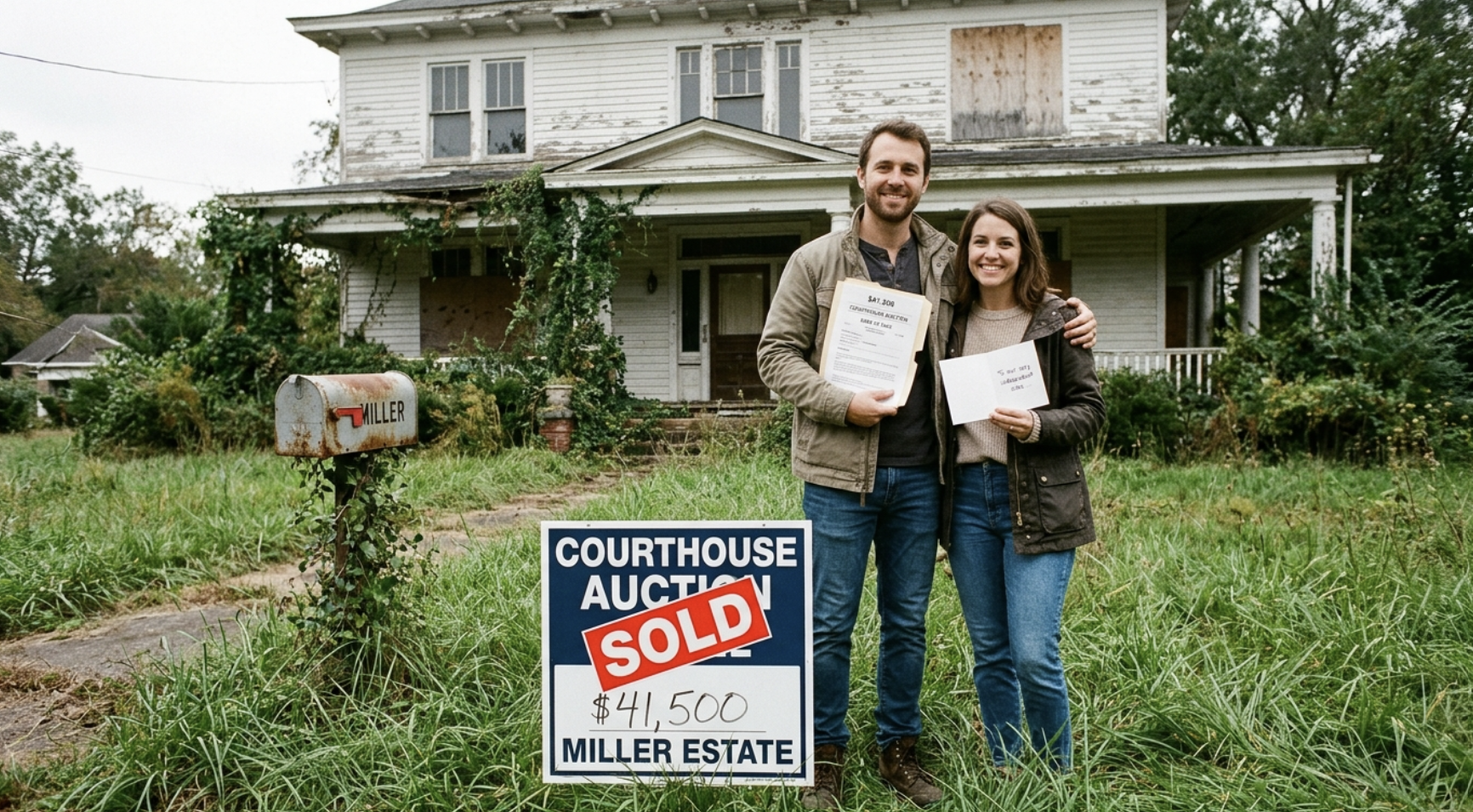
“No. The county auction clerk said the house had been abandoned for six years. Why?”
Opal closed her eyes briefly.
“Because this property has a history, and your father-in-law knows more about it than he’s ever told you.”
Before I could ask another question, she started walking toward the porch.
I followed her inside.
The house smelled of dust, damp wood, and the faint sweetness of old cedar. Nate had already replaced several floorboards and removed the ruined carpeting from the living room. A few tools lay beside the fireplace, and a stack of salvaged lumber rested against the wall.
Opal moved slowly through the room, touching the doorframe, the windowsill, and finally the mantel above the fireplace.
“This house was once beautiful,” she murmured.
“Did you know the Millers?”
“I knew Mrs. Miller. Her name was Eleanor. She was a kind woman who worked harder than anyone I ever met.”
Opal settled into the chair Nate had brought from our old apartment.
“Her husband died young. She raised two children here, worked at the school cafeteria, and grew vegetables to sell at the farmers’ market. When times were hard, she never complained.”
She paused and looked at me.
“People like Eleanor understand what it means to build a life with your own hands.”
I sat across from her.
“Why did you ask whether Ronald knew we’d bought the property?”
Opal’s expression changed.
“Because twenty years ago, your father-in-law had an opportunity to buy this same house.”
I blinked.
“What?”
“Ronald was younger then. He and Judy had three children, a mortgage, and more expenses than they knew what to do with. Eleanor was struggling to keep up with the property taxes after her husband died. She offered to sell the place to Ronald at a price he could afford.”
“Did he buy it?”
“No.”
“Why not?”
Opal looked down at her hands.
“Because he believed the property was worthless. He said the house was too old, the land was inconvenient, and the barn would cost too much to repair. Eleanor offered him a generous arrangement, but he refused.”
She looked around the room.
“Someone else eventually bought a portion of the surrounding farmland, but this house remained in Eleanor’s family until her estate became tangled in unpaid taxes and legal expenses.”
I frowned.
“That explains the auction, but what does Ronald have to do with it now?”
Opal leaned forward.
“Before Eleanor died, she told me something. She said she had hidden a document in this house. A document that might explain why Ronald never wanted anyone in the family to take an interest in this property.”
My heart began to beat faster.
“What kind of document?”
“I don’t know exactly. Eleanor wouldn’t tell me where she put it. She only said that one day, someone would come along who understood the difference between being given something and earning it.”
I stared at her.
“Do you think she meant us?”
“I think it’s worth finding out.”
Just then, the sound of a truck engine came from the driveway.
Opal’s face went pale.
I hurried to the window.
A dark pickup had stopped outside. Nate was climbing down from the driver’s side, carrying a toolbox.
Behind him, another vehicle pulled into the yard.
It was Ronald’s truck.
I turned toward Opal.
“You said not to tell him.”
“I didn’t tell him,” she whispered.
Outside, Nate greeted his father, apparently surprised by the unexpected visit.
Ronald said something I couldn’t hear, then pointed toward the house.
A moment later, both men started toward the porch.
Opal gripped my wrist.
“Listen carefully,” she said. “Whatever happens today, don’t let Ronald convince you that you owe him anything.”
Before I could respond, the front door opened.
Nate stepped inside first.
“Dad says he heard about the auction,” he explained. “Apparently, somebody at the courthouse recognized our name.”
Ronald followed him into the living room.
His eyes swept across the stripped walls, the exposed floorboards, and the pile of electrical supplies.
Then he laughed.
“Well, I’ll give you two credit for being ambitious.”
Nate’s jaw tightened.
“What are you doing here, Dad?”
Ronald ignored the question and walked toward the fireplace.
“I came to see what you’ve gotten yourselves into. This place has been a money pit for years. You could spend twice what you paid and still end up with a house nobody wants.”
“We’re not planning to sell it,” I said.
“Everyone says that at first.”
He ran a finger across the mantel, examining the dust.
Then he turned toward Opal.
“Grandma, I didn’t realize you were here.”
“Clearly,” she replied.
Ronald forced a smile.
“What brings you out to this old place?”
“I wanted to see what my grandson and his wife had accomplished.”
“Well, you’ve seen it.” He gestured toward the damaged walls. “They’ve bought themselves a problem.”
Nate put down his toolbox.
“It’s our problem, Dad. We’ll handle it.”
Ronald’s expression hardened.
“I hope you understand what you’re doing. A property like this can swallow every dollar you have.”
“We understand.”
“And if you run short of money, don’t expect us to rescue you.”
The words hung in the air.
For a moment, I was back at Easter dinner, staring into that bluebird card while three envelopes containing $20,000 each sat in the hands of Nate’s siblings.
Nate remembered it, too.
He looked at his father and answered quietly.
“We wouldn’t ask you to.”
Ronald appeared satisfied.
“Good. Independence is a wonderful thing when you can afford it.”
Opal struck the floor with her cane.
“That’s enough, Ronald.”
He turned toward her.
“What?”
“You heard him. They aren’t asking you for anything. So stop talking to them as if they’re children who need your permission to live their own lives.”
Ronald’s cheeks reddened.
“I was only offering advice.”
“No,” Opal said. “You were reminding them that you didn’t help.”
Silence filled the room.
Ronald glanced at me, then at Nate.
Finally, he straightened his jacket.
“Fine. Do whatever you want. Just don’t come crying to us when this place falls apart.”
He walked out.
Through the window, I watched him climb into his truck and reverse down the driveway.
Nate stood perfectly still until the engine disappeared.
Then he exhaled.
“I’ve spent my entire life trying to prove to that man that I’m capable of doing something on my own.”
Opal reached for his hand.
“You don’t have to prove it anymore.”
He looked at her.
“What did you mean earlier, Grandma? What did you and my dad have to do with this property?”
Opal glanced at me.
I waited for her to answer.
Instead, she said, “First, I want you both to promise me something.”
“Anything,” Nate replied.
“Whatever you discover in this house, don’t let money become more important than the people you love.”
We exchanged confused looks.
Then Nate nodded.
“We promise.”
Opal rose slowly from her chair and approached the fireplace.
She examined the mantel again, pressing her fingers against its edges.
“Help me move this chair,” she instructed.
Nate and I moved the old chair away from the wall.
Opal bent down and pointed toward a narrow wooden panel beneath the mantel.
“That wasn’t here when Eleanor first moved into this house. Her husband installed it shortly before he died.”
Nate fetched a screwdriver from his toolbox.
He carefully removed the small panel.
Behind it was a dark, narrow cavity.
At first, all we could see was dust.
Then Nate reached inside and pulled out a small metal box wrapped in a faded piece of cloth.
Opal covered her mouth.
“Oh, Eleanor,” she whispered. “You actually left it here.”
Nate placed the box on the mantel.
It was old, with a rusted latch and a tiny keyhole.
There was no key.
He worked carefully with a thin screwdriver until the latch finally released.
Inside lay three things.
A yellowed envelope.
A small leather-bound notebook.
And a photograph of a young woman standing on the porch of the Miller house beside a man I recognized immediately.
It was Ronald.
Not the gray-haired man who had just insulted us, but a younger Ronald, perhaps twenty-five years old, standing beside Eleanor Miller with one arm resting on the porch railing.
On the back of the photograph, someone had written a date.
Twenty-eight years earlier.
Nate stared at it.
“Why was my dad in this photograph?”
Opal sat down again, looking suddenly exhausted.
“Because your father once made a promise to Eleanor.”
“What promise?”
“One he never kept.”
Nate picked up the envelope.
His hands trembled slightly as he unfolded the paper inside.
The document was a handwritten letter addressed to Opal.
The first line read:
Dear Opal, if you are reading this, then someone has finally bought the house because they saw something in it that your grandson once refused to see.
Nate looked up sharply.
“Grandma, what does this mean?”
Opal took a long breath.
“It means we need to read the whole letter.”
We gathered around the mantel as Nate continued.
The letter explained that Eleanor’s husband had spent years repairing the house and restoring the surrounding land. He had believed the property would become a lasting home for his children.
After his death, Eleanor struggled financially. Ronald had visited her several times, offering to help her sell the property. But their conversations had eventually ended in an argument.
According to Eleanor, Ronald had promised to help her secure a fair price for the house if she agreed to sell him a small section of land behind the barn.
She had accepted the arrangement in good faith.
But Ronald changed his mind when he learned that the land might be worth more than he had initially believed.
He walked away from the agreement, leaving Eleanor to deal with the financial consequences alone.
The letter didn’t accuse him of a crime. It described a broken promise, a bitter argument, and a relationship that had never recovered.
Then came the final paragraph.
I don’t know who will own this house when you read these words. I only hope they will understand that a home is not measured by what it costs, but by what people are willing to sacrifice to keep it standing.
Nate lowered the letter.
For a long time, nobody spoke.
Finally, he looked at Opal.
“Did Dad ever tell you about this?”
“Yes,” she answered. “But he told me a different version. He said Eleanor had become unreasonable and that there was no point trying to help her.”
“Did you believe him?”
“I wanted to. He was my son.”
Her voice broke slightly.
“But I always wondered why he became so angry whenever anyone mentioned the Miller property.”
I looked at the photograph again.
There was something heartbreaking about seeing Ronald so young, standing on that porch before bitterness and pride had hardened his expression.
But I also thought about the bluebird card.
About the extra shifts.
About the boat Nate had sold.
About the countless evenings we had spent repairing machinery and serving strangers while his siblings received help that we were never offered.
I wondered whether our struggle had been entirely necessary.
Then Opal touched my shoulder.
“There’s something else in the box.”
Beneath the notebook was a folded sheet of paper.
Unlike the letter, this document bore an official county seal.
Nate unfolded it carefully.
His eyes widened.
“What is it?” I asked.
He read the heading twice before answering.
“It’s a record of an old access agreement.”
Opal nodded.
“Keep reading.”
The document described a narrow strip of land running behind the Miller property toward the county road. Years earlier, the Millers had granted a neighboring farm temporary access across that strip under specific conditions.
The agreement had expired decades ago, but the county record suggested that the boundary had never been properly updated.
Nate looked confused.
“Does this mean the land behind our barn isn’t included in our purchase?”
“Not necessarily,” Opal replied. “It means you need to check the current survey and title documents before assuming anything.”
She was right.
The following Monday, Nate contacted a local property attorney and arranged for a surveyor to inspect the boundary.
We spent the next two weeks working on the house while we waited for the results.
I kept thinking about the letter.
Part of me wanted to confront Ronald immediately.
Another part knew that doing so without understanding the facts would only create another family argument.
Nate made the same decision.
“We bought this house for ourselves,” he told me one evening as we painted the kitchen. “Not to settle an old disagreement between Dad and somebody who died years ago.”
I smiled.
“Then we’ll keep working.”
And we did.
We repaired the porch, replaced the broken windows, and turned the smallest bedroom into a proper guest room. The house slowly began to feel like a home rather than an abandoned building.
For the first time in years, Nate seemed lighter.
He still worked long hours, but he no longer spoke about proving himself to his father.
Instead, he talked about planting apple trees, building a vegetable garden, and saving enough money to replace the barn roof before winter.
Then, one Thursday afternoon, the surveyor called.
He had found something unexpected.
The boundary line was exactly where the county’s original records placed it. The old access agreement had expired, and the neighboring property had no current legal right to use the strip.
More importantly, our deed included the entire parcel described in the auction documents, including the land behind the barn.
There was no hidden fortune waiting for us.
No secret inheritance.
No miraculous discovery that would make us wealthy overnight.
But there was something valuable: certainty about what we owned and the right to decide what to do with it.
The attorney advised us to update the property records and keep copies of the old documents.
We followed his advice.
Then we made another decision.
We would not use the letter to humiliate Ronald.
We would keep it safe, along with the photograph, and let the house become what we had always wanted it to be.
A home.
Still, I couldn’t help wondering what would happen when Ronald learned that we had uncovered his old connection to the property.
I didn’t have to wait long.
The next Sunday, Judy called.
Her voice was unusually cheerful.
“We’re planning a family dinner next weekend,” she announced. “Everyone will be there. Kim, Jeff, Stacy, the children, and your grandmother.”
“That sounds nice,” I replied.
“We were thinking it would be lovely to have it at your new house.”
I glanced toward Nate, who was repairing a cabinet hinge.
He raised his eyebrows.
Judy continued.
“Ronald says the property has plenty of room, and the weather should be beautiful. We could bring food and eat outside.”
I almost laughed.
For two years, we had kept our plans private because we didn’t want to be accused of asking for help.
Now that the house had attracted attention, everyone wanted to see it.
“I’ll talk to Nate,” I said.
After I hung up, I told him what she had asked.
He put down the screwdriver.
“What do you think?”
I considered the question.
Part of me wanted to refuse. I wanted to tell them that the house they had mocked was not available for their convenience.
But then I remembered Opal’s warning.
Don’t let money become more important than the people you love.
“We can invite them,” I said. “But we’re not going to pretend the last two years didn’t happen.”
Nate nodded slowly.
“Agreed.”
That evening, we called Judy back and accepted the invitation.
For the next week, we worked on the house with renewed energy.
We cleaned the porch, arranged chairs beneath the old maple tree, and prepared the garden for its first family gathering.
We didn’t borrow money or buy expensive decorations.
We simply made the place comfortable.
When Sunday arrived, the first vehicle pulled into our driveway shortly after noon.
Kim climbed out, staring at the house.
“Wow,” she said. “I didn’t expect it to look like this.”
Jeff walked around the porch, inspecting the new railings.
“How much have you spent fixing it up?”
“Less than we would have spent buying a newer house,” Nate replied.
Stacy arrived with her children and immediately asked to see the upstairs bedrooms.
Judy carried a casserole into the kitchen, looking around with obvious surprise.
“This place has really changed.”
“There’s still a lot to do,” I said.
Ronald arrived last.
He stepped out of his truck, looked at the repaired porch, and frowned.
Then his eyes settled on the old barn.
For a moment, he said nothing.
Nate greeted him politely and led everyone toward the backyard.
We ate beneath the maple tree. The food was simple, the conversation awkward at first, but the children eventually began playing in the yard.
For a little while, it almost felt like an ordinary family gathering.
Then Kim asked the question everyone had been avoiding.
“So, how did you two manage to buy this place without help?”
The table went quiet.
I set down my glass.
“We saved for two years. Nate took extra repair jobs, I worked additional shifts, and we cut our expenses wherever we could.”
Kim looked embarrassed.
“I didn’t realize you were working that much.”
“You never asked,” Nate replied.
She lowered her eyes.
Jeff cleared his throat.
“Well, Mom and Dad gave us the money because they thought we needed it. You two seemed to be doing fine.”
Nate looked at him calmly.
“We were managing. That doesn’t mean we didn’t need help.”
Nobody answered.
Ronald finally spoke.
“You’ve always been independent. That was the point of the card.”
Nate turned toward him.
“Being independent doesn’t mean we never needed anyone. It means we learned how to keep going when nobody offered to help.”
His voice wasn’t angry.
That somehow made the words more powerful.
Judy looked down at her plate.
“I thought you would be proud of us,” she said quietly. “I thought you would understand that we were trying to encourage you.”
Nate took a breath.
“Mom, I appreciate encouragement. But encouragement doesn’t pay an unexpected bill or help someone save for a house. You gave three people twenty thousand dollars each. You gave us a card. I thanked you because I didn’t want to embarrass you at dinner.”
He paused.
“But I was hurt.”
Judy’s eyes filled with tears.
For the first time, I saw her understand that the card had not been a small misunderstanding that we had forgotten.
It had stayed with us.
Not because we wanted their money, but because the difference in treatment had made us question where we stood in the family.
Ronald shifted in his chair.
“You could have told us you were upset.”
Nate nodded.
“You’re right. I could have. But I didn’t want to beg for something you had already decided not to give.”
The conversation stopped.
Then Opal, who had been quietly listening from the other end of the table, placed her fork beside her plate.
“There’s something all of you need to understand,” she said.
Everyone turned toward her.
“Money is not the only way a family can hurt someone. Sometimes it’s the way you make one child feel capable and another feel unworthy of help.”
Judy began crying.
Ronald stared at the table.
Opal continued.
“Nate and his wife have worked hard for everything they have. You should be proud of them. But don’t use their success as an excuse to pretend they never needed kindness.”
Nobody spoke for several seconds.
Then Ronald stood up.
“I need some air.”
He walked toward the barn.
Nate watched him go but didn’t follow.
I squeezed my husband’s hand beneath the table.
We had not invited everyone to our house to make them feel guilty.
We had invited them because, despite everything, they were still family.
But we would no longer pretend that love meant keeping quiet whenever something hurt us.
And as I looked around the table, I realized that the Miller property had already given us something the money could never have bought.
It had given us a place where we could finally speak honestly.
And the most difficult conversation of all was still waiting in the barn.
PART 4
Ronald stayed in the barn for nearly twenty minutes.
When Nate finally walked out to check on him, I watched from the kitchen window. His father stood beside an old workbench, holding the photograph of himself and Eleanor Miller that we had found inside the metal box.
Nate must have brought it outside.
I couldn’t hear their conversation, but I saw Ronald lower his head.
Then, for the first time since I’d known him, I saw my father-in-law wipe tears from his eyes.
When the two men returned to the backyard, Ronald pulled a chair beside the table.
“I owe you both an apology,” he said.
Nobody moved.
He looked at Nate first.
“When I was young, I thought being a good father meant preparing my children for a difficult world. I believed that if I helped you too much, you’d never learn to stand on your own.”
Nate listened without interrupting.
“But I made a mistake. I confused helping someone with making them weak. And when I saw you succeeding without my help, I used that as an excuse to tell myself that you never needed it.”
He looked toward me.
“That card was thoughtless. You deserved the same consideration I gave your brothers and sister.”
Judy began crying again.
Ronald took a long breath.
READ CONTINUE FULL STORY
My In-Laws Gave Their Other 3 Children $20,000 Each—We Got Only a Card. Two Years Later, We Bought an Abandoned House for $41,500, and Everything Changed…
Part 1 of 2