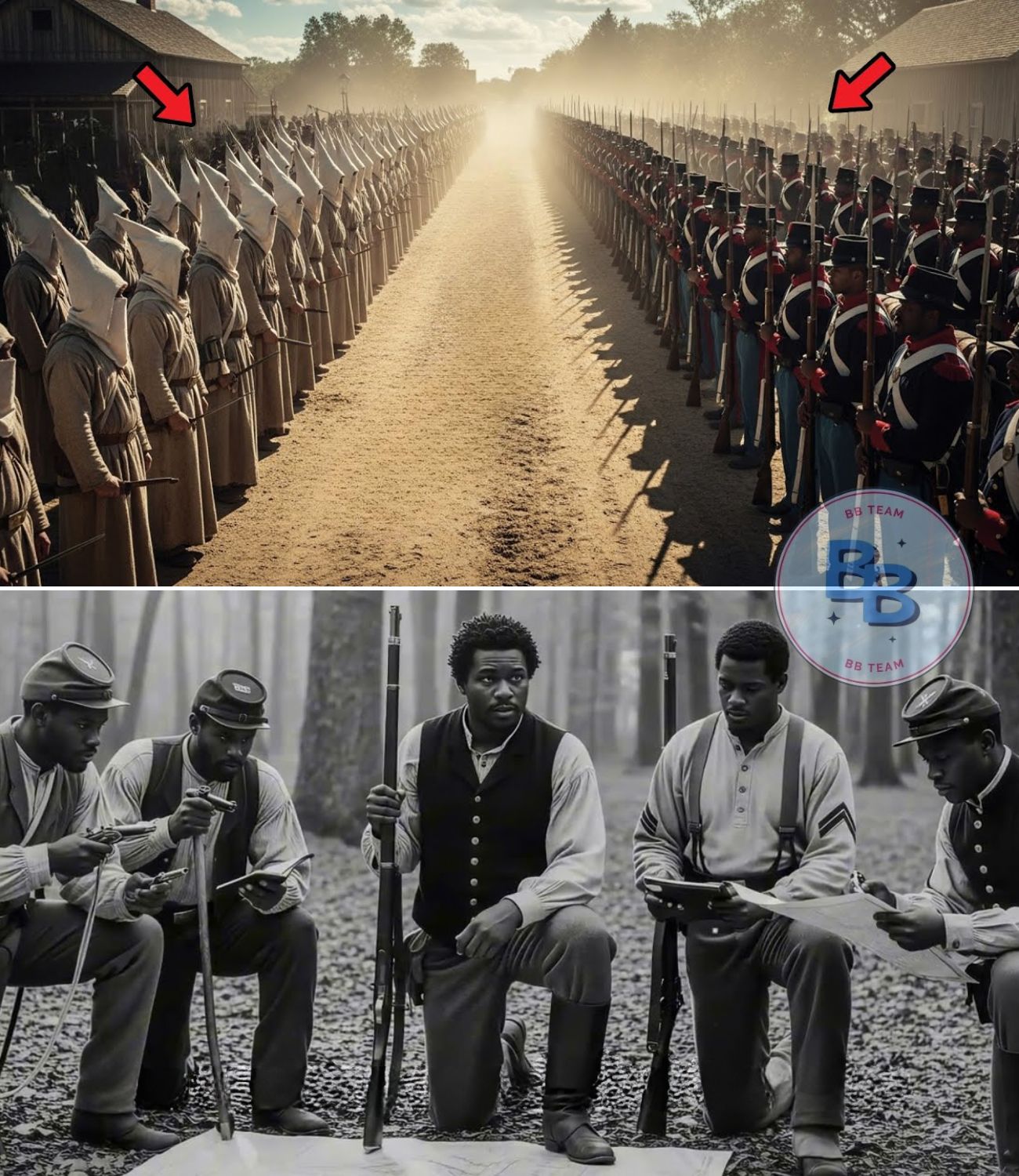
They say everything changed the night the schoolhouse burned when Elias High Tower walked through the smoke and realized the war he fought was waiting for him at home. Folks whispered that the fire wasn’t meant to destroy a building. It was meant to break a community. And when a teacher was found hanging by the river, Elias gathered the only men who truly understood the danger.
a hardened unit of black Union veterans who had survived trenches, sieges, and nightmares far darker than cowards in white hoods. This wasn’t just a group of men. It was a machine built from war. Caleb Ransom reading the woods like scripture. Isaac Ward turning scraps of rumor into ironclad intel. Lewis Carter, all heart and fire, meeting terror headon.
And Thomas Brent, quiet but precise, charting the back roads the writers thought were hidden. Together they crushed a clan chapter so completely the whole state felt the shock. But victory has a cruel echo. Because the real power behind the hoods wasn’t in the woods. It was sitting in offices holding badges and writing laws meant to bury men like them.
And that’s when Elias understood, “You can beat the riders, but the real clan is the one that thinks it runs the state.” Before we go any further, comment where in the world you are watching from, and make sure to subscribe because tomorrow’s story is one you don’t want to miss. The sun rose pale and weak over the dirt road, casting long shadows that stretched like fingers across the scrub grass.
Sergeant Elias High Totower walked with measured steps, his shoulders squared despite the weight of the scrap lumber balanced against his chest. Each board had come from a different family, salvaged fence posts, wagon slats, pieces of barn siding given freely by people who had little to spare. The wood smelled of old smoke and hard work. He adjusted his grip.
The boards shifted. Splinters pressed into his palms through the calluses he’d earned during the war. The schoolhouse appeared ahead, small but proud against the morning sky. Fresh paint gleamed white on its walls. The roof still held patches of darker shingles where repairs had been made just last week.
It stood at the edge of the settlement like a promise kept. Elias saw teacher Norah Samuels on the porch, her broom moving in steady sweeps. Dust rose in small clouds with each stroke. She wore a simple gray dress with the sleeves rolled to her elbows. Her hair was tied back with a strip of blue cloth. She paused when she noticed him approaching and lifted one hand in greeting.
“Morning, Sergeant,” she called. Morning, teacher. Children gathered in the yard, their voices bright and unguarded. A girl with braided hair chased a boy around the oak tree. Two smaller children crouched in the dirt, drawing pictures with sticks. An older boy stood near the steps, holding a slate board under one arm.
Nora leaned her broom against the wall. “Those for the shelves? Yes, ma’am. Thought I’d get them installed before class starts. She smiled. The expression softened the permanent worry lines around her eyes. The children will be grateful. We’ve been stacking books on the floor since Tuesday.
Elias climbed the steps and set the lumber down carefully. The boards clattered against the porch. He straightened and looked out over the yard. The morning felt almost normal, almost peaceful. Then the wind shifted. Smoke. Not cook fire smoke. Not the clean scent of morning hearths. This was thick and chemical. It carried the sharp bite of kerosene.
Elas turned his head slowly, searching for the source. Nora had stopped moving. Her hand gripped the broom handle. “You smell that?” she asked. “Yes.” The smoke drifted heavier now, rolling over the small hill behind the schoolhouse. Gray tendrils curled through the morning air. Elias moved first.
He jumped from the porch and ran toward the back of the building. His boots pounded against the hard earth. Norah followed, her skirts gathered in both fists. They rounded the corner. Torches lay scattered in the grass. Six of them, their flames still hungry and bright. The kerosene soaked rags wrapped around their ends burned with unnatural intensity.
Patches of dry grass had already caught fire, spreading in ragged circles. Elias dropped to his knees and grabbed the nearest torch. He threw it toward the bare dirt. The flames hissed but kept burning. He reached for another. The children. Norah gasped. Movement caught his eye. Far across the field where the treeine began, shapes moved between the trunks.
Riders, six or seven of them. White hoods covered their faces. Their horses stood motionless as statues. One rider raised his arm. Glass shattered. A bottle arked through the air and crashed against the schoolhouse wall. Flames erupted instantly, racing up the wooden siding. Another bottle followed, then another.
The fire found the roof. No. Norah started toward the building. Elias grabbed her arm. Get the children away now. She hesitated for only a moment, then turned and ran back toward the front yard, shouting warnings. The children’s voices changed, laughter becoming confusion, becoming fear. The riders wheeled their horses and disappeared into the trees.
Their departure was silent and organized, professional. Elias ran to the front door. Heat blasted against his face when he pulled it open. Smoke poured from the interior, thick and black. He could see the shelves along the far wall, the ones they’d built together last month, books lined them, primers and readers donated by a church in Philadelphia, geography texts, a Bible with guilt edges.
He ducked low and pushed inside. The smoke burned his throat. His eyes watered. He grabbed an armful of books from the nearest shelf and stumbled backward toward the door. The ceiling groaned above him. He made it outside and dumped the books in the dirt. Turned to go back. The roof collapsed inward with a sound like thunder.
Sparks exploded upward in a massive cloud. Flames reached toward the sky, 15 ft high, then 20. Elias backed away. The heat drove him further, further still. The schoolhouse burned. By nightfall, only the stone foundation remained. The walls had fallen inward, leaving a skeleton of charred beams that glowed orange in the darkness.
Families stood in clusters around the ruins, their faces lit by the dying fire. No one spoke much. The children stayed close to their parents. Elas walked the perimeter searching for anything salvageable. He found nothing but ash. Someone called his name. He turned. A group of men approached from the direction of the creek.
They moved slowly carrying something between them. As they came closer, Elias saw it was a body. Jonas Reed, Norah’s assistant, a young man who had taught the smallest children their letters. He had served in the colored troops at Fort Wagner. Now he hung limp in the arms of the men who carried him.
His neck bore the marks of a rope. His Union jacket had been torn open. The brass buttons ripped away. They laid him on the ground carefully, as though gentleness could somehow matter now. Norah knelt beside the body. Her hand covered her mouth. The sheriff arrived an hour later, riding a bay mare that looked bored.
Sheriff Abram Toiver dismounted slowly and adjusted his hat. He walked to the ruins and studied them for perhaps 30 seconds. Unknown vagrants, he announced to no one in particular. Probably drifters passing through. Nothing to investigate here. Elias stared at him. Nothing to investigate. The sheriff shrugged. No witnesses. No evidence.
These things happen sometimes. These things? Yes, Sergeant. These things. Toiver mounted his horse. I’d advise folks to stay inside after dark for safety. He rode away. The families began to disperse as midnight approached. They walked back toward their cabins in small groups, holding their children close. Their footsteps were quiet against the dirt.
Elias returned to his own cabin alone. He lit the lantern and set it on the rough wooden table. From beneath his bed, he pulled the wooden case he hadn’t opened in two years. The bayonet lay inside, wrapped in oiled cloth. He unwrapped it slowly. The blade caught the lantern light, 17 in of tempered steel.
The Union Arsenal stamp was still visible near the hilt. Elias sat down. He found his wet stone and began to sharpen the blade with long, careful strokes. The scraping sound filled the cabin. Metal against stone. Again. Again. His hands moved with the precision learned in military camps. The rhythm was familiar, comforting in its simplicity. Hope was not enough.
He had learned that today. The community needed something more than prayers and promises. They needed a defense. The blade grew sharper under his hands. The tobacco warehouse stood at the edge of town. Its walls weathered gray and stre with old water stains. The sign above the door had faded years ago, leaving only ghost letters visible in certain light.
No one had used the building for business since before the war. Now it served a different purpose. Elias pushed the door open. [clears throat] The hinges groaned. Morning sunlight cut through gaps in the wall boards, creating bars of light across the dusty floor. The smell of old tobacco still clung to the air, sweet and earthy and permanent.
Four men sat on crates near the back wall. They looked up as Elias entered. Caleb Ransom leaned against a support beam, arms crossed over his chest. His face was lean and sharp, his eyes constantly moving, taking in details. A former scout, he noticed everything. Isaac Ward sat with perfect posture, his hands resting on his knees. He wore a clean shirt buttoned to the collar.
His expression was calm and watchful. Organization came naturally to him. Always had. Lewis Carter smiled when he saw Elias, the expression genuine despite the early hour. He was broader than the others, built for endurance. His hands were scarred from years of hard labor, but they moved with surprising gentleness. Thomas Brent sat slightly apart from the others, younger, nervous energy in every movement.
He twisted a piece of rope between his fingers over and over. Morning, Sergeant, Lewis said. Elias walked to where they sat. He didn’t waste time with pleasantries. Jonas Reed is dead. The rope stopped moving in Thomas’s hands. Caleb straightened. When night before last, they lynched him after burning the schoolhouse.
Isaac’s jaw tightened. The sheriff called it unknown vagrants. Wrote away. Lewis stood up slowly. His hands curled into fists. Jonas taught my nephew his letters. I know. He was at Fort Wagner. Charged the ramparts twice. I know. Silence filled the warehouse. Dust moes drifted through the bars of sunlight.
Outside, a cart rattled past on the main road. Elias continued, “This won’t stop. Not without us making it stop. I’m forming a night patrol. Military discipline. Proper organization. Anyone who wants out can leave now.” No one moved. Good. Then we need to understand what we’re facing. Elias pulled a piece of paper from his pocket.
Caleb, tell them what you’ve seen. Caleb pushed away from the beam. Three farms hit in the last month. The Johnson’s lost their barn, burned to the foundation. The Washingtons found a note nailed to their door. Crude drawing of a noose. No signature needed. Last week, riders circled the Freeman place for 2 hours. Just circled. Didn’t attack.
Just wanted them to know they could. Isaac added, “They’re establishing patterns, creating fear without constant engagement. It’s strategic like cavalry harassment.” Lewis said, “Hit and fade. Keep the enemy off balance.” Elias nodded. “Exactly. They’re using tactics, so we use better ones.” Thomas spoke for the first time, his voice quiet.
How many are there? Unknown. But they’re organized enough to coordinate attacks across the county. We’re five men, Thomas said. We start with five. We build from there. Elias looked at each of them in turn. I need your skills. Caleb, you’ll handle scouting, track their movements, learn their routes. Isaac, weapons and supplies.
Find what we need and keep it secure. Lewis, you train volunteers. Anyone willing to stand watch. Thomas, you know the roads better than anyone. You’ll map supply routes, ours and theirs. Thomas nodded slowly. The rope twisted between his fingers again. We drill at night, Elias continued. Behind this warehouse. Same hand signals we used in the war.
Same formations. We move quiet. We move smart. We don’t engage unless necessary. And when it is necessary, Caleb asked, “Then we engage decisively.” The word hung in the air. Decisively. Lewis cracked his knuckles. “When do we start?” “Tonight.” They began that evening. The warehouse backed onto an empty field, overgrown with weeds, and scattered with broken fence post, perfect for drilling without being seen from the road.
Elas lined them up as the sun set. He walked the formation, correcting positions tighter. You’re not a mob. You’re a unit. Isaac, shift left 6 in. Caleb, watch your spacing. They practiced movement drills, silent advancement, quick dispersal, reformed lines. The signals came back easily. Hand gestures learned in military camps, ingrained through repetition until they became instinct.
Two fingers pointed forward. Advance. fist raised. Stop. Palm down, moving side to side, spread out. The moon rose. They kept drilling. Word spread quietly through the freed community. People understood what was happening without needing to be told. A woman brought cornbread wrapped in cloth. A man left a box of rifle cartridges behind the warehouse door.
Another family set up a lookout post on their property, positioning someone to watch the road and signal if riders approached. Support came in whispers and small gestures, a nod in passing, a door left unlocked, food appearing overnight. Caleb spent his days tracking. He disappeared before dawn and returned after dark with information scratched onto scraps of paper, roots, timing, numbers.
He moved through the countryside like smoke, seen by no one, seeing everything. Isaac organized what little they had. Three rifles, two pistols, ammunition counted and rationed, supplies cashed in hidden locations. He created lists and schedules, ensuring nothing was wasted. Lewis gathered volunteers, farmers willing to stand watch, craftsmen ready to signal warnings, old men who remembered how to hold weapons.
He trained them patiently, building their confidence through repetition. Thomas mapped the roads. He walked every supply route within 10 m, noting shortcuts and bottlenecks. His drawings were precise, almost artistic in their detail. Each night they gathered intelligence. Riders passed through the Miller property every Tuesday.
A caravan moved supplies on Thursdays, heading south. The main group assembled somewhere near the old Hutchkins estate. Patterns emerged. Schedules became clear. One week after the schoolhouse attack, Elias stood in the moonlit field behind the warehouse. The others gathered around him. Isaac held a handdrawn map, the paper covered with careful notation.
Tomorrow night, Isaac said the supply caravan moves through Hutchkins Pass. Six riders minimum, possibly eight. They’ll be carrying ammunition and kerosene, probably intimidation materials, too. Elias studied the map. The route was narrow, trees on both sides, limited visibility, perfect for an ambush if positioned correctly.
Caleb pointed to a spot on the map. Best position is here. High ground, cover, single exit point. How certain are you about the timing? Elias asked. Very. They’ve used this route three times. Same night. Same hour. Lewis leaned forward. We can stop them. Cut off their supplies. Show them we’re not helpless.
Elias looked at each man. Caleb’s eyes were sharp and ready. Isaac’s expression remained calm and calculating. Lewis practically vibrated with controlled energy. Thomas was pale but steady. Tomorrow night, Elias said quietly. We end their terror. The fallen logs smelled of rot and moss. Elias pressed his shoulder against the damp bark, feeling the chill seep through his shirt.
Around him, the others held position in absolute silence. No movement, no sound except the rhythmic pulse of crickets filling the darkness. The crossroads lay ahead. Two narrow dirt paths intersected beneath a canopy of oak branches. Moonlight barely penetrated the leaves, creating shadows thick enough to hide in. Perfect terrain, just like Isaac’s map had shown. Elias counted his breathing.
In through the nose, out through the mouth. The same rhythm he’d learned before every battle. It kept the heart steady, kept the mind clear. To his left, Lewis crouched behind a thick pine trunk. The big man’s hands rested on his knees, completely still. His eyes tracked the eastern approach, waiting.
To his right, Isaac knelt in a shallow depression, his rifle positioned across a fallen branch. The weapons barrel pointed toward the road without wavering. Isaac’s face showed no emotion, pure concentration. Thomas lay flat 20 yards back, watching the rear approach. His breathing came too fast.
Elas could hear it even from this distance. The young man was afraid. That was fine. Fear could sharpen instincts if controlled properly. Caleb had disappeared into the woods an hour ago. He’d gone to confirm the caravan’s approach and give warning when they got close. The scout moved through trees like he’d been born among them. No broken branches, no disturbed leaves, just gone.
The crickets continued their song. Minutes stretched. Elias’s legs began to ache from holding position, but he didn’t shift. Discipline meant control. Control meant survival. A bird call cut through the night. Three short notes, then two long. Caleb’s signal. Riders approaching. Elias raised his fist. The others saw. They tensed but didn’t move otherwise.
Perfect discipline. The sound reached them first. Hoof beatats. Multiple horses moving at an easy pace. Wagon wheels creaking. Men’s voices talking low. They weren’t being careful. They thought these roads belong to them. Elias counted the sounds. Seven horses, two wagons, exactly what Isaac had predicted.
The lead riders appeared around the bend. White hoods covered their faces. Torch light flickered across their robes, making the fabric glow orange against the darkness. The sight made Elias’s jaw tighten. >> [clears throat] >> He’d seen those hoods before. Over burning homes, around lynching trees. Behind the riders, two wagons rolled into view.
Wooden crates filled the wagon beds. Supplies, ammunition, kerosene. The tools of terror transported openly because no one dared stop them. One rider laughed at something another said. The sound carried clearly through the still air, casual, comfortable. They felt safe here. That would change. The caravan moved toward the crossroads.
50 yards, 40, 30. Elias waited. His hand stayed raised. Not yet. 20 yards. He dropped his fist. Lewis surged from behind the pine. He moved with shocking speed for such a large man. Crossing the distance before the riders could react. He grabbed the nearest horseman and yanked him from the saddle. The rider hit the ground hard.
His hood fell back, revealing a young face twisted with shock. Isaac fired a single shot. The lead wagon’s front wheel exploded into splinters. The vehicle lurched sideways, blocking the narrow path. Horses screamed and reared. Elias stepped into the road. His rifle pointed at the second rider. Don’t move. The rider’s hand went for his pistol.
Caleb appeared behind him like a ghost. He pressed a knife against the man’s throat. He said, “Don’t move.” The rider froze. Thomas emerged from the rear position, blocking the retreat path. His rifle shook slightly, but he held his ground. Chaos erupted. Three riders wheeled their horses and fled back down the path.
Hoof beatats thundered away into darkness. Elias let them go. They weren’t the priority. The remaining riders tried to reorganize. One reached for a rifle. Lewis kicked it from his hands and drove a fist into his stomach. The man doubled over, gasping. Isaac moved to the second wagon.
He grabbed the driver and hauled him down. On the ground, face down, hands behind your head. The driver complied, whimpering. Elias approached the two riders Caleb had secured. He pulled their hoods off roughly. Two white faces stared back at him. The first was sharp featured and defiant, his jaw clenched. The second looked calmer, almost emotionless.
Names, Elias demanded. The defiant one spat. Go to hell. Elias pressed his rifle barrel against the man’s chest. Names. Now, Harlon Tate, the Defiant One finally said. His voice carried rage rather than fear. The calmer one answered without prompting. Merritt Cole. Search them, Elias ordered. Then tie their hands. Isaac moved quickly, checking pockets and removing weapons.
He found papers in Tate’s coat, letters, lists of names, locations. He handed them to Elias without comment. Lewis secured the prisoner’s hands with rope, binding them efficiently. Military knots, impossible to escape. Caleb examined the wagons. He pried open a crate. Ammunition, rifles, kerosene, rope. He looked at Elias. Everything needed for their work.
Load it, Elias said. We’re taking everything. They worked quickly. The captured supplies went into one wagon. The prisoners sat bound in the back of the second. The entire operation took less than 15 minutes. Tate glared at Elias. Your dead men. All of you. The militia will hunt you down. Maybe, Elias said, “But you won’t see it.
” They moved through the darkness, avoiding main roads. Isaac drove the lead wagon. Lewis handled the second. Caleb scouted ahead, ensuring their path stayed clear. Thomas watched the rear. The nearest federal jurisdiction lay three counties away. The state militia controlled everything closer. Their officers either sympathetic to the clan or actively participating, but federal agents operated independently.
They answered to different authority. The journey took 4 hours. They arrived at the federal outpost just before dawn. A small building near the county line marked with Union flags. Two agents stood guard outside. Elas approached them. We have prisoners, clan leadership, and evidence. The senior agent examined Tate and Cole.
He looked through the papers Isaac had found. His expression hardened. These documents list planned attacks, dates, locations, names of collaborators. That’s why we brought them to you, Elias said. The agent nodded slowly. We’ll take custody, file formal charges. But you understand this will create problems. I understand.
They transferred the prisoners and evidence. The agents promised protection for the freed community and immediate investigation. Whether those promises meant anything remained to be seen. The unit rode back as the sun rose. Pink and orange light spread across the sky, burning away the night’s shadows. Birds sang morning songs. The world looked clean and new.
As they neared town, people emerged from their homes. They’d heard what happened. News traveled fast among the freed community. Faces that had been tight with fear now showed something different. Relief. Hope. A woman waved from her porch. An old man nodded with respect. Children ran alongside the wagon, laughing. Actually laughing.
The sound seemed strange after so many months of silence and terror. Lewis smiled. We did it. We did something. Elias corrected, but he felt it, too. The shift, the change. For the first time since returning home, the weight pressing down on his chest had eased slightly. They parted ways at the warehouse, each man heading home to rest. Sleep would come easily today.
Earned through action rather than exhaustion. Alias walked through the dewy fields toward his cabin. Morning light made the grass glow silver. Everything felt different, lighter, like something broken had finally begun to heal. His cabin appeared ahead, small but solid. The garden Norah had helped him plant showed green shoots breaking through soil. Then he saw the horse.
A state militia mount stood tied to his fence post. official tac polished leather. The animal stamped impatiently, its breath misting in the cool air. A rider sat on Elias’s porch steps, blue uniform, brass buttons. He held a sealed envelope in his hands. The hope Elias had felt moments ago turned cold and heavy in his chest.
The rider stood as Elias approached. Sergeant Elias High Tower. Yes. The writer extended the envelope. Summons from Colonel Wde Farnum. You’re ordered to appear before the state militia court within 48 hours. Elias took the envelope. The wax seal bore the state militia insignia. Official, legal, inescapable charges? Elias asked.
The writer’s expression remained neutral. Armed rebellion against lawful authority. That’s all I was told to say. He mounted his horse and rode away without another word. Elias stood alone in his yard holding the summons. The envelope felt heavier than paper should around him. Morning birds continued singing. The sun continued rising.
Everything looked the same as it had moments ago. But nothing was the same at all. Later that morning, Elias broke the wax seal. His fingers worked carefully, but his heart hammered against his ribs. The paper unfolded with a crisp sound that seemed too loud in the cabin’s silence. The document was formal.
Legal language filled the page in neat handwriting. Official stamps marked the bottom. Everything about it screamed authority by order of Colonel Wde Farnum, commander of the state militia. The words blurred together at first. Elias forced himself to read slowly, carefully. Charged with armed rebellion against lawful authority, unlawful seizure of citizens, destruction of private property, conspiracy to incite racial violence.
The accusations went on. Each one twisted truth into something unrecognizable. The ambush became rebellion. The captured clan leaders became innocent citizens. Their defense of the community became conspiracy. The final paragraph ordered him to surrender within 48 hours. Location, the county courthouse.
Authority: Colonel Wde Farnum. Elias set the summons on his table. His hands remained steady, but something cold settled in his stomach. This wasn’t justice. This was retaliation. He needed to talk to the others. Caleb’s farm lay 2 mi outside town. The property was small, a cabin, a barn, a few acres for crops, but it sat far enough from other homes to offer privacy.
Elias arrived to find the others already there. They stood in Caleb’s yard holding identical envelopes, the same wax seals, the same official weight. “You two?” Isaac asked. “All of us?” Elias said. They gathered inside Caleb’s cabin. The space felt cramped with five men, but it was safer than meeting openly. Caleb cleared his table, and they laid out their summons side by side. Lewis read his aloud.
The charges were identical. Armed rebellion, unlawful seizure, conspiracy. Each man ordered to surrender within 48 hours. “This is wrong,” Thomas said. His voice shook. “We saved people. We stopped murderers. Doesn’t matter. Caleb said flatly. We’re black men who took action. That’s their crime right there.
Isaac studied his summons. Colonel Farnum. Anyone know him? I’ve heard the name, Elias [clears throat] said. State militia commander. Positioned here after the war ended. Positioned or volunteered? Caleb asked. Because men who volunteer for militia duty in occupied counties usually have reasons. The observation hung in the air.
They all understood what Caleb meant. A knock interrupted their discussion. Light but urgent. Everyone tensed. Caleb moved to the window. His posture relaxed slightly. Margaret Price. He opened the door. A white woman in her 30s stood outside. Her dress was plain but well-maintained. Her face was pale and her hands trembled slightly as she clutched her shawl. “Mrs.
Price,” Caleb said. “Come in.” She entered quickly, glancing over her shoulder before Caleb closed the door. Her eyes swept across the men, then settled on Elias. “Your Sergeant High Tower,” she said. “I am. I need to tell you something about Colonel Farnum.” She took a breath. “My husband was killed 2 years ago.
The official report said he died in a farming accident. But that’s a lie. The men waited. He was murdered, Margaret continued. By writers, masked men who came at night. They killed him because he refused to join them refused to participate in their work. The clan, Lewis said quietly. Margaret nodded. Before he died, he told me things, names, connections.
He said Colonel Farnum wasn’t just sympathetic to them. He controls them, finances them, protects them. The clan chapters throughout this county and beyond. Farnum runs them like a military operation. Elias felt the cold in his stomach spread. You’re certain my husband kept records, letters, financial documents. I hid them after he died.
Margaret’s voice steadied as she spoke. Farnum wants to make examples of you, public trials, public executions if possible. He needs to show that black men can’t challenge white authority without consequences. Why tell us this? Isaac asked. Margaret met his eyes. Because what’s happening to you is wrong, and because if Farnum succeeds, it won’t stop with you.
It’ll be a message to every freed person in this state. Thomas shifted uncomfortably. What can we do? The summons is legal. If we don’t surrender, we’re fugitives. You’re fugitives either way, Margaret said. Surrender and you’ll hang. Run and you’ll be hunted. But at least running gives you time.
The words settled over them like a shroud. Elias looked at Margaret. Thank you for this warning. It took courage to come here. She nodded and left as quickly as she had arrived. After she’d gone, the men sat in heavy silence. “We need to hide,” Caleb finally said. “Figure out our next move where they can’t find us.” “The swamp,” Isaac suggested.
“There’s an abandoned cabin about 5 mi in. Hunters used it years ago. Nobody goes there now.” “We’d need supplies,” Lewis said. “I can get them,” Thomas offered quickly. “My wife has relatives who can help.” Elias studied Thomas. The younger man seemed eager, too eager perhaps, but they needed supplies, and Thomas knew the area well. “All right,” Elias agreed.
“Gather what we need: food, water, ammunition. Meet us at the old tobacco warehouse tonight. We’ll move after dark.” That night, they gathered their belongings and made the trek to the swamp cabin. The structure was small and rotting in places, but it had a roof and walls. More importantly, it was hidden deep enough that casual searches wouldn’t find it.
They settled in, arranging their supplies and posting watch rotations. Thomas seemed distracted, jumping at small sounds. His hands shook when he handled his rifle. “You all right?” Elias asked him privately. Thomas nodded too quickly. “Fine, just tired.” Elias didn’t believe him, but he let it go. They were all under pressure.
Fear made men act strangely. Near midnight, Elias woke from a light sleep. A sound had disturbed him. Something out of place. He lay still, listening. The cabin door creaked, very softly. Someone moving carefully. Elias sat up slowly. Thomas’s bed roll was empty. Moving silently, Elias went to the window. Through the cracked glass, he saw a figure walking away from the cabin.
Thomas moving through the trees with clear purpose, heading back toward town. Elias considered following, but decided against it. Better to wait. Better to see what happened. He settled back down, but sleep wouldn’t come. His mind turned over possibilities. None of them good. Outside, hidden in the deeper shadows behind a cypress tree, Caleb stood watching.
He’d been on perimeter watch when Thomas emerged. He’d seen the younger man check over his shoulder multiple times before setting off. Now Caleb followed at a distance. His scout training made him nearly invisible in darkness. He moved between trees like smoke. Thomas walked for nearly an hour. His path led straight back to town, past sleeping homes, past the burned schoolhouse ruins, straight to the courthouse square.
Behind the courthouse, lamp light glowed from a small building. the militia barracks. Thomas approached the door. He knocked three times. A pattern. The door opened. Lights spilled out. A figure stood silhouetted in the doorway, tall, broadshouldered, wearing an officer’s coat. Thomas stepped inside. The door closed behind him.
Caleb stood in the shadows across the square. His jaw clenched, his hands formed fists. Something was terribly wrong. The next morning, Caleb waited until the others were awake before pulling Elias aside. They walked away from the cabin far enough that their voices wouldn’t carry. Thomas left last night, Caleb said. His voice was low, controlled.
Around midnight, I followed him. Alias studied his friend’s face. Where’d he go? The militia barracks behind the courthouse. Caleb’s jaw tightened. He knocked three times like a signal. Someone let him in. Looked like an officer from what I could see. The words hit Elias like a fist to the gut.
He’d suspected something was off with Thomas, but confirmation made it real. Made it dangerous. How long was he inside? Maybe 20 minutes. Then he came back here. Acted like nothing happened. Elias looked back toward the cabin. Through the trees, he could see Thomas helping Isaac sort through their supplies. The younger man moved normally, smiled at something Isaac said. “No sign of guilt or deception.
” “You sure it was him?” Elias asked. “Dead certain.” “Then we have a problem,” Elias thought for a moment. “But we can’t confront him yet.” “Not until we know what we’re dealing with.” “What do you want to do?” “We need information. real information. Elas made a decision. The two riders we captured, Tate and Cole, they’re still being held at the Federal Outpost.
We need to question them. Caleb nodded slowly. You think they know something? I think they know everything. Men like that don’t work alone. They follow orders. We just need to find out who’s giving them. That night, the unit prepared to travel. Elias told Thomas to stay behind and guard their supplies.
The younger man protested at first, but eventually agreed. “You sure about leaving him here?” Isaac asked as they moved through the dark. “If he’s reporting our movements, better he reports the wrong ones,” Elias said. “Besides, I need to know what he does when we’re gone.” The federal outpost sat 15 miles away in the next county.
The jurisdiction was cleaner there. Federal agents held real authority, and local militia couldn’t interfere as easily. They traveled through the night, avoiding roads and staying to game trails. Caleb led the way, his scout training making their passage nearly invisible. Dawn was breaking when they reached the outpost. A small fort-like structure with federal flags flying.
Armed guards stood at the gate. Elias approached carefully, hands visible. Sergeant Elias High Totower, Union Army, discharged. We need to speak with the commanding officer. The guards recognized military bearing when they saw it. One disappeared inside while the other kept watch. Minutes later, a federal agent emerged.
A middle-aged white man with sharp eyes and a permanent frown. I’m Agent Carson, he said. You’re the men who brought in Tate and Cole. We are. What do you want with them now? information, Elias said about who they work for, who runs their operation. Carson studied them for a long moment. Then he stepped aside. Come with me.
They followed him into the outpost. The building was clean and organized, professional. Everything the county courthouse wasn’t. Carson led them to a holding area. Two cells sat side by side. In one, Harlon Tate paced like a caged animal. In the other, Merritt Cole sat perfectly still, staring at nothing. “You have 15 minutes,” Carson said.
“We’ve already questioned them, but maybe they’ll talk more to you.” Elias approached Tate’s cell. The man stopped pacing when he saw them. His face twisted with hatred. “Come to gloat,” Tate spat. “Come for answers,” Elias said calmly. “You burned the schoolhouse. You lynched Jonas Reed. I want to know why.
Because that’s what we do, Tate sneered. Keep you people in line. Who told you to do it? Nobody tells us nothing. We just know what needs doing. Elias let the silence stretch. Then he turned to Cole’s cell. The quieter man looked up slowly. Your friend’s going to hang. Elias said. Federal agents don’t play games. But you? You seem smarter than him.
Smarter men make deals. Cole’s expression didn’t change, but something flickered in his eyes. “What kind of deals?” he asked quietly. “The kind where you tell us who runs your operation, who gives orders, who pays for your supplies?” Elias paused. “In exchange, maybe the agents go easier on you.
” Cole glanced at Tate, who was gripping the bars of his cell, face red with anger. “Don’t say nothing, Merritt,” Tate growled. They can’t prove. Shut up, Harlon. Cole said softly. Then he looked back at Elias. You really crushed us. Good. Took down seven men, destroyed our supply wagons, scattered the rest. That’s right. Only problem is we weren’t the real threat.
Cole’s lips twitched in something that might have been a smile. We were the distraction. Elias felt his blood go cold. What do you mean? Our chapter, the riders you ambushed. We’re what you’d call expendable. Cole stood up, moving closer to the bars. The real work happens higher up. Men in suits, men with titles, judges, landowners, state officers.
Who runs it? Caleb asked sharply. Colonel Wde Farnum, militia commander. He coordinates everything. finances operations, protects members, makes sure nothing touches the important men. Cole’s voice was flat. Matter of fact, we’re just the muscle, the visible face. When you destroyed us, you destroyed the camouflage, nothing more. The words landed like hammer blows.
Elias had thought they’d won a victory. Had thought they’d crushed the enemy, but they’d only shattered the shell. The real threat remained intact. How many chapters does Farnum control? Isaac asked. Throughout the state, dozens, Cole shrugged. Maybe more. We only knew about our region.
Agent Carson stepped forward. This matches what we’ve suspected. But suspicion isn’t proof. We need proof then. Elias said quietly. They left the outpost as the sun climbed higher. The journey back felt heavier. every step weighed down by new understanding. They weren’t fighting riders anymore. They were fighting an entire system, a governmental conspiracy that stretched through courts and militia and state offices.
When they reached the swamp cabin, Thomas was gone again. His bed roll sat empty. His rifle was missing. No note, no explanation. Son of a Lewis muttered. Elias stood in the doorway, staring at the empty space. The betrayal stung worse now that he understood the stakes. Thomas wasn’t just reporting movements. He was feeding information to a massive coordinated operation.
A figure approached through the trees. Everyone tensed until they recognized Margaret Price. She carried a leather satchel, clutching it tightly to her chest. Her face was pale but determined. I brought the documents, she said. The ones my husband hid, the ones showing how Farnum operates. They gathered inside as Margaret spread papers across the table, ledgers, financial records, letters written in coded language.
These show payments, she explained, pointing to columns of numbers, state funds being redirected, money flowing from the militia budget to various projects. My husband decoded some of it before he died. The projects are clan chapters. Elas studied the documents. The evidence was damning. Dates, amounts, locations. A paper trail connecting state authority directly to racial terrorism.
This is what we need, he said. This proves Farnum’s conspiracy. It also makes you his biggest threat, Margaret said quietly. Once he knows these documents exist, he’ll do anything to destroy them. and you. Thunder rumbled in the distance. Through the cabin’s cracked window, dark clouds gathered on the horizon. The air felt heavy, electric.
Rain began to fall. Light at first, then harder. Drops drumming against the roof like warning signals. Elias looked at his men, at the documents spread before them, at the evidence of a conspiracy so deep it infected the entire state government. He thought about Jonas Reed hanging from a tree, about the burned schoolhouse, about every freed person living in fear because men in power wanted to maintain control.
The central conflict had shifted, evolved into something far more dangerous than masked riders and night terrors. “We’re not fighting riders now,” Elias said. The rain grew louder, but his voice cut through clearly. “We’re fighting the state.” The words hung in the air. “Final, undeniable.” Outside, the storm descended.
Rain continued through the night and into the next day. The swamp cabin’s roof had gaps. the previous owners never bothered fixing. Water dripped through in steady streams, pooling on the wooden floor. Elias stood in the center of the room, watching droplets fall. Lewis climbed onto a chair, pressing his hand against the worst leak.
We need tar and canvas, Lewis said. This whole sections rotted through. There’s canvas in the barn behind the old Witmore place, Caleb offered. Abandoned for months. Nobody watching it. Get it, Elias said. Take Isaac with you. The two men left while the others gathered buckets to catch the water. Thomas worked quietly in the corner, avoiding eye contact.
He’d returned that morning with no explanation for his absence. Elias watched him, but said nothing. Not yet. They needed to know exactly what Thomas was reporting before confronting him. By afternoon, Caleb and Isaac returned with canvas and borrowed tools. They patched the roof while rain hammered down outside.
The work was slow and miserable, but necessary. When the repairs were finished, Elias called everyone together. Margaret had returned with warm food wrapped in cloth. She set it on the table while the men gathered around. We can’t operate like before, Elas began. The ambush worked because they didn’t expect us. Now Farnum knows we exist, knows we’re organized, so we need to change our approach.
What are you thinking? Caleb asked. We become invisible underground. Elias pointed to the map spread across the table. Farnum controls the militia, controls the courts, controls official channels. So we build our own network, a defense system that operates below his site. He outlined the plan carefully. Each man would have specific responsibilities.
Caleb would lead scouting operations. He knew the terrain better than anyone. Every game trail, every creek crossing, every hidden path through the swamps. His job was mapping militia patrol patterns. I need to know where they go, when they move, how many men they travel with.
Elias said, “We can’t fight them directly anymore, but we can avoid them, and when necessary, we can disrupt them.” Caleb nodded. I’ll need help. Someone fast and quiet. Take volunteers from the community. The younger men who know the land. Elias turned to Lewis. You’ll train them not for combat, for silent movement, hand signals, communication without words.
teach them how to move through the woods without leaving tracks. Lewis had always been the best at keeping morale high. His warmth made people trust him naturally. I can do that. Already got a few men in mind who’d be good at it. Isaac received the most delicate task. As the former quartermaster, he understood logistics and organization better than any of them.
Elias needed him to create a communication system that couldn’t be intercepted. Coded messages, Elias explained. Simple enough that our people can remember them, but complex enough that militia can’t decode them if they’re caught. How do we deliver them? Isaac asked. Children running errands, playing in the streets. Elias paused. Kids move through town without suspicion.
A boy delivering bread, a girl fetching water. Nobody pays attention to them. Isaac considered this. We’d need to teach the codes carefully. Make sure the children understand they’re carrying important information without making them targets. Can you do it? Yes, I’ll start tomorrow. Margaret spoke up for the first time. What about the documents? The evidence against Farnum.
Elias looked at her directly. I need you to hide them somewhere safe. Somewhere he’d never think to look. My cellar, she said immediately. It’s dry. Stone walls, hidden entrance beneath the kitchen floor. That puts you in danger. If Farnum suspects you have them, he already suspects everyone. Margaret interrupted. Her voice was steady.
My husband died fighting these men. I’m not afraid of them. Elias saw the determination in her eyes. The same steel he’d seen in soldiers who’d lost everything but refused to break. “All right,” he said. Hide them deep. Tell no one where they are. Not even us. Over the following days, the unit transformed.
They stopped operating as a military squad and became something else, a network, a web of information and disruption that spread through the freed community. Caleb’s scouts moved through the countryside like ghosts. They mapped every militia patrol route, noting times and frequencies. Within a week, they could predict when and where Farnum’s men would appear.
Lewis gathered young freed men behind the old tobacco warehouse. He taught them to move through forests without snapping branches, to communicate with hand gestures, to freeze at the sound of horses and blend into shadows. The training was quiet but effective. Soon, runners could carry messages across 10 miles without being seen.
Isaac created a simple code using common objects. A white stone meant militia approaching from the north. A red cloth tied to a fence post meant danger. Children learned to recognize these signs while appearing to play innocently. One young girl, maybe 8 years old, proved particularly good at it. She’d skip through town delivering bread, stopping to adjust her shoe while noticing who entered the courthouse.
Then she’d report everything to Isaac with perfect accuracy. Elias coordinated it all. He planned night operations with surgical precision. They disrupted supply wagons heading to militia camps. Not violently, just quietly. A wheel removed here, a rope cut there. Supplies delivered to the wrong location.
They intercepted mail between clan chapters. Isaac studied the letters, then forged responses that gave false information. Militia writers showed up at empty meeting points. Supplies arrived at abandoned barns. Most effective all, they forged official orders. Isaac’s handwriting skills proved invaluable. He could copy the colonel’s signature perfectly after studying Margaret’s documents.
False orders sent militia patrols to the wrong counties. canceled meetings that were actually scheduled, created confusion throughout Farnum’s network. The clan’s movements became erratic, disorganized. Riders showed up at locations expecting support that never arrived. They missed scheduled operations because forged cancellations reached them first.
The freed community began to feel safer. Women walked to the well without fear. Men worked their small plots of land without constantly watching the treeine. Church services continued past sunset. Hope crept back slowly, carefully. But Thomas continued his betrayal. He watched everything, listened to every plan.
[clears throat] Every night he slipped away when he thought no one was watching. Elias knew. He’d known since Caleb first reported the suspicious behavior, but he needed to understand the full extent of the betrayal before acting. So he fed Thomas specific information, false patrol routes, imaginary meeting locations, and he watched what happened.
When militia showed up at those false locations, Elias knew for certain Thomas wasn’t just reporting general movements. He was providing detailed intelligence. The question was how to use this knowledge without tipping their hand. That night, the unit settled into their rotating watch schedule. Lewis took first shift. Caleb would relieve him at midnight.
Thomas had third watch, and Elias would take the final hours before dawn. Elias lay on his bed roll, appearing to sleep. His breathing was steady and deep, but his mind remained alert. 2 hours after full dark, he heard Thomas move. The younger man rose carefully, stepping over sleeping forms.
He slipped through the door without making a sound. Elas didn’t follow. He’d learned everything he needed to know about Thomas’s movements. Instead, he waited. Outside, Thomas moved through the swamp toward the edge where solid ground began. A single rider waited in the shadows, one of Farnum’s men. Thomas approached and spoke in hushed tones.
They’re planning something big. Elias mentioned federal agents. Said something about evidence. The writer leaned forward. What kind of evidence? Documents. Papers that prove the colonel’s connection to everything. Margaret Price has them hidden somewhere. Where? I don’t know. Elias wouldn’t say. But they’re planning to deliver them soon.
The writer pulled out a small pouch and handed it to Thomas. Coins clinkedked softly. Keep listening. Report anything about those documents. The colonel needs to know exactly when and where they’ll be moved. Thomas took the money and nodded. Neither man noticed Isaac standing in the treeine 50 yards away.
He’d been returning from checking on one of the scout positions when he’d spotted Thomas leaving camp. Now he watched the exchange, too far away to intervene or hear specific words, but the meeting itself told him everything. The rider turned his horse and disappeared into the darkness. Thomas counted the coins, then tucked them into his coat.
He stood there for a moment, shoulders slumped, before turning back toward camp. Isaac remained frozen behind the trees. His mind raced through possibilities. Should he confront Thomas now? Wake Elias. Follow the rider? Before he could decide, Thomas was already walking back. Isaac stayed hidden, watching the younger man slip into the cabin like a ghost.
Minutes passed. The swamp returned to its normal night sounds, crickets, distant frogs, wind through Spanish moss. Isaac finally moved, circling wide to approach camp from a different direction. When he entered, everyone appeared to be sleeping. Thomas lay on his bed roll, eyes closed, breathing steady.
But Isaac knew the truth now, knew it completely. And in the morning, he’d have to tell Elias that their worst suspicion was confirmed. The traitor wasn’t just among them. He was feeding their enemies everything. At sunrise, Isaac found Elias checking the perimeter. Morning fog still clung to the swamp water, making the world feel small and closed in.
We need to talk, Isaac said quietly. Elias turned. He read the tension in Isaac’s face immediately. What happened last night? I saw Thomas meet with one of Farnum’s riders. Isaac described everything. The exchange, the money, the conversation he couldn’t quite hear but understood perfectly. Elias’s jaw tightened. He’d suspected for days, but confirmation hit different.
Where is he now? Still sleeping. Get him. Bring him to the clearing behind the cabin. Alone. 20 minutes later, Thomas stood in the small clearing, looking at the ground. Morning light filtered through the trees. Birds sang. Everything felt too peaceful for what was about to happen. Elas kept his voice level, controlled.
How long have you been working for Farnum? Thomas flinched. I don’t don’t lie to me. Isaac saw you last night. The rider, the money, all of it. The younger man’s shoulders sagged. His hands trembled. For a long moment, he said nothing. Then the words came tumbling out. 3 weeks since the summons arrived. Thomas’s voice cracked. He came to my house.
said if I didn’t cooperate, his men would visit my wife, my daughter. He showed me a drawing of my cabin. Told me he knew exactly where they slept. Elias felt anger rising in his chest, hot and sharp. So you sold us out. I didn’t have a choice. Thomas looked up, eyes wet. What would you have done? Let them hurt my family.
My daughter is four years old. Elias four. You had a choice. You could have told us. And then what? You can’t protect everyone all the time. Farnum has resources. We don’t. Men, we don’t. Legal authority, we don’t. Thomas wiped his face roughly. I thought if I gave him small things, harmless things, he’d leave my family alone.
What did you tell him? Patrol routes, meeting times, general movements. Thomas paused. Last night I told him about Margaret’s documents. Elias’s hands formed fists. He took a step closer. You told him about Margaret. I didn’t say where the documents were hidden. I don’t know where they are, but I told him she has them.
The urge to strike Thomas was strong, overwhelming. Elias had seen men shot for less during the war. Desertion, betrayal, trading information to the enemy. But this wasn’t the war. And Thomas wasn’t a soldier anymore. He was a frightened father trying to protect his child the only way he knew how. Elias forced his breathing to slow.
You put everyone at risk. Margaret, the whole unit, every family counting on us. I know. Thomas’s voice was barely a whisper. I’m sorry. I’m so sorry. Sorry doesn’t fix this. I know that, too. Elias studied the younger man, saw genuine remorse, genuine fear, genuine desperation. None of it excused what Thomas had done, but it explained it.
“You’ll tell him nothing else,” Elias said finally. “When he contacts you again, you give him false information. Locations we’re not using, plans we’re not making.” Thomas looked up, surprised. “You’re not. I’m not killing you. I’m not even sending you away. But you’re done with anything important. No more planning meetings.
No more sensitive tasks. You’ll do basic work. Visible work. Nothing that matters. Elias. And if I find out you’re still feeding him real information, I won’t be this understanding a second time. Clear? Thomas nodded rapidly. Clear? Yes. I swear. Get out of my sight. Thomas hurried back toward the cabin. Elias stood alone in the clearing, watching morning light strengthen through the branches. Isaac appeared from the trees.
You were merciful. Was I? Elias shook his head. Or did I just make another mistake? You gave him a chance to fix what he broke. That’s more than most would do. His family’s in danger. That’s real. Farnum will use that leverage until we remove it. Elias turned to Isaac. We need to move faster. Get those documents to federal authorities before Farnum can destroy them.
Over the next week, Elias orchestrated a careful plan using Margaret’s evidence. First, a formal complaint to federal marshals stationed three counties away. The documents showed clear proof of misuse of state funds, conspiracy, and militia corruption. Second, a petition signed by black residents. names and testimony describing harassment, violence, and systematic intimidation.
Dozens of families added their marks to the paper. Third, a request for military oversight of the county, citing unsafe conditions and local law enforcement’s refusal to protect freed people. The federal investigators arrived quietly, two men in plain clothes, who stayed with sympathetic white families, and asked careful questions.
They reviewed Margaret’s documents, interviewed witnesses, documented evidence. Within days, they validated everything. Official letters arrived declaring federal oversight of county militia operations. Farnum received orders restricting his authority, pending a full investigation. Armed federal agents established a temporary office in town.
The effect was immediate. Security improved. The community’s daily life brightened in ways that felt almost miraculous. Church gatherings resumed without fear. Families filled the pews on Sunday. Singing hymns that had been silenced for months. The sound of voices raised in joy echoed through the streets. Market stalls reopened.
Black vendors sold vegetables, crafts, and baked goods beside white merchants. Money changed hands. Conversations happened. Normal commerce returned. Children played openly. They ran through the streets playing tag, laughing, acting like children should act instead of hiding in corners and watching for riders.
This was the story’s emotional peak, a brief, precious moment when dignity was restored, when freedom felt real instead of theoretical. Elias walked through town and saw people smiling, saw hope in their eyes, saw the future they’d been fighting for actually taking shape. It lasted exactly 4 days. Then Farnum struck back. His militia raided Margaret’s farm at night.
They burned her crops. Tobacco nearly ready for harvest, gone in flames. They slaughtered her livestock, destroyed her equipment. They left her alive but shaken with a message. Stop helping them or next time we burn the house with you inside. Two nights later, Lewis and Isaac were captured during a routine patrol.
They’d been checking on a family near the county line when militia riders surrounded them. No warning, no chance to escape. The next morning, their uniforms appeared nailed to the courthouse door. blue wool coats with brass buttons, the fabric torn and bloodied. Elias stood in front of the courthouse at dawn, staring at the display.
His hands clenched into fists so tight, his nails cut into his palms. Around him, towns people gathered in horrified silence. Some wept, others looked away. The federal agents were nowhere to be seen. Conveniently absent when Farnum made his move. Caleb appeared beside Elias. Where are they? I don’t know. But those uniforms are a message.
What message? Elias’s voice came out cold, flat. That he can still reach us. That federal oversight doesn’t matter. That we’re not safe no matter what authority we bring in. What do we do? Elias stared at the nailed uniforms. Lewis’s coat. Isaac’s coat. Two good men who’d survived the war only to be taken here in a place that was supposed to be home.
The war has truly begun again, he thought. Chance, maybe. Elias turned toward the cabin. Now we prepare for what’s coming. Because Farnum won’t stop. The ride back from the courthouse took 3 hours. Elias moved through the swamp trails mechanically, his mind replaying the image of those uniforms nailed to the wood. Lewis’s jacket, Isaac’s shirt, both torn, both stained.
The message was clear. You think you can win? Watch what happens to those who follow you. When Elias reached the swamp cabin, the remaining men were already gathered outside. Caleb stood with his arms crossed. Thomas sat on a rotting stump 20 ft away, face buried in his hands, shoulders shaking with silent sobs. Nobody spoke as Elias dismounted.
The quiet felt heavier than any accusation. “They have Lewis and Isaac,” Elias said finally. His voice sounded flat, even to his own ears. Caleb cursed under his breath. “When?” last night. During their patrol near the eastern ridge, Elias tied his horse to a post. Farnham’s men must have been waiting, knew exactly where they’d be.
Everyone’s eyes shifted toward Thomas. The younger man didn’t look up, just kept crying into his hands. What’s the plan? Caleb at I don’t know yet. The admission hung in the air like smoke. Elias High Tower always had a plan. Always knew the next move. But right now, standing in the mud with his men captured and his network exposed, he had nothing.
Before anyone could respond, movement came from the treeine. The men tensed, hands moving toward weapons. A small figure emerged. Just a boy, maybe 12 years old, barefoot, wearing a stable hands rough clothes. Sergeant High Totower, the boy called nervously. Elias stepped forward. Who are you? David, I work at the militia stables. Pastor Cole sent me.
The boy looked around anxiously as if riders might appear any moment. He said, “You need to know something.” “What? Your men? The ones they captured?” David swallowed hard. “Kon Farnum is going to execute them at dawn in the camp. He wants everyone to watch.” The words hit like a physical blow.
Elias felt the ground shift beneath him. Dawn, he repeated. Yes, sir. Tomorrow morning. He already built the scaffolds. The boy’s voice trembled. I’m sorry. Pastor said you had to know. Elias pulled a piece of cornbread from his pack and handed it to the boy. You did right coming here. Get back before you’re misted.
David nodded and disappeared into the trees as quickly as he’d arrived. Caleb broke the silence first. We have maybe 16 hours. Not enough time, Elias said. For what? For anything that works. Elias walked toward the cabin door. The militia camp is fortified, guarded. We’d need twice our numbers and three times our ammunition to assault it directly.
So, what do we do? Let them die? Elias spun around, anger flashing. You think I want that? Caleb held his ground. I think you’re looking for reasons not to act. I’m looking at reality. Elias’s voice rose. We go charging in. We all die. Then who protects the community? Margaret’s farm is already burned. Her life is already threatened.
[clears throat] If we’re dead, Farnum moves on her next. Then the families who’ve been sheltering us. Then the children whose parents thought we could keep them safe. So we abandon Lewis and Isaac. I didn’t say that. Then what are you saying? Elias felt something breaking inside him. All the pressure, all the weight, all the impossible choices stacking higher and higher until the structure couldn’t hold anymore. I’m saying I don’t know.
The words came out raw, desperate. I don’t know how to save them without destroying everything else. I don’t know how to protect everyone who’s counting on me. I don’t know how to be what you all need me to be. The other men stared. They’d never heard Elias raise his voice like this. Never seen him lose control.
Thomas finally looked up from his hands. His face was wet, broken. This is my fault. Yes, Elias said quietly. It is. I’ll turn myself in. Maybe if I Farnum doesn’t want you. He wants all of us. Elias rubbed his face. and he wants the community to see that resistance ends in death. Silence fell again.
The late afternoon sun filtered through the trees, painting everything in amber light. Birds sang, insects buzzed, the world continued like nothing was wrong. I need to think, Elias said finally. Alone. He walked away from the cabin without waiting for responses. His feet carried him automatically along paths he’d traveled dozens of times through the swamp, past the creek, toward the place where everything started.
The schoolhouse ruins appeared as the sun touched the horizon. Charred timbers jutted from the ground like broken teeth. Ash covered everything. The smell of burned wood still lingered weeks later. Elas stood at the edge of the destruction, remembering that morning, the hope in Norah’s face, the children’s laughter, Jonas’s smile as he carried books inside.
All of it gone because men in masks decided it should be. He stepped into the ruins and knelt in the ashes. The blackened ground felt rough against his knees. Pieces of charcoal crumbled under his weight. “I thought I was doing right,” he whispered to the empty air. protecting people, defending what’s ours.
But everything I touch turns to ash. Lewis captured. Isaac captured. Margaret terrorized. Thomas’s family threatened. The whole community balanced on the edge of destruction. And for what? Because Elias High Totower decided he could fight back. Because he thought military discipline and righteous anger were enough to challenge an entire system.
Maybe the sheriff was right, he continued. Maybe we should have just endured, survived, waited for things to change on their own. But even as he said it, he knew it was a lie. Things didn’t change on their own. Power never yielded without force. “The people who burned this schoolhouse would burn a hundred more if nobody stopped them.
” “I just wanted justice,” Elias said, his throat tightened. But I don’t know where justice ends and vengeance begins anymore. I don’t know if I’m protecting people or just feeding my own need to strike back. The question hung in the darkening air unanswered. Elias closed his eyes, remembered Lewis’s laugh. Isaac’s steady presence, the way both men had stood beside him without hesitation, trusting his leadership, believing in the cause.
Now they’d die because of that trust. I’m sorry, he whispered. I’m so sorry. He didn’t know how long he knelt there. Time seemed to stop in the ruins. The sky deepened from orange to purple to black. Stars emerged overhead. Then light appeared behind him. Elias turned, expecting riders, expecting Farnum’s men finally coming to finish what they’d started.
Instead, he saw torches, dozens of them, moving through the darkness in a slow, deliberate procession. The freed community stepped into view, men and women, old and young, farmers and craftsmen and washer women and stable hands, all walking together toward the ruins. Pastor Jonathan Cole led them. The older man’s face was lined but strong, determined.
Sergeant High Totower, he said quietly. Elias stood slowly. Ash fell from his knees. Pastor, what are you doing here? We heard about Lewis and Isaac. Pastor Cole gestured to the crowd behind him. We heard about the execution. You shouldn’t be here. It’s not safe. Nowhere is safe. The pastor stepped closer.
His voice carried across the ruins. Not our homes. Not our churches. Not even this schoolhouse we built with our own hands. Farnum and his riders have made that clear. Which is why you need to stay hidden. [clears throat] Protected. Protected by who? A woman’s voice called from the crowd. Elias recognized her. Sarah Mitchell, whose husband had been whipped for voting.
By staying quiet, Elias said, by not drawing attention. We tried that. Another man said. They still came for Jonas, still burned the school, still terrorized our families. Pastor Cole raised his hand, quieting the crowd. He looked directly at Elias. “We know what you’re facing tomorrow. We know the choice weighing on you. Then you know there’s no good answer.
There’s no easy answer,” the pastor corrected. But there is a right one, which is, “Whatever tomorrow brings, we stand with you.” Pastor Cole’s voice grew stronger. Not because we expect you to save us. Not because we think you have all the answers, but because this fight belongs to all of us.
Not just the men with military training. All of us. Elias felt something shift in his chest. If we move against the militia camp, people will die. People are already dying. An older woman stepped forward. Her name was Ruth. Her son had been lynched two months before Elias arrived. “At least this way. We die standing.
” “We’re not soldiers,” Elias protested weakly. “Neither were you once,” Pastor Cole said. “The war made you one. This makes us the same.” The crowd murmured agreement. Torches flickered in the darkness, illuminating determined faces, frightened faces, but present faces. Here, ready? Elias looked at them all. Saw farm workers holding pitchforks, blacksmiths with hammers, women with kitchen knives, old men with hunting rifles from before the war.
Not an army, not even close, but something else. Something that mattered more. Community. If we do this, Elias said slowly, if we move against Farnum tomorrow, there’s no going back. He’ll retaliate with everything he has. Then we face it together, Pastor Cole said simply. Elias felt tears burning behind his eyes. All the weight he’d been carrying alone suddenly distributed across dozens of shoulders.
Still heavy, still terrible, but bearable now. He thought about Lewis and Isaac waiting in that camp. Thought about Jonas hanging from a tree. Thought about every injustice, every burned home, every terrorized family. Thought about what justice really meant. Not vengeance, not mindless violence, but the simple act of standing together and saying, “No more.
” Elias straightened his shoulders, looked at the assembled faces, found his voice again. Then we move at midnight, he said. And God help us all. An hour before midnight, the gathering behind Margaret’s rebuilt barn looked nothing like a military force. Farmers stood next to washer women. Old men checked ancient rifles beside young boys gripping pitchforks.
The smell of sweat and fear mixed with the earthy scent of hay and livestock. Elias stood on an overturned crate looking at the assembled faces. Torch light painted everything in flickering orange. He’d given orders to soldiers before. Professional men trained for war. This was different. “Listen carefully,” he said.
“No heroics, no individual charges. We move as one unit or we don’t move at all.” Caleb stepped forward, his expression serious. “My team understands the plan. We draw attention east. Set fires controlled enough to look dangerous, but contained enough not to spread to innocent homes. Keep the militia busy while you move on the camp. How many riders do you need? Six? Maybe seven. Caleb glanced at the volunteers.
Anyone who can handle a horse and stay calm under pressure. Several men raised hands. Elias recognized them. stable workers, delivery drivers, men comfortable with animals. Caleb selected quickly, assembling his decoy team with practiced efficiency. Remember, Elias told them, you’re not engaging, just making noise, drawing eyes, then you scatter into the woods and disappear.
We know, Caleb said quietly. Trust us. Elias nodded. Trust. That’s what this whole night required. Trust that untrained people could execute complex tactics. Trust that luck would favor them when skill fell short. Trust that justice meant something in a world built on injustice. Margaret approached, carrying a heavy iron bell.
Her face showed exhaustion and determination in equal measure. Soot still streire days earlier. Three rings, she said. Just like we discussed. You’re sure about this. If Farnum survives tonight, you’re the first person he’ll target. He already targeted me, burned my crops, threatened my life. I’m past worrying about what might happen.
She met Elias’s eyes. Ring this bell, or die hiding. Those are my choices now. Elias understood. That’s what Farnum never grasped. Push people far enough, take everything they have, and eventually they stop calculating risk. They just act. Thomas stood apart from the main group, shoulders hunched. His shame was visible even in the darkness.
Elias walked over to him. You ready? Thomas looked up, surprised to be addressed. You still want me involved? I want you useful. You know the drainage channels better than anyone. That knowledge matters tonight. I don’t deserve your trust. No. Elias agreed. You don’t. But Lewis and Isaac deserve to live. So earn back what you lost by helping me bring them home. Thomas nodded slowly.
Something changed in his posture. A straightening, a purpose beyond guilt. Isaac’s cousin stepped forward. A young man named Daniel. What about weapons? Half these people are carrying farm tools. Farm tools kill just fine when necessary, Elias said. But tonight, we’re not trying to kill. We’re trying to rescue.
Speed and surprise matter more than firepower. He addressed the full assembly again. The militia expects us to attack with rage. To come charging in like the savages they call us. We’re going to do the opposite. Silent, disciplined, precise, like ghosts moving through fog. Pastor Cole raised his hand.
And if things go wrong, if we’re discovered before reaching the holding cells, then we adapt. War never follows the plan exactly. But remember, our goal is Lewis and Isaac. Everything else is secondary. We get them out. We disappear into the swamp and we scatter. The group murmured, “Understanding.” Nervous energy rippled through the crowd.
People shifted weight, checked their makeshift weapons, whispered prayers. Elias checked his pocket watch. 11:15. Time to move. Caleb’s team leaves first. Give them 20 minutes to get into position. Then we go. Caleb gathered his decoy riders. They moved to their horses with surprising quiet, mounting smoothly. Elias watched them disappear into the darkness, heading east toward the main road. The waiting began.
Minutes crawled past. Elias rechecked his revolver. Six rounds. He’d carried this weapon since Vixsburg, cleaned it a thousand times, fired it in anger and defense and desperate survival. Tonight might be the last time. Margaret stood by the barn door, bell in hand. Her knuckles were white where she gripped the iron handle, waiting for the signal, waiting to commit herself completely.
Thomas crouched near the fence, studying a handdrawn map by torch light. The drainage channels were marked in careful detail. His carpentry skills translated well to precise measurements and spatial awareness. He’d become valuable despite his betrayal. Pastor Cole moved through the crowd, touching shoulders, whispering encouragement.
Some people he prayed with, others he simply stood beside. His presence calmed the worst fear tremors. Then far in the distance, orange light bloomed against the dark sky. Caleb’s fires. Shouts erupted from the direction of the militia camp. Bells rang in alarm. Horses winnied. Men yelled orders in confusion. Elias counted to 60. Let the chaos build.
Let the militia commit to the eastern threat. Then he nodded to Margaret. She raised the bell. The first ring echoed across the valley, clear and strong. A second ring followed. Then a third, all clear. Move, Elias said. The rescue team flowed out from behind the barn like water finding cracks. They’d practice this movement for hours, staying low, using shadows, maintaining spacing.
Not perfect, but better than charging blindly. The swamp waited ahead. Fog was already rising from the warm water, creating natural cover. Elias led them to the treeine, then into the marsh itself. Cold water soaked through boots. Mud sucked at feet, but the fog thickened beautifully, turning the world into gray soup.
Thomas moved beside Elias, navigating by memory and instinct. Drainage channel is 200 yd north, runs directly under the camp’s western wall. Guards should be focused on the fires, but we can’t assume. They moved through the fog in silence. Behind them, 30 people followed. Their breathing, their footsteps, their barely controlled fear, all of it present, but contained.
The drainage channel appeared suddenly, a dark opening in the earth where runoff flowed from the camp. Thomas knelt beside it, checking the depth. Waters lower than usual. We can move through without swimming. Elias gestured. People filed into the channel one by one, crouching low. moving through ankle deep water. The stone walls were slick with moss.
The smell was terrible, but it worked. They emerged inside the camp’s western perimeter. The militia had built this place quickly with more attention to intimidation than security. Guard towers faced outward, not inward. Soldiers scrambled toward the eastern fires, leaving gaps everywhere. Perfect chaos. Elias spotted the holding cells, a low building near the commander’s quarters.
Two guards stood outside, looking toward the distant flames with obvious concern. He signaled the team. They spread out, surrounding the building from multiple angles. Farm tools gleamed in the firelight. Kitchen knives, hammers, pitchforks, an army of the desperate. Then Elias stepped into the open. The morning sun climbed higher, burning away the last traces of fog from the previous night’s rescue.
The churchyard filled slowly. Families arriving in small groups. Women carried infants. Old men leaned on walking sticks. Children darted between the gathering crowd, their voices bright with questions nobody could answer yet. Elias stood near the church steps, his left eye swollen, nearly shut from the fight at the riverbank.
His knuckles were wrapped in clean bandages Margaret had insisted on applying at dawn. Every breath pulled at bruised ribs, but he stood straight, shoulders back, facing the community that had risked everything beside him. Pastor Cole arranged chairs in a semicircle. Federal officials sat in their crisp blue uniforms, looking formal and official in a way that made some freed people nervous.
Memories of authority ran deep. Not all men in uniform had meant freedom. But these men wore serious expressions mixed with something else. Respect, maybe recognition. The taller official stood first, unrolling an official document. his voice carried across the yard. By order of the United States government, this county is hereby placed under federal reconstruction protection.
Effective immediately, all state militia operations are suspended pending investigation. Murmurss rippled through the crowd. A woman near the back started crying quietly. Relief, not grief, the official continued. Colonel Wade Farnum has been charged with conspiracy, intimidation, and misuse of government funds for criminal purposes.
Additional state officials are under investigation. Indictments will follow. Someone shouted, “Praise Jesus!” Others joined in. [clears throat] The sound built gradually, not explosive celebration, but deep grateful acknowledgement that justice had finally arrived. Elias watched faces transform. Fear that had lived in every expression for months began loosening its grip.
People stood taller, met each other’s eyes, allowed themselves to believe. The second federal official stood, holding a different document. Furthermore, voting stations will open next week. All eligible citizens, regardless of race, will cast ballots without interference or intimidation. Federal troops will oversee the process.
Now the crowd erupted. Men shook hands. Women embraced. Children asked what voting meant and received hurried explanations from parents who barely believed it themselves. Margaret stood near the edge of the gathering. Her burned dress replaced with something borrowed but clean. Her face showed exhaustion and cautious hope. Fighting for dominance.
She caught Elias’s eye and nodded once. A warrior’s acknowledgement. The first official raised his hand for quiet. One final matter. This community requires ongoing protection while we establish permanent security. Therefore, we are authorizing the formation of a federal approved defense brigade with full legal standing. He turned toward Elias.
Sergeant Elias High Totower. You are appointed commander. You’ll recruit, train, and lead a force to maintain order and protect freed people throughout this county. Elias felt the weight of every eye turning toward him. Not just attention, expectation. Trust earned through blood and risk and choices that still haunted his nights.
I accept, he said simply. Applause filled the churchyard. Not polite clapping, but real noise. Hands striking together with force, with gratitude, with belief that maybe safety was possible now. Thomas Brent stood near the back, half hidden behind taller men. His shame remained visible in how he held himself, shoulders curved inward, head slightly bowed.
But when the crowd’s attention shifted away from Elias, Thomas stepped forward. “I need to speak,” he said. His voice cracked. He cleared his throat and tried again. I need to say something. Pastor Cole gestured him forward. Thomas walked through the crowd like a man approaching judgment. People parted silently. Some faces showed anger, others confusion, a few showed pity.
Thomas reached the front and turned to face everyone. His hands shook. “I betrayed you,” he said. I gave information to Colonel Farnum because I was scared. Because he threatened my family. Because I thought cooperation would keep us safe. He paused, swallowing hard. I was wrong. And I’m sorry.
Silence stretched across the yard. Heavy, uncomfortable. I can’t undo what I did, Thomas continued. Can’t bring back the time you lost hiding because of me. can’t erase the danger I put everyone in. But I’m asking for a chance to make it right, to work beside you, to earn back what I destroyed. He looked directly at Elias. I’ll do whatever you need.
Repair buildings, run messages, stand watch. Whatever proves I’m with this community now completely. Elias studied him, saw genuine remorse, saw a man broken by his own choices, seeking redemption through action rather than words alone. We need carpenters, Elias said finally. The schoolhouse needs rebuilding.
Can you handle that? Thomas’s eyes widened. Yes. Yes, I can do that. Then start tomorrow. Dawn. Relief flooded Thomas’s face. He nodded repeatedly, unable to speak. When he finally stepped back into the crowd, several people touched his shoulder. Forgiveness offered cautiously, but offered nonetheless. Margaret approached the federal officials pulling papers from her satchel.
I have documentation of additional corruption, land seizures, false debts, intimidation tactics. If you’re investigating Farnum’s network, you’ll need this. The taller official accepted the papers. scanning them quickly. His eyebrows rose. This is extensive. How did you gather all this? I kept records. My husband taught me bookkeeping before they killed him.
I knew someday this information would matter. She glanced at her burned fields visible in the distance. Now I’m rebuilding, and I’d appreciate volunteers if anyone can spare time. Hands shot up immediately, more than Margaret could possibly use. people offering labor, materials, time, repaying her courage with whatever they could give.
The gathering gradually shifted from formal announcements to practical planning. Men discussed rebuilding schedules. Women organized food distribution for workers. Children were recruited as messengers and lookouts for the new brigade. Organization emerged from chaos, purpose from fear. By afternoon, the first work crew headed toward the schoolhouse ruins.
Elias led them, carrying an axe over one shoulder. Thomas walked beside him, silent, but present. Behind them, a dozen volunteers hauled lumber, nails, tools borrowed and donated. The foundation still stood, blackened, but solid. Fire had destroyed the structure, but not the base itself. They could build from this.
Elias drove stakes into the ground, marking where new support beams would rise. Thomas measured carefully, translating Elias’s vision into precise dimension. Others cleared debris, stacking charred wood to the side, salvaging anything usable. Children gathered to watch, sitting in small groups near the treeine. Their faces showed fascination and hope.
Some asked questions, others just observed silently, witnessing adults build something instead of mourning what was lost. By late afternoon, the first beams stood vertical, braced temporarily until the frame was complete. The structure took shape slowly, taller than before, wider with space for more students. Margaret arrived with water and bread.
She’d organized a rotation of women bringing food to work sites, ensuring nobody stopped from hunger. Efficiency born from necessity. As sunset approached, Elias lifted the first completed plank. Heavy oak plained smooth by Thomas’s skilled hands. He positioned it carefully across the support beams, and three men helped secure it with iron nails.
The sound of hammers rang across the valley. Sharp, clear, definitive. Children clapped. A few cheered. The sound built as more people arrived, drawn by the noise and the sight of something new rising where destruction had lived. Elias stepped back, wiping sweat from his forehead. The schoolhouse frame stood against the orange sunset, incomplete, but undeniable, real.
The community gathered behind him, not just watching, but standing together, united by shared risk, shared victory, shared determination, that this time what they built would last. Elias looked toward the horizon where the sun touched distant hills. Light spilled across fields where freed families now worked land they owned.
Across roads they could travel without fear. Across a county they’d reclaimed not through permission, but through courage. They had not just survived, they had won. I hope you found that story powerful. Leave a like on the video and subscribe so that you do not miss out on the next one. I have handpicked two stories for you that are even more powerful. Have a great day.