PART 3
My uncle Gary slowly lowered his fork.
“Dad,” he said, forcing a laugh that sounded painfully unnatural, “come on. It’s Christmas. Whatever you think you heard, I’m sure there’s been some misunderstanding.”
Grandpa turned toward him.
“Misunderstanding?”
He opened the small green notebook.
“November 26, 2020. Thanksgiving dinner. You spent twenty minutes telling your wife that my combine would bring at least sixty thousand dollars at auction. You said you wanted the keys before I died so you could sell it without dealing with the other family members.”
Gary’s face lost its color.
“That was just a conversation.”
“Yes,” Grandpa replied. “A conversation you had about selling my property while I was sitting three feet away from you.”
Nobody moved.
Grandpa turned another page.
“December 24, 2021. Christmas Eve. Brett asked you whether the old man would notice if you took the antique tractor from the barn. You told him I wouldn’t notice if he took the entire barn.”
My cousin Brett immediately sat up.
“That’s not what I meant!”
Grandpa looked directly at him.
“Then perhaps you can explain what you meant.”
Brett opened his mouth, but nothing came out.
I had seen my family argue countless times. I had watched them blame each other for broken fences, unpaid bills, missing tools, and ruined holidays.
But I had never seen them this afraid of a man they had spent years treating as though he didn’t exist.
Grandpa closed the notebook.
“I didn’t bring this up because I wanted to ruin Christmas,” he said. “I brought it up because your grandmother isn’t here anymore, and I’m tired of pretending I don’t know what kind of people you’ve become.”
His voice softened when he mentioned Grandma.
For the first time that evening, I saw the sadness underneath his anger.
He had lost the woman he loved after sixty-two years of marriage. The house was quieter now. Her chair beside the window remained empty. Her favorite blue mug still sat on the kitchen shelf because Grandpa couldn’t bring himself to put it away.
And instead of gathering around him, comforting him, or helping him through his grief, his children had spent the past eight months discussing how to divide his life.
Grandpa glanced toward the empty chair.
“Your mother used to tell me that family is the one thing money can’t replace. I believed her. I still do. But she also taught me that loving someone doesn’t mean allowing them to destroy you.”
Then he looked toward the front door.
“Katie, please bring Mr. Dawson inside.”
I stood so quickly that my chair scraped against the wooden floor.
“Of course, Grandpa.”
As I walked toward the porch, I heard Linda whisper urgently to Gary.
“What did he do? What has he signed?”
I didn’t stop.
I already knew that whatever Grandpa had planned, it wasn’t something he had decided that afternoon.
He had been preparing for this moment for years.
And I had a feeling the green notebook was only the beginning.
The December wind hit my face as I stepped onto the porch.
Mr. Dawson was sitting in his parked car, reading a document beneath the glow of the dashboard. He was Grandpa’s attorney, a quiet man in his late sixties who had helped Grandma and Grandpa manage their affairs for nearly thirty years.
When I knocked on his window, he looked up.
“Is he ready?” he asked.
“Yes. Everyone is inside.”
Mr. Dawson gathered his papers.
“Then let’s go.”
As we crossed the porch, I noticed the farmhouse looked different from the outside. Warm light spilled through the windows. Snow rested along the fence posts. The old barn stood dark against the winter sky, its enormous doors closed for the night.
I had spent most of my childhood here.
I had learned to ride a bicycle in the driveway, collected eggs from Grandma’s chickens, and helped Grandpa repair the fence after storms. I remembered him carrying me on his shoulders during the county fair because I was too small to see over the crowd.
Back then, the farm had never seemed like something valuable that could be sold.
It was home.
It was where Grandma taught me to bake apple pie, where Grandpa showed me how to plant corn, and where my parents brought me whenever life became too complicated.
But somewhere along the way, my relatives had stopped seeing the farm as a home.
They had begun seeing it as a number.
A number that could pay off mortgages.
A number that could eliminate debts.
A number that could buy boats, new cars, and comfortable retirements.
And now they were about to learn that the person who owned that number had been listening all along.
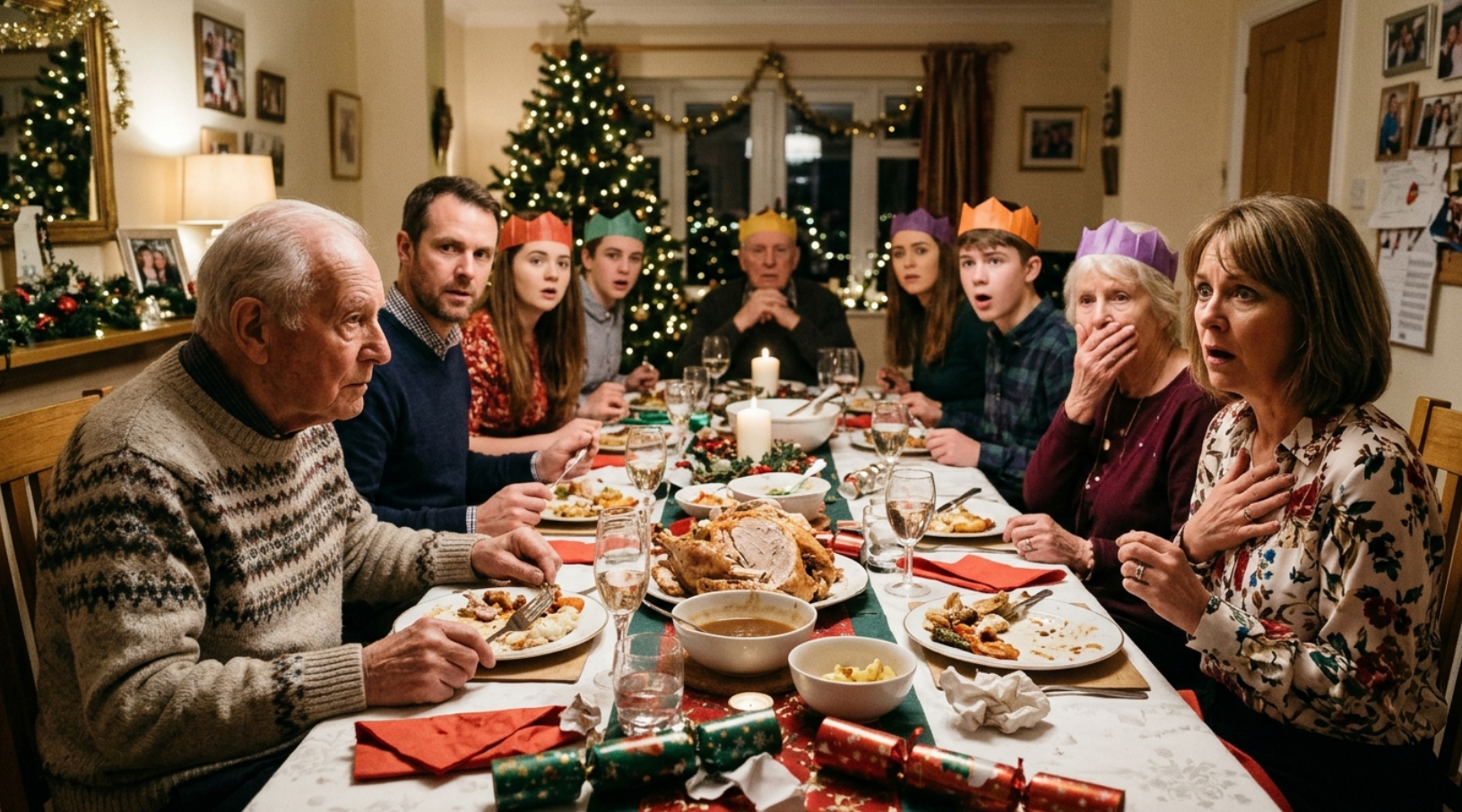
When we entered the dining room, every eye turned toward us.
Grandpa gestured toward an empty chair.
“Thank you for coming, James.”
Mr. Dawson nodded.
“Of course, Henry.”
Linda immediately stood.
“James, thank goodness you’re here. Perhaps you can explain what’s happening. Dad seems to believe we’ve been discussing his death behind his back.”
Mr. Dawson removed his coat and placed it over the back of his chair.
“Henry asked me to attend this evening because he has several matters he wants to discuss with the family. I suggest everyone sit down.”
“Several matters?” Gary repeated.
“Yes.”
“About the farm?”
Grandpa looked at his son.
“About my life, Gary. The farm is only one part of it.”
That sentence seemed to unsettle Gary more than anything else.
He sat down slowly.
Mr. Dawson opened his briefcase and removed a thick folder.
Before he could speak, Linda interrupted.
“Dad, if you’ve changed your will because you’re angry about some jokes, I hope you’ll reconsider. We’re your children. We have a right to know what you’ve decided.”
Grandpa tilted his head.
“A right?”
Linda hesitated.
“Well, we’re your family.”
“That’s true.”
“Then you should trust us.”
Grandpa stared at her for several seconds.
“Linda, do you remember what you told your mother in the hospital last February?”
Her eyes widened.
“What?”
“Your mother was still conscious. She was weak, but she could hear you. You stood beside her bed and asked me whether we had updated the will. You wanted to know if the farm would be sold immediately after she passed away.”
Linda’s lips parted.
“I was trying to help.”
“You also told her that keeping the farm was a waste of money and that I would be better off in a care facility.”
“I didn’t mean—”
“You said that the place was too much work for an old man and that you could sell it before the next planting season.”
Grandpa paused.
“Your mother started crying after you left the room.”
Linda lowered her eyes.
For a moment, the only sound was the ticking of the old clock above the fireplace.
“I didn’t know she was crying,” Linda whispered.
“No,” Grandpa said. “You didn’t stay long enough to find out.”
Those words struck harder than any accusation.
My grandmother had spent her final months hoping her children would come together. She had asked about birthdays, school performances, grandchildren’s jobs, and whether everyone would come for Sunday dinner.
Even when she was too weak to leave her bedroom, she asked Grandpa to save leftovers for Linda because Linda was always busy.
She had loved them without keeping score.
And they had mistaken that love for an endless supply of forgiveness.
Mr. Dawson cleared his throat.
“Henry, would you like me to proceed?”
Grandpa nodded.
“Yes, please.”
The attorney unfolded the first document.
“Before we discuss the estate, I need to clarify something. Henry is mentally competent, fully aware of his assets, and has received independent legal advice regarding his wishes. Nothing in these documents was prepared under pressure from any family member.”
Gary leaned forward.
“Why would anyone think he wasn’t competent?”
Mr. Dawson looked at him calmly.
“Because three weeks ago, someone contacted my office asking whether Henry’s hearing loss might make him incapable of understanding legal documents.”
The room went silent again.
Grandpa slowly turned his head toward Gary.
“Would you like to tell everyone who made that call?”
Gary’s face turned red.
“I was concerned about you.”
“Were you concerned about me,” Grandpa asked, “or concerned that I might sign something you didn’t agree with?”
Gary pushed his chair back.
“This is ridiculous. I’m leaving.”
“Please do,” Grandpa said.
Gary froze.
Grandpa’s expression remained steady.
“But before you go, remember that the attorney has records of every document I have signed, and I have no intention of allowing anyone to misrepresent my wishes.”
Gary looked toward Linda, hoping she would intervene.
She didn’t.
For once, nobody rushed to rescue him.
Mr. Dawson placed the first document on the table.
“This is the current estate plan. It replaces the previous version, which was drafted several years ago.”
Brett swallowed.
“Who gets the farm?”
Grandpa looked at him.
“Is that really the only question you have?”
Brett’s eyes dropped to the table.
“No, Grandpa.”
“Then perhaps you should listen before asking it again.”
The attorney continued.
“The farmhouse, the surrounding agricultural land, the barns, the equipment, and the south parcel are all addressed in the new plan. The documents also establish provisions for the farm’s ongoing operation and maintenance.”
Linda grabbed the edge of the table.
“Who owns it?”
Grandpa took a slow breath.
“I do, Linda. I still own it. I’m sitting right here.”
“I know that, Dad. I’m asking what happens afterward.”
“And that’s exactly the problem.”
He leaned back in his chair.
“For six years, I’ve listened to you discuss my death as if it were a business appointment. I’ve heard you calculate the value of my land while I was eating dinner. I’ve watched you treat every holiday as another opportunity to estimate how much money you’ll receive when I’m gone.”
His eyes moved from Linda to Gary, then to Brett.
“You were so busy planning your future with my property that you forgot I was still living my life.”
No one answered.
Then Grandpa reached for the green notebook again.
“There are things in here that even James hasn’t read yet.”
The attorney looked at him with a hint of surprise.
“Henry, I thought we were going to discuss the documents first.”
“We will. But I want them to understand something.”
Grandpa opened the notebook to a page marked with a small red ribbon.
“On March 14, 2023, I heard Linda tell Gary that if I ever discovered what they had been discussing with a realtor, they would simply say I was confused.”
Linda suddenly stood.
“That’s enough!”
Grandpa didn’t flinch.
“Is it?”
He turned another page.
“On October 9, 2024, I heard Gary tell Brett that they should persuade me to sign a power of attorney before my health declined any further.”
Gary shook his head.
“You’re twisting everything.”
“Then tell us what you meant.”
“I meant that you might need help managing things!”
“And yet you never asked whether I needed help. You asked whether you could control my decisions.”
Mr. Dawson raised a hand.
“Henry, I think we should keep the discussion focused on the estate documents.”
Grandpa nodded.
“You’re right.”
He closed the notebook and looked at all of them.
“Here’s what you need to understand. I have spent my entire life working this land. I repaired fences in blizzards. I worked through summers when the heat was so bad the tractor seat burned my legs. I borrowed money to buy better equipment, and I paid every loan back.”
His voice grew quieter.
“Your grandmother and I built this place together. She worked beside me when we couldn’t afford hired help. She packed my lunch before sunrise and waited for me when I came home after dark. When the crops failed, she never blamed me. When we finally had a good harvest, she celebrated as if we’d won the lottery.”
He glanced at Grandma’s empty chair.
“This farm isn’t just land. It’s the life we built together.”
Then he looked at Linda.
“And I will not allow anyone to tear it apart simply because they think they deserve a piece of it.”
Linda’s eyes filled with tears, but I couldn’t tell whether they were tears of shame or fear.
Perhaps, for the first time, even she didn’t know.
Mr. Dawson turned to the next page.
“There is one additional matter Henry wants everyone to understand before we review the inheritance provisions.”
He placed several printed photographs on the table.
I recognized the south parcel immediately. It was the broad stretch of farmland beyond the old red barn, where Grandpa used to take me to watch the sunrise.
The second photograph showed a boundary marker near the creek.
The third showed a new survey map.
“What are these?” Gary asked.
“An independent property survey,” Mr. Dawson replied. “It was commissioned to clarify the boundaries and ownership records for the entire farm.”
Linda stared at the map.
“Why would you need a new survey?”
“Because someone contacted a commercial realtor about purchasing part of the property without my authorization.”
Gary looked away.
Grandpa folded his hands.
“I wanted to know whether that conversation was just talk or whether someone was taking steps to make it happen.”
The attorney opened another folder.
“The realtor confirmed that he had been approached about the south parcel. No sale was completed. Henry did not authorize the transaction.”
Linda began shaking her head.
“We were only asking about the value. There’s nothing illegal about asking what property is worth.”
“No one said there was,” Mr. Dawson replied. “But the owner has the right to decide whether his property is marketed or sold.”
Grandpa nodded.
“Exactly.”
He looked toward the window.
“I know the farm is valuable. I know the south parcel could be worth a great deal to the right buyer. But I also know what happens when land is divided without thought. The fences get moved. The water access becomes a dispute. The barns get neglected. Everyone spends years fighting over a place that once brought them together.”
He turned back to the table.
“I don’t want that to happen after I’m gone.”
For a brief moment, I thought he might announce that he was selling the entire farm and leaving nothing to anyone.
Instead, he reached across the table and gently touched my hand.
“Katie, do you remember what your grandmother used to say about the apple trees?”
I smiled sadly.
“She said you could tell how a person cared for something by whether they planted trees they might never live long enough to enjoy.”
Grandpa’s eyes softened.
“That’s right.”
He squeezed my hand.
“She understood something the rest of this family seems to have forgotten. A good life isn’t measured by what you can take from it. It’s measured by what you leave behind.”
I felt tears forming in my eyes.
I had been the only grandchild who visited regularly, even when there was no holiday or birthday to celebrate. I helped Grandma prepare meals when she became ill. I drove Grandpa to his hearing appointments. I sat with him on the porch after Grandma died, even when neither of us felt like talking.
I never did those things because I expected the farm.
I did them because I loved him.
And suddenly, I realized that Grandpa knew the difference.
He had known it all along.
But before I could say anything, Linda leaned forward.
“So Katie gets everything?”
Her question cut through the room.
Grandpa slowly withdrew his hand from mine.
“No, Linda. That’s not what I said.”
“Then what are you saying?”
“I’m saying that the future of this farm has been decided according to my wishes, not according to who shouts the loudest or who needs money the most.”
Linda looked at Mr. Dawson.
“Please tell us what the will says.”
The attorney glanced at Grandpa.
“Are you ready, Henry?”
Grandpa looked around the table one last time.
“Yes.”
Mr. Dawson opened the final envelope.
And when he began reading the first paragraph, Linda’s face changed in a way I will never forget.
Because the first name mentioned in the document wasn’t mine.
It wasn’t Linda’s.
And it wasn’t Gary’s.
It was the name of someone who hadn’t even been invited to Christmas dinner.
PART 4
“The first beneficiary is the Henry and Eleanor Whitaker Farm Preservation Trust, established to protect the farmhouse, agricultural land, barns, and surrounding property from forced sale or division.”
Mr. Dawson’s voice was calm, but the effect on my family was immediate.
Linda blinked several times.
“A trust?” she demanded. “What does that mean?”
“It means your father has made arrangements to preserve the farm for future generations,” the attorney explained. “The land will not automatically be divided among individual heirs, and no beneficiary can simply demand that the entire property be sold for personal financial gain.”
Gary pushed his chair back.
“So none of us gets the farm?”
“That’s not what I said,” Mr. Dawson replied. “The trust provides for the farm’s continued operation, maintenance, and preservation. Henry has also established separate provisions for his family.”
Grandpa nodded toward the document.
“Please continue.”
The attorney read the next paragraph, explaining that the farmhouse would remain Henry’s home for as long as he wished to live there. After his death, the property would be managed according to the trust’s terms, with a designated manager responsible for maintenance, agricultural operations, and financial records.
Then came the name of the person appointed to that role.
“Katie Whitaker.”
I stared at him.
For a moment, I genuinely thought I had misheard.
“Me?”
Grandpa smiled gently.
“Yes, sweetheart. You.”
Linda let out a bitter laugh.
“Of course. The favorite grandchild gets everything.”
Grandpa’s smile disappeared.
“No, Linda. The person who showed up when I needed someone gets the responsibility.”
He looked at me.
“Katie never asked me for the farm. She never asked what it was worth. She never asked whether I’d changed my will. She came here because her grandmother was sick, because I was lonely, and because she understood that an old man might need company even when he didn’t need money.”
My eyes filled with tears.
Grandpa continued.
“She knows where the irrigation pipes freeze in winter. She knows which barn roof needs repairing. She knows why your grandmother planted apple trees along the eastern fence instead of cutting them down to make room for more crops.”
He paused.
“Most importantly, she understands that this land is something to care for, not something to consume.”
Linda looked at me as if I had personally stolen something from her.
“I hope you’re happy, Katie.”
I shook my head.
“I’m not happy about any of this, Aunt Linda. I never wanted our family to end up like this.”
“Easy for you to say when you’re the one benefiting.”
Grandpa struck the table with his palm—not violently, but firmly enough to stop her.
“That’s enough.”
Linda fell silent.
“You keep talking about what Katie is receiving. Have you asked yourself what she has given?”
He turned toward his oldest daughter.
“When your mother was dying, Katie sat beside her for hours. She helped her eat when she was too weak to hold a spoon. She washed the dishes after everyone else went home. She listened to your mother talk about her childhood because she knew those memories mattered.”
His voice trembled.
“Where were you, Linda?”
Linda’s mouth opened, but Grandpa continued.
“You visited, yes. But you spent half your time asking me about the property, the bank accounts, and the paperwork. Your mother noticed. She didn’t tell you because she loved you too much to hurt you.”
The room became painfully quiet.
“I know you loved your mother,” Grandpa said softly. “I have never doubted that completely. But somewhere along the way, you began loving what she would leave behind more than the time you still had with her.”
Linda sat down.
For the first time that night, she looked genuinely ashamed.
But the revelations were not over.
Mr. Dawson turned to the next page.
“Henry has also established an education and emergency assistance fund for his grandchildren. The fund will provide assistance according to specific eligibility requirements. It is not an unrestricted inheritance, and the trustees will evaluate requests based on their stated purposes.”
Brett immediately leaned forward.
“How much money is in it?”
Grandpa looked at him.
“That’s your first question?”
Brett’s face reddened.
“I just want to understand.”
“Then understand this. The fund exists to help people build stable lives. It will not pay off gambling debts, luxury purchases, or loans taken out because someone assumed an inheritance was guaranteed.”
Brett looked down at his plate.
Grandpa knew about his debts.
Of course he did.
Brett had spent years borrowing money to support a lifestyle he couldn’t afford. He drove an expensive truck, bought things he didn’t need, and complained constantly about how unfair life was.
Whenever someone suggested that he get another job or reduce his spending, he insisted that everything would be fine once Grandpa passed away.
Now that future had disappeared before his eyes.
“Grandpa,” Brett said quietly, “I didn’t think you’d actually heard me say those things.”
Grandpa studied him.
“That is precisely why you said them.”
Brett swallowed.
“I was wrong.”
“Yes,” Grandpa replied. “You were.”
He didn’t soften the truth, but neither did he humiliate him.
“Being wrong doesn’t mean you can’t become a better person. But an apology isn’t a magic key that opens every locked door. You will have to prove that you understand what you’ve done.”
Brett nodded, though he still looked devastated.
Then Mr. Dawson reached the final section.
“There are also personal bequests to family members, subject to the conditions outlined in the estate documents. Henry has chosen to provide modest, equal cash gifts to his children, with the remainder of his personal estate handled according to his written instructions.”
Linda looked up sharply.
“Equal gifts?”
“Yes.”
“And the farm stays with Katie?”
“The farm is held under the preservation trust, with Katie serving as manager under its terms. She does not receive unrestricted personal ownership of the entire property.”
That distinction seemed to surprise everyone.
Grandpa leaned forward.
“I am not giving Katie a kingdom. I’m asking her to protect a home.”
He looked at me.
“If you accept this responsibility, you will have to work with the trustees, maintain proper records, and make decisions that protect the farm for the future. You won’t be allowed to sell it just because you need money. You won’t be allowed to neglect it just because farming becomes difficult. And you won’t be allowed to turn it into a monument to me.”
I nodded through my tears.
“I understand.”
“Good.”
He smiled.
“Because I didn’t choose you to make you rich. I chose you because I believe you’ll remember why this place matters.”
I couldn’t speak.
All I could do was hold his hand.
And then Linda asked the question that changed the evening again.
“What happens if we challenge it?”
Mr. Dawson carefully closed the folder.
“You are entitled to seek independent legal advice about any legitimate concerns. However, Henry’s documents have been prepared with legal guidance, and he has taken steps to document his wishes and his decision-making capacity.”
Linda’s face tightened.
“I didn’t mean—”
“Yes, you did,” Grandpa interrupted gently. “And I want you to think very carefully about what you’re asking.”
He looked at all three of them.
“You can leave this house tonight and spend the next ten years fighting over my decisions. You can pay lawyers to argue about land that you never planted, barns you never repaired, and a house you rarely visited unless there was a holiday or an inheritance to discuss.”
He paused.
“Or you can go home, think about what happened here, and decide whether you want to be the kind of family your mother believed we were.”
Nobody answered.
Then Grandpa stood.
He was eighty-two years old. His hands trembled slightly when he pushed himself away from the table, and his shoulders were no longer as straight as they had been when I was a child.
But there was nothing weak about him in that moment.
“Dinner is over,” he said. “The pie is in the kitchen if anyone wants some.”
He turned and walked toward the living room.
I followed him.
Behind us, nobody touched the pie.
READ THE ENDING PART
For Six Years, My Family Thought Grandpa Was Deaf—Until Christmas Dinner, When He Revealed He’d Heard Every Cruel Word They Said About His Inheritance
Part 1 of 2