His road name was Chief. He was seventy years old when he passed, rode out of a town outside Memphis, Tennessee his whole life, worked as a machinist before he retired. And he was exactly the kind of man the world judged in half a second. Big. Bearded. Tattooed. The kind of man people crossed the street to avoid.
I’m telling this the way it came together. From a volunteer who was in the room. From the people who run the home. From one of his club brothers. And from the kids themselves — grown now, most of them — who wanted the world to know who their Biker Dad was.
He had no children of his own. He died ten years ago. And he is, to this day, the father of twenty-five people. This is how that happened.
Let me tell you about Chief’s life first, because the emptiness in it is what makes the rest so full.
Chief married young, and by every account he and his wife were devoted to each other. They wanted children. It never happened — one of those quiet griefs a lot of couples carry, the family that never came. And they made their peace with it, and they had each other, and that was a good life.
And then his wife died. Ten years before Chief did. And suddenly this big man was alone. No wife. No children. No family to speak of. Just an empty house and a Harley and a decade of solitude stretching out ahead of him.
A lot of men, in that situation, fold inward. Get bitter. Disappear into their grief. Chief did the opposite. Because Chief had something most people don’t realize he had: twenty-five kids. Well — not his. Not legally. But his in every way that matters.
Because for thirty years — thirty years, long before his wife even died — Chief had been volunteering at the local orphanage.
I want you to understand what thirty years of showing up actually means.
Most volunteers come and go. They help for a season, feel good about it, drift away when life gets busy. That’s normal. That’s most of us. Chief wasn’t most of us. Chief showed up, week after week, for three decades. Generations of kids passed through that home, and Chief was there for all of them. Kids who arrived as toddlers and aged out as teenagers knew Chief their entire childhoods. He was the one constant in a place defined by impermanence.
He didn’t do it for show. He didn’t do it for credit. He did it because, the volunteer told me, Chief understood something about those kids. He understood what it is to want a family and not have one — he’d lived that grief himself, the children he never got. And these kids were living the other side of the same grief: children who wanted parents, with no parents who wanted them. Chief and those kids were two halves of the same loss. And so he gave them what he had. He gave them himself.
He learned every kid’s name. Not just the cute ones, not just the easy ones — all of them. He remembered what each child loved and feared and dreamed about. He showed up to their school events when no one else would. He taught them things. He listened to them. For the kids in that home — kids whom the world had, in the cruelest way, decided not to want — Chief was the one person who showed up on purpose, again and again, just for them. He was, for thirty years, the closest thing to a father that hundreds of children ever had.
After his wife died and he was truly alone, those kids became even more his whole world. They were the only family he had left. And he was the only family a lot of them had at all.
I want to be honest about what this story is.
It’s not just a story about a tough man with a soft heart. It’s a story about a man who had no children, and who became the father of every child the world forgot. About how family isn’t always blood. About how the people who choose to show up, over and over, with no obligation and no reward, can become more “family” than family.
And it’s a story about how that man chose to die.
Because when the cancer came — lung cancer, late stage, the kind with no road back — Chief had to think about his final days, and his final wishes, and what he’d leave behind.
He didn’t have much. A modest life. But he made his will, and what he did with it tells you who he was. His beloved Harley — the thing a biker treasures most — he left to his club. To his brothers. So a piece of him would keep riding.
And everything else. Everything he had. He left to the orphanage. To the kids. The man with no children left his entire estate to the children the world had abandoned. Because they were his children, in every way that counted, and he was going to take care of his kids even after he was gone.
But the money wasn’t the real gift. The real gift was the thing nobody knew he was doing.
In his final year — the year he was dying, the year he knew he was running out of time — Chief took on a secret project. He told no one. Not his brothers, not the staff, not the kids.
He started writing letters.
One letter for every child in that home. Twenty-five kids. Twenty-five letters. And here’s the thing that breaks everyone — they weren’t a form letter. They weren’t “to all my dear children” copied twenty-five times. Each letter was individual. Personal. Written to one specific child, by name, about that exact child.
Because Chief knew these kids. Thirty years of paying attention. So he wrote to each one about who they actually were. He wrote to the smart one about how brilliant he was. He wrote to the shy one about the quiet strength he saw in her. He wrote to the angry kid about the good heart underneath the anger. He wrote to each child the specific, personal, true things that only someone who truly saw them could write. He told each one what was special about them. What he believed they could become. How proud he was. How much he loved them.
A dying man, in his last year, with his failing strength, spending what little energy he had left writing twenty-five love letters to twenty-five children who had no one else to tell them they were special. So that after he was gone — after the one person who’d always shown up was gone forever — each of those kids would have something. Words. His words. Proof, in his own shaky handwriting, that they had been seen, and known, and loved, by someone, completely.
He was making sure that his death didn’t leave them with nothing. He was leaving each of them a piece of a father’s love they could hold in their hands for the rest of their lives.
And then came the end. And Chief’s last request.
He was too weak to walk by then. Fading fast. And when they asked if there was anything he wanted, any final wish, he didn’t ask for comfort or peace or to go home. He asked to be taken to the orphanage. One last time. To say goodbye to his kids.
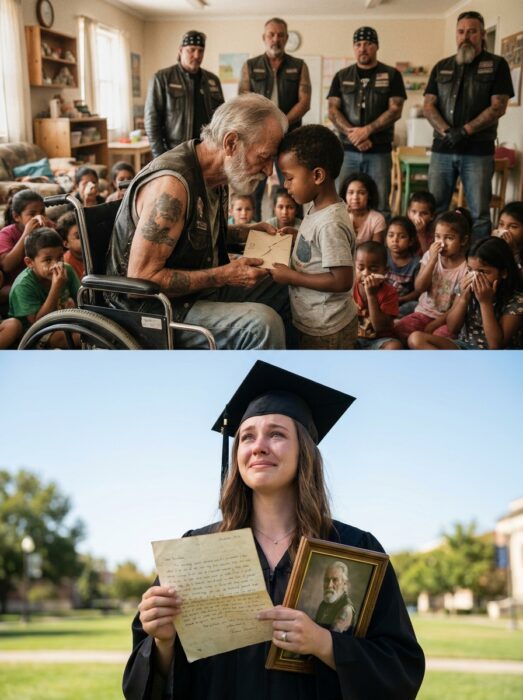
So five of his brothers came. And they gently loaded their dying brother into a wheelchair, and they brought him to the children’s home. With his box of twenty-five envelopes on his lap.
All twenty-five kids gathered around him. And they knew. Even the little ones knew. This was goodbye. Their Biker Dad was dying, and he’d come to say goodbye, and the room was already full of tears.
And Chief, so weak he could barely speak, called them up. One at a time. By name. The way he’d always known each of their names.
And to each child, he handed an envelope. Their letter. The one written just for them.
He couldn’t make speeches. He didn’t have the strength. He could barely get out a few words to each child. So instead of words, he did something else. As he gave each kid their letter, he leaned forward, and he pressed his forehead to theirs. Forehead to forehead. A blessing. A goodbye. A wordless I love you, I see you, you are mine. Twenty-five times. Twenty-five foreheads. Each child got their letter, and their forehead pressed to his, and his eyes looking into theirs one last time.
Twenty-five kids, crying. Five hardened bikers, crying. A dying man giving the last of his strength to make sure every single child knew they were loved.
And when he’d finished — when the last child had their letter and their forehead pressed to his — Chief closed his eyes.
And he passed away. Right there. In the arms of twenty-five children and five brothers. Surrounded, in his final moment, by the family he’d built out of love and showing up. The man who died with no children of his own, leaving this world held by twenty-five kids who were, in every way that mattered, his.
I want to sit with that, because it’s almost unbearably beautiful.
A man who wanted children his whole life and never had them. A man who lost his wife and lived a decade alone. A man the world looked at and saw only something to fear. He died surrounded by more love than most people ever know. Twenty-five children holding him. Twenty-five letters in twenty-five small hands. A lifetime of showing up, returned to him a hundredfold in his final breath.
He chose where to die. He chose to die among his kids. And he made sure that when he left, he left each of them with proof of his love that they could keep forever.
The kids started calling him Biker Dad after that day. Not “the biker” anymore. Biker Dad. Because that’s what he’d been. That’s what he died as. The father of twenty-five.
And they kept those letters. Every one of them. Through everything that came after — the foster placements, the aging out, the hard roads that orphanage kids so often walk — they kept their letters. Because those letters were the one thing they had that said, undeniably, in a dying man’s handwriting: you were loved, you were seen, you are special, I believe in you. For a kid who grows up believing nobody wanted them, that letter was everything. It was a father’s voice they could return to anytime the world told them they were nothing.
And here’s where the story becomes something the whole world knows.
Ten years passed. The kids grew up. And one of them — a little girl from that room, now a young woman of twenty — did something on the anniversary of a milestone.
She graduated from college.
Think about that. An orphan. A kid from a children’s home, the kind of kid the statistics say doesn’t make it, doesn’t go to college, doesn’t beat the odds. And she did. She graduated.
And on her graduation day, she took out her letter. The one Biker Dad had written her ten years before, when she was a little girl and he was dying. The letter she’d read a hundred times, every time life got too heavy, every time she wanted to give up. The letter where he’d told her she was going to do great things. Where he’d said he believed in her.
And she posted it. On Facebook. A photo of the worn, ten-year-old letter in a dying biker’s shaky handwriting. And she wrote:
“This is the letter my Biker Dad wrote me before he died, ten years ago. I’ve read it every time things got hard. He told me I was going to succeed. He told me he believed in me. So I believed him. Today I graduated from college. Biker Dad — wherever you are — can you see this? I did it. I made it. You were right about me. Thank you for being the only one who ever told me I could.”
It went viral. Eight million shares.
Eight million people read about a dying biker who wrote twenty-five orphans personal letters and died in their arms, and a little girl who grew up and graduated college on the strength of believing the words he’d left her.
And then the other kids saw it. The other twenty-four. Scattered across the country, grown now, living their lives. And one by one, they came forward. And they posted their letters too.
Twenty-five letters. From a dead man. Ten years gone. All going viral at once.
Each letter different. Each one personal. Each one the specific, true, loving words a man had written to a specific child in the last year of his life. Twenty-five grown adults, sharing the letters that had carried them through their hardest years, the words of the father they’d built out of a volunteer who simply never stopped showing up.
The kid he’d called brilliant had become an engineer, and posted his letter. The shy girl he’d seen strength in had become a nurse, and posted hers. The angry kid whose good heart he’d named had grown into a good man, and posted his. Twenty-five lives, shaped by twenty-five letters, all tracing back to one man who decided that no child should grow up without someone telling them they mattered.
Biker Dad, dead for ten years, was still being a father. Still showing up. Still telling his kids, from beyond the grave, that he believed in them. And the whole world watched it happen.
The comments became something I’ve never seen. People who grew up in foster care and orphanages, sharing what it would have meant to have one person believe in them like that. People sobbing over the idea of a dying man spending his last year writing love to children who weren’t his. People moved beyond words that ten years after his death, this man was still fathering twenty-five people. And so many people, so many, saying the same thing: go be someone’s Biker Dad. There’s a kid out there who just needs one person to show up.
The top comment said: “He had no kids of his own so he became the dad of 25 the world threw away. He spent his last year on earth making sure each of them would always have proof they were loved. Ten years later they ALL posted their letters. He’s still their father. He’ll always be their father.”
Another, the one that became the title everywhere: “‘Biker Dad, can you see this? I did it.’ A dying biker wrote 25 orphans a letter each and died in their arms. A decade later all 25 letters went viral. Show up for a kid. Be somebody’s Biker Dad.”
Here’s where it stands now.
The twenty-five kids — grown adults now — have become, because of those viral letters, a kind of family to each other. They found each other again through the story. The siblings-of-circumstance who’d grown up together under one man’s love, reconnected by his words a decade after he died. They have a group now. They call themselves Biker Dad’s Kids. They get together. They look out for each other. The family Chief built didn’t end when he died — it grew, and it endures, and it loves itself the way he loved all of them.
And his legacy spread far past them. The story inspired people all over to volunteer at children’s homes, to mentor foster kids, to write the letters, to be the one who shows up. Chief — who wanted only to quietly love twenty-five forgotten children — ended up moving millions to go love the forgotten children near them. His thirty years of showing up multiplied into countless others showing up. A man with no children became, in death, the spiritual father of a movement.
The Harley he left his club still rides. They take it out on the anniversary of his death, every year, all of them together, in his honor. And the orphanage he left everything to is still there, still caring for kids, with a wall now — a wall where they’ve framed copies of all twenty-five letters, so that every new child who comes through that home can see them. Can see the proof that someone, once, loved twenty-five kids enough to spend his dying year telling each of them they were special. So that every forgotten kid who walks in knows: it’s possible. Someone might see you. Someone might believe in you. Someone might show up.
His brothers kept something, in the inside pocket of a vest they had made — a memorial vest, with his name and his patches. A photo. The whole orphanage, twenty-five kids, gathered around an old biker in a wheelchair, every one of them holding an envelope, every one of them crying, every one of them his. The last photo. The family he made, in the moment he left it.
The Harleys still rumble around that town outside Memphis. People still see the riders and decide exactly what they are. Rough. Hard. Not the type you’d want near your kids.
They have no idea. They have no idea that one of those men spent thirty years and his entire dying year loving twenty-five children nobody else wanted — that the scariest-looking man in town became the only father two dozen forgotten kids ever knew, and stayed their father long after he was gone.
He had no children.
He died the father of twenty-five.
Biker Dad, can you see this? I did it.
That’s the whole thing. A man with no family built one out of the children the world abandoned, loved them with thirty years of showing up, and made sure that even his death would leave each of them holding proof that they mattered.
Be somebody’s Biker Dad. Show up. Write the letter. Tell a kid you believe in them.
It might be the thing that carries them their whole life. It might be the voice they hear, ten years on, the day they finally make it — telling them they always could.
A dying biker with no children of his own spent his final year secretly writing personal letters to all 25 kids at the orphanage he’d served for 30 years — then handed them out, pressed his forehead to each child’s, and died in their arms. Ten years later, a girl shared hers on her college graduation: “Biker Dad, can you see this? I did it.” All 25 letters went viral. Show up for a kid. Be somebody’s Biker Dad.
Follow the page for more stories from the road and the people who ride it. Biker Dad, can you see this? I did it. 
My Brother Stole Every Dollar I Had and Disappeared—Then My 10-Year-Old Daughter Quietly Said, “Mom, I Already Took Care of It”
Part 2 of 2