Part 2
I was not family. I was just one of the mothers in the room, which means I had the terrible advantage of seeing everything before I understood anything. My daughter Sophie had been invited because she and Lily sat at the same kindergarten table, where they traded stickers, shared crayons, and argued over who got to be the purple mermaid during recess. I knew Jenna from school pickup lines, from polite waves, from two rushed conversations about snack day and flu season. I knew Bear only by sight.
Everyone in Abilene knew Bear by sight.
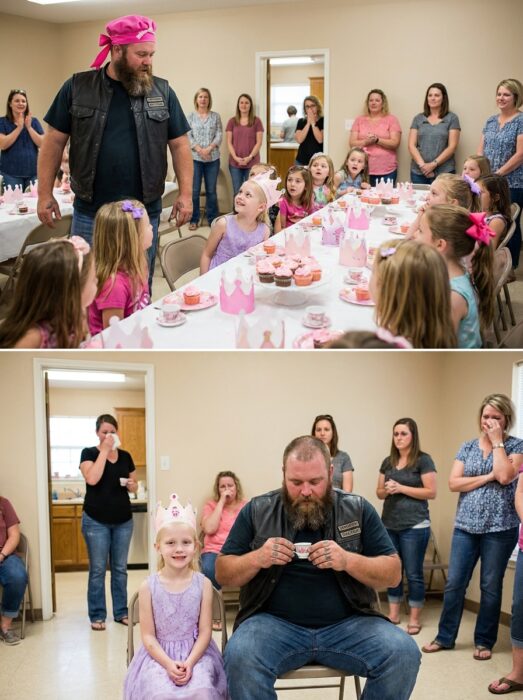
He rode a black Harley-Davidson Road King that sounded like thunder trapped in a metal barrel, and he usually parked outside Miller’s Diner on Route 83 with three or four other riders from his club. He was not a man people rushed to approach. His leather cut was worn at the edges, heavy with patches, road dust, and years of weather. His arms were covered in skulls, roses, names, old dates, and lines of ink that disappeared under his sleeves. His hands were enormous and scarred, but that afternoon, those hands held a tiny porcelain cup with two fingers while twelve little girls watched him pretend to drink tea.
That was the first crack in the room.
One mother smiled for real.
Then another.
Lily giggled, and Bear’s face changed so quickly it hurt to see. The hard lines around his eyes loosened. His shoulders dropped. The man everyone was afraid to look at became, in that moment, only a father trying to make his daughter laugh before the world asked too much of her.
He sat at the end of the tiny table on a chair that looked ready to surrender under him. His knees rose too high. His boots stuck out like black anchors beneath the lace tablecloth. The pink ribbon hat sat on his head with heroic stupidity, slightly crooked, one fake flower trembling whenever he moved. A little girl named Madison asked if he was a giant prince. Bear looked at Lily before answering.
“Only if the birthday queen says so.”
Lily lifted her teacup. “You can be the royal guard.”
Bear nodded once, serious as a courtroom. “That tracks.”
We laughed then, but Jenna did not. She stood near the kitchen door with both arms folded across her stomach, watching Lily’s hair every time it moved. I remember thinking she looked too emotional for a birthday party. I thought maybe she was tired. Maybe money was tight. Maybe Bear had almost missed the party and she was relieved.
I was wrong.
The truth sat in the room with us, hidden under pink frosting and paper crowns.
Two weeks before that party, Lily had been diagnosed with leukemia after bruises appeared on her legs and a fever refused to break. Jenna told me later that Bear heard the doctor say the word cancer and went so still she thought he had stopped breathing. He did not ask dramatic questions. He did not punch a wall. He did not collapse in the hallway. He simply took Lily’s hand, placed it flat against his chest, and said, “Feel that? Still beating. We keep going.”
That was Bear.
He was not good with speeches.
He was good with staying.
The night they told Lily about chemotherapy, she asked if it would hurt. Jenna cried before she could answer. Bear did not. He sat on the carpet in Lily’s bedroom, surrounded by stuffed animals, princess books, and glow-in-the-dark stars stuck to the ceiling. His leather cut hung on the back of the rocking chair like some strange shadow in a child’s room.
Lily touched her hair.
“Will I look different?”
Bear’s jaw tightened.
“Maybe for a while.”
“Will people stare?”
He looked at her then, really looked, and something inside him made a decision before his mind caught up.
“Then they can stare at me first.”
She asked what that meant.
He held up the pink tea-party hat she had chosen online for her birthday, the one with the ribbon and fake flowers. It was meant for her. It was far too small for him. He put it on anyway. It sat on his head like a joke told by grief.
Lily smiled for the first time that day.
Bear pointed at the hat. “You pick it. I wear it. Every day you want. Until your hair grows back.”
Lily studied him with the seriousness only children facing adult terror can have.
“Even at the hospital?”
“Especially there.”
“Even if your biker friends see?”
Bear did not blink.
“They got eyes. They’ll survive.”
That was the promise.
The tea party was the first test.
Part 3
The false climax came when one of the mothers posted the photo.
She did not mean harm. I believe that. The image was too strange, too sweet, too shareable for a person trained by social media to resist. Bear sat in a tiny chair with a pink ribbon hat on his head, holding a teacup between tattooed fingers while Lily leaned against his arm in a lavender dress. The caption said, “Scariest dad at the princess party turned out to be the sweetest.”
By evening, it had spread through the school.
By Sunday, it had reached the diner, the gas station, two local Facebook groups, and half the Red River Riders’ extended circle. Some people loved it. Some made jokes. Some called him soft. Some said a man wearing that hat in public must have lost a bet. The comments rolled in with the usual mix of hearts, laughing faces, and strangers trying to be clever from behind clean screens.
Bear saw them.
He did not respond.
That Sunday afternoon, he rode to the club garage wearing the same pink hat.
Not hidden in his saddlebag. Not tucked under his arm. On his head.
The Harley’s engine rolled into the lot, deep and low, and every man outside the garage turned at once. For a second, nobody spoke. The hat’s ribbon fluttered in the hot wind above his beard, above his tattoos, above the leather cut that usually ended conversations before they began.
Then Tank started laughing.
Tank was not cruel, but he was loud, and sometimes loudness does the damage cruelty would have done if it had the courage. He slapped a hand against the tool chest and said, “Brother, tell me there’s a story, because I ain’t ready to believe fashion did that to you.”
The other men laughed too.
Bear parked, killed the engine, and sat there while the metal cooled beneath him. He let the laughter burn out. He looked at Tank, then at the others, then took off his gloves one finger at a time.
“My daughter starts chemo tomorrow,” he said.
The garage emptied of sound.
Tank’s smile disappeared like somebody had shut off a light.
Bear stepped off the bike. His boots hit gravel. His leather creaked when he stood. The pink hat stayed exactly where it was.
“She asked me to wear it,” he continued. “So I’m wearing it.”
No one answered.
He walked past them into the garage, opened the old refrigerator, took out a bottle of water, and twisted the cap with hands that were not as steady as he wanted them to be. He did not cry. He did not ask for sympathy. He did not explain leukemia, or fear, or how a six-year-old had asked whether people would laugh when she lost her hair.
He only said, “Anybody got a problem with it, say it now.”
Nobody did.
Then Bishop, the oldest Rider there, stepped forward. He was sixty-eight, white American, thin as a fence post, with silver hair, a crooked back, and hands permanently stained from engines. He reached into the donation box they kept for charity rides and pulled out a twenty-dollar bill.
“What size hat does a grown fool wear?” he asked.
Bear stared at him.
Bishop shrugged. “If the princess is designing uniforms, I’ll need one too.”
That was the second crack.
Tank took off his cap and rubbed one hand over his shaved head.
“Make mine blue,” he muttered. “Pink washes me out.”
The garage laughed again, but this time it sounded different.
Less like mockery.
More like men trying not to cry where other men could see.
The next morning, Bear walked into the pediatric oncology wing wearing the pink hat from the tea party. Lily wore a yellow mask, a purple hoodie, and the same lavender dress under it because she said princesses could fight in layers. Jenna carried the hospital bag. Bear carried Lily when her courage ran out in the parking garage.
People stared.
Of course they did.
A six-foot-five biker in full leather, skull tattoos, and a pink ribbon hat does not disappear in a hospital hallway. Nurses looked up. Parents looked twice. A little boy in a wheelchair pointed. Lily buried her face in Bear’s neck.
He stopped walking.
“You want the hat lower?” he asked.
She nodded.
He tugged the brim down until it sat almost over his eyebrows.
“Better?”
“A little.”
Then he whispered, loud enough for only those nearest to hear, “They gotta get through me first.”
Lily breathed against his shoulder.
And they kept walking.
Part 4
Eight months is a long time when measured in chemo appointments.
It is longer when measured in a child’s hair falling out strand by strand, in plastic bracelets cut off and replaced, in cafeteria coffee gone cold before anyone drinks it, in the small bravery of swallowing medicine while adults pretend it tastes fine. It is longest for parents who learn the language of blood counts, ports, neutrophils, fevers, scans, and waiting rooms where every chair seems to hold somebody’s worst day.
Bear wore a pink hat to every appointment.
Not the same one.
Lily designed them.
At first, she chose simple things. Pink ribbon. Fake flowers. A plastic jewel clipped to the side. Then, when her hair began to thin and sadness made her quiet, Bear brought blank hats to her bed with glue, markers, stickers, and feathers. Some days she decorated them herself. Some days she only pointed. Some days she was too tired to care, and Bear wore the last one she had made until she cared again.
There was the hat with purple butterflies.
The hat with tiny dinosaurs because she said cancer was “getting stomped.”
The hat with silver stars for scan day.
The hat with cotton balls glued around the brim because Lily thought it looked like a cloud, and Bear wore it through the hospital lobby without a flicker of shame while three teenagers tried not to laugh.
There was one covered entirely in googly eyes.
That one became famous in the oncology ward.
Bear hated the googly-eye hat. You could tell. Every time he turned his head, the eyes shook. Every nurse smiled. Every child noticed. Lily laughed so hard that day she forgot to be afraid for almost four minutes, and because of those four minutes, Bear wore that hat three appointments in a row.
The story spread inside the hospital long before it spread anywhere else.
A little boy named Mason asked if Bear was a pirate princess. Bear said, “Depends who’s asking.” A nurse named Denise started keeping a photo wall near the infusion room with Lily’s permission, one picture for each hat. Parents began looking for him on treatment days, not because he was entertaining, but because his presence changed the air. He was proof that a person could look ridiculous on purpose and still be strong.
That was the twist people outside the hospital did not understand.
Bear was not wearing the hats to be funny.
He was taking the stare before it reached his daughter.
When Lily lost the last of her hair, she did not cry at first. She sat on the bathroom counter at home, wearing pajamas with moons on them, staring at the sink where soft brown curls had gathered in small wet clumps. Jenna stood behind her, shaking. Bear stood in the doorway, still in work jeans, still smelling like motor oil, one hand braced against the frame.
Lily touched her head.
“Do I look sick?”
Jenna covered her mouth.
Bear stepped forward. He did not rush. He did not say the easy thing. Children know when adults lie kindly.
He picked up the pink hat with silver stars from the counter and placed it on his own head first.
Then he looked in the mirror beside her.
“You look like my girl,” he said.
Lily’s eyes filled.
“What if I don’t want people to see?”
“Then they look at me.”
“What if they still see?”
Bear leaned closer, his beard brushing her shoulder.
“Then I stand closer.”
That became their arrangement.
At the hospital, in restaurants, at school events, at grocery stores, he stood closer. Sometimes he wore the hat high and proud. Sometimes he bent down so Lily could adjust it before they walked inside. Sometimes she picked the most ridiculous one possible because she was angry and wanted the world to look at him instead of her.
He always let her.
One appointment in month five, she was too weak to walk from the car. Bear carried her through rain, his leather wet, the pink feathered hat sagging under water until it looked half dead. A man near the elevator smirked, not knowing, not thinking, just reacting to the sight of a biker in a ruined princess hat.
Bear saw it.
Lily saw it too.
For one second, I thought Bear might say something. So did Jenna. So did the man, apparently, because his face changed fast when Bear turned.
But Bear only shifted Lily higher against his chest and asked, “Want me to add glitter next time?”
Lily whispered, “Gold glitter.”
“Done.”
The man looked at the floor.
That was Bear’s kind of violence now.
He did not swing.
He stayed gentle where people expected him to be dangerous.
Part 5
The Red River Riders changed too, though none of them would admit it cleanly.
At first, only Bishop wore a hat with Bear. His was blue, despite Tank’s joke, and had one crooked ribbon stapled badly to the side. He wore it into the hospital cafeteria one Tuesday and pretended not to notice when Jenna cried into her napkin.
Then Tank showed up in a pink cowboy hat with “Team Lily” written across the brim in black marker.
Then three more came.
By the sixth month, every chemo day looked like a strange parade in the hospital parking garage. Big men in leather cuts, tattooed arms, boots, gray beards, shaved heads, and handmade hats designed by a six-year-old girl who had become the unofficial president of their dignity. They did not crowd the oncology wing. They knew better. Most stayed outside or in the cafeteria, buying coffee, carrying bags, fixing flat tires for strangers, giving directions to families who looked lost.
But Lily knew they were there.
That mattered.
On hard days, Bear would carry her to the window and point down at the parking lot where the bikes sat lined up under fluorescent lights. Helmets hung from handlebars. Pink hats bobbed as men talked too softly for bikers. Sometimes Bishop raised a hand. Sometimes Tank did a ridiculous bow. Once, the whole line of riders tipped their hats at the same time, and Lily smiled through nausea.
Jenna filmed that one.
Not for the internet.
For survival.
Because when you are living inside illness, proof of tenderness becomes something you rewatch at 2 a.m. when the fever is down but fear is not.
The original tea party photo had gone viral by then, but Bear refused interviews. A local news reporter waited outside the hospital once, and Bear walked past him carrying Lily’s stuffed unicorn and a hat shaped like a cupcake. The reporter called, “Mr. Donovan, can we ask why you do this?”
Bear did not stop.
Jenna turned back and answered for him.
“Because his daughter asked.”
That was all.
Simple answers are sometimes the only honest ones.
Lily finished treatment in late winter, though no one used the word cured too loudly at first. Families who have lived around cancer learn not to shout at the future. They whisper thank you and wait for the next scan. But when the doctor said remission, Jenna folded forward in the chair like the bones had left her body. Bear sat still with Lily on his lap, one hand over the cupcake hat, the other pressed against Jenna’s back.
Lily looked from one adult to the other.
“Is it done?”
The doctor smiled carefully.
“For now, sweetheart, the treatment is done.”
Lily turned to Bear.
“My hair will come back?”
“Yeah, Bug.”
“Then you can stop wearing the hats.”
The room went quiet.
Bear looked down at her. For eight months, the hats had been a shield, a joke, a promise, a distraction, and sometimes the only thing in a hallway strong enough to hold her fear. Now Lily was giving him permission to take it off. She thought she was freeing him.
He rubbed one thumb over the ribbon.
“No.”
Lily frowned. “But I’m better.”
Bear nodded.
“You are.”
“So you don’t have to.”
“I know.”
“Then why?”
He took the hat off, looked at it for a long moment, then placed it gently back on his head.
“Because one day you might need to remember I didn’t forget.”
Jenna started crying first.
Then the nurse.
Then the doctor looked away.
Lily touched the brim of the hat with two fingers, the same way she had touched her own hair in the mirror months before.
“But every day?”
Bear shrugged.
“Maybe not every day.”
She narrowed her eyes.
He sighed.
“Most days.”
That made Lily laugh.
It was not a huge laugh. Not a movie laugh. It was small, tired, and real, and it carried eight months of needles, fear, glue, ribbons, hospital bracelets, and a father who never once let her be the only person stared at.
Part 6
A year later, Lily had enough hair for a tiny ponytail.
It stuck straight out at the back when Jenna tied it, soft and stubborn, like it had returned with an attitude. Bear loved that ponytail more than any motorcycle he had ever owned. He would never say it that way, but you could tell. He stared at it when Lily ran ahead of him, the way some men stare at sunsets after storms.
Her seventh birthday was not a tea party.
Lily chose a backyard barbecue with cupcakes, water balloons, and a craft table where everyone decorated hats. Not just girls. Not just children. Everyone. Mothers, fathers, uncles, neighbors, nurses, riders, and one pediatric oncologist who arrived late wearing a hat covered in gold glitter because Lily had mailed him instructions.
Bear wore the first pink hat again.
The original.
It had faded slightly by then. One ribbon edge had frayed. A fake flower had fallen off and been glued back badly. The hat did not sit right on his head, and it never had, but he wore it while grilling hot dogs, carrying folding chairs, and letting children stick extra gems to the brim when he stood still too long.
I watched him from the porch that afternoon.
The Harley sat in the driveway beside a row of minivans. His leather cut hung over the back of a chair. His boots were dusty. His beard had more gray in it. Lily ran past him with a water balloon in one hand, laughing so hard her new little ponytail bounced behind her.
She looked ordinary.
That word can sound plain until you have almost lost it.
Near sunset, after most families had gone and the riders were stacking chairs, Lily climbed into Bear’s lap. She was too big for it now, but he adjusted without comment. Fathers do that. They make room until the room runs out.
She reached up and touched the pink hat.
“You still don’t have to wear it.”
Bear looked across the yard at the last paper plates, the crooked birthday banner, the glitter stuck to the grass.
“I know.”
“People don’t stare at me now.”
He nodded.
“Good.”
She studied his face.
“Do you like wearing it?”
Bear took a long breath. The old version of him might have made a joke, might have said no, might have hidden the truth behind something rough. But children who survive something terrible become very good at hearing what adults do not say.
So he answered clean.
“I like what it tells you.”
“What?”
“That I’m not embarrassed to belong to you.”
Lily leaned against his chest.
The yard went quiet around them, not because everyone heard, but because some moments make their own room.
Later, when the riders left, their engines rolled down the street one by one, low and steady under the evening sky. Bear stood in the driveway with Lily on his hip, pink hat on his head, one hand lifted as the taillights disappeared.
The last bike turned onto the road.
The sound faded.
Lily rested her cheek against his shoulder.
Bear kept the hat on.
Part 7
People still ask about the pink hats.
At the diner. At the gas station. Outside school. Sometimes strangers recognize Bear from the old photo and ask if he was the biker from the tea party. He usually gives them one nod and nothing more. He does not tell the whole story unless Lily says it is okay. He does not turn her illness into a performance. He does not polish pain until it looks inspirational for people who did not live it.
But on certain mornings, he still wears one.
First day of school. Bloodwork days. Follow-up scans. Birthdays. Bad days. Good days. Random Tuesdays when Lily wakes up quiet and cannot explain why. He keeps the hats in a long cardboard box in the hall closet, each one labeled in Lily’s handwriting. Butterflies. Dinosaurs. Gold glitter. Googly eyes. Cupcake. Cloud. Hospital rain day.
The original pink ribbon hat hangs on a hook near his leather cut.
Black leather beside pink ribbon.
Both real.
Both his.
Last spring, Lily’s hair had grown down past her ears, soft brown curls returning in uneven waves. She stood in front of the mirror before a school concert, brushing it carefully, while Bear waited in the hallway wearing the hat with silver stars.
She looked at him through the mirror.
“Daddy?”
“Yeah, Bug.”
“I’m not scared today.”
Bear touched the brim.
“Good.”
“You can take it off.”
He smiled a little.
“Maybe after the first song.”
Lily rolled her eyes, but she was smiling too.
Then she walked into the school auditorium with her father behind her, a six-foot-five biker in full leather and a pink hat, standing where every child could see him.
Not in front of her.
Not instead of her.
Beside her.
That was always the promise.
Follow the page for more stories about the people we almost judge too quickly.