“A Saturday morning in May. I am Patricia Lassiter, a 49-year-old English teacher in Maumelle, Arkansas. I am standing fourteen feet from aisle nine of the Walmart on Highway 49, and I cannot look away.
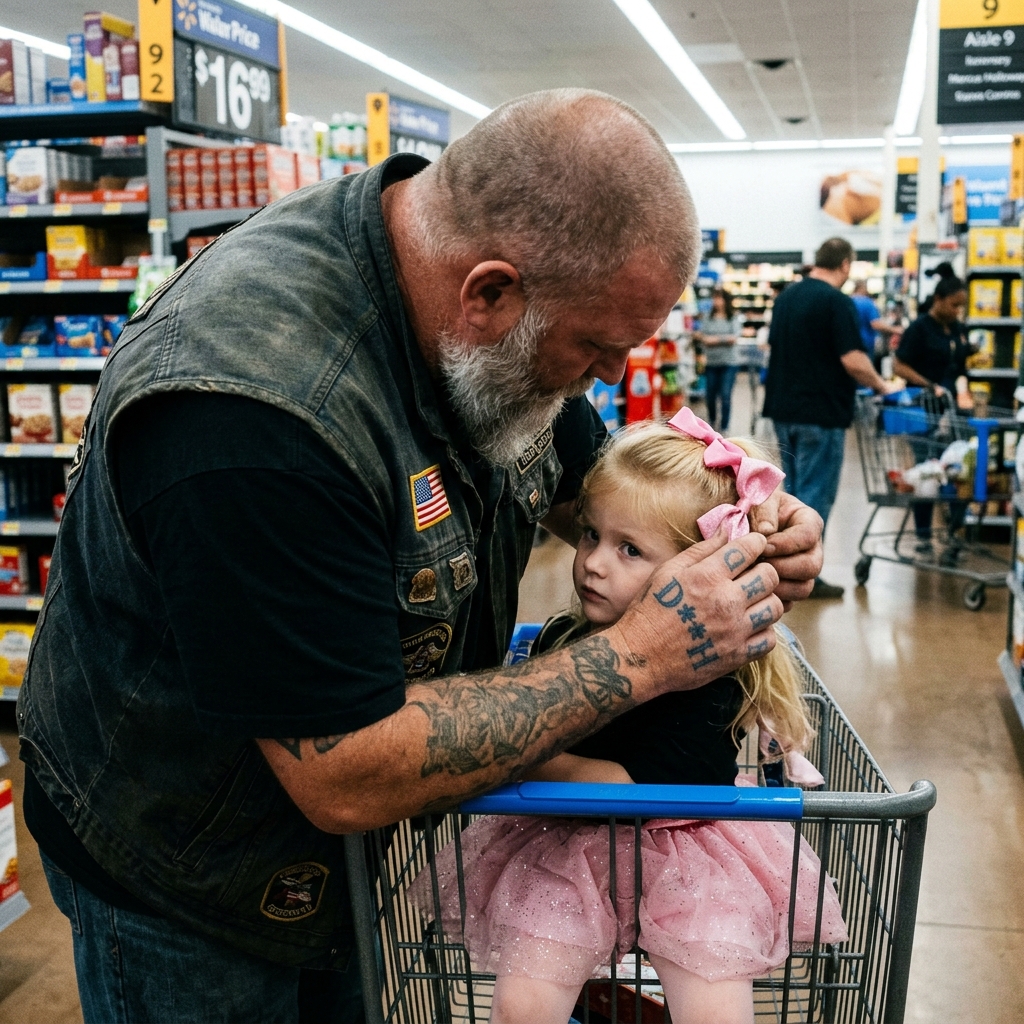
A 6’5, 280-pound man pushes the cart. Shaved head. Thick salt-and-pepper beard. Tattoos everywhere. Faded blue letters on his right knuckles: D-E-A-T-H. A 1%er motorcycle club patch on his leather cut.
And sitting in the child seat is a 4-year-old girl with a slightly crooked hand-tied pink satin bow.
She looks up at him with the absolute serious authority only a tiny queen possesses and says: “”Daddy. Stop. My bow. Fix it.””
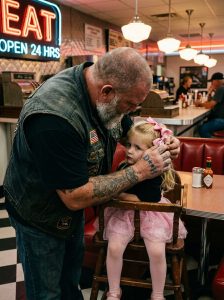
He stops immediately. He bends his enormous tattooed frame over the front edge of the cart and brings his face down to her eye level. He takes his DEATH-knuckled hand and begins to very carefully, with the gentle precision of a man who has perfected this exact task, reposition the bow.
“”Better, princess?”” His voice is a low rumble.
She tilts her head. Inspects his work. Nods once. “”Better.””
—
Marcus “”Wraith”” Holloway. Combat veteran. An IED in Kandahar that killed his two closest brothers and left the diagonal scar across his cheek. Eighteen months in Tucker Maximum Security. The teardrops under his eye were for the men he couldn’t carry out of the vehicle fast enough. The DEATH tattoo was a promise he made to himself to bury the man he was before.
He was sober. He met his wife Hannah in an AA meeting. They had a daughter.
And every single Saturday morning for over a year, this was their sacred routine.
A stranger named Jennifer Reyes snapped one photograph from the checkout line. The back of his shaved head. The knuckles on the cart. Her tiny hand high-fiving his chest. She captioned it: “”Toughest man at Walmart today.””
In eight days, it crossed five million shares.
Marcus had no idea. He found out when his brothers in the Iron Diamond Brotherhood MC showed him the screenshot at the diesel shop on Tuesday morning. They laughed. They printed T-shirts. The world thought it knew the PART 2.
Nobody knew the truth.
—
I didn’t either. Not until fourteen months later, when Marcus and Hannah finally invited me to their back porch, and he told me the real reason he pushed that cart.
He did not start the Saturday morning trips for Brooklyn.
He started them for Hannah.
In March of 2022, while Marcus was working a two-hour brake job out of town, Hannah — twelve weeks pregnant with their second child — miscarried. Alone in their bathroom. She drove herself to the ER.
Marcus broke every speed limit getting to her hospital bedside.
They buried the small carved wooden box under the dogwood tree in their backyard.
Hannah couldn’t get out of bed for six weeks.
Without telling her why, without ever asking for a single word of recognition, Marcus started taking their one-year-old Brooklyn out of the house every single Saturday morning. The park. The farmer’s market. The Walmart. He gave his wife four hours of complete silence every weekend, just so she could grieve in the private space of her own home.
By the time Hannah was strong enough to return to her Saturday yoga class, the Daddy-and-Brooklyn routine had become a permanent, unshakable part of their lives. Brooklyn forgot it was ever anything else.
The bow. The cotton candy. The cart.
—
It was never about the bow.
It was always about the immense, silent grief Marcus carried inside his massive chest so his wife wouldn’t have to carry it alone.
When his patched brothers in the Iron Diamond Brotherhood finally learned the real reason behind the pink bow and the five million shares — when they understood why the toughest man they knew spent his Saturday mornings driving a Walmart cart — they didn’t laugh anymore.
What they did next is the reason I am writing this at one in the morning, fourteen months later. It completely changed how I see the men we are all so quick to judge from a distance.
Have you ever misjudged someone based on their appearance, only to discover a story that completely transformed how you see them?”
“I am Patricia Lassiter. An English teacher. I spend my days parsing sentences, looking for the truth hiding between the words. The subject is the doer. The verb is the action. I believed for a long time that people were the same way. That the surface told the story. That you could read a man by his cover.
I was wrong.
I learned this truth three hundred and thirty-four days ago, in front of aisle nine of a Walmart on Highway 49 in Maumelle, Arkansas. And I have not stopped learning it since.
Let me take you back to the morning the whole world thinks it knows about.
—
The light that Saturday was the color of dishwater. Overcast May gray pressing against the big front windows. The store hummed with that specific Walmart electricity — the compressors, the coolers, the distant beep of a register. My cart had a squeaky left wheel that I silently cursed every time I pushed it past the cereal.
I was looking for vanilla extract. My mother swore by a specific brand that this particular Walmart never seemed to stock, but I checked anyway, every Saturday, out of a habit I could not explain.
And then I heard her.
A voice like a tiny diamond bell, ringing with the absolute, undivided authority that only a four-year-old girl can possess. It cut through the hum of the store like a blade.
“”Daddy. Stop. My bow. Fix it.””
It was not a request. It was not a whine. It was a decree issued by a monarch who had never once been told no.
The cart stopped.
Not slowed. Stopped. Instantly.
I looked up from the shelf and my breath caught in my throat.
The man pushing the cart was a mountain. I do not use that word lightly. Six-foot-five, easy. Two hundred and eighty pounds of dense muscle packed into a worn black leather motorcycle cut over a clean black t-shirt. Shaved head. A thick salt-and-pepper beard that ran halfway down his massive chest. His arms were sleeves of dense black-and-gray ink — old skulls, weathered roses, names in cursive script running down his right forearm.
And on his right hand, the one gripping the cart handle, in stark faded blue prison-style letters across all four knuckles: D-E-A-T-H.
My first instinct was to look away. To cross to the next aisle. My second instinct was to tighten my grip on my purse.
I did neither.
Because the monster with the DEATH knuckles was doing something I could not reconcile.
He had bent his enormous frame over the front edge of the cart. He had brought his face — the one with the long diagonal pink scar across his right cheek, the two faded blue teardrop tattoos under his left eye — down to the absolute eye level of the small girl in the child seat.
He was not fixing the bow with the hand that said DEATH.
He had placed his left hand — the hidden one — gently on the back of her tiny blonde head, cradling it like it was made of blown glass. And his right hand, the one with the faded ink, was using the tips of his massive fingers to very carefully, with the precise loving attention of a man who had perfected this exact task, reposition the slightly crooked hand-tied pink satin bow on her hair.
He smoothed the ribbon. He tucked a strand of hair behind her tiny ear. He inspected his work.
“”Better, princess?”” His voice was a low rumble, a bass note that vibrated in the floor tiles.
The little girl tilted her head. She had a face full of freckles and the serious, unyielding expression of a Supreme Court justice reviewing a case. She reached up and touched the bow. She nodded once.
“”Better.””
He tapped her on the nose. He winked. He straightened up and resumed pushing the cart toward the candy aisle, as if he had just completed the most important task of his Saturday morning.
In that moment, I suspect he had.
I stood there, frozen. My vanilla extract completely forgotten. I felt like I had just witnessed a miracle in the condiments section. A thing that should not be possible, happening right in front of me.
I did not snap the photograph. That was Jennifer Reyes, a young mother with a good eye and a quick phone. She caught them at the checkout from behind. The back of his shaved head. The DEATH knuckles on the handle. The little girl’s high-five against his chest. The pink bag of cotton candy.
She posted it. “”Toughest man at Walmart today.””
It crossed five million shares in eight days.
The whole world thought they knew the story. A tough biker with a soft heart. A viral moment of tenderness. A man who could crush you with one hand, gently fixing his daughter’s bow.
It was a beautiful photograph.
It was also an incomplete sentence.
The truth was buried so deep inside Marcus Holloway that he had almost taken it to the grave with him. I would not learn it until fourteen months later, when Hannah Holloway — his wife — finally invited me to their back porch.
And the truth changed everything.
—
The invitation came as a surprise. I had written to them, a careful email through a mutual contact, explaining that I was the teacher from aisle nine, that the moment had stayed with me, that I saw them sometimes on Saturday mornings and never knew how to approach them.
Hannah wrote back. Three sentences. “”Patricia. We know who you are. Come have coffee on Saturday afternoon. Marcus will talk to you.””
That was how I found myself sitting on a worn wooden porch overlooking a small backyard in a quiet Maumelle neighborhood. An old dogwood tree stood in the corner of the yard. There were fresh flowers at its base. A small carved star was visible on a wooden marker beneath the branches.
Marcus came out with two mugs of coffee. He handed one to his wife and sat down heavily in a creaking wooden chair. He was wearing a plain gray t-shirt. Without the leather cut, without the patches, he looked different. Softer around the edges. Human.
He did not waste time with small talk.
“”You saw us that day,”” he said. It was not a question. “”You want to know why I really push that cart.””
I nodded.
He looked at Hannah. She looked at the dogwood tree. A long silence stretched between them, filled with a conversation that did not need words.
“”I started taking Brooklyn to Walmart,”” he said slowly, “”the same week we buried our son under that tree.””
I felt the words hit my chest like stones.
“”I never knew,”” I whispered. “”The article, the photo — nobody said —””
“”Nobody knew,”” Hannah said quietly. She was holding her coffee mug with both hands, her knuckles white. “”That was the point.””
—
Marcus “”Wraith”” Holloway was born in North Little Rock, Arkansas, the second of three boys. His father walked out when he was six. His mother worked two jobs — a Tyson chicken-processing plant during the day and a Waffle House at night. By the time he was twelve, he was raising himself.
He joined the Army at eighteen to find a family. He found one in Fox Company, 1st Battalion. Two brothers in particular. Specialist Miguel Ramirez and Sergeant David Wheeler. They were his people. They bled together. They laughed together.
In October of 2010, outside Kandahar, their vehicle hit an IED.
Marcus was in the turret. The explosion threw him clear. He crawled back into the burning wreckage. He pulled Ramirez out first. He was already gone. He went back for Wheeler. He carried them both across the dirt. He laid them down. He screamed for a medic that never came.
The scar across his right cheek came from the shrapnel. The two teardrop tattoos under his left eye — the ones the internet assumed were for enemies he had made — they were for the brothers he carried out of that vehicle.
“”We don’t leave nobody,”” he said to me on the porch. His voice was flat, distant. “”And I left them in that fire. I got them out, but they were already gone. I carried two dead men out of a burning truck. It broke something inside me that I did not know how to fix.””
He came home. He could not sleep. He could not talk. He started drinking to silence the memories. In 2014, a bar fight in North Little Rock. He started it. He finished it. The other man spent a week in the hospital.
Eighteen months in Tucker Maximum Security Prison in Pine Bluff.
“”The DEATH tattoo,”” he said, holding up his massive right hand, “”was a promise. I was in a five-by-seven cell. I was the worst version of myself that had ever existed. A drunk. A brawler. A ghost. I decided I had to kill that man. Bury him completely. I had that word tattooed on my knuckles as a gravestone. Everything I was before I walked into that cell — I promised I would leave it there.””
He walked out of Tucker in November of 2016. Thirty-five days sober. No job. No friends who were not drinking. No family who would speak to him.
He found the Iron Diamond Brotherhood MC. A club of men who understood what it meant to carry a graveyard inside your chest.
And in October of 2018, he walked into an AA meeting at a small Methodist church in North Little Rock.
Hannah was sitting in the third row.
She was twenty-seven years old. A yoga instructor. Four years sober. She had the kindest hazel eyes Marcus had ever seen. She did not flinch at his scars. She did not look away from his ink. She saw past the wall he had built.
“”I was not a good man when I met her,”” Marcus said. “”I was a man who had done good things and bad things. I did not know which version was going to wake up each morning. But she looked at me like I was already the man I was trying to become.””
They married in October of 2019.
Brooklyn Hannah Holloway was born on March 12, 2021, at 3:14 a.m.
“”I held her on my chest at 3:47 a.m.,”” Marcus said. His voice cracked. “”And I knew. I knew I had been walking through the dark my whole life, and she was the light on the other side. I was not a monster who learned to be soft. I was a man who had been waiting to be given permission to love something without fear.””
—
For a year, it was a fragile, beautiful peace. Marcus worked at the diesel shop. Hannah taught her yoga classes. Brooklyn grew.
In March of 2022, Hannah was twelve weeks pregnant with their second child. A boy. They had already chosen a name. They had started clearing out the spare room.
The miscarriage happened on a Sunday morning at 4:47 a.m.
Marcus was not home. He was two hours south in Pine Bluff, working an overnight brake job on a 1997 Ford F-250. A side job. Money for the baby.
Hannah woke alone in the dark. She felt the cramp. She knew immediately what it meant.
“”The bathroom floor was cold,”” Hannah told me. She was not crying. Her voice was steady, but it had the careful flatness of a story she had told herself a thousand times in the dark. “”I remember the cold so clearly. The tile. The grout lines. White tile with gray grout. I sat down on the floor and I waited. I did not scream. I did not call out. I just sat there and let the cold hold me, because I knew what was happening and there was nothing I could do to stop it.””
She called Marcus when it was over.
He answered on the first ring.
She just said his name. “”Marcus.””
“”I’m coming home.””
He did not ask why. He did not make her explain. He just said the words and dropped the wrench on the concrete floor of the shop and walked out. He drove ninety-five miles an hour down the two-lane highway in the dark. He called his sponsor. “”Pray. Right now. Pray.”” He called Hannah’s sister. “”Get to the house.””
He found her in the ER triage at 7:14 a.m. He was still wearing his work coveralls, soaked in grease and transmission fluid. He got on his knees on the hospital linoleum. He put his forehead against her knees. He did not say a word. He did not tell her it would be okay. He did not tell her they could try again. He just stayed there. A wall of flesh and silence, holding her to the earth.
“”I could not fix it,”” Marcus said quietly. “”For the first time in my life, I could not fight it. I could not drink it away. I could not outrun it. I just had to sit in it. And I did not know if that was enough.””
It was.
—
They came home from the hospital with empty hands and a small cardboard box from the funeral home. Marcus could not stand the thought of a stranger handling this. He took the box of cedar from his workshop. He carved a small casket by hand. He was not a woodworker. It was lopsided. The lid did not sit perfectly straight. He carved a tiny star on the top.
They buried it under the dogwood tree in the backyard on a Tuesday afternoon.
And then Hannah fell apart.
“”I could not get out of bed,”” she said. “”I do not mean I was sad. I mean my body would not move. The grief was a physical weight on my chest. I could not eat. I could not shower. I could not hold Brooklyn. I could not be a mother. I could not be a wife. I was a shell on the bed.””
Marcus did not ask her to get up.
He did not bring her breakfast. He did not tell her that Brooklyn needed her. He did not say the words “”you have to be strong for your daughter.””
He did something else.
The next Saturday morning, at exactly 9 a.m., he got up. He made a bottle. He dressed Brooklyn in a little white sleeper with bears on it. He walked to the bedroom door. Hannah was in the bed, facing the wall.
“”Baby,”” he said. “”I’m taking her to the park. We’ll be back before lunch.””
He did not wait for an answer. He did not ask for permission. He just left.
The silence when the front door clicked shut was a physical presence in the house. It filled the room. It pressed against Hannah’s chest. For the first time in six weeks, she was completely alone. She was not a mother who had to perform normalcy. She was not a wife who had to be strong. She was just a woman. A grieving woman. In an empty house.
She sat up. She looked out the window at the dogwood tree. The dirt beneath it was still fresh.
And she wept. She wept the kind of weeping that does not make a sound. She beat her fists against the pillow. She screamed into the empty room. She cried until she had nothing left.
When Marcus came home two hours later, with Brooklyn holding a dandelion in her tiny fist, Hannah was sitting on the edge of the bed. She had a glass of water in her hand. She had not had a glass of water in she did not know how long.
He did not say a word. He just looked at her. He saw the water. He saw the tears still wet on her face. He nodded once, and he took Brooklyn into the nursery.
“”I did not know what he was doing that first Saturday,”” Hannah said. “”I thought he was just getting out of the house. It took me three Saturdays to understand. He was giving me permission to fall apart. He was standing guard at the door of my grief. He was letting me break in private so I could put myself back together before our daughter came home.””
—
He did it the next Saturday. And the next. And the next.
Rain or shine. Nine o’clock. Every single Saturday.
The park. The farmer’s market. The Walmart on Highway 49.
It was never about the destination. It was about the departure. He was creating a space of silence for his wife. Four hours of complete quiet every weekend, just so she could grieve in the privacy of her own home, without the weight of a child watching.
By the time Hannah was strong enough to return to her Saturday morning yoga class — four months later — the Daddy-and-Brooklyn routine had become the law of the household. Brooklyn forgot it was ever anything else.
“”In her mind,”” Marcus said, a rare smile touching the scar on his cheek, “”Saturdays belong to me. Always have. Always will.””
The bow ritual started when Brooklyn was three. Her hair was getting longer. Hannah had put a pink satin bow in her hair one Saturday morning before she left for yoga. The wind in the parking lot knocked it sideways.
Brooklyn, even at three, was a perfectionist.
“”Daddy. Fix it.””
Marcus stared at the bow. He was a man who could rebuild a diesel engine blindfolded. He could strip an M4 rifle in forty seconds. He had never touched a hair bow in his life.
He took a guess.
Brooklyn inspected his work with the cold judgment of a tiny dictator. “”No, Daddy. The other side. Tighter.””
He did it again.
She reached up. She touched the bow. She nodded. “”Better.””
That night, Hannah found him at the kitchen table at 2 a.m., a length of dental floss stretched between his enormous hands, muttering “”over, under, through.”” He had watched a YouTube tutorial. He was practicing.
“”I knew then,”” Hannah said softly, “”that he was not just healing me. He was healing himself. He was learning to do the soft things. The things his father never taught him. The things a man like him was never supposed to know how to do.””
The bow became the centerpiece of the ritual. Every Saturday, Brooklyn would pick her outfit — always the glittery pink tutu, the white t-shirt, the pink Velcro sneakers. Hannah would tie the bow at 8:45 a.m. And by 9:47 a.m., it would need fixing.
Marcus became an expert. He developed a system. Left hand to cradle the head. Right hand to adjust the ribbon. Check the angle. Smooth the tail. Nod once. “”Better, princess?””
“”Better.””
And then the pink cotton candy. The big bright bag that lived in her lap from the candy aisle to the checkout. Every Saturday. Fourteen months straight.
—
Jennifer Reyes snapped the photograph on a Saturday in May.
Marcus found out about it the following Tuesday morning at the diesel shop. His brothers in the Iron Diamond Brotherhood showed him the screenshot. They were laughing.
“”Brother,”” Diesel said, holding up his phone. “”We need to talk about your Saturday morning.””
Marcus looked at the screen. The back of his own shaved head. The DEATH knuckles. The pink bow. His daughter’s tiny hand high-fiving his chest.
Toughest man at Walmart today.
He laughed. He is a good actor.
His chapter printed five hundred t-shirts. The back of the shirts read: “”AT THE CLUBHOUSE, A 1%ER. AT WALMART, A DRIVER.””
They thought they were celebrating the joke. The hard man with the soft spot.
And then Diesel learned the truth.
“”Brother,”” Diesel said, pulling him aside at the clubhouse. “”I know you. You hate Walmart. You hate crowds. You hate fluorescent lights. Why do you go? Tell me the truth.””
Marcus told him.
He told him about the cold bathroom floor. The carved wooden box. The six weeks in bed. The dogwood tree. The Saturdays.
Diesel did not laugh.
At the next chapter meeting, Diesel stood up in front of the entire club. He was not a man given to speeches. He was a mechanic. A simple man who said what he meant.
“”Brothers,”” he said. “”The man with the DEATH knuckles. The one we made the driver shirts for. He is not a tough guy with a soft spot for his daughter. He is a man who carried the weight of his wife’s grief on his shoulders, every single Saturday, for over a year. He never told a soul. He never asked for credit. He never once complained. He did it so the woman he loved could fall apart in peace. He stood guard at the door of her pain. That is not being a driver. That is being a king.””
The room went silent. You could hear the ice melting in the glasses.
The chapter voted that night. The five hundred t-shirts had already been printed. But they voted to send all proceeds — fourteen thousand, eight hundred and forty-seven dollars and fifty cents — to the Pulaski County Children’s Hospital pediatric oncology unit. In Brooklyn’s name.
And they gave Marcus a new shirt.
Brooklyn’s shirt, a small custom pink version, arrived at the house a week later. The back read, in glittery pink letters: “”THE BOSS.””
Marcus wears his driver shirt to the clubhouse.
He wears it to Walmart on Saturdays.
“”The DEATH on my knuckles,”” he said, looking at his hand in the fading porch light, “”was a grave for a man I hated. The pink bow is a flag for the man I became. I buried one. I raised the other. Every Saturday, I push that cart, and I am reminded that the softest thing I have ever done is also the strongest thing.””
—
I am writing this at one in the morning, three hundred and thirty-four days after I first saw them in aisle nine.
I am an English teacher. I am supposed to understand stories. But Marcus Holloway taught me that the most important stories are never spoken aloud. They are lived. In the silence of a Saturday morning. In the space a man creates for his wife to grieve. In the careful fingers of a former convict tying a pink bow.
The photograph is still out there. Five million shares. Toughest man at Walmart today.
It is not wrong.
But it is incomplete.
The toughness was never in the ink. It was never in the size. It was never in the prison time or the combat tours.
The toughness was in the discipline of silence.
The toughness was in the choice to carry a grief that was not his alone, to make it his own, to push it around a grocery store in a shopping cart, so that the woman he loved could breathe.
The toughness was in sitting on a cold hospital floor, holding his wife’s hand, and accepting that some things cannot be fixed. They can only be held.
—
I saw them again last Saturday.
I do not pretend anymore. I do not hide in the next aisle. I walk right up to them. Brooklyn calls me Miss Teacher. Marcus nods. A quiet acknowledgment between people who know the same beautiful, terrible truth.
He was pushing the cart. She was eating pink cotton candy. The bow was perfectly straight.
“”Every Saturday,”” I asked him once, “”for the rest of her life?””
He looked down at his daughter. She was talking to a bag of gummy worms. She had absolute authority over the candy aisle.
“”For as long as she needs me to push the cart,”” he said. “”And then a little longer.””
Some men, you do not measure by their tattoos.
Some men, you measure by who is sitting in their cart.
Have you ever misjudged someone based on their appearance, only to discover a story that completely transformed how you see them?
I have.
His name is Marcus Holloway.
And the real story was never in the photograph.
It was in the space his love created.
It was in the silence he guarded.
It was in a lopsided cedar box under a dogwood tree.
And a pink bow, tied perfectly, every single Saturday morning.
 If this story moved you, please follow our page for more real stories about the men everyone misjudges and the little girls who somehow always know exactly who their daddies are. We post a new story every week.
The year after the photograph splintered the silence Marcus had spent a lifetime building.
I learned this in fragments. Porch conversations. Late-night phone calls from Hannah. The way Diesel would fall silent when the subject came up at the clubhouse.
The world wanted more.
The world had seen the DEATH knuckles and the pink bow, and the world wanted the whole fairy tale. The reformed outlaw. The gentle giant. The perfect redemption arc.
But redemption is not a photograph.
Redemption is a garage at 2 a.m. with a piece of unfinished cedar.
Let me tell you what happened when the world came knocking.
—
It started with an email forwarded from the diesel shop’s website. A producer from a national morning show. They had seen the five million shares. They wanted Marcus and Hannah to fly to New York. They would put them in makeup. They would sit them on a white couch. They would ask about the bow.
The email sat in Marcus’s inbox for three weeks before I heard about it.
Hannah told me on a Thursday afternoon. She had called me, her voice tight with a tension I had never heard before. “”Patricia. He wants to refuse. He won’t even talk about it. He just says no.””
“”Does he have a reason?”” I asked.
“”His reason is that the story isn’t theirs. It’s ours. He says if they put us on that couch, they will boil everything down to a five-minute segment. They will make him a hero and me a footnote. And the dogwood tree will never be mentioned. He says he will not let our son be a footnote.””
I understood.
I understood exactly.
The world loved the photograph because it was simple. A tough man. A soft moment. A complete sentence. But the real story was never simple. The real story was a lopsided cedar box and a woman bleeding on a bathroom floor at 4:47 a.m.
You cannot put that on a white couch.
You cannot put that in a five-minute segment.
Marcus knew this. He had known it the moment he saw the share count. He had known it when Diesel showed him the phone at the coffee station. He had known it when the t-shirts were printed. The world was celebrating a punchline. He was living a eulogy.
—
“”I told the producer no,”” Marcus said to me the following Saturday.
We were standing in his driveway. The morning was cool. The dogwood tree was dropping pink petals across the lawn. Brooklyn was in the house, watching cartoons, her Saturday tutu already laid out on her bed.
“”She called me three times,”” he continued. “”Third time, I answered. She said I was an inspiration. She said my story could help people.””
“”Could it?”” I asked.
He looked at the tree. At the carved star. At the petals falling like pink snow over the small patch of dirt where his son was buried.
“”Maybe,”” he said. “”But I don’t owe the world my grief. I don’t owe them a performance of my healing. I owe my daughter a Saturday morning. I owe my wife a space to breathe. I owe the two men I carried out of a burning truck the dignity of a life worth living. That’s where my debt lies. Not to a television audience.””
He paused.
“”You want to know the real reason I said no?””
I nodded.
“”Because if I go on that show, and I smile, and I tell the story, and the audience applauds—then what? I go home. I sit in this driveway. I look at this tree. And the applause doesn’t follow me here. The cameras don’t follow me here. I am alone with the dirt and the star and the silence. And the silence doesn’t care about five million shares. The silence just asks me if I am keeping my promises. And I have to be able to answer yes.””
—
The producer did not stop calling.
She called Diesel. She called the chapter president. She called the number for the diesel shop. She offered money. She offered a charity donation. She offered to plant a tree on national television.
Marcus did not budge.
But the pressure did not come from the producer alone. It came from inside.
Hannah called me the following Tuesday, her voice raw.
“”She made me feel like I was hurting other women by staying silent. She said there are thousands of women who miscarried alone. Who are sitting on bathroom floors right now. And my husband’s story could reach them. Could help them. And I told her Marcus said no. And she said, ‘But what do you say?’””
My heart stopped.
“”And what did you say?”” I asked.
“”I said Marcus isn’t the only one who gets to decide how our grief is used.””
—
The tension in that house became a physical thing. I felt it the next time I visited. The air was thick. The silence between Marcus and Hannah was a wall you could press your hand against.
They were not fighting.
They were not speaking.
They were orbiting each other like planets whose gravity had shifted.
Brooklyn, at four and a half, felt it too. She started holding Marcus’s hand tighter in the Walmart aisles. She started asking Hannah to stay for breakfast on Saturdays.
Children know.
They know when the foundation of the house is cracking.
—
Diesel pulled me aside at the clubhouse the following Friday night.
“”Sis,”” he said. “”They’re breaking. He won’t bend. She can’t stop hearing that producer’s voice in her head. Somebody has to tell them the truth.””
“”Which truth?”” I asked.
“”That it doesn’t matter what they decide. The tree doesn’t care. The star doesn’t care. The little girl in the pink tutu doesn’t care. The only thing that matters is that they decide together. Or the silence will decide for them.””
I drove to their house that night.
It was past midnight. The lights were off. But I saw a glow from the garage.
Marcus was inside. Sitting on the overturned bucket. Holding the small cedar box. The unfinished one. The one he had been carving for over a year.
The door was open. I stepped inside.
He did not look up.
“”I can’t give them the tree,”” he said. “”I can’t give them the box. I can’t give them the drive home from the hospital. That is ours. That is hers. That is mine. If I give it away, what do I have left to hold?””
“”You have the Saturdays,”” I said.
“”It’s not enough.””
“”It is enough. It has always been enough. The Saturdays are the answer. They are the living answer to the question the photograph asked. The world saw a moment. You built a life. The Saturdays are the full sentence.””
He looked at the box.
“”Hannah wants to help people,”” he said. “”She thinks the story can heal someone. And maybe she’s right. Maybe I’m keeping the door locked because I’m afraid of what happens when I open it.””
“”And what happens when you open it?””
He was quiet for a long time.
“”I don’t get to close it again.””
—
The next morning, I called Hannah.
“”Come to my porch,”” she said. “”Both of you.””
We sat on the worn wooden porch. The dogwood tree was in full bloom. Brooklyn was inside with a sitter.
Marcus broke the silence first.
“”I’ve been carving that box for a year,”” he said. “”I couldn’t get the star right. It was always crooked. I thought if I got the star right, I could let go. But the star doesn’t have to be perfect. I carved it with my hands. That’s enough.””
Hannah took his hand. The DEATH knuckles. The ones that had gripped a shopping cart handle through fourteen months of silent Saturdays.” “””I don’t need the world to know,”” she said. “”I need you to know. I need you to know that I see you. I see the Saturdays. I see the 2 a.m. tutorials. I see the box. I see the man who came home from Tucker and decided to become someone else. I see you.””
“”What about the producer?”” he asked.
“”I’ll call her today. I’ll tell her our story is not for sale. It’s not for applause. It’s for us. It’s for Brooklyn. It’s for the boy under the tree. And it’s for the men and women who will never be on a television show, but who will sit on their own bathroom floors at 4:47 a.m., and know that love is still possible.””
Marcus looked at her. The wall between them cracked.
“”I didn’t know you felt that way,”” he said.
“”I didn’t know I could say it,”” she said.
—
The producer never called again.
Marcus and Hannah started speaking again. Not about the interview. About the Saturdays. About the tree. About the silence they had been holding separately.
They decided, together, to keep the dogwood tree private.
But they also decided to write a letter. A single letter. To be published in the local Little Rock newspaper. Not for the national audience. Not for the five million shares. For the people in their own community who might be holding their own silence.
The letter was short. One paragraph.
It said: “”We are the family in the photograph. The one with the DEATH knuckles and the pink bow. The story is not what you think. It is not about a tough man learning to be soft. It is about a man who already knew how to love, and a woman who let him love her through the hardest thing she has ever endured. If you are sitting on a bathroom floor right now, you are not alone. The love that found us can find you too. It doesn’t look like a photograph. It looks like a Saturday morning.””
They signed it.
Marcus and Hannah Holloway.
—
The letter ran on a Thursday.
By Sunday, the diesel shop had received forty-seven messages. From women who had miscarried alone. From men who had driven home in the dark. From a grandmother in Texarkana who said she had been sitting on that floor for thirty years and had never told a soul.
Marcus read every single message.
He answered none of them.
But he kept them in a shoebox on the workbench in the garage. Next to the unfinished cedar box.
“”The star is done,”” he said to me the next time I visited.
He held up the box. The lid. The carving.
It was still slightly crooked.
It was perfect.
—
Brooklyn is six now.
She still wears the pink tutu on Saturdays. She still demands the bow be fixed every ten minutes. She still eats pink cotton candy in the cart of the Walmart on Highway 49.
But something has changed.
She has started fixing the bow herself.
“”Daddy. I got it.””
She looks in the visor mirror of the truck. She adjusts the ribbon. She smooths the tail. She nods.
“”Better.””
Marcus watches her. His DEATH-knuckled hand resting on the steering wheel.
“”Better, princess?”” he asks.
She looks at him. The same serious authority she has had since birth.
“”Yes, Daddy. I did it.””
He does not correct her.
He does not tell her she missed a strand.
He just starts the truck and drives them to Walmart, where the bow will inevitably fall loose again, and she will ask him to fix it, and he will.
Because some rituals can be shared.
But the duty of fatherhood never ends.
It just changes shape.
It moves from his hands to hers.
And back again.
Every single Saturday morning.
—
The dogwood tree is still there.
The star is still slightly crooked.
The shoebox on the workbench is full.
And in aisle nine of the Walmart on Highway 49 in Maumelle, Arkansas, a 6’5, 280-pound 1%er biker with DEATH tattooed on his knuckles is pushing a shopping cart.
A six-year-old girl is sitting in the child seat.
Her pink bow is perfect.
She is eating pink cotton candy.
She is absolutely safe.
And the world can take its photograph.
But it will never capture the silence he guarded.
The grief he carried.
The love he rebuilt from the ashes of his own hands.
Some stories are not meant to go viral.
They are meant to be lived.
One Saturday at a time.”