The call came at 12:03 a.m., while James was standing in a hotel lobby five hundred miles from home with a cup of burned coffee in one hand and his rolling suitcase still beside his shoe.
The lobby smelled like lemon cleaner, stale carpet, and the kind of coffee nobody drinks unless they are too tired to care.
Rain tapped against the tall glass doors behind him.

Outside, Minneapolis looked silver and blurred under the streetlights.
He was supposed to be asleep by then.
He had a client meeting in the morning, a presentation he had spent two weeks fixing, and a flight home scheduled two days later.
Then Carolyn Sherwood’s name lit up his phone.
Carolyn lived next door to James and Melissa in the kind of suburban neighborhood where people waved over mailboxes, pretended not to hear arguments through open windows, and remembered whose kids had peanut allergies.
She was sixty-four, a retired school librarian, and she had never once called James after nine at night.
Not even when his sprinkler broke and soaked half her side yard.
Not even when the wind knocked their trash cans into the street.
So when he answered, he already knew something was wrong.
“James,” Carolyn whispered.
He could hear wind behind her.
He could hear her porch chimes clinking fast, like a nervous hand was shaking them.
“What happened?” he asked.
“I don’t know what to do.”
Those were the words that made his stomach drop.
Not because they were dramatic.
Because Carolyn was not a dramatic woman.
She was the neighbor who brought zucchini bread in August and told children to use bookmarks instead of folding pages.
She noticed things.
She handled things.
If Carolyn did not know what to do, then whatever was happening was already past ordinary.
“Tell me,” James said.
There was a small sound on the line, like she had turned away from someone.
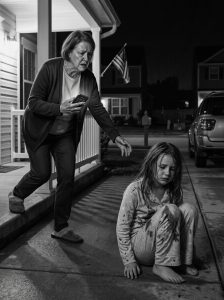
Then Carolyn said, “Your daughter is sitting in your driveway.”
James did not move.
For one second, the hotel lobby kept going without him.
A couple laughed by the elevator.
A man in a navy jacket dragged his suitcase across the tile.
The coffee machine hissed near the front desk.
Then Carolyn kept talking.
“Sarah. She has blood on her face and on her pajamas. She’s alone. It’s midnight. She won’t talk.”
James’s mind refused the sentence the way a body refuses a bad fall for the first split second.
Sarah was eight years old.
She still slept with the hallway light on if he was traveling.
She still asked him to check behind the bathroom door when the furnace clicked.
She still saved the red gummy bears for him because she said they tasted like medicine anyway.
“What do you mean, blood?” James asked.
His voice sounded strange to him.
Too calm.
Too thin.
“I mean blood,” Carolyn said, and now she was crying. “On her forehead. Her arm. Her clothes. I tried knocking. I tried calling Melissa. Nobody answered.”
James put the coffee cup down on the nearest table and missed the coaster completely.
A brown ring spread across the polished wood.
He did not care.
“Stay with her,” he said. “Keep the porch light on. Do not let her out of your sight.”
“I won’t.”
“Is she looking at you?”
“No. She keeps looking at the house.”
That landed somewhere in James that panic could not reach yet.
The house.
His house.
The one with Sarah’s purple bike leaning in the garage.
The one with Melissa’s ceramic planter by the front steps.
The one where his daughter should have been asleep under a pink blanket with a stuffed dog tucked under her arm.
“Carolyn,” he said, “do not hang up.”
Then he put her on speaker and called Melissa from another line.
No answer.
He called again.
No answer.
He called a third time, then a fourth, then a fifth.
By the tenth call, his hand had started shaking.
By the twentieth, his call log looked less like a husband trying to reach his wife and more like evidence waiting for somebody to admit what it meant.
Melissa lived with that phone in her hand.
She checked it in the school pickup line.
She checked it in the grocery aisle.
She checked it while stirring pasta, while watching TV, while brushing her teeth.
James had joked about it before.
Not tonight.
Missing one call could happen.
Missing twenty while their daughter sat bleeding outside was a choice or a cover.
He did not know which possibility scared him more.
At 12:17 a.m., he called Norma Richard, Melissa’s mother.
Norma answered on the fourth ring.
“James,” she said.
No sleep in her voice.
No confusion.
No alarm.
Just his name, flat and calm, like she had been expecting the call and had already decided how much to give him.
“Norma, where is Sarah?” he demanded. “What happened at my house?”
There was a pause.
It was not the pause of a woman trying to understand.
It was the pause of a woman arranging herself behind a lie.
Then she said, “Oh, James. She’s not our problem anymore.”
The words did not make sense.
They were too cold to belong to a grandmother.
They were too prepared to be an accident.
James stared through the hotel glass at the rain streaking down in crooked lines.
“She is eight years old,” he said.
Norma sighed.
That sigh did something to him.
It was bored.
It was tired.
It was the sound of somebody being inconvenienced by a child bleeding in a driveway.
“You should speak to Melissa,” she said.
“Melissa won’t answer.”
“That is between you and your wife.”
Then Norma hung up.
James stood there with the dead line against his ear.
Cold families do not always sound cruel in the way people expect.
They do not always scream.
They do not always threaten.
Sometimes they sound rehearsed.
Sometimes the worst thing in the room is how quickly someone knows what not to feel.
He grabbed his suitcase, walked into the rain, and got into his car.
The drive home should have been seven hours.
The GPS said that like roads were only roads, like time was only time, like fathers did not cross states with terror sitting in the passenger seat.
James drove with Carolyn still on the phone until his Bluetooth switched over and her voice filled the car.
“She’s on my porch now,” Carolyn said. “I wrapped a blanket around her.”
“Is she talking?”
“No.”
“Is she awake?”
“Yes.”
“Tell her I’m coming.”
“I did.”
“What did she do?”
Carolyn was quiet for a moment.
“She looked at your driveway.”
The rain came harder.
James pulled onto the shoulder before he realized he had done it.
Truck lights roared past him on the highway.
Every time an eighteen-wheeler blew by, the car rocked, and the screen of his phone glowed in his lap.
Not our problem anymore.
The phrase would not stop circling.
It was not a misunderstanding.
It was not panic.
It was a script.
For one ugly second, James wanted to call Norma back and scream until something human came out of her mouth.
He wanted to throw the phone hard enough to crack the windshield.
He wanted to be home already, standing in the driveway, pulling the truth out of whoever had left his daughter there.
But rage is a terrible driver.
So he swallowed it.
He called his brother.
Christopher answered like a man dragged from sleep.
“Jamie?”
“Go to my house,” James said. “Now. Sarah is outside.”
There was no wasted question.
That was Chris.
He had always been that way.
They had grown up with a mother who worked three jobs and a neighborhood that taught boys early which sounds meant trouble.
James learned systems.
Chris learned people.
One became a consultant.
The other became a criminal defense attorney, which meant he spent his life watching what people did when they thought nobody could prove it.
“Text me the address again,” Chris said, already moving.
“You know the address.”
“I know. Text it anyway.”
That was the first sign that Chris had stopped being only a brother.
He was building a record.
Thirty-two minutes later, the phone rang.
James answered before the first ring finished.
“I’ve got her,” Chris said.
His voice was quiet.
Too quiet.
“Is she alive?” James asked.
“She’s alive. I’m taking her to the ER.”
James pressed his foot harder on the gas, then forced himself to ease up.
“What happened?”
Chris did not answer.
In the background, James heard a small sound that would follow him for the rest of his life.
Not a cry.
Not a word.
A breath.
One broken little breath, like Sarah had learned to make even breathing careful.
“Chris,” James said.
“Drive safe,” Chris told him.
“Don’t do that.”
“Do not call Melissa again. Do not call Norma. Do not call anyone else.”
James’s mouth went dry.
“What did you see?”
There was movement on Chris’s end.
A sliding door.
The hum of fluorescent lights.
The distant beep of a monitor.
That thin hospital sound every parent recognizes instantly and never wants to hear.
Then Chris turned away from the phone and spoke to someone at the ER intake desk.
“Start a hospital intake form,” he said, “and document every mark.”
James took his foot off the gas.
For a second, the car slowed in the lane before he caught himself.
It was not the words alone.
It was the way Chris said them.
Flat.
Precise.
Controlled.
Like his lawyer brain had stepped over his brother heart and taken command of the room.
A woman at the intake desk asked Sarah’s date of birth.
James heard paper slide against a clipboard.
He heard Chris answer, “Eight years old.”
Then Chris added, “She was found alone outside a residence. Approximate exposure time, five hours.”
Five hours.
James had to repeat it in his mind because it was too large to hold.
Five hours was longer than a school morning.
Five hours was longer than a birthday party.
Five hours was long enough for a child to stop believing anyone was coming.
Carolyn must have followed them to the hospital, because James could hear her in the background.
“I should have checked sooner,” she kept saying.
Her voice sounded smaller each time.
Chris answered once, gently but firmly.
“No. You are the reason she’s alive and inside right now.”
Then the intake nurse asked who Sarah’s legal guardian was.
James waited for Melissa’s name.
It should have been automatic.
Mother.
Wife.
Household.
Emergency contact.
But Chris did not say Melissa first.
He said James.
The hallway changed after that.
James could hear it through the phone.
Voices lowered.
The nurse’s tone became careful.
A security guard somewhere nearby asked if they needed a private room.
A clipboard clicked against a counter.
Sarah whispered something.
It was too soft for James to understand.
But Chris heard it.
And Chris went silent.
That silence was worse than shouting.
Christopher could stand in court across from angry men, grieving mothers, police officers, and judges who wanted his client gone before lunch.
He could question a hostile witness without blinking.
He could hear ugly things and keep his face still.
But when Sarah whispered from that ER chair, James heard his brother stop breathing.
Two full seconds passed.
“Chris?” James said.
Nothing.
“Chris.”
Then his brother came back to the phone.
His voice was not loud.
It was not emotional.
That made it worse.
“Jamie,” he said, “when you get here, do not go into that house first.”
James’s hands tightened around the steering wheel.
“Why?”
“Come to the hospital.”
“What did she say?”
Chris lowered his voice even further.
“There is something Sarah just told me,” he said, “and I need you to hear it before Melissa gets a chance to explain it away.”
The rain kept coming.
The highway stretched ahead.
And for the first time since Carolyn’s call, James understood that the worst part of the night might not be what he already knew.
It might be what his little girl had been brave enough to say only after someone finally got her under bright hospital lights, away from the driveway, away from the house, and away from the people who had decided she was not their problem anymore.