
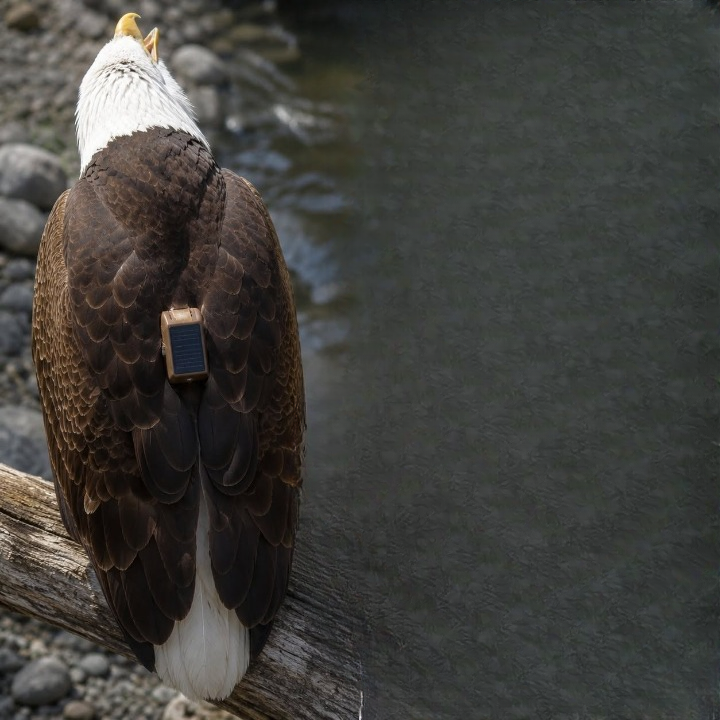
For twenty years, scientists tracked the movements of a single eagle, a solitary bird whose life unfolded in ways that no human could have anticipated. When the GPS data first arrived, it looked like chaos—a tangled web of lines stretching over mountains, rivers, and open seas. At first glance, it seemed random, unpredictable, even reckless. Yet as the years passed, as the researchers layered more and more environmental data over the bird’s path, a startling truth emerged: this eagle was not lost. It was navigating a world far more complex than any map could represent, using a language written in wind, thermals, and instinct.
Each sudden turn of its wings, each unexpected pause, began to make sense when overlaid with weather patterns, shifts in air currents, and the hidden highways of the atmosphere that humans rarely consider. A sharp deviation from one direction coincided with a rising column of warm air, a thermal that provided effortless lift. A prolonged glide over a seemingly empty plain matched the eagle’s anticipation of an approaching storm, taking shelter just out of human sight. Every movement, every tiny adjustment, reflected a negotiation with the planet itself—a living map that combined survival, energy efficiency, and environmental awareness.
The eagle’s journey was a lesson in flexibility. Where scientists had sought predictable lines and repeatable paths, the bird embraced nuance, uncertainty, and adaptation. It became clear that the erratic patterns, once dismissed as mistakes or distractions, were in fact sophisticated strategies honed over decades. Each route was a balance of risks: predators to avoid, prey to locate, storms to navigate, and energy reserves to conserve. The GPS trails, once mere dots on a screen, now told a story of intelligence that could not easily be quantified.
Over time, the eagle’s migrations began to reveal patterns of extraordinary consistency amid apparent randomness. It returned to the same roosting sites year after year, often following slightly different routes depending on weather conditions. Some detours, which seemed unnecessary at first, coincided precisely with wind corridors that allowed it to conserve energy on long flights. Others were timed to seasonal changes in prey populations or to avoid storms that could have been fatal. The eagle’s life became a masterclass in environmental literacy, teaching the researchers that survival is not about rigid rules but about learning the subtle rhythms of the world around you.
One of the most humbling revelations was how the bird’s behavior challenged the assumptions of human science. For decades, researchers had relied on models that treated animals as following simple, linear paths. Predictable, measurable, and easy to quantify. But the eagle laughed at such simplifications. Its life was anything but linear. Decisions were made in real time, often in ways that would have seemed irrational if viewed through the lens of standard models. It was not simply moving from point A to point B—it was conversing with its environment, responding to invisible cues, and solving problems that humans could barely recognize.
The eagle also demonstrated resilience and ingenuity. In years when storms struck unexpectedly, it altered course without hesitation. When thermals shifted, it adapted, gliding effortlessly along currents that humans could not perceive. Scientists were forced to admit that the bird had an awareness of the world that exceeded their own, an ability to process multiple variables simultaneously in a way that no algorithm could replicate. Its behavior was a reminder that intelligence does not always follow the forms humans expect. Sometimes, it is quiet, subtle, and inseparable from survival itself.
Beyond the technical revelations, the eagle’s journey offered profound philosophical insights. Watching a single life unfold across continents for decades, scientists realized how little they truly understood about the natural world. They began to see patterns of interconnectedness: how mountains, winds, oceans, and skies interact with a creature that has been navigating them for millennia. The bird’s route was not only a path of survival but also a testament to the intelligence of ecosystems and the intricate balance that humans often overlook. It was a story about resilience, adaptation, and the quiet mastery of an animal attuned to the living planet.
The lessons extended beyond biology. In tracking this eagle, the researchers confronted their own assumptions about order, control, and predictability. They learned to respect the limits of human observation and the humility required to understand intelligence in its myriad forms. Nature, they realized, is not a problem to solve—it is a conversation to enter. And the eagle, with its wings spread wide over decades of flight, had been speaking to them all along.
By the twentieth year of observation, the eagle’s life had become legendary within the scientific community. Papers were published, conferences held, and debates sparked about the significance of long-term animal tracking. But more than any scientific milestone, the story of this eagle touched a deeper truth: that intelligence, patience, and survival are often hidden in plain sight, waiting to be revealed through careful observation and respect for life in all its forms.
In the end, the GPS lines that had first seemed chaotic transformed into a kind of living language. A map of instinct and experience, shaped by the wind and the seasons. It was a record of a life lived in dialogue with the world itself, a lesson that precision is not always measured by straight paths but by the ability to read, respond, and adapt. The eagle had shown that the natural world operates on a logic far richer than human models, and that sometimes, the greatest teachers are the ones who never step into a classroom.
Through this extraordinary study, scientists came to appreciate that the eagle’s intelligence was not an isolated phenomenon—it was a reflection of the subtle, complex, and interdependent systems that sustain life on Earth. Its decades of flight became a metaphor for endurance, adaptability, and awareness, a reminder that survival requires far more than strength—it demands observation, patience, and the willingness to adjust to an ever-changing world.
Ultimately, the story of this eagle reminds us of the wonder hidden in every corner of nature. It reminds us that patience, careful study, and humility can reveal extraordinary truths. What appeared at first to be chaos was, in fact, a masterclass in navigation, resilience, and understanding the rhythms of a living planet. And in following the flight of one single eagle for twenty years, humans were reminded that the world is far more intelligent, intricate, and alive than we often allow ourselves to imagine.