PART 3
My stomach tightened.
“Why didn’t you call me?”
“Because your mother specifically instructed me not to contact you unless certain circumstances occurred. She believed your sister was monitoring her communications.”
I looked down at the blue tin resting on my lap.
“What circumstances?”
Mr. Fenwick leaned back in his chair.
“Your sister selling the property without your mother’s consent was one of them.”
I felt the room tilt.
He continued.
“Now, before we discuss the house, I want you to understand something. Your mother was not confused when she signed the trust documents in 2019. She understood exactly what she was doing. Your father was alive at the time, and both of them were present when the documents were executed.”
He opened the file.
There it was.
A copy of the trust agreement.
My mother’s signature.
My father’s signature.
And beneath them, the name of the person who was supposed to receive the property.
Emily Carlson.
My daughter.
I covered my mouth.
“Mom really did this?”
“Yes. Your parents wanted to make sure their granddaughter would have something secure when she became an adult. They had concerns about how the family finances were being handled, particularly after your father’s health began declining.”
I stared at him.
“What concerns?”
Mr. Fenwick paused.
“Your sister had been borrowing money from your parents for years. Some of those loans were never repaid. Your father eventually became uncomfortable with the situation.”
I remembered those years.
Karen always had an explanation.
A business opportunity.
An emergency bill.
A temporary financial problem.
Mom and Dad always helped her.
I had occasionally questioned it, but Karen would accuse me of being jealous or selfish.
Apparently, my father had eventually stopped believing her explanations.
Mr. Fenwick turned another page.
“There’s something else. Your mother did not simply leave you that letter. She left evidence.”
He pointed toward the blue tin.
“May I?”
I pushed it across the desk.
He opened the lid carefully.
Inside were several small notebooks, bank statements, handwritten calculations, folded receipts, and a sealed envelope.
The notebooks were arranged by year.
2023.
2024.
2025.
And 2026.
My mother’s handwriting covered nearly every page.
Mr. Fenwick picked up the first notebook.
“Your mother kept a record of every withdrawal she couldn’t explain.”
I leaned forward.
“How much?”
He didn’t answer immediately.
Instead, he opened a spreadsheet that had been prepared from the documents.
Then he turned his computer toward me.
I looked at the total.
$47,860.
Forty-seven thousand, eight hundred and sixty dollars.
I read it again.
Then again.
“That’s impossible.”
“Unfortunately, the records appear to support the amount.”
My hands began trembling.
“Karen had power of attorney.”
“Yes.”
“She was supposed to be helping Mom.”
“I understand.”
“She was supposed to be protecting her.”
Mr. Fenwick lowered his eyes.
“That is precisely why this situation concerns me.”
I picked up one of the bank statements.
There were withdrawals I recognized.
There were others I didn’t.
Some were small.
$250.
$400.
$600.
Others were much larger.
One transfer was for $8,500.
Another was for $12,000.
And next to several of them, Mom had written the same sentence.
I did not authorize this.
I couldn’t breathe properly.
Then I noticed something.
The $12,000 transfer had been made in November 2024.
That was the month Karen had told me Mom needed extra assistance because her memory was getting worse.
I remembered calling Mom that Sunday.
She had sounded perfectly normal.
She asked about Emily’s school.
She asked whether I was eating properly.
And before hanging up, she whispered something strange.
“Beth, sweetheart, don’t let anyone take my little blue house.”
At the time, I thought she was confused.
I had laughed gently and told her nobody was taking anything.
Now I understood why she had said it.
“There’s another envelope,” Mr. Fenwick said.
I looked at the sealed envelope inside the tin.
My name was written across the front.
Not my full name.
Just:
Beth. My daughter. Please read this alone.
I opened it.
Inside was a handwritten letter.
My dearest Beth,
If you are reading this, then I was unable to explain everything to you myself.
I know you have wondered why I sometimes sound frightened when Karen is around. I know you have noticed that our Sunday conversations have become shorter.
I want you to know that I have not stopped loving you. I have not forgotten you.
There are days when my memory is not as good as it used to be. Sometimes I forget what day it is. Sometimes I repeat a question. Sometimes I cannot remember where I put my glasses.
But forgetting where I put my glasses does not mean I have forgotten who owns my house.
I stopped reading.
Tears were falling onto the paper.
I wiped my face and continued.
Karen tells people that I am no longer capable of making decisions. She tells them I am confused. She tells them she is doing everything for my own good.
But there is something she doesn’t know.
I have been keeping copies of everything.
Your father taught me never to sign anything without reading it. He also taught me that family members can sometimes hurt you more deeply than strangers because they know exactly where your heart is.
I wish he had been wrong.
I pressed the letter against my chest.
Then I reached the final paragraph.
Beth, if Karen has sold the house, please don’t fight for it just because it is a house. Fight for the truth. Your father and I did not leave that property to Emily because we wanted to make anyone rich. We did it because we wanted her to have choices.
And there is something else you must know.
The money Karen took was not the only money missing.
Three days before she moved me into the care home, she asked me to sign a document. She said it was permission for her to manage my medical expenses.
I refused.
She became very angry.
The next morning, she told me I was going to live somewhere else.
Beth, I don’t believe that was a coincidence.
Please ask Mr. Fenwick about the second account.
I love you more than I ever managed to say.
Mom.
I looked up.
“The second account?”
Mr. Fenwick had gone completely still.
He closed the notebook in front of him.
“Your mother mentioned that account when she visited me.”
“What account?”
He stood, walked to the filing cabinet, and returned with another folder.
“Your parents opened a separate savings account in 2018. It was intended to cover emergencies, medical expenses, and eventually Emily’s education.”
He placed a statement on the desk.
I looked at the balance.
$186,400.
For a moment, I felt relieved.
Then I noticed the account activity.
A large withdrawal had been made on February 7.
Two days before Mom entered the care home.
Amount:
$175,000.
Recipient:
A private investment company.
I looked at Mr. Fenwick.
“Who owns this company?”
He slowly turned the statement around.
The company name was unfamiliar.
But the registered director’s name wasn’t.
It was Karen.
I couldn’t speak.
“She moved the money two days before Mom was taken to the facility?”
“That’s what the statement indicates. We need to establish the legal authority for that transfer and where the funds went.”
“Can she do that?”
“That depends on the account ownership, the trust documents, and the precise scope of her authority. But this is something that needs immediate investigation.”
I stared at the statement.
Then my phone vibrated.
A message from Karen.
Where are you? I just received a call from someone asking about Mom’s house. What exactly are you doing?
I didn’t respond.
Another message arrived.
Beth, I hope you’re not making this into something it isn’t. Mom is safe. Everything I did was for her.
Then a third.
You have no idea how difficult the last few months have been for me.
I read the messages silently.
For years, I had felt guilty for living far away.
I had apologized for not being physically present.
I had thanked Karen repeatedly for handling everything.
And now, sitting in an attorney’s office, I was looking at documents suggesting that the person I had trusted most with our mother’s care might have been taking advantage of her.
Mr. Fenwick placed his hand on the file.
“Beth, I recommend that you do not confront your sister yet.”
“Why?”
“Because we have not finished examining the documents.”
He opened the final folder.
Inside was a photograph.
It showed Mom sitting at the kitchen table in her old house.
She was holding a piece of paper.
Karen was standing behind her.
I recognized the date written on the back.
February 6.
Three days before the move.
“What is this?”
“Your mother gave it to me during her January visit. She told me she wanted evidence of something that happened shortly before she was removed from the property.”
I turned the photograph over.
There was another handwritten note.
This is the document Karen wanted me to sign. I refused. She told me I would regret it.
My eyes moved to the paper in the photograph.
It wasn’t a medical authorization.
It was a document titled:
PROPERTY TRANSFER AND BENEFICIAL INTEREST AGREEMENT.
And at the bottom, there was a signature that looked remarkably like my mother’s.
Except my mother had never signed it.
I looked at Mr. Fenwick.
“Someone forged her signature.”
He didn’t immediately answer.
Then he said something that made my blood run cold.
“Beth, that document was submitted to another office before your mother entered the care home.”
“Which office?”
He slid a second sheet across the desk.
It contained a filing reference and a date.
And beneath it was the name of a person who had witnessed the signature.
I recognized the name.
It was Karen’s husband.
My brother-in-law.
But the worst part was still waiting.
Because according to the filing record, the document had been submitted to transfer an interest in the property to a company that Karen controlled.
And the transfer had been recorded just four days before the house was sold.
I sat motionless.
The house had been sold for $290,000.
Karen had told me the money went toward Mom’s care.
But if the trust documents were valid, and if the later property transfer was unauthorized, then the sale might be far more complicated than anyone had told me.
I gathered the papers.
“I need to see my mother.”
Mr. Fenwick nodded.
“I agree. But before you do, there’s one more thing.”
He pulled out a small white envelope.
“Your mother asked me to give you this only after you had seen the bank records.”
I opened it.
Inside was a photograph of my mother and father standing in front of their house on Oakwood.
Dad had his arm around Mom.
They were both smiling.
On the back, Mom had written one sentence.
The house was never the most important thing we left behind. The most important thing was the family we hoped would protect one another.
I began crying again.
And just as I put the photograph back into the envelope, my phone rang.
Karen.
I answered.
For several seconds, neither of us spoke.
Then she said:
“Beth, I know you’ve been talking to Mr. Fenwick.”
My heart started pounding.
“How?”
“Don’t pretend you don’t know what I’m talking about. Someone contacted me this morning.”
I looked at the attorney.
He shook his head slightly, signaling me to remain calm.
Karen continued.
“Listen carefully. Whatever Mom told you, whatever papers you found, you need to stop.”
“Why?”
“Because you don’t understand what happened.”
“Then explain it to me.”
Silence.
Then Karen lowered her voice.
“You want the truth? Fine. But you need to understand that I did what I had to do.”
“What does that mean?”
“It means I sacrificed everything to take care of Mom while you sat two states away making your Sunday phone calls.”
I closed my eyes.
“Karen, where is the $175,000?”
There was a long pause.
When she finally spoke, her voice had completely changed.
“Who told you about that?”
I looked at the bank statement.
“Where is the money?”
She hung up.
I stared at my phone.
Then it rang again.
But this time, it wasn’t Karen.
It was the care home.
A woman introduced herself as the facility administrator.
“Mrs. Carlson, I’m calling because your mother has been asking to speak with you. She says there’s something important she needs to tell you before your sister comes to visit tomorrow.”
I stood up.
“What does she want to tell me?”
The administrator hesitated.
Then she said:
“Your mother told one of our nurses that she remembers where the original property documents are.”
I gripped the edge of the desk.
“Where?”
The administrator lowered her voice.
“She says your sister took the wrong copy.”
And suddenly, I understood.
The documents Mom had hidden in the house might not have been the only originals.
There was another set.
And Mom knew exactly where it was.
But what I didn’t know was that Karen was already on her way to the care home—and she had no idea I was about to arrive first.
PART 4
I drove to the care home that afternoon without telling Karen.
For the entire forty-minute journey, I kept hearing the administrator’s words.
Your mother says your sister took the wrong copy.
What did that mean?
What original documents had Karen missed?
And why had Mom waited until now to tell anyone?
When I arrived, the administrator, a woman named Patricia, was waiting near the reception desk.
“Mrs. Carlson is in her room,” she said. “She’s been asking about you since breakfast.”
“Has Karen been here?”
Patricia glanced toward the hallway.
“Not yet. But she called twice this morning.”
I followed her down the corridor.
Mom was sitting beside the window in a pale blue cardigan. Her white hair was neatly brushed, and a small vase of yellow flowers sat on her bedside table.
For a moment, I couldn’t move.
She looked smaller than I remembered.
Much smaller.
“Mom?”
She turned.
Her eyes widened.
“Beth?”
I rushed toward her.
“Hi, Mom.”
She reached for my hands.
“Oh, sweetheart. You came.”
I hugged her carefully, afraid of hurting her.
She held me for a long time.
Then she pulled back and studied my face.
“Did you bring it?”
I frowned.
“Bring what?”
“The photograph. The one with your father.”
I opened my bag and showed her the photograph Mr. Fenwick had given me.
She smiled.
“Good. He kept it.”
Then her expression changed.
“Did you find the blue tin?”
“Yes, Mom.”
“And did you speak to Mr. Fenwick?”
“Yes.”
She closed her eyes.
“Thank goodness.”
I pulled a chair closer to her bed.
“Mom, I need you to explain everything. I saw the bank statements. I saw the documents Karen tried to make you sign. I know about the house.”
Mom looked toward the door.
“Is she here?”
“No.”
“Are you sure?”
I nodded.
Mom took a slow breath.
“Then listen carefully, Beth. I don’t have as much energy as I used to.”
I held her hand.
“I’m listening.”
She began telling me something I had never known.
In 2019, when Dad was still alive, he and Mom had started worrying about their finances.
Dad had discovered that Karen was using money from their joint account to pay personal expenses.
At first, they thought it was an accident.
Then it happened again.
And again.
Dad confronted Karen privately.
She cried.
She apologized.
She promised it would never happen again.
Mom said Dad wanted to report the withdrawals, but she begged him to give Karen another chance.
“Your father loved both of you,” Mom whispered. “He didn’t want the family destroyed over money.”
I looked down.
“But it didn’t stop.”
“No. It didn’t.”
Mom explained that the house was placed in a trust for Emily because my parents wanted to protect the property from future disputes.
They had also created a separate savings account.
The intention was simple.
The house would eventually belong to Emily.
The savings would help with her education.
And Mom would continue living in the house for the rest of her life.
“Karen knew about the savings account,” I said.
Mom nodded.
“She knew there was money. But she didn’t know everything.”
“What didn’t she know?”
Mom looked at me.
“The original trust documents were never kept in the house.”
I leaned closer.
“Where were they?”
Mom reached toward her bedside drawer.
Inside was a small silver key attached to a faded red ribbon.
“Your father rented a private safety deposit box at the bank. The key is here.”
I stared at it.
“What’s inside?”
“The original trust agreement. The original property deed. And another document your father insisted we prepare.”
“What document?”
Mom hesitated.
“A letter explaining what should happen if someone attempted to sell the property without my consent.”
I felt my throat tighten.
“Does Karen know?”
“No. She believes she has the only copy.”
Mom shook her head.
“Your father always said that the person who controls the paperwork isn’t necessarily the person who owns something.”
I almost laughed through my tears.
That sounded exactly like him.
Then Mom suddenly squeezed my hand.
“Beth, there’s something else.”
“What?”
“Your sister didn’t just want the house.”
I waited.
“She wanted me declared incapable of managing my own affairs.”
I felt cold.
“Why?”
“Because she believed that if she could get control over all my finances, she could transfer everything without anyone questioning her.”
Mom’s voice trembled.
“She told people I was forgetting things. She told the doctor I was becoming difficult. She told the neighbors I was no longer safe alone.”
“Mom…”
“Some of those things were true, sweetheart. I did need help. I did forget things. But I was never unable to understand what belonged to me.”
She wiped her eyes.
“Being old is not the same as being invisible.”
I leaned forward and kissed her forehead.
“I know, Mom.”
For the first time in months, I felt like I was finally hearing her real voice.
Not through a telephone.
Not through Karen’s explanations.
But directly from my mother.
Then she said something that changed everything.
“Karen is coming tomorrow.”
“I know.”
“No, Beth. You don’t understand. She thinks I have already signed the second agreement.”
“What second agreement?”
Mom looked toward the window.
“The one she brought me the night before I left the house.”
I felt my stomach drop.
“She brought another document?”
Mom nodded.
“But I didn’t sign it.”
I stared at her.
“Then what happened?”
“Your sister left it on the table. When she went to answer the telephone, I put the document inside my husband’s old lockbox.”
“Where is the lockbox?”
Mom gave me a tired smile.
“Under the third wooden stair.”
I almost stopped breathing.
The blue tin.
The same hiding place.
But we had already found the tin.
“Mom, we checked underneath the stair.”
“You found the tin?”
“Yes.”
“Then you need to look beneath it.”
I stared at her.
“Beneath it?”
Mom nodded.
“Your father built a second compartment.”
I immediately called Mr. Fenwick.
He answered on the second ring.
“Beth?”
“Mom says there’s another compartment beneath the third stair. She says the original lockbox is there.”
There was silence.
Then he said:
“Do not attempt to retrieve anything without documenting its location. The new owners may be able to help us.”
I called Tyler.
He answered almost immediately.
“Beth? Is everything okay?”
“I need to ask you a favor. Remember the staircase where you found the blue tin?”
“Of course.”
“Would you be willing to check underneath it again? There’s apparently another compartment.”
Tyler didn’t hesitate.
“We’ll go tonight.”
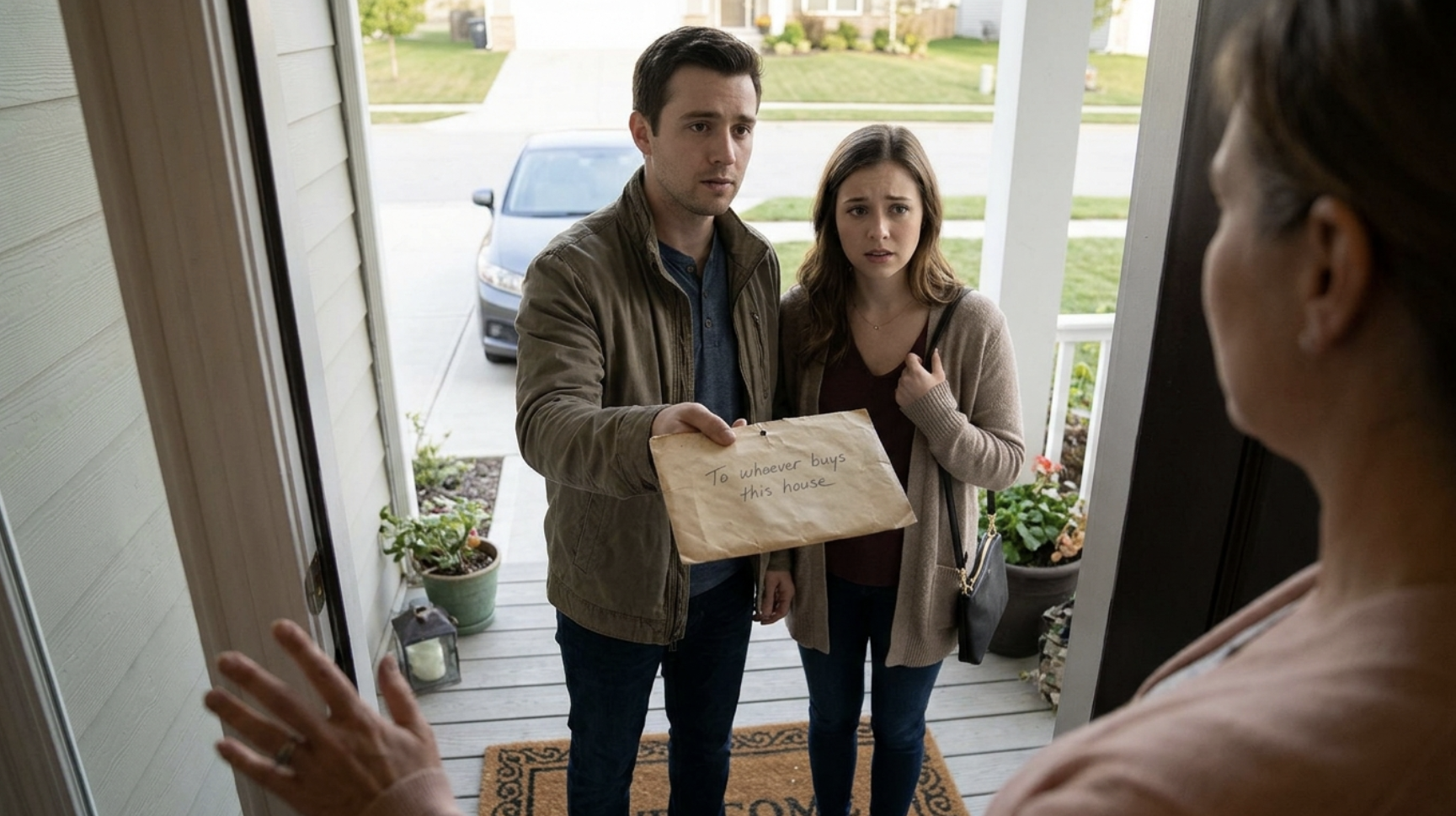
The following morning, Tyler and Hannah met Mr. Fenwick at the property.
I couldn’t be there because Mom had a medical appointment, but Tyler promised to record everything.
He later told me what happened.
The third stair had a small section of wood that looked slightly different from the rest.
When Tyler carefully lifted it, he found a narrow cavity.
Inside was a black metal box.
It was old, dusty, and secured with a small combination lock.
Hannah took several photographs before touching it.
Mr. Fenwick recognized the box immediately.
It was the same one my father had shown him years earlier.
After documenting its condition, they opened it using the combination my mother had provided.
Inside were four items.
The original trust agreement.
The original deed.
A second bank statement.
And a sealed letter addressed to Mr. Fenwick.
The second bank statement revealed something even more disturbing.
The $175,000 transfer wasn’t an isolated transaction.
The money had been moved into an account connected to Karen’s private investment company.
And the letter from my father explained why the account existed.
He had written it in 2019.
To Mr. Fenwick,
If this letter is ever opened, I ask that you carefully examine any future attempts to transfer our property or savings.
My wife and I have established the trust for our granddaughter, Emily. We want her protected.
We have also made arrangements to ensure Dorothy can continue living in her home for the remainder of her life.
Neither daughter should be able to sell the property or remove Dorothy from it without the proper legal authority.
I hope this letter is never needed.
But if it is, please protect my wife.
She has spent her entire life protecting everyone else.
It is time someone protected her.
I cried when I heard those words.
My father had been gone for five years.
Yet somehow, he had left behind the protection we desperately needed.
Two days later, Mr. Fenwick filed the necessary legal notices and began the process of challenging the unauthorized transfers.
He also contacted the appropriate authorities regarding the suspected financial exploitation and forged documents.
The investigation was no longer something Karen could dismiss as a family disagreement.
There were bank records.
Original documents.
A dated letter.
And evidence from the property buyers.
The young couple who had purchased the house became important witnesses.
Tyler and Hannah also provided their closing documents, bank records, and a copy of the letter they had discovered in the attic.
They had paid $290,000 in cash.
They had acted in good faith.
They had no idea there was a dispute involving the trust.
Mr. Fenwick assured them that their legal position would be considered separately from any investigation into Karen’s actions.
I was grateful to them in a way I couldn’t explain.
They had purchased a house.
Instead, they had uncovered a family’s hidden history.
And they could have simply thrown that envelope away.
They didn’t.
Three days after the lockbox was discovered, Karen finally called me.
I was sitting beside Mom when my phone began vibrating.
I answered and put it on speaker.
“Beth, we need to talk.”
“Okay.”
“Alone.”
“Mom is here.”
There was a pause.
Then Karen laughed bitterly.
“Of course she is.”
I said nothing.
“Listen, I don’t know what Mr. Fenwick has told you, but you’re making a terrible mistake.”
“What mistake?”
“Dragging lawyers into this.”
“Karen, where is the $175,000?”
She sighed.
“I already explained that money was used for expenses.”
“Which expenses?”
“Mom’s care. Medical bills. The house. Everything.”
“Then show me the receipts.”
Silence.
“Why are you doing this?” she finally asked.
“Because Mom deserves answers.”
“You’re acting like I stole from her!”
Mom suddenly spoke.
“Karen?”
My sister went completely quiet.
“Mom?”
“Yes. It’s me.”
I watched Mom straighten her back.
For a moment, she looked like the woman who had raised us.
“Why did you tell Beth that I was too confused to make decisions?”
Karen’s voice softened.
“Mom, I was only trying to help you.”
“Then why did you ask me to sign papers giving you my house?”
“I never did that.”
Mom looked at me.
I reached for her hand.
“Karen, I know what I signed and what I refused to sign,” Mom continued. “I may forget what I ate yesterday, but I remember what happened in my own kitchen.”
Karen started crying.
“Mom, you don’t understand how hard everything has been.”
“I understand more than you think.”
“You have no idea what I sacrificed!”
Mom’s eyes filled with tears.
“Your father and I sacrificed for both of you. We paid for your education. We helped you when your marriage was struggling. We gave you money when you needed it.”
Karen interrupted.
“That’s not fair!”
Mom’s voice became stronger.
“What wasn’t fair was taking money from your mother’s account and telling everyone you were doing it for her.”
There was a long silence.
Then Karen said something I will never forget.
“Fine. If you want Beth to handle everything, let her do it. I’m done.”
Mom closed her eyes.
“I never asked you to do everything, Karen. I asked you to love me.”
The call ended.
Neither Mom nor I spoke for several minutes.
Then she whispered:
“Do you think she will ever understand?”
I kissed her hand.
“I don’t know, Mom.”
She looked at the photograph of Dad.
“I hope she does.”
The investigation continued for several months.
The bank records were examined.
The signatures were compared.
The private investment company was investigated.
The authorities also reviewed Karen’s use of the power of attorney.
Eventually, the evidence established that substantial funds had been transferred without proper authorization.
The documents Karen had submitted regarding the property were also challenged.
Mr. Fenwick helped establish that the trust had been validly created in 2019 and that the later attempted transfer did not override it.
The legal process was complicated, especially because the house had already been purchased by Tyler and Hannah.
But the young couple cooperated fully.
They agreed to provide testimony and documents when requested.
After months of negotiations and legal proceedings, an agreement was reached that protected their legitimate interests while restoring Emily’s beneficial interest under the trust.
The financial investigation also resulted in recovery proceedings.
A substantial portion of the missing money was eventually returned to the accounts where it belonged.
Karen was required to account for the unauthorized transactions.
The matter also resulted in formal legal consequences for the suspected financial misconduct and document falsification.
I won’t pretend that everything happened overnight.
It didn’t.
There were difficult meetings, endless paperwork, and days when I wondered whether the truth would ever be fully established.
But it was.
And the most important thing was that Mom was no longer being treated as someone whose wishes could simply be ignored.
Her power of attorney arrangements were reviewed.
An independent professional was appointed to help manage her financial affairs.
Mr. Fenwick ensured that Emily’s trust interests were properly protected.
And Mom was finally given a say in her own future.
One afternoon in October, Tyler and Hannah visited us at the care home.
They brought their baby.
The little boy was wearing a yellow sweater and had the biggest smile.
Mom laughed when Hannah placed him gently in her arms.
“What’s his name?” she asked.
“Oliver,” Hannah answered.
Mom smiled.
“Hello, Oliver. You have no idea how much trouble you’ve caused.”
Everyone laughed.
Tyler looked embarrassed.
“Mrs. Carlson, we never intended to become involved in your family affairs.”
Mom shook her head.
“Please don’t apologize. You did something very kind.”
Hannah reached into her handbag.
“We also brought something.”
She handed Mom a small wooden frame.
Inside was a photograph of the house on Oakwood.
It had been taken on the day they moved in.
The garden was green.
The front windows were clean.
And there were flowers beside the front door.
On the bottom of the frame, Hannah had engraved a sentence.
Some houses are built with wood and stone. Others are built with love.
Mom began crying.
“Thank you,” she whispered.
Then she looked at Tyler.
“Are you happy there?”
He smiled.
“We are. Oliver has a little room upstairs, and Hannah has already planted flowers in the garden.”
Mom nodded.
“Good. That’s all I ever wanted. For someone to be happy in that house.”
I realized something that afternoon.
Mom wasn’t grieving the property anymore.
She had accepted that the house had become part of another family’s story.
What she had wanted all along was for her wishes to matter.
And now they did.
Karen and I didn’t speak for nearly six months.
I won’t lie and say I didn’t miss my sister.
We grew up sharing a bedroom.
We fought over clothes.
We laughed at family dinners.
We buried our father together.
There were hundreds of memories I couldn’t simply erase.
But forgiveness and trust are different things.
I wasn’t ready to trust her again.
One evening, she sent me a message.
I want to see Mom. I know I made mistakes.
I showed it to Mom.
She read it slowly.
Then she handed the phone back.
“Tell her she can visit.”
“Are you sure?”
“She’s still my daughter, Beth.”
I nodded.
“But she needs to understand that things will be different.”
Mom smiled sadly.
“Sometimes people need to lose something before they understand its value.”
Karen eventually visited.
The first meeting was uncomfortable.
She sat beside Mom’s bed, holding her hands and crying.
“I’m sorry, Mom.”
Mom looked at her for a long time.
“Are you sorry because you hurt me, or because you got caught?”
Karen lowered her head.
“I know you don’t believe me.”
“I want to believe you,” Mom replied. “But I need to see that you understand what you did.”
Karen cried harder.
Mom didn’t shout.
She didn’t insult her.
She simply said:
“I don’t need you to be perfect. I needed you to be my daughter.”
For the first time, Karen didn’t have an excuse.
She just sat there and listened.
Their relationship remained complicated, and Mom maintained the boundaries she needed to feel safe.
But they began speaking occasionally.
It wasn’t the relationship they had before.
Perhaps it never would be.
Still, it was a beginning.
The following spring, Emily came to visit her grandmother.
She was twenty years old by then, studying at university and beginning to understand the story behind the family property.
She sat beside Mom’s bed and showed her photographs from school.
Mom listened carefully.
Then Emily asked:
“Grandma, why did you and Grandpa leave the house to me?”
Mom smiled.
“Because we wanted you to have something that nobody could take away from you.”
Emily shook her head.
“But I don’t need a house to know you love me.”
Mom reached for her hand.
“I know, sweetheart. But your grandfather believed that one day you might need a place to start again. He wanted you to have choices.”
Emily began crying.
She hugged her grandmother.
“I wish Grandpa were here.”
Mom looked at the photograph on her bedside table.
“So do I.”
Then she turned to me.
“Beth, do you remember what your father used to say about that house?”
I smiled.
“He said the kitchen was the most important room because that’s where everybody came together.”
Mom laughed.
“That’s right.”
For a moment, the room felt full of people who were no longer there.
Dad.
The years we spent growing up.
The Sunday dinners.
The little arguments that seemed so important at the time.
And all the things we had taken for granted.
A year after Tyler and Hannah discovered the envelope, I received a letter in the mail.
It was from Mom.
Her handwriting was shakier than before, but I recognized it immediately.
I opened it at my kitchen table.
My dearest Beth,
I don’t know whether you will remember everything about this difficult year. I hope you remember some of the good things too.
You came when I needed you.
You listened when other people told you I was confused.
You believed me when I was afraid nobody would.
I know you were hurt that you lived so far away. Please don’t carry that guilt anymore.
You called me every Sunday. You asked about my meals. You told me about Emily. You made me laugh.
You were my daughter even when you couldn’t be physically beside me.
I also want you to understand something about the house.
It was never worth more than my children.
But protecting what your father and I worked for mattered because it represented a promise we made to the future.
I am proud that Emily has choices. I am proud that you stood up for what was right. And I am proud that you did not let anger turn you into someone you aren’t.
Please remember that being a good daughter does not mean agreeing with everything.
Sometimes it means saying no.
I love you.
Mom.
I read the letter three times.
Then I placed it inside a small wooden box with the photograph of my parents.
I kept it there for the days when I needed to remember her words.
Mom is now 86.
She still has good days and cloudy days.
Some mornings she remembers every detail of her childhood.
Other mornings, she asks whether Dad is coming home from work.
When that happens, I don’t correct her immediately.
I sit beside her.
I hold her hand.
And sometimes, I tell her stories about the man she loved.
I visit as often as I can.
Emily visits too.
Karen comes occasionally, although the relationship between us is still healing.
There are things I cannot forget.
There are apologies I am still waiting to see proven through actions.
But I no longer allow the past to control every moment of the present.
As for the house on Oakwood, Tyler and Hannah still live there.
They recently sent us a photograph of Oliver standing in the garden.
He was holding a little watering can, trying to water the same flowers Hannah had planted when they first moved in.
Behind him was the old kitchen window.
The window where Mom used to sit every morning with her coffee.
I printed the photograph and took it to her.
She studied it for a long time.
Then she smiled.
“Look at that little boy.”
“He’s growing quickly,” I said.
Mom nodded.
“Your father would have liked him.”
I sat beside her.
“Yes. He would have.”
After a few minutes, Mom looked at me.
“Beth?”
“Yes, Mom?”
“Did I do the right thing?”
I knew exactly what she meant.
The letter.
The hidden documents.
The trust.
The decision to protect herself even when it meant confronting her own daughter.
I took her hand.
“You did the right thing, Mom.”
She looked out the window.
“I was afraid.”
“I know.”
“I didn’t want my children fighting.”
I swallowed hard.
“Neither did I.”
She squeezed my fingers.
“Then promise me something.”
“Anything.”
“Don’t let money become more important than family. But don’t let family use love as an excuse to hurt you either.”
I couldn’t answer immediately.
Finally, I nodded.
“I promise.”
She leaned back against her pillow.
And for the first time in a long while, she looked peaceful.
THE LAST LESSON MY MOTHER TAUGHT ME
People often ask me whether I regret that my sister sold our mother’s house.
The answer is complicated.
Of course I regret what happened.
I regret that my mother spent her final years worrying about money she had worked her entire life to save.
I regret that she felt she needed to hide letters in the attic because she was afraid nobody would believe her.
I regret that I trusted someone else’s version of events instead of asking more questions.
But I don’t regret what happened after that envelope was discovered.
Because two strangers who had purchased a house for their growing family chose to do the right thing.
Because an elderly woman who had been dismissed as confused finally had her voice heard.
Because my daughter learned that her grandparents had protected her future long before she understood what that meant.
And because I learned that being far away doesn’t mean you have to remain silent.
My mother once told me that the most important thing a person owns is not their house, their bank account, or their possessions.
It’s the dignity to make their own choices.
She was right.
And I think about that every Sunday when I sit beside her.
Sometimes she remembers the letter.
Sometimes she doesn’t.
But I always remember.
The house was sold in 19 days. The truth took months to uncover. And the most valuable thing my parents left behind wasn’t the property or the money. It was the lesson that love should protect people, never give someone permission to control them.
And somewhere in the attic of a little house on Oakwood, the empty space where that envelope was once nailed remains a reminder:
Sometimes the truth waits quietly for years.
All it needs is one person willing to open the envelope.
THE END
My Sister Sold Mom’s House in 19 Days and Claimed the Money Was for Her Care—Then the New Owners Found a Hidden Letter in the Attic That Exposed Everything
Part 1 of 2