Chapter One: The Perimeter
Dawn hadn’t fully broken when I rolled my aging Subaru up to the perimeter checkpoint of Redwood Valley Regional Airport. The dashboard clock glowed a faint 6:17 AM, illuminating a shattered phone mount and a fuel gauge hovering stubbornly near empty. It wasn’t the majestic arrival most civilians anticipate from a Lieutenant Colonel. But pomp wasn’t on my itinerary. I wasn’t there to cut a ribbon, shake hands with local politicians, or sip lukewarm coffee in a boardroom while administrators assured me their facility was operating flawlessly. I was there to audit a strip of asphalt: Runway 22.
In a few hours, an Air Force heavy transport was scheduled to drop out of the sky, bearing critical emergency communications infrastructure for a coastal community brutalized by a recent hurricane. Cell towers were shredded. Highways were impassable. First responders were operating in the dark, desperate for the equipment sitting in the belly of that incoming bird. So, my tolerance for bureaucratic theater was sitting at absolute zero.
I wore a standard dark field jacket over my uniform blouse. No gleaming medals. No polished silver eagles broadcasting that Lieutenant Colonel Marissa Kendall had arrived to ruin someone’s morning. My arsenal consisted solely of a battered leather portfolio, a secure encrypted radio clipped to my hip, and a federal airfield access authorization gripped in my right hand.
The junior officer manning the security booth looked like his soul was still waiting on its first dose of caffeine. His nametag identified him as Miles Benton. He possessed the rigid posture and wide, anxious eyes of a man who still harbored the delusion that employee handbooks could shield him from vindictive managers. I recognized that specific brand of terror; I used to wear it myself.
He slid the reinforced transaction tray outward. “Morning, ma’am.”
“Morning,” I replied, keeping my tone level. “Lieutenant Colonel Marissa Kendall. I’m operating under a federal tasking for Runway 22 inspection access.”
Miles accepted my military ID and the printed authorization. He ran them through the optical scanner. The small monitor to his left instantly flared a vibrant, undeniable green. Cleared. No administrative holds, no flashing error codes demanding a supervisor’s intervention.
Miles exhaled a tight breath and nodded. “You’re cleared, Colonel.” His fingers reached for the gate release toggle.
Then, the heavy steel door at the rear of the booth swung open, and the ambient temperature in the room seemed to plummet. My sister walked in.
Kendra Kendall Pierce, the Deputy Director of Operations for Redwood Valley. Her hair was styled into an immaculate armor, her trench coat tailored to perfection, her face set in the habitual expression of a woman who had spent four decades equating personal outrage with absolute righteousness. Her eyes locked onto mine, and her jaw tightened. It wasn’t shock. Kendra was fully aware of my military rank. She knew I had carved out a career without ever leveraging the considerable weight of our family’s local legacy. That, fundamentally, was the root of her disdain.
What she was ignorant of, however, was the precise reason my Subaru was idling at her service gate this morning. She had no idea that Air Mobility Command was practically holding its breath waiting for my field report. She didn’t comprehend that the black radio resting against my hip carried more jurisdictional authority than the combined signatures of her entire executive board. To Kendra, I was perpetually trapped in the amber of our childhood: the stoic younger sister our parents always instructed to yield, the resilient one, the one expected to absorb the collateral damage because Kendra was sensitive.
She looked past my shoulder at the dented car, then down at my unadorned jacket, and finally at the federal clearance resting in Miles’s trembling hand. “Well,” she practically purred, her voice dripping with artificial sweetness. “You always did have a flair for the dramatic.”
I refused to take the bait. “Kendra. I’m here for Runway 22 access. That’s all I need.”
She let out a short, hollow laugh, perfectly calibrated to ensure the junior officer heard it. “Of course you are. You ghost this town for years, waltz back in, and suddenly the earth is supposed to stop spinning because Marissa has orders.”
“We aren’t in town,” I countered, my voice dropping an octave. “And we aren’t in Mom’s living room. This is an active, restricted operations area.”
Her gaze hardened into obsidian. There it was. The invisible tripwire I was never permitted to cross. In our childhood home, Kendra’s tears were the ultimate currency. She could throw a tantrum, shatter the peace, and manipulate our mother into sighing, Just let her have her way, Marissa. You’re stronger than she is. Under that roof, objective truth was completely irrelevant.
But we weren’t under that roof anymore.
Miles cleared his dry throat. “Ma’am,” he stammered carefully, addressing my sister. “The authorization… it cleared.”
Kendra’s head rotated toward him with the slow, terrifying grace of a predator. I watched the poor kid’s soul temporarily detach from his body.
“It cleared?” she asked, her voice dangerously soft. “Yes, ma’am.” “Close the screen.”
Miles became a statue. I watched the internal war wage across his face. His shoulders locked. His fingers hovered paralyzed above the keyboard. He knew exactly what the digital log proved. He also knew whose signature was required on his upcoming probation review.
“Miles,” I intervened, projecting as much calm authority as I could muster. “Leave the confirmation visible.”
Kendra closed the distance to the counter, invading his space. “Do not issue directives to my personnel.”
“I’m not issuing a directive,” I stated. “I am preserving a federal record.”
A tiny, cruel smile played on her lips. “Did you hear that, Miles? She’s preserving the record. Always obsessed with playing the hero.”
Miles swallowed audibly.
“Kendra,” I warned, “the scanner verified my federal access. This is not a request.”
“And I am telling you, this is my gate. No, it is not.”
Her expression fractured. It was a subtle shift. Most people mistakenly believe that pure fury requires screaming. It doesn’t. True, volatile anger often surfaces when someone realizes they have lost the tactical advantage of facts, prompting them to blindly grasp for raw power.
Kendra reached into the metal tray and snatched my authorization document.
Miles gasped. “Ma’am, I really don’t think—”
“Close the screen!” she barked.
This time, self-preservation won out. Miles hit the key. The glowing green verification vanished into a black void.
Kendra pinched the heavy cardstock between her manicured fingers as if she were holding a contaminated rag. Outside, a motorized luggage tug decelerated. Two men in neon vests by the chain-link fence paused their conversation, their heads swiveling toward the escalating drama in the booth. Kendra drank in the attention. An audience was her preferred oxygen.
“You might outrank a few grunts on a military base, Marissa,” she whispered venomously. “But you do not outrank me here.”
Then, with a sharp, deliberate motion, she tore the federal authorization cleanly in half.
The ripping sound was incredibly faint, yet it echoed like a gunshot in the confined space of the booth. I watched, paralyzed by her sheer audacity, as she layered the halves and tore them again. Four pieces became eight. She released her grip, letting the shredded remnants of a federal directive flutter onto the stainless-steel counter like the depressing confetti of a failed coup.
“Now,” she sneered, brushing her palms together. “You don’t have authorization.”
Silence suffocated the room. Miles looked as though he was actively praying for the concrete floor to swallow him whole. I stared down at the jagged scraps. My surname was violently severed across two pieces. The embossed government seal was fractured right down the center.
The fatal flaw of people who fundamentally misunderstand power is their assumption that authority resides in the physical paper. It doesn’t. The paper is merely a receipt for the authority that already exists.
I slowly lifted my chin and met my sister’s eyes. I didn’t raise my pitch. I didn’t step aggressively forward. I didn’t hurl the insults that were burning the back of my throat, because I was still bound by the restraints of my uniform.
“Kendra,” I said, my voice eerily flat. “Are you officially denying me entry after a valid federal authorization was electronically confirmed?”
She crossed her arms, a fortress of misplaced arrogance. “Yes.”
I shifted my gaze. “Officer Benton, did you witness and hear that denial?”
He parted his lips to speak, but Kendra immediately snapped, “Do not answer her.”
That was the only confirmation I needed. I reached down and methodically gathered the torn pieces of paper. One by one, with agonizing deliberation, I slid them into a clear plastic evidence sleeve from my portfolio.
Kendra rolled her eyes, scoffing loudly. “Oh, give me a break. Are we playing CSI now? Is that an evidence bag?”
“Not yet,” I replied.
That wiped the smug satisfaction from her face for precisely half a second.
Then, the encrypted radio on my hip emitted three sharp, piercing electronic tones. The booth went graveyard still. Kendra stared at the black device as if a viper had just uncoiled on my belt.
A baritone voice crackled through the speaker, crisp and undeniable. “Mobility Operations to Falcon Three. Colonel Kendall, confirm inspection status.”
Kendra froze. Miles’s head snapped up. Outside, the ground crew had completely abandoned the pretense of working.
I rested my hand over the radio. For the very first time since the sun came up, my older sister looked at me and finally understood that this confrontation had absolutely nothing to do with which daughter our mother loved more. My thumb hovered over the transmit button. Once I depressed that piece of molded plastic, this ceased to be a squabble between siblings. It became a federal incident. I pressed it down.
Chapter Two: The Escalation
“Falcon Three to Mobility Operations,” I spoke into the mic, my voice stripped of all familial emotion. “This is Colonel Kendall. Inspection access to Runway 22 has been actively denied at Service Gate 4. Federal airfield authorization was scanned and confirmed valid by airport access control prior to this denial.”
The ensuing silence in the booth was so profound it felt heavy. Kendra blinked, her confident facade cracking. Miles Benton actually stopped breathing.
The radio crackled back to life. “Copy, Falcon Three. Confirming denial occurred after positive credential return?”
“Confirmed,” I stated. “Gate officer verbally reported a cleared status. The supervising airport operations official subsequently overrode the access protocol.”
Kendra lunged a half-step toward me. “Marissa—”
I raised a single index finger. I didn’t shove it in her face, and I wasn’t outwardly hostile. It was just a silent, immovable barrier that clearly communicated: Do not make this catastrophically worse for yourself. She bristled. Boundaries were a foreign concept to Kendra; she treated them like optional suggestions.
“Identify the supervising official,” the command voice requested.
I held my sister’s panicked gaze. Her features were rigid, but her eyes darted frantically, searching for an escape hatch that didn’t exist.
“Kendra Kendall Pierce,” I enunciated clearly. “Deputy Director of Operations, Redwood Valley Regional.”
Kendra’s jaw dropped, but her vocal cords failed her. That was a historical first. I practically wanted to mark the calendar.
“Copy,” Mobility Operations replied. “Aircraft remains on schedule. Mission status critically requires field inspection update. Report any further obstruction to mission access.”
“Understood.” I released the comms button.
Kendra found her voice at the absolute worst possible moment. “You did not just report me to the United States Air Force.”
“I reported a factual sequence of events.”
“This is a family matter!” she hissed, her voice vibrating with desperate rage.
“No,” I countered. “It ceased being a family matter the exact second you intentionally blocked an active operations inspection.”
She forced a laugh, but it was brittle and thin. “You are completely unhinged. You strut in here playing dress-up, wave a piece of paper in my employee’s face, and now you’re trying to spark an international incident just because your fragile feelings got bruised?”
“My feelings are not listed on the incoming flight schedule.”
The words landed with more brutal force than I intended. Miles jerked his head down, but he couldn’t completely camouflage the suppressed smirk twitching at the corner of his mouth. Kendra caught it. The poor kid was about to endure the wrath of a wounded narcissist.
Before she could verbally decapitate him, a pristine white airport management SUV slammed on its brakes outside the gate. A man in a tailored navy topcoat scrambled out, clutching a smartphone to his ear. He wore the strained, overly-rehearsed smile of a corporate fixer who spent his mornings practicing damage control in his bathroom mirror.
Graham Talbot, the Airport Director.
I recognized his name from the logistical briefing packets. I had also read three separate emails from his desk, all flagged as ‘Urgent,’ practically overflowing with corporate sycophancy about how Redwood Valley was honored, prepared, and deeply humbled to facilitate this relief mission. In my experience, administrators lean heavily on the word ‘honored’ right when they want you to stop digging into their business.
Talbot breached the booth with both palms raised in a placating gesture, looking like a man trying to soothe a cornered grizzly bear. “Colonel Kendall,” he smoothed, his voice like oiled silk. “Graham Talbot. I deeply apologize. I believe we’ve stumbled into a terribly unfortunate family misunderstanding.”
There it was. Packaged and delivered. Not a security breach. Not a denial of federal authority. A family misunderstanding. Kendra had obviously texted him in a panic, deploying her customized distress signal to summon her corporate shield. He had arrived armed with entirely the wrong narrative.
“Mr. Talbot,” I said, icing over my tone. “A federal airfield access credential was electronically validated, and then physically mutilated by your Deputy Director after she explicitly ordered this gate officer to purge the confirmation screen.”
Talbot’s practiced smile suffered a microscopic tremor. It wouldn’t have convinced a jury, but it told me everything I needed to know. “I am absolutely certain we can clarify this minor procedural hiccup without needlessly escalating the situation.”
“Preserve the gate camera footage,” I commanded, ignoring his diplomacy. “Preserve all access logs from 0600 hours forward. I want the scanner transaction history, the radio dispatch recordings, all maintenance access records, every single work order for Runway 22, and a detailed list of any administrative overrides executed at this checkpoint.”
Kendra interjected, her voice laced with manufactured confidence. “The local server buffer cycles automatically.”
I slowly rotated to face her. “Does it?”
She crossed her arms, lifting her chin. “That is standard system architecture.”
“Fascinating.”
It was a profoundly idiotic lie. Not because local buffers never overwrite—some systems do, some don’t. It was idiotic because her delivery reeked of desperation. She spoke with the aggressive, faux-technical certainty of someone who desperately needed digital evidence to vanish into the ether. Panic has a distinct acoustic signature.
Talbot smoothly inserted himself physically between us, trying to reclaim the alpha position in the room. “Colonel, I give you my personal assurance that Redwood Valley treats military coordination with the utmost gravity.”
“Then securing those digital records won’t be an issue.”
“Certainly not. We appreciate your diligence.” His smile was now stretched drum-tight.
Kendra shot a venomous glare at the junior officer. “Miles. You will officially document that there was an unresolved credential anomaly that required pending supervisor review.”
Miles gulped air. I watched his knuckles turn white against the seams of his uniform trousers. He was trapped. He knew he had seen the vibrant green screen of a cleared authorization. And he had just watched his boss destroy it like a losing lottery ticket.
“I strongly advise against writing that,” I said quietly.
Kendra whipped her head toward me, her eyes ablaze. “I am instructing my personnel!”
“And I am informing your personnel that generating fraudulent documentation during a federal mission access event is a catastrophic career strategy.”
Miles stared intensely at the floor tiles. The poor man was suspended over an abyss, wedged between his mortgage payments, his boss’s wrath, and a Lieutenant Colonel holding the shredded evidence of a federal crime. They definitely don’t put this scenario in the airport security recruiting brochures.
My radio shattered the tension once more. “Mobility Operations to Falcon Three. Command requests official inspection status. Can Runway 22 be certified for inbound mission arrival at this time?”
Those words sucked the remaining oxygen out of the booth. Talbot’s diplomatic smile evaporated entirely. Kendra’s rage morphed instantly into stark, unadulterated fear.
That was the only metric that mattered. Not Kendra’s bruised ego. Not Talbot’s PR spin. A massive military aircraft, laden with lifesaving gear, was burning fuel waiting for an answer. And this corrupt administration was the sole reason I couldn’t provide one.
I unclipped the radio. “Falcon Three. Negative certification at this time. Runway 22 inspection has not commenced. Access to the inspection zone was obstructed post-credential verification. I cannot, and will not, certify that surface until a physical audit and a full review of supporting maintenance records are complete.”
A heavy pause hung on the frequency. Then: “Copy. Mission clock remains critical and active. Provide immediate update the moment inspection access is restored.”
“Understood.”
I let the radio fall silent. Talbot rigidly massaged his jawline. That subtle, nervous gesture screamed volumes. The realization had finally penetrated his corporate armor: this wasn’t an internal HR spat he could bury in a memo titled Process Improvement. A federal relief flight was actively holding, and the liability was now resting squarely on his shoulders.
“Colonel,” Talbot said, his tone entirely stripped of its former warmth. “We will have you escorted to Runway 22 immediately.”
“By whom?” I demanded. “Your operations staff?”
“Yes.”
“Unacceptable. I require the lead airfield lighting technician directly responsible for the Runway 22 grid.”
Kendra scoffed nervously. “That is completely unnecessary.”
I fixed Talbot with a dead stare. “Is it?”
He hesitated for three agonizing seconds. Then, he unholstered his phone. “Get Eli Navaro down to Service Gate 4,” he barked into the receiver. “Right now.”
Kendra stared at her boss as if he had backhanded her across the face. He refused to meet her eye. It was the first structural fracture in their alliance.
As Talbot and Kendra stepped outside to wait by the SUV, the heavy door clicking shut behind them, Miles Benton leaned across the counter. His face was the color of chalk.
“Colonel,” he whispered, his voice trembling so violently I almost couldn’t hear him. “There’s something deeply wrong with Runway 22. It’s been bleeding out for weeks.”
Chapter Three: The Discovery
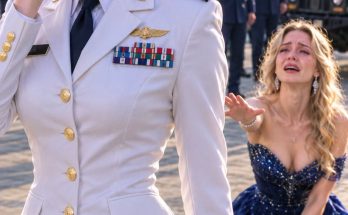
On New Year’s Eve, my younger sister grabbed my federal flight pass and ripped it into pieces in front of a crowd, laughing as she humiliated me. What she didn’t realize was that Air Force Command had been monitoring my mission in real time. Seconds later, my radio suddenly came alive with an urgent transmission, and the entire airport froze as my true identity was revealed. The moment my sister discovered the consequences of what she had done, the smug look vanished from her face. She dropped to her knees, desperately begging me to spare her.
Part 1 of 3