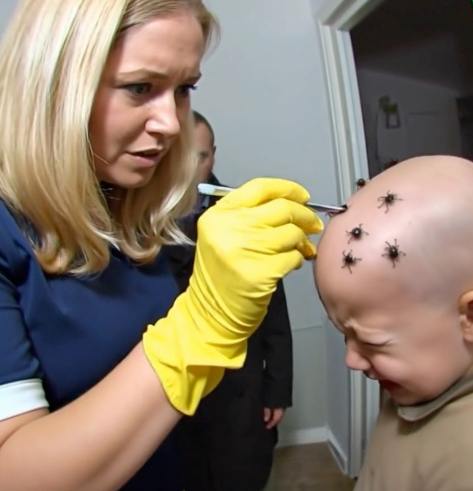
on The Billionaire’s Heir Who Suffered Unexplained Pain—Until the Night Nanny Paula Discovered a Hidden Device No Scan Had Detected, Forcing Her Into a Choice That Would Change the Entire Household Forever
Paula had worked in wealthy homes long enough to understand one simple truth: money solved almost everything except the things that mattered most. In mansions like the one she now worked in, silence was often mistaken for peace, and control was mistaken for care. But neither of those things helped a child who cried himself to sleep every night for reasons no one could explain.
Felix was seven years old, the only son of a billionaire whose name rarely appeared in public but whose influence quietly shaped entire industries. On paper, he had access to the best doctors in the world. Specialists had flown in, scans had been performed, tests had been repeated, and yet every result came back the same: normal. Healthy. No explanation.
And still, Felix suffered.
It began as headaches. Then came dizziness. Then nights where he woke up screaming, clutching his head as though something inside him was burning. The household staff learned quickly not to speak too loudly about it. The father responded to bad news with cold efficiency, the kind that ended conversations before they began. The mother retreated into denial, insisting the boy was simply sensitive.
Only Paula stayed close enough to notice the pattern no one else wanted to see. The pain wasn’t random. It came in waves, often triggered by stress, noise, or exhaustion. And more unsettling than anything else, Felix sometimes touched the same spot on his head, whispering that it “felt wrong there,” as if he could sense something beneath the surface of his own body.
At first, Paula dismissed it as imagination. Children often gave shape to their suffering in ways adults misunderstood. But over time, doubt crept in. There was something too precise about his gestures, too consistent about his complaints. It wasn’t just pain. It was as if something was in the wrong place.
The turning point came one afternoon when Felix grabbed her hand during a moment of quiet and said, almost pleadingly, “It doesn’t stop here. It’s always here.” His small fingers pressed firmly against the crown of his head.
That night, Paula could not sleep.
She had no authority to question doctors, no training to override medical conclusions, and no permission to interfere beyond her duties as a nanny. In that house, boundaries were enforced not through rules alone, but through the unspoken fear of consequences. Yet the image of Felix’s face stayed with her—the exhaustion in his eyes, far too heavy for a child.
Eventually, she made a decision she couldn’t fully justify even to herself. She would look more closely. Not as a violation of trust, but as an act of care no one else seemed willing to attempt.
Later that night, the mansion settled into its usual rhythm of controlled silence. Lights dimmed, hallways emptied, and even the air seemed to slow. Paula entered Felix’s room under the pretense of checking on him. He was asleep, his breathing uneven, his small frame tense even in rest.
She sat beside him for a long moment, watching his expression shift slightly with discomfort. Then, carefully, she focused on the area he always indicated. There was nothing visible—no injury, no mark, nothing that explained the intensity of his suffering. And yet she couldn’t shake the feeling that something was being missed.
What followed was not a dramatic revelation, but a quiet moment of realization. A suspicion forming not from certainty, but from everything that didn’t add up. She left the room without waking him, her mind heavy with questions she had no right to be asking.
The next day passed slowly. Felix struggled more than usual. He skipped breakfast, refused to join his lessons, and sat quietly by the window pressing his fingers to his head. No one intervened beyond offering him mild reassurance.
That evening, Paula sought out Carlos, one of the estate’s gardeners, a man who had worked there longer than anyone else. He had a reputation for being observant, the kind of person who noticed when something in a place didn’t belong. She didn’t tell him everything—only enough to express her concern that something about Felix’s condition felt overlooked.
Carlos listened without interrupting. When she finished, he was silent for a long moment before saying, “Sometimes what we’re told to look for isn’t what’s actually there.”
It wasn’t agreement. But it wasn’t dismissal either.
That was enough.
Together, they decided to remain observant, not intrusive. To watch, to listen, to be present in case something revealed itself naturally. It was a fragile compromise between caution and instinct.
Over the next several days, Paula paid closer attention. She noticed subtle details others ignored: Felix reacting sharply to certain frequencies of sound, flinching at vibrations, becoming disoriented during moments of emotional stress. None of it fit neatly into any diagnosis she had ever heard of.
And then, one night, something changed.
Felix woke suddenly in distress. Not crying—this was different. He was disoriented, frightened, insisting that “it was moving again.” The household doctor was called, but again, nothing physically obvious could be found. Sedation was suggested. Rest was prescribed. The explanation remained the same: unexplained neurological sensitivity.
But Paula no longer believed “unexplained” meant “nothing is there.”
Later that night, while the house was distracted by a brief technical emergency in the electrical system, Paula returned to Felix’s room. Not with a plan formed in certainty, but with the weight of a decision she could no longer postpone: she needed closer understanding of what was happening to the child.
What she discovered in that quiet, dimly lit room would not immediately make sense. There was something subtle, something that didn’t belong in a child’s body, something that had never been detected by any scan or examination. It was small, hidden, and deeply wrong.
Her hands shook—not from fear alone, but from the realization that Felix’s suffering had not been imagined.
Carlos arrived shortly after, having noticed her distress. What followed was not a moment of action, but of urgent restraint and careful judgment. They realized quickly that whatever they were dealing with required professional intervention far beyond their abilities. The priority was no longer discovery—it was protection.
When morning came, Felix was moved under immediate medical supervision. The household, once so confident in its certainty, was forced into chaos. Specialists returned. New examinations were ordered. Questions were no longer dismissed.
For the first time, something was found—something that validated what had been overlooked.
And as the truth unfolded in fragments, the mansion that had once operated on control and silence was forced to confront its greatest flaw: the assumption that nothing could be wrong if nothing could be seen.
Felix began to recover slowly after proper treatment. His pain diminished. His sleep returned. The household, shaken and uncertain, had no clear answers for how many signs had been missed or why.
But Paula did not stay for recognition.
For her, nothing about what happened felt like triumph. It felt like a reminder—that intuition is not evidence, but sometimes it is the only signal that something deserves to be questioned.
As she left the estate weeks later, she looked back only once. The house stood as it always had—grand, silent, imposing.
But somewhere inside it, a child was finally at rest.
And that, for Paula, was the only closure that mattered.