I used to believe that keeping my husband happy was the same thing as having a peaceful marriage.
At sixty-eight, I finally understood how wrong I had been.
It happened on an ordinary afternoon, in the kitchen of the farmhouse where I had lived almost my entire adult life.
My husband, Alden, had just come home.
He was still wearing his work clothes, and I could tell from the way he dropped his keys that he wasn’t in a pleasant mood.
I had learned to notice those little things.
The keys.
The footsteps.
The way he opened the refrigerator without saying hello.
For forty-five years, those sounds had told me what kind of evening I was going to have.
But that afternoon was different.
I had already made a decision.
And I wasn’t going to take it back.
Alden walked past the kitchen table and stopped near the front window.
For a moment, he simply stood there.
Then he leaned closer to the glass.
I knew what he had noticed.
The front pasture looked different.
The old gate stood open, and a temporary fence had been installed along the property boundary.
Beyond it, several dozen goats were wandering through the grass.
Some were white.
Others were brown or spotted.
A few younger ones were jumping around near the old oak tree.
I thought they looked perfectly content.
Alden did not.
He turned toward me.
“Joanne, what happened out there?”
I looked up from my coffee.
“What do you mean?”
He pointed through the window.
“Those animals. Why are they here?”
“They belong to Miriam Yoder.”
His forehead wrinkled.
“I know whose goats they are. I’m asking why they’re standing in my pasture.”
There it was.
My pasture.
A phrase I had heard so many times that I had almost forgotten to question it.
I set my cup down.
“Alden, we need to discuss something.”
He gave me a tired look.
“Can it wait? I’ve been working all day.”
“No. I think we should settle it now.”
He looked back through the window.
“First, you’re going to explain why Miriam has put her animals on our land.”
I stood and walked to the kitchen drawer.
Inside was a large brown envelope.
I had placed it there that morning, beside the kitchen towels and the little notebook where I wrote grocery lists.
My hands felt unusually steady when I picked it up.
I carried it to the table.
“Sit down for a minute.”
Alden looked at the envelope.
“What did you do?”
“Nothing you can’t read about.”
He remained standing.
I opened the envelope myself.
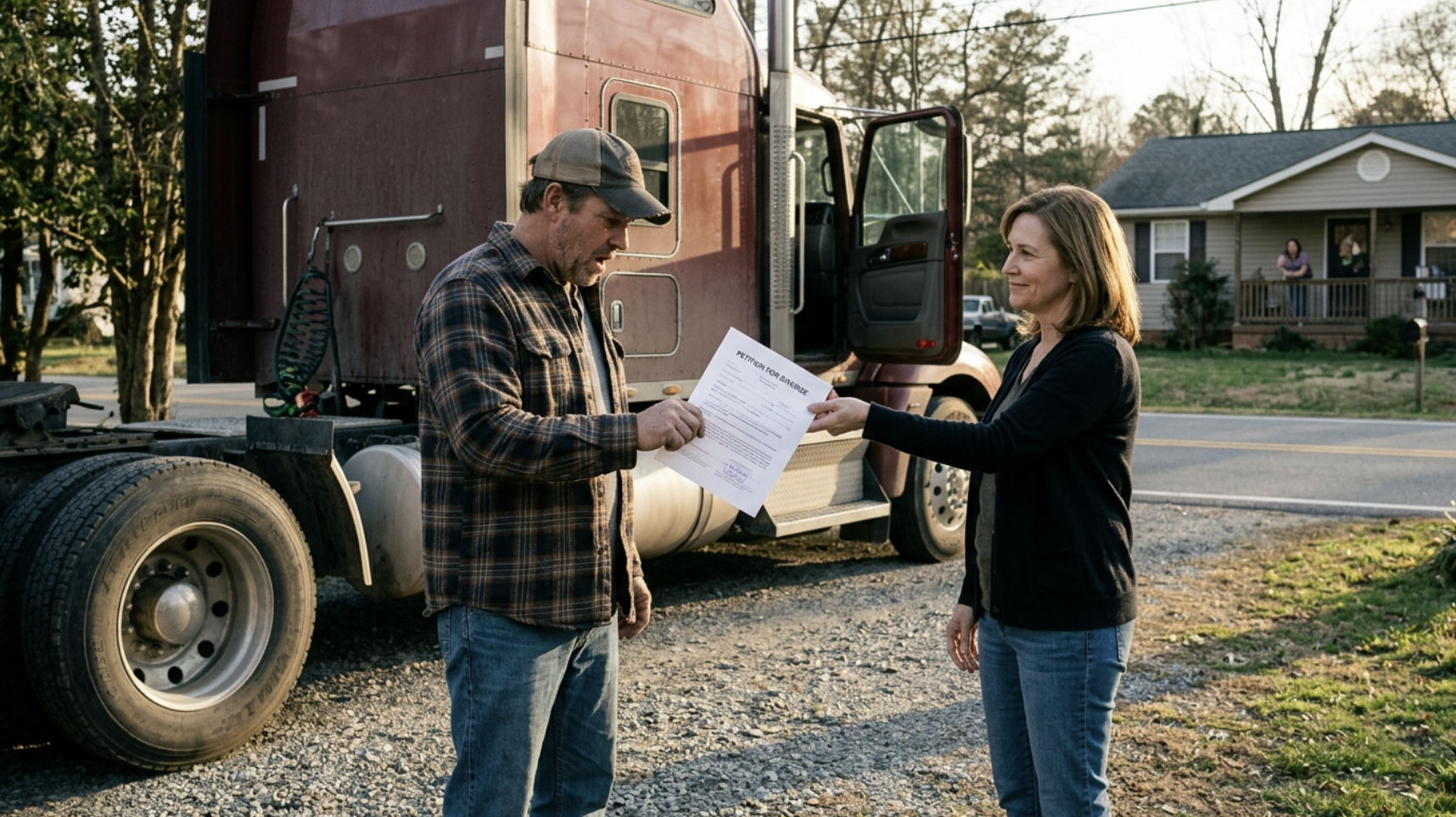
The first document was a certified copy of the property deed.
The second was a pasture rental agreement signed by Miriam and me.
The third was confirmation that my retirement pension would now be deposited into a bank account controlled only by me.
I arranged the papers in front of him.
Alden stared at them.
Then he picked up the rental agreement.
He read the heading.
His expression changed before he reached the bottom of the first page.
“You made a deal with Miriam?”
“Yes.”
“Without talking to me?”
“Yes.”
He dropped the agreement onto the table.
“You had no business doing that.”
I pulled out a chair.
“I had every right to do it.”
He laughed.
It was a short, sharp sound.
“Joanne, you’ve been sitting in this house by yourself too much. You’re getting some foolish ideas.”
I didn’t respond.
He pointed toward the pasture.
“That land is mine to manage.”
I slid the deed toward him.
“Look at this first.”
He gave it a quick glance.
“I know what a deed is.”
“Then read the owner’s name.”
He looked irritated.
But he picked it up.
His eyes moved across the paper.
Then he stopped.
He studied the page again.
I watched him trace a finger beneath the printed name.
Joanne Kittle.
Only my name.
Not Alden’s.
He looked at me.
“What am I supposed to do with this?”
“Understand what it says.”
He straightened.
“We’ve been married since 1981.”
“I know.”
“We’ve lived here together all those years.”
“Yes.”
“Then don’t act as though I have no say in this place.”
I looked at the deed.
“My father left this farm to me, Alden. The house and all forty acres have been in my name since 1981.”
He pushed the paper away.
“You’re splitting hairs.”
“No. I’m telling you who owns the property.”
His face tightened.
I could see him trying to decide whether I was serious.
Usually, that was the moment when I softened my words.
I would smile.
Or apologize.
Or offer him another cup of coffee.
Anything to make the tension disappear.
That afternoon, I did none of those things.
Alden tapped the table.
“Who convinced you to do this?”
“Nobody.”
“Was it Miriam?”
“No.”
“She’s been coming around here a lot.”
“She’s our neighbor.”
“She shouldn’t be filling your head with nonsense.”
I looked toward the window.
Miriam’s goats were quietly eating grass beneath the oak tree.
They didn’t know they had become the subject of an argument.
“Alden, I made this decision myself.”
He folded his arms.
“Since when?”
That question stayed with me.
Since when?
Since when had I begun making decisions about my own property?
Since when had I stopped asking permission?
Since when had I decided that being married didn’t mean handing another person control over my whole life?
The answer wasn’t simple.
It had taken forty-five years.
And one particularly cruel conversation about money.
Alden had recently waved his paycheck in front of me during an argument.
He had told me that the person earning the money got to make the rules.
He believed his paycheck settled every disagreement.
It didn’t matter what I needed.
It didn’t matter what I thought.
He expected me to accept his decisions because he considered himself the provider.
I remembered standing in that same kitchen, listening to him speak as though I had never contributed anything.
And I remembered the humiliation.
Not anger, at first.
Humiliation.
I had worked thirty-one years delivering mail.
I had driven through freezing mornings and summer storms.
I had carried packages down muddy driveways.
I had memorized the roads of our county better than most people knew their own neighborhoods.
Yet somehow, in Alden’s mind, his wages counted more than mine.
Even after my retirement, he treated my pension as money he was entitled to control.
When our joint checking account was closed, I realized just how little financial independence I had left.
That was when I began making changes.
Small ones.
Careful ones.
But they belonged to me.
I opened an individual bank account.
I arranged for my pension to go there.
And I signed an agreement allowing Miriam to use part of the pasture for her goats.
I hadn’t acted to hurt Alden.
I had acted because I was frightened of what would happen if I continued doing nothing.
Now he was standing across from me, demanding an explanation.
I picked up the bank notice.
“You once told me that earning money gave a person the right to decide how it was spent.”
He nodded.
“That’s common sense.”
“Then I’m going to manage my own pension.”
His expression hardened.
“What are you talking about?”
I gave him the notice.
He read it.
Then he looked up.
“You changed the deposit?”
“Yes.”
“Where?”
“To another account.”
“Which one?”
“One that’s in my name.”
“At what bank?”
“The same bank.”
He looked almost relieved.
“Fine. Give me the account details.”
I shook my head.
“No.”
He stared.
I could see that he hadn’t understood me.
“What did you say?”
“I’m not giving you access to that account.”
He took a step closer.
“Joanne, don’t be ridiculous.”
“I’m serious.”
“We’re husband and wife.”
“That doesn’t mean you need the number.”
His jaw moved.
For a moment, he seemed unable to find words.
That almost frightened me more than his anger.
I had never refused him something so directly.
During our marriage, he had always known where my money went.
He knew my passwords.
He saw my statements.
If he wanted to look through the household records, I handed them over.
I never imagined refusing him.
But he had never offered me the same freedom.
And I was beginning to understand the difference.
Alden leaned against the counter.
“You’re too old to start playing games with money.”
I felt that insult.
I would be lying if I said I didn’t.
He had a way of making me feel foolish simply by questioning my judgment.
For years, I had believed him.
I had wondered whether I really was too sensitive.
Too cautious.
Too easily confused.
But now I was looking at a document from the bank that showed I had completed something important without his help.
I wasn’t confused.
I was capable.
And that seemed to upset him.
“I know exactly what I changed,” I told him.
“You don’t understand what you’re doing.”
“I understand enough.”
He shook his head.
“You’ve always needed me to handle these things.”
I looked down at my hands.
They were resting on the table.
No trembling.
No nervous twisting of my wedding ring.
I noticed that and almost smiled.
For decades, the smallest disagreement could make my fingers shake.
I had become so practiced at preventing arguments that I rarely noticed how afraid I was.
But now I was sixty-eight.
The farm belonged to me.
My pension belonged to me.
And I had started wondering what else I had been surrendering without realizing it.
Alden picked up the lease.
“How much did Miriam talk you into taking?”
“Three hundred and fifty dollars each month.”
He let out another laugh.
“That’s all?”
“Yes.”
“For forty acres?”
“Not forty acres. The agreement covers only the front pasture.”
He looked back at the paper.
I continued.
“They’re responsible for maintaining the fencing and water arrangements. They’ll take care of the grass, too, and they’ve got liability insurance.”
He waved the agreement.
“You’ve been taken advantage of.”
“I don’t believe I have.”
“Of course you don’t. That’s the problem.”
I looked at the goats again.
The front pasture had been neglected for a long time.
The grass grew high in places.
The fencing needed attention.
And Alden had spent more time talking about improvements than actually making them.
Miriam and her husband had offered an arrangement that suited both of us.
Their animals had room to graze.
My pasture would be looked after.
And I would receive a little income.
Nothing extravagant.
Just money I could use without asking anybody.
That mattered more than Alden understood.
He slapped his paycheck onto the table.
“This is what keeps everything running around here.”
I looked at the check.
Then at the deed.
For a moment, I remembered my father.
His rough hands.
His old work boots.
The way he used to stand in the doorway after a long day and look toward the fields.
He had spent his life taking care of that land.
And in 1981, it became mine.
I had always been grateful.
But I had allowed Alden to talk about it as though my father’s work had somehow become his.
I looked at my husband.
“My father had this house before you married me.”
He stopped talking.
I continued quietly.
“The land didn’t appear because you brought home a paycheck.”
He stared at me.
I didn’t look away.
He finally pointed toward the window.
“Call Miriam and have her remove the goats.”
“No.”
“Joanne.”
“I signed an agreement with her.”
“Then cancel it.”
“I’m not doing that.”
He pulled out his phone.
“Maybe the sheriff can explain a few things to you.”
I stood.
“If you think that’s necessary, you can call.”
He looked at me for a long moment.
Then he lowered the phone.
I walked to the sink with my coffee cup.
I could hear his breathing behind me.
I expected another argument.
Instead, he muttered something about women forgetting their place.
I rinsed the cup.
Put it on the drying rack.
And stayed quiet.
Not because he had won.
Because I finally understood that I didn’t have to answer every insult.
That evening, Alden refused to come upstairs to our bedroom.
He stayed in the living room.
I heard him walking across the floor.
Then the telephone conversations began.
First Brenda.
His oldest sister.
Then his other sisters, Linda and Carol.
I couldn’t make out every word.
But I heard enough.
According to Alden, I had suddenly become unreasonable.
Miriam had influenced me.
I was hiding money.
I had rented out land that belonged to the family.
He didn’t mention that the deed carried only my name.
He didn’t mention that my pension was the result of thirty-one years of work.
And he certainly didn’t mention the way he had spoken to me about his paycheck.
By the time he finished calling his sisters, I knew my own telephone would ring.
I wasn’t wrong.
A little after ten, Brenda called.
I sat beside the kitchen window before answering.
“Hello, Brenda.”
She skipped the greeting.
“Joanne, what on earth are you doing?”
I looked at the closed envelope.
“Good evening.”
“This isn’t funny. Alden says you’ve been making decisions behind his back.”
“About what?”
“The property. The money. Those animals.”
I watched a goat move past the fence in the moonlight.
“I’ve rented part of my pasture.”
“His pasture, you mean.”
I closed my eyes briefly.
“No, Brenda. The farm is mine.”
She made an impatient sound.
“You’ve been married for decades. Don’t act like a stranger.”
“I’m not acting like a stranger.”
“Then why would you embarrass my brother this way?”
I glanced toward the living room.
Alden was sitting in his chair, watching television.
“Brenda, do you remember who owned this house before I married Alden?”
She hesitated.
“That’s not the point.”
“It is to me.”
She sighed.
“Alden has worked hard his whole life.”
“So have I.”
She laughed dismissively.
“Oh, Joanne. You delivered letters.”
I went still.
Thirty-one years.
That was all she could see.
A little woman driving around with envelopes.
She hadn’t seen the icy roads.
The dogs charging out of yards.
The elderly people waiting by their mailboxes because I was the only person they expected to see that day.
She hadn’t seen the medicine deliveries.
The heavy parcels.
The miles I covered when my back hurt and my hands were numb.
And she had never cared to ask.
“Yes,” I told her. “I delivered mail for thirty-one years.”
She said nothing.
“And I worked hard doing it.”
“You’re being dramatic.”
“Maybe you think so.”
“You’re making yourself look foolish.”
I stared at the table.
Then I said something I had never dared tell her before.
“I don’t need you to approve of me, Brenda.”
She started speaking again.
I ended the call.
For a few seconds, I held the phone in my lap.
My hands had begun trembling.
But the feeling wasn’t the same as before.
I was upset.
I was hurt.
And I was angry.
Yet underneath all of that, I felt something unfamiliar.
Relief.
I didn’t have to keep explaining myself to people determined not to understand.
I switched off the kitchen light and went upstairs.
Alden remained in the living room.
I lay down in our bed alone.
The old farmhouse settled around me.
I could hear the familiar creak near the hallway.
The wind pressed lightly against the windows.
I had spent so many nights lying awake, wondering how to make things right with my husband.
That night, I didn’t plan an apology.
I didn’t rehearse what I would say in the morning.
I didn’t wonder whether his sisters would forgive me.
I simply closed my eyes.
And for the first time in years, I slept without feeling that I had done something wrong.
Click here to continue reading: PART 2: My Husband Offered to Restore Our Old Arrangement, but One Small Question Exposed What He Really Wanted From Me
After Forty-Five Years of Marriage, My Husband Discovered That the Farm He Called His Had Never Actually Belonged to Him
Part 1 of 15