Chapter 1: The Snow Belt and the Sacred Lie
Have you ever sat across a dinner table and watched the person you raised with your own hands shrink your entire existence into an embarrassing footnote?
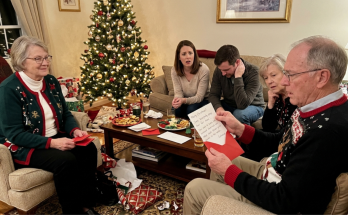
It happened to me under the warm glow of Edison bulbs at an upscale rehearsal dinner on the shores of Lake Ontario. Twenty-two pairs of eyes flickered over me while my little sister, swirling a glass of pinot noir, laughed away my twenty-year military career with six dismissive words: “She just does supplies down there.”
The room chuckled—a polite, oblivious ripple of amusement. Nobody noticed that my fork had frozen halfway to my plate, or that my pulse had spiked to a combat rhythm. But before you can understand why those words carved straight through my ribs, you have to understand where we came from. You have to understand that in my family, silence was not merely an absence of noise; it was an inheritance.
I grew up in Pulaski, New York, an austere outpost wedged tight against the eastern tip of Lake Ontario. Locals call it the snow belt, an unforgiving landscape where the clouds unleash relentless lake-effect powder from November straight through April. Survival there required a particular kind of quiet resilience. My father, Hank Miller, spent twenty-eight years scaling frozen utility poles as a high-voltage lineman, battling gale-force sleet that would make seasoned mountaineers weep. My mother, Martha Miller, vanished into the graveyard shift at the regional hospital, wrestling industrial dryers from eleven at night until dawn.
I was ten years old in the bitter spring of 1995 when my little sister, Chloe, was born. When my mother returned to her overnight shifts eleven weeks later, the domestic ledger fell to me. While other kids were riding dirt bikes or playing Little League, I learned how to warm formula to wrist-temperature, how to decipher the subtle pitches of an infant’s wailing, and how to balance seventh-grade pre-algebra textbooks across my knee with a sleeping baby nestled against my collarbone.
“Support her neck, Jody,” my mother whispered to me once, her knuckles raw and trembling with exhaustion as she positioned my small hands. “Always the head. Promise me you won’t let go.”
“I promise, Mom,” I answered, feeling an immense, solemn weight settle into my chest.
When Chloe was four and I was fourteen, we salvaged a battered pink bicycle from a neighbor’s yard sale for six dollars. Every dusk, through the humid, mosquito-heavy northern summer, we took over the gravel lot behind St. Paul’s Church. I ran alongside her until my lungs burned and sweat stung my eyes, my palm anchored beneath her plastic saddle.
“Don’t let go, Jody!” she would shriek, her laughter bordering on panic. “Promise you won’t let go!”
“Not until you’re ready,” I panted back. “Not until you don’t need me anymore.”
On our ninth evening, as the church bells rang seven, I opened my fingers. She pedaled fiercely across the stones, pigtails whipping behind her, entirely unaware that thirty feet of empty air separated us. When she finally peered over her shoulder and saw me standing back with my arms held wide, the sheer surprise sent her skidding straight into a overgrown lilac hedge.
She tumbled into the dirt in a heap of skinned knees and bruised vanity. For a breath, I feared a cascade of tears. Instead, she scrambled up, twigs snagged in her curls, and leveled a furious, chubby index finger directly at my chest.
“You broke your word!” she cried, her voice quivering between outrage and awe. “You said you’d hold on!”
“You didn’t need me anymore, Chloe,” I told her, my throat constricting with pride. “Look where you landed. You crossed the whole lot yourself.”
She stood there trembling, chest heaving beneath her overalls, before sprinting forward and colliding with my waist so hard she knocked the breath out of me. She buried her face in my flannel shirt, sobbing and giggling all at once. “Promise me you’ll never let go without warning me first,” she mumbled into the fabric.
“I promise,” I murmured into her hair.
We make promises in childhood with innocent certainty, blind to the way time and hardship will contort our vows into shapes we can barely recognize.
That winter, a devastating ice storm crippled Oswego County. The power grid collapsed, plunging towns into sub-zero darkness. My father lived out of his utility bucket truck for nine days, wrestling severed cables in blinding sleet. My mother remained stranded at the hospital, where backup generators ran non-stop. For five days, our universe shrank to the perimeter of an old cast-iron woodstove in the living room.
Chloe was terrified of the dark. To calm her, I stood a heavy Maglite upright on the pine floor, casting a pale circle of light onto the ceiling.
“Is that an official nightlight?” she asked, clutching my sleeve with frozen fingers.
“It’s official if it keeps the shadows away,” I replied, smoothing her bangs.
She drifted off in minutes, but I stayed awake, stoking birch logs every two hours until dawn’s gray fingers touched the frosted glass. That week taught me the silent rule that would dictate the rest of my adult life: Being the one who keeps watch while others rest is a lonely vocation. Nobody thanks the sentry, but someone has to stand guard.
Years later, I stumbled upon a faded snapshot tucked inside my father’s workbench drawer. It showed him as a young man, standing beside a splintered, fire-blackened power pole, his face soot-stained and hollow. When I asked him about the photograph, he quietly closed the album and reached for his coffee mug. He never said a word.
I didn’t realize it then, but I was looking at my family’s blueprint for survival: hide the scars, swallow the terror, and never burden the people you love with the brutal machinery that keeps them safe.
Chapter 2: The Fire in the Grape Field
At her rehearsal dinner, my sister laughed to her in-laws, “Don’t ask about the army—they didn’t keep her, she just did supplies.” 22 guests chuckled. Then the groom’s father, a retired general, asked my unit. I whispered three words. His glass froze mid-air. He stood, walked out to the porch, and dialed a number: “General? I’m looking right at her.” The room went dead silent.
Part 1 of 5