
on This Simple Family Riddle Is Stumping Thousands Online — Can You Solve It Without Falling for the Trick?
Some puzzles look so simple that most people answer them without a second thought.
That’s exactly why they are so effective.
The best riddles don’t require advanced math, special knowledge, or complicated formulas. Instead, they challenge something much more important: your ability to slow down and pay attention.
Recently, a family riddle has been making the rounds online, leaving thousands of people scratching their heads after confidently choosing the wrong answer. At first glance, it appears straightforward. But hidden within a few ordinary words is a detail that changes everything.
Think you’re ready?
Let’s find out.
The Riddle That Has Everyone Talking
Here it is:
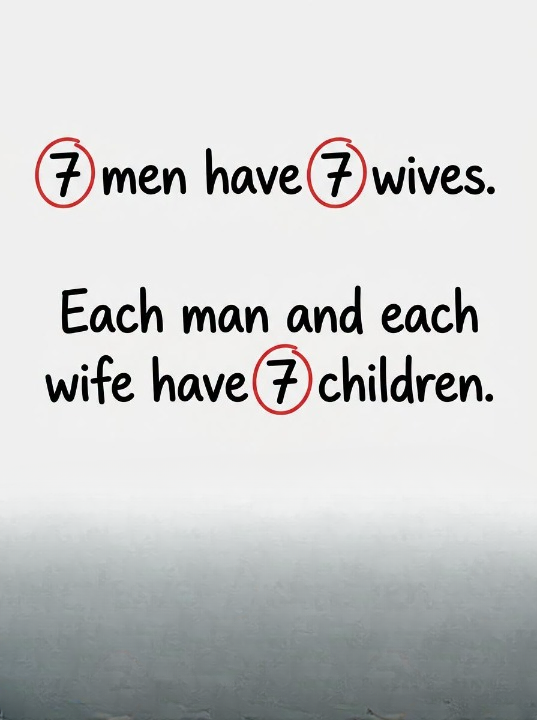
7 men have 7 wives.
Each man and each wife have 7 children.
How many people are there in total?
Take a moment before reading further.
Most people immediately start multiplying numbers in their heads. Some arrive at answers like 98, 112, or even larger totals.
But before grabbing a calculator, read the wording carefully.
The secret to solving this puzzle isn’t mathematics.
It’s interpretation.
Why So Many People Get It Wrong
The confusion comes from one particular sentence:
“Each man and each wife have 7 children.”
Many readers mistakenly count the children twice.
They assume each man has seven children and each wife also has seven different children, which dramatically inflates the final number.
But that’s not what the riddle says.
The husbands and wives are married couples.
The seven children belong to each couple, not separately to each individual adult.
Once you recognize that detail, the solution becomes much simpler.
Solving the Puzzle Step by Step
First, count the adults.
There are:
- 7 men
- 7 wives
That gives us:
14 adults
Now count the children.
There are 7 couples.
Each couple has 7 children.
So:
7 × 7 = 49 children
Finally:
14 adults + 49 children = 63 people
Final Answer
 63 people
Simple once you see it.
The challenge isn’t the arithmetic. The challenge is resisting the urge to rush.
Ready for Another One?
If the first riddle caught you off guard, here’s another puzzle that tricks people in a similar way.
Read carefully.
Your parents have six sons, including you.
Each son has one sister.
How many people are in the family?
Take a moment.
Don’t rush.
Many people immediately assume there must be six sisters because there are six sons.
But is that what the riddle actually says?
Breaking It Down
Let’s identify each family member.
We have:
- Two parents
- Six sons
So far, that’s:
8 people
Now consider the sister.
The riddle says:
“Each son has one sister.”
It does not say each son has a different sister.
In fact, all six brothers share the same sister.
That means there is only:
1 sister
Adding everyone together:
- 2 parents
- 6 sons
- 1 sister
Total:
9 people
Final Answer
9 people
Again, the trick isn’t math.
It’s careful reading.
Why These Riddles Are So Popular
There is a reason family riddles like these spread so quickly across social media.
They create a perfect combination of confidence and surprise.
When people first read them, they feel certain they know the answer. The wording seems simple, and the numbers appear easy to calculate.
That confidence encourages quick responses.
Then comes the twist.
A single overlooked detail changes everything.
Psychologists often point out that the human brain loves shortcuts. In everyday life, those shortcuts help us process information quickly. But riddles take advantage of that tendency.
Instead of rewarding speed, they reward patience.
The people who solve these puzzles correctly are usually the ones who pause long enough to question their first assumption.
The Real Lesson Behind the Puzzle
Although these riddles are entertaining, they also reveal something interesting about the way we think.
Many mistakes happen not because information is missing, but because we assume details that were never stated.
We fill in gaps automatically.
In everyday situations, this can lead to misunderstandings, poor decisions, and incorrect conclusions.
Riddles expose that habit in a harmless and often humorous way.
They remind us that sometimes the correct answer is right in front of us.
We just need to slow down long enough to see it.
One Final Challenge
Now that you’ve solved both riddles, try sharing them with friends or family members.
Don’t give away the answers.
Just watch how quickly people respond.
Some will get them immediately.
Others will confidently choose the wrong number and only realize their mistake when they hear the explanation.
That’s what makes these puzzles so enjoyable.
They’re not really about numbers.
They’re about attention.
And sometimes, attention is much harder than arithmetic.
So tell us honestly:
Did you get both answers right on your first attempt, or did one of these deceptively simple riddles manage to fool you?