I used to believe that forty years of marriage meant a person could never become a stranger to you.
I was wrong.
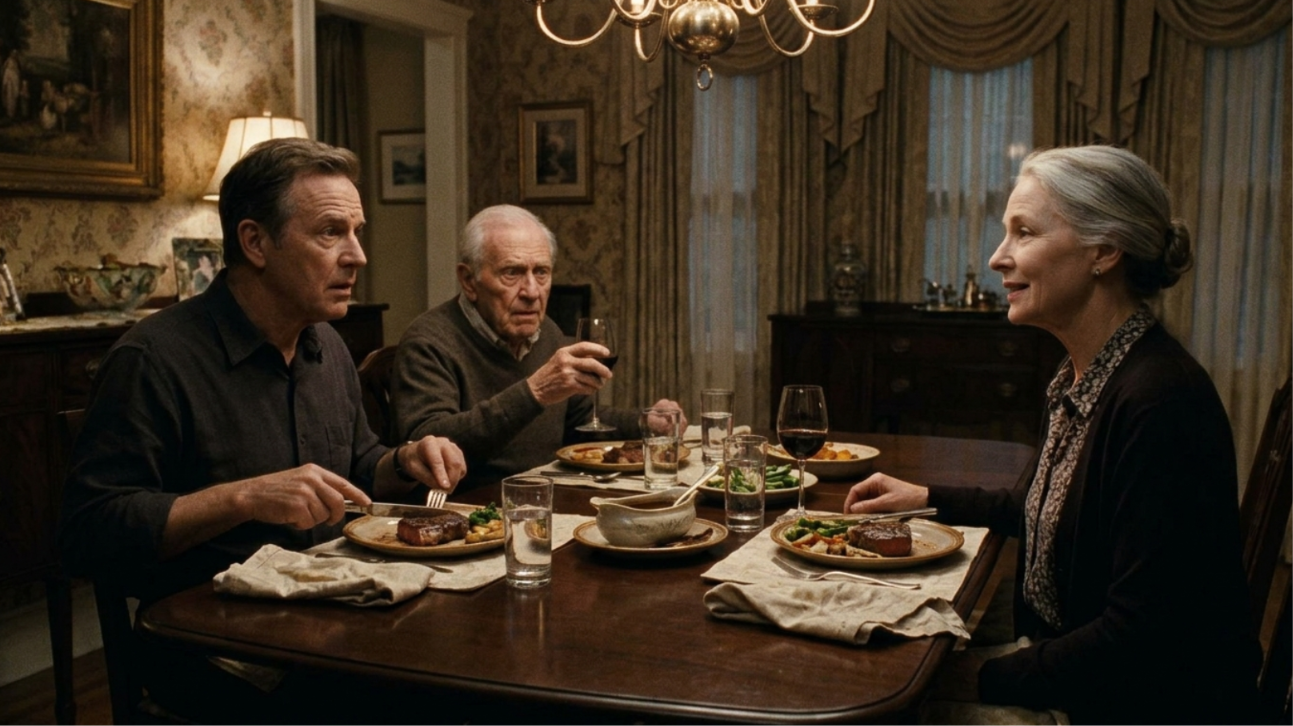
The night Gerald told me to leave our home, I was sitting across from him at the dining room table.
I was sixty-five years old.
My husband had just explained that our marriage was finished.
And his ninety-one-year-old father was sitting beside him, watching me as though I were an employee about to be dismissed.
There was still food on my plate.
Green beans with toasted almonds.
A piece of steak I had barely touched.
Gerald had been cutting his meat when he made the announcement.
He hadn’t even put down his knife.
“Terry, I’ve made my decision.”
I looked at him.
“About what?”
He placed his fork beside his plate.
“Our marriage. I’m filing for divorce.”
For a moment, I thought I had misunderstood him.
Forty years.
We had been married for forty years, and he had delivered those words in the same voice he used to discuss a delayed construction project.
I looked toward Walter.
My father-in-law didn’t appear surprised.
That was the first thing I noticed.
He wasn’t confused.
He wasn’t upset.
He was waiting.
“Gerald, what are you talking about?”
My husband reached for his wineglass.
“I don’t want to argue about this. It’s already been decided.”
I felt my hands grow cold.
“Decided by whom?”
He looked irritated.
“By me, Teresa.”
He rarely called me Teresa unless he wanted to remind me that he was serious.
For most of our marriage, I had been Terry.
Terry, where are my keys?
Terry, did you call the accountant?
Terry, Father needs his medication.
But when Gerald wanted obedience, I became Teresa.
I had never paid much attention to that before.
That evening, I noticed everything.
Walter shifted in his chair.
“You’ve had a comfortable life,” he said.
I turned toward him.
“Excuse me?”
“You heard me. Gerald has provided for you all these years.”
I stared at the man whose meals I had prepared and whose medical appointments I had arranged.
He spoke as though I had spent four decades sitting in a comfortable chair while everyone else worked.
I wanted to remind him of the years I had managed the company payroll.
Of the suppliers who called me when invoices went unpaid.
Of the nights I had stayed awake beside Gerald while he worried about losing the business.
Instead, I asked my husband another question.
“Where am I supposed to go?”
Gerald reached beside his chair and picked up a brown envelope.
He slid it across the table.
“The papers explain the arrangement.”
I didn’t touch it immediately.
The envelope was ordinary brown paper.
There was nothing remarkable about it.
That almost made the moment worse.
The end of my marriage had arrived in something that looked like an office supply.
I opened it.
Inside were documents prepared by an attorney.
I recognized the language well enough to understand what Gerald wanted.
He had started divorce proceedings.
He expected me to cooperate.
And he wanted me out of the house.
“How long do I have?”
He looked directly at me.
“Forty-eight hours.”
I repeated the number in my head.
Two days.
Forty years of marriage, reduced to two days to collect my belongings.
I looked around our dining room.
The curtains I had selected.
The cabinet filled with dishes we had received as wedding gifts.
The long wooden table where Naomi had celebrated birthdays when she was little.
I knew every scratch on that table.
I knew which chair creaked.
I knew how the afternoon sun crossed the floor.
And Gerald was telling me that none of those things mattered anymore.
Walter cleared his throat.
“I think your husband is being generous.”
I turned slowly.
“Generous?”
He nodded.
“He could have made this much more unpleasant.”
Something inside me went very still.
For years, I had listened to Walter criticize nearly everything I did.
My cooking.
My housekeeping.
The way I organized company records.
He had never liked the idea that I understood the business.
Whenever I made a suggestion, he reminded me that Whitfield & Son Construction was a family company.
Apparently, after forty years of marriage, I still hadn’t qualified as family.
Gerald pushed the envelope closer.
“I just need you to acknowledge receiving the documents.”
I looked at the page.
I knew better than to sign an agreement I hadn’t read.
That lesson had come from decades of handling contracts.
“Is this only an acknowledgment?”
“Yes.”
“Not an acceptance of your settlement?”
He sighed.
“It’s a receipt, Terry. Don’t turn this into a legal argument.”
I read the language carefully.
Then I signed the acknowledgment of delivery.
Nothing more.
Gerald watched my pen.
I noticed how quickly his shoulders relaxed.
He appeared to believe that the hardest part was over.
That I would cry.
That I would pack.
That I would disappear quietly because I had always been the person who tried to keep peace in the family.
Looking back, I understood why he expected it.
I had trained him to expect it.
Whenever Gerald was angry, I softened my words.
Whenever Walter insulted me, I changed the subject.
Whenever the company needed something, I gave more than anyone asked.
I called it loyalty.
Sometimes it was simply fear of disappointing people.
Gerald folded his napkin.
“We can handle this without making enemies.”
I looked at him.
“Is that what you think we’re doing?”
He frowned.
“I think you’re making it more emotional than necessary.”
I had to look away.
My husband had just ended our marriage over dinner.
And he was uncomfortable because I had feelings about it.
Walter reached for his glass.
“There’s no reason for a scene.”
A scene.
That was another word the men in my family liked to use whenever I disagreed with them.
I could spend hours solving their problems without complaint.
But one question from me became a scene.
I glanced again at the documents.
Gerald had arranged them carefully.
His attorney’s name was printed across the top.
The proposed terms concerned our marriage and household arrangements.
But something important was missing.
There was no meaningful acknowledgment of my interest in the family company.
I read the pages again.
Then I looked at Gerald.
“Does your attorney know everything about our finances?”
He lifted an eyebrow.
“Of course.”
“Everything?”
“Yes, Teresa.”
Walter gave an impatient sigh.
“Why are you asking foolish questions?”
I ignored him.
“Did you explain the ownership agreement?”
Gerald stopped moving.
Only for a second.
But I saw it.
He had been holding his wineglass near his mouth.
Now the glass stayed exactly where it was.
“What agreement?”
His voice sounded different.
I folded the document and placed it on the table.
“The one we signed at Michael Bennett’s office three years ago.”
Walter’s expression changed.
I continued.
“The agreement with all three signatures.”
Gerald lowered his glass.
“That was a business arrangement.”
“I know.”
“It doesn’t concern our marriage.”
“Then I’m sure your attorney has already reviewed it.”
Neither man answered.
The silence was the first honest thing I had heard all evening.
I looked at Walter.
He was staring at his son.
Gerald was staring at the envelope.
They weren’t trying to remember which agreement I meant.
They remembered perfectly.
They simply hadn’t expected me to bring it up.
Walter leaned forward.
“Don’t complicate matters, Terry.”
I looked directly at him.
“I’m asking about a document.”
“You know perfectly well what I mean.”
I did.
He wanted the conversation to end before I mentioned anything else.
Gerald set down his glass.
“The house is in my name.”
I nodded.
“I understand that.”
“Then you understand your position.”
I looked at the envelope.
“Not entirely.”
His face tightened.
“Teresa.”
I stood.
My knees felt weaker than I wanted to admit.
But my voice remained steady.
“I think I’ve heard enough for tonight.”
Walter gave a disapproving shake of his head.
“You always did have a talent for turning ordinary matters into trouble.”
I almost answered him.
Then I realized there was nothing left to explain.
A man who believed a forty-year marriage could end with forty-eight hours’ notice was not going to understand me because I found better words.
I picked up my napkin.
I placed it beside my plate.
“Dinner is finished as far as I’m concerned.”
Gerald looked up sharply.
“Where do you think you’re going?”
“Upstairs.”
“We haven’t settled anything.”
I looked at the papers.
“You’ve made that very clear.”
He pushed his chair back.
“Remember what I said about the deadline.”
“I remember.”
I left the dining room without raising my voice.
That surprised me.
I had imagined that if my marriage ever ended, there would be shouting.
Accusations.
Tears.
Instead, I heard the familiar sound of my shoes against the hallway floor.
Behind me, Walter muttered something about my attitude.
Gerald answered him quietly.
I kept walking.
For forty years, I had turned around whenever one of them called my name.
That night, I didn’t.
Upstairs, our bedroom looked exactly as it had that morning.
Gerald’s shirts hung neatly on one side of the closet.
My clothes occupied the other.
His watch collection sat in a wooden case on the dresser.
I had given him that case for his sixtieth birthday.
I remembered how pleased he had been.
He had kissed my cheek and told me I always knew what he needed.
I looked at the case now.
Then I looked at the photograph beside it.
Our wedding picture.
I was twenty-five.
Gerald was smiling at me.
His hand covered mine.
We looked certain about our future.
I lifted the frame.
For a moment, I studied the young woman in the photograph.
She looked happy.
More than happy.
She looked safe.
I wondered what she would have said if someone had told her that the man beside her would eventually give her two days to leave their home.
I couldn’t imagine her believing it.
I set the photograph down with its face against the dresser.
Then I sat on the bed.
I didn’t cry immediately.
I thought about Naomi.
Our only daughter.
She was thirty-eight now, married to Daniel, with children of her own.
I wondered whether Gerald had called her before dinner.
I wondered what he had told her.
And I wondered how much of my marriage I had spent keeping unpleasant truths away from her.
I had always thought that was part of being a good mother.
Protecting the family.
Keeping disagreements private.
Helping everyone believe things were better than they were.
The bedroom suddenly felt unfamiliar.
I stood and walked to my dresser.
In the bottom drawer was a small envelope I hadn’t opened in years.
Inside was a key tied to a faded blue ribbon.
I held it in my palm.
Three years earlier, I had placed that key there after a meeting with Michael Bennett.
I had told myself it was only a precaution.
I had hoped I would never need it.
But I hadn’t thrown it away.
I sat down again and took out my phone.
There was one person I needed to speak to before I made another decision.
I found Michael’s number.
Then I pressed call.
He answered after a few rings.
“Teresa? Has something happened?”
I closed my eyes.
“Yes.”
He waited.
I took a breath.
“Gerald wants a divorce.”
Michael didn’t interrupt.
“He told me tonight. He says I have forty-eight hours to leave.”
I heard him exhale.
“Have you signed anything?”
“Only a receipt acknowledging the papers.”
“Nothing agreeing to the settlement?”
“No.”
“That’s important.”
I looked at the bedroom door.
“Walter was at dinner too.”
Michael was quiet.
Then he said, “I understand.”
I stared at the key.
“They’re acting like I have no rights at all.”
“Teresa, you and I need to review the documents.”
“I mentioned the agreement.”
He paused.
“What did Gerald say?”
“He called it a private business matter.”
“And Walter?”
“He wanted me to stop talking.”
Michael didn’t sound surprised.
That bothered me.
I asked whether we could meet the following morning.
He agreed immediately.
Then he reminded me about the blue binder.
“Bring everything you have relating to that agreement.”
“I will.”
I thought the conversation was finished.
But Michael spoke again.
“There is something else you should know.”
I sat straighter.
“What is it?”
“Gerald’s attorney contacted me today.”
I gripped the phone.
“About the divorce?”
“Not directly.”
“Then why?”
“He had questions about the ownership structure of Whitfield & Son Construction.”
I looked down at the key.
“Why would he be asking about that now?”
Michael hesitated.
“Because there appears to be a plan to transfer company assets.”
I didn’t understand.
“What assets?”
“That’s what we’re going to examine.”
“Can Gerald move them without telling me?”
“Not necessarily. The agreement contains protections we need to review carefully.”
I looked toward the dresser.
The wedding photograph was still facedown.
“Michael, do you think Gerald planned all this?”
“I don’t want to draw conclusions before we look at the records.”
I understood his caution.
He had always been careful with facts.
That was one reason I trusted him.
“Come to my office tomorrow,” he said.
“I’ll be there.”
After we ended the call, I remained seated.
I could hear voices downstairs.
Gerald and Walter were still talking.
They sounded comfortable.
Ordinary.
As though nothing important had happened.
I imagined Gerald explaining how quickly the house would be emptied.
I imagined Walter approving whatever his son suggested.
Then I opened the dresser drawer again.
Beneath the envelope was a small notebook.
Its cover was worn.
I opened it to the first page.
Years earlier, I had written a reminder to myself about keeping records.
Every important decision needed evidence.
That rule had guided me through decades of company work.
I had saved letters.
Invoices.
Bank records.
Contracts.
And signed promises.
Gerald used to laugh about the filing cabinets.
He thought I kept too much paper.
I had never agreed.
Now I slipped the notebook into my handbag.
I placed the key beside it.
And I turned off the bedroom light.
I couldn’t tell myself I wasn’t frightened.
I was.
I had no idea where I would be living when everything was over.
I didn’t know how Naomi would react.
I didn’t know whether the company I had helped build could survive whatever Gerald was planning.
But I knew something I hadn’t known at dinner.
I didn’t have to accept his version of my life.
I had spent years making myself smaller to keep other people comfortable.
That night, I decided I would stop.
For once, Gerald could manage his own problems.
Walter could manage his own complaints.
And I could finally look after Teresa.
I slept better than I expected.
Not because the pain had gone away.
It hadn’t.
But because I had made one decision that belonged entirely to me.
In the morning, I would see Michael Bennett.
And I would bring the records Gerald had spent years telling me nobody needed.
Click here to continue reading: PART 2: My Husband Expected Me to Start Packing, but I Went to the Attorney Who Remembered How We Saved His Company
After Forty Years of Marriage, My Husband Gave Me Two Days to Disappear, but One Question Changed the Entire Dinner
Part 1 of 15