Part 2…..
I asked Antonia whether she knew who had sent me the envelope. She looked at the handwriting, then back at me, and said only that some documents could be discussed after the stewardship paperwork was processed. Before I left, she added, “Be gentle with the house. It hasn’t been touched in a very long time.”
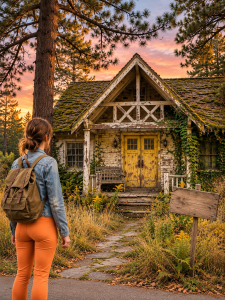
Back on Mariposa Lane, I slipped around the rotten porch steps and fitted the key into the right-hand door. It turned without a struggle. Inside, the air smelled dry, like an old library, and when I tried the wall switch, a dim ceiling light came on; someone had kept power connected to this place all those years.
The kitchen table held a brown ceramic coffee cup with a dark ring at the bottom and a folded newspaper from 2003. A sweater hung over a chair, reading glasses lay on a windowsill, and a calendar still showed October of that year. In the bathroom I found a hairbrush with brown strands caught in it, and by the back door stood a pair of woman’s boots.
Nothing looked arranged for visitors. It looked as though someone had expected to come home after an errand and had never made it back. I kept my hands off most things, afraid of disturbing the only clues I had, until I reached the bedroom at the back.
Beside a neatly made bed covered in a wedding-ring quilt sat a framed photograph. A dark-haired young woman stood with a man and a baby in a knitted yellow sweater beside a small cake with eleven candles. I couldn’t tell whether they were my donor’s family, the home’s former owners, or people the writer simply wanted me to see.
A narrow door off the kitchen opened onto steps leading underground. I switched on a weak basement light and smelled old photographic chemicals before I reached the bottom. There was a sink, an enlarger, drying lines, and a wall of metal archival boxes labeled with dates, clients, and places across Oregon, each marked with the initials M. E.
I had studied photography at college and had spent five years making inventories for other people’s estates, so I recognized that these weren’t household snapshots. The first box I opened contained carefully printed black-and-white photographs of buildings, the sort of images architects build entire portfolios around. Whoever made them understood light so well that an ordinary wall seemed worth studying.
I lifted one print from the stack and stopped breathing for a moment. It showed a ruined conservatory in winter, its metal frame exposed against the sky and one bare pear tree standing inside. I knew that image; it was on the cover of The Vanishing Garden, the paperback sitting in my backpack upstairs.
Along the photograph’s edge was an embossed credit identifying M. Eaves as its original maker. My book credited the work to Delphine Rook, an author I’d believed was telling a personal story through words and pictures. I laid the print beside the paperback and stared until I could admit what I had found: someone else’s name had been attached to work preserved in this basement.
I couldn’t yet prove who had done it or why the archive had been hidden. I didn’t even know whether M. Eaves was the woman connected to my transplant. But the deadline outside suddenly felt different, because the cottage held something that would disappear with it, and I had become responsible for keeping it safe.
I slept on the living room couch in my denim jacket with my backpack as a pillow. At six I took my medication from its organizer with water I’d kept in the car, then went downstairs wearing a small headlamp. If I was going to protect this archive, I needed to know what was actually there before I tried to move anything.
A box of family portraits carried the names Harlan, Marisol, and Ivy, dated July 2001, with a note calling it “our last summer.” I recognized the baby in the yellow sweater from the photograph upstairs. In another box I found private self-portraits of Marisol Eaves in this same house, sometimes holding Ivy, sometimes standing alone with her camera.
On the back of one photograph, in shaky handwriting, someone had written, “I lost her Thursday.” I put it down gently, because there were several ways to lose a child and I had no right to choose one before I knew. Whatever had happened here was not just a story about an artist’s missing credit.
The other boxes showed a career beginning in the 1990s: houses in Lake Oswego, studios in Astoria, cottages on the coast, and projects for Vance Design Studio. Marisol’s invoices identified her as a freelance photographer working from this address. Yet published versions I’d seen at the university credited the design firm, not the woman who had made the pictures.
By noon my stomach was unsteady, and I realized I’d skipped breakfast after taking my pills. I drove downtown to a cafe called Kiln + Crumb, ordered coffee and an egg sandwich, and sat at the counter. The man serving me was in his mid-forties, with graying brown hair tied back, a flannel shirt, and a pale ring of clay on his forearm.
He handed me coffee in an uneven brown pottery mug with a narrow ocher band around the rim. It was identical to the one sitting on the abandoned kitchen table. When the man noticed the brass key hanging from a cord around my neck, he stopped drying a cup and asked where I’d gotten it.
“From the county, for the house on Mariposa Lane,” I answered. His eyes closed briefly before he asked my name, and when I told him, he said he was Tomas Delacroix. “I made that mug,” he said, “and I made the one on the kitchen table.”
Part 3
Tomas wrote something on a little card and asked me to meet him at four, after closing, on the trail behind the cafe. I paid and returned to my Subaru before unfolding it. The message said, “I was afraid you would come. I was more afraid you would not,” followed by a T; the blue handwriting matched the envelope under my apartment door.
I spent the afternoon on the cottage’s broken porch with the old brown mug in my hands. I wanted to be angry at Tomas for sending me into a boarded-up life without an explanation, but I also knew I’d found something worth protecting. At four-fifteen I returned to the cafe, and he led me down a path through brush to a bench overlooking the Columbia River.
“I sent the letter,” he admitted when we sat. “I didn’t know how else to bring you here.” He said he had been Marisol Eaves’s friend since 1998, when she was twenty-four and brought a portfolio into the small gallery he ran in Hood River. He asked me to listen through the whole story before deciding what to do with the house.
Marisol was born in Pendleton in 1974 and had begun photographing buildings as a young college student. She married a civil engineer named Harlan Beaumont in 1998, and they settled in the cottage. Their daughter, Ivy, was born in 2000, and Tomas remembered her as a quiet little girl who studied faces as though trying to understand every word before it was spoken.
In September 2001, eleven-month-old Ivy died in her sleep. The doctors called it sudden infant death syndrome and found no preventable cause. Marisol stopped photographing for months, while Harlan returned to work and insisted he was managing, though neither of them had really found a way to live around the empty place at their table.
In the spring of 2002, Harlan died by suicide. Tomas was one of the people who had to identify his car, and when he told me, his hands locked together so tightly I could see the white across his knuckles. I covered one of them with mine for a moment, then waited while he found the rest of his words.
Marisol eventually began using her camera again, mostly to take private pictures she never meant to publish. She also needed to pay the mortgage, so she accepted another assignment from Marcus Vance’s design firm, even though he had a history of taking the credit and paying late. During Thanksgiving of 2002, Marcus brought his nineteen-year-old son Elijah to her house.
Elijah was studying writing at Reed College. Tomas said he was allowed to see her darkroom, where he found the personal photographs and the journals she had kept after Ivy and Harlan died. By the following year, he was developing a manuscript about a grieving mother and an orchard, built from details Marisol had never agreed to share.
He submitted that manuscript under the name Delphine Rook. The first book eventually appeared in print, followed by more that used Marisol’s photographs and private history, while readers assumed Delphine was a woman writing from her own experience. The cover I’d treasured through five difficult years had belonged to someone whose grief was never meant to become another person’s career.
Marisol found out what he was doing and consulted a Portland lawyer in 2003. She was told there might be a civil case, but it could be expensive and publicly invasive, requiring her to expose photographs, journals, and family losses that she could barely speak about privately. After losing Ivy and Harlan, she couldn’t bear the thought of strangers taking her sorrow apart in a courtroom.
“She asked me to help her leave,” Tomas said. With his help, Marisol abandoned her old identity, and he later burned her car on a remote road to make it appear she’d vanished. He had concealed what he’d done for twenty-three years, a decision he no longer tried to dress up as harmless, even though he believed he had been helping a friend survive.
Marisol took the name Vera Ashfield and found work cataloging specimens at a small natural history museum in central Oregon. She lived quietly and stopped taking photographs. Her old house remained protected under an unusual confidential preservation arrangement established through legal help, but most people who remembered Marisol believed she had died in 2003.
I stared at Tomas. “Then she’s alive?” He nodded, and the question I’d never dared ask my transplant coordinator came out before I could stop it: “What does any of this have to do with my kidney?”
In 2021, Tomas told me, Marisol survived a serious car accident near Madras. After recovering, she became a living kidney donor through OHSU under the name Vera Ashfield. She was matched with a young woman in Portland and went home after donating, asking for no public recognition and not even the recipient’s name.
That young woman was me. I’d spent five years imagining that a donor might have died to save me, never knowing she was alive in Oregon, working in a museum and carrying her own losses. I stared across the river until the water blurred, then asked Tomas why she hadn’t answered my letters herself.
“She wrote replies,” he said, “but couldn’t send them.” This year, after receiving my fifth letter, she finally called him and asked him to bring me to Mariposa Lane. She wanted someone who had been carrying part of her life to know who she was, but she was frightened of being found and wasn’t ready to meet me immediately.
Part 4
There was more. Tomas unfolded a copy of a county permit filing and showed me a corporate applicant, Ashbrook Columbia Holdings, seeking faster clearance of the cottage. Records linked it through Linden Arc Partners to the business interests holding rights associated with Delphine Rook, and a lawyer connected to that company had been monitoring the preservation file.
Tomas believed Elijah Vance had discovered Marisol’s new identity and wanted the archive gone before she could prove where the books and photographs came from. I asked if he had proof Elijah personally ordered anything, and Tomas shook his head. The corporate connection was real, but motive was something we would have to establish carefully; I was grateful he didn’t ask me to treat suspicion as a verdict.
An emergency hearing was scheduled for Thursday morning, less than forty-eight hours away. The applicant argued that the cottage was unsafe and that I couldn’t possibly meet preservation requirements, while the original demolition date still stood outside. Because my stewardship application was now public, anyone watching that file could also find my name.
Tomas said a former editor named Linnea Osgood could help document the photographs and published credits. She had questioned the sourcing of a Delphine Rook book back in 2016 but hadn’t been able to publish her findings. He promised to bring her to the house the next morning, and I promised nothing beyond staying to protect what was there.
That night I tried to eat my leftover sandwich at the kitchen table but couldn’t finish it. I slept in the back bedroom under the old quilt and woke at 2:47 a.m. to a cracking noise on the porch. From the darkened hallway, I saw a tall man outside using his phone to photograph the teal doors; he left in a black SUV before I could see his face clearly.
I didn’t know who he was, and I wasn’t about to chase him into the yard. I sat on the floor beside the bed until dawn, thinking about how easy it would be for a demolition crew to end twenty-three years of silence without ever opening a box. By morning I had decided that, with or without proof of anyone’s motive, the archive was coming out of that basement.
Before seven, I’d carried eleven boxes into the kitchen. My shoulders ached, and I had to stop several times to drink water and catch my breath. Tomas arrived in an old red pickup with coffee and a compact gray-haired woman in rimless glasses who introduced herself as Linnea Osgood.
Linnea surveyed the boxes, then explained that the company’s filing challenged both the urgency of preservation and my capacity to do it. The county hearing could address whether the demolition should be expedited, not settle copyright ownership or declare a missing person alive. She had contacts who could review the evidence later, but for now we needed organized records, a safe storage place, and someone who could speak for the house.
“Before you say Marisol’s name publicly,” Linnea asked, “have you considered whether she wants you to?” I looked at the photograph of the family beside the old mug. “I need to ask her,” I said, and Linnea’s expression softened as if that was the answer she’d been hoping for.
Tomas said he’d called Marisol the night before and she had agreed to see me. He wrote the directions to her small gray house near Mosier, east of Hood River, and asked only that I not demand an apology from her. I took my backpack and drove out along the river with the window slightly open, trying to imagine the face of the person whose kidney was working inside me as I drove.
The gravel driveway led past a vegetable garden and three rain barrels. I parked my Subaru, crossed the short yard, and entered through a door left open an inch. The house was modest, with a braided rug, bookshelves of field guides, a wood stove, and a kitchen table where a woman sat with her hands folded in front of her.
She was fifty-two, her dark hair threaded with silver at the temples, wearing an oatmeal cardigan over a plain gray shirt. Her reading glasses rested in her hair; when she finally looked up, her eyes went briefly toward my side, and her hand moved to the same place on her own body. I stood beside the table unable to say the speech I’d rehearsed all the way from Hood River.
“I wrote you five letters,” I managed. “I read them,” she said, and showed me the chair opposite her. She knew the month I’d sent each one, and when she placed her hand on the table beside mine, I slid my little finger against her thumb without trying to take more than she offered.
Marisol told me she’d written four replies and put them in a drawer. She hadn’t mailed them because she was afraid that once I knew her name, the past would come looking for her too. “I thought staying silent kept me safe,” she said, “but after a while it only meant I couldn’t be found.”
She explained that after her accident, she had wanted to give someone younger a chance to live without being trapped by the things that had happened before. Her donation wasn’t an attempt to repay a debt to anyone. She simply knew what it meant to wake up when she hadn’t expected to, and she wanted somebody else to have that chance.
I told her about the Thursday hearing and the corporate filing. I explained the risk that the archive might be lost, and that speaking her name in a public county room would expose the life she had built as Vera Ashfield. I said I would help preserve the work if she wished, but I would not take away her right to decide whether to be known.
Part 5
She was quiet long enough that I could hear the wood stove tick. Then she asked what I’d really been seeking in those annual letters, and the answer startled me because I hadn’t known it until I said it. “I wanted you to tell me I was allowed to be here.”
Marisol looked directly at me. “You are allowed to be here,” she said. “And I’m allowed to be here, too.” Then she told me to say her name at the hearing, promised she would stand beside me, and asked if I’d help her pack a bag.
We drove back toward Hood River together. In her canvas tote were clothes, a folder containing the four unsent letters, and a framed photograph she didn’t explain. I kept both hands on the wheel while she watched the river, and neither of us tried to turn that quiet drive into something bigger than it was.
At the cottage, Marisol paused in front of the teal doors and traced the old paint with two fingers. I stayed a step behind while she entered the rooms she’d left in 2003. Tomas and Linnea were already sorting photographs, and when Marisol saw the brown mug still sitting on the kitchen table, she stopped as though she’d found a familiar voice waiting for her.
We divided the work. Linnea matched project labels, invoices, and dates to published images; Tomas placed fragile prints and negatives in protective sleeves; and I used the scanner Linnea had brought to make copies of what we could. Tomas rented a climate-controlled storage unit, paid for two months, and began carrying sealed boxes there in his pickup.
Marisol moved slowly through the old rooms while the rest of us worked. In the bedroom she touched the glass of the photograph showing Harlan and Ivy beside her, then whispered, “Hello, little one.” I stepped into the hallway, because some moments aren’t invitations even when someone has asked you into their home.
By evening, we’d moved much of the archive. Reed McKenzie, a local carpenter in his sixties who’d known Marisol years before, came to help carry boxes and examine the porch so no one would get hurt. He looked stunned to see her, hugged her once after she nodded, and then asked where she needed his hands.
At seven my phone rang with a number I didn’t recognize. The caller introduced himself as Elijah Vance and said he understood I had been inside the house. He warned that speaking publicly about what I’d found could hurt a woman who had already suffered, and politely suggested I stay away from the hearing.
“She’s here,” I told him, looking through the window toward Marisol at the kitchen table. “She’s coming tomorrow, and she’d like you to hear her name.” His smooth voice tightened, and he said I didn’t know what I was doing; I ended the call without pretending the conversation proved anything about his connection to the permit filing.
When I told Marisol, she placed her pen on the table and folded her hands. “I’ve been afraid for twenty-three years,” she said. “If I wait until I’m not afraid, I’ll never go.” We sat together until the last daylight left the windows, and this time when I reached across the table, she took my whole hand.
Thursday morning we reached the Hood River county hearing room shortly before nine-thirty. Linnea carried a folder of indexed records, Tomas sat behind us, Reed was near the back, and Antonia Ortiz Benavidez had come to observe the preservation matter. I wore my old denim jacket and kept copies of the archive photographs on two drives in my backpack.
A hearing officer called the emergency clearance review to order. Patrick Hales, counsel for Ashbrook Columbia Holdings, argued that the house posed a safety concern and that my new stewardship couldn’t meet the schedule. I stood when asked to identify myself and said that I was there without an attorney but had a person with direct knowledge of the property’s history who wanted to speak.
I glanced at Marisol first. She nodded, and I said into the microphone, “Her name is Marisol Eaves, and she lived at 1428 Mariposa Lane.” I explained that she was present, that she had arranged the original preservation protection, and that records treating her as dead or missing needed to be examined rather than relied upon to destroy the property.
Marisol stood and gave her full name, Marisol Juana Eaves, and her date of birth, March 11, 1974. She explained that she’d lived as Vera Ashfield since 2003 and was willing to provide records to establish the connection. The officer made clear that this hearing couldn’t resolve every question about her identity, ownership, or the alleged misuse of her work.
Then Marisol spoke about Ivy, Harlan, and how her photographs and journals had been taken into a publishing project without her consent. She didn’t demand that the county punish anyone for that. She asked only that the government not rush the destruction of a structure holding original materials while genuine ownership and preservation questions were unresolved.
At the back of the room I noticed a tall man with long hair drawn back, dressed in a dark coat. I recognized Elijah Vance from photographs I’d seen of the writer Delphine Rook, and he watched Marisol without approaching her. Hales asked for time to verify the new information rather than address the publishing allegations, which were outside the hearing’s purpose.
Final
The hearing officer reviewed the change in circumstances and denied the request for emergency clearance. The original November 2 demolition was put on hold pending a proper review of the property’s status and ownership, and my stewardship was left in place for the time being. The ruling didn’t settle a copyright case or make the cabin safe, but it gave us the one thing we couldn’t have found in a metal box: time.
Outside the building, Marisol stood on the sidewalk with her face lifted toward the pale sunlight. She didn’t smile or speak for almost a minute. Then she said, “All right,” climbed into my Subaru, and waited while I turned the key.
Over the next three weeks, Linnea worked with Marisol to prepare a carefully sourced retrospective for Modern Architecture Review. It reproduced the original photographs, credit marks, dated negatives, and invoices beside the work that had appeared under other names. Linnea also revisited her shelved 2016 reporting, now that the original artist was willing to give her account publicly.
Marisol chose one extended interview by email and no television appearances. Asked whether she wanted an apology from Elijah, she answered, “I want my name on things.” It was the simplest request in the world, and after twenty-three years it was finally printed beside her photographs.
The publisher began a rights review and withdrew the disputed books from circulation by the end of November; the planned sixth book was canceled, and Elijah lost his agent’s support. No criminal conviction followed, and Marisol chose not to bring a long civil lawsuit over the remaining claims. She didn’t want to spend another stretch of her life explaining her family’s private grief to strangers.
The cottage still needed more than a favorable hearing. Reed helped me rebuild the porch and stabilize the parts of the house we could safely work on, while Antonia guided us through the county’s inspection and preservation requirements. We secured the remaining archive in proper storage and kept backup copies so that a plumbing leak or one bad winter couldn’t erase the proof again.
In December, I gave up my Portland apartment and made Mariposa Lane my home. I no longer worked at Hartwell and Mayberry, but five years of estate inventories had taught me how to organize records, and people who cared about the photographs began offering time, expertise, and modest contributions. The cottage remained under stewardship while the longer-term property arrangements were worked through, and I understood that a fourteen-dollar fee had never paid for the actual repairs.
I folded the old wedding-ring quilt into a cedar chest and bought a blue one made from recycled wool for the back bedroom. The brown ceramic mug joined the others in the kitchen cupboard, many of them made by Tomas. Marisol sometimes visited, but she kept her museum job and her quiet house near Mosier, letting herself decide how much of her former life to reclaim.
We founded a nonprofit called Mariposa Archive to locate, identify, catalog, and republish uncredited work by women photographers of American architecture, especially work made between 1980 and 2010. Linnea, Reed, and Antonia joined the board, while Marisol accepted a half-time role directing legacy projects. Tomas declined a board seat and kept making pottery, which was his way of saying he would still be there when we needed him.
In January, after further administrative review, the county recognized the cottage’s cultural significance and replaced its demolition status with longer-term preservation protections. The property and stewardship paperwork took more meetings than any of us would have liked, but the work finally had a stable future. Antonia came to see the rebuilt railing and cleaned-up teal doors and said, “The house looks like itself again.”
I went to Eugene to tell my parents the whole story. Mom listened with a hand wrapped around her coffee cup, then cried when I described meeting Marisol. Dad stayed quiet a long time before saying, “That’s a lot to carry, kid,” and I told him that for once I felt as though I had set something down instead.
When I returned to Hood River, I found Marisol’s four unsent letters waiting in their cardboard folder on the kitchen table. I hadn’t opened them yet. I wanted to read them on a day when I could give every word my attention, not because I needed proof anymore that I’d been worth saving.
That spring, Mariposa Archive held its first exhibition in a modest gallery on Oak Street, three doors from Kiln + Crumb. We called it She Was Always Here and hung work by eleven women whose photographs had circulated without proper recognition. Marisol’s original images were at the center, and her name appeared on the gallery wall where anyone walking in could see it.
An older woman stopped before one of Marisol’s photographs of a Portland boathouse. When I explained that the photographer had never been credited in the original publication, the woman said she’d spent thirty-two years editing magazines and knew how often it happened. I pointed her toward Marisol, who was quietly answering questions across the room, and watched the two women shake hands.
After the gallery closed, I walked back up Mariposa Lane beneath the cool April sky. The porch was sound now, the grass cut except for a wild patch near a flat river stone I’d placed in the yard. On it I’d carved three words: “She was here.” I thought of Ivy, of Marisol, and of the twenty-two-year-old me who once believed her future had ended in a hospital bed.
At my front steps, I touched my side, just above the scar, and whispered, “We’re home.” I unlocked the teal door with the same brass key, while somewhere down the highway Marisol sat at her own kitchen table writing a letter she intended to mail this time. At the bottom she would sign her real name, and the first words on the page were, “Thank you for finding me.”
THE END. I’ve shared the complete story, and I truly hope it touched your heart. If this story moved you, please leave a comment, like, and share the post. Thank you for reading!