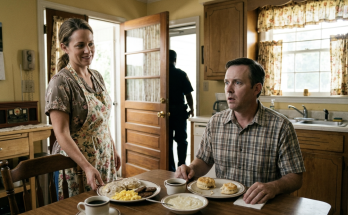
Chapter 1: The Battlefield of Cinnamon and Pine
The dashboard clock of our aging Subaru glowed with a pale, unforgiving luminescence: 2:00 a.m. I found myself shivering, not from the Pennsylvania winter howling against the frosted windowpanes, but from the icy realization of what had just transpired. My husband, Daniel, sat rigid beside me, his hands gripping the steering wheel with the precise, controlled tension of a man accustomed to holding the weight of nations, yet currently unraveling over the weight of his own family.
To understand the sheer absurdity of my exile to a makeshift cot beside sacks of bleached flour, you must first understand the theater of our lives. It was Christmas Eve, 2025. We had navigated the treacherous, sleet-covered highways from our quiet sanctuary outside Lancaster to the sprawling, ancestral farmhouse of Daniel’s parents near Lititz. I was forty-two, a woman who had spent twelve grueling years in the army, commanding logistics and surviving the relentless grind of military operations, before transitioning to a civilian corporate director role. Daniel was forty-five. To his family, he was just “Danny,” a career enlisted man, a dependable but unambitious soldier who took orders and fixed things.
The truth was a heavily guarded state secret. Daniel was a high-ranking military officer, a strategist whose security clearance required secure, encrypted communications even on holidays. For the sake of operational security—and a deeply ingrained desire to keep his volatile family out of the glaring spotlight of his command—he had allowed them to maintain their illusion of his mediocrity.
His mother, Margaret Hail, thrived on that illusion. Margaret was a woman who wielded passive-aggression with the precision of a sniper. Her holidays were not celebrations; they were tactical deployments. Every napkin had its designated coordinate. Every greeting card was triaged by perceived social value.
That morning, I had meticulously loaded our vehicle with an arsenal of provisions: a small mountain of wrapped gifts, specialty groceries, and a massive, pre-baked French toast casserole that had consumed my entire evening. As Daniel hauled the heavy cooler down our driveway, his encrypted phone buzzed. He stepped away, his voice dropping into that authoritative baritone that commanded thousands of personnel across the globe. When he returned, he was just “Danny” again, smiling softly and kissing my forehead.
“You’ve secured the perimeter, I see,” he joked, gesturing to the groceries. “Unless she expects a spare oven, we’re fully supplied.”
“I want to believe that,” I murmured, the familiar knot of anxiety tightening in my gut.
The farmhouse was a picturesque lie. It smelled intoxicatingly of roasting ham, spiced cider, and fresh pine. But the moment my boots crossed the threshold, the temperature plummeted. Margaret stood in the foyer, her eyes scanning me like a customs officer searching for contraband.
“Rebecca,” she stated. It was a noun, not a greeting. “Good, you’re here. Did you secure the citrus?”
“Yes, Margaret. And the heavy cream.”
Daniel’s father, Walter, a retired electrician with a gentle demeanor and hands permanently etched with the phantom scent of machine oil, offered a warm embrace. But before our coats were even unbuttoned, Margaret had mobilized her forces.
“Rebecca, the kitchen requires your immediate attention,” she commanded.
What followed was a five-hour marathon of culinary servitude. I became the unseen ghost in the machinery of Margaret’s perfect Christmas. I butchered celery, scoured heirloom platters, and hauled heavy crates of porcelain from the damp cellar. I was accustomed to hard labor, but in the military, labor earned respect. Here, it earned invisibility.
Around mid-afternoon, Daniel received a call. Not from the Pentagon, but from Walter’s tenant regarding a ruptured, freezing pipe at a rental property. The situation required immediate triage. Daniel, the dutiful son, volunteered to intercept the plumber.
“Don’t hold the rations for me,” he told his mother, grabbing his coat.
Margaret dismissed him with a flick of her wrist. “We’ll manage Rebecca.”
Those words echo in my mind now like a warning siren. Shortly after he departed, the golden child arrived. Vanessa, Daniel’s older sister, breezed through the heavy oak doors alongside her passive husband, Paul, and their sharp-eyed, twenty-two-year-old daughter, Clara. Vanessa presented a cardboard bakery box with the grand flourish of a conquering hero returning with spoils.
“Mom! I brought the dessert!” Vanessa announced.
Margaret practically wept with gratitude, bestowing a standing ovation upon a box of commercially produced sugar cookies, while deliberately ignoring the hours of labor radiating from the kitchen sink where I stood. Clara, perceptive and untainted by the family’s toxic hierarchy, drifted toward me. “Need reinforcements, Aunt Rebecca?”
“No, darling,” Margaret intercepted, her voice dripping with artificial sweetness. “Go rest. You’ve had a strenuous twenty-minute drive.”
Dinner was a masterclass in marginalization. But the true ambush occurred afterward, during the allocation of quarters. The house was expansive, yet suddenly, mysteriously, barren of space. Vanessa and Paul were granted the grand master suite. Clara received the airy corner room. Aunt Judith, Walter’s formidable older sister, was placed downstairs to spare her aching joints.
When Margaret beckoned me to follow her, I assumed we were heading to the den, our usual domain. Instead, she halted before the narrow, unheated pantry. She unlatched the door, revealing a canvas folding cot wedged suffocatingly between bulk supplies of canned beans and towers of paper towels. The cot’s metal leg was braced with silver duct tape.
“Your quarters, dear,” she announced, her face devoid of a single micro-expression of warmth.
I stared into the claustrophobic gloom. “The pantry? What about the pull-out sofa in the den?”
“Reserved,” she countered smoothly, “for the grandchildren tomorrow.”
“They aren’t staying the night, Margaret.”
Her eyes narrowed, the veneer cracking to reveal the steel beneath. “Rebecca, do not initiate hostilities. The house is at capacity. Daniel can bunk with Walter when he returns. A soldier like him is used to the floor anyway. It is one night.” She turned on her heel, tossing a final grenade over her shoulder. “Be operational by 0400 hours. You are cooking breakfast for eighteen.”
I stood frozen, the heavy scent of raw flour and dried onions suffocating me. Eighteen people. Alone. At 4:00 a.m. Vanessa sauntered past, peering over her mother’s shoulder.
“Oh, look!” Vanessa chirped. “Your own private culinary suite!”
I didn’t utter a word. I could have unleashed a verbal barrage that would have leveled the farmhouse. But I knew the tactical disadvantage of losing my temper in enemy territory. I retreated into the dark pantry, changing into my sleepwear in the freezing shadows, listening to the muffled laughter and festive television specials vibrating through the drywall. I lay on the sagging canvas, the duct tape groaning beneath my weight, plotting my survival. But survival, I was about to learn, was no longer sufficient.
The front door echoed with a heavy thud, and heavy, familiar combat boots moved purposefully across the hardwood. The pantry door handle began to turn.
Chapter 2: The Tactical Retreat
We spent Christmas at my in-laws’ house, where everyone had a warm bed—except me and my 4-year-old daughter. My mother-in-law shoved us into a freezing pantry with one tiny cot. “Be up at 4 a.m. You’re cooking breakfast for 18 people!” she ordered, while the rest of the family treated my little girl like she didn’t exist. I held my shivering daughter close and tried not to cry. But at 2 a.m., my husband suddenly opened the door, handed us our coats, and whispered, “Get dressed. We’re going home.” What he did next left his entire family speechless…
Part 1 of 6