Chapter 1: The Squeal of the Serpentine
My mother, Lenor, always equated a smudge of grease with an absolute moral failure. In her meticulously curated world, dirt was a symptom of a lesser class, and manual labor was a punishment reserved for those lacking ambition. She never understood that some of us don’t just want to exist in the world; we want to know how the gears grind beneath the floorboards.
It was a Friday evening, precisely twenty minutes to eight. The Kansas air was unseasonably warm, a heavy sixty-four degrees with a relentless southern wind rattling the corrugated aluminum doors of my shop in Marysville. I was in Bay 3, my back turned to the creeping twilight, entirely absorbed by the guts of a Peterbilt 389. The massive rig belonged to a cattle hauler out of Frankfort, and its driver’s seat bore a jagged, five-inch laceration across the left bolster.
I was on my knees on a low wooden creeper, my knuckles permanently stained with diesel soot, pinching a curved upholstery needle between my fingers. The sharp, metallic tang of oxidized iron and stale coffee hung thick in the air.
I didn’t need to glance over my shoulder to know they had arrived. I heard the engine first. My mother’s pristine Buick Enclave possessed a serpentine belt that shrieked like a tortured banshee. It didn’t matter if it was a blizzard or a heatwave; that engine always announced her arrival with a scream.
My father, Myron, disembarked first. His polished loafers crunched against the gravel lot with hesitant, measured steps. Then Mom. Then my older sister, Railan, slithering out of the backseat. She was wearing oversized designer sunglasses, an absurd choice considering the sun had vanished a half-hour prior. Brad, her husband, trailed them, his shoulders sagging, moving with the heavy, reluctant drag of a man commanded to march to a firing squad.
Through the smudged windshield of the Buick, I caught a fleeting glimpse of my niece, Meera. She hadn’t moved. She sat rigid in the backseat, her eyes bolted to her own lap, hands locked together in a white-knuckled grip.
Aside from Meera, who I mentored on weekends, not a single member of my bloodline had crossed the threshold of my business in over a decade. My mother habitually drove two miles out of her way on Highway 36 just to avoid looking at the illuminated sign that bore my name.
They hadn’t come for a heartfelt reunion.
Railan didn’t bother with a pleasantry. She didn’t ask how I was doing. She just crossed her arms, her manicured nails drumming aggressively against her cashmere sleeves, and announced, “We need to talk about Meera’s college.”
I didn’t flinch. I slowly set the curved needle down on the cracked leather seat and wiped my hands on a shop rag.
“She got into K-State,” Railan continued, her voice possessing that familiar, serrated edge of unearned entitlement. “The first two years are going to run about forty thousand dollars. That’s all-in. Housing, the sorority fees, textbooks. Brad and I are stretched to the absolute limit. Mom and Dad are drowning. You, Clara, are the only one in this family with capital just sitting around collecting dust.”
My father cleared his throat, adjusting his tailored windbreaker. He delivered the line they had undoubtedly rehearsed in the Buick. “Think of it as a premium, Clara. You pay in now, and the family’s covered later. Make the check out to your sister. She’ll handle the disbursements.”
They hadn’t driven across town to visit a daughter or a sister. They had driven across town to shake down an ATM.
None of them knew about the frayed, slate-gray cardboard folder. It was resting exactly where it always did—under a stack of faded heavy-machinery invoices in the bottom left drawer of my desk in the main office. It had been sitting in the dark since the night I walked away from their toxic orbit ten years ago. And buried within that folder was a newer document, a piece of paper that would serve as the final, devastating nail in their coffin.
But as I looked at my mother’s sneering face, remembering the years of her vicious mockery regarding my chosen profession, I realized they were about to learn a very hard lesson about what happens when you underestimate the girl holding the wrench.
Chapter 2: The Garage and the Ghost
To understand the venom incubating in that gray folder, you have to understand the soil we grew out of. You have to know about a wheat farmer named Leonard Kubic.
Grandpa Leonard was a man forged from topsoil, diesel exhaust, and sheer stubbornness. He farmed six hundred acres of winter wheat north of town. He possessed a deep, fundamental distrust of anyone who wore a necktie on a Tuesday, and unfortunately for my father, that included his only son. My dad, Myron, sold insurance policies out of a brick storefront downtown. Kubic Insurance. He was a master of psychological leverage, capable of making a weathered farmer feel profoundly negligent for being underinsured, all while accepting their check with a practiced, sympathetic smile.
Railan, my older sister, was destined for Kansas State University. She was the golden child, born with a striking, effortless beauty that made adults instantly forgive a terrible personality. She weaponized it early.
I was different. I was the anomaly. I took things apart. The toaster. The lawnmower carburetor. By the time I was twelve, I could reassemble them to run smoother than factory spec. Dad looked at my grease-stained hands with profound disgust. Mom treated my mechanical inclinations like a terminal disease.
“A young lady belongs in a lecture hall, Clara,” my mother would hiss, scrubbing my fingernails with a bristled brush until my cuticles bled. “Not crawling under a filthy chassis like some uneducated vagrant. Heavy mechanics? Welding? It’s repulsive. It’s beneath us.”
Grandpa Leonard, however, called it a gift.
When I was five, Grandpa opened an account at the bank on Broadway. He put my name on the ledger. Because I was a minor, state law required an adult custodian to manage it until I turned twenty-one. Grandpa named my father. Every harvest, Grandpa deposited the check from his first semi-load of wheat into that account.
“That’s your school money, Clara,” he told me once, sitting on the rusted tailgate of his Ford. “Whatever school you decide on. University counts. Diesel mechanics counts. You just tell your dad when it’s time.”
I remembered the exact afternoon he said it, because it was the same summer Grandma Vlasta taught me how to sew. She was a force of nature, Bohemian Czech on both sides. The driver’s seat in Grandpa’s grain truck had ruptured, the foam spilling out like yellow intestines. She marched me out to the barn with a heavy spool of industrial thread, a curved needle, and a scrap of thick vinyl.
“Small stitches, Clara,” she instructed, her voice thick with her accent, guiding my small hands. “A big stitch is a lazy promise you cannot keep.”
That skill anchored itself in my bones. By sixteen, I was patching truck seats and sweeping floors at Pavlik Diesel. Milo Pavlik, the gruff owner, saw my potential and let me turn wrenches. While my family mocked my “greasy little hobby,” I was building a reputation among the haulers.
But my family was systematically draining my future.
The theft happened slowly. First, my mother confiscated my summer wages from hauling hay, claiming it went toward my “room and board”—only to spend it days later on designer dresses for Railan’s sorority rush. Then, she siphoned twenty-one hundred dollars from a joint bank account I had naively trusted her with, funding Railan’s spring break trip to Gulf Shores. I was seventeen. I didn’t scream. I just opened a private account in the next town over, took a gray cardboard folder from Milo’s supply closet, placed the evidence of her theft inside, and buried it in a desk drawer.
The killing blow came during my senior year. I was accepted into an elite heavy machinery and diesel technology program in Beloit. Tuition and tools totaled seventeen thousand dollars. I brought the acceptance letter to my father.
“It’s time, Dad,” I said. “Grandpa’s account. Tuition is due in July.”
He didn’t even look up from his newspaper. “It’s there, Clara. Don’t worry about it.”
Six months later, at a joint graduation party in our garage—a massive celebration for Railan’s college degree, and a reluctant afterthought for my high school diploma—I asked him to transfer the funds.
My mother dropped a stack of plates. The garage went dead silent.
“That money is gone, Clara,” she announced, her voice dripping with condescension. “It went to your sister’s university. Your sister was first in line.”
Dad stepped in, lowering his voice. “Grandpa would have wanted it to go where it did the most good. You’re just going to a trade school. A grease pit. It’s not a real education for a woman. You can work your way through that.”
I looked across the garage at Railan, who was leaning against her graduation present: a brand-new, gleaming white Jeep Wrangler.
I didn’t cause a scene. I simply walked into the house, packed two milk crates of clothes, and drove away in my beaten-up truck. I moved in with Milo and his wife, working sixty-hour weeks to pay my own way through tech school. I vowed that night, staring at the ceiling of a borrowed bedroom, that I would uncover exactly how they had bled me dry, and I would make them choke on every single penny.
Chapter 3: The Beneficiary and the Bleeding
Under Kansas law, a Uniform Transfers to Minors Act (UTMA) account legally belongs to the child. The custodian merely manages it. On my twenty-first birthday, I walked into the bank on Broadway. I knew the money was gone, but I needed the autopsy report.
Mrs. Sedlacek, a teller who had worked there since before I was born, pulled up the ledger. The color instantly drained from her cheeks.
“Clara,” she whispered, her voice trembling. “Your father was only the custodian. He could only legally spend this for your direct benefit. Not anyone else’s.”
She printed the history. I watched my grandfather’s blood, sweat, and wheat transform into luxury line items. Checks written to the K-State sorority. Checks to high-end travel agencies. And then, the ultimate betrayal.
Eleven days after I sat at the kitchen table and showed my father my acceptance letter to the diesel program—the exact night he looked me in the eye and told me my money was safe—he authorized a cashier’s check for $9,500 to a Jeep dealership in Manhattan.
The white Jeep Wrangler. My father had bought my sister’s affection with my grandfather’s sweat, liquidating the account entirely five weeks before my graduation.
I took the stamped documents, drove to my shop, and placed them in the gray folder. I didn’t sue. A lawsuit is loud and allows the guilty to play the victim. I preferred a silent, loaded gun kept in a dark drawer.
By twenty-three, I bought the diesel shop from Milo on a generous contract for deed. I was the sole owner of a thriving, lucrative heavy machinery business—the very trade my mother claimed would render me a destitute embarrassment.
Meanwhile, Railan’s life progressed exactly as one might expect for someone who never faced a consequence. She married Brad, a decent man widowed when his daughter, Meera, was six. Railan formally adopted Meera, but instantly relegated her to the shadows when she and Brad had a biological son, the golden child, Breen.
In the summer of 2020, my mother, desperate for free childcare, began dumping twelve-year-old Meera at my shop on Saturdays. Meera was quiet, observant, and starving for validation. I gave her a wrench. Eventually, I handed her a curved needle and heavy thread. By Christmas, she was stitching truck seats better than I did. She wrote Grandma Vlasta’s rule on her wrist in blue ink: A big stitch is a promise you can’t keep.
The depth of my family’s cruelty revealed itself a year later. Meera and I were eating kolaches on overturned oil buckets when she quietly confessed, “Grandma and Grandpa opened a massive college account for Breen today. Mom posted about it everywhere. Nobody ever opened one for me. It’s fine. I get it. I’m not really theirs.”
The sheer, breathtaking toxicity of my bloodline hit me like a physical blow. They were repeating the cycle, discarding the child who didn’t fit their pristine aesthetic.
The next Monday morning, I sat across from Mrs. Sedlacek. I opened a Kansas Learning Quest 529 College Savings Plan. Beneficiary: Meera Ostrom. Owner: Clara Kubic. I set up an irrevocable monthly transfer of six hundred dollars directly from my shop’s profits. I told no one.
While I was building a fortress, my family was dousing their own house in gasoline.
Railan, fueled by arrogance, opened a luxury clothing boutique. Mom and Dad dumped sixty thousand dollars of their retirement savings into the storefront to maintain the illusion of their daughter’s success. When it started hemorrhaging cash, they poured in more. Simultaneously, Dad’s insurance agency began to wither as younger farmers moved to online policies.
By the spring of 2026, they were suffocating under a mountain of debt. And as the water crested their chins, they looked across town, saw the “grease pit” they had so thoroughly mocked turning a massive profit, and decided it was time to harvest the crop they had tried to salt.
Which brought us to this Friday night. Standing in Bay 3, demanding forty thousand dollars they had absolutely no right to.
“It’s your turn to help, Clara,” Dad commanded, his voice echoing off the concrete.
“My turn,” I repeated flatly.
Mom stepped forward, her face twisted in a mask of righteous manipulation. “Grandpa Leonard would have wanted his great-granddaughter in college, Clara. You know he would.”
My jaw locked. The audacity of invoking Grandpa’s name to extort me for money to bail out Railan’s vanity project severed the final, frayed cable of my restraint. But as Dad took a step forward, his face flushing red, I knew the trap was set, and it was time to spring it.
Chapter 4: The Coup d’État
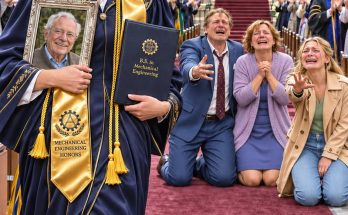
Grandpa saved every wheat harvest check for my education. When I got into diesel mechanic school, I asked for the money at my graduation party. In front of 40 relatives, Mom shamelessly announced, “We gave it all to your sister. She deserved it more!” Dad laughed. “You should be grateful we raised you!” I clenched my fists. “Fine. I’ll pay my own way. But you’ll never control my future again.” I walked away without looking back. Ten years later, my parents came begging, bitterly regretting what they’d done…
Part 1 of 2