I used to believe that when you helped your family, they remembered.
Maybe they didn’t mention it.
Maybe they never said thank you.
But somewhere inside, I believed they understood.
I was wrong about that.
I found out at Thanksgiving, when my daughter-in-law, Brittany, decided my place at the family dinner table was worth forty-five dollars.
And I found out even more at Christmas, when I finally stopped keeping everybody else’s secrets.
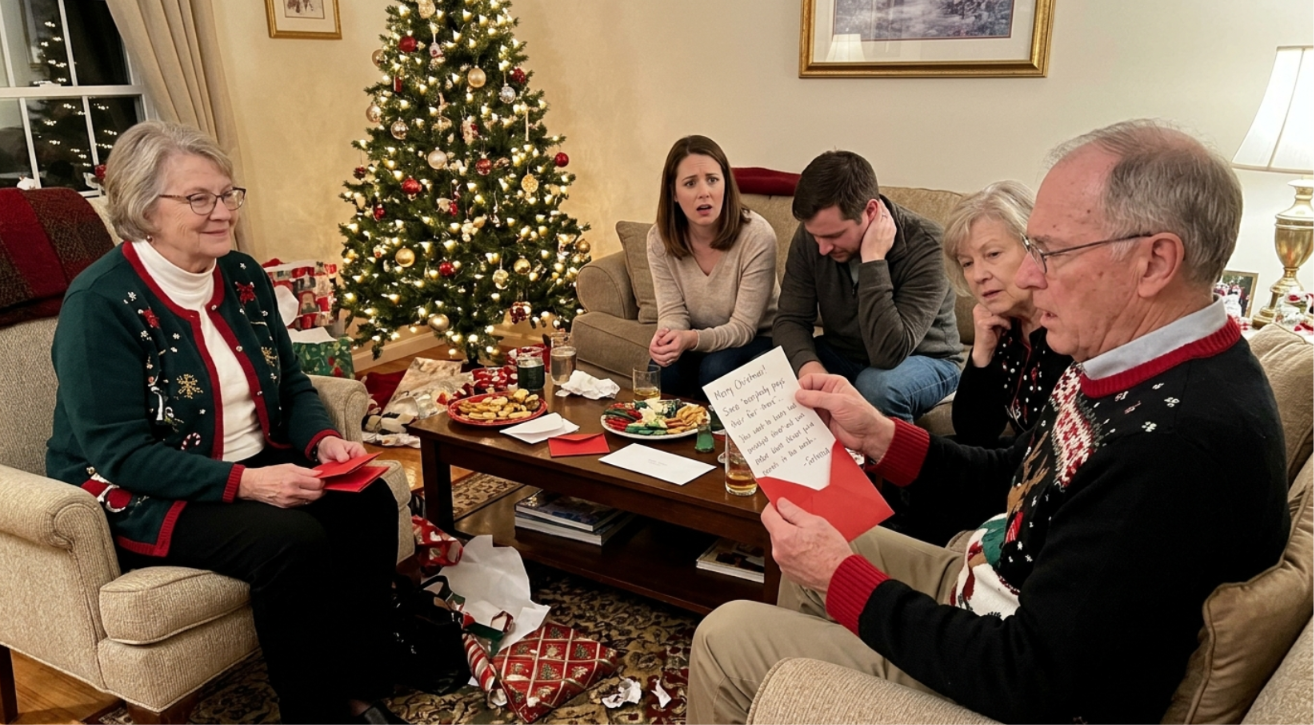
I was standing beside the Christmas dining table when Brittany first noticed the red envelopes.
She had been looking at the place settings.
Then she looked at me.
Her cheeks changed color.
“Georgia, what are those supposed to be?”
I straightened the envelope nearest my plate.
“Just something I wanted everyone to have.”
She glanced around the table.
There were twelve of us, including my two grandchildren.
Nobody had opened anything yet.
Brittany lowered her voice.
“Why are you doing this now?”
I looked at her for a moment.
“Because I thought Christmas might be a good time to do something a little different.”
Her mouth tightened.
I recognized that expression.
I’d seen it at Thanksgiving.
Back then, I’d been standing in her kitchen with food I’d prepared myself.
I had brought the noodles my family expected me to make every holiday.
There had been pies, too.
Homemade food.
The sort of things I had spent years bringing because I liked seeing everybody enjoy them.
I never counted the hours.
That was my first mistake.
I assumed nobody else was counting either.
Brittany had decided that Thanksgiving dinner needed to be divided into individual costs.
She called it fairness.
I called it something else in my head, but I kept my mouth shut.
Forty-five dollars.
That was what she wanted from me.
Not because I’d ordered a special meal.
Not because I’d asked her to prepare anything unusual.
Just because I was eating Thanksgiving dinner with my own family.
I still remembered the way the amount had settled between us.
It wasn’t enough money to ruin me.
I had spent more than that on groceries without thinking twice.
But that wasn’t the point.
The point was that somebody had looked at me, my food, my years of helping, and decided I owed her forty-five dollars for being there.
I had wanted my son to say something.
Kyle had been there.
He had heard what was happening.
I kept waiting for him to remind Brittany that I wasn’t some stranger who had wandered in looking for a free dinner.
I was his mother.
I was the woman who had raised him.
Instead, he stayed quiet.
That silence followed me home.
I knew I was getting older.
I knew families changed.
Children married and made homes with people who didn’t always see things the same way their parents did.
I understood all that.
But I had never imagined that growing older would mean having to justify my presence at my own family’s holiday table.
Especially after everything I had quietly done to help them.
I didn’t say those words aloud at Thanksgiving.
I didn’t want an argument with my grandchildren listening.
I had spent too many years making holidays peaceful to become the person who ruined one.
So I swallowed what I was feeling.
I told myself I could afford the forty-five dollars.
I told myself Brittany probably thought she was being practical.
I told myself Kyle would speak to her later.
Looking back, I gave everybody a generous explanation except myself.
For myself, I had only embarrassment.
And that embarrassment grew worse when I went home and started thinking about all the money I had been spending for people sitting at that same table.
I wasn’t a wealthy woman.
I had worked at the deli counter in Kroger for thirty-one years.
Thirty-one years of standing on hard floors.
Thirty-one years of slicing meat, wrapping cheese, cleaning equipment, and smiling at people who sometimes treated me as if I were part of the counter.
I had worked early mornings.
I had worked when my feet hurt.
I had worked through days when I would have preferred to be anywhere else.
But I had always been proud of earning my own money.
Hal had been proud of it, too.
My husband worked extra hours whenever our family needed something.
He never complained much about that.
He would come home tired, eat whatever I’d prepared, and ask how my day had gone.
We weren’t people who bought everything we wanted.
We saved.
We waited.
We repaired things before replacing them.
And we raised Kyle believing that money was something you respected because somebody had to work to earn it.
Hal and I had been married forty-two years.
After he passed away, I kept many of the habits we’d built together.
I still watched my spending.
I still kept track of bills.
And I still tried to help our son whenever I could.
At first, it was simple.
Kyle needed assistance with his phone bill.
Then there was his truck insurance.
I understood why a young family might struggle with expenses.
They had children.
They had a mortgage.
Life cost more than it used to.
So when Kyle needed help, I gave it.
I didn’t make him feel ashamed.
I didn’t remind him about it every month.
And I certainly didn’t ask him to thank me at every holiday.
I simply kept paying.
Somewhere along the way, those temporary arrangements became ordinary.
Month after month, the charges appeared.
Month after month, I covered them.
There were other family members involved, too.
Ron and Debbie, Brittany’s parents, had phone lines connected to the same account.
Kyle had asked me to help when Ron lost his company phone.
He told me the situation wouldn’t last long.
I believed him.
That was almost four years before the Christmas dinner.
Nearly four years.
At first, I hardly thought about it.
The bill was paid automatically, and I had enough coming in to manage it.
It seemed easier than asking everybody for their portion every month.
And because I thought I was helping my son keep the family together, I didn’t ask many questions.
I see now how foolish that sounds.
Not because helping was foolish.
Because I never made it clear that my help had an end.
By the time Thanksgiving arrived, I had grown so used to paying those bills that I didn’t even think about them when Brittany mentioned forty-five dollars.
Not immediately.
I was too shocked.
But afterward, sitting at my kitchen table, I started looking at the numbers.
The same table where Hal used to sit with me when we worked out our household expenses.
I remembered how he would put his glasses on, check the figures, and tell me we had enough if we kept being sensible.
I could almost hear him.
I opened my checkbook.
Then I looked through the charges I’d been covering.
There was the phone account.
There was Kyle’s truck insurance.
There were the lines that belonged to adults who had apparently forgotten they were being helped.
I wrote the amounts down.
I didn’t do it because I wanted revenge.
At least, that wasn’t what I called it then.
I did it because I wanted to understand something.
How had I become a person who could pay other people’s bills for years and still be treated as though I needed to contribute more?
I sat there longer than I expected.
The figures didn’t change.
Neither did the feeling in my stomach.
I wasn’t angry about a meal.
I was hurt by what the meal had revealed.
And the more I looked at those payments, the more I realized how little the people involved seemed to know about them.
Some of them might not have known at all.
That possibility bothered me.
Kyle handled many of the arrangements.
He had come to me when help was needed.
He had been the person who explained why the payments mattered.
I trusted him.
He was my son.
I had trusted him before he could even walk.
But trust doesn’t make an uncomfortable question disappear.
It only makes asking it harder.
By Christmas, I had decided I wasn’t going to keep wondering.
I wasn’t going to keep guessing what everybody knew.
I would put the information in front of them.
Not in anger.
Not with shouting.
Just the truth, written plainly enough that nobody could misunderstand it.
That was why I prepared the red envelopes.
Each one held information meant for the person receiving it.
The adults needed to know what had been paid, what would change, and when.
I also made sure the changes wouldn’t happen immediately.
Nobody would have a phone disconnected without time to arrange another plan.
Nobody would wake up to discover insurance had disappeared overnight.
Thirty days.
That was the notice I decided to give.
I thought it was fair.
More than fair, considering how little warning I’d received when my Thanksgiving dinner came with a price.
And now, on Christmas Day, those envelopes were sitting in front of everyone.
I could feel Brittany watching me.
I knew she wanted an explanation before anybody started reading.
But for once, I didn’t intend to explain everything for my son.
The papers could do that.
The numbers could speak for themselves.
Kyle reached toward his envelope.
I watched his fingers touch the red paper.
And for the first time since Thanksgiving, I felt that I wasn’t the only person who would have to sit with something uncomfortable.
Click here to continue reading: PART 2: When My Son Opened His Christmas Envelope, He Found Two Ordinary Bills That Exposed Years of Quiet Help I Had Never Mentioned
I Thought My Family Understood Why I Helped Them Until My Daughter-in-Law Put a Price on My Place at Thanksgiving
Part 1 of 16