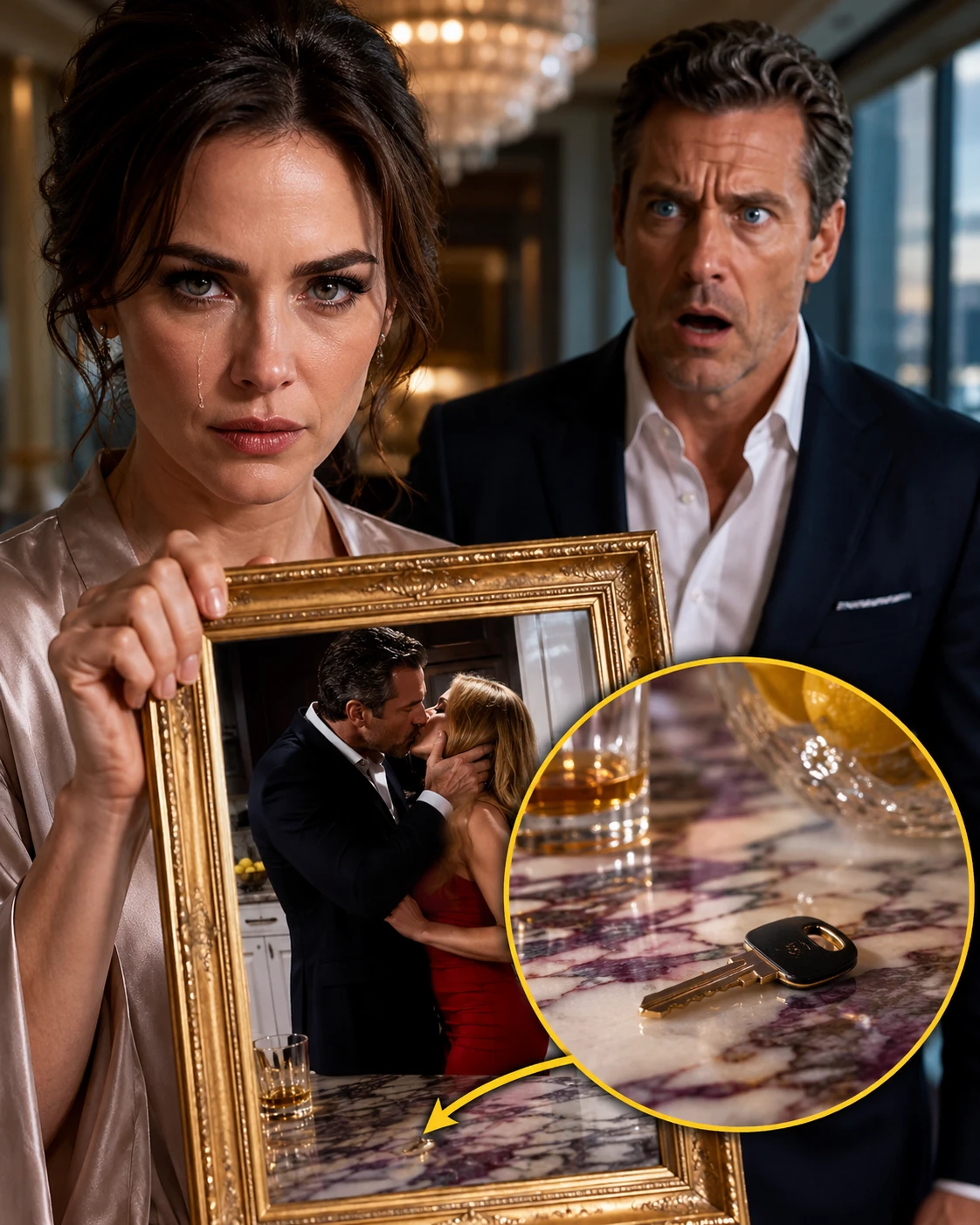
The frame was gold, expensive, and stupid.
It arrived at 7:12 on a Thursday morning, carried up by our doorman in white gloves as if it were a wedding portrait or a painting from Christie’s. The box was wrapped in ivory tissue, tied with a black satin ribbon, and addressed in looping, feminine handwriting to Mrs. Bennett Ashford.
Not Vivienne.
Not Mrs. Vivienne Ashford.
Mrs. Bennett Ashford.
A title. A possession. A name I had worn for nine years like a diamond collar.
I opened it alone in the marble foyer of our penthouse on Fifth Avenue, still in my silk robe, my hair pinned loosely at my neck, my coffee cooling on the console table beside a bowl of white orchids.
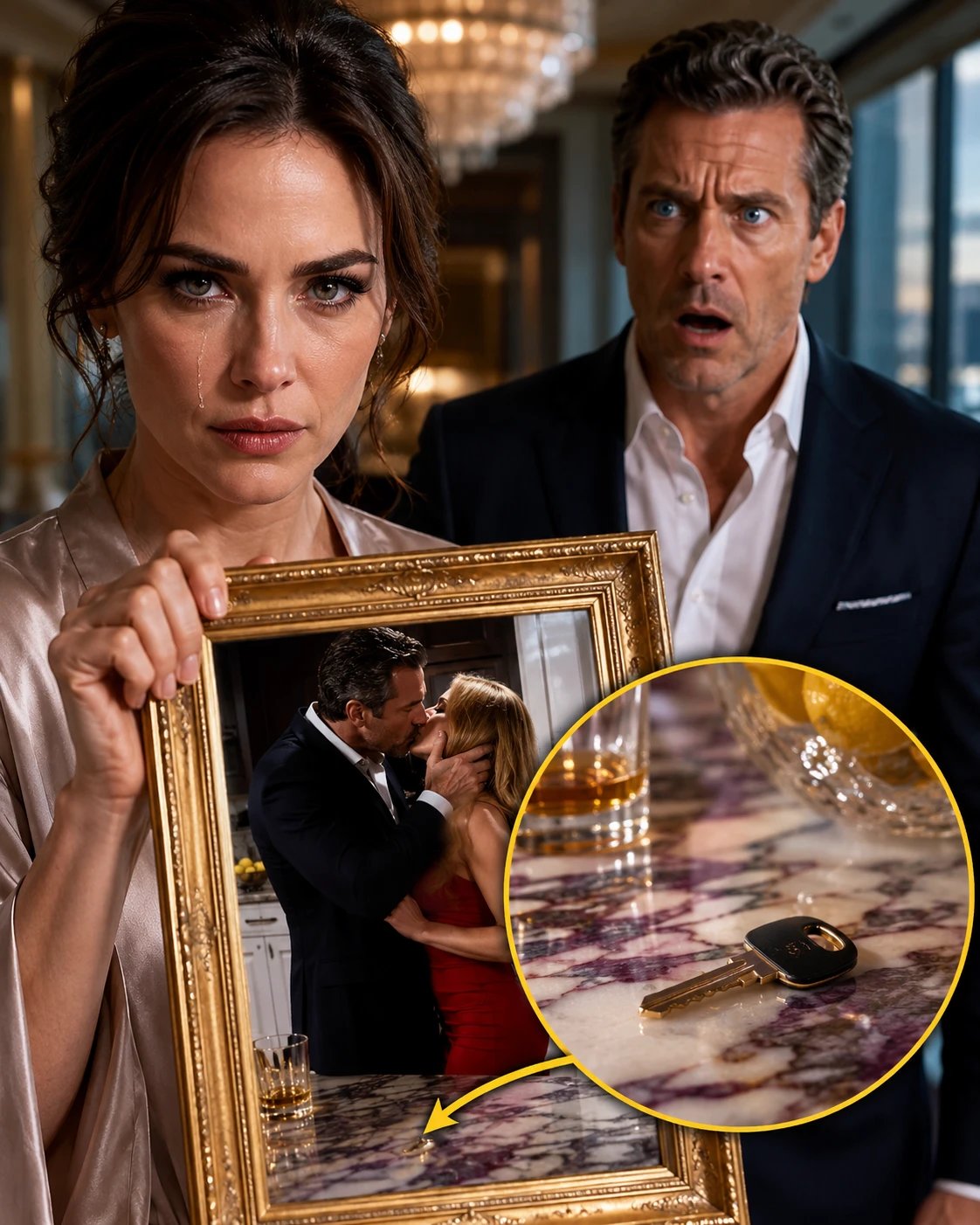
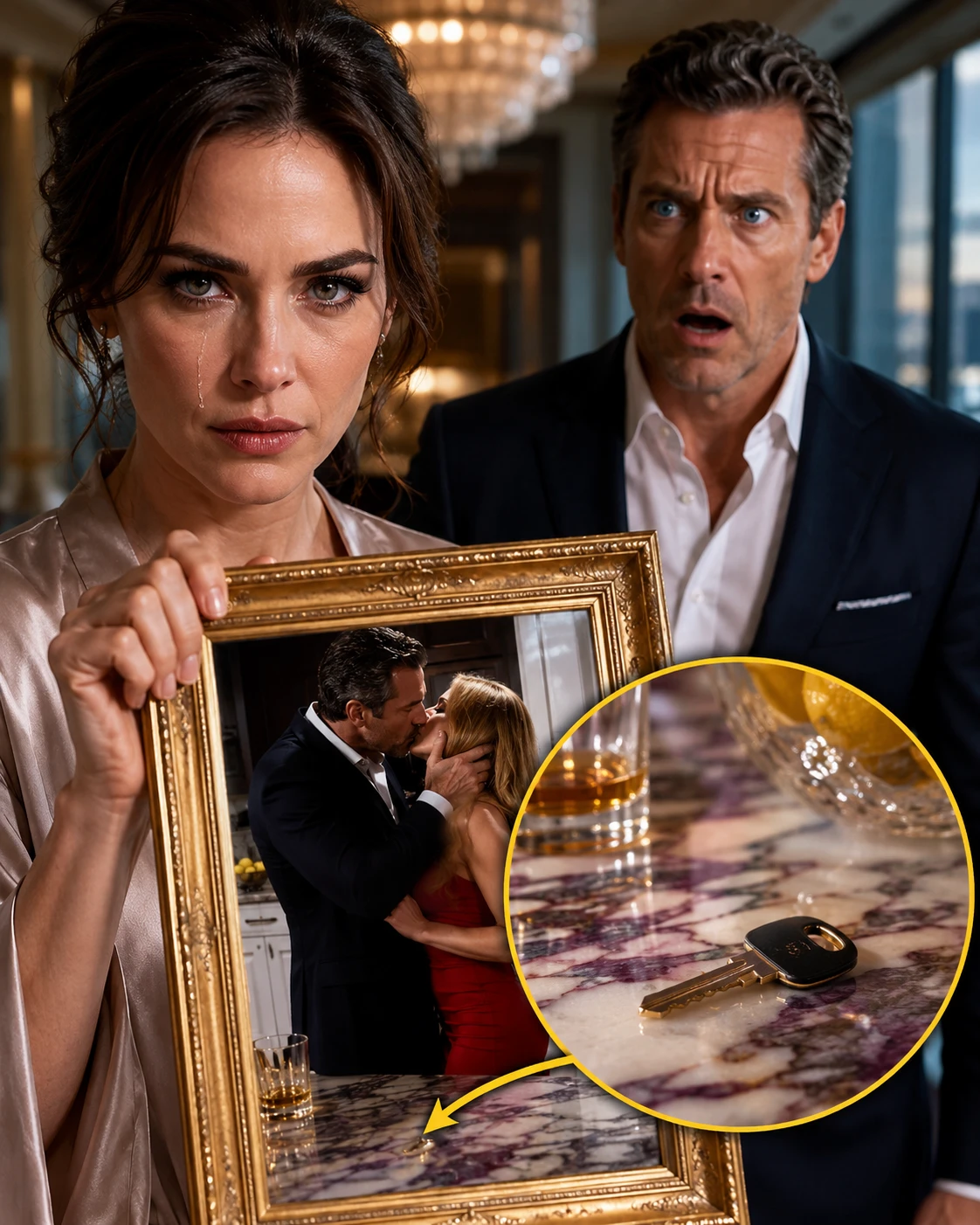
Inside the box was a photograph.
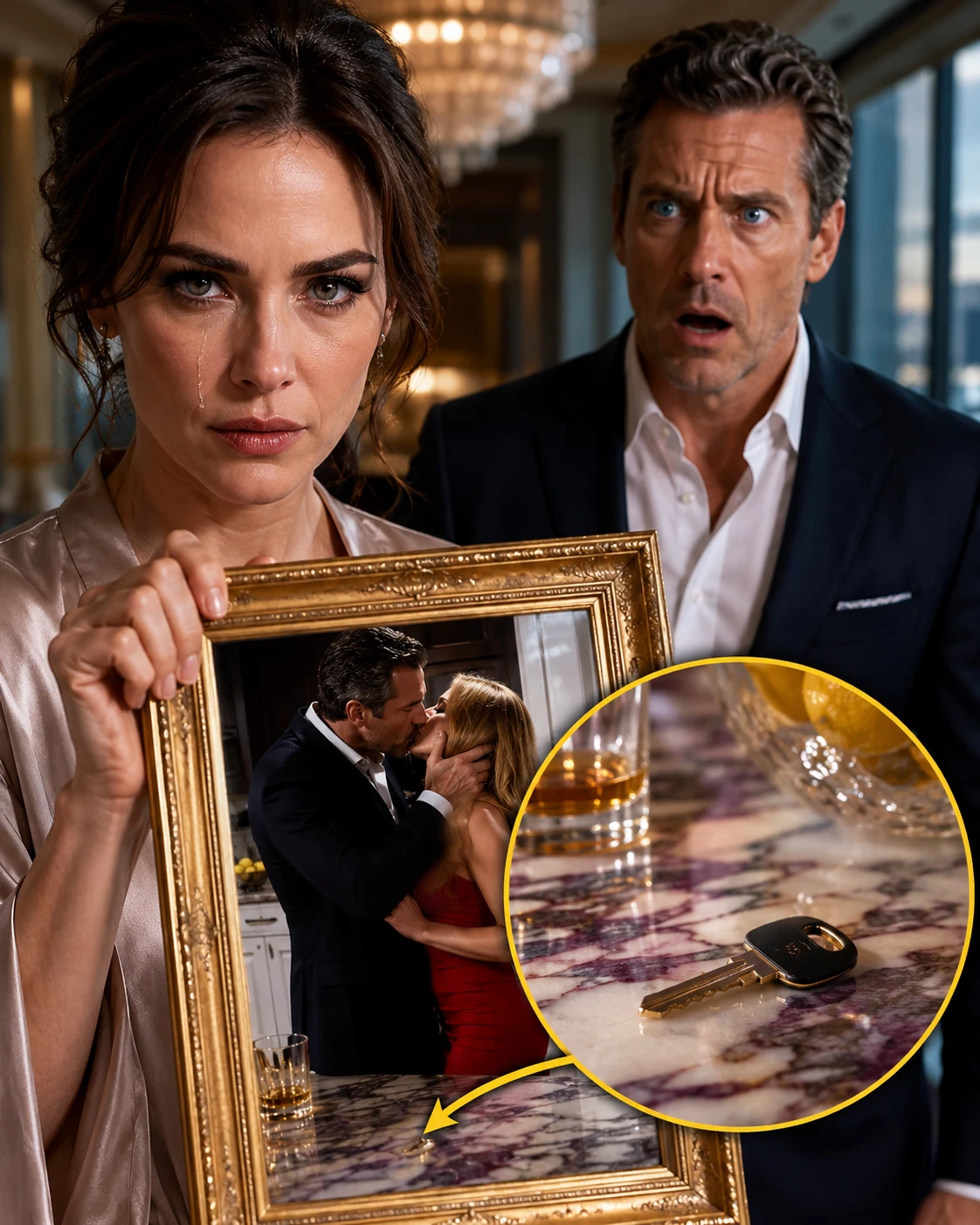
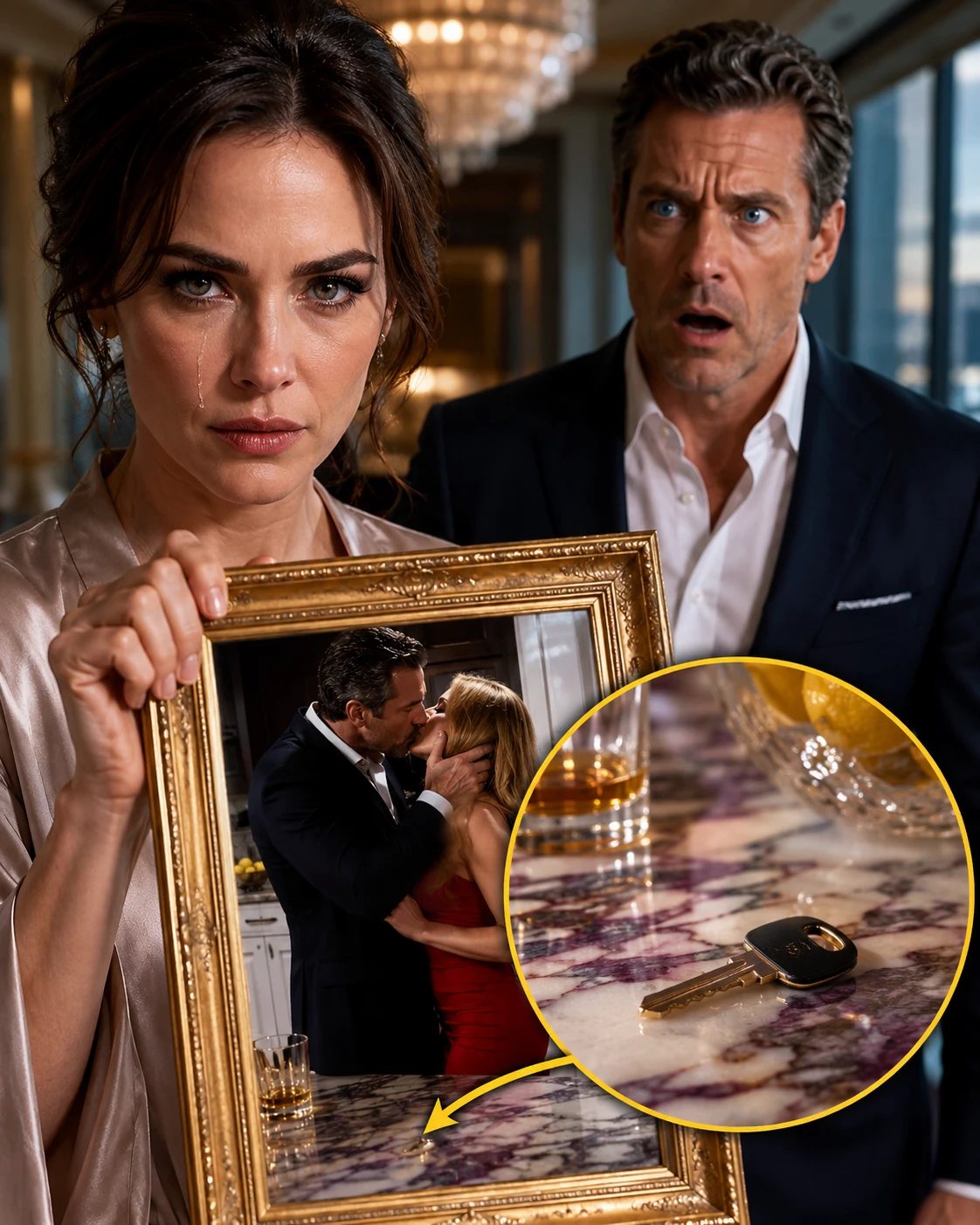
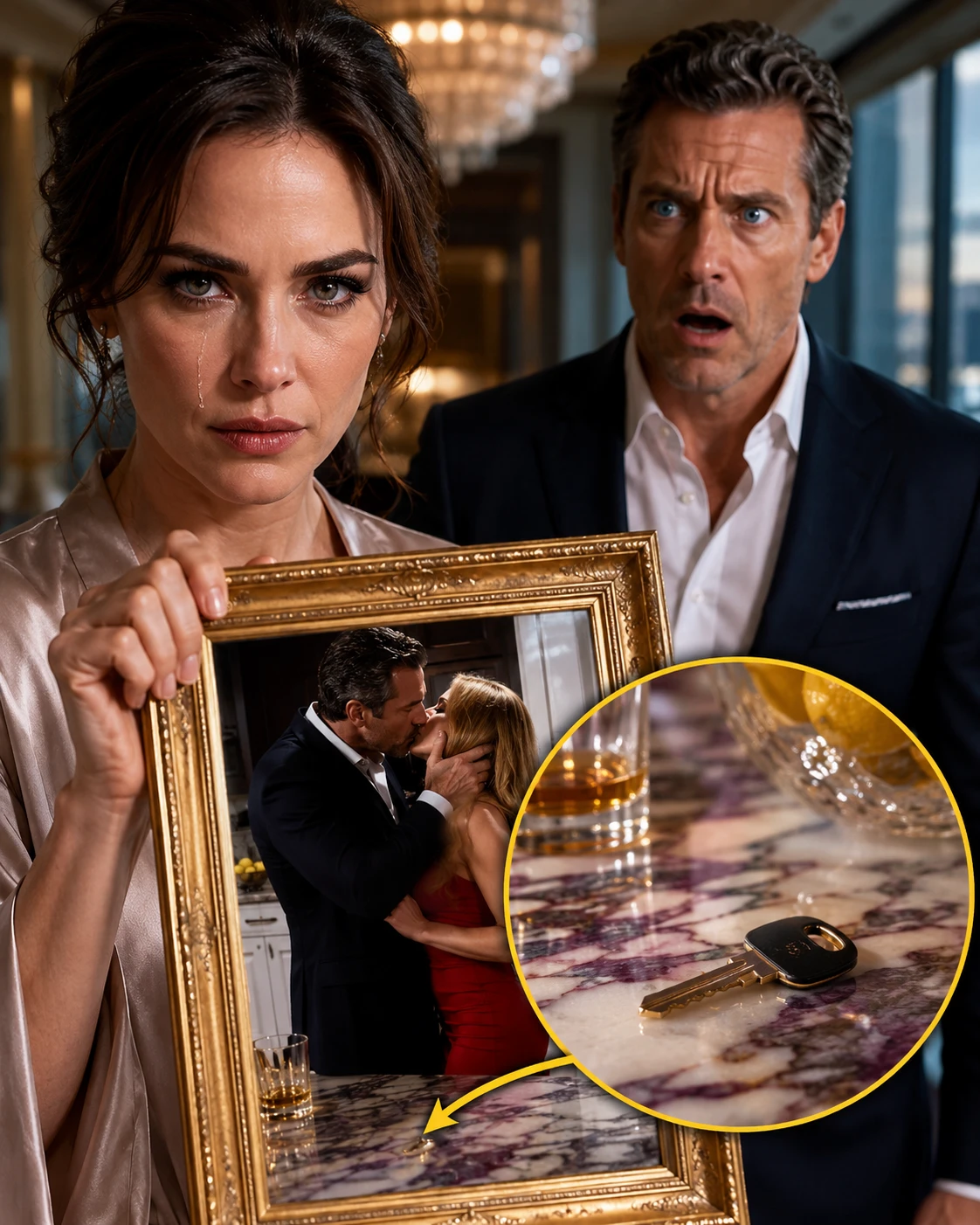
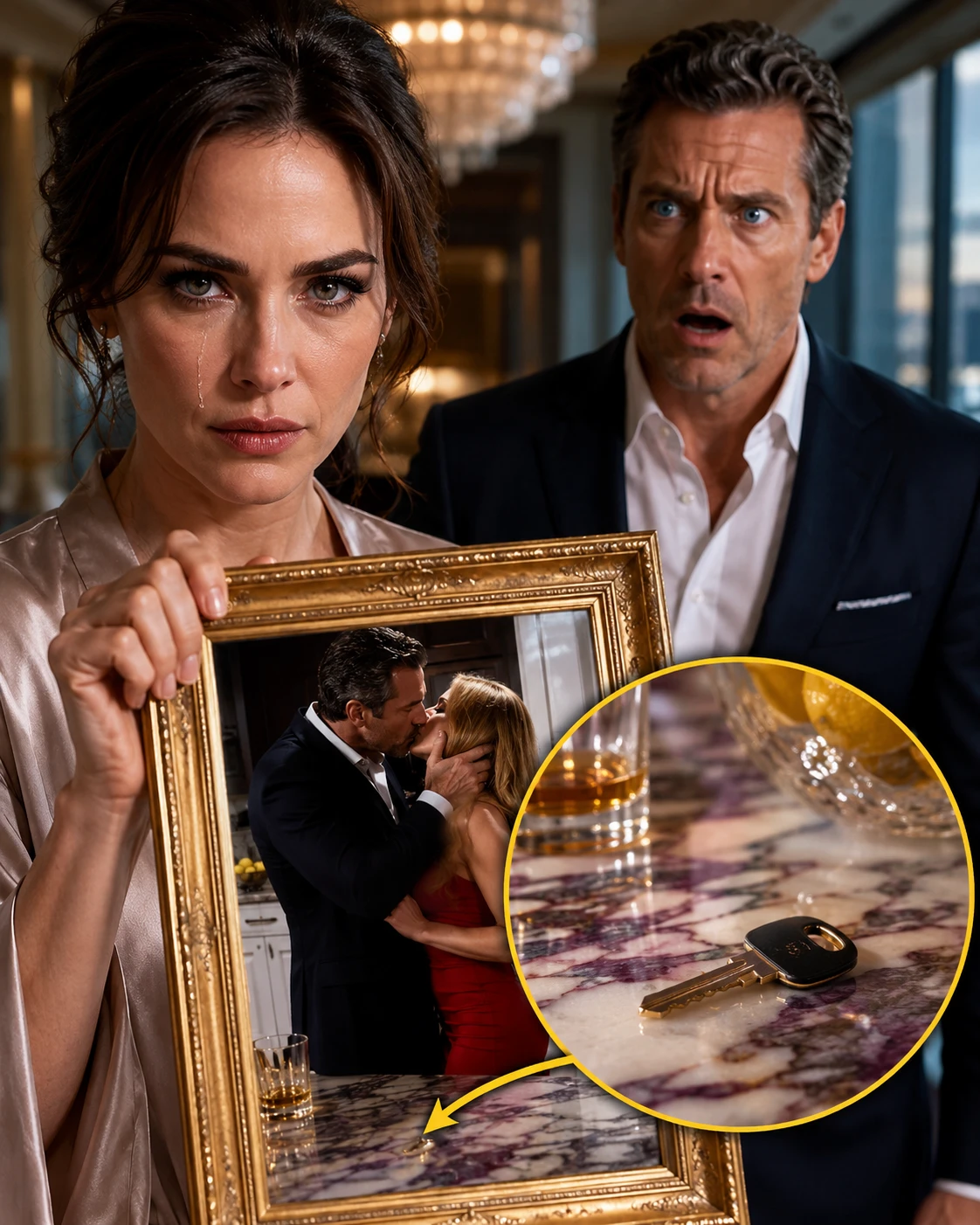
My husband, Bennett, had one hand buried in the golden hair of a woman half my age and twice as desperate. Her back was pressed against the island in my kitchen. My kitchen. The one with the hand-cut Calacatta Viola marble I had imported from Italy, the one where I had hosted senators, gallery owners, old-money wives, and a few men powerful enough to ruin a country before lunch.
They were kissing as if they wanted to be caught.
As if they wanted me to see.
As if the photo itself were a dagger sharpened in perfume.
For one full minute, I did nothing. I did not cry. I did not throw the frame. I did not collapse to the floor like a woman in a movie who had just discovered her life was a beautifully furnished lie.
I simply looked.
The mistress had chosen a flattering angle for herself. Of course she had. Her cheekbones caught the late afternoon light. Her dress was red, tight, expensive in the obvious way. Bennett looked younger than he was, which meant he looked ridiculous. A fifty-one-year-old man with a twenty-seven-year-old hunger, kissing scandal like it might turn him immortal.
Then my eyes shifted.
Not to his hand.
Not to her mouth.
Not to the shame.
To the counter behind them.
There, beside my husband’s half-empty glass of Macallan and the crystal bowl where I kept lemons, lay a small brass key with a black enamel head.
My safe key.
The same key Bennett had sworn had gone missing three weeks earlier.
The same week my jewelry disappeared.
I leaned closer until my breath fogged the glass of the frame.
The mistress had sent me a photograph to break my heart.
Instead, she had mailed me evidence.
CHAPTER 1 — The Gold Frame and the Woman Who Did Not Scream
By eight o’clock, Bennett was dressed for war in a navy Brioni suit and the innocent expression of a man who believed charm was still a legal defense.
He walked into the breakfast room while I was sitting beneath the Murano chandelier, calmly buttering a piece of toast I had no intention of eating. The framed photograph rested on the table between us, propped against a vase of pale roses.
Bennett stopped.
For the first time in our marriage, I watched him calculate and fail.
“Vivienne,” he said.
My name sounded inconvenient in his mouth.
I lifted my eyes. “Good morning.”
He looked at the photograph, then at me, then back at the photograph, as if it might transform into something less damning if he stared long enough.
“Where did you get that?”
“It came by messenger.”
His jaw tightened. “From whom?”
I smiled faintly. “You tell me.”
Bennett had always been handsome in a clean, expensive, American way. Gray at the temples, blue eyes, disciplined body, the kind of face that made investors feel like their money was safe even when it wasn’t. He had been devastating at forty-two when I married him, newly divorced, charismatic, brilliant at raising capital and worse at telling the truth.
Back then, I mistook his hunger for ambition.
There is a difference.
Ambition builds a table.
Hunger eats everyone seated at it.
He pulled out the chair opposite me, but he did not sit. “It isn’t what it looks like.”
I laughed once, softly.
The sound startled even me.
“Bennett. It looks like your mouth on another woman’s mouth in my kitchen.”
“She’s emotional.”
That was his first mistake.
Not “I’m sorry.”
Not “I betrayed you.”
Not even “I was drunk.”
She’s emotional.
As if Sloane Avery, with her glossy hair and curated sadness, had simply floated into our penthouse on a cloud of feelings and accidentally landed under his tongue.
I placed my knife down with care. “Is that what we’re calling her?”
His nostrils flared. “This is complicated.”
“No. Offshore tax strategy is complicated. Wine inheritance law is complicated. Kissing your mistress beside my lemons is vulgar, but not complicated.”
His face hardened. There it was, the glimpse beneath the polish. Bennett did not like being embarrassed. He liked to do the embarrassing.
“She’s a consultant,” he said. “She helped with the Whitmore Foundation gala.”
“She also helped herself to my kitchen.”
“Vivienne.”
He said it as a warning.
I looked back at the photograph. “Did she pick the frame?”
“What?”
“The frame. Gold, ornate, painfully literal. It looks like something a villainess in a daytime drama would buy after maxing out a credit card at Bergdorf.”
His eyes flicked to the frame. “I don’t know.”
“Shame. I thought maybe you two had chosen it together. A little domestic moment. Kissing, framing, mailing.”
Bennett leaned forward, both hands on the table. “You need to listen to me carefully.”
Ah.
There he was.
Not the remorseful husband. Not the ashamed lover.
The man who assumed every room belonged to him once he lowered his voice.
“This photo getting out would hurt both of us,” he said. “It would hurt the foundation. It would hurt your mother’s name. It would humiliate you publicly.”
I took a sip of coffee.
“What an interesting concern,” I said, “considering the private version doesn’t seem to trouble you.”
His mouth tightened.
“I’ll handle Sloane.”
The name landed between us like perfume spilled over blood.
Sloane Avery.
Twenty-seven. Former pageant girl from Scottsdale. Current public relations darling with a talent for making wealthy men feel misunderstood. She had the kind of beauty that looked algorithmically assembled: blond waves, full lips, narrow waist, eyes always wet enough to suggest depth. I had met her twice. Once at the Carlyle, when she touched Bennett’s sleeve too long. Once at our gala planning meeting, when she called me “iconic” with the sincerity of a knife.
I knew women like Sloane.
Not because I hated younger women.
Because I had once been underestimated by older ones.
Sloane thought youth was power. She had not yet learned that youth was merely a currency, and like all currencies, it could be spent foolishly.
Bennett finally sat.
“Nothing happened with the jewelry,” he said abruptly.
My hand paused over my cup.
I did not look at the safe key in the photograph.
I did not let him see that he had just told me exactly where to aim.
“What a strange thing to bring up,” I said.
His eyes narrowed. “You’re thinking it.”
“I haven’t said a word.”
“You always do this.”
“Do what?”
“Sit there like some marble statue while you judge everyone.”
“Marble is generous. I was going for bone china.”
He pushed back from the table, anger flashing. “I told you the key went missing. I had nothing to do with your jewelry.”
“My jewelry?”
“Our jewelry. The insurance covers—”
“No,” I said.
The softness in my voice made him stop.
I stood and lifted the frame from the table. My reflection shimmered over the glass: thirty-nine years old, dark hair, pale face, a woman built by boarding schools, gallery openings, funerals, and self-control. I wore pearls at breakfast because my grandmother had believed civilization began at the throat.
“The Ashford diamond rivière belonged to my grandmother. The emerald parure belonged to my mother. The sapphire ring was a gift from my father on my twenty-first birthday, six months before his heart stopped in a hotel room in Chicago. They were never ours.”
Bennett looked away.
Good.
“I filed the insurance paperwork,” he said. “The police report too. You know that.”
“Yes,” I said. “You were very helpful.”
His eyes returned to mine.
For a second, he saw me.
Not the wife. Not the hostess. Not the woman whose silence he had mistaken for weakness.
Me.
Something like unease crossed his face.
Then his phone buzzed.
He glanced down.
I did too.
SLOANE AVERY.
The name flashed across his screen with a tiny preview.
Did she open it yet?
Bennett flipped the phone face down.
Too late.
I set the photograph gently back on the table.
“Tell Sloane,” I said, “her composition is excellent.”
He rose. “You are not going to turn this into some society spectacle.”
“No, Bennett.” I smiled. “You did that when you kissed her in a kitchen with three security cameras and a missing safe key on the counter.”
His expression changed.
Just slightly.
A twitch near the mouth. A narrowing around the eyes.
Fear, when it first appears on a powerful man, is never loud. It arrives like a cold draft under a locked door.
“We disabled those cameras during the renovation,” he said.
“We disabled the visible ones.”
He stared at me.
I let the silence bloom.
Then I picked up my coffee and said, “You’re going to be late.”
Bennett left twenty minutes later.
He did not kiss my cheek.
I watched from the window as his black car slid into morning traffic, carrying him downtown toward his glass office and whatever lies he had scheduled between nine and noon.
When he was gone, I walked to the kitchen and stood exactly where Sloane had stood in the photograph.
The marble island gleamed.
The lemons were fresh.
The air smelled faintly of espresso, lilies, and war.
I opened the drawer beneath the wine fridge and removed a small, old-fashioned brass key taped to the underside.
The real safe key.
The one in the photograph was a duplicate.
Bennett had never known there were two.
That had been my first rule, taught to me by my grandmother, Helena Hart, a woman who survived three husbands, one hostile takeover, and the kind of childhood that makes softness a luxury.
“Men admire trust,” she used to say, fastening diamonds at her throat. “But they respect locks.”
I had trusted Bennett with many things.
Never the locks.
At nine o’clock, I called Julian Cross.
He answered on the second ring.
“Vivienne,” he said.
Julian’s voice had always sounded like dark wood and winter rain. He was a litigation attorney with offices on Madison Avenue, a widower, an old friend of my family, and the only man my mother had ever described as dangerous in a complimentary tone.
“I need you,” I said.
There was no hesitation.
“Where?”
“My penthouse.”
“How bad?”
I looked at the gold frame on my kitchen island.
“Expensive,” I said. “And about to become public.”
CHAPTER 2 — The Mistress in Red and the Husband in Debt
Julian arrived without drama, which is how truly powerful people enter rooms.
No entourage. No visible panic. No performative outrage.
Just a charcoal overcoat, black leather gloves, and eyes the color of storm clouds over the Hudson.
He stood in my kitchen and studied the framed photograph for a long time. He did not ask if I was all right. Julian knew better than to ask a woman bleeding internally if she wanted a bandage.
Finally, he said, “She mailed this?”
“By courier.”
“Envelope?”
“In the foyer drawer. I used gloves.”
His mouth tilted, almost a smile. “Of course you did.”
I handed him the packaging. “There’s also a note.”
He unfolded the cream card.
In Sloane’s perfect handwriting, it read:
A woman deserves to know when she’s already been replaced.
Julian’s expression did not change, but the room seemed to cool.
“Charming,” he said.
“She forgot to dot the i in replaced. Passion makes people careless.”
He looked at me then, really looked, and something softened behind his eyes.
“Vivienne.”
“I’m not going to cry in the kitchen.”
“I didn’t ask you to.”
“Good.”
“I was going to ask whether you’ve eaten.”
I almost laughed.
Almost.
Julian Cross had been in my life for twenty years in the way certain constellations are in the sky: distant, known, impossible to touch without disaster. He had been my father’s junior counsel once. Later, a family friend. Later still, the man who stood beside my mother at my father’s funeral when Bennett was conveniently delayed by a meeting in Boston.
He had married young. Lost his wife to ovarian cancer at thirty-six. After that, he became quieter. Sharper. The sort of man people invited to dinners because they feared what it meant not to.
Bennett disliked him.
That alone had always recommended Julian to me.
I led him to the service pantry, where the security server was hidden behind a panel of antique mirrored glass. The visible cameras in the kitchen had, as Bennett said, been disabled during renovations. But after a burglary in the building the previous year, I had authorized a new system through the building’s private security contractor: discreet pinhole cameras in the smoke detectors, motion logs at elevator access points, and timestamped footage stored off-site.
Bennett had signed the invoice without reading it.
A habit that had built half his confidence and all of his vulnerabilities.
Julian removed a flash drive from his pocket. “Show me the week the jewelry disappeared.”
I typed in the passcode.
The screen lit.
Three weeks earlier, at 11:42 p.m., Bennett entered the kitchen with Sloane Avery.
I felt the first true crack inside me then.
Not because I saw them together.
The photograph had already done that.
Because Bennett was wearing the gray cashmere sweater I had given him for Christmas. Because he poured Sloane my wine. Because she walked barefoot across my heated limestone floors as though she belonged there.
They kissed.
They laughed.
He opened the drawer beneath the wine fridge and removed something.
The duplicate key.
Julian’s jaw tightened.
On the footage, Bennett held the key up. Sloane said something, smiling. He shook his head, then tucked it into his pocket.
“Audio?” Julian asked.
“Kitchen only records video. New York consent issues. I was careful.”
“You always are.”
We watched Bennett and Sloane leave the kitchen.
Ten minutes later, elevator logs showed Bennett accessed the private lower level where our climate-controlled safe room was located.
At 12:08 a.m., he returned carrying a black velvet case.
I recognized it before my mind allowed me to name it.
My mother’s emerald parure.
Necklace, earrings, bracelet, brooch. Colombian stones set in platinum. Appraised at four million dollars and emotionally valued at more than I could survive saying aloud.
Sloane clapped her hands like a child.
Bennett opened the necklace and held it against her throat.
I did not move.
Julian paused the video.
“You don’t have to keep watching.”
“Yes,” I said. “I do.”
He resumed.
Sloane turned toward the reflective wall panel beside the pantry, admiring herself in emeralds that had touched my mother’s skin on the night my father proposed.
Then she kissed Bennett again.
Long. Slow. Grateful.
A transaction dressed as desire.
My stomach clenched, but my voice stayed even.
“He told me the safe key went missing four days later. I noticed the jewelry missing the morning after that.”
Julian nodded. “And he filed the police report?”
“Yes.”
“Insurance claim?”
“He insisted. Said it was practical.”
Julian looked at me. “Insurance fraud, theft, false reporting, possibly wire fraud depending on what he did with the pieces.”
“Find out what he did.”
“I will.”
“There’s more.”
I walked to the study.
It had been my father’s once, before I redesigned it for Bennett. Dark green walls. Brass lamps. First editions. A partner’s desk large enough for treaties or betrayals.
I opened the bottom drawer and removed a folder labeled HART HOUSEHOLD — PERSONAL.
Julian watched as I laid out copies of bank statements, wire transfers, and private investigator notes.
“I started noticing irregularities eight months ago,” I said.
His eyes sharpened. “Eight months?”
“Bennett blamed market timing. I blamed Bennett.”
I showed him the transfers from our joint account to a vendor called AURORA EVENT STRATEGIES LLC.
Julian read the page. “Sloane’s firm?”
“Yes. But Aurora was only formed ten months ago. Before that, Sloane worked under her own name and charged normal consulting fees. Aurora invoices us five times market rate.”
“How much?”
“Six hundred forty thousand dollars over eight months.”
Julian looked up.
“For a gala?”
“For a gala, two donor dinners, and apparently emotional support.”
His mouth tightened, but his eyes betrayed amusement.
“Vivienne.”
“I’m coping.”
“Cruelly.”
“It’s my best quality.”
Julian turned another page. “These payments came from the foundation account.”
“Yes.”
“That’s charitable money.”
“Yes.”
A silence settled.
Outside the study windows, Manhattan glittered in the clear morning light. Taxis moved like yellow blood through the streets. People carried coffees, secrets, grudges, invoices. The city did not care about broken hearts. It preferred contracts.
Julian gathered the papers. “Who else knows?”
“My accountant, Mara Voss. My private banker. And now you.”
“Bennett?”
“Thinks I’m elegant wallpaper.”
“That’s useful.”
“It often is.”
By noon, Julian had a strategy.
Not a tantrum.
Not a confrontation.
A strategy.
First, preserve the photograph, note, packaging, courier records, security footage, and metadata. Second, trace Aurora Event Strategies and all transfers connected to Sloane. Third, review Bennett’s access to the Hart family trust, the Whitmore Foundation, our joint accounts, and the marital estate. Fourth, obtain appraisals and provenance documentation for the missing jewelry. Fifth, determine whether Bennett had pledged, sold, or concealed the pieces.
“And sixth?” I asked.
Julian slid the gold frame into an evidence bag.
“Let them think you’re ashamed.”
I looked at him.
“That will be easy,” I said. “Everyone expects a humiliated wife to hide.”
“Yes.”
He zipped the bag shut.
“So hide beautifully.”
That evening, Bennett returned home smelling of vetiver, rain, and another woman’s perfume badly covered by soap.
I was in the dressing room, fastening diamond studs into my ears.
He stood in the doorway.
“We need to talk.”
“We did.”
“No. You performed. We need to talk like adults.”
I met his eyes in the mirror. “Adults don’t mail photographs of adultery before breakfast.”
His face flushed. “I spoke to Sloane. She regrets sending it.”
“How moving.”
“She was hurt.”
“By what? The marble?”
“By the situation.”
“The situation being that you promised her my life before I had finished using it?”
His silence answered.
I turned.
Bennett’s gaze flicked over my black satin dress, the diamond bracelet on my wrist, the red sole of the heel near my foot.
“Where are you going?”
“The Whitmore Foundation preview dinner.”
His eyebrows lifted. “You’re still going?”
“Of course.”
“Vivienne, people may have heard—”
“About your consultant’s emotional instability? How unfortunate.”
“Don’t do this.”
“Do what?”
“Walk into a room like nothing happened.”
I stepped closer and adjusted his tie with the intimacy of a mortician.
“Bennett,” I said, “nothing has happened.”
His eyes searched mine.
I smiled.
“Yet.”
The dinner was held at the Frick Madison, a private preview for donors before the foundation’s annual auction. The room glowed with candlelight and old money. Women in black silk murmured beside men who measured their worth by silence. Champagne traveled on silver trays. A quartet played something fragile and European.
I arrived alone.
That mattered.
In our world, entrances were statements. Solo entrances were declarations.
By the time I crossed the gallery, whispers had already begun.
Poor Vivienne.
Did you hear?
A photograph, apparently.
His mistress is so young.
The words brushed my skin like snowflakes. Cold, temporary, beneath my attention.
Then I saw her.
Sloane Avery stood beside the Degas, laughing too loudly at something Bennett’s friend Miles had said. She wore white. Of course she wore white. A satin gown cut low enough to be strategic, diamonds at her ears that looked new, and a confidence so bright it bordered on pleading.
Bennett stood five feet away from her, pretending not to stand with her.
Their eyes found me at the same time.
It is a peculiar power, arriving after people have rehearsed your humiliation.
They expect tears.
They expect trembling.
They expect the wife to clutch her pearls while the mistress clutches the husband.
They do not expect the wife to smile as if she owns the building.
I walked straight toward them.
Sloane’s laughter died.
“Vivienne,” Bennett said.
“Sloane,” I said warmly. “How brave of you to come.”
Her cheeks pinked. “I was invited.”
“By my foundation?”
Bennett’s jaw worked. “She assisted with the donor list.”
“Did she?”
I let my gaze drift to her earrings.
Emeralds.
Small, vivid, Colombian green.
Not my mother’s earrings.
Not exactly.
But close enough to be a message.
Sloane touched one self-consciously. “They were a gift.”
“I’m sure.”
The nearby conversation thinned. People sensed blood. Rich people pretend to hate scandal, but they circle it like sharks around a yacht.
Sloane lifted her chin. “I don’t think we should do this here.”
I smiled. “Do what?”
“This.” Her voice trembled just enough to seem innocent. “I know you’re upset.”
There it was.
The public script.
The wounded younger woman.
The cruel older wife.
The man in the middle, burdened by feelings and poor choices.
Bennett reached for my arm. “Vivienne.”
I stepped away before he touched me.
Sloane’s eyes glittered.
“I never wanted to hurt you,” she said, louder than necessary.
A woman near the champagne table stopped pretending not to listen.
I tilted my head. “Then you should have chosen a smaller frame.”
A ripple moved through the room.
Sloane’s mouth opened.
Bennett went pale.
I took a glass of champagne from a passing tray.
“To emotional women,” I said softly, lifting it toward Sloane. “May they always remember what they put in the background.”
For one second, she did not understand.
Then she did.
Her hand flew again to her earring.
Bennett stared at me.
The quartet played on.
I walked away before either of them could speak.
That night, while society dissected my smile, Julian’s investigators began following the money.
By Friday, we had Aurora’s bank records subpoena-ready.
By Monday, we had photographs of Sloane entering a private jeweler on West 47th Street.
By Wednesday, we had a pawnbroker in Palm Beach who remembered Bennett.
By Thursday, Mara Voss, my accountant, called with a voice like a blade.
“Vivienne,” she said. “You need to come in.”
Her office overlooked Bryant Park and contained no flowers. Mara believed flowers were emotional clutter. She was sixty-two, severe, loyal, and the only person I knew who could make a balance sheet feel like a murder weapon.
Julian was already there when I arrived.
That told me everything.
Mara slid a file across the table. “Bennett is in debt.”
I sat. “How much?”
She looked at Julian, then back at me.
“Personally? Around eighteen million.”
I blinked once.
That was all I allowed myself.
“Business exposure?”
“Worse,” Mara said. “Ashford Capital has liquidity problems. Some investments are underwater. He’s been using new investor money to calm old investors. Not technically a Ponzi yet, but it’s wearing the perfume.”
Julian’s expression darkened. “The jewelry?”
“Collateral,” Mara said. “At least some of it. He pledged the emerald parure through a private lender in Miami tied to a shell company. The diamond rivière is unaccounted for. The sapphire ring was sold in pieces.”
For the first time, my fingers went cold.
“My father’s ring?”
Mara did not soften. She respected me too much.
“Yes.”
I looked down at my hands.
Bare except for my wedding ring.
A flawless oval diamond in a platinum setting Bennett had chosen because he said it looked timeless.
How funny.
Some things age badly the moment the truth enters the room.
Julian’s voice was low. “Vivienne.”
I raised my hand slightly.
Not yet.
Grief is a room with many doors. I had opened too many that week. The ring would have to wait outside.
Mara continued. “There’s another issue.”
“There always is.”
“Bennett has been moving assets.”
“Where?”
“Delaware entities. Wyoming LLCs. A trust in South Dakota. Some offshore activity through the Caymans. But he made one serious mistake.”
Julian leaned forward. “Which is?”
Mara’s eyes met mine.
“He used marital funds to service debt tied to assets he concealed before updating the postnuptial disclosures.”
I smiled then.
Slowly.
Mara smiled back.
Julian looked between us. “Explain.”
I turned to him. “Our postnup has a morality clause, a financial disclosure clause, and a clawback provision.”
Julian’s brows lifted.
Mara looked almost proud. “Mrs. Ashford insisted.”
I remembered the day clearly.
Three years into the marriage, Bennett had laughed when I asked for a postnuptial agreement. He said it was unromantic. I said romance was not injured by paperwork unless romance intended to commit fraud. He signed two weeks later, after my trust declined to guarantee a credit facility for his fund without it.
The clause was elegant.
If either spouse engaged in financial concealment, marital asset diversion, proven theft from separate property, or conduct causing reputational harm to the Whitmore Foundation, the injured spouse could claim accelerated separation terms, legal fees, punitive contractual damages, and full recovery of misappropriated assets.
Bennett had signed because he believed himself too clever to get caught.
Men like Bennett do not fear contracts.
They fear women who read them.
Mara tapped the file. “He didn’t just cheat. He breached.”
A warmth moved through me.
Not happiness.
Something cleaner.
Purpose.
“Good,” I said.
Julian watched me carefully.
“Good?” he asked.
“Yes.”
Outside, Bryant Park shone in winter light. People skated over ice that looked solid only because no one had fallen through it yet.
I removed my wedding ring and placed it on Mara’s conference table.
The diamond caught the light.
Cold. Perfect. Meaningless.
“Find every asset,” I said. “Every account. Every transfer. Every lie.”
Julian’s eyes held mine.
“And Bennett?”
I slid the ring across the table toward him.
“Let him keep believing I’m heartbroken.”
CHAPTER 3 — Public Humiliation Is Cheaper Than Discovery
Bennett chose the wrong battlefield.
He chose a ballroom.
The Whitmore Foundation Winter Auction had been scheduled for months at The Plaza, beneath chandeliers heavy enough to crush a family legacy. It was my mother’s favorite event, a night where old art and new money pretended to like each other for tax reasons. The auction raised millions for arts education programs across New York, Boston, Chicago, and Detroit. It also served another purpose: it reminded people that the Hart-Whitmore name did not need to shout.
Bennett wanted to shout.
He thought scandal, once controlled, could become theater. He thought if he appeared calm, affectionate, regretful but firm, society would forgive him before dessert. He thought Sloane’s youth would read as romance, while my composure would read as coldness.
He underestimated how much America enjoys watching a beautiful man ruin himself under good lighting.
Two days before the auction, Page Six ran the blind item.
Which Manhattan financier’s elegant wife may be losing more than diamonds to a much younger blonde?
No names.
Names were unnecessary.
By lunch, my phone held seventy-three messages.
By dinner, Sloane’s Instagram story featured champagne, a white fur coat, and the caption: Some women inherit diamonds. Others become them.
Tactless, yes.
Useful, absolutely.
Julian forwarded it to our evidence file.
I attended the auction in black velvet.
Not because I was mourning the marriage.
Because black photographs well.
My gown had long sleeves, a square neckline, and no ornament except my grandmother’s pearl choker. Not diamonds. Not emeralds. Not sapphires. Pearls. The jewelry of women who know how to survive with their throats exposed.
The Plaza ballroom shimmered. White roses rose from silver urns. Gold chairs lined the tables. The air smelled of candle wax, perfume, truffles, and concealed judgment.
I arrived on time.
Bennett arrived ten minutes later with Sloane.
The ballroom inhaled.
She wore red again.
A scarlet silk gown with a slit nearly to her hip, diamonds at her throat, and the confident smile of a woman who had confused access with victory.
Bennett placed his hand at the small of her back.
A camera flashed.
My humiliation became public property.
For exactly six seconds, I felt the wound.
Not because I wanted him back.
God, no.
Because a marriage is still a house you built, even after you discover termites in the walls. Watching Bennett parade Sloane through my mother’s foundation felt like seeing someone track mud over a grave.
Then Julian appeared at my side.
He wore a black tuxedo, a white pocket square, and an expression so calm it made nearby men stand straighter.
“You’re gripping your glass,” he said.
I loosened my fingers.
“Better?”
“No. But the glass is safer.”
I looked at him despite myself.
He did not smile, but the corner of his mouth considered it.
“You came.”
“You asked.”
“I didn’t.”
“You never have to.”
That landed somewhere dangerous.
So I looked away.
Across the room, Bennett was accepting sympathy.
That was the fascinating part.
People approached him as though he were the injured party. Men clapped his shoulder. Women touched his arm with theatrical concern. Sloane lowered her eyes beside him, playing reluctant love. Bennett looked grave, burdened, noble in the way only rich men can look noble while destroying everyone around them.
Then the auction began.
The foundation chair gave opening remarks.
I followed.
I walked to the podium beneath the chandelier, my heels silent on the carpet, my face projected on two large screens beside the stage.
The room quieted.
I looked out at donors, trustees, journalists, collectors, socialites, trustees’ wives, trustees’ mistresses, and all the men who believed the difference between those categories was discretion.
“Good evening,” I said.
My voice did not tremble.
“Tonight, the Whitmore Foundation honors legacy. Not simply what we inherit, but what we protect. What we refuse to cheapen. What we preserve when fashion, ego, and appetite try to convince us that everything precious can be replaced.”
A hush.
Bennett’s face tightened.
Sloane’s smile flickered.
I continued. “My mother believed that art teaches us how to look longer. To notice what careless people miss. The brushstroke beneath the varnish. The crack beneath the gilt. The truth in the background.”
Julian stood near the left wall, still as a shadow.
Mara sat at table one with her hands folded.
My private investigator, whose name the room did not know and never would, stood beside a floral arrangement dressed as a waiter.
“Tonight,” I said, “we raise money for children who deserve beauty without having to inherit it. We raise money for teachers, museums, city programs, and the fragile idea that culture belongs to more than those who can afford a table at The Plaza.”
Applause began.
Polite, then stronger.
I let it swell, then lifted my glass.
“To legacy,” I said. “And to the women who protect it quietly.”
The applause became thunder.
I stepped down.
Bennett’s eyes burned into me.
Sloane looked bored, which meant frightened.
The dinner passed in glittering discomfort. Course after course arrived: caviar, lobster, filet, chocolate soufflé. Everyone pretended to talk about art while checking who was watching whom. Bennett did not come near me until after the live auction, when a Basquiat print exceeded estimate by forty percent and the room had enough champagne in it to forgive murder.
He intercepted me near the marble staircase.
“Are you proud of yourself?” he asked.
I looked around. “Of the foundation? Very.”
“You know what I mean.”
“I rarely do anymore.”
His smile was sharp. “You think you can embarrass me?”
“I think you’re doing beautifully alone.”
Sloane appeared beside him, red silk whispering like a warning.
“Vivienne,” she said. “I’m sorry this is painful for you.”
I studied her.
There was a time when I might have hated her simply for being young. But standing there under The Plaza’s chandeliers, I saw what she truly was: not a rival. Not a femme fatale. Not even a villain.
A girl who had mistaken proximity to a powerful man for power.
Still dangerous.
Still accountable.
But not impressive.
“Sloane,” I said, “has anyone ever told you that sincerity does not improve when rehearsed?”
Her lips parted.
Bennett stepped closer. “Enough.”
“No,” Sloane said, suddenly bright with anger. “Actually, let her speak. Everyone already knows. She can stop pretending to be above it.”
People nearby turned.
That was her second mistake.
The first had been the photograph.
The second was believing I feared an audience.
She raised her voice. “You think money makes you untouchable, Vivienne? It doesn’t. Bennett loves me. He chose me. Maybe because I don’t treat him like some accessory in my perfect little life.”
A circle formed.
Of course it did.
Phones appeared.
Of course they did.
Bennett looked alarmed now, but not enough to stop her.
Sloane continued, cheeks flushed, eyes shining. “You can stand up there talking about legacy all night, but you couldn’t even keep your own husband.”
A sound passed through the crowd.
A collective intake.
A social guillotine dropping.
My face appeared on someone’s phone screen, live-streamed to a private Instagram story that would be everywhere by midnight.
I looked at Sloane.
Then at Bennett.
Then back at Sloane.
“My dear,” I said, gently enough to kill, “I don’t keep things that steal from me.”
Her expression shifted.
Confusion.
Then fear.
Bennett grabbed my elbow.
Hard.
Julian was beside us instantly.
“Remove your hand,” he said.
Bennett looked at him with pure hatred.
Julian did not move.
For a moment, the three of us stood there: husband, wife, and the man patient enough to know the law was sharper than any fist.
Bennett released me.
Sloane laughed, too loud. “Steal? Are you accusing me of something?”
I smiled.
“No,” I said. “Not here.”
That frightened her more than yes would have.
Because yes can be denied.
Not here suggests a room already waiting elsewhere.
The clip went viral before the valet brought my car.
By midnight, it was on Instagram.
By morning, Facebook pages had chopped it into a reel with captions:
HUSBAND BRINGS MISTRESS TO WIFE’S GALA.
WIFE DESTROYS HER WITH ONE SENTENCE.
I DON’T KEEP THINGS THAT STEAL FROM ME.
The internet loved it.
Then the internet did what it always does.
It zoomed in.
Someone noticed Sloane’s diamond necklace.
Someone else found old photos of my mother wearing the emerald parure.
A TikTok account dedicated to luxury scandals posted a side-by-side of Sloane’s earrings from the preview dinner and a Sotheby’s archive image of my mother’s Colombian emeralds.
They were not the same earrings.
But the speculation was useful.
By noon, #TheWifeZoomedIn was trending in the strange, feverish corners of American social media where betrayal becomes entertainment and strangers become juries.
Bennett called me seventeen times.
I did not answer.
Sloane posted a statement.
It was a mistake.
She wrote, in white text over a beige background:
I will not be bullied by powerful women weaponizing old money. Love is complicated. Please respect my privacy during this deeply painful time.
Julian sent me a screenshot with one line:
She used the word “weaponizing.” Discovery will enjoy that.
I laughed for the first time in days.
A real laugh.
It hurt.
That afternoon, Bennett came home early.
He found me in the dining room with Mara, Julian, and two forensic accountants. Stacks of folders covered the table where we had hosted Christmas dinner the year before.
His face darkened.
“What is this?”
I signed a document without looking up. “Paperwork.”
“Get out,” he said to Julian.
Julian turned a page. “No.”
Bennett looked at me. “Vivienne, you are embarrassing yourself.”
“There it is,” I said.
“What?”
“The last refuge of men without facts. Call the woman embarrassing.”
He moved toward the table. “This is my home.”
“No,” I said, finally looking at him. “It isn’t.”
He stopped.
A beautiful pause.
A priceless one.
The kind of pause that should be displayed in a museum under the title: Man Discovering Consequences.
“What did you say?” he asked.
I nodded to Mara.
She slid a deed across the polished mahogany table.
“The penthouse,” I said, “is owned by Hart Residential Holdings.”
His eyes narrowed. “That’s a family entity.”
“My family.”
“We live here.”
“You live here because I permitted it.”
His mouth opened, then closed.
Julian handed him another document. “You’ll also want to review the notice of preservation, the spoliation letter, the postnuptial breach notice, and the litigation hold. Your counsel should contact me directly.”
Bennett did not touch the papers.
“What have you done?” he asked me.
I stood.
The room seemed to sharpen around us.
“I looked in the background.”
His face changed.
There it was again.
Fear.
“You don’t know what you’re doing,” he said.
“Bennett, I know exactly what I’m doing.”
“This will ruin us.”
“No,” I said. “It will separate us.”
He stepped closer, lowering his voice. “You think Julian Cross cares about you? You think he’s here because of loyalty? He’s been waiting for this. Men like him don’t rescue women for free.”
Julian’s expression did not change.
Mine did.
Not outwardly.
Inside, something old and loyal went very still.
Bennett saw that he had missed and tried again.
“You’re angry. I understand. But if you push this, everyone gets hurt. The foundation. Investors. Your name. Your mother’s memory.”
“My mother’s memory survived cancer,” I said. “It can survive you.”
His eyes went flat.
Then he smiled.
A small, cruel smile I had seen only once before, years ago, during a negotiation when he bankrupted a founder and called it discipline.
“You want a war?” he asked.
“No,” I said. “I want an audit.”
Mara’s lips twitched.
Bennett looked at the files, then at me.
“You’ll regret this.”
I walked to the dining room doors and opened them.
“Not today.”
He left that night for the Pierre.
Sloane posted a photo from a hotel bar two hours later.
Two champagne flutes.
Her hand with a diamond bracelet I recognized.
Not mine.
A loaner piece from Marceau & Bell, a jeweler Bennett had used for corporate gifts.
He was spending borrowed money to look unbothered.
That is how men drown in silk.
CHAPTER 4 — The Coldest Woman in New York
The lawsuit landed on a Monday morning.
By design.
Julian filed in New York Supreme Court at 9:01 a.m., timed for maximum legal efficiency and minimum emotional ambiguity. The complaint was elegant and devastating: breach of postnuptial agreement, conversion of separate property, fraud, unjust enrichment, breach of fiduciary duty connected to foundation funds, and a demand for immediate injunctive relief preventing Bennett from transferring, pledging, selling, or concealing assets.
The criminal referral went separately.
Quietly.
To people who did not care about gala gossip, Instagram statements, or emotional consultants.
The evidence packet included the photograph in the gold frame, courier records, security footage, elevator logs, appraisals, insurance paperwork, foundation invoices, bank transfers, shell company records, jeweler communications, and one particularly useful email Bennett had sent to Sloane at 2:14 a.m.:
V won’t notice until after Palm Beach. Wear the green set there. You deserve beautiful things.
V won’t notice.
That sentence became its own kind of weather.
Once filed, the case moved through New York society like smoke beneath a door. No one said much publicly. Privately, the calls began.
Board members.
Donors.
Investors’ wives.
Reporters.
Women who had once smiled at Bennett now wanted lunch with me. Men who had once dismissed me as decorative now discovered respect in their calendars.
But I was not interested in revenge by rumor.
Rumor is cheap.
I wanted signatures.
The temporary restraining order froze several accounts tied to Bennett and his entities. A judge, apparently unimpressed by husbands who misplaced heirlooms into their mistresses’ necks, granted expedited discovery.
Sloane received her subpoena at a Pilates studio in Tribeca.
There was video.
Of course there was.
She wore pale blue leggings and a cropped sweatshirt that said BLESSED. A process server approached while she was exiting class with an oat milk latte. Her smile faded as she accepted the envelope.
By evening, the internet had done what the internet does best: added dramatic music.
The mistress sent a photo. The wife sent a subpoena.
It would have been funny if it had not also been my life.
Bennett’s first legal move was predictable.
He claimed emotional distress.
His second was pathetic.
He claimed the jewelry had been loaned, not stolen.
His third was dangerous.
He accused me of illegal surveillance.
Julian destroyed that argument in six pages. The cameras were disclosed in building security records, installed in common household areas for safety, without audio, and known to all residents through the renovation addendum Bennett had signed. He had initialed the page.
He had even written Looks fine beside the camera plan.
Carelessness is the signature arrogance leaves behind.
Sloane’s attorney was a man named Trent Hollis, all veneers and television hair. He issued a statement calling the lawsuit “a malicious attempt by an older wealthy spouse to punish a younger woman for being loved.”
That statement lasted twelve hours before Julian replied with a filing attaching Sloane’s invoices to the Whitmore Foundation, her texts with Bennett about “moving the old wife money,” and a photo of her wearing my mother’s emerald necklace at a private villa in Palm Beach.
The villa belonged to a lender named Victor Halloway.
Victor Halloway owned the shell company holding Bennett’s debt.
Victor Halloway also had a son who sat on the board of a museum receiving foundation grants.
People began resigning from boards that had not yet been mentioned.
I watched it unfold from my penthouse with the strange calm of a woman standing outside her own burning house, admiring the symmetry of the flames.
Then, on the ninth day, Bennett came to see me.
Not at home.
At my mother’s old townhouse on East 72nd Street.
Hart House.
The townhouse was five stories of limestone restraint, purchased by my great-grandfather in 1926 and left to me through a trust Bennett had never controlled. It had been empty since my mother died, preserved more than lived in. White sheets covered furniture in the formal rooms. Dust softened the chandeliers. Her perfume still lived in the wallpaper if the weather turned damp.
I had gone there to be alone.
Bennett found me in the library.
He looked older.
Good tailoring cannot conceal sleeplessness forever.
“Julian told you I was here?” I asked.
“No.”
“Then you had someone follow me.”
He looked around the room. “You always come here when you want to feel superior.”
“I come here when I want quiet.”
“Same thing.”
He stood near my father’s old globe, one hand in his coat pocket.
For the first time in days, he seemed less angry than tired.
“I made mistakes,” he said.
I looked at him.
The library windows faced the garden, bare in winter, all black branches and stone.
“Mistakes,” I repeated.
“Yes.”
“What a small word for theft.”
He flinched.
Good.
“I was under pressure,” he said. “You don’t understand what it’s like.”
“To steal from your wife?”
“To carry everything. To have everyone expecting you to be brilliant, rich, invincible. Your family name opened doors for me, yes, but it also came with judgment. I was always the outsider at your table.”
“You sat at that table happily when it funded you.”
His mouth tightened. “I loved you.”
That was worse than any lie.
Because perhaps he had.
In his way.
In the way selfish men love beautiful things: proudly, possessively, and only while the beautiful thing reflects well on them.
“No,” I said. “You loved being chosen by me.”
He looked away.
A small victory.
A sad one.
“Sloane doesn’t matter,” he said.
I almost pitied her.
Almost.
“She will be disappointed to hear that.”
“She got carried away.”
“Again, the emotional woman.”
He stepped closer. “Vivienne, we can settle. Quietly. I’ll return what I can. We’ll announce a separation. You keep the foundation clean. I keep the fund alive. No criminal escalation.”
I studied him.
“What you can?”
His eyes darkened.
“The sapphire ring is gone,” he said.
There it was.
The door I had refused to open.
Grief stepped in anyway.
My father had given me that ring in Nantucket, after my college graduation. A deep Ceylon sapphire surrounded by old mine-cut diamonds, set in platinum. He had slipped it onto my right hand and said, “For the days you forget you belong to yourself.”
Bennett had sold it in pieces.
Broken the stones from the setting.
Turned memory into liquidity.
For a second, I could not breathe.
Bennett saw it and softened his voice.
“I’m sorry.”
He was.
Not for selling it.
For saying it.
For watching the wound land.
I turned to the window.
Snow had begun to fall over the garden, light and merciless.
“Leave,” I said.
“Vivienne.”
“You are standing in my mother’s house asking me to protect your reputation after you sold my father’s ring.”
He reached for me.
I moved before he touched me.
“Don’t.”
His hand fell.
A dangerous silence filled the room.
Then he said, “Julian can’t give you what I gave you.”
I laughed then.
Not loudly.
Not kindly.
“What did you give me, Bennett?”
He looked at me as if the answer should be obvious.
“A life.”
I walked to the library desk, opened the drawer, and removed a folder I had brought that morning.
Inside was a copy of the original financing structure for Ashford Capital.
I placed it on the desk.
“No,” I said. “My family gave you a life. I gave you legitimacy. You gave me a gold frame.”
He stared at the folder.
His face drained slowly.
“What is this?”
“The original note.”
His eyes moved over the page.
Then he understood.
Here was the secret Bennett had never bothered to learn because men like him rarely study the foundation beneath the house once they’re inside it.
When Ashford Capital nearly collapsed in its third year, my father had quietly arranged bridge financing through a private lending vehicle. Bennett always believed the lender was a neutral institutional partner. After my father died, the note moved through several entities as part of estate planning.
Eventually, it landed in Hart Strategic Holdings.
My trust.
Bennett’s empire had not merely been built with my family’s money.
Its spine was still held by my signature.
“You own the note,” he said.
“Yes.”
“You can’t call it.”
“You breached covenants.”
His breathing changed.
“Vivienne.”
“I warned you,” I said. “I do read paperwork.”
He looked at me with something close to hatred.
Then, beneath that, something worse.
Recognition.
He had married a woman he thought he could manage.
He was finally meeting the woman who had let him think so.
“If you call that note,” he said, “you destroy the fund.”
“No,” I said. “You destroyed it. I’m just refusing to finance the corpse.”
He moved so fast I thought, absurdly, that he might strike me.
Instead, he swept the folder from the desk.
Papers scattered across my mother’s Persian rug.
Before I could move, Julian appeared in the doorway.
I had not heard him enter.
Bennett turned.
“Of course,” he said bitterly. “Your shadow.”
Julian looked at the papers on the floor, then at me. “Are you all right?”
“Yes.”
Bennett laughed. “You love this, don’t you? Playing protector. Waiting for your chance.”
Julian stepped into the room.
He did not raise his voice.
That made it worse.
“I’ve been waiting,” he said, “for her to stop protecting you.”
Bennett went still.
So did I.
Julian’s eyes did not leave Bennett’s face.
“You mistook her restraint for dependence,” he continued. “That was your mistake.”
Bennett looked between us.
Then he smiled with sudden ugliness.
“There it is. How long, Vivienne? Were you sleeping with him before or after you started building your little case?”
I felt the insult like cold water.
Not because it was true.
Because it was predictable.
Men caught in betrayal often accuse the woman they betrayed of being secretly worse. It comforts them to imagine equality where none exists.
Julian moved one step closer.
“Say that again,” he said quietly.
Bennett looked at him, and for once, he lacked the courage.
I bent and picked up the papers myself.
One by one.
Julian did not help.
I appreciated that.
Some things a woman must gather with her own hands.
When the folder was whole again, I faced Bennett.
“You have until five p.m. tomorrow to accept Julian’s settlement terms,” I said. “After that, the note gets called, the foundation cooperates fully with investigators, and I file a formal request for emergency relief regarding the jewelry and concealed assets.”
Bennett stared at me.
“You wouldn’t.”
I smiled.
It was not warm.
“My mistake was convincing you I had limits.”
He left Hart House in the snow.
That night, Sloane went live on Instagram.
She cried beautifully.
Mascara, but not too much. Candlelight, but not obvious. White sweater slipping off one shoulder, diamond cross at her throat, trembling voice.
She said I was ruining her life.
She said Bennett was a good man trapped in a loveless marriage.
She said I was cold, controlling, obsessed with status.
Then she said the sentence that ended her.
“Vivienne Ashford thinks she can frame me because I sent one stupid picture.”
Julian sent me the clip with three words:
Thank you, Sloane.
Because in law, intent matters.
Because consciousness of guilt matters.
Because “frame me” from a woman who had mailed the frame was too perfect to waste.
The next morning, her attorney withdrew.
CHAPTER 5 — The Final Twist Was Never the Affair
The deposition took place in a glass conference room high above Midtown.
Sloane arrived wearing beige.
A mistake.
Beige is what guilty people wear when they want to look harmless.
She sat across from Julian, her new attorney, a court reporter, and a videographer. Bennett did not attend, but his shadow did. It showed in the way Sloane kept glancing at her phone, waiting for instructions that never came.
I watched from a separate room through a live feed.
Mara sat beside me with a legal pad.
I wore gray cashmere and my grandmother’s pearls.
Julian began gently.
That was how he hunted.
“Ms. Avery, did you send Mrs. Ashford the framed photograph?”
Sloane swallowed. “Yes.”
“Why?”
“I felt she deserved the truth.”
“Which truth?”
“That Bennett and I were in love.”
“Are you still in love?”
Her face tightened. “Yes.”
“Is Mr. Ashford?”
“My personal relationship is not—”
“It is relevant to motive,” Julian said calmly. “Are you still in a relationship with Mr. Ashford?”
“Yes.”
“When did the relationship begin?”
She hesitated.
Her attorney murmured, “Answer if you know.”
“About a year ago.”
Julian nodded. “Before or after Aurora Event Strategies began billing the Whitmore Foundation?”
“I don’t remember.”
He slid a document forward. “This is your first invoice to the foundation, dated March 3rd. This is a hotel receipt from the Lowell Hotel, dated March 2nd, under Mr. Ashford’s name. You ordered room service for two at 11:48 p.m. Does that refresh your recollection?”
Sloane stared.
“I guess before.”
“Before what?”
“Before Aurora billed the foundation.”
“And when did Mr. Ashford first give you jewelry belonging to Mrs. Ashford?”
“He didn’t.”
Julian’s face gave her nothing.
He placed a photograph on the table.
Sloane in Palm Beach, laughing beside a pool, emeralds blazing at her throat.
“Is this you?”
“Yes.”
“Is that jewelry yours?”
“It was borrowed.”
“From whom?”
“Bennett.”
“So Mr. Ashford loaned you jewelry?”
“Yes.”
“Did he tell you it belonged to his wife?”
“No.”
Julian placed another document down. “This is a text message from you to Mr. Ashford dated June 11th. You wrote, ‘She has so much locked away, Ben. It’s obscene. Nobody wears dead women’s rocks anymore.’ Did you send that?”
Sloane’s face lost color.
“I was joking.”
“About Mrs. Ashford’s dead mother?”
She looked toward her attorney.
He looked at the table.
Julian continued.
“You later wrote, ‘Use the little black key. You said she never checks.’ What key were you referring to?”
“I don’t know.”
Julian placed the gold-framed photograph on the table.
Even through the screen, I felt the room change.
“Is this the photograph you mailed to Mrs. Ashford?”
“Yes.”
“Please look at the counter behind you. Do you see a key?”
Sloane’s eyes filled.
“I didn’t know it was there.”
“That wasn’t my question.”
“Yes.”
“What key is it?”
“I don’t know.”
“You just testified you discussed a little black key with Mr. Ashford.”
“I don’t remember.”
Julian leaned back.
Silence.
The kind that makes weak people speak.
Sloane did.
“He told me the jewelry was basically his. He said she didn’t care about it. He said she used things to control him.”
Julian’s voice softened. “Ms. Avery, did you know the jewelry was separate property belonging to Mrs. Ashford?”
“I didn’t think—”
“Did you know?”
She began to cry.
There was no beauty in it now.
Only fear.
“Yes,” she whispered.
Mara exhaled beside me.
I closed my eyes.
Not with relief.
With finality.
Julian continued for three hours.
By the end, Sloane had admitted to sending the photograph, discussing the key, wearing the emeralds, receiving inflated payments through Aurora, and allowing Bennett to use Aurora invoices to move foundation money. She tried to blame him. Then herself. Then stress. Then love.
Love carried a lot of sins for people who did not know what it meant.
Bennett settled the civil case forty-eight hours later.
But settlement is a gentle word.
What happened was surrender in a custom suit.
He agreed to return all recoverable jewelry, compensate the trust for unrecovered pieces at treble value under the postnuptial clause, transfer his interest in several marital assets, resign from all foundation-related roles, cooperate in asset tracing, and pay my legal fees. He also agreed not to contest the call of the Ashford Capital note.
His fund collapsed publicly within the month.
Not because I announced it.
Because truth, once subpoenaed, has a talent for finding windows.
Investors sued.
Regulators circled.
The private lender in Miami cooperated faster than anyone expected, perhaps because men like Victor Halloway understand that prison has poor room service.
The emerald parure came back first.
It arrived in a velvet case escorted by two attorneys and a security guard. I opened it in Julian’s office.
The stones were still beautiful.
That angered me.
I wanted them diminished by what had happened. I wanted some visible mark, some cloud in the green fire, proof that betrayal had touched them and failed to be forgiven.
But jewelry is cruel.
It survives the necks of foolish women.
It survives the hands of thieves.
It survives grief better than flesh.
I lifted the necklace.
For a moment, I could see my mother in the mirror of memory, fastening it before a benefit dinner, her dark hair swept up, her mouth painted red.
“Never let a man make you feel expensive,” she once told me. “Be expensive before he enters the room.”
I laughed then.
A small, broken sound.
Julian stood by the window, giving me privacy without leaving.
“Do you want me to step out?” he asked.
“No.”
He turned.
I held the necklace in both hands. “Did you know?”
“Know what?”
“That the note was in my trust.”
He nodded. “Yes.”
“For how long?”
“Since your father died.”
I looked at him. “You never told me.”
“It wasn’t mine to use. And you didn’t need it then.”
That was Julian.
Dangerous, yes.
But not because he grabbed power.
Because he could wait beside it.
I placed the emeralds back in the case. “Bennett said you wanted something from me.”
His expression closed slightly.
“Bennett said many desperate things.”
“I’m asking you.”
The city moved beyond the glass behind him, steel and light and hunger.
Julian looked older suddenly. Or perhaps simply honest.
“I wanted you to be safe,” he said.
“That isn’t an answer.”
“It’s the only answer I’m permitted.”
“Permitted by whom?”
“By decency.”
I smiled sadly. “How inconvenient.”
“Frequently.”
There are moments in life when the air changes.
Not dramatically.
No music. No thunder. No cinematic rain.
Just a small shift in the room, as if some invisible door has opened and you can either walk through it or spend the rest of your life describing the handle.
I did not walk through.
Not then.
I was still married, still grieving, still carrying the broken pieces of my father’s ring in places no jeweler could repair.
But I looked at Julian Cross and understood something Bennett had never known.
Desire did not have to take.
Sometimes it stood quietly at the edge of ruin and held the light steady.
The final hearing took place in March.
New York was thawing, reluctantly.
Outside the courthouse, reporters waited behind metal barricades. The story had become too large to belong to me. It had everything Americans could not resist: wealth, infidelity, stolen diamonds, a mistress with bad captions, a husband in disgrace, a wife who did not cry on camera, and a gold-framed photograph that had detonated a life.
My attorney asked me to avoid comment.
I intended to.
Then Sloane arrived.
She looked smaller without Bennett beside her.
Her hair was pulled back. No diamonds. No red dress. No performance. Just a navy coat, a pale face, and the stunned expression of someone discovering that consequences do not care how pretty you are.
She saw me near the courthouse steps.
For a second, I thought she would look away.
She did not.
She walked toward me.
Julian moved slightly, but I touched his sleeve.
Sloane stopped two feet away.
“I didn’t know he was using me like that,” she said.
I studied her.
There were many answers available.
Cruel ones.
True ones.
Viral ones.
Instead, I chose the one I could live with.
“You knew enough.”
Her lips trembled. “I loved him.”
“No,” I said. “You loved winning.”
That landed.
She looked down.
“I’m sorry about the ring,” she whispered.
The world narrowed.
“What did you say?”
She swallowed.
“The sapphire. Bennett kept one stone. He didn’t sell all of it. He said it was bad luck to lose everything.”
My heartbeat changed.
“Where?”
Sloane looked toward the courthouse, then back at me.
“He put it in the gold frame.”
I stared at her.
“The photo,” she said. “The backing. He said it was funny. Like a trophy. I thought he meant the picture.”
For a moment, I heard nothing.
Not the reporters.
Not the traffic.
Not my own breath.
Julian’s voice was low. “Vivienne?”
I turned to him.
“The frame,” I said.
We had placed it in evidence storage.
The gold, expensive, stupid frame.
The one I had hated.
The one that had carried betrayal into my home.
The one no one had taken apart because the photograph itself had been enough.
By noon, Julian had a court order.
By three, the frame was opened in a controlled evidence room with two attorneys, a clerk, and a camera recording every movement.
Inside the backing, taped beneath the velvet lining, was a tiny folded square of black silk.
Inside the silk was the center sapphire from my father’s ring.
Loose.
Deep blue.
Alive.
I reached for the table because my knees almost failed.
Julian was beside me immediately.
He did not touch me until I nodded.
Then his hand covered mine.
Warm. Steady. Present.
No one spoke.
The sapphire lay under fluorescent evidence-room light, stripped of diamonds, stripped of platinum, stripped of its setting, but not of itself.
My father’s voice came back to me so clearly I almost turned.
For the days you forget you belong to yourself.
I had forgotten.
For years, in small, polished ways.
I had confused endurance with devotion.
I had confused silence with grace.
I had confused being chosen with being loved.
But the sapphire had survived inside the frame meant to humiliate me.
My father’s last gift had been hidden inside my husband’s mistake.
That was the final twist.
Not the affair.
Not the theft.
Not the debt.
The final twist was that Bennett, in his arrogance, had preserved the one thing that could bring me back to myself.
The divorce was finalized in June.
I took back my name before lunch.
Vivienne Hart.
Not Ashford.
Never again Ashford.
Bennett accepted a plea deal later that summer. The financial crimes were larger than anyone expected, though not larger than his ego had promised. He lost his license, his fund, his friends, and eventually his freedom for a number of years that sounded both too long and not long enough.
Sloane avoided prison by cooperating.
She moved to Arizona, deleted her accounts, and reportedly began working for a real estate office in Scottsdale. I did not follow her life. Hatred is still a form of attention, and I had already paid enough.
The Whitmore Foundation survived.
More than survived.
Donations doubled.
The gala clip became a fundraising legend, which would have horrified my mother and secretly delighted her. We expanded arts programs into five more public school districts. At the first student exhibition after the scandal, a twelve-year-old girl from Queens painted a portrait of a woman in pearls holding a sword made of light.
She titled it The Wife Zoomed In.
I bought it anonymously.
It hangs now in Hart House, beside the library where Bennett learned too late that power can be quiet.
As for the emerald parure, I wore it once.
Not to a gala.
Not to a courtroom.
To dinner at home.
Hart House had been restored by then. The sheets removed, the chandeliers cleaned, the garden replanted with white roses, lavender, and a stubborn little magnolia tree that bloomed too early, as if it had somewhere to be.
I hosted twelve girls from the foundation’s scholarship program for a private dinner. They arrived in borrowed dresses and nervous laughter, touching the banister as if the house might scold them. We ate roast chicken, potatoes, salad, and chocolate cake because luxury should not always require translation.
After dinner, I showed them the jewelry.
Not as wealth.
As history.
“This necklace belonged to my mother,” I told them. “It was taken from me once.”
A girl with braids and serious eyes asked, “Did you get it back?”
“Yes.”
“How?”
I looked around at their faces.
Hungry, bright, impatient with fairy tales.
“I kept records,” I said.
They laughed, but I did not.
Then I let each girl try on a single emerald earring while standing before the mirror. They gasped at themselves. Not because the stones made them beautiful, but because the stones made them visible to their own imagination.
That mattered.
More than revenge.
More than headlines.
More than Bennett’s ruin.
Later, after they left, I stood alone in the library with the sapphire from my father’s ring resting in my palm.
Julian arrived at nine.
Not as my attorney.
Not anymore.
He brought no flowers. He knew me better than that.
He brought a small velvet box from a jeweler in Boston who specialized in antique restoration.
Inside was a new ring.
Platinum, simple, strong. The recovered sapphire set at the center, surrounded not by replacement diamonds, but by a plain border of metal engraved so finely I had to lift it close to read.
You belong to yourself.
My throat tightened.
“Julian.”
“It’s not a proposal,” he said quickly.
I laughed.
He looked almost embarrassed, which on Julian Cross was a rare and valuable thing.
“I know,” I said.
“I wanted you to have it back in a form no one else had chosen.”
I slid the ring onto my right hand.
It fit perfectly.
Of course it did.
We stood there in the lamplight, two people old enough to know that healing was not a montage, not a kiss in the rain, not a clean ending tied with satin ribbon. Healing was returning to rooms that once hurt and opening the windows. It was eating breakfast. Signing papers. Sleeping through the night. Laughing without checking whether anyone had earned it.
Julian looked at the ring. “Better?”
I turned my hand, watching the sapphire catch the firelight.
“Different.”
“That’s more honest.”
“Yes.”
He looked at me then, and the years between us seemed to gather quietly at our feet. My father’s funeral. My mother’s illness. Bennett’s rise. My marriage. My silence. The gold frame. The courtroom. The evidence room. Every almost-said thing. Every boundary held because timing matters when people are not selfish.
I stepped closer.
“Are you still permitted only one answer?” I asked.
His eyes darkened.
“Vivienne.”
“I’m not fragile.”
“No,” he said. “You’re not.”
“I’m not grateful in a way that confuses rescue with love.”
“I know.”
“And I’m not ready to be anyone’s wife.”
A small smile touched his mouth.
“Good.”
“Good?”
“I’ve had enough of watching men underestimate your independence. I’d prefer not to join them.”
That was when I kissed him.
Not desperately.
Not to replace.
Not to prove I could be wanted.
I kissed him because the house was warm, the windows were open, my father’s sapphire was back on my hand, and for the first time in years, desire felt like a door I opened myself.
Julian’s hand rose to my cheek with unbearable restraint.
He kissed me as if patience had finally become permission.
Outside, New York glittered beyond the garden walls, bright and brutal and alive. Somewhere, someone was cheating. Someone was lying. Someone was mailing a mistake in an expensive frame, believing cruelty made them powerful.
Let them.
There will always be women who scream.
There will always be women who break plates, burn suits, cry in bathrooms, forgive too quickly, leave too late, stay too long, or love men who do not deserve the pronunciation of their names.
I honor all of them.
Survival has many dialects.
Mine happened to be quiet.
Mine wore black velvet to The Plaza.
Mine hired the best attorney in Manhattan, preserved the metadata, froze the accounts, called the note, recovered the emeralds, saved the sapphire, and turned a mistress’s petty little performance into a legal exhibit with a chain of custody.
Warm Conclusion — The Life After the Ruin
Years later, people still asked me about the photograph.
They asked at charity luncheons, in powder rooms, at art fairs, over champagne in the Hamptons. Women lowered their voices and leaned close, hungry for the secret.
How did you stay so calm?
I always gave them a different answer, depending on what I thought they needed.
Sometimes I said, “Good lawyers.”
Sometimes, “Excellent lighting.”
Sometimes, “Never underestimate a woman with access to the household server.”
But the real answer was less glamorous.
I stayed calm because something in me had already known.
The body knows before the mind is ready. It notices the late nights, the changed passwords, the new cologne, the way a man stops asking questions because he no longer wants the truth of your answers. It notices how laughter leaves a room. How touch becomes performance. How your name becomes useful rather than beloved.
The photograph did not destroy my marriage.
It developed the negative.
That is what betrayal does, sometimes. It does not create the truth. It simply makes it visible.
And once a woman sees clearly, truly clearly, she becomes difficult to manage.
I live at Hart House now.
The penthouse was sold to a tech founder’s ex-wife who paid cash and asked no questions. I hope she fills it with noise. I hope she laughs in the kitchen. I hope she changes the marble.
The gold frame sits in my study, empty.
People think that is strange.
They think I keep it as a trophy.
I do not.
I keep it as a reminder that humiliation is not the end of a story unless you stop reading there.
Some days, sunlight hits the frame and it glows beautifully, still expensive, still stupid, still unable to understand how completely it failed.
The mistress sent a photo.
The wife zoomed in.
And in the background of my own heartbreak, I found the key.
She framed the kiss. I framed the theft.