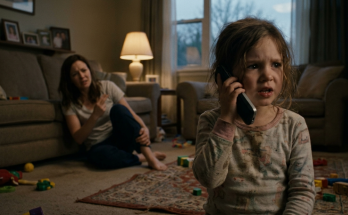
Five days after I gave birth, my husband told me, “You had the baby, you raise it.”
Then he turned up the television.
That was the part I never forgot.

Not the words, though they were cruel enough.
Not even his mother’s smile from the edge of my bed.
It was the remote in his hand.
The casual little press of his thumb, as if our newborn son were no different from the neighbor’s lawn mower or a dog barking down the street.
Just noise.
Something to drown out.
The bedroom smelled like warm formula, milk-soaked cotton, baby wipes, and the faint metallic edge of blood I was still too embarrassed to talk about out loud.
My shirt was damp against my skin.
My stitches pulled every time I shifted my feet.
The curtains were closed, but a line of late afternoon light cut across the carpet and landed on the burp cloth I had dropped an hour earlier and had not had the strength to pick up.
Noah had been crying for what felt like forever.
He was five days old.
Five days in the world, and already his father had decided he was somebody else’s responsibility.
“Daniel,” I whispered, because my voice had become one more thing my body could barely manage, “I need help.”
Daniel did not look away from the TV.
“I need sleep,” he said.
I almost laughed.
I had not slept more than forty minutes at a time since we brought Noah home from the hospital.
My body was still leaking, aching, swelling, burning in places I did not know could hurt all at once.
The hospital discharge packet was still on the dresser beneath Daniel’s keys, the top page circled in blue ink where the nurse had told him what warning signs to watch for.
Heavy bleeding.
Fever.
Severe pain.
Signs of postpartum depression.
He had nodded at the hospital intake desk like a good husband.
He had carried the car seat to the SUV while the nurse smiled and told us we had a beautiful baby.
He had buckled Noah in, kissed my forehead, and said, “We’ve got this.”
By the time we got home, “we” had become me.
His mother, Patricia, sat on the edge of our bed eating grapes from a glass bowl.
Her gold bracelets clicked together every time she reached for another one.
She had moved in the day after Noah was born.
People kept telling me I was lucky.
A mother-in-law in the house.
An extra pair of hands.
A woman who had raised a son and knew what she was doing.
But Patricia had not washed a single bottle.
She had not changed a diaper.
She had not held Noah so I could shower without hearing phantom crying through the water.
She had come to supervise.
To correct.
To sit in my bedroom eating fruit and judging how much pain made me inconvenient.
“In my day,” she said, “women didn’t complain every five minutes.”
I looked at her.
My vision had that sleepless shimmer around the edges, like the whole room was underwater.
“In your day,” I asked, “did men abandon their children too?”
Daniel finally turned.
His expression changed before his body did.
Flat first.
Then annoyed.
Then cold.
“Watch your mouth,” he said.
Noah cried harder against my chest.
I bounced him gently, because even angry, even shaking, even hurt beyond words, I knew exactly how fragile he was.
His little face was hot against my neck.
His fist opened and closed against my collarbone.
I looked at Daniel and tried to find the man I had married.
The one who brought me ginger ale in a paper cup when morning sickness hit in the grocery store.
The one who painted the nursery pale blue and got paint in his hair because he refused to tape the trim properly.
The one who cried in the hospital hallway after my first miscarriage and said he did not care how long it took, we would be a family someday.
We had been together six years.
Six years is long enough to build a language out of ordinary things.
A look across a crowded room.
A hand on the small of your back.
A gas station coffee left in your cup holder before work.
That was why his cruelty felt so unreal at first.
It wore the face of someone who once loved me well enough that I had trusted him with the rest of my life.
Patricia smiled.
“He’s tired of your drama,” she said. “You trapped him with that baby.”
Something inside me went quiet.
Not broken.
Quiet.
There is a kind of silence women learn when screaming would only feed the people waiting to call them unstable.
It is not surrender.
It is storage.
Daniel grabbed his keys from the dresser.
“I’m going out,” he said. “Don’t call me unless the house is on fire.”
I blinked at him.
“You’re leaving?”
He laughed.
“You wanted to be a mother so badly. Be one.”
Patricia lifted her chin.
“And stop acting like this is his problem.”
The room froze around those words.
The TV kept laughing.
Noah kept crying.
The sound machine on the changing table kept hissing fake ocean waves into a room where nobody was being soothed.
A burp cloth slid from my shoulder and dropped onto the carpet.
A bottle rolled slightly against the leg of the dresser, stopped, and stayed there.
Patricia watched me with the calm confidence of a woman who had never been told no by the son she raised.
Daniel watched me like I was something he could push back into place by looking irritated enough.
Nobody moved.
For one ugly heartbeat, I imagined picking up Patricia’s glass bowl and throwing it against the wall.
I imagined grapes scattering under the dresser.
I imagined Daniel flinching for once.
I imagined the relief of being loud enough to match what they had done.
Then Noah hiccupped against my chest.
That tiny sound brought me back to myself.
I had a baby in my arms.
I had stitches pulling in my body.
I had a husband showing me exactly who he was when he thought I was too weak to do anything with the information.
So I did not yell.
I did not beg.
I walked to the closet.
My legs shook with every step.
I pulled Noah’s diaper bag from the shelf and opened it on the bed.
Patricia made a little amused sound through her nose.
Daniel frowned.
“What are you doing?”
I packed formula samples first.
Then two clean sleepers.
A pack of wipes.
The soft blue blanket my mother had knitted in the last month of my pregnancy.
The pacifier Noah only sometimes accepted.
My discharge papers from the hospital.
The copy of Noah’s birth certificate request from the county clerk.
The postpartum care sheet Daniel had signed at the hospital intake desk after the nurse told him I was not supposed to be lifting, driving, or doing everything alone.
I placed each item carefully because moving too fast made pain flare low and sharp.
Then I opened the bottom drawer of my nightstand and removed the thin black folder.
Daniel’s eyes moved to it.
Not long.
Just a flicker.
But I saw it.
I had made a career out of flickers.
Before I became Daniel’s exhausted wife, before swollen ankles and nursery paint and tiny socks folded in pairs, I worked contract audits for small companies that could not afford to keep losing money quietly.
I found vendor payments that went to fake addresses.
I matched signatures across purchase orders.
I traced invoice numbers that skipped like stones.
I built timelines from bank statements, payroll exports, email headers, and men who thought women with soft voices did not understand spreadsheets.
Daniel knew that about me.
He used to brag about it.
“My wife can find a missing dollar in a hurricane,” he told people at backyard cookouts.
He stopped bragging when the missing dollars started pointing close to home.
Two months before Noah was born, I had found the first invoice.
Not because I was snooping.
Because Daniel had left his laptop open on the kitchen counter while I was making toast I could barely keep down.
A payment confirmation had popped up in the corner.
The vendor name was unfamiliar.
The amount was not.
It matched a transfer I had seen in our joint account three weeks earlier.
At 2:14 a.m., while Daniel slept beside me and Noah kicked hard under my ribs, I took photos of the screen.
I told myself there was probably an explanation.
Then I found the second one.
Then the third.
By the time I went into labor, I had screenshots, bank statements, invoice numbers, and a spreadsheet I kept in a password-protected folder Daniel did not know existed.
The thin black folder was not everything.
It was only enough.
“Where do you think you’re going?” Daniel asked.
“To my mother’s house.”
Patricia laughed.
“Go ahead,” she said. “You’ll crawl back by morning.”
I clipped Noah into his carrier.
He fussed once, then settled when I tucked the blanket around him.
My hands trembled only when his tiny fingers curled around mine.
I looked at him and felt something settle in me so cleanly it scared me.
I was not leaving to punish Daniel.
I was leaving because my son had just been shown what love looked like in that house, and I refused to let that be his first lesson.
Daniel stepped closer.
“You’re not taking my son anywhere.”
I looked up.
“Your son?”
The words landed harder than I expected.
Patricia stood.
Her bracelets clattered.
“Daniel, stop her.”
He reached for the car seat handle.
That was the moment the room changed.
He thought he was grabbing power.
He was grabbing evidence.
Because one of the pages in that folder was a copy of a bank statement mailed to Patricia’s address.
Another was a signed invoice connected to Daniel’s side account.
Another was a note I had written on hospital stationery while Noah slept in the bassinet beside me, listing every time Daniel refused care during the first five days after discharge.
Dates.
Times.
Witnesses.
9:17 p.m., Friday.
Daniel says, “You had the baby, you raise it.”
Patricia present.
Newborn crying.
Mother bleeding and under discharge restrictions.
People think documentation is cold.
It is not.
Sometimes documentation is the only warm thing left between you and people willing to rewrite your pain before the sheets are even changed.
I pulled the carrier back before Daniel could lift it.
His grip tightened.
Noah startled and wailed.
That sound snapped through me.
“Let go,” I said.
Daniel’s jaw flexed.
“Or what?”
I reached into the diaper bag, pulled out my phone, and showed him the screen.
The call timer was running.
Twenty-three minutes.
My mother had heard everything.
Daniel stared at the number.
Patricia stopped moving.
For the first time all evening, the TV laughter felt far away.
“I called her before I packed,” I said.
Daniel’s eyes narrowed.
“You think your mother scares me?”
“No,” I said. “But the person sitting with her might.”
That was not a bluff.
My mother worked part-time for a retired family attorney who still helped women prepare paperwork when they had nowhere else to start.
No exact office name.
No dramatic movie moment.
Just a woman with a printer, a legal pad, and forty years of knowing what men say when they think no one is writing it down.
Daniel’s grip loosened just enough.
I pulled Noah’s carrier fully into my arms.
Patricia’s face had changed.
The smugness was still there, but fear had slipped beneath it like a draft under a door.
“What is in that folder?” she asked.
I did not answer.
I walked out with Noah.
Every step down the hallway hurt.
Every step also felt like returning to my own body.
Daniel followed me to the front door.
He did not help.
He did not apologize.
He only watched me carry our son across the porch and down the driveway like he was trying to decide whether I was still too weak to matter.
A small American flag on the neighbor’s porch shifted in the evening air.
The sky had gone the pale blue-gray that comes right before dark.
My mother’s old SUV was parked at the curb because she had driven over after hearing the first ten minutes and then stayed back when I whispered, “Let me leave on my own.”
She got out when she saw me.
Her robe was under her winter coat.
Her hair was in a messy clip.
She did not say anything at first.
She just took the diaper bag from my shoulder before I could pretend I did not need help.
That was love.
Not speeches.
Weight removed.
At her house, the porch light was already on.
She had put a clean towel on the couch and a pillow beside it.
There was a paper coffee cup on the kitchen table, a phone charger plugged into the wall, and a yellow legal pad waiting beside a pen.
The retired attorney, Mrs. Hale, sat at the table in a navy cardigan, reading glasses low on her nose.
She did not look surprised.
Women like her rarely do.
“Sit,” she said gently. “Start from the hospital discharge.”
I sat.
Noah slept in his carrier beside my chair, worn out from crying.
My mother stood behind me with one hand on my shoulder.
I opened the black folder.
The first page was the hospital discharge sheet.
The second was my handwritten log.
The third was the copy of the county clerk receipt for Noah’s birth certificate request.
Then came the invoice.
Mrs. Hale’s expression sharpened.
“This is his signature?” she asked.
“Yes.”
“And this vendor?”
“Not real,” I said. “At least not in the way he thinks it looks real.”
My mother’s hand tightened on my shoulder.
She had known Daniel was failing me.
She had not known there was money involved.
That is the thing about betrayal.
There is always one layer designed for the family to see and another layer designed for the bank account.
At 9:28 p.m., Daniel called.
His name lit up my screen.
My mother looked at me.
Mrs. Hale slid the legal pad closer.
I answered and put him on speaker.
“Bring my son back,” Daniel said.
No hello.
No “Is Noah okay?”
No “Are you bleeding?”
Just ownership.
Mrs. Hale wrote one word on the legal pad.
Custody.
I looked at it and felt my throat tighten.
“You told me to raise him,” I said.
“I was angry.”
“You turned up the TV.”
Silence.
Then Patricia’s voice came through in the background.
“Tell her she has no money. Tell her she has nowhere to go.”
My mother covered her mouth.
Not because she was shocked by Patricia’s cruelty.
Because hearing it out loud made it real in a way even my tears had not.
Daniel said, “You’re being dramatic.”
Mrs. Hale wrote another note.
Minimizing.
I almost smiled.
Not because anything was funny.
Because I had spent years turning chaos into categories for other people, and now someone was doing it for me.
“Before you threaten me again,” I said, “you should know something.”
Daniel exhaled hard.
“What did you do?”
I pulled the second bank statement from the folder.
This was the one I had not wanted to believe.
The mailing address was Patricia’s.
The account had received transfers from Daniel’s business account.
Some were small enough to look harmless.
Some were not.
The oldest transfer was dated six months before Noah was born.
The memo line on one deposit matched an invoice I had copied at 2:14 a.m.
Patricia’s name appeared as an authorized contact.
Not owner.
Not innocent bystander either.
Contact.
The kind of word people use when they want distance without losing access.
“Patricia,” I said, loud enough for the phone to catch her, “did Daniel tell you I had copies?”
The silence changed.
It became crowded.
Daniel did not speak.
Patricia did not speak.
My mother whispered, “Emily.”
Mrs. Hale looked up from the legal pad.
“Ask again,” she said softly.
So I did.
“Patricia, did Daniel tell you I had copies of the invoices tied to the account at your mailing address?”
A chair scraped on Daniel’s end.
Patricia’s voice came back smaller.
“I don’t know what she’s talking about.”
That was the first lie she told badly.
Daniel said, “Emily, you need to calm down.”
There it was.
The oldest trick.
Make the woman’s tone the emergency so nobody has to look at the facts in her hand.
I looked at Noah sleeping beside me.
His mouth was open slightly.
His tiny chest rose and fell under the blanket.
For five days, I had wondered if I was failing because I could not make my body heal, my baby settle, and my husband care all at once.
But an entire room had tried to teach me that exhaustion was weakness.
It was not.
It was evidence of how long I had been carrying what Daniel refused to touch.
“Daniel,” I said, “I am not coming home tonight.”
“You don’t get to decide that.”
“Yes,” I said, and my voice finally sounded like mine again. “I do.”
Mrs. Hale nodded once.
My mother started crying then, quietly, with one hand pressed to her mouth.
Not collapsing.
Not wailing.
Just breaking in the private way mothers break when they realize their daughter waited too long to ask for help.
Daniel’s voice dropped.
“You think some papers make you safe?”
I looked at the folder.
At the discharge forms.
At the invoice copies.
At the bank statement with his mother’s address.
At the handwritten log that began five days after birth and ended with the sentence he thought would humiliate me.
You had the baby, you raise it.
“No,” I said. “I think the truth does.”
Mrs. Hale reached for the phone.
“Mr. Carter,” she said, her voice calm enough to make the whole kitchen colder, “this conversation is being documented. You will not threaten a postpartum mother while she is caring for a five-day-old infant.”
Daniel went silent.
Patricia whispered something I could not make out.
Mrs. Hale continued.
“If you want to discuss visitation, support, property, or finances, you may do so through proper channels. Tonight, you will let your wife and child sleep.”
For the first time since Noah was born, nobody asked me to be smaller.
Nobody told me to calm down.
Nobody called care a burden and abandonment a right.
Daniel finally spoke.
“This is my mother’s fault,” he said.
I closed my eyes.
There it was.
Not remorse.
Strategy.
Patricia gasped in the background.
“Daniel!”
He kept going.
“She got involved in things. She said it would be temporary. She said Emily wouldn’t notice until after the baby came.”
My mother’s hand left my shoulder.
Mrs. Hale’s pen stopped moving.
I opened my eyes.
The kitchen was painfully bright.
The porch light glowed through the window.
Noah slept through the moment his father gave away the one truth he had spent months hiding.
Patricia was not just cruel.
She was involved.
And Daniel, cornered by paperwork, had turned on her faster than he had ever turned toward me.
“Say that again,” Mrs. Hale said.
Daniel realized too late what he had done.
“I didn’t mean—”
“You said she told you Emily wouldn’t notice until after the baby came,” Mrs. Hale said. “Is that correct?”
No answer.
Only breathing.
Then Patricia started crying.
Not the soft kind.
The angry kind.
The kind that still believes it is owed comfort while standing in the wreckage it helped build.
“She was taking him from us,” Patricia said.
My eyes opened wider.
From us.
Not from Daniel.
Not from his father.
From us.
In that one phrase, I heard the entire shape of the house I had just left.
Patricia had not come to help with Noah.
She had come to take position.
She had watched me bleed and shake and beg for help because weakness made me easier to replace.
My mother stepped away from the table and walked to the sink.
She gripped the counter with both hands.
Her shoulders shook once.
Then she turned back around.
“You will never speak about my daughter like that again,” she said.
Her voice was not loud.
That made it stronger.
Daniel said nothing.
Patricia muttered, “She can’t keep him from us.”
Mrs. Hale looked at me.
“This is the part where you stop answering them tonight,” she said.
I nodded.
My hand hovered over the red button on the phone.
Daniel suddenly said my name.
“Emily.”
I paused.
There was something in his voice now that had not been there before.
Fear.
Not for me.
Not for Noah.
For himself.
“What exactly is in that folder?” he asked.
I looked down at it.
I thought of the woman I had been six years earlier, laughing in a grocery store parking lot while Daniel kissed my forehead.
I thought of the woman in the hospital bed, watching him sign discharge papers he never intended to honor.
I thought of the woman in the bedroom, bleeding through her shirt while Patricia ate grapes on her bed.
Then I thought of Noah.
Five days old.
Learning nothing yet except warmth, hunger, touch, voice.
I wanted the first story of his life to be this one.
Not that his mother was abandoned.
That his mother got up.
I ended the call.
The kitchen went quiet.
My mother came around the table and put both arms around me from behind.
I did not realize I was crying until I felt the tears hit my wrist.
Mrs. Hale closed the folder, but not before slipping a sticky note onto the top page.
Preserve originals.
Scan copies.
Do not return alone.
Those were not dramatic words.
They were better.
They were instructions.
The next morning, my mother drove me to a copy shop before sunrise while Noah slept in the back seat.
I wore the same gray sweatpants and one of her oversized hoodies.
My hair was greasy.
My body hurt.
But I stood at the copier and made clean duplicates of every page.
Hospital discharge forms.
County clerk receipt.
Bank statements.
Vendor invoices.
Screenshots with timestamps.
My handwritten care log.
The clerk behind the counter did not ask questions.
She only slid the warm stack of paper toward me and said, “Do you need a rubber band?”
I almost cried again at the kindness of that ordinary sentence.
By noon, Daniel had texted nine times.
First angry.
Then pleading.
Then blaming Patricia.
Then asking for photos of Noah as if he had not refused to hold him the night before.
I responded once.
Noah is safe. Communication about arrangements can be in writing.
Mrs. Hale approved the wording.
My mother approved the part where I did not add “you absolute coward.”
That restraint cost me more than I will admit.
Over the next week, the story Daniel had told himself began to fall apart.
Not all at once.
Men like Daniel do not collapse like buildings in movies.
They leak.
A contradiction here.
A deleted text there.
A sudden concern for the baby whenever someone else might be watching.
Patricia tried calling my mother.
My mother did not answer.
Patricia left a voicemail saying this was a misunderstanding, that new mothers were emotional, that Daniel needed support too.
Mrs. Hale saved it.
Daniel emailed me a list of things he claimed belonged to him, including the bassinet my mother bought and the unopened diapers from my baby shower.
Mrs. Hale saved that too.
He asked when I was coming home.
I did not answer.
Because home is not a place where a woman bleeds while two people debate whether her pain is inconvenient.
Home is where someone takes the diaper bag off your shoulder before you have to ask.
Three weeks later, Daniel saw the first formal paperwork.
I was not there when he opened it.
I did not need to be.
By then, I had learned that revenge is noisy, but protection is organized.
The filing included temporary custody requests, support documentation, and attached notes about postpartum care needs.
The financial folder went where it needed to go next.
Not to punish him for being a bad husband.
To stop him from turning lies into money and money into control.
Patricia sent one final message through Daniel’s phone.
You are tearing this family apart.
I read it while Noah slept on my chest, his breath warm against my collarbone.
For once, I did not shake.
I typed back nothing.
Some sentences do not deserve the dignity of a response.
Months later, people would ask me how I stayed so calm that night.
They imagined strength as something clean and dramatic.
They imagined me walking out like a movie scene, chin high, music swelling, the whole world understanding what had happened.
It was not like that.
I was in pain.
I was scared.
I could barely carry the car seat.
My milk was leaking through my shirt, my hands were shaking, and I cried so hard at my mother’s kitchen table that I had to press a burp cloth to my face so I would not wake the baby.
But I left.
That mattered more than how I looked doing it.
An entire room had tried to teach me that exhaustion was weakness.
I learned something different.
Exhaustion was proof that I had carried too much for too long.
And the moment Daniel said, “You had the baby, you raise it,” he thought he was giving me an insult.
He was actually giving me instructions.
So I raised him.
Not in Daniel’s house.
Not under Patricia’s bracelets and smirks and grape-bowl judgments.
Not beside a man who turned up the TV when his newborn cried.
I raised Noah in rooms where people answered when help was asked for.
I raised him around women who wrote things down, men who showed up, and a grandmother who could make a bottle with one hand while telling me to sleep with the other.
And Daniel learned, slowly and expensively, that silence had never meant surrender.
It meant I was listening.
It meant I was documenting.
It meant that when I finally spoke, I would not need to scream.
The papers would do that for me.