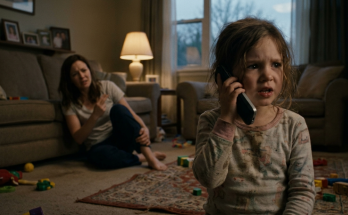

My husband let his mistress wear my robe while meeting our son.
Not just any robe.
The ivory silk one I had worn the morning after our wedding, the one embroidered in champagne thread with my initials over the heart: V.M.
Vivienne Montgomery.
My name. My marriage. My place in the story he thought he was powerful enough to rewrite.
Our six-year-old son, Oliver, stood in the doorway of Grant’s glass penthouse above Central Park, his tiny hand still wrapped around mine. His cheeks were pink from the March wind. His navy pea coat was buttoned wrong because he insisted on doing it himself in the car, and one of his curls had fallen over his forehead.
He stared at the woman reclining on my former cream sofa, holding my former crystal coffee cup, wearing my robe like she had earned the right to be soft in it.
Then he pointed at her chest.
“Why is she wearing your name?”
The room went so quiet I heard the ice crack in Grant’s tumbler.
Grant Montgomery, my husband of nine years, froze beside the marble bar with his wedding ring still on and his mistress’s lipstick still faint on his mouth.
The woman smiled.
Not nervously. Not apologetically.
Amused.
Like my child had said something cute. Like the theft of a life was a joke only adults understood.
I looked at my husband. I looked at her. I looked at the robe.
Then I looked down at my son.
“Oliver,” I said softly, “put your gloves back on.”
Grant stepped toward me. “Vivienne. Don’t make a scene.”
That was the first mistake he made that night.
Thinking I needed a scene.
Thinking revenge required screaming.
Thinking humiliation only mattered when it happened loudly.
I helped my son with his gloves. I buttoned the coat correctly. I picked up his dinosaur backpack from the entry table and ignored the way Grant’s mistress crossed one bare leg over the other, letting the silk fall open just enough to remind me she was not only wearing my name.
She was sleeping beside the man who had promised to protect it.
Oliver looked up at me, worried now. Children always understand weather before adults admit there is a storm.
“Are we still having dinner with Daddy?” he whispered.
“No, sweetheart,” I said. “We’re going home.”
Grant lowered his voice. “You can’t just take him. This is my scheduled visitation.”
I turned to him then.
I did not cry.
I did not shake.
I did not ask how long, or why her, or whether he loved her.
I had already learned that when a man betrays you, he will often offer explanations not to heal you, but to make himself feel less monstrous.
“The custody order says no unrelated romantic partners during visitation,” I said.
Grant’s face tightened.
The mistress’s smile faded by one inch.
I raised my phone, not dramatically, not with a flourish, just enough.
The photo captured everything.
The robe.
The initials.
The mistress.
My child standing in the doorway with confusion on his face and truth in his mouth.
Then I took Oliver home.
Without raising my voice.
By morning, the photo, the child’s statement, and the custody order were in my lawyer’s hands.
And by the time Grant Montgomery realized I had gone quiet, it was already too late.
Because I had built a life with him like a wife.
But I had protected myself like a widow.
CHAPTER 1 — THE SILK ROBE AND THE SMALL VOICE
People in Manhattan love glass.
Glass towers. Glass dining rooms. Glass walls overlooking skylines. Glass elevators where everyone can watch you rise.
They call it luxury.
I have always thought glass was a warning.
It makes people believe they are untouchable because they are visible. They forget that when the light changes, glass becomes a mirror.
Grant’s penthouse on West 59th was almost entirely glass. He bought it two years after our wedding, when Montgomery Development was finally solvent again, after the papers began calling him “the youngest real estate prince in New York.”
They never mentioned the wife who sat up with him through bankruptcy drafts.
They never mentioned the woman who sold the sapphire earrings her grandmother left her so payroll could clear before Christmas.
They never mentioned that the emergency capital came from a private holding company no one could trace to me because my grandmother, Eleanor Marlow, taught me early that women should never place their entire survival in the hands of a man who says, “Trust me.”
The world saw Grant Montgomery.
Golden boy. Yale jawline. Old Connecticut blood. A man who could walk into a ballroom and make donors open checkbooks by smiling like he had already forgiven them for being less important.
I saw the truth beneath the tuxedo.
The migraines after failed deals.
The rage when a journalist called him “overextended.”
The way he needed admiration the way other men needed oxygen.
For a long time, I mistook that need for ambition. I thought if I loved him gently enough, he would stop performing and finally rest.
That was the stupidest kind of love.
The kind that thinks exhaustion is intimacy.
The woman in my robe was named Sloane Whitaker.
I knew her name before she knew I knew it.
Thirty-one. Former event planner. Recently rebranded as a lifestyle consultant. Blonde in the expensive way that requires a colorist who charges more than a schoolteacher’s rent. She wore diamonds that were either borrowed or badly chosen, because people born into money understand restraint. People trying to appear born into money often mistake sparkle for status.
She had entered our orbit at the Harper Children’s Foundation gala the previous fall. Grant introduced her as “Sloane from sponsorship coordination,” and she laughed too brightly at everything he said.
I noticed.
Wives always notice.
We notice perfume in the wrong hallway. A second phone face down. New passwords. Sudden gym discipline. A man who used to complain about charity dinners now volunteering to attend committee lunches.
I noticed, but I waited.
Not because I was weak.
Because I had a son.
Because my attorney, Celeste Park, once told me, “When powerful men betray their wives, they expect emotion. Give them documentation.”
So I documented.
I documented the nights Grant claimed meetings ran late while his driver’s logs placed him in Tribeca.
I documented credit card charges at a boutique hotel in SoHo under the corporate entertainment account.
I documented the rose-gold bracelet purchased from Cartier and expensed through a “client gift” category.
I documented because I had learned from the women before me that pain without proof becomes gossip, but pain with exhibits becomes leverage.
Still, I had not expected him to bring her near Oliver.
That crossed a line so bright even he should have seen it.
After I took Oliver home from the penthouse, he fell asleep in the back seat halfway down Fifth Avenue. Manhattan blurred around us in ribbons of gold and red. Streetlights slid across his face. He looked so small beneath his dinosaur blanket, so trusting in the silence.
Our driver, Mr. Ellis, did not ask questions. He had worked for my grandmother before he worked for me, and he understood the dignity of silence.
At our townhouse on East 72nd, I carried Oliver upstairs myself. He woke briefly when I eased off his shoes.
“Mommy,” he murmured.
“Yes, baby?”
“Was that lady pretending?”
My throat closed.
I had prepared myself for rage, for legal strategy, for the icy clarity required to dismantle a man in court.
I had not prepared myself for my child trying to make sense of imitation.
I brushed his curls back.
“Sometimes adults make confusing choices,” I said. “But you do not have to worry about them tonight.”
“She had your letters.”
“Yes.”
“Did she steal them?”
I sat very still on the edge of his bed.
Children are not naive. They are precise. Adults complicate things to survive them. Children name the shape of the wound.
I kissed his forehead. “She wore something that did not belong to her.”
He considered this, sleepy but solemn.
“Then you should get it back.”
“I will,” I whispered.
He slept after that, one hand tucked beneath his cheek.
I stood in his doorway for a long time.
The townhouse was quiet around me, all limestone and shadow. It had belonged to my grandmother, though Grant liked to imply it was a Montgomery residence because men like him believe proximity is ownership.
Downstairs, in the library, I poured one inch of scotch into a crystal glass and did not drink it. I placed my phone on the desk and opened the photograph.
There she was.
Sloane in ivory silk.
Grant in the background.
Oliver at the edge of the frame, confused and heartbroken in the way only children can be heartbroken: without knowing yet that they will remember it forever.
I sent the image to Celeste Park at 9:47 p.m.
Then I sent a voice memo, quiet and exact.
“Grant violated section four of the temporary custody agreement. Romantic partner present during visitation. Partner wearing my personal property. Child witnessed and asked why she was wearing my name. I removed him peacefully. Please file emergency review.”
Celeste responded three minutes later.
Noted. Do not engage with Grant tonight. Preserve all messages. I’ll be in chambers by eight.
At 9:56, Grant called.
At 9:57, he called again.
At 10:02, a text.
You overreacted.
At 10:05.
Sloane didn’t know the robe was yours.
At 10:08.
Oliver is too young to understand any of this.
That one made me smile.
Not because it was funny.
Because it proved he was afraid.
Men like Grant only remember children are innocent after using them as props.
At 10:14, he tried a new tactic.
You’re going to embarrass yourself if you make this public.
I set the phone facedown.
Embarrassment.
That was the currency Grant believed in most. His entire life was built around avoiding it, outsourcing it, transferring it to women, assistants, contractors, tenants, anyone beneath the shine.
He thought I feared it too.
Once, I had.
I feared being the divorced woman at the charity luncheon.
The wife whispered about in powder rooms.
The mother judged for failing to keep a family whole.
But humiliation does something useful when it reaches the bone.
It burns away performance.
At 11:30, I opened the safe behind the third shelf in the library.
Inside were passports, property deeds, trust documents, two velvet boxes, and a slim black binder labeled M.H.
Marlow Holdings.
My grandmother’s final lesson.
I was twenty-three when she taught me how to read a balance sheet and twenty-four when she died, leaving behind not just money but structure. Structures matter more than money. Money can be stolen, wasted, seduced. Structure survives greed.
Marlow Holdings owned pieces of things.
Quiet pieces.
Minority stakes in hotels. Silent positions in development loans. Land options in neighborhoods men like Grant bragged about “discovering” after women like my grandmother had already bought the debt.
When Grant’s company nearly collapsed seven years ago, a private investment fund rescued him.
He never knew that fund was mine.
He called the investor “some old-money shark with taste.”
I called her Grandma.
I pulled out the folder Celeste had prepared eighteen months earlier, when I first suspected Grant’s affair and quietly asked what would happen if my marriage became war.
The answer was written in tabs.
Custody.
Prenup.
Infidelity clause.
Separate property.
Corporate exposure.
Reputational risk.
Hidden liabilities.
People think revenge is impulsive.
Real revenge is administrative.
It has page numbers.
By midnight, I had reviewed every clause.
By one, I had sent Celeste six additional documents.
By two, I stood barefoot in the library, looking at the portrait of Eleanor Marlow above the fireplace.
She had been painted at sixty, in black satin, one hand resting on the back of a chair as if she had just decided not to sit.
When I was sixteen, crying because a boy at boarding school had kissed me in private and mocked me in public, she handed me a linen handkerchief and said, “Vivienne, never confuse being wounded with being powerless. The first is temporary. The second is often a lie men need you to believe.”
I did not sleep that night.
At dawn, I showered, dressed in charcoal cashmere, and made Oliver pancakes shaped like lopsided stars.
He laughed because one looked like a fish.
That laugh saved me from becoming cruel in the wrong direction.
I wanted to destroy Grant.
But not at the cost of becoming someone my son would one day fear.
There is a difference between revenge and justice.
Revenge wants blood.
Justice wants receipts.
At 8:12 a.m., Celeste called.
Her voice was crisp, surgical, soothing in the way only terrifying attorneys can be.
“We have enough for an emergency custody motion,” she said. “The photograph is strong. Oliver’s statement will need to be handled carefully, likely through a child specialist, not directly by us. But Grant violated the order.”
“Good.”
“There’s more,” she said.
I looked out the kitchen window. Snow had begun falling lightly over the courtyard.
“What?”
“I reviewed the corporate documents you sent last night. There are irregular transfers from Montgomery Development to Whitaker Lifestyle Group. Monthly consulting payments. Significant ones.”
“Sloane has a company?”
“She has an LLC,” Celeste said. “Barely. It was formed eleven months ago.”
Eleven months.
The gala had been six months ago.
I closed my eyes.
Of course.
The affair had not begun when I noticed it.
Betrayal never begins when the wife notices.
That is only when the room finally smells like smoke.
“How much?” I asked.
“Two hundred forty thousand over the last year, maybe more through pass-through vendors.”
“For what services?”
“That is the elegant part,” Celeste said. “There don’t appear to be any.”
I opened my eyes.
Outside, the snow fell harder.
Inside, something in me went perfectly still.
Grant had not just brought his mistress into my home life.
He had possibly paid her with corporate funds from a company tied to investors, loans, and assets I quietly controlled.
He had placed his betrayal inside my jurisdiction.
Celeste continued, “Vivienne, I know you want custody addressed first. But if we pull the financial thread, this becomes much bigger.”
I watched Oliver at the breakfast table, carefully drowning a pancake in syrup.
My son had seen a woman wearing my name.
Now I would show him what it meant to defend one.
“Pull it,” I said.
CHAPTER 2 — THE WIFE WHO STOPPED BLEEDING IN PUBLIC
Grant learned quickly that I was not answering his calls.
So he did what men do when private control fails.
He tried public pressure.
The first leak appeared on a Tuesday afternoon, buried in a society column that pretended not to be paid gossip.
Sources close to the Montgomery family say Vivienne Montgomery has grown increasingly isolated amid divorce tensions, raising concerns about whether the couple’s young son is being used as leverage.
I read it in the back of a black town car outside Oliver’s school.
My hands did not tremble.
Not even when I reached the phrase “emotionally volatile.”
Not even when I saw the accompanying photograph of me from three years earlier, leaving a hospital after my miscarriage, pale and hollow-eyed behind sunglasses. They had cropped out Grant’s hand on my elbow. They had cropped out grief until it looked like instability.
That was Grant’s signature.
He did not invent lies.
He rearranged truths until they served him.
I forwarded the article to Celeste.
Her reply came quickly.
Good. He’s panicking.
That evening, at pickup, two mothers looked away when I approached. One whispered behind a coffee cup. Another smiled too brightly and asked whether I was “holding up.”
Holding up.
A phrase people use when they want to inspect your damage without seeming hungry.
I smiled back.
“Beautifully, thank you.”
Oliver ran into my arms wearing a paper crown from art class.
The crown said KING OF MATH in glitter glue.
I bowed dramatically. “Your Majesty.”
He giggled. “Mommy, you have to be the queen.”
“Always,” I said.
From across the sidewalk, I saw Sloane.
She stood beside a silver Range Rover, wearing a camel coat, oversized sunglasses, and the expression of a woman who had mistaken access for arrival.
Grant was not with her.
That was deliberate.
She wanted me to see her.
She wanted the school mothers to see me seeing her.
For a moment, the entire sidewalk seemed to hold its breath.
Sloane lifted her hand.
A tiny wave.
Almost friendly.
Almost obscene.
I looked at her for exactly one second.
Then I looked through her, as if she were a stain on glass, and opened the car door for my son.
That night, my phone lit with another text from Grant.
You’re making this ugly.
I replied for the first time.
No, Grant. I’m making it documented.
He did not respond.
The next morning, Celeste’s investigator delivered a preliminary report to the townhouse. His name was Amos Reed, a former forensic accountant with a face like weathered stone and the softest voice I had ever heard.
“People assume mistresses are expensive because of jewelry,” Amos said, laying papers across my dining table. “But jewelry is amateur hour. Real money hides in invoices.”
There were invoices.
Consulting retainers.
Brand strategy.
Event alignment.
Lifestyle partnership development.
All billed from Whitaker Lifestyle Group to Montgomery Development or its subsidiaries.
Sloane had been paid through five different entities for work no one could prove she performed.
Worse, several payments were attached to projects financed through investor funds with restrictions. One of those projects involved affordable housing credits. Another involved a hotel redevelopment where Marlow Holdings owned a silent debt position.
Grant had used business channels to bankroll his affair.
Men like him always think rules are for people without family names.
Amos tapped one page.
“This transfer is the problem. Seventy-five thousand, routed through a vendor, then to Whitaker, then used as a down payment on a condominium in Miami.”
I frowned. “Sloane bought property?”
“Not exactly. The deed is held by an LLC. Manager of record is Sloane Whitaker. Beneficial owner is hidden.”
“Grant?”
“Likely,” Amos said. “But there’s more.”
He slid another page toward me.
The LLC had a familiar address.
A law firm in Delaware.
The same firm Grant used to create special-purpose entities for Montgomery Development.
I stared at the paper until the words sharpened.
Grant had not just paid Sloane.
He had built her an exit.
A condo. A company. A role. A costume.
My robe.
My life, copied in cheaper fabric and funded through stolen channels.
The old version of me might have broken then. She might have gone upstairs, locked the bathroom door, and sobbed into towels so Oliver would not hear.
I did not.
Pain had become a room I knew how to walk through.
“Keep going,” I told Amos.
He nodded, almost approvingly.
A week later, the emergency custody hearing happened in a private courtroom downtown.
Grant arrived in navy Tom Ford, jaw shaved clean, his sadness tailored perfectly. His attorney, Warren Kline, was the sort of man who used the word “unfortunate” when he meant “damaging.”
Sloane did not attend.
Cowardice often has good legal instincts.
Grant looked at me across the courtroom with practiced sorrow.
As if we were both victims of my reaction.
When the judge reviewed the photo, her expression did not change. Judges are trained not to react. But I saw her look once at Oliver’s small face in the frame, then at the embroidered initials on the robe.
Warren Kline argued that the encounter had been brief, accidental, harmless.
“Ms. Whitaker was present in the home for a matter of minutes,” he said. “The child was not endangered.”
Celeste stood.
She wore a black suit with a single pearl at her throat. Celeste never raised her voice either. That was why I hired her.
“The issue is not whether the child was physically endangered,” she said. “The issue is whether Mr. Montgomery willfully violated a court order designed to protect a six-year-old from emotional confusion during a high-conflict separation. The photograph shows Ms. Whitaker in intimate attire, wearing Mrs. Montgomery’s personalized garment, during scheduled visitation.”
Grant’s jaw moved.
Celeste continued. “The child spontaneously asked, ‘Why is she wearing your name?’ That statement was documented immediately, and Mrs. Montgomery removed him without confrontation.”
The judge turned to Grant.
“Mr. Montgomery, did you understand the visitation restriction?”
Grant swallowed.
“Yes, Your Honor.”
“And did Ms. Whitaker spend the night before the visitation in your residence?”
His attorney stood. “Your Honor—”
The judge looked at him.
He sat.
Grant’s silence answered.
The order changed that afternoon.
Supervised visitation.
No third-party romantic partners.
No overnight contact.
Mandatory co-parenting counseling.
Grant’s face went gray.
He could survive losing me.
He could survive losing money.
But supervision?
That word would bruise his image.
After court, in the hallway, he cornered me beside a marble column.
Celeste took one step closer, but I lifted a hand.
Grant’s voice was low. “You’re enjoying this.”
I looked at the man I had once loved so much I learned the rhythm of his breathing in sleep.
“No,” I said. “That’s what makes us different.”
His eyes hardened.
“You think this makes you powerful?”
“No, Grant. I was powerful before. This made me finished.”
For the first time, I saw real fear in his face.
Not fear of losing me.
Fear that he had underestimated me.
That evening, my grandmother’s old friend, Lydia Ashcroft, invited me to tea at the Plaza.
Lydia had been widowed three times, each husband richer than the last, though she insisted it was not her fault that men with weak hearts kept proposing.
She wore emeralds at four in the afternoon and could ruin a reputation with a pause.
We sat beneath the palm court chandeliers while tourists took photos and women with excellent facelifts pretended not to recognize me.
Lydia stirred her tea.
“I hear Grant has acquired a little blonde problem.”
I sipped mine. “The blonde is not the problem.”
“No?”
“The arrogance is.”
Lydia smiled. “Good. Then you’re looking in the right direction.”
I said nothing.
She leaned closer. “Do you know why your grandmother survived men who were smarter, richer, and crueler than Grant Montgomery?”
“Because she was smarter than they were.”
“No, darling. Because she let them believe she wasn’t until the paperwork was signed.”
From her handbag, Lydia removed a cream envelope.
Inside was an invitation.
The Montgomery Legacy Foundation’s spring gala.
Grant’s crown jewel. The annual event where developers, bankers, politicians, and socialites gathered beneath chandeliers to applaud philanthropy and negotiate greed between courses.
This year, Grant was receiving the foundation’s Civic Vision Award.
I almost laughed.
Lydia watched me.
“He’s bringing her,” she said.
“To the gala?”
“Of course. Men like Grant confuse shamelessness with strategy. He’ll present her publicly enough to humiliate you, but not explicitly enough to be accused of cruelty. He wants you either absent or emotional.”
I looked at the invitation.
Black tie.
The Plaza Hotel.
Saturday, April 18.
“Will the board allow that?”
“The board allows money. Morality is decorative.”
I traced the raised lettering with one finger.
Once, I would have stayed home. I would have preserved dignity by disappearing.
But disappearance is what men count on.
A humiliated woman is expected to hide.
A powerful woman attends.
“I’ll be there,” I said.
Lydia’s smile widened.
“Wear black.”
CHAPTER 3 — THE GALA WHERE EVERYONE SAW THE WRONG WOMAN
In the weeks before the gala, Grant’s campaign intensified.
He posted photos with Oliver from supervised visits cropped carefully so the supervisor’s shoulder never appeared.
He gave an interview about “the importance of family legacy.”
He allowed himself to be photographed leaving lunch with Sloane at Le Bilboquet, her hand resting lightly on his arm, her diamond bracelet catching the sun like a confession.
The bracelet was the Cartier one.
Corporate gift.
My exhibit B.
Society reacted exactly as society always does when a wealthy man behaves badly.
With curiosity disguised as concern.
Invitations still arrived at my townhouse.
Flowers arrived too.
Some from women who meant well.
Some from women who wanted to know whether I was bleeding on the rug.
I sent thank-you notes to all of them.
Handwritten.
Cream stationery.
Black ink.
Never give enemies the satisfaction of seeing your manners die before your marriage does.
Meanwhile, Celeste, Amos, and I worked.
The financial thread became a rope.
Then a noose.
Montgomery Development had been inflating vendor costs on three projects. Funds moved through shell consultants, then into accounts linked to Sloane, Grant’s personal expenses, and one offshore account in the Cayman Islands under a trust name that made Celeste laugh once without humor.
“Montrose Family Preservation Trust,” she read aloud.
“Subtle,” I said.
“Men committing fraud love words like preservation.”
There was also the matter of the Miami condo. Amos confirmed the beneficial owner through a banking contact and subpoena-ready records. Grant had funded the purchase, but Sloane was listed as manager. The condo was not only a love nest. It was an asset shield.
Grant intended to divorce me, appear financially burdened, reduce settlement exposure, and continue life with Sloane in a property he believed I would never find.
But Grant had made one devastating mistake.
He had used Montgomery Development’s revolving credit facility to move cash.
That facility was secured by debt partly owned by Marlow Holdings.
My company.
My grandmother’s ghost.
My teeth.
When Celeste explained the strategy, I sat in her office overlooking Bryant Park and listened as sunlight cut across the conference table.
“We can pursue this several ways,” she said. “Divorce court, civil action, corporate default, possible criminal referral if the investor misuse is as clear as it appears. But timing matters.”
“Because of the gala.”
“Because of the gala,” she confirmed. “He’s receiving an award in front of every lender, board member, and political ally he needs. Publicly humiliating him without legal foundation could backfire. But if certain filings become available that morning…”
“He walks into the ballroom already ruined.”
“Not ruined,” Celeste said. “Exposed.”
I looked at her.
She smiled faintly.
“Ruin is what people do to themselves before the evidence arrives.”
There was another development.
Damon Vale returned to New York.
I had not seen Damon in eleven years, though his last name still lived inside my maiden name like a door I had chosen not to open.
No relation, despite the teasing we endured at twenty-two. We met in graduate school at Columbia, both scholarship kids orbiting old money with careful posture. Damon was from Pittsburgh steel country, the son of a union electrician and a nurse. He wore thrifted jackets and read contracts like poetry. I wore inherited pearls and pretended I knew how not to be lonely.
We almost loved each other.
Then my grandmother got sick.
Then Grant Montgomery appeared with certainty, roses, and a family name that made hospital administrators answer calls faster.
Damon left for London banking.
I married Grant.
Some doors close quietly enough that you can pretend they were never doors.
Damon contacted me through Celeste, not personally.
That was typical of him. Precise. Respectful. Infuriating.
His firm had acquired distressed real estate debt in the United States. One of their analysts noticed irregularities in Montgomery Development’s financing stack. He recognized my connection through Marlow Holdings and asked whether we needed independent support.
Celeste invited him to the townhouse for a meeting.
He arrived on a rainy Thursday wearing a dark overcoat and carrying no umbrella, as if weather had tried and failed to inconvenience him.
He looked older, of course.
So did I.
But age had sharpened him elegantly. Silver at the temples. Calm eyes. A face that had learned not to reveal the first thought.
“Vivienne,” he said.
“Damon.”
For one second, the room remembered us.
Then Celeste cleared her throat.
We worked for three hours.
Damon understood debt structures the way surgeons understand arteries. He found pressure points Grant did not know existed. A covenant breach. A reporting violation. A personal guarantee triggered by fraudulent transfer. A clause allowing noteholders to demand immediate cure or assume control.
“Grant thinks his family name protects him,” Damon said, reviewing the documents.
“It usually has.”
Damon looked up. “Names are useful on invitations. Less so in court.”
I should not have liked how that sounded.
But I did.
After Celeste left, Damon stayed behind in the library, looking at my grandmother’s portrait.
“She would have liked this room,” he said.
“She designed it.”
“Of course she did.”
I poured tea because scotch felt too cinematic and I was trying to avoid becoming a woman in a revenge commercial.
Damon accepted the cup.
“I’m sorry,” he said.
“For Grant?”
“For the part that happened before the paperwork.”
That nearly undid me.
Not “sorry about the divorce.”
Not “sorry he cheated.”
But sorry for the invisible part.
The nights I must have felt him leaving before he left. The humiliation of suspecting and still setting the table. The quiet violence of being replaced in increments.
I looked down at my tea.
“Thank you.”
Damon did not touch me.
That was why I trusted the moment.
Grant always touched when words failed, as if my body were a handle he could use to move me.
Damon let silence stand.
The night of the gala arrived cold and glittering.
I wore black.
Not mourning black.
War black.
A column gown of silk velvet with a high neck, bare back, and no jewelry except my wedding ring on my right hand, turned inward so the diamond faced my palm. My hair was swept into a low knot. My lipstick was the color of dried roses.
Lydia Ashcroft sent a car with a note.
Do not arrive early. Queens are never the first in the room.
At 8:17 p.m., I stepped into the Plaza ballroom.
Conversations thinned.
Not stopped. These people were too trained for that.
But thinned.
I felt heads turn like flowers toward flame.
The ballroom glowed with obscene beauty. Gold ceiling. Crystal chandeliers. White orchids spilling from silver urns. Champagne towers. Men in tuxedos laughing with mouths full of secrets. Women in gowns sharp enough to cut glass.
And there, near the center of the room, stood Grant.
With Sloane.
She wore red.
Of course she did.
A strapless satin gown, diamonds at her throat, blonde hair over one shoulder. She looked expensive from a distance and frantic up close. The robe incident had taught her nothing except the thrill of being seen.
Grant saw me.
His smile faltered, then returned harder.
He crossed the room with Sloane on his arm, performing graciousness for the audience.
“Vivienne,” he said warmly. Too warmly. “I wasn’t sure you’d come.”
“I was invited.”
Sloane extended a hand.
“Vivienne,” she said. “It’s good to finally speak properly.”
Properly.
The audacity of mediocre women is often borrowed from arrogant men.
I took her hand.
Her fingers were cold.
“Sloane,” I said. “How is Miami?”
Her smile died.
Only for a second.
But Grant felt it. His eyes snapped to mine.
I released her hand.
The first crack had opened.
Dinner was served beneath candlelight. I sat at table twelve between Lydia and a senator who owed my grandmother a favor from 1989 and still seemed afraid of her. Across the room, Grant laughed too loudly. Sloane kept touching her necklace.
At 9:05, Celeste texted.
Filed.
At 9:07, Amos texted.
Service confirmed at registered agent.
At 9:10, Damon, who was not attending but was apparently watching the timing like a battlefield commander, texted one line.
Covenant notices delivered to lenders.
I placed my phone facedown and took a sip of water.
Lydia leaned close. “Is the knife in?”
“Several.”
“Good girl.”
At 9:30, Grant took the stage to accept his Civic Vision Award.
The applause was generous because people applauding wealth often confuse volume with loyalty.
Grant stood beneath the spotlight, handsome and doomed.
He spoke about legacy.
He spoke about responsibility.
He spoke about children being the future.
I almost admired the nerve.
Then, halfway through his speech, phones began lighting up across the ballroom.
Not all at once.
That would have been vulgar.
One by one.
A banker near the front frowned at his screen.
A board member leaned toward his wife.
A councilman stopped smiling.
At the press table, a reporter looked up sharply.
Grant noticed.
His rhythm broke.
“As I was saying,” he continued, “our commitment to ethical development—”
A sound moved through the room.
Not a gasp.
A ripple.
The sound of private information becoming public enough to be dangerous.
Celeste had filed the divorce motion, custody enforcement supplement, and preservation request that afternoon under seal where appropriate, but the corporate default notices were not sealed. Neither were the emergency injunction requests involving asset transfers tied to investor funds.
By 9:34, half the room knew Montgomery Development had been accused of misusing funds.
By 9:36, several knew the mistress standing beside his reserved seat was connected to the payments.
By 9:37, Grant knew they knew.
That was when Warren Kline, his attorney, appeared near the side stage, pale and whispering urgently to an aide.
Grant stopped speaking.
The silence was exquisite.
Then Sloane stood.
I think she meant to leave discreetly.
But red satin does not disappear in a white orchid ballroom.
Every eye followed her.
She took three steps toward the exit before a woman from the foundation board murmured, too loudly, “Is that her?”
Someone else said, “The consultant?”
A man laughed once into his napkin.
Sloane’s face flushed crimson.
For a moment, I saw not the mistress, not the costume, not the thief in my robe.
I saw a woman who had believed a man’s promises because they came wrapped in wealth.
It did not soften me.
But it clarified the hierarchy of blame.
Grant descended from the stage without finishing his speech.
The award remained on the podium, gleaming under the lights like evidence.
He came directly to my table.
Lydia sat back, delighted.
“Outside,” Grant said under his breath.
I dabbed the corner of my mouth with a napkin.
“No.”
“Vivienne.”
The senator beside me suddenly found his wine fascinating.
Grant leaned closer. “You have no idea what you’ve done.”
I looked up at him.
“Yes,” I said. “I do.”
His face twisted.
“You think you can take my company?”
“No, Grant.”
I stood.
The room pretended not to watch.
“I already owned the part that mattered.”
He went still.
That was the moment he understood the shape of the trap.
Not all of it.
Enough.
His voice dropped to a whisper.
“Marlow.”
I smiled for the first time that evening.
“My grandmother sends her regards.”
CHAPTER 4 — THE HOUSE OF CARDS HAD MY SIGNATURE UNDER IT
Grant came to the townhouse at midnight.
Not to apologize.
Men like Grant do not apologize at midnight. They negotiate.
Mr. Ellis called from the front hall to say Mr. Montgomery was at the door. I told him to let Grant wait outside for three minutes, not because I needed the time, but because consequences should have a foyer.
When Grant entered the library, his tuxedo tie was undone and rain darkened the shoulders of his coat. For the first time in years, he looked less like a portrait and more like a man.
I sat behind my grandmother’s desk.
Celeste sat to my right.
Damon stood near the window, hands in his pockets, saying nothing.
Grant saw him and laughed without humor.
“Of course.”
Damon did not respond.
Grant looked at me. “Is this what it was? Some long revenge fantasy with your college almost-boyfriend?”
Celeste sighed. “Mr. Montgomery, speak carefully.”
He ignored her.
“You’re going to destroy our family over a mistake?”
I tilted my head.
“A mistake is leaving your phone in a taxi. You built a payment structure.”
His mouth tightened.
“You don’t understand business.”
I almost smiled.
There it was.
The oldest lullaby men sing to women before robbing them.
“Explain it to me,” I said.
He looked at Celeste, then Damon, then back at me. His calculation was almost visible. Charm would not work. Anger had witnesses. Vulnerability might.
He softened his face.
“Vivienne,” he said, and for a second his voice resembled the man I married. “I handled things badly. I hurt you. I can admit that. But if you push this, hundreds of employees suffer. Projects collapse. Investors panic. Is that what you want?”
It was a clever move, making his consequences look like my cruelty.
I opened a folder.
“Montgomery Development’s payroll account was protected before the notices went out. Employee wages are covered for ninety days through escrow. Critical contractors were contacted. Affordable housing commitments can be transferred to a compliant operator if needed.”
Grant stared.
Damon spoke then, calm and lethal.
“The workers are not your shield.”
Grant turned on him. “Stay out of my marriage.”
Damon’s eyes did not move from his.
“I’m here for the debt.”
The words landed like a blade between ribs.
Grant looked back at me.
“What do you want?”
That question.
At last.
Not “What are you feeling?”
Not “How can I fix this?”
What do you want?
Because now I had power, and power is the only language men like Grant believe is real.
“I want full legal custody with structured visitation determined by a child specialist. I want the divorce settled under the infidelity and misconduct clauses. I want all marital assets frozen pending review. I want you to resign from Montgomery Development until the investigation is complete.”
He laughed. “Absolutely not.”
I slid the next paper forward.
“Then Marlow Holdings and associated noteholders will accelerate the debt at 9:00 a.m.”
His face changed.
There are moments when a person ages in public. Not gradually. Not gracefully. A collapse behind the eyes.
Grant picked up the paper.
“You can’t.”
“I can.”
“My father will fight this.”
“Your father’s trust is overleveraged.”
His hand tightened around the document.
That was the next secret.
The Montgomerys were not as rich as people believed. They owned beautiful things with debt beneath them. Horses, houses, club memberships, foundation plaques, all mortgaged against reputation.
Reputation is an asset until it becomes a liability.
Grant sank into the chair across from me.
For one suspended second, I remembered him at thirty, laughing in the rain outside City Hall because we had forgotten the umbrella. I remembered him holding Oliver for the first time, crying so hard he had to sit down. I remembered the man he could have chosen to be if admiration had not eaten him alive.
Grief passed through me.
Not for the marriage.
For the version of myself that had kept waiting for him to return to his best moment.
“You planned this,” he said.
“No. You created this. I prepared for it.”
Celeste pushed another document forward.
“There is also the matter of Mrs. Montgomery’s personal property.”
Grant frowned.
“The robe?” he said, disgusted. “This is about a robe?”
“No,” I said. “That is your problem. You keep thinking symbols are small because you do not respect what they represent.”
Celeste opened a photograph.
Not the one from the penthouse.
This was an inventory image from the townhouse safe room, dated eighteen months earlier for insurance purposes. The ivory robe was listed under personal inherited textiles and couture, part of the Marlow family archive.
Grant stared at it.
I said, “That robe did not come from the penthouse closet.”
He looked up.
“It was stored here,” I continued. “In a locked cedar cabinet in my dressing room. Separate property. Insured. Photographed. Catalogued.”
Celeste added, “The housekeeper’s statement confirms Mrs. Montgomery last saw it in the townhouse three weeks before the incident. Security logs show Mr. Montgomery entered the residence while Mrs. Montgomery and Oliver were in Boston for a pediatric appointment. He used an access code that was not authorized for personal removal of property.”
Grant’s face lost color.
The robe had not been an accident.
He had taken it.
Not Sloane.
Grant.
He had entered my home, removed my intimate property, and given it to his mistress.
That was the cruelty I had not allowed myself to imagine.
He did not just let her wear my name.
He dressed her in it.
Damon looked out the window, jaw tight.
Celeste’s voice remained even.
“We are prepared to include unlawful removal of separate property and intentional emotional harm in the filings.”
Grant stood abruptly.
“That’s insane. It’s a piece of clothing.”
I stood too.
“No. It was a message.”
His breathing grew rough.
“You think you’re better than her? Sloane loves me without all this ice.”
There it was.
The final smallness.
A man drowning in consequences still trying to compare the women.
“I hope she does,” I said. “She’ll need something to hold onto.”
He moved toward the door.
Then stopped.
“If you do this, I’ll make sure Oliver knows you destroyed me.”
The room changed.
Not dramatically.
But enough that Celeste sat straighter, and Damon turned from the window.
I walked around the desk until I stood close enough to see the burst blood vessel in Grant’s left eye.
“Listen carefully,” I said. “You may lie to society. You may lie to investors. You may lie to women who think your attention is a ladder. But you will not put your poison in my child’s mouth.”
His face hardened.
“Or what?”
I smiled.
That was the only warning he got.
The next morning, Grant refused to sign.
So Marlow Holdings accelerated.
By noon, Montgomery Development’s board called an emergency meeting.
By two, Grant had been asked to take a temporary leave.
By four, Sloane’s LLC accounts were frozen pending inquiry.
By six, every society woman who had whispered behind coffee cups was sending me heart emojis and prayer hands.
I ignored them all.
The next three weeks were not glamorous.
People imagine revenge as a single dramatic reveal, a woman in diamonds turning away as chandeliers tremble.
The truth is revenge is mostly paperwork, therapy appointments, stomachaches, and phone calls with accountants.
Oliver began seeing Dr. Hannah Bell, a child psychologist with gentle eyes and a room full of wooden animals. She helped him name feelings without forcing him to carry adult explanations.
He told her, apparently, that Daddy’s house felt “like a stage.”
When Dr. Bell shared that with me, I cried in the car afterward for seven minutes.
Then I fixed my mascara and went to a deposition.
Grant’s deposition was a masterpiece of arrogance under pressure.
He claimed the payments to Sloane were legitimate consulting fees. When asked to describe her deliverables, he said, “Brand atmosphere.”
Celeste paused.
Even the court reporter looked up.
“Mr. Montgomery,” Celeste said, “can you define brand atmosphere in measurable terms?”
He could not.
Sloane’s deposition came two days later.
I did not attend in person. Celeste advised against it. But I read the transcript that night with a glass of wine untouched beside me.
At first, Sloane performed.
She claimed she and Grant were “emotionally connected.”
She claimed she believed my marriage was “functionally over.”
She claimed the robe was “just something Grant had at the penthouse.”
Then Celeste showed her the insurance inventory.
Then the security log.
Then the payment records.
Sloane’s answers got shorter.
By page 143, she asked for a break.
By page 147, her attorney requested a private discussion.
By page 162, the story changed.
Grant had told her the robe was a gift he had bought for her.
Grant had told her the initials stood for “Vérité Maison,” a fake luxury line he claimed he was investing in.
I actually laughed when I read that.
Vérité Maison.
Truth House.
Even his lies had a cruel sense of humor.
Then came the line that shifted everything.
Question: Did Mr. Montgomery ever discuss moving assets in anticipation of divorce?
Answer: He said Vivienne would never find Miami.
Question: Did he explain why?
Answer: He said she was elegant, not smart.
I sat alone in the library and read that sentence three times.
Elegant, not smart.
It should have hurt more than it did.
Instead, it released me.
Love often dies in stages. Mine died finally not when he cheated, not when he humiliated me, not when he threatened me through our son.
It died when I realized he had survived nine years beside me without ever seeing me clearly.
A stranger’s contempt would have meant nothing.
His contempt was proof that the marriage he mourned losing had never truly existed.
A week later, Sloane’s attorney contacted Celeste.
She wanted to cooperate.
Celeste asked whether I would consider it.
I thought of Sloane in my robe, smiling at my son’s confusion.
My first instinct was no.
Then I thought of Grant dressing her in stolen silk and telling her it was made for her.
A theft inside a theft.
Cruelty does not become innocence because it is shared unevenly. But strategy sometimes requires using every cracked mirror in the room.
“What does she have?” I asked.
Celeste’s eyes sharpened.
“Recordings.”
Grant, apparently, liked to talk after drinking.
He had bragged to Sloane about moving money. About hiding assets. About making me look unstable. About how judges hated “icy mothers.” About the robe.
The robe recording was the one Celeste played for me in her office with the blinds drawn.
Grant’s voice came through tinny but unmistakable.
“She’ll see it eventually. That’s the point. Vivienne cares about symbols. The robe will hurt more than lingerie.”
Sloane laughed softly on the recording.
“Isn’t that cruel?”
Grant answered, “Cruelty is only a problem when you don’t win.”
I sat very still.
Celeste stopped the audio.
“We don’t have to use it unless you authorize.”
I looked at the paused waveform on her laptop.
A jagged little mountain range of malice.
“Use it,” I said.
CHAPTER 5 — THE FINAL TWIST WAS NEVER ABOUT HIM
The settlement conference took place in a private mediation suite on the forty-second floor of a Midtown tower.
The room smelled like espresso, leather, and fear disguised as professionalism.
Grant arrived with Warren Kline and two corporate attorneys. He looked thinner. Still handsome, but reduced, as if someone had lowered the resolution on his face. His suit was immaculate. His eyes were not.
I arrived with Celeste.
Damon came as representative for one of the noteholder groups. He sat at the far end of the table, not beside me. That mattered. He understood optics. He understood restraint.
Sloane was not present.
But her recordings were.
The mediator, a retired judge named Patricia Halloway, began with the usual language about compromise, privacy, and preserving dignity.
Grant watched me the entire time.
When the custody terms were discussed, he objected to supervised visitation continuing.
“I’m his father,” he said.
Judge Halloway looked over her glasses.
“No one is disputing biology, Mr. Montgomery. We are discussing conduct.”
He flushed.
Celeste presented Dr. Bell’s recommendations. Structured visitation. Therapeutic support. No romantic partners for at least one year. No disparagement. No exposure to litigation details. Parenting coordinator appointed.
Grant resisted until Celeste placed the transcript of his threat on the table.
You may lie to society. You may lie to investors. But you will not put your poison in my child’s mouth.
Actually, that was mine.
His line was worse.
If you do this, I’ll make sure Oliver knows you destroyed me.
Grant signed the custody framework at 11:42 a.m.
The financial settlement took longer.
He tried to keep the Greenwich house.
The house had belonged to his mother’s family, but it was refinanced twice during the marriage and tied to guarantees now under review. He wanted it because men like Grant prefer inherited rooms. They make failure look temporary.
I did not want the house.
It had too many portraits of people who would have blamed me for surviving.
Instead, I wanted my townhouse, Oliver’s education trust fully funded, repayment of misused marital and corporate funds, and formal acknowledgment that assets routed to Sloane or related entities were subject to recovery.
Grant fought the acknowledgment hardest.
Not because of the money.
Because acknowledgment is the death of narrative.
A man can survive rumors.
He can survive “private mistakes.”
But signed admissions have no manners.
At 2:15, Damon’s counsel presented the debt restructuring proposal. Grant could resign permanently and cooperate, allowing the company to continue under board-appointed management, or face acceleration, litigation, and likely collapse.
Grant stared at Damon.
“You’ve wanted this for years.”
Damon’s expression remained calm.
“I wanted many things years ago. Your loan covenants were not among them.”
Warren Kline muttered something to Grant.
Grant stood and walked to the window.
Below us, Manhattan glittered in afternoon light, indifferent and hungry.
When he turned back, his face had changed.
Not softened.
Emptied.
He looked at me.
“Was any of it real?”
It was the first honest question he had asked.
The room waited.
I thought of our wedding morning. The ivory robe. His hand at my waist. His smile when he called me Mrs. Montgomery as if the name were a gift instead of a merger.
I thought of Oliver’s first steps across the nursery rug while Grant filmed and cheered.
I thought of all the dinners, winters, hospital corridors, whispered plans.
“Yes,” I said. “That’s why this is unforgivable.”
Something flickered in his eyes.
Good.
Let him carry one true thing.
He signed at 3:08.
People later said I took everything.
That was not true.
I took what was mine.
I protected what was Oliver’s.
I left Grant enough money to live comfortably if he learned the difference between comfort and worship.
Society, of course, told the story badly before it told it correctly.
At first, I was the cold wife who destroyed her husband.
Then I was the brilliant heiress who secretly controlled the debt.
Then I was the tragic mother.
Then the glamorous survivor.
People love putting women into costumes after condemning them for the ones they refuse to wear.
I ignored most of it.
But I did agree to one interview.
Not television. Not a glossy magazine.
A written profile with Mara Ellison, a journalist known for making powerful men regret underestimating footnotes.
We met in my library.
I told her very little about pain and a great deal about documentation.
I said children should never be used as emotional props.
I said financial betrayal often accompanies romantic betrayal because entitlement rarely respects categories.
I said the most dangerous thing a woman can do in a collapsing marriage is believe she has no options before she has read the documents.
Mara asked about the robe.
I looked at the fireplace for a moment.
Then I said, “It was never about fabric.”
The article went viral in the strange, uncontrollable way modern stories do.
Clips. Quotes. Reaction videos. Women stitching my sentences over footage of themselves removing wedding rings, opening bank accounts, walking into courthouses, applying lipstick in elevators.
Someone made a meme of the phrase: Real revenge is administrative.
Celeste hated that one until her paralegal printed it on a mug.
The public adored the robe detail.
Of course they did.
People understand symbols faster than contracts.
Sloane disappeared to Miami for a while, then resurfaced with a podcast episode called “When You’re the Other Woman and Also the Other Victim.” I did not listen. Celeste did, for legal reasons, and reported that it was “emotionally ambitious but not actionable.”
Grant resigned from Montgomery Development. The company survived under new leadership. The foundation quietly removed his award from its website.
His father stopped speaking to him for six months, then resumed in the icy way old families call forgiveness.
Grant moved into a rented apartment in Tribeca.
Supervised visits with Oliver were awkward at first. Oliver resisted. Then slowly, with Dr. Bell’s help, they built something smaller than before, but perhaps more honest.
I did not interfere.
That surprised people.
They expected me to poison the well.
But children are not wells.
They are gardens.
You do not pour acid into the soil because someone else trampled the flowers.
Spring became summer.
The townhouse filled with light again.
Oliver lost his first tooth biting into a peach and demanded the Tooth Fairy pay “New York rates.” I gave him twenty dollars and a note written in looping silver ink. He suspected me immediately but accepted the cash.
Damon remained in the city.
For months, we were careful.
Coffee after meetings. Walks in the park when Oliver was with his therapist. Occasional dinners with Celeste present so nobody could accuse us of turning scandal into romance before the ink dried.
I appreciated the slowness.
At thirty-eight, desire felt different than it had at twenty-two. Less like falling. More like choosing a door and walking through with your eyes open.
One evening in September, Damon came to the townhouse for dinner.
Oliver, who had decided he was suspicious of all adult men until proven otherwise, challenged him to chess.
Damon lost deliberately.
Oliver noticed.
“You’re cheating backwards,” he said.
Damon considered the board. “That is a serious accusation.”
“You could have taken my knight.”
“I was intimidated.”
“By me?”
“Obviously.”
Oliver narrowed his eyes, then smiled.
It was small.
But it was a beginning.
Later, after Oliver went to bed, Damon and I stood in the courtyard beneath the maple tree my grandmother had planted when I was born.
The leaves had begun to turn at the edges.
Damon looked up at the house.
“You know,” he said, “when we were young, I thought this kind of life would make people safe.”
“The money?”
“The walls. The names. The rooms where everyone speaks softly.”
I smiled. “Soft rooms can still hold knives.”
He looked at me then.
“And you?”
“Me?”
“Are you safe?”
I thought about it.
For years, I had thought safety meant being chosen.
Then being loved.
Then being married.
Then being believed.
Now I understood safety differently.
It was the deed in my name.
The lawyer who answered at midnight.
The friend who told the truth.
The child sleeping upstairs without confusion pressed into his chest.
The woman I had become when silence stopped meaning surrender.
“Yes,” I said. “I am.”
Damon reached for my hand, slowly enough that I could refuse.
I did not.
His hand was warm.
There were no fireworks.
Thank God.
Fireworks are explosions people romanticize because they happen at a distance.
This was steadier.
A lamp in a window.
A key turning in a lock you own.
The final twist came in October.
By then, the divorce was nearly complete. The custody order was stable. The corporate investigations were winding down. Grant had signed every necessary document except one final acknowledgment related to the recovery of personal property.
The robe had never been returned.
I assumed Sloane had taken it to Miami, perhaps burned it, perhaps kept it as a trophy until the trophy began to smell like evidence.
Then a package arrived at the townhouse.
No return address.
Inside was a white archival box tied with black ribbon.
Celeste insisted on being present when I opened it.
Damon happened to be there too, reviewing a foundation proposal in the library. Oliver was upstairs building a Lego courthouse, which I chose not to interpret too deeply.
Inside the box lay the robe.
Cleaned.
Folded.
Ivory silk.
Champagne initials.
V.M.
For a moment, nobody spoke.
Then I saw the envelope tucked beneath it.
The note was from Sloane.
Vivienne,
I told myself a lot of stories because I wanted to believe his attention meant I had won something. I know this does not fix what I did. I know I wore what was yours, and worse, I smiled when your son noticed.
Grant gave me the robe the morning before the visit. He said you had abandoned everything soft about being his wife. He said I deserved beautiful things. I believed him because I wanted to.
There is something sewn into the inner hem. He did not know I found it. I think it belongs to you.
I am sorry.
S.W.
Celeste put on gloves before touching the robe.
She turned it carefully, examining the hem.
There, beneath a seam near the lower edge, was a tiny slit in the lining. Not damage. A hidden pocket.
My breath stopped.
I knew that pocket.
I had forgotten it existed.
My grandmother had the robe made for my mother, Vera Marlow, before her wedding. After my mother died, Eleanor altered the initials from V.M. to match mine and gave it to me the night before I married Grant.
Something small and flat slid from the pocket into Celeste’s gloved palm.
A key.
Not a house key.
A safe deposit key.
Attached to it was a tarnished brass tag stamped with a number and three letters.
E.M.B.
Eleanor Marlow Bank.
My grandmother’s private bank in Boston, absorbed years ago by a larger institution but with legacy boxes still maintained.
I sat down slowly.
Damon looked at me. “Vivienne?”
I could barely speak.
“My grandmother told me she left one thing for me that I would only find when I stopped needing to be rescued.”
Celeste stared at the key.
“Did she explain?”
“No. I thought it was a metaphor.”
“It appears Eleanor preferred enforceable metaphors,” Celeste said.
Three days later, Celeste and I flew to Boston.
The bank vault smelled like cold metal and old secrets.
The box had not been opened in fourteen years.
Inside were three things.
A letter.
A stack of original stock certificates and trust amendments tied to Marlow Holdings assets no one had fully mapped.
And a small velvet pouch containing my mother’s wedding band.
I read the letter in the bank’s private room while Celeste reviewed the documents with widening eyes.
My dearest Vivienne,
If you are reading this, it means the robe came back to you.
Perhaps because you cherished it.
Perhaps because someone tried to take it.
Either way, remember this: what is truly yours has a way of returning, but only after you stop begging thieves to understand ownership.
I placed these documents here because I watched too many women inherit beauty and no control. Beauty is admired, borrowed, envied, and stolen. Control must be structured.
The assets enclosed are not for a husband, not for a family name, not for any man who calls your caution cold.
They are for you.
Use them to build rooms where women and children are believed before they are broken.
And wear your own name.
Always.
E.M.
I pressed the letter to my mouth and cried.
Not the silent tears I had mastered in marriage.
Real tears.
Ugly, grateful, daughterless tears.
Celeste pretended to study a certificate very intensely.
The hidden documents revealed that Marlow Holdings had claim to a dormant but valuable portfolio of land options, old mineral rights, and equity positions now worth far more than anyone expected. Enough to expand the foundation I had only begun imagining.
Enough to build something bigger than revenge.
Enough to turn the robe from evidence into inheritance.
That winter, I launched the Marlow Name Initiative.
Legal aid for women in custody disputes.
Forensic accounting support for spouses facing financial abuse.
Emergency housing for mothers leaving elegant prisons.
Therapy funds for children who had seen too much and been told they were too young to understand.
At the opening event, held not at the Plaza but in a restored library in Brooklyn, I wore a simple white suit and my mother’s wedding band on a chain around my neck.
No diamonds.
No borrowed name.
Oliver sat in the front row beside Damon and Celeste. He had drawn a picture of the building with a sign that said MOMMY HELPS PEOPLE KEEP THEIR STUFF.
Accurate enough.
After my speech, a young woman approached me with tears in her eyes. She could not have been more than twenty-seven. She wore a thrift-store blazer and clutched a folder to her chest.
“My husband says everything is his because he makes the money,” she whispered.
I took her hand.
“Then we’ll start with the documents.”
Her shoulders shook.
In that moment, I understood something my grandmother had tried to teach me all along.
A name is not just what people call you.
It is what you answer to.
It is the line you draw.
It is the door you lock.
It is the signature at the bottom of the page that says: I was here, I knew, I owned, I chose.
Grant came to the foundation opening near the end.
Uninvited, but not unwelcome.
He stood at the back in a dark coat, looking at the photographs on the wall. Not of me. Not of donors. Of mothers and children entering new apartments, holding keys, sitting with lawyers, laughing over paper cups of coffee.
Oliver saw him first.
He looked at me, asking without words.
I nodded.
Grant approached slowly.
Damon stepped away to give us space. That was his grace.
Grant looked different. Not redeemed. Real life is not that cheap. But stripped of some shine. His hair was longer. His face less certain.
“Vivienne,” he said.
“Grant.”
He looked toward Oliver, who was showing Celeste his drawing.
“He seems happy.”
“He is healing.”
Grant nodded. The sentence hurt him. It should have.
“I wanted to say…” He stopped, swallowed. “I wanted to say I’m sorry.”
There was a time when those words would have opened every locked room in me.
Now they entered politely and found no throne.
“Thank you,” I said.
His eyes searched mine, perhaps hoping for warmth, perhaps punishment. Both would have meant he still held a central place in me.
I gave him neither.
He glanced at the foundation sign.
“Marlow Name Initiative,” he read.
“My grandmother’s idea, in a way.”
“She always scared me.”
“She was perceptive.”
A small smile touched his mouth and vanished.
“Oliver asked me something last week,” he said.
I waited.
“He asked why I gave away something that belonged to you.”
My chest tightened.
“What did you tell him?”
Grant looked down.
“I told him I was selfish. And wrong.”
That was more than I expected.
Not enough to erase anything.
But enough, perhaps, to plant a different seed in my son’s garden.
“I’m glad,” I said.
Grant nodded again.
Then he left without asking for anything.
That was how I knew the apology had cost him something real.
Later that night, after the guests were gone and Oliver was asleep in the car, Damon drove us back across the bridge into Manhattan. Snow fell softly against the windshield. The city shimmered ahead, bright and merciless and beautiful.
Oliver woke as we turned onto our block.
“Mommy?”
“Yes, love?”
“Did we get your robe back forever?”
I looked at the archival box on the seat beside me.
“Yes.”
“Good,” he murmured, already drifting. “Because it knew your name.”
Damon’s hand found mine in the dark.
The townhouse windows glowed when we arrived. Warm gold against winter stone. For the first time in a long time, I did not see a fortress or a museum or the stage of a failed marriage.
I saw home.
Inside, I carried Oliver upstairs, though he was getting too heavy. I tucked him in beneath his blue quilt, placed his stuffed fox under his arm, and kissed the soft place between his eyebrows.
In the hallway, I paused outside my dressing room.
The cedar cabinet had been repaired. New lock. New code. My code.
The robe rested inside, wrapped in acid-free tissue, not because I was afraid to wear it, but because some things deserve rest after surviving misuse.
I touched the embroidered initials once.
V.M.
Vera Marlow.
Vivienne Montgomery.
Vivienne Marlow again.
My mother. My marriage. Myself.
A name can be stolen for a night.
It can be mocked, worn, photographed, misunderstood.
But ownership is not the same as possession.
And sometimes the smallest witness in the room is the only one brave enough to say what everyone else is trying not to see.
CONCLUSION — WHAT CAME BACK WITH MY NAME
A year later, Oliver and I spent the first week of summer in Maine, in a cedar-shingled house overlooking a gray-blue cove. Not the Hamptons. Not Newport. Nothing society could rank properly.
Just sea grass, fog, blueberry pancakes, and mornings quiet enough to hear gulls argue over the tide.
Damon joined us for the weekend.
He and Oliver built a crooked kite shaped like a dragon. It flew badly, crashed dramatically, and became an instant family legend.
On Sunday evening, we ate lobster rolls on the porch with paper napkins and bare feet. Oliver had ketchup on his chin. Damon had sunburn across his nose. I wore linen pants, no makeup, and my mother’s ring on its chain.
The luxury I wanted now was not chandeliers.
It was peace without performance.
It was my son laughing without checking the room.
It was a man beside me who did not need to own my light to stand in it.
It was knowing every account, every deed, every password, every boundary.
It was knowing that softness had returned to me not as weakness, but as reward.
After dinner, Oliver curled against me under a blanket.
“Mommy,” he said, “when I’m big, can I have a robe with my name?”
I smiled into his hair.
“Yes.”
“But nobody else can wear it unless I say.”
“That’s right.”
He thought about this.
“Names are important.”
I looked out at the water, where the last light of the day had turned the waves silver.
“Yes,” I said. “They are.”
The world had tried to make my humiliation entertainment.
So I made it evidence.
My husband had tried to replace me with a woman dressed in my symbols.
So I took back the symbols and found an inheritance.
His mistress had played wife.
My child saw the truth.
And in the end, the thing Grant thought would break me became the thing that opened every locked door my grandmother left behind.
She wore my name. My child recognized the theft.
CAPTION
The mistress played wife. The child saw the truth.