
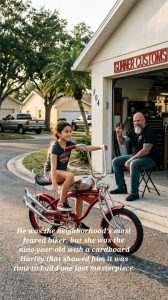
My daughter is named Marigold. Everybody calls her Goldie. She is nine. She has my dark brown hair, which I cut myself at our kitchen table because the cheapest kids’ haircut in Lakeland is twenty-two dollars and we do not have it. She has her father’s hazel eyes — her father is somewhere in the state of Georgia. She has a small slight nine-year-old body and the kind of absolute fearless confidence that nine-year-old girls have right before the world tries to take that confidence away from them.
She has been obsessed with motorcycles since she was four.
She can identify a Sportster from a Road King at fifty feet. She can tell you the difference between a Shovelhead and an Evo engine by listening to the idle. She has been saving four dollars a week of allowance, since the previous May, toward a Harley.
She had calculated that she would, at that rate, have a thousand dollars in twenty-eight years.
She did not want to wait.
What she did instead, on a Saturday morning in early June, was take a large brown Amazon box out of our recycling bin and spend the entire morning at our kitchen table with my scissors, a roll of duct tape, two Sharpies, and a small bottle of red Dollar Tree poster paint.
By eleven a.m. she had built — out of cardboard — a hand-cut Harley-Davidson gas-tank cutout. Painted red. HARLEY-DAVIDSON in white block letters across the top. A small hand-drawn bar-and-shield logo in the middle that she had copied freehand off a YouTube thumbnail.
She had duct-taped the cardboard tank to the crossbar of her 2002 Schwinn ten-speed.
She had zip-tied two empty silver Budweiser cans I had not noticed her saving from our recycling bin to the rear axle as “exhaust pipes.”
She had glued a black foam handlebar grip cover, salvaged off a busted handlebar in our neighbor Mr. Hutchinson’s garage, onto her right grip so it looked like a Harley throttle.
She had taped a small American flag — Popsicle stick, Sharpie marker — to the rear rack.
She rolled the bike down the driveway at eleven-fifteen.
She got on it.
She started pedaling.
She made the *vroom vroom* sound with her small mouth, at a volume that could be heard three houses down, with her cheeks puffed out and her face beaming with the kind of uncomplicated nine-year-old joy I had not, in three years of being a single mother working two jobs in Lakeland, Florida, been able to give my daughter on a budget.
The fourth house from ours on the left side of the cul-de-sac is a small white concrete-block two-car garage with a hand-welded red metal sign over the bay door that reads GUNNER CUSTOMS.
The owner is a fifty-year-old biker named Gunner Wallace.
Six foot one. Two hundred and twenty pounds. Shaved head. Full thick gray beard. Both arms sleeved in old prison-style tattoos so faded and blue they read solid from across the cul-de-sac. He has been a master Harley custom builder for sixteen years. He has been clean since 1996. He is the kind of man my own mother told me, when we moved into this house, to not let Goldie wave at.
Goldie has been waving at Gunner every day for three years.
She rode past his open garage bay on her cardboard Harley at eleven-twenty.
She waved with her free left hand.
Gunner was sitting on a folding stool in the front of his bay with a coffee cup in his enormous tattooed right hand.
He waved back.
Then he set the coffee cup down on the concrete.
He stood up.
He watched my nine-year-old daughter ride a homemade beer-can Harley up and down our cul-de-sac for two hours that Saturday morning without saying a single word.
He did the same thing the next Saturday.
He did the same thing the Saturday after that.
What Gunner Wallace built in his garage between the second Saturday of June and the fourth Saturday of June — and what he put down on the concrete of our driveway at six-eighteen p.m. on a Saturday evening with my daughter standing silent on our porch for ten full seconds — is the part of this story I have not been able to write down until now.
When the heavy, rhythmic knock echoed through our front door that Saturday evening, Goldie was already in her oversized pajama shirt, eating a bowl of generic mac and cheese. I wiped my hands on a dish towel and opened the door, half-expecting Mr. Hutchinson complaining about Goldie’s imaginary engine revving.
Instead, Gunner Wallace stood there. His imposing frame took up the entire doorway, smelling faintly of motor oil, grease, and cheap Folgers coffee. He held his grease-stained cap in his hands, looking strangely small despite his massive size.
“Renee,” he said, his voice a low, gravelly rumble that sounded like a low-idle engine itself. “Brought something for the kid. If it’s alright.”
Goldie was already slipping past my legs, her hazel eyes wide. She peered past Gunner’s massive frame toward the curb, where his beat-up black F-150 was idling. Dropped down onto the tailgate was a makeshift wooden ramp.
And there, in the bed of the truck, sat a masterpiece.
It wasn’t a motorcycle—she was nine, after all—but it was the closest thing a bicycle could ever get to mechanical royalty. Gunner had taken an old, salvaged low-rider bicycle frame and completely transformed it. He had stripped it down and painted it a deep, flawless candy-apple red that caught the fading Florida sunlight like liquid fire.
The handlebars were gleaming, chrome mini-apes, perfectly scaled for a nine-year-old’s reach. He had fabricated a real, miniature steel teardrop gas tank, hand-painted with the exact bar-and-shield logo Goldie had tried to draw, flanked by the name *GOLDIE* in gold-leaf lettering.
But the piece de resistance? Two polished, chrome-plated steel pipes ran along the right side of the rear wheel, ending in real, miniature fishtail exhaust tips. Tucked neatly beneath the frame was a small, battery-operated speaker connected to a modified throttle grip.
Goldie didn’t speak. She didn’t move. She just stood on the concrete porch, her mouth slightly open, her bare toes curling against the warm porch floor, staring at it for ten full seconds.
“Go look at it, bug,” I whispered, my voice caught in my throat.
She broke into a sprint. Gunner unlatched the tailgate and carefully wheeled the bike down the ramp, letting the kickstand click down onto our driveway. Goldie approached it like she was touching something holy. Her small hand hovered over the leather banana seat, stitching immaculate and perfect.
“Give the throttle a twist,” Gunner said, a tiny, rare crease of a smile breaking through his thick gray beard.
Goldie gripped the right handle and twisted her wrist back. From the hidden speaker beneath the tank, a deep, throaty, authentic recording of a 1920s Harley-Davidson board-track racer roared to life, chugging with a perfect, syncopated *potato-potato-potato* rhythm.
Goldie let out a shriek of pure, unadulterated joy that I think they probably heard all the way over on Combee Road. She threw her arms around Gunner’s massive, tattooed leg, burying her face into his grease-stained jeans.
Gunner froze for a fraction of a second, his massive arms hanging awkwardly in the air, before he gently patted her shoulder with a hand the size of a dinner plate. “You’re welcome, kiddo,” he muttered.
As Goldie instantly mounted the bike, testing the pedals and revving the speaker engine down the driveway, I walked over to Gunner, tears stinging the corners of my eyes.
“Gunner… I don’t know what to say,” I said, looking at the sheer amount of labor, love, and expensive chrome parts on the bike. “I can’t pay you for this. I work checker shifts, I—”
“Don’t,” Gunner interrupted softly, looking out at Goldie as she successfully executed a tight U-turn at the end of the cul-de-sac. “Don’t owe me a dime, Renee. I needed to build it. More than she needed to ride it.”
He looked down at his boots, shifting his weight. The tough exterior of the hardened biker seemed to melt away, revealing a profound, heavy sorrow that he had been carrying for over a decade.
“I had a daughter,” Gunner said, his voice dropping an octave, thick with a grief that time had never managed to dull. “Her name was Lily. She would’ve been twenty-one this year. When she was seven, she used to sit on a milk crate in my shop, handed me wrenches. She wanted a red chopper more than anything in the world.”
He swallowed hard, his eyes reflecting the amber Florida sunset. “A drunk driver took her and her mother off the highway back in 2015. After that… I quit. Locked the shop. Couldn’t look at a kid’s bike without breaking inside. I spent eleven years keeping people out.”
He looked back up at Goldie, who was currently “idling” at the end of the driveway, waving enthusiastically at Mr. Hutchinson.
“Then three weeks ago, this little firecracker starts riding past my shop on a piece of cardboard and aluminum cans, making engine noises with her mouth,” Gunner said, a tear finally slipping into his gray beard. “She looked right at me and waved like I was a human being. Every single Saturday. She didn’t see an old, scary convict. She just saw another biker.”
He wiped his face quickly with the back of his hand. “It woke me up, Renee. I realized I had Lily’s old frame in the rafters. I spent the last fourteen nights working on it until three in the morning. Every weld, every coat of paint… it felt like I was finally saying goodbye to the pain, and keeping the love.”
I didn’t think about it. I just reached out and hugged him. He stiffened, but then he returned it, a brief, solid reassurance between two parents who knew what it meant to love a child with everything they had.
That was fourteen months ago.
The candy-apple red bicycle still looks as pristine as the day he brought it over, because Goldie wipes it down with an old microfiber cloth every night before bed.
Every single afternoon at exactly four-thirty, Goldie rolls out of our driveway. She pedals down the cul-de-sac, twists the throttle to let the digital engine roar, and passes house number four.
Gunner is always there, sitting on his folding stool in the front of his open garage bay, a cup of coffee in hand. And as Goldie rides past, she doesn’t just wave anymore. She raises two fingers off the handlebar in the universal, low-handed wave that motorcyclists give each other on the open highway.
Gunner Wallace drops his left hand low, flashes two fingers back at her, and watches her ride safely into the sunset.