PART 2: The air behind the strip mall tasted like hot asphalt and rotting lettuce, the kind of smell that clung to the back of your throat and made you wish you’d taken the long way home. I cut the engine on my Softail, swung my leg over, and planted my boots on cracked pavement already sticky from the afternoon sun. All I wanted was a bottle of water from the Dollar General and ten minutes out of the saddle before the last thirty miles to my trailer. That was it. No crusade. No reckoning. Just a middle-aged man with a sore back and a leather vest that had seen better decades.
But the laughter found me first.
It was a sharp, hyena sound, the kind that doesn’t come from joy. It came from the dumpster corral behind the grocery store, where the pavement was stained with old oil and the shopping carts gathered like abandoned vertebrae. Four boys stood in a loose semicircle, their silhouettes jerky with that particular cruelty teenagers mistake for power. On the ground, a small tan dog was trying to disappear into the concrete. Medium build. Coat so matted with filth you couldn’t tell where fur ended and dirt began. One ear folded permanently, like a flag that had given up on the wind. I’d seen him before — skulking near the loading dock, never begging, never barking. He just existed, the way some of us learn to.
One of the boys shoved him with a sneaker. Not a tap. A shove that lifted the dog’s front paws off the ground. The dog yelped, a sound so thin and high it seemed to slice the heat in half, and the boys laughed louder. A second kick came harder, caught him in the ribs, and I saw his whole body flinch in a way that told me this wasn’t the first time someone’s boot had found him.
A woman near her minivan froze, keys halfway to the door. A man loading groceries into a trunk glanced over, shook his head, and kept stacking bags. Someone muttered, “Knock it off,” so softly it evaporated before it reached the dumpsters. Nobody moved. Nobody stepped forward. And I saw myself, twelve years old, behind the bleachers at a junior high football game, watching an older kid named Darren Tate pin a boy smaller than me to the chain-link fence and spit in his hair. I’d stood there, frozen, telling myself it wasn’t my fight. I’d carried that silence into every year since, a splinter I’d never dug out.
I didn’t think. I walked.
Not charging, not shouting. Just a steady, deliberate stride that said I’ve spent thirty years making up for one moment of cowardice, and I’m not adding another. Behind me, I heard Gracie’s boots hit the ground — Gracie, my road sister, fifty-three, built like a dockworker, with a braid down her back and a voice that could strip paint. Tommy and Mack were still on their bikes, engines idling, watching. We’d ridden together for eighteen years, a small chapter of a larger club, the kind of people who didn’t start fights but sure as hell finished them when something smaller than us was getting stomped.
The dog was trembling so hard his whole body vibrated, tucked against a rusted dumpster, one paw bent at an angle that made my stomach clench. As I got closer, the boys noticed me. The tallest one — red baseball cap, a smirk that looked borrowed from an older brother — puffed out his chest.
“What, you got a problem?” he said, the words dripping with that rehearsed defiance kids mistake for courage.
I didn’t answer. I crouched about three feet from the dog, keeping my hands open, palms up. He flinched so violently his head smacked the dumpster, and he let out a whimper that wasn’t even a sound so much as a vibration through the ground. I held still. Didn’t move. Didn’t breathe. Waited.
“It’s just a stray,” another boy muttered, the word just landing like a wet cigarette on skin.
That’s when I looked up. I didn’t rise. I just lifted my eyes, and I said, “Who kicked him?”
My voice came out lower than I expected, a gravel drag from some pit I hadn’t opened in a long time.
The red-cap kid laughed, but it was thinner now. “We were just messing around. Ain’t nobody’s dog.”
Gracie stepped up behind me, her shadow falling over the boys like a cloud. She didn’t say a word. She just crossed her arms, and I saw one of the kids swallow hard. Tommy and Mack had killed their engines. The silence that followed was heavier than any throttle rev.
I stood slowly, my knees cracking, my back complaining, but I made sure my posture didn’t threaten. I wasn’t there to intimidate children. I was there to be a wall. “That dog’s got more right to this alley than you do,” I said. “He didn’t choose to be here. He’s just surviving. And you’re teaching him that surviving means getting kicked.”
Red-cap rolled his eyes. “Whatever, man. You can’t tell us what to do.”
From the corner of my eye, I saw a security pickup pull into the lot. A young guard with a too-tight uniform and a hand already resting on his belt stepped out. “What’s going on here?” he called, voice carrying that tinny authority rent-a-cops wield like a plastic badge.
The boys erupted. “They came at us!” “They’re threatening minors!” “We didn’t do nothing!”
The guard’s eyes swept over us — four bikers in leather and denim, one woman with a scowl that could curdle milk — and he squared up to me. “Sir, I need you to back away from those kids.”
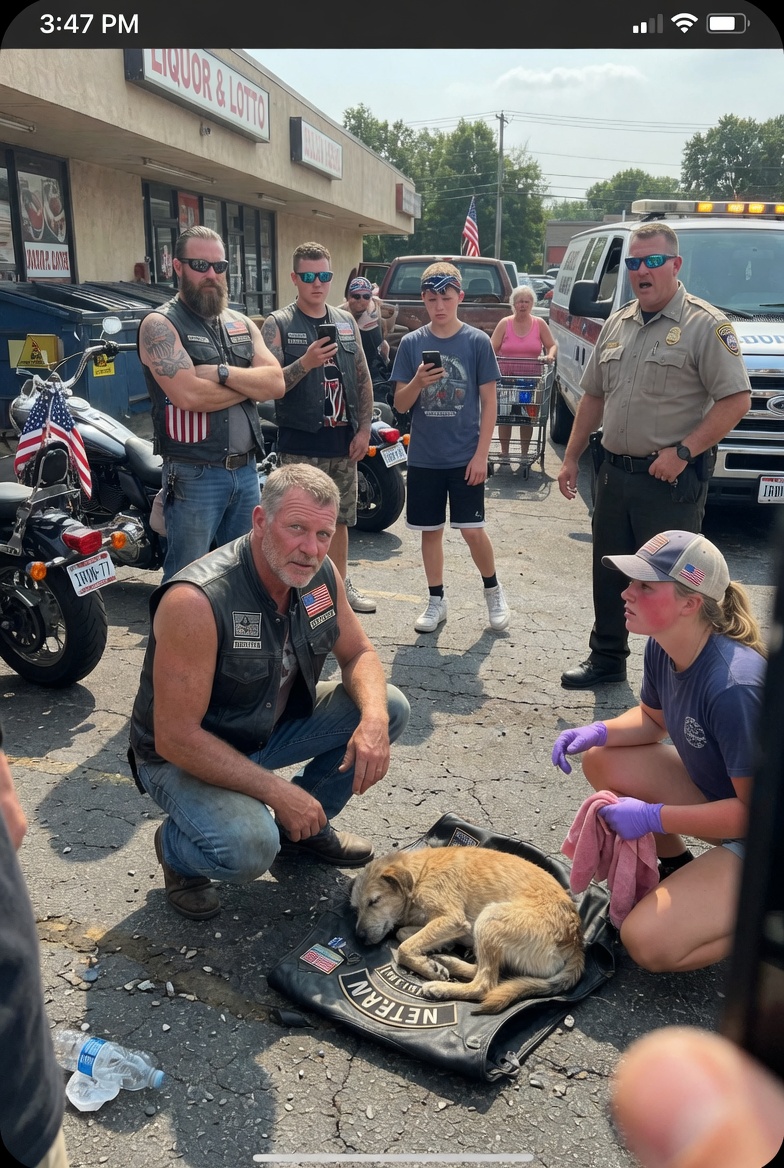
I didn’t argue. I wasn’t there to fight a security guard. But I didn’t back up either. I took off my vest instead. Slow, deliberate, the way you’d disarm in front of a scared animal. I laid it on the asphalt beside the dog, carefully sliding it under his trembling body so he had something between his ribs and the scorching ground. The leather was still warm from my ride, and the dog’s shivering eased just a fraction. His good eye — the one not swollen half-shut — rolled up to me, and I saw something in there that wasn’t hope. It was closer to a question. Why now?
The guard stepped closer. “You need to tell me what’s happening.”
“Call animal control,” I said.
“We’ll handle it from here. You can leave.”
“Now,” I said, the word a flat stone dropped in still water.
One of the boys, a skinny kid with acne and a stained shirt, muttered, “You can’t prove nothing.”
I reached into my pocket. Every one of us ran helmet cams — safety precaution for long hauls, evidence for close calls. I pulled out my phone, thumbed to the footage, and held the screen toward the guard. The video was shaky but clear enough: four figures, a dog, a kick, laughter. The guard’s face went through a quiet transformation, his posture shifting from confrontation to something closer to embarrassment. The boys’ faces drained in stages. Red-cap’s smirk evaporated entirely.
“Delete that,” he demanded, his voice cracking.
I hit send instead. To the county animal control tip line. To our club’s rescue liaison. To the police non-emergency number. I didn’t need to gloat. The phone slid back into my pocket, and I said nothing.
The guard cleared his throat. “Okay. I’ll take statements. You boys stay right there.”
The boys looked suddenly smaller, the way all bullies do when the audience disappears. The woman with the minivan had drifted closer, her phone now recording. The man who’d been loading groceries had stopped and was just standing there, arms at his sides, face unreadable. A small crowd was gathering, not to gawk, I realized, but to witness. Maybe that’s all any of us need — someone to witness so the cruelty doesn’t happen in the dark.
In the distance, I heard the low purr of more engines. My club brothers and sisters, the ones who’d been waiting at a rest stop ten miles back for a call that said we’d found trouble. They pulled in one by one, eleven motorcycles rolling to a stop in a perfect line beside ours. Helmets came off. Vests were straightened. Not a single person ran. They just stood there, aligned, a quiet fence of denim and ink. A few of the bystanders whispered. I heard someone say, “Is this some kind of gang thing?” and I wanted to laugh, but my throat was too tight.
The guard looked from us to the boys and back, clearly recalculating. He pulled out his radio. “I’m going to need backup,” he said, but his voice had lost its edge.
I crouched beside the dog again. He hadn’t tried to bite me. He hadn’t even growled. He just lay there, breathing in short, shallow hitches, his tongue lolling dry over cracked lips. I took my water bottle from my saddlebag and poured a little into my palm, holding it near his muzzle. He lapped weakly, each swallow a small victory. Gracie knelt beside me, her gruff exterior melting into something maternal and fierce.
“What’s your name, baby?” she murmured to the dog, not expecting an answer. She ran a fingertip gently along his jaw, and his tail gave the faintest twitch, a flag trying to remember how to wave.
Tommy, a lean man with a salt-and-pepper goatee and arms sleeved in old ink, approached the security guard with a business card. “We partner with Rust Belt Paws,” he said. “Nonprofit rescue. Animal control knows us. They’ll be here in ten.”
The guard squinted at the card. “You guys do this often?”
Tommy shrugged. “Often enough.”
Behind us, one of the boys tried to edge toward the parking lot exit, but Mack — six-foot-four, retired Marine, built like a refrigerator — took a single step sideways, and the kid froze. “We’re not done,” Mack said quietly, and it wasn’t a threat. It was just a fact.
I turned my attention back to the dog. His leg was definitely hurt; when I ghosted my hand near the joint, he whimpered and tried to pull away, but he couldn’t move far. The skin was raw in places, old scars crisscrossing newer wounds. This dog had been fighting to survive for a long time, and some of the worst damage hadn’t come from other animals. It had come from us.
A white van pulled into the lot, the rescue logo on its side smudged with dust from a long day. A woman stepped out — late thirties, sunburned cheeks, calm eyes that had seen too many broken animals and hadn’t yet gone hard. She introduced herself as Mara. She didn’t ask for explanations. She just knelt beside the dog, her movements slow and practiced, and whispered, “Hey, buddy. I’m here now.”
The dog flinched once. Then he did something that cracked something open inside me: he leaned into her hand. Just a slight shift of weight, a surrender that was also an answer. I’d seen that lean before — in the mirror, years ago, after I finally let someone help.
Mara checked him over with practiced hands, murmuring reassurances. “Bruised ribs, possible sprain. No obvious breaks, but he’s dehydrated and underweight. We’ll need x-rays.” She looked up at me. “You the one who called?”
“Yeah,” I said.
“Good. He’d have been dead by nightfall if you hadn’t.”
The words hit me harder than they should have. I thought of all the times I hadn’t called. All the moments I’d walked past. All the dogs — literal and figurative — I’d left behind because stopping was inconvenient.
The security guard had coaxed the boys into a huddle by his truck, taking down names and phone numbers. Red-cap’s mother arrived first, a woman with tired eyes and a uniform from the local diner, still smelling of fry oil. She took one look at her son, then at the dog being loaded into the crate, and her face crumpled not with anger but with a profound exhaustion I recognized from my own mother. “What did you do?” she asked him, and her voice was a cracked whisper.
The boy didn’t answer. He just stared at his sneakers, scuffed and expensive, and I saw a flicker of something — shame? confusion? — pass over his features. I didn’t feel satisfaction. I felt tired.
Mara secured the crate in the van. Before she closed the door, the dog looked at me through the wire mesh. His eyes were the color of weak tea, and they held mine for a long, unbroken moment. I nodded, a small, stupid gesture, as if he could understand. Maybe he could. I’d learned over the years that dogs understand more than we give them credit for. They understand when someone finally stays.
The rescue van pulled away, tires crunching over loose gravel. The crowd dispersed slowly, the woman with the minivan slipping her phone into her purse, the grocery man driving off with a look that might have been guilt. The boys were led to their parents’ cars one by one, the guard taking notes. Gracie put a hand on my shoulder.
“You okay, Cole?” she asked.
Cole. My name. I’d almost forgotten it, in the heat of it all. I nodded, but I wasn’t okay. I was back behind those bleachers, smelling popcorn and damp grass, watching Darren Tate’s fist twist into a shirt collar and doing nothing. The shame was as fresh as it had been at twelve, only now it had a counterweight: the dog’s head leaning into Mara’s hand, the sound of his tail trying to wag.
We mounted up. The engines started, a low and respectful rumble, and we rode not toward home but toward the animal hospital where Mara was taking the dog. I didn’t discuss it with anyone; I just turned left instead of right, and the club fell in behind me. That’s what we did. We followed when it mattered.
The vet clinic sat at the edge of town, a low brick building with a sign that flickered: BRIGHTWOOD ANIMAL HOSPITAL — COMPASSION IN ACTION. Inside, the air smelled of antiseptic and wet fur, and a receptionist with pink scrubs and tired eyes looked up as we filed in. Nine of us, all leather and road dust. She blinked twice.
“We’re with the stray,” I said. “Mara from Rust Belt Paws brought him in.”
She nodded slowly, her gaze traveling over my vest, then over Gracie’s gray braid, Mack’s stoic face, Tommy’s easy smile. “You the ones from the parking lot?”
“Yes, ma’am.”
“He’s in the back. Doctor’s with him now. You can wait here.” She gestured to a row of plastic chairs that had seen better decades.
We waited. Some of the club members went back to the parking lot to make calls, but Gracie and I sat. I couldn’t stop staring at the door that led to the exam rooms. Behind it, I knew, a dog that had been kicked for sport was fighting for his life, and I couldn’t shake the irrational belief that if I looked away, he’d stop breathing.
After an hour, a vet emerged. Dr. Amari, according to her coat. Young, sharp-eyed, with a stethoscope draped around her neck like a necklace. “You the one who found him?”
“Yes.”
“He’s stable. Bruised ribs, a sprained left front leg, some old fractures that healed wrong. He’s also got heartworm, which tells me he’s been on his own for a while. No chip. Nobody’s missing him.”
Nobody’s missing him. The words landed hard. I thought of all the people who’d driven past that dog, tossed him scraps or ignored him entirely, and I felt a hot surge of anger that had nowhere to go. “Can we see him?”
She hesitated. “He’s sedated. It’s better if you come back tomorrow.”
“Please,” Gracie said. “Just for a minute.”
Something in her voice must have convinced the vet, because she nodded. “Two minutes. Follow me.”
The back area was a maze of kennels, the noise of barking and whining a chorus of small broken things. In the last cage, the tan dog lay on a soft blanket, an IV drip running into his leg. His ribs were wrapped, his eyes closed. He looked smaller than he had in the parking lot, stripped of the fight that had kept him upright. I knelt by the cage and pressed my palm flat against the metal mesh.
“Hey, buddy,” I whispered. “You made it.”
He didn’t stir. But his breathing was even, and that was enough.
We left the clinic when the staff started giving us that look — the one that said we were lingering too long. Outside, the night had settled in, stars smeared behind light pollution, the air finally cooling. Gracie climbed onto her bike and patted the seat behind her. “Come on. I’ll buy you a coffee. You look like hell.”
We rode to a diner on the highway, a 24-hour place with cracked vinyl booths and a waitress who called everyone “hon.” Over weak coffee and a slice of pie I didn’t touch, Gracie finally asked the question she’d been holding since the parking lot.
“What’s going on with you, Cole? You’ve been off all day. And don’t tell me it’s just the dog.”
I stared into my coffee. “When I was twelve,” I said, “I let a kid get hurt. Real hurt. Broken jaw, three missing teeth. I was right there, Gracie. I could’ve yelled. I could’ve run for help. I didn’t do anything. He looked at me while it was happening, and I just… stood there. The dog today — he had that same look. Like he knew I might not help. And I couldn’t be that kid again.”
Gracie was quiet for a long moment. Then she reached across the table and covered my hand with hers. “You’re not that kid, Cole. You haven’t been for a long time. But it’s okay to still feel him. That’s how you know he’s gone.”
I wanted to believe her. I wanted to let that twelve-year-old’s shame dissolve into the coffee and be done with it. But shame isn’t a stain; it’s a scar, and scars don’t vanish. They just stop hurting as much, if you’re lucky.
The next morning, I called the clinic. The dog had made it through the night. Heartworm treatment would be a long road, they said, and he’d need a foster home or a rescue placement. I didn’t hesitate. “I’ll foster him.”
There was a pause on the line. “Sir, do you have experience with injured dogs?”
“I’ve got experience with wounded things,” I said. “And a big enough yard.”
They told me to come by at noon.
I showed up with a crate, a bag of high-quality kibble, and a small stuffed duck I’d bought at a gas station because it looked stupid and soft. Mara met me at the door, her expression a mixture of surprise and approval. “You’re serious.”
“Always.”
The dog was awake when I entered the kennel area. He lifted his head at the sound of my boots, and his tail gave that same hesitant twitch, as if he was afraid to commit to joy. I opened the cage door and sat on the floor, the stuffed duck in my lap. “I don’t know if you remember me,” I said. “But I’m the one who took too long.”
He didn’t move toward me. He just watched, his tea-colored eyes assessing. I respected that. Trust wasn’t a gift; it was an exchange, and he’d been shortchanged enough.
I visited every day for a week while he finished his initial treatment. I’d sit on the floor, read aloud from a paperback western I’d grabbed from a dollar bin, and wait. Gracie came with me sometimes. Tommy brought a blanket from his own dog, an old pit bull named Bess who’d been a fight-ring survivor. Mack donated a worn leather collar that had belonged to a dog he’d lost years ago. The club, for all its rough edges, was built on a foundation of broken things finding each other.
On the seventh day, the dog stood up. His splinted leg wobbled, and his ribs were still tender, but he stood. And then he limped toward me, each step a small act of courage, and he pressed his nose into my palm. I didn’t cry. I’ve never been a man who cries easy. But something in my chest loosened, a knot I’d been carrying for thirty years, and I took my first deep breath since I was twelve.
I named him Amos. It means “carried” or “borne by God,” depending on who you ask. Seemed fitting.
The next few weeks were a crash course in patience. Amos was terrified of sudden movements, of loud voices, of boots. The first time I dropped a pan in the kitchen, he scrambled under the couch and didn’t emerge for an hour. I sat on the floor, talking softly about nothing, until he crept out and rested his chin on my knee. I learned to move slower, to telegraph every gesture, to let him come to me. In return, he learned that hands could deliver food, that a leash meant a walk and not a dragging, that a rolled-up newspaper was for reading, not for striking.
Gracie showed up one afternoon with a bag of treats and a determined look. “You need to socialize him with other people,” she said. “He can’t just trust you. He needs to know not everyone’s a threat.”
So we started small. Tommy brought Bess over, and the two dogs sniffed each other through the fence, tails wagging cautiously. Mack sat on the porch and let Amos approach him, which took about forty minutes of patient stillness. By the end of the week, Amos was accepting treats from half the club, though he still flinched if anyone raised their voice.
Meanwhile, the video I’d sent had gone viral. A local news station picked it up, then a national animal welfare page, and suddenly my phone was buzzing with interview requests. I ignored most of them, but I agreed to one — a sit-down with a journalist who promised to focus on the rescue work our club did, not on the drama. The story aired on a Tuesday, and by Wednesday, Rust Belt Paws had received enough donations to cover Amos’s medical bills and then some.
But the story also brought the boys back into our orbit. The police had charged them with animal cruelty, a misdemeanor in Ohio that carried fines and community service. Their parents requested a meeting, something called “restorative justice,” where the offenders and the affected parties sit in a circle and talk. I almost said no. The thought of facing those kids, of listening to their excuses, made my hands curl into fists. But Mara called and said, “It’s about Amos, Cole. He’s the victim here, not you.”
So I agreed.
The meeting was held in a community center conference room, the kind with folding tables and a coffee machine that brewed regret. I walked in with Gracie and Mara, Amos’s medical file under my arm and a photo of him, healthy now, tucked in my vest pocket. The boys were already seated, their parents flanking them like bodyguards. Red-cap’s name was Tyler. The skinny kid was Brandon. The other two were Jacob and Luis. Their mothers looked exhausted; their fathers looked defensive.
A mediator, a soft-spoken woman named Esther, guided us through the process. The boys were asked to describe what they’d done, why they’d done it, and how they thought it had affected others. Tyler went first, his voice monotone, his eyes on the table. “We were just messing around. It was a stray. We didn’t think it mattered.”
I let the silence stretch after he finished. Then I pulled out the photo of Amos. Not the broken, trembling dog from the parking lot, but the dog he was now: coat glossy, eyes clear, wearing a bandana Gracie had sewn for him, lying on a dog bed in my living room. I slid it across the table.
“This is Amos,” I said. “He spent six weeks learning that a raised hand doesn’t always mean a hit. He still has nightmares. He still flinches when I reach for my boots. The vet says his ribcage will always be misshapen because some of those old fractures never got treatment. He’s not a stray. He’s got a name and a home and people who love him. And you almost took that away because you were ‘messing around.’”
Tyler’s mother started crying. Brandon’s father stared at the photo with an expression I couldn’t read. Luis, the smallest of the four, wiped his nose on his sleeve and said, “I’m sorry.”
I wanted to tell him that sorry wasn’t enough. But I looked at his face — the acne, the too-large shirt, the hangdog slump of his shoulders — and I saw the kid behind the bleachers. Not Darren Tate. The other one. The one who’d gotten spit on. The one who’d looked at me with pleading eyes while I did nothing. And I realized that cruelty came in many forms, and so did cowardice, and these boys had been both cruel and cowardly, but they were still boys. Still capable of change. I had changed. I was still changing.
“What do you want us to do?” Tyler’s mother asked, her voice raw.
I took a breath. “Community service at the rescue. A hundred hours each. Working with the dogs. Shoveling kennels. Cleaning cages. Learning what it means to be responsible for something smaller than you.”
The mediator nodded. The parents agreed. The boys, after some prodding, nodded too. It wasn’t vengeance. It wasn’t justice, not really. But it was a start.
Over the next months, I watched Tyler and the others show up at Rust Belt Paws every Saturday. Mara worked them hard. She made them scrub floors, walk dogs, sit in on training sessions about animal behavior. At first they were sullen, resentful. But slowly, something shifted. Tyler started asking questions. Brandon, who’d been the quietest, began volunteering extra hours. One day, I came to pick up Amos from a socialization session and found Luis sitting in a kennel with a terrified Chihuahua, reading aloud from a comic book, the same way I’d read to Amos in the clinic.
I didn’t forgive them. I didn’t have to. But I understood them a little better. They’d grown up in a world that taught them that strength meant domination, that empathy was weakness, that a stray dog’s life was worth less than a laugh. They were learning a different lesson now, and it was hard. I knew how hard it was. I’d been learning it my whole life.
Amos, meanwhile, blossomed. His heartworm treatment finished, and he gained weight, his coat turned a rich caramel color, and his folded ear, which the vet had said might never stand straight, became his signature. He’d bound across the yard after a tennis ball, limping only slightly, and when he brought it back, he’d drop it at my feet and look up with an expression of pure, uncomplicated joy. In the evenings, he’d curl up on the couch beside me, his head on my thigh, and I’d run my fingers over the ridges of his ribs, the permanent record of his suffering, and I’d feel a quiet gratitude that he’d let me be part of his healing.
One night, as I sat on the porch watching the sun bleed into the horizon, Gracie joined me with a beer. Amos was sprawled on the deck, chasing rabbits in his sleep, his paws twitching. “You know,” Gracie said, “when we rolled into that parking lot, I thought we were just getting water.”
“Me too.”
“Funny how the universe works.”
I thought about that. About all the small decisions that had led me to that moment: taking that exit, wanting water, choosing to ride that afternoon instead of the next day. About the twelve-year-old boy who’d failed, and the forty-eight-year-old man who’d finally stopped. About a dog with a broken body and an unbroken spirit, who’d taught me that it’s never too late to be the person you wished you’d been.
“You ever think about what would’ve happened if we’d been ten minutes later?” Gracie asked.
“Amos would be dead,” I said. “And I’d still be that kid behind the bleachers.”
She clinked her bottle against mine. “But you’re not. You haven’t been for a long time.”
We sat in silence, the kind that feels full rather than empty, and I listened to Amos’s gentle breathing, the crickets tuning up for the night, the distant hum of traffic on the interstate. The world was still full of cruelty and indifference, parking lots where dogs got kicked and people walked past. But it was also full of moments when someone stopped. When someone stayed. When someone decided that what was broken could be mended, that what was hurting could be held.
The next Saturday, the boys finished their community service. Tyler sought me out before he left. He was taller now, or maybe just standing straighter. “Mr. Cole,” he said, “I know you probably hate me. But I wanted you to know… I got a dog. A rescue. His name’s Rocket. He’s got three legs. I’m trying to do right by him.”
I looked at him for a long moment. Then I pulled the photo of Amos from my pocket, the one I’d shown at the meeting, and handed it to him. “Keep it. Remember what you almost destroyed. And remember that you chose differently.”
He took the photo, his fingers trembling slightly, and nodded. “I will.”
He walked away, and I felt something shift in my chest. Not forgiveness, exactly. But release. The splinter I’d carried since I was twelve was finally working its way out. I’d stopped a kick in a parking lot, but I’d done more than that. I’d stopped a cycle. One small dog, one small moment, had rippled outward in ways I was only beginning to understand.
Weeks later, the local paper ran a follow-up story: “From Cruelty to Compassion: How a Stray Dog United a Town.” They featured Amos, now officially adopted and thriving, and they interviewed me, Gracie, Mara, and even Tyler, who spoke about his community service and his new dog. The article went viral in our corner of the internet, but what mattered most wasn’t the attention. It was the letters that started arriving — handwritten letters from people who’d read the story and were inspired to foster, to adopt, to intervene when they saw an animal in need. A teacher in Toledo used the story in her classroom to talk about bullying. A retired truck driver in Kentucky wrote that he’d started carrying dog treats in his cab for strays he met at rest stops. A mother in Indiana said her son, who’d been struggling with anger, had read the article and decided to volunteer at a shelter.
One afternoon, I sat down to answer the letters, Amos curled at my feet. I wrote back to each person, sharing a little more of my own journey — the kid behind the bleachers, the decades of regret, the parking lot, the long road to healing. I didn’t leave anything out. I figured if people were going to call me a hero, they should know the truth: that I was just a man who’d spent thirty years trying to make up for one moment of silence, and who’d finally found his voice in the yelp of a stray dog.
The real hero, I told them, was Amos. He was the one who’d kept going despite everything. He was the one who’d trusted again, who’d learned to wag his tail, who’d let himself be loved. I was just the guy who’d stopped the bike.
But I came to understand that stopping was its own kind of heroism. Not the flashy, cape-and-mediocre kind, but the quiet, daily kind that said: I see suffering, and I will not look away. It wasn’t about being fearless. It was about being afraid and acting anyway. It was about choosing presence over convenience, compassion over indifference, even when — especially when — it was easier to ride on.
Months passed. Amos’s limp became barely noticeable, and his nightmares grew less frequent. We found a routine: morning walks, afternoon rides (Amos in a sidecar the club had rigged up as a joke, though he loved it), evenings on the porch. He became something of a mascot for our chapter, a four-legged reminder of what we stood for. We started running rescue transports on the weekends, moving dogs from high-kill shelters to foster homes, and Amos always came along, riding shotgun in the van, offering quiet comfort to the scared animals we carried.
At one transport, we delivered a mother pit bull and her litter to a sanctuary in Pennsylvania. The director, an older woman named June, took one look at Amos and said, “That’s a therapy dog if I ever saw one.” She wasn’t wrong. Amos had a gift for stillness, for meeting frightened creatures exactly where they were. He’d lie beside a trembling dog, not pushing, just present, and somehow that presence was a balm. I started bringing him to the rescue’s socialization sessions, and the staff noticed a difference: dogs that were shut down began to open up after time with Amos. Dogs that were aggressive calmed under his quiet gaze. It was as if he was saying, I’ve been where you are. I know the way out.
One evening, after a particularly emotional session with a bait dog named Daisy — a sweet hound mix who’d been used as practice for fighting dogs and was so traumatized she wouldn’t lift her head — I sat on the floor of the kennel with Amos beside me and cried. Not for Daisy, not exactly, but for all the suffering I’d witnessed and all the suffering I hadn’t. Amos nudged my hand, then rested his head on my knee, and I let the tears come. When I was done, Daisy had lifted her head. She was watching us, her eyes curious, her body still tense but less so. And I understood something I hadn’t before: healing wasn’t linear. It was a messy, two-step-forward-one-step-back journey, and you couldn’t rush it. All you could do was show up.
That’s what I told the boys when they came back, months later, to pick up the hours they’d missed. They were different now. They didn’t slouch. They looked me in the eye. Tyler had kept his dog Rocket healthy and happy, and he spoke about him with a tenderness that surprised me. “He sleeps in my bed,” Tyler said, almost embarrassed. “I know it’s weird, but he has nightmares. So I stay up with him.”
“That’s not weird,” I said. “That’s love.”
He smiled, a real smile, and I saw the boy he could have been all along, the one buried under peer pressure and a culture that rewarded cruelty. I didn’t excuse what he’d done. But I saw the work he was doing to change, and I respected it.
The summer after Amos’s rescue, we hosted a charity ride for Rust Belt Paws. Over a hundred bikers showed up, from all over the Midwest, rumbling through town in a parade of chrome and leather. Amos rode in the sidecar, wearing a tiny vest and a pair of dog goggles, and the crowd cheered when we pulled into the fairgrounds. We raised enough money to fund heartworm treatment for two dozen dogs and to expand the rescue’s intake facility. I gave a speech that day, standing on a makeshift stage with Amos at my feet. I didn’t talk about the parking lot. I talked about the bleachers.
“When I was twelve,” I said into the microphone, my voice cracking, “I saw a boy get hurt, and I didn’t help. I told myself it wasn’t my fight. But it was. Every time we look away, we’re saying that someone else’s pain doesn’t matter. Every time we stay silent, we’re giving permission. I spent thirty years regretting that day. And then, in a dirty parking lot behind a strip mall, I saw another creature getting hurt, and I almost drove past. But I didn’t. And that one decision — to stop, to step off my bike, to say ‘no’ — it changed my life. Not because I’m a hero. Because I finally stopped being a bystander.”
The crowd was silent. Then someone started clapping, and the sound swelled, and I looked down at Amos, who was wagging his tail, and I felt the splinter dislodge completely. I was free.
I’m not going to tell you that saving one dog solved everything. It didn’t. The world is still full of parking lots, full of boys with boots and hearts that haven’t learned to feel. But it’s also full of people who stop. Who pull over. Who crouch down and slide their vest under a trembling body. And every time one person stops, it ripples. It teaches. It heals. I know, because I was healed — not by my own courage, but by a dog who, against all odds, chose to trust me.
Tonight, Amos is asleep on the couch, his legs twitching with some dream of rabbits or endless fields. I’m sitting on the porch again, watching the stars fight through the light pollution. The road hums in the distance, calling to me, as it always does. But I’m in no hurry. I’ve learned to be still. To be present. To be the man who stays.
And if you’re reading this, and you’ve ever walked past something that broke your heart, know this: it’s never too late to stop. To turn around. To be the one who doesn’t look away. The world doesn’t need more heroes. It needs more people willing to cut the engine, step off the bike, and say, “I’m here.” Even if your voice shakes. Even if your hands tremble. Even if you’re terrified. Because sometimes, the smallest act of presence is the bravest thing you’ll ever do.
I named him Amos because it means “carried.” But the truth is, he carried me. He carried me out of my own guilt, my own silence, my own long history of looking away. And every morning when he puts his head on my chest and sighs, I’m reminded that redemption doesn’t come in grand gestures. It comes in small choices. A hand extended. A vest on the ground. A promise whispered into the ear of a broken creature: I see you. I’m not leaving.
The road is still out there. But tonight, I’m exactly where I need to be. And that, I think, is the whole story. Not how a dog was saved, but how a man was. The rest is just the ride home.