His mistress sent me a screenshot of their joint bank account application at 9:17 p.m., while my champagne flute was still sweating on the marble bar of the Meridian Club.
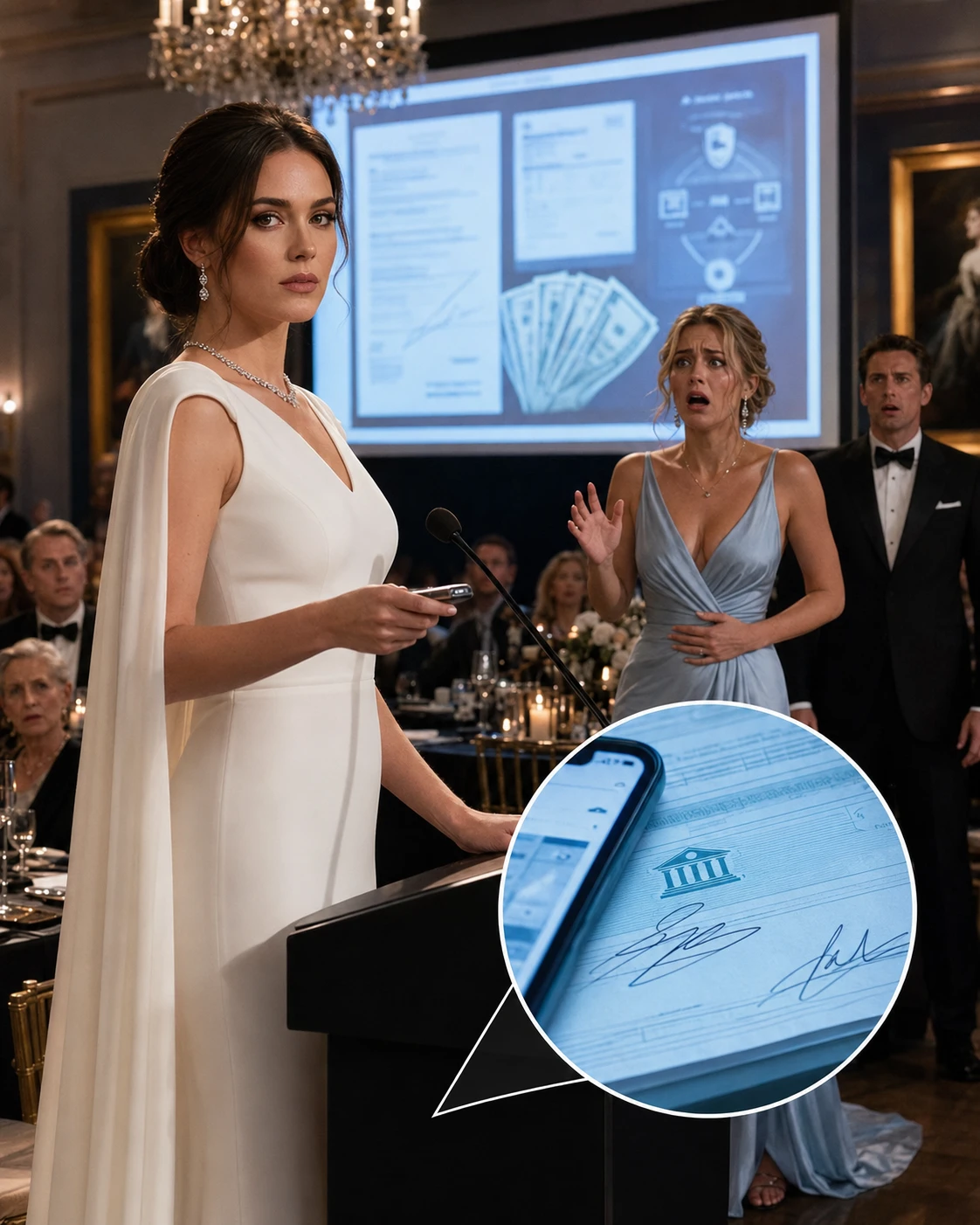
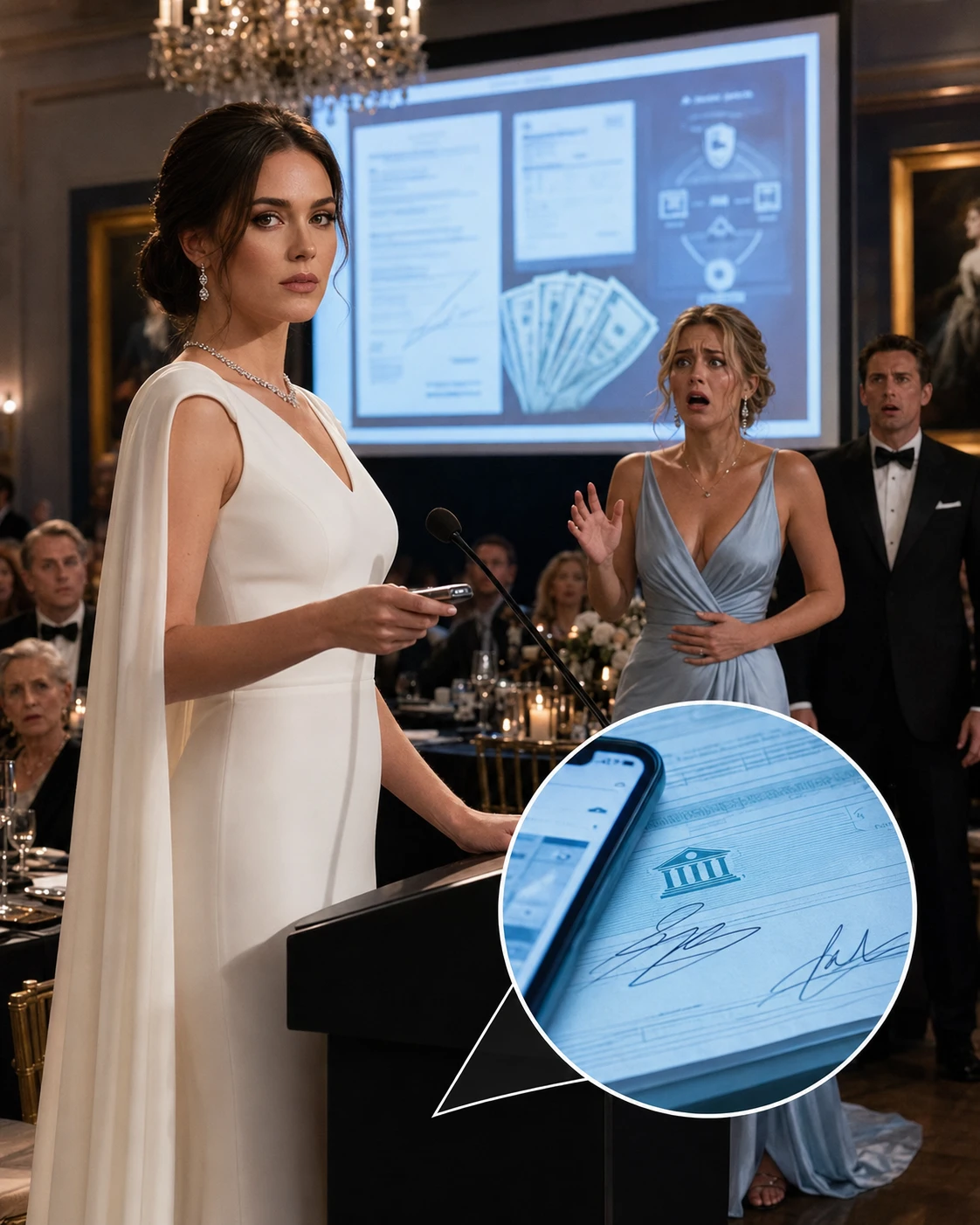
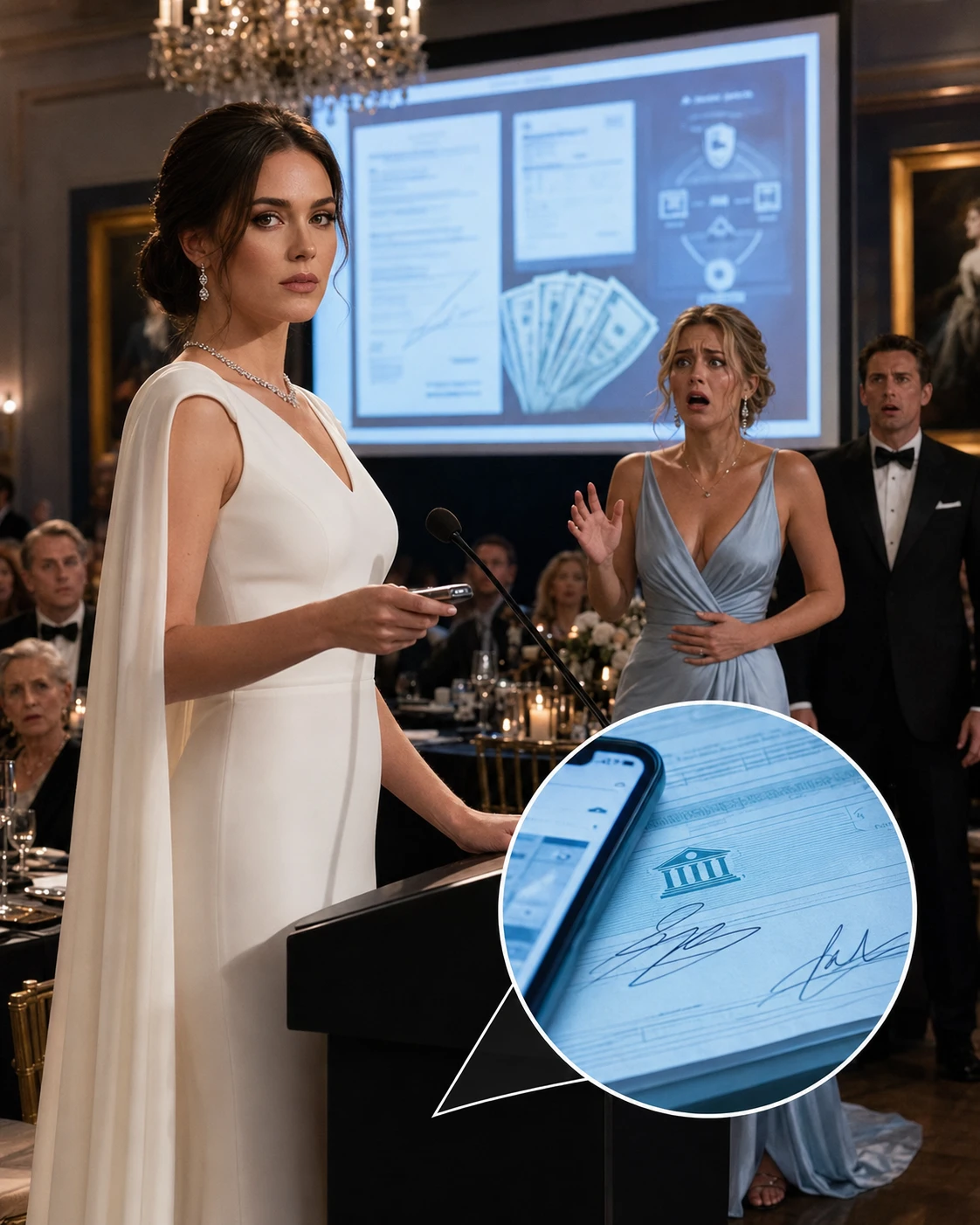
She wrote, “We’re building a future you can’t touch.”
I stared at the image, at the pretty little blue bank logo, at my husband’s name typed beside hers, at the line that made every crystal chandelier above me seem suddenly cold.
Income Support: Whitmore & Vale Design Holdings.
My company.
Not his salary. Not their private savings. Not the inheritance he loved to imply he had, though his mother’s estate had been sold twice before I met him. My company records. My contracts. My profit statements. My signature blocks scanned and attached as proof that he had the financial strength to open a private account with a woman whose lipstick was currently on the rim of his wineglass across the room.
My husband had used my business to secure approval for an account meant to hide money from me.
Behind me, a string quartet played something soft and expensive. In front of me, Grant Whitmore laughed with his hand resting lightly on Sloane Mercer’s bare lower back, as if the entire room had been built for their betrayal.
She sent me the future.
I sent it to the fraud investigator.
CHAPTER 1
THE WOMAN IN THE GOLD DRESS
The Meridian Club sat above Fifth Avenue like a secret New York had decided to keep only for people with money, cruelty, or both.
That night, the elevators opened onto thirty stories of candlelight, white orchids, and old money pretending it had not recently learned the word “crypto.” Women floated through the room in silk gowns the color of pearls and bruises. Men in tuxedos laughed with the careless confidence of people who believed consequences were for the middle class.
I wore black.
Not because I was mourning. Not yet.
The dress was vintage McQueen, long-sleeved, high-necked, cut so close to my body it made every movement deliberate. My mother used to say a woman should own one dress that looked like an apology from a man. I had bought this one after my first seven-figure quarter, before I married Grant, before I understood that a husband could smile at you over breakfast while quietly planning your erasure.
“Mrs. Whitmore,” the maître d’ said, bowing slightly as he guided me inside. “Mr. Whitmore is by the east windows.”
Of course he was.
Grant loved windows. He loved any place where people could see him framed by height and glass, where the city looked small behind him. He had built his entire personality around appearing like a man who belonged at the top of things.
I found him exactly where the maître d’ said he would be.
Tall, blond, almost offensively handsome in the clean American way that made strangers trust him with keys and secrets. Grant Whitmore had a jawline made for campaign posters and a voice that could make lies sound like weather reports. When we met seven years earlier, he had been the charming son of a fading Connecticut family, all tennis whites and polished manners, living off the remains of a name that still opened doors but no longer paid mortgages.
I was Amelia Vale then. Mia to my friends. Founder of Vale House, a luxury design and estate restoration firm that turned neglected brownstones and dead Palm Beach mansions into magazine covers. I had built my company from a borrowed desk in a Brooklyn warehouse to a brand celebrities whispered about as if hiring me were a status symbol.
Grant used to say he fell in love with the way I saw beauty in ruined places.
Later, I realized he had mostly seen equity.
Beside him stood Sloane Mercer.
She was younger than me by eight years, maybe nine if she lied well. Gold dress, gold heels, gold cuffs on both wrists. She had the glossy, engineered beauty of a woman who believed every room was a mirror if she tilted her head correctly. Her hair fell in a perfect dark wave over one shoulder. Her mouth was painted the color of a fresh wound.
When Grant saw me, his smile performed surprise.
“Mia,” he said. “There you are.”
There you are.
As if I had misplaced myself.
I crossed the room with every eye catching briefly on me. People always noticed when a woman walked alone toward her husband and another woman. Wealthy rooms had a talent for smelling blood before anyone admitted there was an injury.
Sloane turned.
For half a second, something bright and ugly flashed in her eyes. Triumph, maybe. Or anticipation. Then she smiled like we were old friends meeting at brunch.
“Amelia,” she said. “You look stunning.”
“Thank you,” I said. “So do you.”
A small lie. A necessary one. War begins most cleanly with manners.
Grant leaned in to kiss my cheek. His mouth touched the air beside my skin.
“You’re late,” he murmured.
“I was reviewing the Avalon contracts.”
A muscle moved in his jaw. Barely.
Sloane’s smile sharpened.
Avalon was the project that had changed everything for Vale House: a $42 million restoration of a Newport estate owned by a tech billionaire with a second wife, three lawsuits, and a panic room lined in walnut. The press called it the most beautiful private renovation in America. Grant called it “our breakthrough,” though he had not chosen a hinge, negotiated a supplier, or stayed awake through the contractor meetings where grown men tried to explain load-bearing walls to me in little voices.
“We were just talking about you,” Sloane said.
“How brave.”
Grant gave a light laugh, the kind men use when they want to remind women they are being observed.
“Sloane was telling Senator Blackwood about the Westport expansion,” he said.
The words landed with the precision of a blade.
My expansion.
My company had spent eighteen months developing plans for a Westport showroom: custom stone floors, private consultation rooms, a members-only archive of European textiles, a courtyard for summer client dinners. The location had not been announced. The funding structure was confidential. The only people who knew the complete details were me, Grant, my CFO, and our attorney.
And apparently Sloane.
“She has a remarkable instinct for brand partnerships,” Grant continued, louder now, turning just enough that the circle around us could hear. “I’ve brought her in as a strategic consultant.”
A woman in emerald satin glanced at my face, then quickly away.
Strategic consultant.
I looked at Sloane’s gold cuffs, her calm smile, the diamond tennis bracelet on her wrist.
I had seen that bracelet before.
Two months ago, Grant told me it was a gift for a client’s wife after a difficult negotiation. The receipt had come from a Madison Avenue jeweler. The purchase had been coded under “relationship retention.”
I almost admired the phrase now.
“How exciting,” I said. “I wasn’t aware we had hired anyone.”
Grant’s eyes cooled.
“We discussed bringing in fresh perspective.”
“No,” I said softly. “You discussed it with yourself.”
The circle went quiet.
Grant leaned closer. His hand tightened around his glass.
“Mia,” he said, voice low. “Not tonight.”
That was Grant’s favorite phrase. Not tonight. Not here. Not now. Not in front of them. Not when you could ruin the illusion I have spent so much of your money building.
Sloane touched his sleeve.
A little touch. Two fingers. Enough to be intimate. Enough to be seen.
“It’s fine,” she said, with the gentleness of a woman pouring gasoline from a crystal pitcher. “I know transitions can be emotional.”
Transitions.
I had learned, over the years, that the cruelest people rarely shout. They choose words that make your pain sound administrative.
Grant straightened and looked past me toward the room.
“Everyone,” he called, lifting his glass. “Before dinner, I’d like to make a small announcement.”
My stomach turned to ice.
No one announces something at a charity gala without making sure someone else will pay for it.
The room softened into silence. Waiters paused near the walls. The quartet faded out mid-note. Cameras shifted. The event photographer, a boy with hungry eyes and a borrowed tuxedo, lifted his lens.
Grant placed his free hand at Sloane’s back.
“I am incredibly proud to share that Vale House will be partnering with Mercer Social to expand our philanthropic reach through the Westport Restoration Fund.”
A murmur moved through the room.
My name. My company. Her brand.
Sloane smiled for the cameras.
Mercer Social was not a business. It was an Instagram account with a PR invoice. Sloane posted curated images of tablescapes, hotel bathtubs, and quotes about feminine power over photos of her own ankles. The idea that she could partner with Vale House on anything besides a lunch reservation was absurd.
But the room did not know that.
The room saw Grant, polished and confident. It saw Sloane, young and glowing. It saw me, standing still in black like a signature left off a document.
Grant continued.
“This next chapter is about legacy,” he said. “About building something larger than one person.”
Larger than one person.
Meaning larger than me.
He looked at me then, and his smile was almost tender.
“Mia has always been passionate about the work. But as Vale House evolves, it’s time for us to open the doors to new voices.”
There it was.
Public. Elegant. Surgical.
He was not leaving me. Not yet.
He was doing something worse.
He was trying to make me look like the old version of my own life.
A few polite claps began. Then more. The kind of applause people offer when they don’t understand the crime but want to be on the side of power.
Sloane stepped forward and accepted the attention as though it had been assigned to her by God.
Grant squeezed her waist.
I held my champagne flute so tightly the stem might have snapped if it had been cheaper.
My phone vibrated in my clutch.
Once.
Then again.
I knew before I looked.
Women always know when another woman wants them to bleed in private.
I opened the message.
Unknown Number.
But the photo told me who it was.
A screenshot of a bank application. Joint account. Grant Whitmore and Sloane Mercer. A private wealth division at Harrowgate Bank. The account purpose listed as “Household and future investment planning.” Estimated opening balance: $2.4 million.
Then the line.
Income Support: Whitmore & Vale Design Holdings.
Attached documentation: profit statements, client contracts, business assets summary, owner certification.
My certification.
My lungs forgot their purpose.
Then the message appeared.
“We’re building a future you can’t touch.”
Across the room, Sloane looked directly at me.
She knew I had seen it.
She lifted her glass.
It would have been easy to break.
Women are taught to fear that word. Hysterical. Bitter. Jealous. Unstable. The first person to show emotion in a rich room loses. Grant knew that. Sloane knew that. They had built this little theater because they expected me to perform the role assigned to me.
Wife discovers mistress.
Wife cries.
Wife makes scene.
Husband looks exhausted.
Mistress looks wounded.
Room chooses charm over truth.
I did not cry.
I did not scream.
I did not throw the champagne.
I smiled.
Not at Grant.
At Sloane.
Then I forwarded the screenshot to Nolan Hart.
Nolan was a fraud investigator with the posture of a priest and the eyes of a man who had ruined powerful people before breakfast. I had hired him six weeks earlier after noticing three things Grant had underestimated me enough to leave behind: a duplicate vendor payment, a missing retainer deposit, and a $96,000 “client hospitality” expense billed on a weekend he claimed to be in Denver.
Nolan answered in under thirty seconds.
Received. Do not confront. Preserve everything. I’m calling Harrowgate’s compliance director.
I typed back with one hand.
Already at gala. They just announced my company partnership with her brand.
Three dots appeared.
Then:
Good. Witnesses.
I almost laughed.
Grant finished his toast to another wave of applause. Sloane leaned into him as cameras flashed. Someone congratulated them. Someone else kissed my cheek and said how modern it all was.
Modern.
That was another word rich people used when they meant shameless.
Grant finally returned to me when the room moved toward dinner.
“You handled that well,” he said.
I looked up at him.
He expected anger. Fear. A whisper-fight near the orchids. He expected me to ask what he was doing, why he had brought her, how long it had been going on. He expected the old choreography of betrayal: the husband sins, the wife begs for an explanation, the mistress enjoys the proof that she has power.
Instead, I asked, “Did you enjoy the toast?”
His brow flickered.
“What?”
“It sounded rehearsed.”
He studied my face. Grant had always hated silence when it came from me. Silence meant he could not steer the conversation. Silence meant he had to guess.
“You’re upset,” he said.
“I’m observant.”
His expression hardened for a fraction of a second before charm returned like a curtain falling.
“Mia, Sloane is useful. Don’t make this personal.”
A strange calm opened inside me.
Useful.
Not beautiful. Not loved. Not irresistible. Useful.
I looked past him at Sloane, who was showing her bracelet to a woman from Vogue Home.
“I won’t,” I said.
Grant exhaled as if he had won.
That was his first mistake of the evening.
His second was leaving his phone face up on the dinner table later, when a message from Sloane lit the screen.
Did she cry yet?
His third was believing I had not seen it.
CHAPTER 2
THE QUIETEST WOMAN IN THE ROOM
I slept beside my husband that night for the last time.
Not because I needed proof of anything physical. I already had enough. The perfume on his collar. The second phone in his gym bag. The hotel charge in Miami during a week he told me he was meeting architects in Austin. The way he said Sloane’s name as if he were trying not to taste it.
No, I stayed because silence has weight.
I wanted Grant to feel the bed remain unchanged. I wanted him to wake beside the woman he thought he had outmaneuvered, kiss her forehead, dress in his charcoal suit, and go into the world believing the floor was still beneath him.
At 6:12 a.m., his alarm chimed.
He rolled over and touched my waist with the lazy entitlement of a man who had never imagined a locked door.
“Morning,” he murmured.
“Morning.”
“About last night,” he said, eyes still closed. “You know how these rooms work. Appearances matter.”
“Yes,” I said. “They do.”
He smiled faintly, relieved by the softness in my voice.
“Sloane opens doors to a younger demographic. You’re brilliant, Mia, but you can be intimidating.”
I stared at the ceiling.
There were thirteen hand-carved plaster roses above our bed. I had commissioned them from a restoration artist in Savannah after finding the original apartment moldings too damaged to save. Grant had complained about the cost until Architectural Digest asked to photograph the room. Then he started calling them “our roses.”
“You think I’m intimidating?” I asked.
“I think you forget not everyone wants to feel like they’re in a boardroom.”
Interesting.
Men like Grant often confuse female competence with violence.
He sat up, ran a hand through his hair, and gave me the smile that used to undo my anger. It looked younger than him now. Like something borrowed from a previous decade.
“I’ll smooth everything over,” he said. “Just trust me.”
Trust me.
The anthem of every man standing over a buried knife.
He kissed my temple and went to shower.
The moment the bathroom door closed, I got out of bed.
My phone had been charging on the nightstand. I opened a secure folder Nolan had instructed me to create after our first meeting. In it were copies of every suspicious document I had found so far: vendor contracts, wire transfers, bank notices, calendar screenshots, expense reports, and photos of Grant’s handwritten notes from a leather portfolio he kept in his home office.
Last night’s screenshot sat at the top.
I added a note.
Public announcement at Meridian Club. Approx. 9:05 p.m. Witnesses: Senator David Blackwood, Patricia Lorne, Miles Kennard, Camille Strauss, event photographer unknown. Grant described Sloane Mercer as strategic consultant for Vale House. No board approval. No contract authorization.
Then I emailed my attorney.
Not the one Grant knew.
My real attorney.
Her name was Vivian Cho, and she had a corner office in a stone building downtown, a voice like silk over steel, and the kind of reputation that made men suddenly remember documents they had forgotten to disclose. Vivian had built her career dismantling husbands who thought prenuptial agreements were decorative.
I met her three months before I married Grant.
My father insisted.
“Love him all you want,” Dad told me, sliding Vivian’s card across the table at the old steakhouse where we celebrated my engagement. “But let a woman with sharper teeth read the paperwork.”
At twenty-nine, glowing with love and the stupid mercy of happiness, I had rolled my eyes.
“Dad, Grant isn’t like that.”
My father had looked at me the way he did when contractors gave bad estimates.
“No man is like that until he is.”
Dad died four years later from a heart attack in his greenhouse, surrounded by lemon trees he had grown in Connecticut soil through pure stubbornness. By then, Grant and I had been married long enough for me to believe my father had been too hard on him.
Grief has a way of making you generous to the wrong people.
Vivian answered my email at 6:41 a.m.
Come at noon. Use the private entrance. Bring nothing from home except your phone and passport.
I looked toward the bathroom door.
Grant was singing.
Badly.
Something upbeat and bright.
I felt nothing.
That was when I knew the marriage had ended before I had ever opened the message from Sloane. The screenshot was not the wound. It was the X-ray.
At 8:30, I arrived at Vale House headquarters in SoHo.
The building had once been a printing factory. I bought it when I was thirty-two and every bank said I was overleveraged. The exterior was soot-dark brick, the windows tall and arched. Inside, I had left the steel beams exposed and softened everything else: limestone floors, warm oak, antique mirrors, white walls hung with enormous black-and-white photographs of houses before we saved them.
The lobby smelled like coffee, beeswax, and expensive flowers.
Home, in other words.
My assistant, Tessa Reid, rose from her desk the second I stepped off the elevator.
Tessa was twenty-six, red-haired, terrifyingly efficient, and allergic to nonsense. She could reschedule a governor, locate discontinued Belgian linen, and make a contractor apologize without raising her voice. She had been with me since her internship, when she showed up in combat boots and corrected a client’s pronunciation of “provenance” with a smile so sweet he thanked her.
“Your ten o’clock is confirmed,” she said. Then she paused. “And you have the face.”
“What face?”
“The face where someone is about to lose a boat.”
I looked at her.
Tessa lowered her voice. “Do I need to cancel your morning?”
“No. I need you to do three things.”
She opened her tablet.
“First, pull every file connected to Mercer Social, Sloane Mercer, Westport Restoration Fund, and any vendor with the word Lantern, Lark, Blue Harbor, or Marigold in the name.”
Her eyes sharpened. “Okay.”
“Second, quietly ask Daniel to freeze external access to our financial archive and run a permissions report.”
“Quietly as in normal quiet, or quietly as in felony quiet?”
“As in no one tells Grant.”
Tessa’s face changed.
There are moments when loyalty becomes visible. Not dramatic. Not loud. Just a door closing gently in someone’s eyes.
“Understood,” she said.
“Third,” I continued, “find out who the gala photographer was last night and purchase the entire raw image set before anyone else asks for it.”
Tessa typed quickly. “Done.”
“I haven’t told you why.”
“You don’t have to.”
That nearly broke me.
Not because of Grant. Because kindness was suddenly harder to withstand than betrayal.
I went into my office and closed the door.
For years, this room had been the center of my life. Floor-to-ceiling bookshelves. A French writing desk from 1890. Two cream sofas facing a marble fireplace. A wall of pinned samples and sketches. On the east side, a terrace overlooked Crosby Street, where the city below moved in fragments: yellow taxis, black umbrellas, steam rising from grates.
Grant used to come here late in the evenings and lean in the doorway.
“Still building empires?” he would ask.
And I, foolish woman, would smile.
“For us.”
Now I understood that “us” had never meant the same thing to both of us.
At 9:14, Nolan Hart called.
“I spoke to Harrowgate,” he said.
He had a voice made for bad news: steady, low, without pity.
“And?”
“They received a joint account application from Grant Whitmore and Sloane Mercer yesterday morning. Supporting materials included income projections from Whitmore & Vale Design Holdings, a client receivables report, and a letter on company letterhead stating that Mr. Whitmore has authority to pledge projected distributions as personal financial support.”
My hand tightened around the phone.
“I never signed that.”
“I know.”
“Who did?”
“Someone using your scanned signature.”
The room narrowed.
“How much?”
“The application requested private client status with an expected initial transfer of $2.4 million. The funds weren’t in the account yet. But they listed incoming wires from two entities: Lantern Key Holdings and Marigold Advisory.”
Lantern.
I closed my eyes.
Tessa was already pulling that name.
“Are they his?” I asked.
“Not directly.”
“Of course not.”
“Lantern Key Holdings is registered in Delaware. Managing member is a trust. The trust lists a Wyoming address. Marigold Advisory is newer, registered in Nevada. I’ll need more time to peel it back.”
“Peel fast.”
“I’m already cutting.”
Nolan paused.
“There’s something else.”
There always is.
“Tell me.”
“Harrowgate’s compliance director was concerned before I called. The application triggered review because the attached company letterhead looked authentic, but the metadata on one PDF suggests it was generated from a personal device registered to Sloane Mercer.”
I sat very still.
Sloane had not simply received the fraud.
She had helped prepare it.
The mistress had sent me a screenshot of a crime she participated in because she thought humiliation was stronger than evidence.
Somewhere inside me, something ancient and cold smiled.
“What do you need from me?” I asked.
“Permission to coordinate with Vivian Cho, your accountant, and your internal IT.”
“Granted.”
“And, Amelia?”
“Yes?”
“Do not warn them.”
I looked out at the city.
Down on Crosby Street, a woman in a camel coat stepped around a puddle without slowing.
“I don’t plan to.”
At noon, I entered Vivian Cho’s office through a private door off a narrow street in Tribeca.
Vivian’s conference room had no art on the walls, only windows and one long black table. The absence of decoration felt intentional, almost religious. You did not come there to be comforted. You came to be sharpened.
Vivian sat at the head of the table in a cream suit, her silver-black hair pulled into a low knot.
Beside her was a man I did not recognize.
He stood when I entered.
Late thirties, maybe early forties. Dark hair. Gray eyes. No wedding ring. His suit was expensive but not loud, the kind of tailoring that suggested wealth without the need to perform it. He looked at me once, directly, and I had the unsettling sense that he had already noticed everything I was trying not to show.
“Amelia,” Vivian said. “This is Julian Cross.”
The name landed somewhere deep in memory.
“Cross Asset Recovery?” I asked.
Julian inclined his head.
“My firm.”
I had heard of him. Everyone in my world had, though rarely in public. Julian Cross found money people tried to make disappear. Offshore accounts. Art purchases. Shell companies. Real estate held through cousins, mistresses, drivers, pastors, childhood friends. If a wealthy man bought a vineyard under his dog’s name to avoid a divorce settlement, Julian Cross was the person who found the dog.
Vivian gestured to the chair beside her.
“Sit,” she said. “We need to talk about your marriage, your company, and the part of your life Grant has not managed to steal because your father disliked him on sight.”
For the first time in twenty-four hours, I almost smiled.
“My father disliked most people on sight.”
“He was correct about this one.”
I sat.
Vivian opened a folder.
“You and Grant have a prenup. Strong, but not invincible. He gets limited appreciation on jointly titled assets, no equity in Vale House unless transferred voluntarily, and no claim to premarital holdings. However, there is a fidelity clause tied to financial misconduct.”
I nodded.
Grant had laughed at that clause when we signed.
“Very southern gothic,” he said at the time, though neither of us was southern and he had never read anything gothic that was not a hotel bar menu.
Vivian continued.
“If we prove adultery alone, it embarrasses him. If we prove financial misconduct connected to the adultery, it destroys him.”
Julian slid a document across the table.
“This is what we know so far.”
I read.
Lantern Key Holdings. Marigold Advisory. Payment flows from three Vale House client retainers. Consulting invoices approved through Grant’s executive access. Transfers disguised as event expenses, lifestyle partnerships, and vendor deposits. A Miami condo lease under an entity connected to Sloane’s former roommate. Payments to a jeweler, a private aviation company, a luxury car subscription service, and a gallery in Palm Beach.
The numbers blurred.
Not because I was shocked.
Because I was furious.
“Total?” I asked.
Julian did not soften the answer.
“Currently traceable? $1.8 million. Potential exposure, with pledged contracts and attempted account funding, closer to $4.6 million.”
I looked at Vivian.
“My company?”
“Protected if we move quickly.”
“My employees?”
“Also protected.”
“My clients?”
“We control disclosures carefully.”
I looked back at the paper.
There was a time when finding out my husband loved someone else would have been the worst thing I could imagine.
Now infidelity seemed almost quaint.
Sex was not the betrayal that mattered most.
Grant had walked into the house I built and started removing beams.
“Can we prosecute?” I asked.
Vivian’s expression did not change, but Julian’s eyes shifted slightly, as if appreciating the temperature of the question.
“We can refer evidence,” Vivian said. “Forgery, bank fraud, wire fraud, breach of fiduciary duty, conversion of company assets. But first, we preserve the company, freeze access, identify the money, and keep him comfortable enough to keep making mistakes.”
I leaned back.
“Comfortable.”
“Yes.”
“You want me to pretend.”
“No,” Vivian said. “I want you to act.”
There was a difference.
Pretending is what women do to survive dinner.
Acting is what they do to win.
Julian spoke then.
“Grant believes you are emotional.”
“He told me this morning I’m intimidating.”
“That means he’s afraid of you when you’re calm.”
I looked at him.
Something quiet moved between us. Not flirtation. Not yet. Something more dangerous. Recognition.
Julian Cross did not look at me like a wronged wife.
He looked at me like a loaded weapon he respected enough not to touch.
Vivian closed the folder.
“Tonight, you go home. You say nothing. Tomorrow, you attend the Westport planning brunch Grant scheduled with Sloane.”
“I wasn’t invited.”
“You will be.”
I looked from Vivian to Julian.
“How?”
Vivian smiled slightly.
“Because I leaked to Grant’s assistant that Patricia Lorne wants you present before she commits donor funds.”
Patricia Lorne was seventy-four, worth half a billion, and enjoyed making men sweat.
I almost laughed.
Vivian continued. “At the brunch, you let them talk. You let them present whatever fantasy they’ve built. You do not correct them. You do not defend yourself. You do not ask questions you do not already know the answers to.”
“And after?”
Julian’s voice was smooth.
“After, we follow what they put on the table.”
I thought of Sloane’s message.
We’re building a future you can’t touch.
Poor girl.
She had mistaken access for ownership.
CHAPTER 3
THE BRUNCH WHERE EVERYONE LIED BEAUTIFULLY
The Westport planning brunch was held at The Astor Room, a private dining space inside a hotel that had once been a bank, then a club, then another bank, and finally a place where people paid thirty dollars for toast.
The room was all arched windows, velvet chairs, and silver coffee service. Outside, January light lay pale and hard across Manhattan. Inside, Sloane Mercer had arranged blush roses down the center of the table as if we were celebrating an engagement.
In a sense, we were.
She and Grant were engaged to a very expensive delusion.
I arrived twelve minutes late.
Not because I was delayed. Because punctuality is polite, and I no longer felt polite.
Grant stood when I entered. His surprise lasted less than a second before he recovered.
“Mia,” he said warmly. “I didn’t realize you were joining.”
“Patricia asked me to.”
At the end of the table, Patricia Lorne lifted one hand without smiling.
Patricia was wrapped in navy cashmere and diamonds older than most states. She had known my father. She had also invested quietly in my first showroom when no bank would return my calls. She considered Grant decorative and had once referred to him as “that pleasant colonial doorknob” after too much gin.
Sloane’s smile held.
“How wonderful,” she said. “We were hoping to align everyone’s vision.”
“I love alignment,” I said, taking the empty chair directly across from her.
At the table were eight people: Grant, Sloane, Patricia, two donor prospects, a brand consultant, a junior attorney I did not know, and me.
Notably absent: anyone from my executive team.
Sloane had placed a printed packet at each seat. The cover page read:
THE WESTPORT RESTORATION FUND
A Vale House x Mercer Social Initiative
Underneath, in smaller lettering:
Founded by Grant Whitmore and Sloane Mercer
I ran one finger over the words.
Founded by.
My pulse did not change.
Grant began with a polished speech about legacy, community, preservation, and making luxury “more emotionally accessible,” a phrase so empty it could have been used as storage. Sloane followed with slides from an iPad, her voice bright and practiced.
The fund, she explained, would acquire endangered historic properties in wealthy suburban markets, restore them using Vale House expertise, host donor dinners, produce video content, and generate “philanthropic storytelling opportunities.”
In other words, she wanted to use my company’s reputation to film herself walking through houses in expensive boots.
The donor prospects nodded. The brand consultant looked hungry. The junior attorney took notes and avoided my eyes.
Then Sloane clicked to a slide titled FINANCIAL STRUCTURE.
I felt, rather than saw, Julian Cross’s advice settle over my shoulders.
Let them talk.
Sloane said, “Initial capital will be supported through Whitmore & Vale projected distributions and strategic private banking instruments. Grant has already started that process with Harrowgate.”
Patricia’s gaze shifted to me.
I lifted my coffee and took a sip.
The silence stretched.
Grant cleared his throat.
“What Sloane means is that we’re exploring banking relationships that allow flexibility while Vale House expands.”
Sloane’s smile tightened. She did not like being corrected. Women who sleep with powerful men often mistake proximity for equal rank.
“Exactly,” she said. “And because Grant has authority over the Whitmore family side of the business—”
“There is no Whitmore family side of the business,” I said pleasantly.
The room froze.
Grant’s eyes flashed.
I tilted my head. “But please continue.”
Sloane looked at him, then back at me.
“To clarify, I mean Grant’s leadership role in the company.”
“He doesn’t have one.”
The brand consultant stopped chewing.
Grant laughed softly.
“Mia is being modest. I’ve been involved in strategy for years.”
“No,” I said. “You’ve been in rooms.”
That landed harder than I expected.
Even Patricia looked into her coffee.
Grant’s face remained smooth, but his ears flushed red. I knew that sign. Grant could control his mouth, his posture, his tone. But his body betrayed him in small, honest ways.
“Mia,” he said, careful and low, “this is not productive.”
“I agree. Misrepresenting corporate authority is rarely productive.”
Sloane leaned forward.
“We’re all on the same team here.”
I looked at her gold watch. Cartier. New.
“Are we?”
The junior attorney shifted.
Grant placed one hand flat on the table.
“Enough.”
One word.
Spoken softly.
A husband’s command disguised as restraint.
Every woman in that room heard it.
Every man pretended not to.
I smiled.
“Of course.”
Then I shut up.
For the next forty minutes, I let them bury themselves.
Sloane discussed donor tiers based on access to Vale House designers, none of whom had agreed to participate. Grant referenced client properties he was legally barred from naming. The junior attorney mentioned a draft licensing agreement I had never seen. The brand consultant proposed a “founders’ film” centered on Grant and Sloane as “the new faces of American restoration.”
Patricia asked one question.
“Amelia,” she said, cutting through a sentence about social reach. “Do you endorse this?”
The room turned to me.
There are moments in revenge when the temptation to strike early is almost sensual.
I could have said no.
I could have said absolutely not.
I could have turned to Grant and asked how Harrowgate enjoyed forged signatures with their eggs.
Instead, I looked at the roses Sloane had chosen.
Blush pink. Bridal. Soft.
“No,” I said calmly. “But I’m very interested to see where it goes.”
The brunch ended ten minutes later.
Grant followed me into the hallway.
The hotel corridor was lined in smoked mirrors. In them, I saw us doubled and tripled: Grant reaching for my elbow, me stepping away, his face losing its public warmth.
“What the hell was that?” he hissed.
I adjusted my glove.
“Brunch.”
“Don’t be cute.”
“I wasn’t aware you disliked cute. Sloane seems committed to it.”
His nostrils flared.
“You humiliated me.”
I looked at him then.
Really looked.
Six feet two. Custom suit. Perfect hair. The man who once cried when my father died, who held my hand in the hospital hallway, who whispered that he would protect what Dad left behind. The man who now stood angry because I had interrupted his theft.
“No,” I said. “I clarified you.”
He stepped closer.
His voice dropped lower.
“You need to be very careful, Mia.”
And there it was.
Not the charming husband. Not the polished partner.
The man beneath.
“You’re threatening me in a hotel hallway?” I asked.
“I’m reminding you that appearances matter. You start acting unstable, people notice.”
The word landed exactly where he intended.
Unstable.
A label waiting in his pocket.
I almost pitied him.
Grant had spent years studying my weaknesses and somehow missed the simplest truth: I had built a company in rooms full of men who thought “no” was an opening offer. I had been called difficult, cold, obsessed, too ambitious, too emotional, not emotional enough. A husband’s vocabulary could not scare me when contractors, bankers, and board members had been sharpening those knives since I was twenty-six.
“Then I’ll be sure to look beautiful,” I said.
I turned and walked away.
At the elevator, my phone vibrated.
A message from Sloane.
She had sent a photo of the brunch packet.
Then:
You’re making this harder than it has to be. Grant wants peace. I want what’s fair.
I replied for the first time.
Fair is a courtroom word.
She answered immediately.
So is bitter.
I screenshotted it.
Then I blocked her.
That afternoon, Nolan and Julian came to Vale House after closing.
I had dismissed most of the staff early under the pretense of a systems upgrade. Tessa stayed. So did Daniel, our IT director, a soft-spoken genius who wore cardigan sweaters and looked like he had never raised his voice, probably because he could end a person’s life by recovering their deleted emails.
We gathered in the archive room.
The archive was my favorite place in the building: a climate-controlled library of project histories, antique hardware samples, fabric books, architectural drawings, and client records. Every home Vale House restored had a box. Some contained blueprints over a century old. Others held paint chips, handwritten notes, fragments of wallpaper, door handles worn smooth by generations.
Grant had always found the archive boring.
That had saved me.
Daniel projected an access log onto the wall.
“Six months ago,” he said, “Grant’s credentials began accessing restricted financial folders outside normal hours. At first, it was sporadic. Then weekly. Then almost nightly. Four weeks ago, a new external device connected through his login.”
Nolan folded his arms.
“Can you identify it?”
Daniel nodded. “MacBook. Device name: Sloane-Mercer-Air.”
Tessa made a sound like a laugh being strangled.
“She named the crime after herself?” she said.
Julian looked almost amused.
“You’d be surprised how often vanity beats caution.”
Daniel continued.
“Files downloaded include client receivables, company profit summaries, grant funding proposals, signature templates, and executive letterhead.”
My mouth went dry at signature templates.
Nolan looked at me.
“This is good evidence.”
“Good,” I repeated.
It was a strange word for something that made me feel like vomiting.
Tessa placed a folder on the table.
“I found the gala photographer. Bought the raw set. You need to see these.”
She spread printed images across the table like tarot cards.
Grant’s hand on Sloane’s waist.
Sloane whispering into Grant’s ear.
Grant watching me as he toasted.
Sloane looking at me while holding up her glass.
And one photo near the end of the evening, taken from across the room.
Grant’s phone face up on the table.
The message visible.
Did she cry yet?
Tessa had enlarged it.
The room went quiet.
“Cruel,” Daniel said softly.
“No,” I said. “Useful.”
Julian’s eyes moved to me.
Again, that recognition.
Not pity. Never pity.
Respect.
Vivian called in at 8:03 p.m.
“We’re filing emergency motions tomorrow morning,” she said through the speaker. “Temporary restraining order against unauthorized use of corporate records, freeze on Grant’s company access, preservation demands to Sloane, Mercer Social, Harrowgate, Lantern Key, Marigold Advisory, and associated entities. We will also notify the board.”
“I don’t have a board,” I said.
“You will by Friday.”
I blinked. “What?”
Vivian’s voice stayed calm.
“Your father established a succession protection mechanism in the Vale Family Trust. If a spouse or executive attempts to impair or misappropriate assets connected to Vale House, you may activate an advisory board with temporary oversight authority.”
I stared at the phone.
“My father did what?”
“He didn’t trust Grant.”
The sentence hit me harder than any betrayal had.
Not because it was shocking.
Because it was love.
My father, stubborn and sharp-eyed, had reached beyond death and left a locked door between me and the man I married.
I sat down.
Julian noticed before anyone else.
He pulled out the chair beside me without a word.
Vivian continued.
“The board can ratify your removal of Grant from all operational access, authorize forensic review, and prevent him from claiming unilateral management participation.”
I swallowed.
“Who’s on it?”
“Me. Patricia Lorne. Your accountant, Howard Bell. And one seat your father left blank for you to appoint.”
My eyes lifted to Julian.
He looked back, unreadable.
Vivian said, “Choose carefully.”
I already had.
That night, I went home to the penthouse Grant and I had bought after the Avalon project. Four bedrooms, two terraces, private elevator, views of Central Park, and a kitchen Grant used mostly to open wine.
He was waiting in the living room.
No jacket. Sleeves rolled. Whiskey in hand. The role tonight was wounded husband.
“You blocked Sloane,” he said.
I removed my earrings in front of the mirror.
“She noticed.”
“She was upset.”
“That must have been difficult for you both.”
He exhaled sharply.
“You’re acting like a child.”
I placed one earring in the dish. Then the other.
Grant came closer.
“Mia, listen to me. Whatever you think is happening, you’re making it worse.”
I turned.
“What do I think is happening?”
He smiled without warmth.
“You’ve always had a suspicious mind. It’s part of what makes you good at business. But in marriage, it’s poison.”
Incredible.
Even now, he tried to make my intelligence sound like a diagnosis.
“I see.”
“Sloane is not your enemy.”
“No?”
“No. She admires you.”
That was the first time I laughed.
It came out soft. Almost delighted.
Grant’s eyes narrowed.
“She does,” he insisted.
“Grant, she sent me a screenshot of your joint bank account application.”
The room went still.
For half a second, he disappeared.
The charm, the training, the good bone structure, all gone.
What remained was panic.
Then he found himself again.
“What screenshot?”
Poor, beautiful idiot.
“Would you like me to forward it?”
His face changed by degrees. Confusion. Calculation. Anger. Control.
“Mia,” he said carefully. “That application was preliminary. It was for a business initiative. Sloane misunderstood.”
“Did she also misunderstand my forged signature?”
His silence was brief.
But not brief enough.
Then he did something I had not expected.
He smiled.
Not the public smile. Not the husband smile.
A mean little curve of the mouth.
“You really don’t know when to stop, do you?”
I felt no fear.
Only focus.
“Apparently not.”
He set down his whiskey.
“Let’s be honest. Vale House became what it is because of us. You’re talented, yes. But you’re not warm. You don’t sell the dream. I do. People like me. They want to be around me. They trust me.”
“And yet you had to forge my signature.”
His eyes flashed.
“You buried me in that company. For years, I stood beside you while everyone called me Mr. Vale House like I was some accessory. Do you know what that does to a man?”
“Yes,” I said. “It reveals him.”
He moved so quickly the whiskey glass tipped behind him.
Not toward me. He did not touch me. Grant was too careful for that.
But he came close enough that I could smell the alcohol on his breath.
“You will not ruin me,” he whispered.
I looked up at him.
“I’m not ruining you.”
“No?”
“No. I’m documenting you.”
His face hardened.
Then my phone rang.
Vivian.
I answered on speaker.
“Amelia,” she said. “The emergency filing is ready. Also, Harrowgate just confirmed they are freezing the pending application and opening an internal investigation.”
Grant’s face drained.
Vivian continued, voice crisp and merciless.
“Please inform Mr. Whitmore that he should preserve all devices, emails, messages, financial records, and communications with Sloane Mercer, Lantern Key Holdings, Marigold Advisory, and any related third parties. Destruction of evidence will be addressed accordingly.”
I looked at Grant.
His mouth opened.
No sound came.
Vivian said, “Good evening, Grant.”
Then she hung up.
For a long moment, neither of us moved.
Outside, the city glittered with impossible indifference.
Grant finally spoke.
“You planned this.”
I picked up my clutch.
“No,” I said. “You planned this. I read it.”
CHAPTER 4
THE PRICE OF A BEAUTIFUL LIE
By morning, Grant Whitmore was locked out of Vale House.
Not dramatically. No shouting security guards. No viral elevator scene. No box of belongings thrown onto the sidewalk.
Just an email.
Dear Mr. Whitmore,
Effective immediately, your access to Whitmore & Vale Design Holdings, Vale House, affiliated systems, financial records, client information, and corporate premises is suspended pending investigation into unauthorized use of company materials and potential financial misconduct.
Regards,
Vivian Cho
Counsel for Whitmore & Vale Design Holdings
Tessa told me he arrived at headquarters at 9:22 a.m., scanned his card twice, and stared at the red light as if it were a personal insult. When security informed him he was not permitted upstairs, he laughed.
Then he called me sixteen times.
I answered none of them.
Sloane posted at 10:04.
A mirror selfie in cream cashmere, sunglasses indoors, captioned:
Some women build. Some women block. I’m still choosing grace.
It got 18,000 likes in two hours.
By noon, gossip pages had picked up pieces of the gala announcement.
“Luxury Design Power Couple Expands Brand with Rising Social Visionary Sloane Mercer.”
“Vale House Enters New Era After Exclusive Meridian Club Reveal.”
“Is Amelia Whitmore Stepping Back?”
That last headline made my staff furious.
I found Tessa in the kitchen, glaring at her phone like she might sue it personally.
“They’re making it sound like you retired into a wine cellar,” she said.
“I like wine cellars.”
“Mia.”
“I’m not stepping back.”
“Good, because I drafted six statements and four of them are legal.”
I took the phone from her hand.
“No statements yet.”
Her face tightened. “They’re controlling the story.”
“No,” I said. “They’re decorating the crime scene.”
That afternoon, Vivian filed in New York Supreme Court.
By 3:30, Grant’s attorney contacted her, indignant and oily. By 4:10, Sloane’s attorney claimed she was merely a “creative consultant” with no understanding of financial documents. By 4:35, Nolan found a deleted folder in Grant’s cloud backup labeled WPRF Capital Strategy.
Inside was everything.
Draft bank letters. Edited signature scans. Wire instructions. Sloane’s comments in the margins. A spreadsheet titled “Post-Separation Positioning.” A timeline projecting how Grant would claim operational contributions to Vale House, leverage the Westport fund, and negotiate a settlement once I was “emotionally destabilized.”
That phrase appeared three times.
Emotionally destabilized.
Under a section called PR Considerations, Sloane had written:
If A reacts publicly, G appears calm/devoted. Frame as founder burnout. Emphasize female-led transition without attacking directly.
Female-led transition.
They were going to steal my company and market it as empowerment.
I read the documents in Vivian’s office while winter light faded behind the windows.
Julian sat across from me, silent.
When I finished, I placed the papers down carefully.
“Do people ever surprise you?” I asked him.
“Yes.”
“How?”
“Sometimes they’re worse than the documents suggest.”
I looked at the margin note again.
If A reacts publicly.
“They wanted me to break at the gala.”
“Yes.”
“They wanted witnesses.”
“Yes.”
“And because I didn’t?”
Julian’s mouth moved faintly.
“They kept talking.”
I leaned back in my chair.
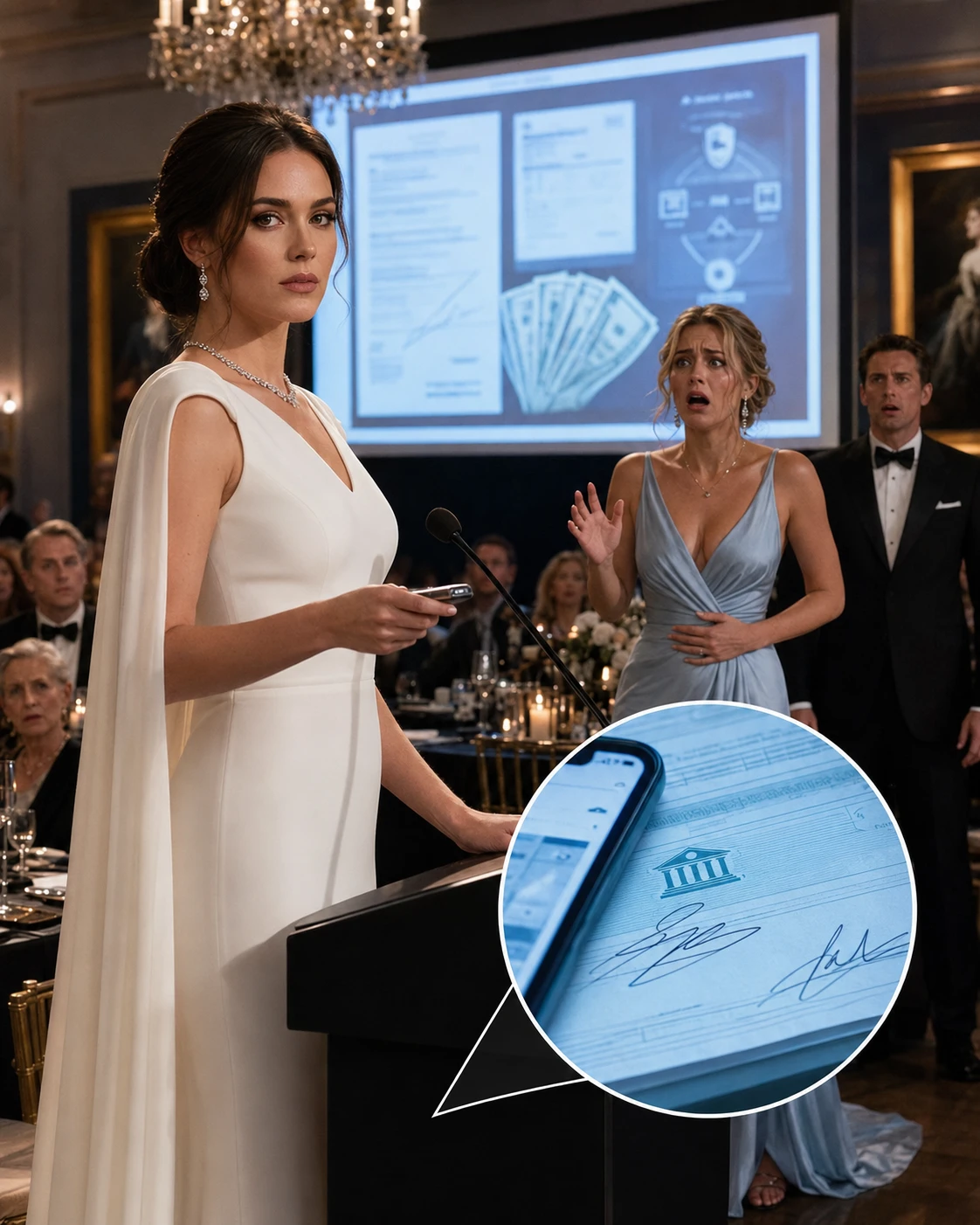
There was something intoxicating about evidence. Not because it healed pain. It did not. But it gave pain a spine. It turned the shapeless horror of being betrayed into pages, dates, transfers, metadata, signatures. A map of where the knife entered and whose hands held it.
Vivian entered with two cups of tea and one expression.
I had learned that expression meant she was about to enjoy herself professionally.
“Grant wants mediation,” she said.
I laughed once.
“No.”
“That was also my answer.”
Julian said, “Sloane is panicking.”
I looked at him.
“How do you know?”
“She unblocked three people connected to your staff on Instagram and posted five stories in forty minutes. Also, she called Harrowgate’s compliance director from a blocked number.”
“Nolan?”
“Recorded internally by the bank.”
“Can we use it?”
Vivian smiled. “Eventually.”
Eventually became my favorite word.
For the next two weeks, my life divided into two versions.
Public Amelia attended client meetings, wore flawless coats, approved limestone from Portugal, smiled at donors, and made no comment about rumors.
Private Amelia sat in conference rooms with lawyers, forensic accountants, and asset recovery specialists while the architecture of Grant’s betrayal unfolded in layers.
Lantern Key Holdings had received $740,000 through fake consulting invoices approved under Grant’s credentials.
Marigold Advisory had invoiced for “brand research” and transferred most of the funds to an account connected to Sloane’s older brother, a nightclub promoter in Scottsdale with a bankruptcy history and a taste for watches.
Grant had pledged projected distributions he had no right to pledge.
Sloane had used company documents to present herself as co-founder of a philanthropic initiative that did not legally exist.
A Miami condo had been leased with money diverted from a client deposit.
Two pieces of art purchased through a Palm Beach gallery were traced to a storage facility in Queens.
A vintage Porsche registered under a Delaware LLC appeared in a garage in Greenwich.
And then came the house.
Not the Miami condo. Not the Westport showroom. Not our penthouse.
A house in Napa Valley.
Julian found it on a Thursday.
He came to Vale House after closing, wearing a dark overcoat dusted with snow. I was alone in the archive, reviewing wallpaper samples for a client in Charleston because even betrayal could not stop rich people from needing powder rooms.
He placed a file on the table.
“You should sit down,” he said.
“I’ve come to dislike that sentence.”
“I know.”
I sat anyway.
He opened the file.
Photographs slid out.
A modern farmhouse tucked into vineyards. White exterior. Black steel windows. Olive trees along the drive. Pool reflecting sunset. Expensive, quiet, perfect.
“What is this?”
“A property outside St. Helena. Purchased eleven months ago by Silver Orchard Trust.”
I stared at the photo.
“And?”
“Silver Orchard is connected to Lantern Key. The trust documents list a beneficiary.”
“Sloane?”
“No.”
Julian turned a page.
The beneficiary name hit me so strangely that, for a moment, I thought I had misread it.
“Grant Whitmore Jr.?”
My voice sounded far away.
Julian watched me carefully.
“Do you have a son?”
“No.”
“Is Grant aware of any child by that name?”
My skin went cold.
I thought of Sloane’s hand on his sleeve. Her gold dress. Her message.
A future you can’t touch.
I stood too quickly.
The chair scraped against the floor.
“She’s pregnant?”
Julian said nothing.
Silence is often the most respectful confirmation.
I turned away, one hand pressed to the edge of the table.
The room tilted.
I had imagined many forms of betrayal. Sex. Money. Ambition. Theft.
But a child.
A future, literally.
For one terrible second, I was not cold. I was not elegant. I was simply a woman standing in the wreckage of a marriage, realizing her husband had been building a nursery inside a crime.
Julian did not touch me.
That mattered.
He waited.
When I could breathe again, I looked back.
“How far along?”
“We don’t know. The trust was drafted before any public evidence. It may have been aspirational.”
Aspirational.
A word for dreams. Or fraud.
“Does Vivian know?”
“Yes.”
“And Grant?”
“We believe he signed the trust documents.”
I looked at the photo again.
The house was beautiful.
That offended me most.
Grant had taken money from my company and bought someone else peace.
“Can we freeze it?”
“Already in motion.”
I looked up.
Julian’s expression was calm, but not empty. There was anger there, controlled so tightly it had become useful.
“Why did you come in person?” I asked.
“Because no one should read that alone.”
The sentence entered me quietly.
Not like romance. Not like desire.
Like warmth under a locked door.
I looked away first.
“Thank you.”
He nodded.
For a moment, the room held something tender and dangerous.
Then my phone lit up.
Grant.
This time, I answered.
“What?” I said.
His voice was ragged.
“Mia, we need to talk.”
“No.”
“Please. This has gone too far.”
“Which part? The forged signature? The stolen funds? The fake philanthropic initiative? The Napa house?”
Silence.
Then a whisper.
“You found that.”
“Yes.”
“Mia—”
“Is she pregnant?”
He breathed in.
That was all.
I closed my eyes.
Not because I hurt.
Because if I looked at the world right then, I might never forgive it.
“How long?” I asked.
“Mia, it’s complicated.”
“It’s arithmetic.”
“She told me in October.”
October.
In October, Grant and I had hosted a dinner for my birthday. He had given me emerald earrings and toasted “the woman who built my home.” After dessert, he made love to me in the blue guest room because our bedroom was full of coats from guests. I remembered the way he had touched my hair. I remembered thinking marriage was not passion every day but perhaps it could still be loyalty.
In October, Sloane had told him she was carrying his child.
And he had come home to me with emeralds.
“Are you still there?” Grant asked.
“Yes.”
“I didn’t know how to tell you.”
“You found a way to tell Harrowgate.”
His voice cracked with frustration.
“I was trying to protect everyone.”
“No, Grant. You were trying to fund everyone.”
“Mia, please. I made mistakes.”
I looked at Julian across the archive table.
His face remained unreadable, but his hands were still.
“You committed crimes.”
“I loved you,” Grant said.
There it was. The emergency exit of weak men.
Love.
As if the word could outrank the evidence.
“No,” I said. “You loved being married to what I built.”
He began to cry.
Quietly at first. Then harder.
Years ago, his tears would have undone me. I would have softened. Explained. Comforted him through the consequences of hurting me.
Now I heard only strategy drowning.
“I’m sorry,” he said. “I’m so sorry. Sloane pushed. She wanted security. She said you’d destroy us if we came clean.”
“You should have believed her.”
“Mia.”
“I will destroy the theft. What survives is not my concern.”
I ended the call.
My hand shook once.
Julian noticed.
I hated that he noticed.
Then he crossed the room, opened a cabinet, poured water into a glass, and set it beside me without a word.
I drank.
“Do you want me to leave?” he asked.
“No.”
The answer came too fast.
He looked at me.
I looked at the files.
“I mean, there’s work.”
“I know what you meant.”
That should have embarrassed me.
It didn’t.
Grief changes the shape of desire. Sometimes what you want is not a kiss or a confession. Sometimes what you want is simply a person who can stand in the same room as your devastation without trying to own it.
Julian Cross stood.
And for that, I began to trust him.
The next week, Sloane made her mistake.
Not the screenshot. That had been arrogance.
This was desperation.
She went live.
It happened on a Tuesday evening, just after I finished a client call with a movie producer in Los Angeles who wanted “a monastery vibe but sexy.” Tessa burst into my office without knocking.
“She’s crying on the internet,” she said.
We pulled up the livestream.
Sloane sat in what looked like the Miami condo, wrapped in a white robe, eyes glossy, face perfectly lit. Thirty-two thousand people were watching her perform heartbreak in real time.
“I never wanted this to become public,” she said, voice trembling. “But there comes a point when women have to speak truth to power. I was invited into a business opportunity by people who made promises, and now I’m being threatened because I believed in a future.”
Comments flew.
You’re so brave.
Tell your truth.
Rich wives are scary.
Is this about Vale House?
Protect your peace queen.
Sloane touched her stomach.
I stopped breathing.
Tessa whispered, “Oh my God.”
Sloane continued.
“I won’t say names. I won’t attack anyone. But I will say this: some women think money means ownership. They think a man, a company, a legacy, even a child can be controlled through lawyers.”
A child.
There it was.
Public enough to wound. Vague enough to deny.
My phone buzzed.
Vivian.
Do not respond.
Julian texted one second later.
We’re recording.
Nolan texted after that.
Let her keep talking.
So I watched.
Sloane cried for twenty-four minutes. She implied I was vindictive, barren, controlling, jealous, abusive through litigation, and “obsessed with destroying a baby’s future.” She described Grant as “a man trapped between duty and love.” She claimed she had documents proving her role in the Westport initiative and her financial expectations.
Then, with the instinct of a person who cannot resist showing the knife, she held up a folder.
“This is the truth,” she said. “Agreements were made. Documents were signed. I’m tired of being erased.”
The screen froze for half a second as she waved the pages.
Half a second was enough.
Daniel captured the frame, enhanced the image, and sent it to Vivian.
The visible heading on the top document read:
PRIVATE SETTLEMENT AND EQUITY PARTICIPATION AGREEMENT
Under it, blurred but readable:
Grant Whitmore and Sloane Mercer shall jointly pursue controlling influence over Vale House brand assets following marital dissolution.
Tessa stared at the screen.
“She just showed motive to thirty thousand people.”
I leaned back in my chair.
“She built a future on content.”
“No,” Tessa said. “She built a confession on Wi-Fi.”
By morning, the livestream had been reposted everywhere.
The public turned against me first.
Of course it did.
America loves a crying woman when she is young, pretty, and positioned against a colder one. By noon, my photos were circulating beside captions like ICE QUEEN WIFE and BILLIONAIRE BOSS DESTROYS PREGNANT MISTRESS. I was not a billionaire. Facts rarely survive contact with comment sections.
One video showed my face at the gala beside Sloane’s tearful livestream.
Text over the video read:
Imagine being so powerful you try to erase your husband’s baby mama.
It had 2.8 million views.
Grant did not defend me.
Sloane posted a black square with a white heart.
Mercer Social gained 400,000 followers.
Vale House lost three clients.
One of them sent a note through their assistant:
Given the sensitivity around your personal matters, we feel it best to pause.
Personal matters.
My company’s money had allegedly been stolen, my signature forged, my records misused, my reputation attacked, and somehow it was still filed under “personal.”
That evening, I walked through the empty showroom alone.
The Westport samples were still laid out on the main table: limestone, oak, unlacquered brass, hand-painted tile. A version of the future I had intended to build before Grant tried to put Sloane’s name on it.
I felt tired then.
Not weak. Tired.
There is a special exhaustion in being a woman expected to remain graceful while people profit from injuring you.
My phone rang.
Patricia Lorne.
I answered.
“Are you drinking?” she asked.
“No.”
“Start.”
I almost smiled.
“I’m at the office.”
“Then drink office whiskey. Your father kept some somewhere.”
“How do you know?”
“I gave it to him.”
I went to the lower cabinet in my office. Behind old sample books, I found a bottle of Macallan older than some influencers. I poured one finger.
Patricia said, “Good. Now listen. The public is stupid in groups but useful in reversals.”
“That should be embroidered.”
“Do not sulk. Do not explain. Do not post quotes about healing. We are going to host a dinner.”
“A dinner?”
“Yes. People believe what happens in beautiful rooms. Grant used that against you. Use it properly.”
I looked out at the dark showroom.
“What kind of dinner?”
“The kind where everyone who matters watches the evidence arrive wearing a tuxedo.”
CHAPTER 5
THE FUTURE SHE COULDN’T TOUCH
The dinner took place three weeks later at the Frick Madison, in a private gallery room arranged for the Vale House Preservation Benefit.
Patricia planned it like a military campaign disguised as a charity event.
Three hundred guests. Museum trustees. Old clients. New donors. Editors. Attorneys. Two district attorneys who pretended they were there for the art. A documentary crew filming a piece about historic restoration. A tech founder whose wife had reposted Sloane’s livestream and now looked nervous whenever she saw my name.
Grant was invited.
So was Sloane.
That had been my idea.
Vivian had objected for seven full seconds before admitting it was useful. Nolan called it “high risk.” Julian said nothing for a long moment, then asked whether I understood what it would cost me emotionally.
I told him I had already paid.
The invitation went out under my name.
Amelia Vale Whitmore requests the pleasure of your company
for an evening supporting the future of American preservation.
Not Whitmore & Vale.
Vale.
My maiden name.
The old one. The real one.
On the night of the dinner, I arrived early.
I wore white.
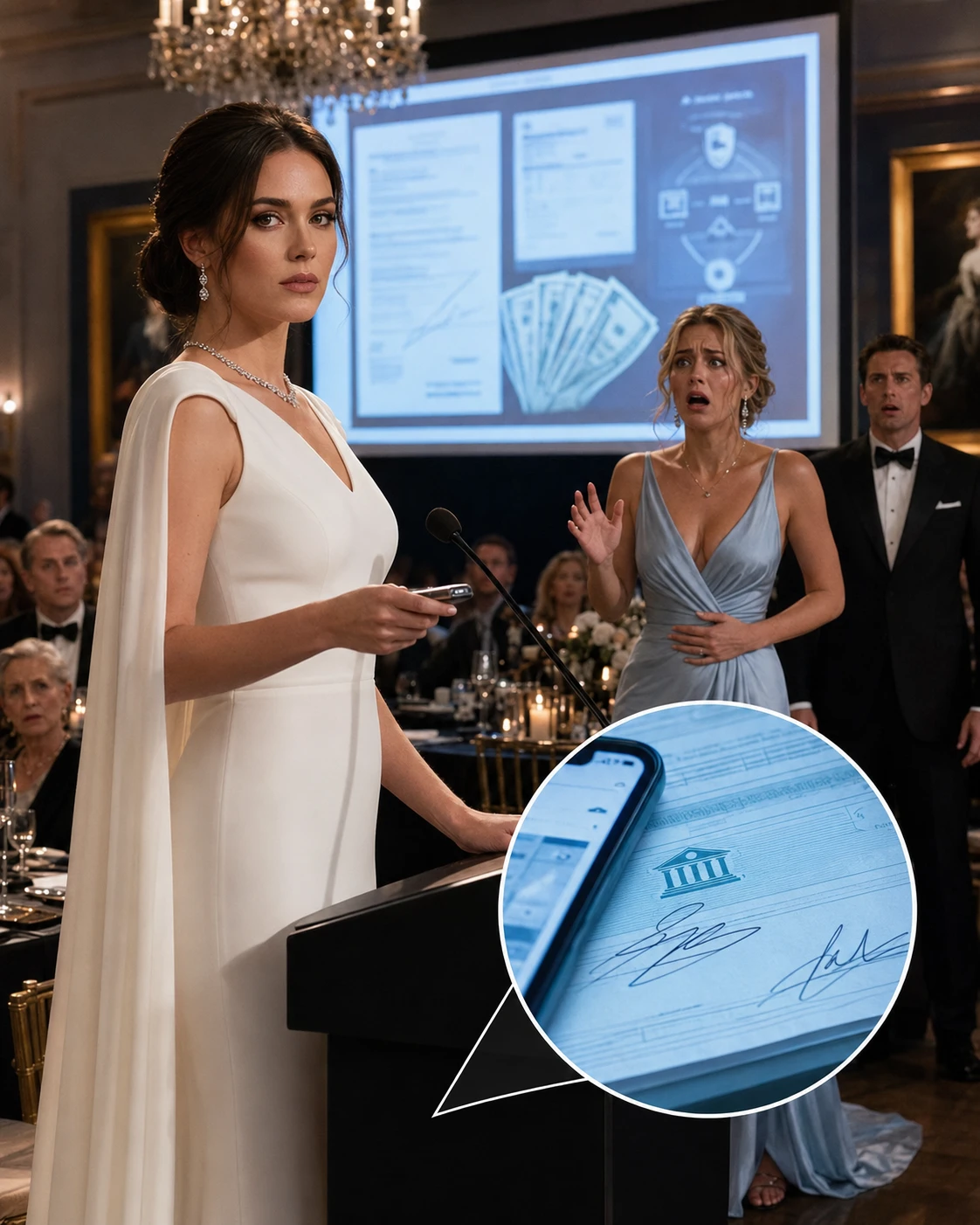
A long column gown with a cape that moved behind me like smoke. My hair was pinned low. My diamonds were my mother’s, the only ones Grant had never touched because they had remained locked in my father’s trust.
The room glowed.
Tall arrangements of winter branches rose from black urns. Candles burned along the tables. The walls held paintings older than every scandal in attendance. Waiters moved silently with champagne. A pianist played near the far archway.
Luxury is not about gold.
It is about control.
Every detail that night whispered mine.
Tessa managed arrivals with a headset and the calm menace of a queen’s guard. Daniel oversaw the projection system. Nolan remained somewhere near the back of the room, indistinguishable from any other quiet man in a dark suit. Vivian stood near the front, speaking with Patricia.
Julian found me beside a marble fireplace.
He wore black.
Not tuxedo black in the usual way. Something sharper. Midnight jacket, white shirt, no ornament except cufflinks that looked old enough to have secrets.
“You look like a verdict,” he said.
The compliment entered the room between us and stayed there.
“You look like a man who hides evidence in beautiful places.”
“I find it there.”
I looked toward the entrance.
“Are they coming?”
“Yes.”
“How do you know?”
“People like that can’t resist attending their own myth.”
He stood beside me, not too close.
“After tonight,” he said, “things change.”
“They already did.”
“For them, yes. I meant for you.”
I looked at him.
His expression was careful. Not guarded, exactly. Patient.
“I don’t know what I am after this,” I admitted.
His voice lowered.
“You don’t have to become something immediately.”
That almost undid me more than any declaration would have.
Grant had always needed me defined. Wife. Founder. Hostess. Asset. Obstacle.
Julian offered me the dignity of being unfinished.
Before I could answer, the room shifted.
Grant had arrived.
He came in wearing a tuxedo and the expression of a man trying to look wronged by architecture. He had lost weight. His face was sharper, eyes shadowed, but he was still handsome enough that several women turned. Shame had not ruined him. Not yet.
Sloane entered beside him.
She wore pale blue silk stretched over the unmistakable curve of pregnancy.
The room noticed.
Of course it did.
A wave of murmurs moved beneath the music.
Sloane had chosen the dress carefully. Soft. Maternal. Expensive. Innocent. Her hair fell loose over her shoulders. No gold cuffs tonight. Pearls. She had studied the backlash and adjusted the costume.
Her hand rested on her stomach as she walked.
Grant’s hand rested over hers.
The performance was almost touching.
Almost.
When they reached me, Grant’s eyes flickered over my dress, my diamonds, Julian beside me.
His mouth tightened.
“Mia,” he said.
“Grant.”
Sloane looked at me with wet eyes and a brave little smile.
“Amelia. Thank you for inviting us.”
“Of course,” I said. “You said you wanted the truth public.”
Her smile faltered.
Only for a moment.
Then she recovered.
“I want peace.”
“No,” I said gently. “You want sympathy. Peace is quieter.”
Grant stepped in.
“Let’s not do this tonight.”
I looked at him.
“Not tonight,” I repeated.
He heard the echo.
Good.
Dinner began at eight.
Patricia gave the first speech, sharp and elegant, about preserving homes because buildings remember what people try to forget. The room laughed in the correct places and grew silent in the better ones.
Then a historian spoke.
Then a client whose family estate Vale House had restored after a fire.
Then me.
I walked to the podium beneath the enormous chandelier.
The room softened into attention.
I looked out and saw every face I needed to see.
Clients who had paused contracts. Editors who had run flattering pieces about Sloane. Donors who had smiled at the gala while Grant placed his hand on another woman’s waist. People who had waited to see which way power would fall before choosing a side.
Sloane sat near the center, one hand on her stomach.
Grant sat beside her, jaw tight.
Julian stood at the back of the room, still as a shadow.
I began.
“When I was twenty-six, I bought a ruined brownstone in Brooklyn with money I did not have.”
A small laugh moved through the room.
“The roof leaked. The floors tilted. One contractor told me it would be cheaper to let the building collapse and apologize to the neighbors. But my father walked through with me and said, ‘Mia, ruined things aren’t always weak. Sometimes they’re just waiting for someone honest to open the walls.’”
My voice did not shake.
“Vale House was built on that principle. We open walls. We find what is hidden. We restore what is worth saving. And we remove what is rotten before it spreads.”
The room grew very quiet.
Grant looked down.
Sloane stared at me.
I continued.
“Recently, there have been public claims regarding my company, my marriage, and a proposed initiative called the Westport Restoration Fund.”
A camera shifted.
“Because those claims involve active legal matters, I have followed counsel’s advice and remained silent.”
Vivian watched me with the expression of a woman who had approved every word.
“But silence is not absence. Silence is not guilt. And silence, when used properly, is a locked room where evidence can be protected.”
A murmur.
I clicked the remote in my hand.
Behind me, the screen lit up.
Not with scandal.
With documents.
The first slide showed the Westport brunch packet.
THE WESTPORT RESTORATION FUND
A Vale House x Mercer Social Initiative
Founded by Grant Whitmore and Sloane Mercer
I said, “This document was distributed at a private planning brunch. Vale House did not authorize it.”
The second slide: company access logs.
I said, “These are access records showing restricted financial documents downloaded using Grant Whitmore’s credentials. One external device was identified as belonging to Sloane Mercer.”
A louder murmur.
Sloane went pale.
Grant leaned toward his attorney, who had appeared beside him like a bad conscience.
The third slide: Harrowgate Bank application.
Names: Grant Whitmore. Sloane Mercer.
Income Support: Whitmore & Vale Design Holdings.
I paused.
There are moments when a room inhales as one body.
This was one.
“This application,” I said, “was submitted to establish a joint private account. It included company records and a letter bearing my scanned signature. I did not authorize that letter. I did not sign that letter. I did not approve the use of Vale House as financial support for any private account.”
Sloane stood.
“This is insane,” she said.
Every head turned.
Her voice trembled, but not with performance now.
With fear.
“My attorneys—”
Vivian rose from her seat.
“Ms. Mercer,” she said, pleasant as winter, “sit down.”
Sloane sat.
Grant did not look at her.
The fourth slide: payment flows.
Lantern Key Holdings.
Marigold Advisory.
Fake consulting invoices.
Transfers.
Jewelry.
Miami lease.
Palm Beach gallery.
Vintage car subscription.
Napa property.
I did not read every detail. I did not have to. The screen was merciless.
“Funds connected to Vale House projects were routed through entities now under investigation,” I said. “We have referred materials to the appropriate authorities.”
A woman near the front whispered, “Oh my God.”
The fifth slide: Sloane’s livestream still.
Her holding up the folder.
PRIVATE SETTLEMENT AND EQUITY PARTICIPATION AGREEMENT
The room erupted in whispers.
Sloane’s face crumpled.
Grant closed his eyes.
I looked at them both.
“This image came from a public livestream in which Ms. Mercer claimed she had been promised a future. The document she displayed appears to describe a plan to pursue controlling influence over Vale House brand assets following marital dissolution.”
I let the words settle.
Following marital dissolution.
Not romance.
Not love.
Strategy.
The sixth slide was the message.
We’re building a future you can’t touch.
The room went silent again.
I did not look at Sloane when I spoke.
“She sent me this herself.”
No one moved.
Even the candles seemed still.
Then I clicked once more.
The final slide was not evidence.
It was a letter.
The Vale Family Trust Protection Provision.
My father’s signature at the bottom.
I said, “My father built certain protections into the structure of Vale House before his death. Those protections have now been activated. Effective today, an advisory board has ratified the removal of Grant Whitmore from all access, authority, and association with Vale House and its related entities.”
Grant’s chair scraped back.
“Mia,” he said.
His voice broke.
Not loudly. Not dramatically.
Just enough for the room to hear the ruin in it.
I looked at him.
For one second, I saw the man I married.
Then I saw the man who forged my name.
“It’s done,” I said.
He stepped into the aisle.
“You don’t understand.”
I almost smiled.
That was the tragic thing.
I understood everything.
Sloane stood too, crying now.
“You’re hurting a child,” she said.
The room shifted uneasily.
There it was. The shield. The final card.
I let her have the silence.
Then I said, “No. I’m protecting one.”
Her face changed.
Grant looked sharply at me.
Vivian inhaled.
Julian’s eyes narrowed slightly from the back of the room.
The final twist had not been on the slides.
Some truths are too delicate for projection.
I folded my hands on the podium.
“Because in the course of this investigation, we discovered something else. Something that does not belong to gossip, or branding, or public cruelty.”
Sloane’s hand flew to her stomach.
I looked at her then, and for the first time all night, my voice softened.
“Ms. Mercer is not pregnant.”
The room exploded.
Not with sound exactly.
With shock.
Sloane’s mouth opened.
Grant turned to her.
“What?” he whispered.
I did not enjoy that part.
I need that understood.
There are forms of exposure that bring satisfaction. This was not one of them. This was uglier. Sadder. A lie built not only to steal sympathy, but to control a man stupid enough to believe he could father a future with stolen money.
Vivian stepped forward.
“We will not disclose private medical records,” she said clearly. “But we can confirm that Ms. Mercer’s own written communications, obtained through lawful discovery and preserved from her devices, describe the pregnancy as a ‘necessary narrative’ and reference a prosthetic garment purchased for public appearances.”
Sloane made a sound.
A wounded, animal sound.
Grant stared at her as if seeing her for the first time.
“You told me,” he said.
Sloane shook her head.
“Grant—”
“You told me.”
Her eyes filled with real tears now.
And still, somehow, she looked at me with hatred.
As if I had invented her lie by discovering it.
I stepped down from the podium.
The room parted as I walked toward them.
Luxury rooms love spectacle until it approaches.
I stopped in front of Sloane.
Up close, she looked younger than I remembered. Not innocent. Never innocent. But small in the way all cruel people become when the performance collapses and only hunger remains.
“You could have taken him,” I said quietly enough that only those nearest heard. “I would have survived that.”
Her lips trembled.
“You had everything.”
“No,” I said. “I built everything.”
Grant reached toward me.
“Mia, please.”
I turned to him.
His face was wrecked. Betrayed, which was almost funny. He looked like a man shocked to discover deception inside the house of deception he had furnished.
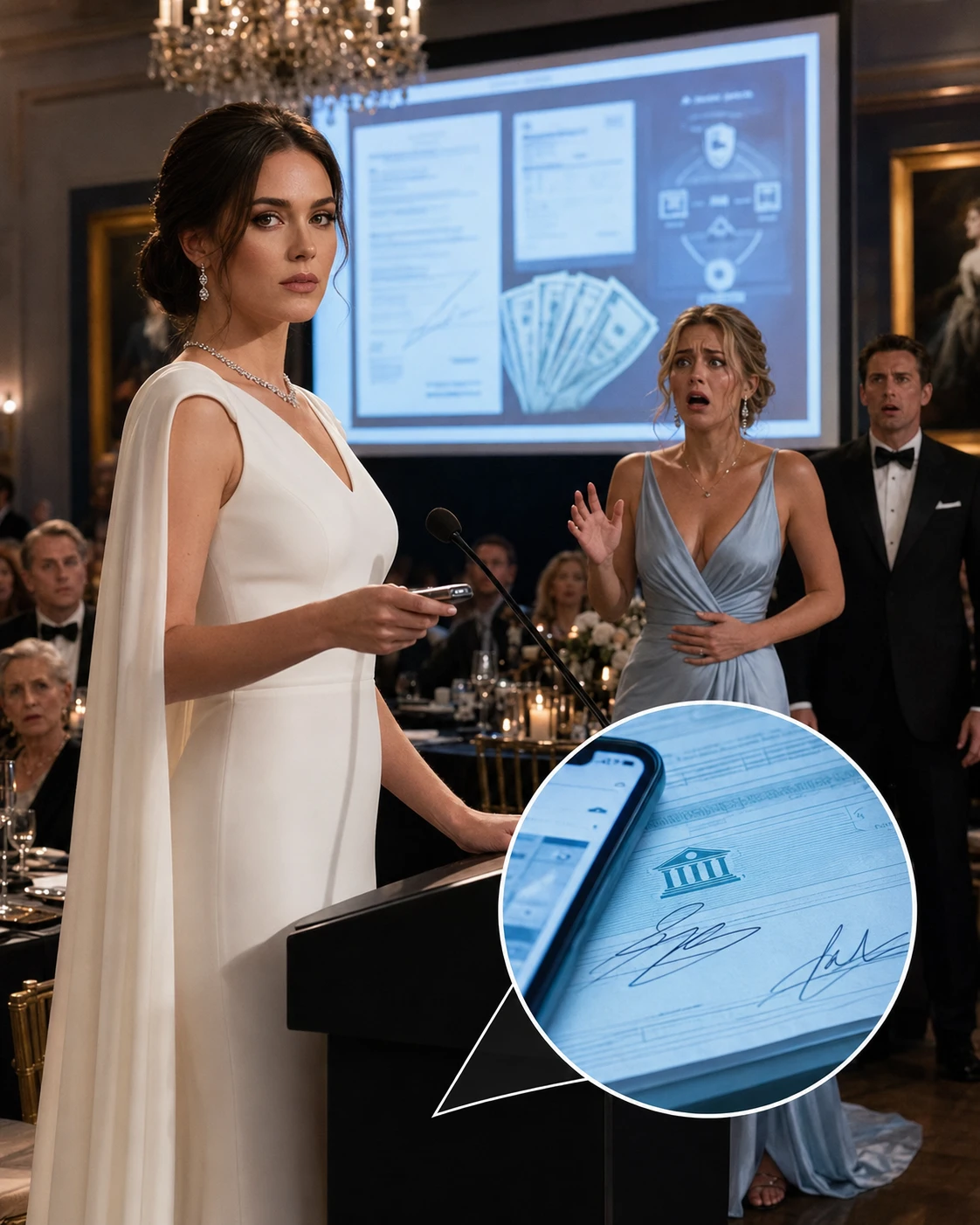
“I didn’t know,” he said.
“You knew enough.”
“She lied to me.”
“And you forged my signature.”
He flinched.
Good.
“You stole from my company. You used my records. You planned to make me look unstable. You stood beside her at the gala while she sent me proof of your fraud because both of you thought my humiliation would be useful.”
His eyes were wet.
“I loved you.”
This time, the words did not even reach me.
“No,” I said. “You loved access.”
Then Nolan appeared beside Grant with two men I had seen earlier pretending not to be law enforcement.
Grant looked from them to me.
“What is this?”
Vivian answered.
“Questions, Mr. Whitmore. You should answer them with counsel present.”
Sloane began sobbing.
Her attorney tried to move her toward the exit.
Too late.
The room had already chosen a side, not because the people in it had become moral, but because evidence had made morality fashionable.
By midnight, the internet had turned.
It always does.
Clips from the dinner spread faster than the livestream. Someone posted the moment the bank application appeared on screen. Someone else captioned Sloane’s message: “Imagine sending the wife your own evidence.” The hashtag FUTURE YOU CAN’T TOUCH trended for two days.
The same people who called me cold now called me iconic.
The same pages that praised Sloane’s bravery posted timelines of her lies with dramatic music.
Mercer Social lost sponsors.
Grant resigned from three boards before they could remove him.
Harrowgate cooperated fully.
The district attorney’s office opened an inquiry.
Civil claims followed.
Assets froze.
The Napa house was tied up before anyone could spend a single sunset there.
The Miami condo was emptied by marshals.
The Porsche was found under a cover in Greenwich.
Two paintings were returned.
Money moved back, slowly, through the long machinery of law.
Not all of it.
The law is not magic.
But enough.
Enough to protect Vale House.
Enough to protect my staff.
Enough to prove that I had not been bitter, unstable, jealous, or cruel.
I had been accurate.
Grant tried to settle.
Vivian made him wait.
Sloane vanished from New York for a while. Someone said Arizona. Someone said Austin. Someone said she was writing a book. I wished her no harm, which is not the same as forgiveness. Forgiveness suggests a debt I felt no need to manage. She had taken her shot. She had missed. The consequences belonged to her.
Grant sent letters.
Not emails. Letters.
The first was twelve pages. The second was six. The third was one.
I read none of them after the opening line of the first:
Mia, I see now that I confused my fear of your power with resentment.
That was enough.
Men often gain wisdom when it becomes legally advantageous.
The divorce became final in September.
I walked out of the courthouse in a navy dress and sunglasses, Vivian at my left, Tessa at my right, Julian waiting by the black car at the curb.
Paparazzi shouted questions.
“Amelia, do you feel vindicated?”
“Are you dating Julian Cross?”
“Any comment on Grant Whitmore?”
“Will Vale House keep the name?”
That last one stopped me.
I turned.
The cameras surged.
I removed my sunglasses.
“Vale House was never his name to keep,” I said.
By Monday, the company was legally restored as Vale House.
Simple. Clean. Mine.
CONCLUSION
THE HOUSE THAT STAYED STANDING
One year later, the Westport showroom opened on a bright October evening.
Not as a fraudulent fund.
Not as a backdrop for Sloane Mercer’s reinvention.
As exactly what I had intended before my husband mistook my silence for emptiness.
The building had once been a carriage house. We restored the brick, replaced the rotted beams, polished the old concrete floors until they reflected light like water. There were private rooms for clients, a courtyard with espaliered pear trees, shelves of antique hardware, and a long table made from reclaimed oak where my team would argue beautifully over stone samples and upholstery trim.
On opening night, the air smelled like rain and candle wax.
Tessa cried in the powder room, then threatened to fire anyone who mentioned it. Daniel brought his mother. Patricia drank champagne and told three different people she had always known Grant was a “decorative liability.” Vivian stood near the door, accepting gratitude as if it mildly inconvenienced her.
Julian arrived late.
Not because he wanted to be dramatic.
Because he had been in federal court helping recover assets for a woman whose husband had hidden money in rare watches.
He found me in the courtyard after the speeches.
The sky above Westport was deep blue, almost black. Strings of lights crossed between the trees. Through the windows, I could see my team laughing inside the showroom we had saved before anyone else could claim it.
Julian handed me a glass of champagne.
“To opening walls,” he said.
I smiled.
“To removing rot.”
We touched glasses.
For months after the dinner, people tried to turn Julian into a headline. The asset hunter who rescued the betrayed wife. The mysterious man beside Amelia Vale. The dark-suited recovery expert with gray eyes and perfect timing.
They misunderstood, as people usually do.
Julian had not rescued me.
He had stood near the fire while I walked out carrying my own name.
That was why, when he reached for my hand in the courtyard, I let him.
Not because I needed a new future quickly.
Because I had learned the difference between a man who wants to stand in your light and a man who is not afraid when you shine.
“Are you happy?” he asked.
The question surprised me.
Not because the answer was no.
Because it was yes, but not the simple kind.
I looked through the windows at Vale House. At Tessa laughing. At Vivian speaking with a donor. At Patricia correcting someone’s posture with her eyes. At the walls we had opened, the beams we had reinforced, the rooms waiting to be filled.
“I’m peaceful,” I said.
Julian nodded.
“That’s better.”
“It is.”
Inside, someone called my name.
Founder.
Not Mrs. Whitmore. Not Grant’s wife. Not the woman from the scandal.
Founder.
I squeezed Julian’s hand once and stepped back toward the doors.
Before I went inside, I looked up at the second-floor windows glowing warmly against the dark.
For years, I had believed love meant building a home someone could share.
Now I knew better.
Love is not giving a man keys to every room inside you.
Love is noticing who respects the locked doors.
The night moved on. Champagne disappeared. Guests praised the plasterwork. Clients booked consultations. My staff stayed too late because none of us wanted to leave.
Near midnight, after the last car pulled away and the candles burned low, I stood alone in the main room.
The showroom was quiet except for the soft hum of the heating system and the rain beginning again outside. On the long oak table lay a single envelope.
No name.
Inside was a printed screenshot.
The old one.
The bank application.
The message.
We’re building a future you can’t touch.
Tessa had framed a copy for the private archive as a joke. Or maybe not a joke. With Tessa, affection often wore combat boots.
Beneath the screenshot, she had placed a small brass plaque.
PROVENANCE: THE DOCUMENT THAT STARTED THE RESTORATION.
I laughed then.
Really laughed.
Not coldly. Not sharply. Not for cameras.
Like a woman alive inside her own life.
I placed the frame on the shelf behind the consultation table, not where clients would see it, but where I would.
A reminder.
Not of betrayal.
Of the moment I stopped asking why they had tried to take what was mine and started asking where they had left the paperwork.
Outside, rain washed the courtyard clean.
Inside, the house stood.
She built a future on my documents. I built a case on hers.