
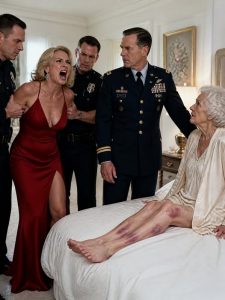
The moment I returned home from deployment, I caught my wife gossiping to the neighbors, ‘His mother has dementia—she keeps hurting herself.’ But my heart sank when I found Mom locked inside a dark bedroom, completely clear-minded, with no phone and covered in bruises she was too terrified to explain. I just smiled, played along with my wife’s lies, and secretly recorded her bragging, ‘Nobody will ever believe that old woman.’ The next morning, I calmly took my wife to the psychiatric assessment she had scheduled for Mom—and quietly handed the doctor a completely different file.
Part 1: The Locked Door
The first thing I heard when I stepped out of the rideshare was my wife telling Mrs. Higgins that my mother had lost her mind.
The second was my mother’s fist pounding from behind a locked bedroom door.
“Liam!” she screamed. “Please don’t leave me trapped in here.”
Sixteen hours earlier, I had been sitting on a military transport, imagining hot coffee, my mother’s peach cobbler, and my wife Clara running into my arms. Instead, I came home to Clara standing on our porch in a perfect white dress, smiling at the neighbors like she was hosting a luxury garden party.
“She gets so confused,” Clara told Mrs. Higgins in a soft, sorrowful voice. “Sometimes she hurts herself. We’re considering professional care now.”
I looked up at the second-floor window.
The curtain moved.
Clara hurried toward me and hugged me tightly. Her body stiffened the moment I asked, “Why is Mom’s bedroom door locked?”
“For her safety, sweetheart.”
I smiled easily. “Of course. That makes sense.”
Deployment had taught me one thing: panic gives away your position. So I kissed Clara’s forehead, carried my duffel bag inside, and waited until the neighbors finally left.
The key was not hard to find. Clara had hidden it at the bottom of her jewelry box.
When I unlocked the bedroom door, I found darkness, a bare mattress, one plastic cup of water, and my mother, Margaret, sitting on the floor in yesterday’s clothes. Her phone was gone. Purple bruises circled both wrists.
She looked up at me with eyes that were clear, sharp, and furious.
“I am not losing my mind, Liam.”
“I know, Mom.”
She started to explain, but heavy footsteps sounded in the hallway. Terror crossed her face.
“Not now,” she whispered quickly. “She watches everything.”
I locked the door again just before Clara reached the hallway. I hated myself for doing it, but Mom had squeezed my hand first, silently telling me it was all right.
At dinner, Clara poured two glasses of wine and calmly described Mom’s supposed decline. Wandering. Memory loss. Falls. She had already persuaded our family doctor to recommend a psychiatric evaluation, and power-of-attorney documents were waiting on the counter.
“You carried so much while I was gone,” I murmured.
Relief passed across Clara’s face. She thought my uniform made me obedient.
She had forgotten that before deployment, I spent four years as a financial fraud investigator for the state attorney general.
Late that night, I opened our home security logs. Clara had deleted three months of footage, but the cloud server still held access records. Every deletion came from her laptop’s IP address.
Then I found Mom’s bank statements had been redirected to Clara’s personal email.
There was also a pending wire transfer request for eighty thousand dollars.
At midnight, I attached a small high-definition audio recorder beneath the kitchen table.
Before bed, I emailed my commanding officer to request emergency family leave. Then I changed every password Clara might know. If she tried to run, spend money, destroy evidence, or lie, she would leave a trail.
Finally, I slipped back to Mom’s door, turned the key, and whispered through the crack, “Tomorrow morning, I need you to act completely confused.”
Mom looked down at the bruises on her wrists, then back at me.
Her smile was colder than mine.
“How confused do you need me to be?”

Part 2: Clara’s Perfect Trap
At breakfast the next morning, Mom shuffled into the kitchen wearing an old bathrobe I had slipped through her window before dawn.
She stared blankly at the toaster, then turned to Clara.
“Is this where the bus picks us up?”
Clara’s smile spread wide.
“Oh, Margaret,” she sighed loudly, making sure I could hear. “You see what I deal with every day, Liam?”
Mom swept her hand across the counter and knocked the sugar bowl onto the tile.
Clara reacted instantly. She grabbed Mom’s wrist so hard her own knuckles turned white.
“Stop embarrassing me,” she hissed.
I kept my head down and forced my voice into a passive tone.
“Clara, please be patient with her.”
She let go of Mom and laughed.
“See? Now you finally understand.”
Once Mom shuffled back upstairs, Clara opened a manila folder with obvious satisfaction. The psychiatric evaluation was set for nine the next morning with Dr. Marcus Thorne, a respected geriatric psychiatrist.
Clara explained that once Mom was declared legally incompetent, she expected me to sign the co-guardianship papers.
“We can put her house on the market immediately,” Clara said. “Use the equity to pay for a permanent care facility.”
“Her house is fully paid off,” I said neutrally.
“Exactly.”
That one word confirmed everything.
This had never been about Mom’s safety.
It was about money.
I spent the rest of the afternoon building a case Clara could not escape. I called the county clerk’s office and placed an immediate fraud alert on Mom’s property deed. No lien, sale, guardianship order, or transfer to Julian Vance—a corrupt local developer—could move forward without my signature.
A former colleague at the attorney general’s office confirmed that the eighty-thousand-dollar transfer request used a crude copy of Mom’s real signature. A locksmith documented that the bedroom lock had been reversed so it could only be opened from the hallway. A military physician privately photographed Mom’s wrists and noted that the bruising matched forceful restraint, not accidental falls.
Then Mom gave me the last piece.
“Your father’s old desk,” she whispered through the cracked door. “Bottom drawer.”
Inside, I found a small camera disguised as a dummy smoke detector. My father had installed it years ago after burglaries in the neighborhood. Clara had disabled the visible modern cameras, but she had missed this old hardwired backup.
The memory card held weeks of unedited footage.
It showed Clara dragging Mom across the hardwood floor.
Clara taking away her phone.
Clara rehearsing her worried neighbor voice in front of a mirror.
And three nights earlier, Clara sitting on the couch with Julian Vance.
“The second she’s declared legally incompetent,” Julian said on camera, “we can liquidate the property under market value. No one will look twice.”
Then Clara leaned over and kissed him.
My anger stopped being emotional.
It became structured.
That evening, I created three encrypted evidence files. One went to Dr. Thorne’s office. One went to Detective Miller in the elder-abuse unit. The third was scheduled to reach Clara’s attorney the exact minute the evaluation began.
Because I kept smiling, Clara grew careless.
That night, she drank too much wine at dinner.
“Your mother always looked down on me,” she sneered. “Now look at her. Pathetic.”
“People can recover,” I said calmly.
Clara snorted. “From advanced dementia? I don’t think so.”
“I meant from whatever caused those deep bruises on her wrists.”
The room turned cold.
Clara leaned across the table, eyes narrow.
“No one will believe that old woman, Liam. I’ve spent months making sure everyone knows she lies, falls, screams, and forgets. By tomorrow morning, a licensed doctor will put it in writing forever.”
The recorder under the table caught every word.
I lifted my glass.
“To tomorrow.”
She clinked hers against mine.
“To the future.”
Upstairs, Mom was waiting by the door. I handed her a clean dress and a framed photograph of my father.
“Are you ready?”
She straightened her shoulders.
“Your wife wanted a psychiatric evaluation,” Mom said coldly. “Let’s make sure she gets exactly what she asked for.”
Part 3: The Evaluation
The next morning, Clara wore her best pearls. She walked out of the house as if she were heading to a celebration, completely convinced she was about to bury my mother’s freedom forever.
I drove us to Dr. Thorne’s clinic in silence. Mom sat quietly in the back seat while Clara lectured her the whole way.
“Don’t argue with the doctor, Margaret,” Clara said, adjusting the mirror. “Your agitation only makes your confusion look violent.”
Mom stared out the window.
“I’ll keep that in mind.”