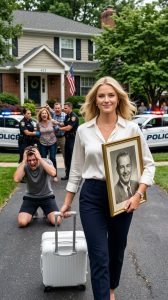
My name is Clare, and by the age of twenty-eight, I had learned a devastating truth about human nature: grief can reveal the core of a person just as clearly as love can. Three years ago, my grandparents, Helen and Robert Thompson, passed away within mere months of each other. They had been the anchoring force of my entire existence, the two people who made me feel most seen, most valued, and most protected in this world. Their consecutive deaths left a deafening, hollow silence inside my chest that absolutely nothing could fill. But they also left me something tangible: their magnificent 1920s Victorian home in Portland, Oregon, along with the entirety of their accumulated estate, a sum just shy of a million dollars.
I had never, not for a single fleeting second, cared for them because I expected an inheritance. I showed up because they were my family, and they needed me. Over their final years, I was the one who kept their pantry stocked with the specific brands of tea they liked. I drove them to endless medical appointments, meticulously organized their complex daily regimens of heart medications, and sat beside them in sterile, suffocatingly bright hospital rooms. I learned to decipher which specialists made my grandfather nervous enough to want to cancel, and I learned how to calm him down. I was the one who held their frail, trembling hands when the hospital rooms grew too quiet and the rhythmic beeping of the life-support machines grew too loud.
My older sister, Julia, rarely made an appearance. She was always too busy with her “brand,” her social life, her endless pursuit of the next big thing. My parents, Karen and Michael, always had an arsenal of perfectly crafted excuses ready at a moment’s notice, ranging from vague, pressing business trips to mild, conveniently timed colds.
But when the time came for the will to be read in a cold, mahogany-paneled downtown law office, they all arrived twenty minutes early. They sat in the plush leather chairs, practically vibrating with the expectation of a massive, unearned payday.
The attorney’s voice was measured, calm, and utterly devoid of emotion as he read the document. He explained, in clear, unambiguous legal terms, that everything had been left exclusively to me. The sprawling Victorian house, the lifetime of savings, the carefully managed investment portfolios, the life insurance policies—all of it. My grandparents had specifically written into the addendum that I was their devoted granddaughter, the only one who gave her time, her energy, and her heart when it mattered most.
My parents sat there, stunned into a heavy, suffocating silence. The color rapidly drained from my father’s face. Julia’s expression tightened into a mask of sheer, unadulterated disbelief. No one shed a single tear for Helen and Robert. No one spoke a word about their endless kindness, their warm laughs, or the void they had left behind.
My father immediately leaned forward, his posture aggressive and sharp, his voice dripping with entitlement.
“Well, obviously, there are some formalities here,” Michael said, waving a hand dismissively at the legally binding document. “How are we going to go about dividing the liquid assets? And who is handling the sale of the property?”
He spoke as if the will were merely a rough draft for a family negotiation.
Julia followed me out into the hallway afterward, her heels clicking sharply against the marble floor. She cornered me near the elevators, smiling a bright, brittle smile that didn’t reach her cold eyes. She looked at me like she had already generously forgiven me for some grave, unimaginable insult.
“Listen, Clare,” Julia began, her tone patronizingly sweet. “I know Grandma and Grandpa were a little confused at the end. Obviously, you’re going to do the right thing and sign half of everything over to me, right? It’s only fair.”
That was the exact moment the heavy veil lifted from my eyes. I understood that my grief had company. Greed had entered the room, pulled up a chair, and absolutely refused to leave.
The house was not just a piece of highly valued real estate to me. It was a living, breathing vessel of memory. The third stair on the main staircase groaned in a specific, comforting pitch, exactly the way it had when I was a child sneaking down for midnight snacks. The massive, intricate stained-glass windows in the formal dining room filled the space with fractured, dancing, jeweled light in the late afternoons. The kitchen still smelled faintly of my grandmother’s signature lavender wood polish and baking flour. And the massive, sprawling oak tree in the backyard had been planted by my grandfather as a sapling before my mother was even born.
My family looked at the property and saw a massive influx of cash. I looked at it and saw the last remaining sanctuary where I still felt connected to the only people who had truly, unconditionally loved me.
Anticipating the wrath that was inevitably coming, I immediately sought out David Morrison. David was an elite estate attorney known throughout the city for being ruthlessly precise, completely devoid of sentimentality in the courtroom, and virtually impossible to intimidate. I sat in his office and laid out my family’s immediate reactions.
“They will not let this go,” David said, interlacing his fingers. “A standard will can be dragged into probate. It can be endlessly challenged. Signatures can be questioned by highly paid ‘experts.’ Claims of undue influence can and will be completely fabricated. If we want to honor your grandparents’ wishes, we need to build a fortress around this estate before they can even file their first motion.”
His solution was a legal ironclad fortress. We immediately created the Helen and Robert Thompson Legacy Trust. We systematically transferred the deed of the house, the investment accounts, and the entirety of the estate’s assets directly into it. I was designated as the sole, lifetime beneficiary, but David assumed the role of the primary trustee. Because of this structure, no one—not even me, under duress—could sell, transfer, or alter the ownership of the house without David’s explicit, legally notarized signature. The estate became entirely untouchable.
For the first few months, I thought the Trust had successfully neutralized the threat. I believed they would complain behind my back, harbor deep, bitter resentment, and eventually move on with their lives.
I was dangerously, tragically naive.
The retaliation began not with lawsuits, but with a campaign of silent, psychological warfare. Two months after the estate was settled, an official city inspector showed up at my front door with a clipboard and a stern expression. Someone had filed an anonymous, highly detailed, and completely fabricated complaint alleging severe structural damage and critical electrical code violations that posed an “immediate threat to the neighborhood.” It took three exhausting weeks of invasive inspections and thousands of dollars in non-refundable municipal fees just to prove the house was perfectly safe and up to code.
Then, the attacks became personal.
One crisp Tuesday morning, I walked out to the backyard with a cup of coffee, only to drop my mug onto the patio. My grandfather’s prized, decades-old rose bushes—the very same ones I had spent the entire spring meticulously pruning and nursing back to vibrant health—had been violently hacked to pieces. The stems were sheared off at the base, the vibrant red petals scattered and crushed into the dirt. The soil around the roots had been heavily salted so that absolutely nothing would ever grow there again.
But the true, visceral terror set in just before the first snow of winter.
I came home late from an exhausting double shift at the hospital. The neighborhood was dead quiet. The moment I unlocked the front door and stepped into the foyer, the air hit me like a physical, suffocating blow. It was freezing inside. The ambient temperature was so low I could literally see the condensation of my own breath pluming in the dark hallway.
I rushed to the living room wall. The digital thermostat hadn’t just been turned down. It had been violently ripped from the drywall, the internal wires dangling like severed, dead nerves.
I checked the back door leading to the garden. It was unlocked.
There were no broken windows. No signs of forced entry. Nothing had been stolen. The expensive television was untouched, my laptop sat securely on the desk.
My father had always been incredibly handy with locks. He used to brag about how he could pick any standard deadbolt in under thirty seconds.
I stood in the freezing, pitch-black silence of my own living room, my palms slick with a sudden, icy sweat. My heart hammered violently against my ribs. They weren’t just angry about the money anymore. They were trying to break my spirit. They had been inside my sanctuary.
And as I stood there in the freezing dark, I heard the unmistakable, subtle groan of the floorboards directly above my head.
I didn’t scream. I didn’t run out into the street. And I certainly didn’t call the police. I knew exactly how the authorities handled things like this: they would write it off as a civil family dispute, take a half-hearted report, and leave me entirely defenseless.
Instead, I backed slowly out of the house, locked the door, and spent the night at a well-lit motel across town. The next morning, I contacted Apex Security Solutions, a high-end, private security firm run by former military contractors. I spared no expense.
Within forty-eight hours, the house was transformed into a digital fortress. Five microscopic, high-definition cameras with integrated, ultra-sensitive audio receivers were seamlessly embedded into the environment. One was hidden inside the intricate living room crown molding. Another was concealed within the vintage kitchen clock. A third was perfectly masked within the front porch light fixture. I also had every single exterior door fitted with heavy-duty, smart deadbolts that required a biometric scan to open.
I turned my sacred sanctuary into a high-tech snare. I just had to wait for them to step into it.
The psychological toll of the waiting game was agonizing. For two weeks, I lived in a state of hyper-vigilance. Every shadow outside my window made me jump. Every creak of the old house settling sounded like a footstep. But I forced myself to maintain my routine, acting oblivious to the invisible war raging around me.
I didn’t have to wait long.
On a miserable, violently rainy Wednesday evening, the front doorbell chimed. I pulled out my phone and checked the live security feed. Standing on my porch, huddled under expensive umbrellas, were Julia, Karen, and Michael. Julia was clutching a sleek, designer leather handbag, shivering slightly in the damp cold, but wearing a look of absolute, terrifying triumph.
I took a deep, steadying breath. I opened the security app, tapped the master control, and initiated the recording sequence. A tiny red dot appeared on my screen, confirming that every word, every breath, every movement in the living room was now being captured and securely uploaded to an encrypted cloud server.
I forced my shoulders to slump. I widened my eyes, artificially injecting a look of deep exhaustion and vulnerability into my posture. Then, I unbolted the door.
They marched in without waiting for a greeting, tracking wet, muddy footprints across the pristine hardwood floors. They didn’t take off their coats.
“We need to talk, Clare,” Julia announced, her voice echoing harshly in the hallway. She strode into the living room and dropped a thick, glossy manila folder onto the center of the coffee table. “It’s over.”
“What do you mean?” I asked, keeping my voice small, allowing it to tremble just a fraction. I wrapped my arms around myself, perfectly playing the part of the cornered prey.
“We’re taking the house,” my father stated flatly. He stood near the grand fireplace, casually inspecting the mantle as if he were measuring the walls to decide on a new paint color. “And if you have even a single ounce of self-preservation left in that head of yours, you’ll pack your bags tonight.”
Julia unceremoniously pulled a thick stack of documents from the folder. They looked incredibly official. They were printed on heavy bond paper, complete with embossed notary stamps, intricate legal formatting, and a very convincing state court seal. But as I glanced down at them, I realized this wasn’t a standard, run-of-the-mill property dispute. This was something far more sinister.
“Our newly retained lawyer, Richard Blackwood, uncovered some very, very disturbing things regarding the estate,” Julia said, her voice dripping with a sickly, rehearsed sympathy. “It turns out, Grandpa and Grandma were heavily in debt with several unregulated commercial creditors. But worse than that… we have sworn medical affidavits from their final weeks.”
She slid a specific piece of paper across the table toward me. I looked down. The words swam before my eyes, the sheer audacity of the lie taking my breath away. It was a deeply detailed, forged medical report, allegedly signed by a Dr. Aris Thorne—a name I had never once encountered in all my years of managing their care. The document categorically stated that Helen and Robert Thompson were suffering from advanced, severe dementia, severe cognitive decline, and documented signs of physical neglect during the time the will was drafted.
“This,” my mother chimed in, stepping forward, her eyes flat and unblinking, “is a finalized draft of the criminal complaint we are fully prepared to file with the district attorney. Elder abuse, Clare. Coercion. Fraud. The systematic isolation of vulnerable adults. The police take it extremely seriously when a young, greedy woman isolates two sick, confused old people and forces them to sign over a million-dollar estate.”
A cold, heavy dread coiled deep in my gut. This had escalated far beyond simple greed. It was sheer, unadulterated malice. They weren’t just trying to take my home; they were actively threatening to destroy my life, strip away my medical license, and lock me in a cage.
“You… you can’t possibly do this,” I stammered, artificially hyperventilating. I let tears well up in my eyes, letting them spill down my cheeks. I sank onto the sofa, burying my face in my trembling hands. “It’s a lie! You know I took care of them! You know I sacrificed everything for them while you were nowhere to be found!”
Keep them talking, a cold, clinical voice in my head whispered. Feed their egos. Feed the monster. Get everything on the record.
“Oh, sweetie, you need to grow up. The truth is whatever we can successfully prove in a court of law,” Julia sneered, leaning down so her face was inches from mine. “And right now, we have a highly respected lawyer who has drawn up ironclad, irrefutable proof that you abused them. The narrative is set. You’re looking at a minimum of ten years in a state penitentiary.”
“Please,” I sobbed, looking up at my father, begging the man who had raised me. “Dad, please. Don’t do this to me. I have nothing else. This house is all I have left of them.”
My father didn’t flinch. His expression remained utterly stony. “You brought this entirely upon yourself the moment you manipulated them into stealing our rightful inheritance. But, because we are a civilized family, we are willing to be merciful.”
Julia tapped a second, highly visible document on the table. “This is a voluntary deed transfer, accompanied by a full, legally binding confession of estate mismanagement and asset forfeiture. You sign the house, the trust, and the accounts over to me right now, tonight, and we will permanently shred the elder abuse complaint. You walk away with nothing, yes, but you get to keep your freedom.”
“And if I refuse?” I whispered, looking from one ruthless face to the next.
“Then Friday morning, at exactly nine o’clock,” Julia smiled, a sharp, predatory flash of perfect white teeth, “we arrive with a court order, a police escort, and a professional eviction crew. You lose the house, you lose your career, and you go straight to jail in handcuffs. Think about it very carefully, little sister. You have until Friday.”
They turned in unison and walked out, leaving the counterfeit papers scattered on the table. The heavy front door clicked shut behind them, locking automatically.
I sat in the oppressive silence for a full, uninterrupted minute. Then, I slowly lowered my hands. I wiped the fake tears from my dry, burning cheeks. I reached into my pocket, pulled out my phone, and ended the cloud recording.
I played it back. The audio was pristine, capturing every single threat, every admission of blackmail, and the clear conspiracy to commit fraud.
Checkmate. But Friday was coming, and I knew they wouldn’t come quietly.
I didn’t sleep for the next forty-eight hours. I spent Thursday sitting at the massive kitchen island alongside David Morrison and Detective Megan Walsh, a hardened, no-nonsense veteran from the Portland Police Bureau’s Economic Crimes Division. We reviewed the high-definition footage on my laptop. Megan’s jaw locked tight, her knuckles turning white as she watched my own flesh and blood threaten me with a fabricated prison sentence.
“They practically gift-wrapped their own arrest warrants and handed them to us on a silver platter,” Megan muttered, aggressively scribbling notes on her legal pad. “This ‘Richard Blackwood’ they keep mentioning—we ran the name through the federal database. It’s a known alias for a man named Gary Stevens. He’s a career con artist, a ghost who specializes in targeting inheritances and vulnerable grieving families. The feds have been hunting him across three state lines for eight months.”
“So we go pick them up now?” I asked, my heart hammering a frantic rhythm against my ribs. “We have the tape.”
David shook his head firmly, adjusting his glasses. “No. If we arrest them right now, based solely on a threat, they will hire expensive defense attorneys and claim it was a misunderstanding, a heated family argument blown out of proportion. Your parents might even try to throw Julia under the bus to save themselves. We need them to execute the crime. We need them to physically show up on Friday with Stevens, attempting to enforce these forged documents and forcibly take possession of the property. Once they cross that threshold and attempt the eviction, it instantly escalates to multiple grand felonies.”
Friday morning arrived, bringing with it a bitter, howling wind that violently rattled the old windowpanes of the Victorian. The sky was the color of bruised iron. I stood in the foyer, dressed in reinforced jeans and a thick, heavy sweater, feeling entirely numb, running on pure adrenaline.
At exactly 8:45 AM, the deep, guttural roar of a massive diesel engine shattered the quiet neighborhood. I watched through the front window as a massive commercial demolition truck—bearing the logo Ironclad Wrecking—roared down the street, intentionally jumping the curb and parking aggressively on my front lawn, ruthlessly crushing the remaining grass into deep mud ruts.
A pristine white BMW pulled up directly behind the truck. Julia, Karen, and Michael stepped out into the freezing wind. They were accompanied by a slick, overly confident man in a sharp, tailored charcoal suit, carrying a heavy leather briefcase. Gary Stevens.
But what made my blood instantly turn to ice was the crew stepping out of the demolition truck. Five massive, heavily tattooed men in steel-toed work boots and hard hats piled out, hauling heavy crowbars, sledgehammers, and power saws.
They marched up the porch steps in a formidable phalanx. Julia didn’t even bother ringing the doorbell; she aggressively tried to use her copied key, found the new biometric deadbolt impenetrable, and began pounding furiously on the solid oak door.
I took a deep breath, unlocked the deadbolt, and pulled the door open.
“Time’s up, Clare,” Julia snapped, her breath pluming in the freezing air. “Did you sign the papers, or are we doing this the hard way?”
“I’m not signing a single thing,” I said, my voice unnervingly steady. “And I am not leaving my home.”
Gary Stevens stepped forward, puffing out his chest, attempting to project legal authority. “Miss Thompson, I am Richard Blackwood. I am holding a court-mandated writ of possession signed by a superior court judge. You are currently trespassing on private property. Furthermore, as the new, legally recognized owner, your sister has authorized immediate, emergency renovations to address the extreme, life-threatening safety hazards on this property.”
“Renovations?” I asked, my eyes darting to the men holding the sledgehammers.
Julia smiled, a vicious, ugly thing, looking past me into the depths of the house. “Yes. I absolutely despise Victorian architecture. It’s so dark and depressing. Boys!” she yelled to the demolition crew, waving her hand dismissively. “Head straight into the dining room. Start by smashing those hideous stained-glass windows. Then tear out that main wooden staircase. I want an open floor plan before my interior designer gets here at noon.”
A massive, bearded man with a twenty-pound sledgehammer pushed violently past me, his heavy boots thudding ominously against the hardwood floors. He marched purposefully toward the formal dining room. The bleak morning light was barely pouring through the intricate red, blue, and gold glass—the very same glass my grandmother used to painstakingly clean by hand every single Sunday.
Panic, hot, blinding, and absolute, exploded in my chest. Where were the police? Megan had explicitly told me to hold the line, to wait for her signal, but they were seconds away from permanently destroying my grandparents’ legacy.
I sprinted down the hallway, throwing myself frantically between the massive wall of fragile glass and the approaching worker.
“Move aside, lady,” the foreman grunted, hefting the massive iron sledgehammer onto his broad shoulder. “We got a contracted job to do, and we get paid by the hour.”
“You swing that hammer, and I swear to God I will press felony destruction of property charges against every single one of you!” I screamed, my voice echoing off the high ceilings.
Julia strolled casually into the room behind me, laughing out loud. “You don’t own a damn thing anymore, Clare. You have zero rights here. Swing the hammer, guys. Ignore her.”
I spread my arms wide, pressing my spine firmly against the freezing, colored glass, feeling the delicate lead lines against my back. “I am the sole legal owner of this property! This is an illegal, fraudulent eviction! If you touch me or this house, it’s aggravated assault!”
The foreman hesitated, lowering the hammer slightly, looking back at Julia for confirmation. My father stepped forcefully into the room, his face dark red with uncontrollable fury.
“Stop throwing a childish tantrum, Clare!” Michael barked, stepping toward me. “Grab her by the arms and physically pull her out of the way! Now!”
Two of the massive workers stepped forward, their thick, calloused hands reaching aggressively for my shoulders. I braced myself, digging my heels hard into the floorboards, closing my eyes tight as their hands clamped down violently on my arms, preparing to rip me away from the wall.
“Touch her,” a booming, authoritative voice echoed like thunder from the front hallway, “and every single person in this room will be spending the next ten years in a federal penitentiary.”
I snapped my eyes open, gasping for air.
David Morrison strode purposefully into the dining room, his long dark overcoat flapping, his eyes cold and hard as flint. Directly behind him, moving with tactical precision, was Detective Megan Walsh. She held her gold police badge high in the air, the metal catching the dull morning light. She was flanked by four heavily armed, uniformed Portland police officers.
The demolition workers immediately released my arms and scrambled backward as if I were on fire. The heavy sledgehammers and crowbars dropped to the floor with deafening, metallic clangs.
Gary Stevens’s smug, arrogant expression dissolved in a fraction of a second. He took one panicked look at Detective Walsh, dropped his expensive leather briefcase, and bolted frantically toward the kitchen, aiming for the back door.
“Stop him! He’s a runner!” Megan shouted.
Two uniformed officers bypassed us in a blur of motion. They tackled Stevens hard to the floor before his hand even grazed the doorknob. The sheer force of the impact rattled the delicate china in my grandmother’s cabinets. The harsh, metallic ratcheting of handcuffs clicking tightly into place echoed through the kitchen.
Julia froze completely, her designer bag slipping uselessly from her shoulder to the floor. “What… what is this? Who are you people?”
David stepped forward, his presence dominating the room. He slammed a genuine, heavily watermarked legal document onto the dining table. “I am David Morrison, primary legal trustee of the Helen and Robert Thompson Legacy Trust. This heavily protected trust owns the property in perpetuity. The documents you are attempting to enforce this morning are amateur, fraudulent forgeries. The judge’s signature is a terrible fake. The court seal is a low-resolution photocopy. And the docket number you used actually belongs to a 2014 minor traffic violation in Dayton, Ohio.”
My mother’s face went chalk-white. She gripped the edge of a chair to keep from collapsing. “There’s a mistake. Our lawyer assured us—”
“Your ‘lawyer’ is Gary Stevens,” Megan interrupted loudly, walking over to him as an officer roughly hauled the con man to his feet, checking his pockets. “He is currently wanted in three separate states for wire fraud, forgery, extortion, and grand larceny. You hired a ghost to steal your daughter’s house.”
“We didn’t know!” Julia screamed, her voice violently cracking into a high, hysterical pitch. She backed away from the officers. “He tricked us! Clare, tell them he tricked us! We thought it was real!”
I slowly walked away from the stained glass. I reached into my coat pocket, pulled out my smartphone, and tapped the screen. The hidden, high-fidelity speakers embedded in the living room ceiling crackled to life, playing the crystal-clear audio recording from Wednesday night at maximum volume.
“This is a finalized draft of the criminal complaint we are fully prepared to file. Elder abuse, Clare. Coercion… You sign the house, the trust, and the accounts over to me right now, tonight, and we will permanently shred the elder abuse complaint.”
The damning sound of their own voices, dripping with malice and extortion, echoed relentlessly through the house.
The silence that followed was suffocating, heavy enough to crush bone. The demolition crew had quietly and rapidly slipped out the front door, wanting absolutely nothing to do with the massive felony they had almost unwittingly participated in.
Then, the inevitable implosion began.
“This was entirely her idea!” Michael roared, suddenly pointing a violently trembling finger at his own daughter, Julia. “She found the guy online! She brought him to us! She said it was a foolproof, legally safe way to get her rightful share of the estate!”
“Are you out of your mind?!” Julia shrieked, her face contorting with raw, unfiltered rage. “You paid him, Dad! You drove to the bank and gave him the five thousand dollar cash retainer out of your own joint checking account! Don’t you dare try to pin this all on me to save yourself!”
“Shut up, both of you! Just shut up!” Karen screamed, tears of absolute panic streaming down her face as a female officer approached her, pulling out a pair of cuffs. “Officer, listen to me, I was just following my husband! I am a victim here! I didn’t want to do this to my daughter. I told them it was cruel! I told them to stop!”
“You literally typed up the forged medical records yourself, Mom!” Julia spat, weeping hysterically, the illusion of her perfect life shattering as the cold steel locked tightly around her wrists. “You sat at your laptop and invented Dr. Thorne! I have the emails to prove it!”
It was a pathetic, sickening bloodbath. There was absolutely no loyalty. No unconditional love. No parental protective instinct. The exact moment severe legal consequences arrived at their doorstep, they turned on each other, tearing one another to pieces like starving, cornered animals. They screamed vile obscenities, aired years of deeply buried, toxic family secrets, and sobbed uncontrollably as the police physically dragged them out the front door.
Dozens of neighbors had gathered on the wet sidewalks, clutching umbrellas, watching in shocked, silent horror as Michael, Karen, and Julia were roughly shoved into the back of three separate police cruisers.
I walked out and stood on the front porch, leaning tiredly against the wooden pillar. I watched the flashing, strobing red and blue lights reflect intensely off the wet pavement. I didn’t feel a triumphant rush of victory. I didn’t feel happy or vindicated. But as the patrol cars finally pulled away, taking the immense toxicity out of my life forever, I felt a deep, profound, physical release. For the first time in years, I could finally breathe clean air.
The house was completely silent, but this time, it was a silence of peace.
The gears of the justice system, usually slow, moved with devastating, unyielding efficiency against them. Gary Stevens, facing a mountain of insurmountable evidence, pled guilty and was swiftly sentenced to eight years in federal prison for his long, documented history of similar frauds.
The criminal trial for my family was a remarkably short, deeply humiliating public affair. Faced with the irrefutable video evidence, the extortion tape, and their own rapid confessions blaming one another, they had absolutely no viable defense strategy. Julia, desperate and terrified of prison, immediately agreed to a plea deal, formally testifying against our parents in open court in exchange for a slightly reduced sentence.
Julia ultimately served fourteen months in a minimum-security state facility. My parents, due to their age and lack of prior criminal records, received heavy, restrictive probation, massive punitive fines, and the absolute, permanent destruction of their carefully curated social and professional lives in Portland. Furthermore, David Morrison helped me file a merciless civil suit against them for severe emotional distress, property damage, extortion, and attempted fraud. Facing total bankruptcy, they were forced to settle out of court, liquidating their own assets. Every single penny of that settlement went directly into the protective vault of the Legacy Trust.
I have not spoken a single word to Michael, Karen, or Julia since the rainy morning they were arrested in my dining room. Some people, when they hear the full extent of this story, look at me with profound pity. They automatically assume I must be walking around with a gaping, bleeding emotional wound where my family used to be.
They are entirely wrong. What I lost that day was not a loving, supportive family. I lost the exhausting, draining, lifelong illusion that they had ever loved me without extreme conditions. Their affection had always been entirely transactional. It depended completely on my silence, my usefulness, and my willingness to stay small and invisible so Julia could shine and my parents could boast. Losing them was not a painful amputation; it was the precise, surgical removal of a malignant tumor.
My grandparents had loved me differently. They loved through their quiet presence. They consistently showed up. They noticed when I was exhausted after a long shift. They cared deeply without constantly calculating what they could financially or socially gain in return. Their final will did not arbitrarily create the truth of our relationship. It simply recorded a truth that had existed my entire life.
Three peaceful years have passed since that chaotic morning. The house has fully healed, and more importantly, so have I. I met a man named Jake at a neighborhood community garden meeting. He was quiet, endlessly patient, and kind in a way that instantly and profoundly reminded me of the two people who had raised my heart.
We were married last month. We didn’t rent a fancy, expensive venue. We simply stood in the backyard, right beneath the massive, sprawling branches of the oak tree my grandfather planted decades ago. The late afternoon light filtered softly through the green leaves, warm and golden. My cousin Rachel—the only relative who had vehemently refused to take part in my parents’ insane scheme because she inherently knew wrong when she saw it—walked me down the grassy aisle.
The house is full of vibrant life now. Jake’s worn, dog-eared historical paperbacks sit comfortably beside my thick medical journals on the built-in library shelves. We cook together in the kitchen on ordinary Tuesday evenings, the rich smell of roasting garlic and fresh tomatoes entirely replacing the lingering scent of fear and betrayal. The third stair still groans predictably when you step on it just right. The massive stained-glass windows still throw beautiful, unbroken colored light across the dining room floor every evening.
This is what Helen and Robert truly gave me: not just a piece of property, and not just financial security. They gave me an impenetrable sanctuary. They gave me a flawless model of love built on genuine, selfless care and fierce, unwavering loyalty. My real, lasting inheritance was finally understanding exactly what love should feel like, and discovering that I possessed the strength to fiercely protect it.
And that is a solid foundation that no sledgehammer, no forged document, and no amount of human greed will ever be able to destroy.
If you want more stories like this, or if you’d like to share your thoughts about what you would have done in my situation, I’d love to hear from you. Your perspective helps these stories reach more people, so don’t be shy about commenting or sharing.