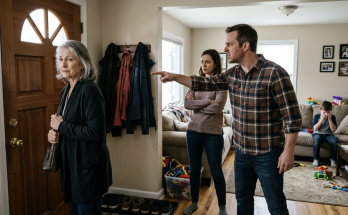

Part 1
My wife was so exhausted she could barely stand, but my mother kept insisting she was only “helping” with the baby.
That day, I came home early.
The first thing I heard was my newborn son crying.
Not an ordinary cry. Not the fussy little whimper of a baby who wanted to be held.
It was a desperate, breathless scream.
The kind of sound that makes your blood turn cold before your mind even understands why.
I dropped my keys in the entryway and rushed inside.
The living room was a mess, but not the normal mess of two new parents trying to survive sleepless nights. It looked like someone had been pushed beyond every human limit.
Laundry was scattered across the floor, half-folded and forgotten. A pot had boiled over in the kitchen. Baby bottles sat on the counter. A blanket had slipped from the sofa and gathered near my wife’s feet.
And there, on that sofa, was Clara.
My wife.
The woman who had given birth to our son only weeks earlier.
She was lying completely still, her face pale, one arm hanging limply over the edge of the cushion.
For one horrifying second, I forgot how to breathe.
Our baby was in the bassinet, red-faced and shaking from crying.
And my mother?
She was sitting at the dining table.
Eating.
A plate of roast chicken, rice, and vegetables was in front of her. A full meal. A hot meal.
The same meal Clara had told me that morning she was too weak to cook.
I looked from the baby to Clara, then back to my mother.
She did not look alarmed.
She did not rush to Clara’s side.
She did not pick up her crying grandson.
She simply lifted her fork, glanced at my unconscious wife, and muttered, “Drama queen.”
Something inside me changed in that moment.
It was not anger at first.
Anger would have been easier.
Instead, everything inside me went still.
A cold, terrifying stillness.
I crossed the room and picked up my son first. His tiny body trembled against my chest as he gasped between cries. I held him close, whispering that Daddy was there, that he was safe, though my own hands were shaking.
Then I knelt beside Clara.
“Clara,” I said, touching her cheek. “Baby, wake up. Please.”
Her eyelids fluttered weakly.
She tried to speak, but only a small breath escaped her lips.
Behind me, my mother sighed like Clara was inconveniencing her.
“Don’t encourage it,” she said. “New mothers love attention. I raised you without fainting every five minutes.”
I turned and looked at her.
For thirty-four years, I had called this woman my mother. I had excused her sharp tongue. I had softened her cruelty in my own mind. I had told myself she was just old-fashioned, just strict, just difficult.
She had always said she was honest.
She had always said people were too sensitive.
She had always said love meant discipline.
And because I was her son, because I had grown up under her roof, I had believed some part of it.
But looking at Clara’s pale face and my son’s trembling body, I finally saw the truth clearly.
Some people do not become cruel overnight.
They simply wait until they have power over someone too tired to fight back.
“You made her cook?” I asked quietly.
My mother dabbed the corner of her mouth with a napkin.
“She offered.”
Clara’s fingers moved weakly against mine.
“No,” she whispered.
My mother’s expression hardened.
“She needed to learn,” she said. “You spoil her. This house is filthy. The baby cries all day. She acts like exhaustion is some kind of excuse.”
I stood up slowly.
My son was still pressed against my chest.
My wife was barely conscious at my feet.
And the woman who had raised me was sitting there as if she had done nothing wrong.
“I’m taking them out of here,” I said.
My mother laughed.
“Don’t be ridiculous. This is my son’s house.”
I looked at her, and my own calmness frightened me.
“No,” I said. “It’s my house.”
Her smile faltered.
I did not argue. I did not yell. I did not waste one more second trying to convince someone who had watched my wife collapse and called it drama.
I wrapped Clara in a blanket, carried her carefully to the car, and secured our son beside her.
My mother followed me onto the porch, shouting about respect, gratitude, family, and everything she believed I owed her.
I did not answer.
I only looked back once.
She stood in the doorway of the home she thought she controlled.
And for the first time in my life, my mother looked unsure.

Part 2
That same hour, I drove my wife and son to a hotel.
Clara slept for fourteen hours.
The doctor said her body had simply reached its breaking point. Exhaustion, dehydration, stress, and dangerously low blood sugar had pushed her too far.
When he gently asked how long she had been going without proper rest, Clara turned her face into the pillow.
She did not sob loudly.
She did not defend herself.
She just cried silently.
That hurt more than anything.
Because I realized then that her suffering had not started that afternoon.
It had been building for weeks.
And I had missed too much.
That night, I fed our son every two hours. I changed diapers badly but carefully. I warmed bottles. I paced the hotel room in the dark with him against my shoulder.
Between each feeding, I watched Clara sleep.
And every quiet minute brought another memory back to me.
My mother telling Clara she was weak.
My mother insisting she move in “just for a little while” after the baby was born.
My mother whispering to relatives that Clara was lazy.
My mother smiling every time Clara apologized for things she had no strength left to fix.
By morning, my phone had seventy-three missed calls.
Then the messages began.
You embarrassed me.
You kidnapped my grandson.
Your wife is turning you against your own blood.
Come home before I change the locks.
I almost laughed at that last one.
Because even after everything, my mother still believed she owned what was never hers.
At noon, my older brother Daniel called.
“Mom says Clara attacked her,” he said.
I stood near the hotel window, looking down at the traffic below.
“Did she?” I asked.
Daniel went quiet for a second.
“Look,” he said carefully, “I know Mom can be intense…”
“Clara fainted,” I said. “Mom sat there eating food she forced Clara to cook while the baby screamed.”
There was silence.
Then Daniel said, much softer, “Mom said Clara was pretending.”
I closed my eyes.
Of course she did.
That had always been my mother’s talent.
She did not need the truth.
She only needed to speak first.
Loudly enough.
Confidently enough.
Long enough for everyone else to start doubting what they saw with their own eyes.
But this time, she had forgotten something.
I was not the scared little boy she used to corner in the kitchen.
I was a grown man.
I was a husband.
I was a father.
And I was also a contracts attorney who believed in documentation.
Months earlier, Clara had asked if we could install a few interior cameras. She worried about the baby monitor failing, especially when she was recovering and moving slowly around the house.
My mother had mocked us for it.
She called it paranoid.
She never bothered asking where the cameras were.
The kitchen.
The nursery.
The living room.
All recording.
All automatically saved to cloud storage under my name.
For the next two days, I said nothing publicly.
I gathered everything quietly.
There was footage of my mother standing over Clara while Clara stirred soup with trembling hands.
There was footage of Clara saying, “Please, I’m dizzy,” and my mother snapping, “Then sit down after the kitchen is clean.”
There was footage of my newborn son crying while my mother sat just a few feet away, scrolling through her phone.
And then there was the final video.
Clara collapsing.
My mother eating.
My mother looking at my unconscious wife and saying, “Drama queen.”
I did not send it immediately.
Not to Daniel.
Not to our relatives.
Not even to my mother.
First, I called the real estate manager and changed the access code to the house.
Then I called the bank.
Then I called our family lawyer.
Then I contacted a private care agency—the same kind of help my mother had once convinced me to cancel because, according to her, “wives should take care of their own babies.”
By the third day, my mother became bold.
She posted online:
“Heartbroken. My son has abandoned his mother for a manipulative woman who uses my grandson against me.”
Relatives rushed to comfort her.
Poor you.
She always seemed fragile.
A mother should never be treated this way.
My wife saw none of it at first. I made sure of that.
She was still healing.
Still trying to believe rest was allowed.
Still holding our son like she was afraid someone might take him from her.
That night, my mother called again.
This time, her voice was sweet.
Too sweet.
“Everyone knows what she is now,” she said. “Bring my grandson home, and I may forgive her.”
Clara was sitting beside me, pale but awake. Our son was asleep in her arms, his little cheek pressed against her chest.
I put the call on speaker.
“My grandson,” my mother repeated. “My house. My family.”
I looked at Clara.
Her eyes were wet, but they were steady.
“You’re right about one thing,” I told my mother.
She paused.
“Everyone should know.”
Then I ended the call.
And uploaded the first video.
The internet did not whisper.
It roared.
Within an hour, the clip was shared through the family group chat.
Then came the second video.
Then the third.
I did not add dramatic music. I did not write a long caption. I did not insult her.
I did not need to.
The footage told the story better than rage ever could.
There was Clara, barefoot and shaking, cooking while my mother watched.
There was Clara asking for a moment to sit down.
There was my mother telling her she could rest after she finished cleaning.
There was my son crying while my mother ignored him.
And then the final clip.
My wife fainting on the sofa.
My mother looking at her.
“Drama queen.”
By midnight, relatives who had insulted Clara began deleting their comments.
The next morning, Daniel called me.
This time, he was crying.
“I didn’t know,” he said.
“No,” I replied. “You didn’t ask.”
That was harsh.
But it was true.
So many people had accepted my mother’s version of events because it was easier than questioning her.
Because Clara was quiet.
Because my mother was loud.
Because some families would rather protect a familiar lie than defend someone who is suffering in silence.
But the videos changed everything.

Part 3
The next morning, my mother arrived at the house with two suitcases and fury written across her face.
She punched the access code into the keypad.
It did not work.
She tried again.
And again.
And again.
I watched through the doorbell camera as her face turned red.
“Open this door!” she shouted. “This is my home!”
I pressed the intercom button.
“It was never your home.”
She froze.
Then her eyes narrowed.
“You can’t lock me out,” she spat. “I’m your mother.”
“You were a guest,” I said.
“I raised you.”
“You hurt me,” I answered. “Then you tried to break my wife.”
Her face twisted.
“That useless little—”
“Careful,” I said. “This is recording too.”
Her mouth snapped shut.
That afternoon, she received a legal notice formally ending her permission to stay on my property.
My lawyer also sent a cease-and-desist letter for defamation, along with screenshots of every post, every comment, and every lie she had spread about Clara.
But the part she never saw coming was the simplest.
For years, I had quietly paid her bills.
Her condo fees.
Her car insurance.
Her medical premiums.
Extra expenses she always accepted without gratitude while telling everyone I still owed her more.
I stopped every voluntary payment.
Not cruelly.
Not illegally.
Just clearly.
Permanently.
She called twenty-six times.
I answered once.
“You can’t do this to me,” she hissed.
“I already did,” I said.
“I’ll tell everyone you abandoned me.”
“They already saw what happens when no one is supposed to be watching.”
Her breathing turned sharp.
“You’ll regret choosing her over me.”
I looked across the hotel room.
Clara was sitting in a patch of sunlight near the window. Our son slept peacefully against her chest. For the first time in weeks, there was color in her cheeks.
“No,” I said. “I regret not choosing her sooner.”
The consequences did not come all at once.
Real consequences rarely arrive like thunder.
They come quietly.
Through phone calls.
Through canceled invitations.
Through people who stop answering.
Through paperwork.
Through closed doors.
Daniel refused to let our mother stay with him after his wife saw the videos. Her church group asked her to step down from the women’s committee. Two cousins who had once trusted her with their children suddenly found other childcare.
Her friends stopped calling as often.
The family group chat, once her courtroom, became the place where her lies fell apart.
Then our lawyer filed official reports documenting what had happened around our newborn son and my recovering wife. Not because we wanted revenge, but because I needed it on record.
My mother had threatened to report Clara.
So we told the truth first.
With evidence.
With timestamps.
With medical records.
She tried to fight back.
She claimed the videos were edited.
So I provided the full footage to the attorney handling the matter and to the relatives she had lied to.
She claimed Clara was unstable.
So Clara’s doctor wrote a statement explaining that her collapse was caused by extreme exhaustion, stress, dehydration, and lack of support.
One by one, my mother’s stories broke apart.
And with every lie that fell, Clara seemed to breathe a little easier.
Three months later, we moved into a new house near the river.
There was no guest room for my mother.
Clara painted the nursery a soft green.
I learned how to fold tiny onesies. Badly, but with enthusiasm.
I learned that babies can somehow need five things at once and still smile like they have forgiven the whole world.
I learned that my wife had been carrying more than exhaustion.
She had been carrying fear.
Fear of being judged.
Fear of being called weak.
Fear that no one would believe her.
Fear that I might choose silence because silence had always been easier in my family.
So every day, I chose differently.
I chose her.
When she needed rest, I made sure she rested.
When she cried for no clear reason, I held her instead of trying to fix it.
When she apologized for the dishes, I told her the dishes could wait.
When our son laughed for the first time on a rainy Sunday morning, Clara burst into tears.
Not because she was sad.
Because joy had finally stopped feeling dangerous.
As for my mother, Daniel told me she moved into a small rented room across town.
She still says she was betrayed.
Maybe she was.
Betrayed by the cameras she mocked.
Betrayed by the paperwork she never expected.
Betrayed by the son she thought would always lower his head.
But most of all, she was betrayed by the truth.
One evening, a letter arrived in the mail.
Her handwriting was on the envelope.
Inside, there was no apology.
Only accusations.
Underlined words.
Angry sentences.
A mother’s pride dressed up as pain.
Clara looked at me from the sofa, our son’s tiny hand wrapped around her finger.
“What does it say?” she asked softly.
I looked at my wife.
Healthy now.
Safe now.
Smiling again.
I folded the letter once.
Then twice.
“Nothing important,” I said.
And for the first time in my life, I meant it.
I tore the letter in half, dropped it into the trash, and went back to my family.