THE WOMAN UNDER THE VEIL
The first person who ever saw Claire Donovan without her wig was not the man she was going to marry.
It was a little girl in a pink baseball cap, sitting cross-legged in a recliner beside her in the infusion room, swinging her sneakers back and forth as if the place were a school bus and not a room full of quiet adults pretending they were not frightened. The girl had cheeks round from medication, a bracelet of plastic beads around her wrist, and a paper crane folded from the pale blue wrapper of a straw.
Claire had been too tired that day to keep pretending. The scarf itched. Her scalp hurt. Her reflection in the dark window beside the chair looked unfamiliar, like someone had erased the woman she had spent thirty years becoming and left behind only the outline. She had taken the scarf off because she thought nobody was looking.
The girl looked.
For one suspended second, Claire felt the old shame rise in her throat. Then the little girl reached up, removed her own pink cap, revealed the smooth curve of her head, and smiled like they had just discovered a secret club.
“Now we match,” she whispered.
Then she giggled.
That was Lily. Seven years old. Smaller than the tote bag her father carried into every appointment. Braver than anyone Claire had ever known.
Four months before Claire’s wedding, Lily was gone.
Claire kept the paper crane.
She kept it in a small velvet jewelry box beside the engagement ring Ethan Parker had given her, tucked between a pair of pearl earrings and the necklace her grandmother had worn to church every Sunday. Not because Claire enjoyed remembering hospital rooms or thin blankets or the metallic taste that lingered after treatment. She kept it because courage, once given to you by a child, became a debt you spent the rest of your life trying to honor.
By the time Claire married Ethan, her hair had not returned the way everyone kept promising it would. Some came back in soft patches. Some did not. Her doctors told her bodies healed unevenly. Her mother told her wedding photos lasted forever.
Those two kinds of truth never sat well in the same room.
Two years before the wedding, Claire found the lump while getting dressed for work. It was a Wednesday morning in late October, the kind of chilly Ohio morning when frost held stubbornly to the windshield and every driveway on the block smelled faintly of leaves and coffee. She was thirty years old, running late for a meeting at the design firm where she worked, one hand holding a half-buttoned blouse, the other searching blindly across the bathroom counter for an earring back.
She almost ignored it.
Everyone ignored things at first. A headache. A strange ache behind the knee. A bill left unopened on the counter because payday was Friday. Claire told herself she would make an appointment after the client presentation, after the weekend, after the office slowed down, after life made room.
Life did not make room.
Three weeks later, sitting on a paper-covered exam table under fluorescent lights, Claire watched her doctor’s face change before the words came. It was subtle, just a tightening at the corners of the mouth, a measured softness in the eyes. But Claire had spent a lifetime reading rooms. She had learned early how to tell whether her mother was disappointed before a single word was spoken, whether her younger brother Mason was about to turn something painful into a joke, whether her father was going to disappear into silence and call it peace.
The doctor took Claire’s hand.
“Claire,” she said gently, “the results came back.”
After that, the world divided.
There was before.
There was after.
There was the woman who had worried about deadlines and grocery lists and whether Ethan would remember to pick up dry cleaning. Then there was the woman standing in the parking lot forty minutes later, holding a folder against her chest while strangers pushed carts toward the supermarket next door, laughing into their phones, living as if the ground had not just opened beneath her feet.
Ethan was the first person she called.
He did not say the right thing immediately. Nobody did. He answered from a job site, wind in the background, someone calling his name. When Claire said, “It’s cancer,” he went silent long enough that she heard the traffic light click from red to green over the speaker.
Then he said, “Where are you?”
“In the parking lot.”
“Stay there.”
“Ethan, you’re across town.”
“Stay there.”
He arrived twenty-three minutes later in paint-stained jeans and a navy work jacket, parking crookedly across two spaces. He did not ask questions before holding her. He did not tell her to be positive. He did not make promises no one had the authority to make. He simply wrapped both arms around her in the cold afternoon and let her shake until the folder bent between them.
Her family reacted in pieces.
Her father, Ron Donovan, came to the hospital with coffee he had forgotten to sweeten and stood beside the window as if the blinds required his full attention. He was a contractor, a man with broad hands and a sun-worn face, the kind of man neighbors called when a deck sagged or a basement wall leaked. He had built half the additions in their county and avoided nearly every emotional conversation in his own house.
Her mother, Elaine, arrived wearing a camel coat and perfume too elegant for the waiting room. She cried before Claire did. But the tears had a strange shape.
“What about the wedding?” Elaine asked, pressing a tissue beneath her eye.
Claire stared at her. “Mom, we don’t even have a date yet.”
“I know, sweetheart. I just mean… what if treatment changes how you look?”
Ethan, sitting beside Claire, went still.
Claire heard the sentence land. She heard what her mother had not said cleanly enough to hide. What if this makes you less beautiful? What if people can tell? What if your pain becomes visible and embarrasses us?
“I’m trying to survive,” Claire said.
Elaine reached for her hand. “Of course you are. Don’t make me sound terrible. I’m only thinking ahead.”
That was Elaine’s specialty. She never harmed you directly, at least not in a way she would admit. She only worried. She only suggested. She only laughed because everyone was too sensitive. She only said what other people were thinking. She only wanted what was best.
Mason did not bother with subtlety.
He came to the house two weeks after Claire’s first treatment, carrying a six-pack of ginger ale Ethan had asked him to bring and a grin that made Claire’s shoulders tighten. Mason was twenty-six then, handsome in the careless way younger sons sometimes were, all charm and no weight. He worked in sales for a logistics company and treated every room like a room waiting to be entertained.
Claire was sitting on the couch beneath a gray blanket, a knit cap pulled low over her head. Ethan was in the kitchen heating soup. Their parents had stopped by after church, Elaine arranging flowers on the sideboard as if a prettier vase could redeem the afternoon.
Mason looked at Claire for half a second too long.
Then he said, “Well, at least you’ll save money on shampoo.”
Elaine made a sound that was half gasp, half laugh.
“Mason,” she said, smiling despite herself, “you’re awful.”
No one told him to apologize.
No one looked at Claire long enough to see if the joke had landed somewhere soft.
Ethan came out of the kitchen with a spoon in his hand and stared at Mason until the younger man looked away. That was one of the first times Claire understood that love did not always announce itself in grand speeches. Sometimes it stood quietly in a doorway with soup warming on the stove, refusing to laugh.
The hair came out on a Tuesday.
Claire remembered that more clearly than the diagnosis. The diagnosis had been too large to hold. The hair was small enough to break her.
She had showered carefully because her skin hurt. She had used the gentle shampoo the nurse recommended, something fragrance-free from the pharmacy with a label that promised kindness. When she ran the comb through her wet hair, half of it came away. Thick brown strands tangled in the teeth. More in her hands. More on the white sink.
She did not scream. She sat on the bathroom floor in Ethan’s oversized sweatshirt and stared at the evidence in her lap.
Losing hair did not make her vain. It made the illness visible. It took the private terror inside her body and wrote it across her head where strangers could read it in grocery aisles, at gas stations, in the reflection of restaurant windows.
That afternoon, she shaved the rest.
Not because she was ready. Because she needed one decision to belong to her.
Ethan came home with groceries and found her standing in front of the mirror, bareheaded, the clippers still on the counter. He froze only briefly, not in horror, but in adjustment, as if his heart needed one second to catch up with what his eyes had seen.
Claire looked down.
“I’m sorry,” she said.
He frowned. “For what?”
She gestured toward her head. The motion was small, almost ashamed.
“This.”
Ethan set the grocery bags on the bathroom floor. One tipped sideways, spilling apples that rolled against the baseboard. He stepped over them, placed both hands on either side of her face, and kissed her forehead.
“The woman I proposed to,” he said, “is still standing right here.”
Then he left the bathroom.
Claire thought he was giving her privacy. Instead, he returned five minutes later holding the clippers.
“What are you doing?” she asked.
“If you’re doing treatment,” he said, plugging them in, “I’m doing solidarity.”
“Ethan, don’t be ridiculous.”
“I’ve built a career on ridiculous decisions.”
Before she could argue, he ran the clippers straight down the center of his head. Brown hair fell into the sink. He looked immediately terrible. His skull had an odd shape at the crown, and there were three tiny scars near his temple she had never noticed.
Claire laughed so hard she cried.
Ethan turned in the mirror, examining himself. “Honestly, I think I’ve made a mistake.”
“You look like a thumb.”
“I look like a committed thumb.”
That was Ethan. He did not make fear disappear. He made it smaller. He made room around it for breath.
Treatment became a calendar of endurance. Mondays for bloodwork. Thursdays for infusions. Saturdays for sleeping through sunlight. Claire learned which nurses warmed the blankets, which crackers tasted least like pennies, which corner of the waiting room had the outlet where she could charge her phone. She learned that courage was not one magnificent act. It was brushing your teeth when lifting your arm felt impossible. It was answering one more message from a coworker who meant well but did not understand. It was watching Ethan fold laundry at midnight because she had fallen asleep trying.
Friends faded. Not all of them, but enough. At first, everyone sent flowers and casseroles and texts full of hearts. Then weeks stretched into months, and concern became awkwardness. People did not know whether to ask about treatment or pretend life was normal, so many of them did neither. Invitations slowed. Calls shortened. Claire stopped blaming them after a while. Fear made people clumsy.
But family had no excuse for cruelty.
Elaine drove Claire to three appointments early on, before Ethan rearranged his work schedule. During one of those drives, Elaine kept glancing at Claire’s scarf in the rearview mirror though Claire sat in the passenger seat.
“You might want to try one with more volume,” Elaine said.
“Volume?”
“Some of the scarves make your face look…” She searched for a gentle word and failed. “Severe.”
Claire watched a line of bare trees slide past the window. “I’m not decorating a mantel, Mom.”
“I’m helping.”
“No, you’re editing.”
Elaine tightened her hands around the steering wheel. “You always take things the worst possible way.”
By spring, the worst had passed, or at least the doctors began to say words that sounded like weather clearing. Claire’s scans improved. Her bloodwork steadied. The active disease was no longer visible. Dr. Rebecca Sloan, her oncologist, smiled with a kind of relief she tried to keep professional.
“You’ve earned the right,” Dr. Sloan said, sliding the report across her desk, “to start planning your future again.”
Claire cried in the parking lot afterward. Not loudly. Just enough that Ethan, sitting beside her in his truck, reached over and turned off the engine though they had not started moving.
Three weeks later, Ethan proposed again.
He had already proposed once, in their kitchen, with candles balanced on the windowsill and pasta overcooked because he was nervous. But this second proposal happened in the hospital garden behind the oncology wing, where patients sat on benches between treatments and pretended the fountain was louder than their thoughts.
It was late afternoon. Tulips had opened along the walkway. Ethan wore a button-down shirt Claire recognized as the one he saved for funerals and job interviews. He guided her to the bench where they had spent so many afternoons making bargains with the universe.
Then he knelt.
Claire covered her mouth. “Ethan.”
“This place deserves a happier memory,” he said.
She said yes before he finished asking.
Wedding planning should have been stressful. Instead, it became the first ordinary joy Claire had allowed herself in two years. She chose ivory flowers and simple invitations with dark green lettering. Ethan handled the caterer, the photographer, the band, the cake tasting, the endless vendor calls that would have exhausted her even before treatment.
“You’ve spent enough time in waiting rooms,” he told her. “Let me sit through meetings about napkin colors.”
They chose a late summer ceremony at Saint Andrew’s, the brick church where Claire’s grandmother had once sung in the choir, followed by a reception at the Westbridge Hotel downtown. The hotel had a ballroom with high windows, old chandeliers, and a terrace where guests could step outside when the music got too loud. It was elegant without being stiff, beautiful without being cold.
Claire bought a wig for the wedding because she wanted to, not because anyone forced her. At least, that was what she told herself.
It was chestnut brown, shoulder-length, soft waves pinned easily beneath her veil. The stylist called it natural. Elaine called it a relief.
“You look like yourself again,” her mother said at the fitting.
Claire looked at her reflection and wondered which self her mother meant.
Nine days before the wedding, Claire stopped by her parents’ house to drop off updated place cards. Elaine had insisted Aunt Evelyn could not sit near Uncle Paul because of something that had happened at a Fourth of July barbecue in 1998, and Claire had changed the seating chart just to avoid another phone call.
The house smelled like cut grass and lemon cleaner. The front door was locked, so Claire went around the side, expecting to find her mother in the garden. As she passed the kitchen window, she heard Mason laughing on the back patio.
“I still can’t believe she’s wearing that wig,” he said.
Claire stopped with the box of place cards in her arms.
Elaine answered without hesitation.
“The groom deserves a real woman,” she said. “Not a bald ghost.”
For a moment, Claire did not understand the sentence. It was too ugly to belong to the afternoon. The sun was shining. A sprinkler ticked across the neighbor’s lawn. Somewhere down the street, a dog barked twice. Ordinary life continued around a sentence that had just cut through thirty years of daughterhood.
Mason laughed.
Claire stood beneath the open window, holding a box full of names written in careful ink. Her own name was on one of them. Claire Donovan. Soon to be Claire Parker. Bride. Survivor. Daughter.
Not real woman.
Bald ghost.
She did not confront them.
That surprised her later. For most of her life, Claire had imagined the moment she would finally speak up as something explosive. A slammed door. A shaking voice. A speech sharp enough to make her mother apologize and her brother look ashamed.
Instead, she turned around quietly, walked back to her car, placed the box on the passenger seat, and drove home.
The house she shared with Ethan was small and yellow, with a porch swing he had hung badly the first time and correctly the second. Claire sat in the driveway for several minutes with the engine off. Through the front window, she could see Ethan moving around the kitchen, probably making coffee he would forget to drink.
She did not go inside immediately.
She took out her phone.
For the first time in her life, Claire started making copies.
Not of everything. Just the truth.
Text messages where Elaine complained that Claire’s illness had made family gatherings “heavy.” Voicemails where Mason joked about her scarves. Emails about medical bills her parents had promised to help with and quietly ignored. Receipts from the hospital payment portal. Photos Elaine had taken during treatment because Claire had asked for private documentation of her own changing body, then promised no one would ever see. Claire saved everything to a secure folder, then to a small flash drive she placed inside the velvet jewelry box beside Lily’s crane.
She did not think of it as revenge.
Revenge was hot. This felt cold and clear.
Something inside her simply whispered, One day, you may need proof.
The morning of the wedding arrived under a blue sky so clean it looked freshly washed. Claire woke before her alarm and lay still beside Ethan for one quiet minute, listening to the hum of the ceiling fan and the distant sound of a garbage truck on the next block. Ethan was already awake. She could tell by the way his thumb moved gently across the back of her hand.
“Still want to marry me?” he asked.
She turned her head on the pillow. “I’m considering it.”
“That’s fair. I snore.”
“You also load the dishwasher like a raccoon.”
“I contain multitudes.”
She smiled. It felt good. Strange, but good.
The bridal suite at the Westbridge was bright and busy by ten o’clock. Makeup brushes clicked against glass jars. Someone’s phone played an old Motown playlist. Her bridesmaids moved around the room in satin robes, steaming dresses, finding earrings, asking for safety pins. Outside the windows, downtown traffic slid past in soft flashes of silver and red.
Claire sat before the mirror while the stylist adjusted the wig and veil. For once, she let herself look.
The woman in the mirror was not the woman on the bathroom floor with hair in her hands. She was not the woman apologizing for a body that had tried so hard to keep living. She was not even the child who had learned to measure love by how little trouble she caused.
She was a bride.
Then the door opened.
Mason stepped in carrying a white gift box tied with a silver ribbon.
The room quieted in that polite way rooms do when someone enters who does not belong. One bridesmaid, Jenna, lowered her mascara wand. The photographer, a soft-spoken man named Daniel, glanced up from checking his camera settings.
“Mason,” Claire said carefully. “This is the bridal suite.”
“I know.” He smiled. “I brought a wedding present.”
Elaine appeared behind him in a champagne-colored dress, pearls at her throat, lipstick perfect. Claire’s father lingered in the hallway, not entering, not leaving.
“What kind of present?” Jenna asked.
Mason’s grin widened.
“So she’ll always remember today.”
The old instinct moved through Claire before thought did. A tightening in her stomach. A warning. She saw Mason’s eyes flick toward the mirror, then toward Elaine. She saw her mother’s mouth twitch, not quite a smile.
“Mason,” Claire said, “not now.”
But he had already crossed the room.
He stood behind her and placed both hands on her shoulders. In the mirror, they looked almost like siblings in an old family photo. The beautiful bride seated in white. The younger brother leaning in, charming, harmless, waiting for the joke to land.
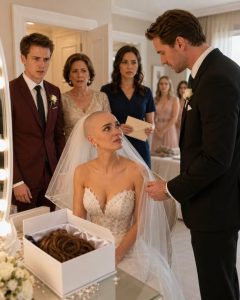
Then he lifted the veil and pulled the wig away.
The room inhaled all at once.
The veil slipped sideways, then fell. The wig landed near the leg of the vanity chair in a soft brown shape that looked suddenly lifeless against the polished floor. Claire’s scalp, bare beneath the bright suite lights, appeared in the mirror before she could prepare herself.
For one second, she was back on the bathroom floor.
Then Elaine laughed.
Not loudly. Not for long. Just once.
“The groom deserves a real woman,” her mother said, “not someone hiding under fake hair.”
Nobody moved.
Claire’s hands gripped the edge of the vanity. Her bridesmaids looked stunned. Daniel lowered his camera as if the equipment had become too heavy. Mason stood behind her, smiling with the nervous pride of a man waiting for applause.
The door opened again.
Dr. Rebecca Sloan stood in the doorway.
She wore a navy dress beneath a light coat, her silver-blond hair pinned back, a small cream envelope in one hand. She had not been invited to the bridal suite. She had been invited to the ceremony, one of the few people Claire insisted on adding even though Elaine said the guest list was getting crowded.
Dr. Sloan looked at the wig on the floor.
Then at Claire’s bare head.
Then at Mason’s hand still hovering near the back of the chair.
Her face changed.
Not dramatically. That was what made it worse.
Her expression became still.
“What exactly,” she asked, “am I looking at?”
Elaine recovered first. “Oh. Doctor. We didn’t realize you were coming back here.”
Dr. Sloan did not answer her. She walked straight to Claire, crouched slightly, and looked into her eyes the way she had in exam rooms when numbers mattered and fear had to be translated into facts.
“Claire,” she said quietly, “are you all right?”
Claire swallowed. “I’m fine.”
It was the oldest lie in the world.
Dr. Sloan looked at Mason. “Who removed her wig?”
Mason shrugged. “I did. It was just a joke.”
“A joke.”
“She’s in remission,” he said, as if that settled something. “Why is everyone still acting like she’s fragile?”
Dr. Sloan stood slowly.
She had spent more than twenty years in oncology. She had delivered difficult news in rooms where clocks ticked too loudly. She had watched husbands sleep in plastic chairs, mothers learn medication schedules by heart, children draw pictures for nurses because they did not know what else to give. She had seen terror, grace, denial, exhaustion, and love stripped down to its barest form.
She looked at Mason as if he had brought dirt into a sanctuary.
“Do you know,” she said, “how many patients are afraid to leave their homes after treatment because they fear exactly this kind of moment?”
Mason’s smile weakened.
Dr. Sloan continued, her voice even. “Do you know how many women sit in my office and ask whether they will ever feel beautiful again? How many postpone celebrations, avoid photographs, step away from mirrors, because someone taught them their changed body is an inconvenience?”
Elaine folded her arms. “No one is saying she isn’t beautiful.”
Claire looked at her mother through the mirror.
Elaine held her chin high. “But marriage should begin with honesty.”
Ethan appeared in the doorway before anyone could answer.
He was wearing his black suit, white shirt, dark green tie slightly crooked because Claire had not been there to fix it. His face held the open warmth she knew better than any face in the world. Then his eyes moved from Dr. Sloan to Elaine to Mason to the wig on the floor.
The warmth left.
He walked into the room slowly, bent down, and picked up the wig with both hands. He did not hand it to Claire immediately. He held it carefully, almost respectfully, then turned to her family.
“You know what I see?” he asked.
No one answered.
“I see the woman who sat through sixteen months of treatment and still asked nurses how their day was. I see someone who comforted a scared little girl in the chair beside her while she was scared herself. I see someone who apologized for being tired, for losing hair, for needing help, when she never owed anyone an apology.”
His eyes moved to Elaine.
“What do you see?”
Elaine’s mouth tightened. “I see my daughter making this more dramatic than it needs to be.”
Ethan nodded once.
“No,” he said. “You see inconvenience. I see courage.”
The room changed then. Not loudly. No one shouted. No one threw open a door. But every person present understood that the center of power had moved. For years, Elaine had controlled rooms with tone, with implication, with the confidence of someone used to being believed. Mason had controlled them with laughter. Ron had controlled them with silence.
Ethan controlled this one by telling the truth plainly.
Dr. Sloan held out the envelope she had brought.
“I came to give Claire something before the ceremony,” she said.
Claire took it with trembling fingers. Inside was the newest scan report. Across the top, in clean black letters, were words she had imagined reading a thousand times.
No evidence of disease.
Her vision blurred.
“I wanted you to have it today,” Dr. Sloan said, “so this day would not belong to fear. It could simply belong to you.”
Claire pressed the paper to her chest. For a moment, she could not speak. She thought of Lily’s crane in the jewelry box. She thought of the girl in the second recliner, removing her cap without shame. Now we match.
The wedding coordinator appeared at the door, headset tucked behind one ear. She stopped, taking in the room without asking the question her face clearly wanted to ask.
“We’re ready whenever the bride is,” she said softly.
Ethan turned to Claire.
“What do you want to do?”
There it was. The question her family almost never asked. Not what would look best. Not what people would say. Not how to make everyone comfortable.
What do you want?
Claire looked at the wig in Ethan’s hands. She looked at the veil on the floor. Then she looked at her own reflection.
For two years, she had believed there were choices she had to make. Sick or beautiful. Survivor or bride. Honest or acceptable. Loved or hidden.
But the woman in the mirror was tired of false choices.
Claire reached for the wig. She held it for a moment, feeling its softness, its careful construction, the illusion it had offered her when she needed one. Then she placed it back inside the box Mason had brought.
“No,” Elaine said, the word slipping out before she could dress it properly.
Claire stood.
“I survived cancer,” she said. “I’m not hiding from my wedding photos.”
Jenna began crying first. Then another bridesmaid. The makeup artist covered her mouth, eyes shining.
Dr. Sloan smiled. “You look absolutely stunning.”
For the first time since treatment began, Claire believed it.
The ceremony started twenty-five minutes late.
When the church doors opened, more than two hundred guests turned. Claire felt their attention like weather across her skin. Ethan stood at the altar, his eyes already wet. The sunlight through the stained-glass windows fell in colored bands across the aisle, touching the white runner, the flowers, the wooden pews polished by generations of hands.
Claire walked bareheaded beneath her veil.
At first, she heard only the music.
Then she noticed the second row.
A little girl sat beside her father, wearing a pink baseball cap. She could not have been more than eight. Her face was pale, her shoulders small inside a lavender dress. As Claire passed, the girl looked up, touched the brim of her cap, then slowly removed it.
Her head was bare.
The girl smiled through tears and gave Claire a thumbs-up.
Claire nearly stopped walking.
For one impossible second, it felt as if Lily had found a way back into the room, not as a ghost, not as grief, but as courage passing from one hand to another.
Ethan saw it too. Claire knew because when she reached him, he whispered, “Lily would be proud.”
She almost fell apart then.
Instead, she took his hands.
The ceremony was not perfect because perfect belonged to photographs and advertisements. It was better than perfect. It was real. Ethan’s voice broke during his vows. Claire laughed through one line of hers because he kept crying, and the church laughed with her, gently, warmly. When the minister finally said, “You may kiss the bride,” applause filled the church in a wave that seemed to lift the ceiling.
For one hour, Claire forgot her mother’s voice.
Then the reception began.
The Westbridge ballroom glowed under chandeliers. Candles flickered on round tables dressed in ivory linen. The band played soft jazz during dinner service. Waiters moved between guests with salads and bread baskets. Claire and Ethan entered to cheers, danced their first dance beneath a wash of warm light, and for a little while the day became what it was meant to be.
A celebration.
Elaine kept her distance. Mason drank too quickly. Ron sat with his hands folded, watching the dance floor as if it were a television he could turn off.
Just before dinner, the ballroom lights dimmed.
Claire turned, confused.
A large screen behind the dance floor came to life.
Mason stood beside the projector, microphone in hand, smiling like a man about to win back the room.
“I made a surprise wedding video,” he announced. “This one’s for the groom.”
Claire felt the air leave her chest.
Ethan’s hand tightened around hers.
The first image appeared.
It was not an engagement photo. Not a childhood picture. Not a family memory.
It was Claire in a treatment chair, asleep beneath a thin blanket, her head bare, her face pale, a hospital bracelet visible on her wrist.
A murmur moved through the ballroom.
Another photo appeared. Claire in a hospital bed after a long appointment, eyes closed, mouth dry, body folded inward with exhaustion. Another showed her from the side while a nurse adjusted equipment. Another captured her sitting in Elaine’s passenger seat after treatment, too tired to hold her head upright.
Private moments.
Private pain.
Displayed twenty feet tall in front of everyone she loved.
Claire turned toward Mason slowly.
“Where did you get those?”
He smirked, though uncertainty flickered now. The room was not reacting the way he had expected.
“Ethan deserves to know who he really married.”
Claire’s voice came out calm. “He already does.”
“Now everybody else does too.”
No one laughed.
At table six, an older woman covered her mouth. Daniel, the photographer, stood near the wall with his face pale and furious. Jenna whispered something that sounded like a prayer.
Ethan walked to the projector and unplugged it.
The screen went black.
Then he turned back to the room.
“Nobody move,” he said.
He did not shout. He did not need to.
Every conversation stopped.
He looked at Mason. “You violated her privacy.”
Mason opened his mouth.
Ethan looked at Elaine. “You violated her trust.”
Elaine’s face hardened. “Those pictures were on my phone.”
Claire stared at her. “You kept them.”
Elaine lifted her chin. “I took them.”
“I asked you to take them for me,” Claire said. “Privately. So I could understand what was happening to my body.”
“They’re family pictures.”
“No,” Claire said. “They are medical pictures. You promised no one would see them.”
The ballroom shifted again. Guests turned in their chairs. The cheerful clink of silverware had vanished. The room had become a place of witness.
Elaine looked around and seemed, for the first time all day, unsure of the audience.
Ethan reached into his jacket pocket and pulled out a folded sheet of paper.
“My wife doesn’t know I brought this,” he said.
Claire looked at him. “What is that?”
He smiled at her, and the tenderness in it nearly undid her.
“Something I wrote after your last treatment.”
He unfolded the paper.
It was not a prepared reception speech. Not a toast. The page was creased from being carried, opened, folded again. Ethan held it steady.
“The day Claire started treatment,” he read, “I made myself a promise. If she ever forgot how brave she was, I would remind her until she believed me.”
Claire pressed a hand to her mouth.
Ethan continued. “She apologized for losing her hair. She apologized for getting sick. She apologized for needing rest. She apologized for surviving something that asked everything from her. One day, I hope to spend the rest of my life convincing her she never needed to apologize for any of it.”
A silence settled over the ballroom, but it was not the cruel silence of shock. It was reverent. Protective.
Ethan folded the paper and walked to Claire. Then, in front of everyone, he knelt.
Claire laughed through tears. “We are already married.”
“I know,” he said. “But I forgot to ask something.”
“What?”
His eyes held hers.
“Will you let me spend the next fifty years proving your family wrong?”
Claire could not answer with words. She nodded.
The ballroom rose.
Applause broke open from every side. Not polite applause. Not the kind people gave because a program required it. Guests stood from their chairs, clapping, crying, cheering. The sound filled the room until Mason stepped back from the projector as if the applause had physical weight.
His plan had failed.
He had not exposed Claire’s weakness.
He had exposed his own.
Then the banquet manager approached Ethan from the side, his expression tight with professional concern. He leaned in and whispered something. Ethan’s face changed.
Claire noticed immediately.
“What?” she asked.
The manager looked at her carefully. “Mrs. Parker, the hotel’s event director is speaking with a guest who works in hospital privacy compliance. Several of those photographs showed visible patient information.”
Claire’s stomach turned.
The manager continued, lowering his voice. “He recognized the hospital forms in the images. He believes there may be serious concerns about how those photos were stored, copied, and displayed.”
Every eye near them moved toward Elaine.
Elaine’s confidence thinned.
A man in a gray suit approached from table twelve. He introduced himself as Michael Hayes, a chief privacy officer at the hospital network where Claire had received treatment. He spoke calmly, not like a man interested in creating a scene, but like someone trained to ask questions whose answers mattered.
“Mrs. Donovan,” he said to Elaine, “may I ask how you obtained and distributed those photographs?”
Elaine looked at Ron.
Ron looked down.
“I took them,” Elaine said.
“With Claire’s permission?”
Claire answered. “For private use only. For me.”
Mr. Hayes nodded and wrote something in a small notebook. “Were you authorized to share them with your son?”
Elaine swallowed. “No.”
“Were you authorized to allow them to be used in a public slideshow?”
“No.”
Mason stepped forward. “She didn’t make the slideshow. I did.”
Mr. Hayes turned to him. “Did Claire give you permission to access those images?”
“No, but—”
“Did she give permission for them to be displayed to her wedding guests?”
Mason’s mouth opened, then closed.
“No.”
Mr. Hayes closed the notebook.
“Thank you.”
Those two words landed harder than anger.
For the first time all day, Ron Donovan stood.
His chair scraped softly against the floor. He looked older than he had that morning, his shoulders rounded inside his suit, his face drained of the stubborn neutrality he had worn for years.
“I knew about the slideshow,” he said.
Claire felt something inside her go quiet.
“You knew?”
Ron nodded, eyes wet. “I thought maybe it would make you stop wearing the wig.”
The words were not loud, but they reached every corner of the ballroom.
Claire stared at her father. The man who had taught her to ride a bike by running behind her down Cherry Street. The man who had fixed her first apartment sink without charging her for parts. The man who had stood in hospital rooms and said almost nothing because he claimed he did not know what to say.
“You agreed with them,” she said.
Ron’s face folded. “I kept choosing the easy side.”
That hurt more than any denial could have.
Because it was true.
Claire stepped away from Ethan gently.
“You don’t have to do this today,” he said.
She looked at him. “Yes, I do.”
She walked to the center of the ballroom. Not fast. Not dramatically. Calmly. Her veil trailed behind her, loosened now, catching the light. Her bald head shone beneath the chandeliers. She held no microphone, but the room listened anyway.
She looked first at Mason.
“You have spent your whole life making people laugh,” she said. “But you never noticed you were only funny when someone else was hurting.”
Mason’s face changed. Not enough to become remorse, maybe, but enough to show the words had found him.
Claire turned to her father.
“You taught me something today.”
Ron lifted his head with a desperate kind of hope.
“You taught me that silence protects the wrong people.”
He began to cry.
Finally, Claire faced Elaine.
Her mother looked small now, not physically, but in the way people look when the costume of control slips off and reveals fear underneath.
“I spent years wondering why I was never enough for you,” Claire said. “I thought if I was easier, prettier, quieter, stronger, you would finally look at me and see your daughter instead of a problem to manage.”
Elaine’s lips trembled, but no words came.
Claire took a slow breath.
“I finally understand. It was never about me. You were embarrassed by illness. You confused appearance with value. You loved the version of me that made you comfortable. But the moment I needed a mother, you chose an audience.”
No one moved.
Claire reached up and removed her veil.
The gesture was simple. That was why it broke the room.
She held the veil in both hands and looked out across the tables filled with friends, coworkers, cousins, neighbors, Ethan’s family, people who had watched pieces of her life from different distances. Her voice did not shake.
“My name is Claire Donovan Parker. I survived cancer. I survived treatment. And today, I survived my own family trying to turn my pain into entertainment.”
The applause began near the back.
One person stood. Then another. Then another.
Soon the entire ballroom was on its feet.
Claire did not smile at first. She simply stood there and let the sound reach the parts of her that had been starved for years. Not applause because she had suffered. Applause because she had stopped protecting people who had mistaken her silence for permission.
Then her wedding planner, Marissa, walked toward the DJ booth.
Claire saw the small flash drive in Marissa’s hand and felt a pulse of recognition.
Three weeks earlier, after overhearing Elaine on the patio, Claire had given Marissa an envelope.
“If something strange happens,” Claire had said, embarrassed by how dramatic it sounded, “please keep this somewhere safe.”
Marissa had not laughed. Good wedding planners understood families better than therapists sometimes.
Now Marissa handed the flash drive to the DJ. He looked at Claire for permission.
Claire nodded.
The screen behind the dance floor came alive again.
This time, the first image was home video footage from Claire’s eighth birthday. She was running across her grandparents’ backyard in a yellow dress, hair flying behind her, barefoot in the grass. Her grandmother’s laughter crackled behind the camera.
The next clip showed Elaine brushing Claire’s hair before the first day of fourth grade, smiling as she tied a ribbon at the end of a braid.
“My beautiful girl,” Elaine’s younger voice said through the speakers.
A soft murmur moved through the room.
Another clip showed Ron teaching Claire to ride a bike, one hand steadying the seat, his voice calling, “Keep going, kiddo. I’ve got you.”
Another showed Christmas morning, Claire and Mason in pajamas, both of them sitting inside a cardboard box instead of playing with the expensive toy that had come in it. Another showed Claire at ten, blowing out candles while Elaine clapped behind her.
The room watched the life Elaine and Ron had once helped build.
Then the final recording played.
The screen went dark. Only audio filled the ballroom.
Elaine’s voice came first, unmistakable.
“If he sees her without the wig, maybe he’ll understand what he’s marrying.”
Then Mason laughed. “Or I’ll make sure everybody sees.”
Ron’s voice followed, lower, uneasy. “We should stop.”
Elaine answered sharply. “No. Maybe this is the only way he realizes she isn’t good enough.”
The recording ended.
There was no gasp this time.
No whisper.
No explanation could improve what everyone had heard.
Elaine looked around the ballroom, searching for one face willing to rescue her. She found none. Not relatives. Not church friends. Not neighbors. Not even Mason, who stared at the black screen as if it had betrayed him.
Aunt Evelyn stood from table four. She was Elaine’s older sister, a woman with silver hair, red glasses, and the moral patience of someone who had run out of it years ago.
She looked at Elaine, then Ron.
“You didn’t lose your daughter today,” Aunt Evelyn said. “You buried your place in her life with your own hands.”
The words settled over the room like a final signature.
Outside, church bells from somewhere downtown began ringing the hour. Inside, Claire felt the strange calm of a door closing.
Ethan came to her side.
“What happens now?” he asked.
Claire looked at the dark screen, then at the tables, then at the man she had married.
“Now,” she said, “we celebrate our wedding.”
For the first time all day, the room laughed.
Real laughter.
The kind that healed instead of cut.
The band began again slowly, uncertain at first, then stronger. Dinner was served. Children returned to the dance floor. The little girl in the pink cap danced with her father near the edge of the room, twirling carefully beneath the chandeliers. Guests came to Claire one by one, not to pity her, but to embrace her, to tell her she looked radiant, to apologize for not understanding sooner, to say nothing at all and simply squeeze her hand.
Elaine, Ron, and Mason left before the cake was cut.
No one followed them.
No one asked Claire to make peace for the sake of appearances.
That was the first wedding gift her family gave her without meaning to.
In the months that followed, consequences arrived quietly, one envelope and phone call at a time.
The hotel documented the incident because private medical images had been displayed without permission during a contracted event. The hospital’s privacy office contacted Claire and reviewed what had happened. Claire did not pursue public drama. She did not want her life turned into a spectacle twice. But she answered every question honestly and submitted every record she had.
Mason’s employer learned of the incident after several guests, including two of his own clients, filed formal complaints about his judgment and conduct. The promotion he had been bragging about for months disappeared. He was not dismissed because he embarrassed his sister. He lost the position because the company decided a person who could publicly expose someone else’s private medical images for a laugh could not be trusted with client confidence.
For the first time in Mason’s life, charm was not enough.
Elaine resigned from her volunteer committees within six weeks. No announcement was made. No argument erupted in the church hallway. People simply stopped handing her responsibility. Parents who once trusted her with fundraisers and care calendars began answering her calls less quickly. Women who had laughed politely at her sharp little comments now heard them differently.
Ron’s construction business suffered in a different way. During the review that followed the wedding, old paperwork surfaced, including altered invoices and signatures tied to disputes Claire had once been asked to “smooth over” because family helped family. Public records did what shouting never could. Clients withdrew. The licensing board reviewed his files. By winter, Donovan Custom Builds had closed its office on Route 18, the one with the faded blue sign Claire used to pass on her way to school.
Claire did not celebrate any of it.
That surprised people.
Some expected revenge to feel triumphant. But Claire found that consequences were not fireworks. They were weather. They arrived because pressure had been building for years. She had not created the storm. She had only stopped standing outside with an umbrella over the people who had made it.
Almost a year after the wedding, on a rainy afternoon in April, Claire’s assistant stepped into her office.
“There’s someone here to see you,” she said.
Claire looked up from a client proposal. “Who?”
Her assistant hesitated.
“Your mother.”
Through the glass wall, Claire saw Elaine standing in the reception area, holding a small cardboard box with both hands. She wore a navy raincoat and no lipstick. Her hair, once always set perfectly, had loosened in the damp air. She looked smaller, not because age had suddenly found her, but because certainty had left.
Claire walked out.
Elaine stood immediately. “I won’t keep you long.”
Claire did not invite her to sit.
Elaine held out the box. “I found these.”
Inside were photographs.
Not treatment photos. Childhood photos. Birthday parties, school plays, camping trips with Grandma Rose, Christmas mornings, the summer Claire lost both front teeth and refused to smile unless someone promised not to laugh. Pictures Claire had asked about for years, only to be told they were misplaced or damaged or somewhere in the attic.
Claire lifted one.
In it, she was eleven years old, sitting on the porch steps with a library book in her lap. Her hair was long and tangled from swimming. Elaine had written on the back in blue ink: Claire, July, my sunshine girl.
Claire looked at her mother.
“Why now?”
Elaine’s eyes filled. “Because they’re yours.”
There was no defense in her voice. No explanation. No performance of being misunderstood.
“I should have given them to you years ago,” Elaine said. “I know that.”
Claire closed the box gently.
“Thank you.”
Elaine seemed startled by the simplicity of it. “That’s all?”
Claire nodded. “That’s all.”
Her mother waited. Claire could feel the old pattern reaching for her. This was where she was supposed to soften, supposed to make the moment easier, supposed to offer a chair, a hug, a clean ending that would allow Elaine to believe apology and repair were the same thing.
Claire did not move.
“There is one thing I want you to understand,” she said.
Elaine nodded. “I’m listening.”
Claire took a breath.
“You didn’t lose me because of cancer. You didn’t lose me because of my wig. You lost me every time you laughed while someone else hurt me.”
Tears rolled down Elaine’s face.
“I know.”
“No,” Claire said gently. “I don’t think you do. Because if you truly understood, you would not want me to carry your regret just so you could feel lighter.”
Elaine lowered her head.
“I’m sorry,” she whispered.
For the first time in Claire’s life, she believed her.
But some apologies arrived after the bridge had already collapsed. You could honor their sincerity without walking back across the wreckage.
“I hope you find peace,” Claire said.
Elaine nodded once, turned, and walked out into the rain.
That was the last time Claire saw her mother in person.
Years passed.
Claire’s hair returned in soft, uneven ways, then thinned again, then became something she stopped measuring. Some days she wore scarves because she liked the color. Some days she wore nothing. On formal nights, she wore earrings large enough to make strangers compliment her before they noticed anything else. Ethan said she had become impossible to shop for because she no longer wanted anything that required hiding.
They built a life in ordinary increments.
Sunday pancakes. Mortgage payments. Bad movies on snow days. Arguments about thermostat settings. Vacations to Lake Michigan. A rescue dog named Waffles who chose Ethan as his favorite and betrayed Claire daily. Grief still visited, but it no longer owned the guest room.
On their tenth wedding anniversary, the Westbridge Hotel invited them back after a major renovation. The old ballroom had been restored, the chandeliers cleaned, the carpets replaced, the terrace expanded with string lights and planters of lavender. The manager recognized Claire immediately.
“We’ve hoped you would come back one day,” he said.
Claire smiled. “So have we.”
That evening, Ethan wore a dark suit and the same crooked tie color from their wedding day. Claire wore a simple emerald dress and no wig. Around her neck was her grandmother’s necklace. In her clutch, wrapped in tissue, was Lily’s paper crane. She brought it everywhere important.
Halfway through the evening, a young bride approached her near the terrace doors.
She was perhaps twenty-eight, maybe younger, wearing a sparkling veil over a bare head. Her eyes were bright with nerves and recognition.
“Claire Parker?” she asked.
“Yes.”
The bride laughed softly, already crying. “I’m sorry. I just wanted to thank you.”
“For what?”
“My oncologist showed me your interview years ago,” the young woman said. “I was going to postpone my wedding. I thought I couldn’t walk down the aisle unless I looked the way I used to.”
She touched her veil.
“Then I saw you. And I walked down the aisle exactly like this.”
Claire felt the room blur.
The bride hugged her carefully, as if holding something fragile and strong at the same time.
“You gave me my courage back,” she whispered.
After she walked away, Ethan found Claire standing beneath the chandeliers, crying quietly into a cocktail napkin.
“You hear that?” he asked.
Claire laughed through tears. “I heard.”
“The people who tried to make you ashamed ended up making other women brave.”
Claire looked across the ballroom.
Here, years ago, her brother had tried to turn her survival into a punchline. Here, her mother had mistaken cruelty for honesty. Here, her father’s silence had finally named itself. Here, a room had changed because the truth was given enough space to stand.
People often asked Claire later whether she regretted what happened at the wedding. Whether she thought the recording had been too much. Whether exposing her family in front of everyone had ruined them.
Claire’s answer never changed.
She did not ruin anyone.
She never invented a lie. She never forced them to speak those words. She never taught them to mock illness or confuse appearance with worth. She never placed private photos on a screen. She never chose an audience over a daughter.
They built their own ending.
Claire simply stopped protecting them from it.
As the band began to play an old song from their wedding night, Ethan held out his hand.
“Dance with me?”
Claire placed her hand in his. “Only if you promise not to step on my dress.”
“I make no promises.”
They danced beneath the same chandeliers, older now, steadier, freer. Claire rested her head against Ethan’s shoulder and felt his hand warm at her back. Around them, strangers celebrated new beginnings without knowing every ghost the room had once held.
For a moment, Claire thought of Lily.
The pink cap. The small smile. The paper crane.
Now we match.
Claire closed her eyes and smiled.
Her brother had believed removing her wig would reveal her greatest weakness.
Instead, it revealed the weakness in everyone who needed her hidden to feel comfortable.
And her mother, with all her polished certainty, had once said the groom deserved a real woman.
For once, Elaine Donovan had been right.
Ethan did deserve a real woman.
And that was exactly who Claire had been all along.