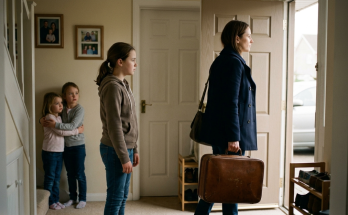
The Envelope That Changed Everything
For thirty years, I believed the man I loved had abandoned me because life with me—and his ten children—had become too much for him.
Then, one Saturday afternoon, a stranger in a gray suit appeared at my door.
He carried a thick envelope with my name written across the front in handwriting I had never forgotten.
“My name is Mr. Johnson,” he said. “I was Robert’s attorney.”
At the sound of that name, every conversation behind me stopped.
My ten grown children were gathered around the dining table, just as they were almost every Saturday. Their children were running through the house, laughing and chasing one another. The kitchen smelled of roasted chicken, warm bread, and Amanda’s lemon cake.
Until that knock, it had been an ordinary family afternoon.
Then Robert’s name entered the room like a ghost.
Mr. Johnson held the envelope toward me.
“Robert instructed me to deliver this to you on this exact date,” he explained. “Thirty years after the day he left.”
My hands began to tremble.
“Where is he?” I whispered.
The attorney’s expression softened.
“I’m sorry, ma’am. Robert passed away.”
Before I could ask another question, he gave me a respectful nod, walked down the steps, and returned to his car.
I remained frozen in the doorway, staring at the handwriting on the envelope.
Behind me, Amanda spoke gently.
“Mama, who was that?”
I turned toward the ten people I had raised, protected, worried over, and loved more fiercely than I had ever imagined possible.
Then I carried the envelope to the table and broke the seal.
What I read inside forced me to reconsider everything I had believed for three decades.
The Widower with Ten Children
I was thirty-two when I met Robert.
He was thirty-seven, soft-spoken and thoughtful, with tired eyes that seemed to carry more responsibility than one person should have had to bear.
Robert was also the father of ten children.
His wife had passed away two years earlier, leaving him to raise them alone.
I first noticed him in a grocery store.
He was pushing an overloaded cart filled with cereal, milk, bread, diapers, and enough food to supply a small school. Several children surrounded him, each asking for something different.
While Robert attempted to settle an argument over breakfast cereal, a little girl reached her arms toward me from the shopping cart.
She had round cheeks, bright eyes, and a smile that made it impossible not to smile back.
Robert quickly lifted her into his arms.
“I’m sorry,” he said. “Sophie reaches for anyone who smiles at her.”
“Then I suppose I’ll have to keep smiling,” I replied.
For the first time since I had noticed him, the exhaustion left his face.
He laughed.
It was a quiet, warm laugh, and something inside me shifted.
I did not know it then, but that small moment beside a shelf of cereal would reshape the rest of my life.
I Fell in Love with an Entire Family
Falling in love with Robert would have been complicated enough.
But I did not fall in love with only him.
I fell in love with his children too.
Amanda was fifteen and already carried herself like a second parent. She watched over the younger children with a seriousness that made my heart ache.
Derrick rarely spoke unless something needed to be repaired. Give him a broken toy, a loose cabinet hinge, or a bicycle chain, and he would study it until he understood exactly how to fix it.
Sue filled every room with stories. She spoke with her hands, her eyebrows, and nearly every other part of her body.
Jacob and David were twins who transformed everything into a competition. They raced while setting the table, argued over who finished homework first, and once competed to see who could fold the most laundry—though neither folded anything correctly.
Then there were the quadruplets, including Tom, four energetic boys who seemed capable of creating chaos simply by entering a room.
And finally, there was Sophie, the youngest.
She began calling me “Mama” before anyone had explained what that word meant.
Within a few months, I spent nearly every evening at Robert’s house.
I helped with homework, prepared dinner, searched for missing shoes, treated scraped knees, washed endless dishes, and learned the unique language of each child’s heart.
Some needed gentle reassurance.
Some needed firm boundaries.
Some wanted advice.
Others only wanted someone to sit beside them until they felt safe again.
The house was noisy, crowded, and constantly messy.
I had never felt more at home.

“Will You Marry Us?”
Six months after we began dating, Robert proposed over meatloaf and mashed potatoes.
He had tried to create a private moment, but privacy was nearly impossible in a house containing ten curious children.
As he reached for my hand across the kitchen table, I noticed several faces peeking around the hallway corner.
Robert smiled nervously.
“Margaret,” he said, “will you marry us?”
Not me.
Us.
That single word meant more to me than any elaborate speech could have.
I looked toward the hallway, where the children immediately disappeared and began whispering loudly.
Then I looked back at Robert.
“Yes,” I said through my tears. “I will marry all of you.”
The hallway erupted in cheers.
For the next several months, our home filled with wedding plans, fabric samples, cake ideas, and debates over who would walk beside whom during the ceremony.
I believed I was standing at the beginning of the happiest chapter of my life.
My mother believed I was making the greatest mistake of it.
My Mother Thought I Was Throwing My Life Away
“Ten children, Margaret,” my mother, Helen, repeated nearly every Sunday. “Do you understand what you are agreeing to?”
“Yes, Mama.”
“You haven’t even had a life of your own.”
I always gave her the same answer.
“They are my life.”
She would shake her head.
“You’re being foolish.”
Perhaps, from the outside, it did look foolish.
I was preparing to marry a widower with ten children. Money was always tight. The house was never quiet. Someone was constantly sick, hungry, arguing, crying, or searching for a missing sock.
But my mother saw only the sacrifices.
She did not see Sophie falling asleep against my chest.
She did not see Amanda slowly allowing herself to be a teenager again.
She did not see Derrick proudly showing me something he had repaired.
She did not hear the children shouting “Mama Margaret” when I walked through the door.
I knew the life I had chosen would not be easy.
But I also knew it was mine.
The Way Robert Looked at Me
Two weeks before the wedding, Amanda helped me try on my dress.
She carefully pulled up the zipper while Sophie clapped from the bed. The boys gathered outside the bedroom, pretending to gag whenever they caught a glimpse of the lace.
I was laughing when I noticed Robert standing in the doorway.
Our eyes met in the mirror.
He was not smiling.
He looked at me with an expression I could not understand—as though he were trying to memorize every detail of my face.
“You’re not supposed to see the dress,” I teased.
“I know.”
“Then why are you standing there?”
He hesitated.
“I just wanted to remember how beautiful you looked.”
At the time, I thought he was being sentimental.
Only much later did I understand the sadness behind those words.
Robert had been changing for months.
He had lost weight. He often complained of headaches. Some evenings, he looked so exhausted that he could barely finish dinner.
Whenever I asked if something was wrong, he blamed his job.
“I’ve just been working too hard,” he would say.
I believed him because I had no reason not to.
One week before our wedding, Robert disappeared.
The Note Beneath the Sugar Bowl
The house felt strangely still that morning.
Robert usually woke before the children. I would hear him moving through the kitchen, preparing coffee or checking lunches.
But that morning, there was nothing.
His side of the bed was cold.
“Robert?” I called.
No response.
I stepped into the hallway and found Amanda standing barefoot at the top of the stairs. Her arms were wrapped around herself.
“Mama Margaret,” she whispered, “Daddy’s truck is gone.”
I told her he had probably gone out to buy something.
She stared at me with those serious eyes.
Even at fifteen, she knew when someone was trying to protect her from the truth.
I called Robert’s workplace.
He was not there.
I called his brother, his closest friend, his foreman, and every other person I could think of.
No one had seen him.
His phone was switched off.
After an hour of unanswered calls, fear took hold of me. I was preparing to contact the police when I noticed a folded piece of paper on the kitchen table.
The sugar bowl had been placed on top of it.
My hands shook as I unfolded the note.
It contained only one sentence.
“I’m sorry, but I can’t do this anymore.”
That was all.
No explanation.
No farewell.
No mention of the children.
Nothing about our wedding.
Nothing about the life we had been building.
I read the sentence repeatedly, waiting for the words to form some kinder meaning.
They never did.
I had barely managed to sit down when Sophie entered the kitchen in her pajamas.
She wrapped her small arms around my leg and looked up at me with Robert’s eyes.
“Mama, can I have some juice?”
In that moment, my heart broke in two different directions.
One part broke for the man who had left me.
The other broke for the ten children he had left behind.

Everyone Told Me to Walk Away
My mother called shortly afterward.
When I told her what had happened, she became quiet.
Then she said the words I had feared she would say.
“Margaret, this is your chance to leave.”
“They’re upstairs, Mama.”
“They are not your children.”
“They need me.”
“They need proper placement. The authorities will find homes for them.”
“Separate homes?” I asked. “Different families?”
“You cannot raise ten children alone.”
“I can’t abandon them.”
“You are thirty-two years old. You still have time to build your own life.”
I looked toward the staircase.
Sophie sat on the bottom step, holding her cup. Amanda stood behind her, listening. The others were crowded nearby, pretending they were not afraid.
“My life is already here,” I said.
My mother’s voice hardened.
“Don’t be foolish, Margaret.”
“I’m not leaving them.”
She ended the call.
Over the next several days, relatives and family friends contacted me. Even members of Robert’s family suggested that the children should enter foster care.
They said I was too young to sacrifice my future.
They said ten children were too much for one woman.
They said someone else would take responsibility.
But every night, those children gathered around my table.
Every morning, they looked toward me for reassurance.
They had already lost their mother.
Now their father had disappeared.
I could not become another person who walked away.
The Signature That Made Me Their Mother
At the county office, a social worker with kind eyes placed a stack of documents in front of me.
“Emergency guardianship is only the beginning,” she explained. “Permanent adoption could take years.”
“I understand.”
“Ten children are an enormous responsibility.”
“I understand that too.”
“There is no shame in deciding you cannot do this.”
I thought of Amanda trying not to cry in front of the younger children.
I thought of Derrick repairing things because fixing objects was easier than speaking about his feelings.
I thought of Sophie calling me Mama.
“They already believe I’m their mother,” I said. “I cannot teach them that mothers leave.”
The social worker studied me for a long moment.
Then she pushed the papers closer.
My signature came out crooked because my hand would not stop trembling.
The legal process took years.
But in my heart, they became my children the moment I signed that first page.
The Year That Nearly Broke Me
Love did not make the next year easy.
There were bills I could barely pay, illnesses that spread from one child to another, school meetings, broken appliances, and nights when I wondered how we would make it to the end of the month.
I worked during the day at a fabric warehouse.
At night, after the younger children were asleep, I sewed uniforms for a local school district.
Amanda learned how to prepare simple dinners.
Derrick took responsibility for the yard and anything mechanical.
Sue organized the laundry.
Jacob and David were assigned the dishes, although they spent more time splashing each other than washing plates.
The quadruplets handled smaller chores under heavy supervision.
Even little Sophie carried napkins to the table with both hands and smiled as though she had performed a miracle.
We became a team because we had no other choice.
Still, there were nights when the house finally became quiet and I sat alone at the kitchen table.
Those were the hours when Robert’s absence felt unbearable.
I asked myself the same questions again and again.
Had he met someone else?
Was he hiding debts?
Had he simply become overwhelmed?
Had he looked at me one morning and decided I was not worth staying for?
That last question hurt the most.
For years, I believed I had not been enough.
There Was Never Room for Another Man
A few men expressed interest in me during those early years.
A neighbor invited me to dinner.
A coworker asked whether I would like to see a movie.
A friend of Derrick’s baseball coach once met me for coffee.
The conversation went well until he asked about my family.
“I have ten children,” I said.
He nearly dropped his cup.
“Ten?”
“Yes.”
“All living with you?”
“Yes.”
He stared at me as though I had announced that I kept ten tigers in my living room.
He never called again.
Eventually, I stopped trying.
My evenings were filled with homework, baths, lunch preparation, school forms, bedtime prayers, fevers, worries, and whispered conversations with children who needed help understanding the world.
I never married.
I never dated seriously again.
But I was not empty.
My life was overflowing.
They Grew into People I Was Proud to Know
The years passed more quickly than I expected.
Amanda became a pediatric nurse. She had spent so much of her childhood caring for younger siblings that caring for children seemed written into her heart.
Derrick opened his own auto repair shop.
Sue became a third-grade teacher, where she used her endless energy and expressive storytelling to make children love learning.
Jacob and David became engineers. They continued competing over everything, including promotions, lawn care, and whose children earned better grades.
Tom and the other quadruplets built lives and families of their own.
Sophie became a social worker.
One afternoon, she sat across from me in the kitchen and explained why she had chosen that path.
“I wanted to become the person for frightened children that you were for us.”
After she left, I cried for nearly an hour.
My parents remained distant for many years.
My mother called every Christmas, asking the same painful question.
“Are you still doing this?”
And I always answered the same way.
“They are my children.”
Eventually, I stopped trying to make her understand.
I had learned that family was not decided only by blood.
Family was also built from packed lunches, sleepless nights, sacrifices, forgiveness, and the decision to remain when leaving would have been easier.

Thirty Years Later
By the time thirty years had passed, the quiet house I had once feared losing was noisy again every weekend.
My children returned with spouses, grandchildren, stories, and containers of food.
The dining table was never large enough.
Someone was always searching for an extra chair.
Someone was always arguing about football.
Derrick repaired things I had not asked him to repair.
Amanda ordered me to sit down and rest.
Sue organized everyone.
Jacob and David debated everything.
Sophie stayed close to me, even when the room was full.
Then came the knock.
Then came Mr. Johnson.
Then came the envelope.
I unfolded the letter while all ten of my children watched.
Robert began by explaining that he had been sick for months before our wedding.
The headaches, weight loss, exhaustion, and pain had not come from working too hard.
One week before we were supposed to marry, doctors told him he was seriously ill.
They believed he might have only months to live.
There was an experimental treatment available, but the doctors could not promise it would help.
Robert wrote that fear had taken over.
He imagined marrying me and leaving me widowed shortly afterward.
He imagined ten grieving children, medical expenses, legal complications, and a future buried beneath debt.
He convinced himself that disappearing would spare us from watching him become ill.
He admitted that the note he left had been deliberately cold.
He believed cruelty would make it easier for me to hate him, forget him, and move forward.
At that point, I had to stop reading.
My chest tightened.
For thirty years, I had interpreted that note as proof that he did not love us.
Now I was learning he had written it because he believed love required him to disappear.
Sophie reached for my hand.
“Keep reading, Mama,” she whispered.
So I did.
He Had Returned Once
The experimental treatment worked.
Against the doctors’ expectations, Robert recovered.
But nearly two years passed before they were confident that his condition had stabilized.
Robert wrote that he returned to our neighborhood once.
He drove past the house three times before finally parking across the street.
He saw Amanda carrying groceries.
He saw Derrick showing the twins how to repair a bicycle chain.
Then he saw Sophie run across the yard toward me, calling me Mama.
Robert remained in his truck for almost an hour.
He wanted to walk to the front door.
He wanted to gather his children into his arms.
He wanted to explain everything.
But he had been gone for two years.
The children had stability again.
They had a mother who had stayed.
He feared his return would lead to custody disputes, confusion, anger, and another painful disruption.
So he drove away.
In the letter, he admitted that this decision might have been wrong.
He had simply convinced himself that returning would cause more harm than remaining absent.
He Had Been Watching from a Distance
Robert never remarried.
He never had more children.
He built a modest bookkeeping and consulting business and quietly saved whatever he could.
Every extra dollar went into a trust for the family he had left.
His health eventually began to fail again.
That was when he contacted Mr. Johnson and arranged for the letter to be delivered exactly thirty years after his disappearance.
By then, all the children would be adults.
There could be no custody battle.
No one could take them away from the life we had created.
Then came the part that left all of us speechless.
Robert had hired a retired investigator—not to interfere, but to make sure the children were safe.
He knew about Amanda’s nursing career.
He knew about Derrick’s auto shop.
He knew about Sue’s first classroom.
He knew about Jacob and David earning their engineering degrees.
He knew that Sophie had become a social worker.
He knew about graduations, marriages, jobs, and grandchildren.
He had watched our family grow from a distance because he feared that seeing us in person would destroy the resolve that had kept him away.
His final words were the hardest to read.
“You gave them the life I was unable to give them. I do not expect my choices to be excused. I only want you to know that I loved all of you, even from the distance I created. Forgive me someday, if your heart can.”
The Burden I Had Carried for Thirty Years
When I finished reading, no one spoke.
For three decades, I had believed Robert left because I was not enough.
Not loving enough.
Not beautiful enough.
Not strong enough to make him stay.
But I had been carrying the wrong burden.
Robert had not left because he loved us too little.
He had left because fear convinced him that disappearing was the most loving thing he could do.
Was he right?
I still do not know.
His decision caused wounds that took years to heal.
His children grew up without the chance to hear his explanation.
He lived and died without returning to the family he loved.
But for the first time, I understood that his departure had not been a rejection of us.
It had been the tragic decision of a frightened man who believed he was protecting the people he loved.
Derrick wiped his eyes with the back of his hand.
Sue stared at the letter.
“He knew about us?” she whispered. “All this time?”
I nodded.
Jacob looked at David.
For once, neither twin had a joke or an argument.
Sophie tightened her fingers around mine.
Amanda stepped behind my chair and wrapped her arms around my shoulders.
Then Tom spoke.
“He trusted you to take care of us.”
I looked around the table.
Ten children.
Ten lives.
Ten reasons I had kept moving during the years when I thought I had nothing left.
“I forgive him,” I said.
My voice trembled, but the words felt true.
“I’m sixty-two years old. I have spent too much of my life carrying anger over a question I could never answer. I don’t want to carry it anymore.”
The Empty Chair Was No Longer a Wound
I lifted my teacup.
My children lifted theirs.
“To Robert,” I said softly.
Amanda shook her head.
“And to Mama.”
Tears filled my eyes.
Before I could protest, all ten voices joined hers.
“To Mama.”
The grandchildren did not fully understand what was happening, but they raised their cups too.
Laughter mixed with tears around the crowded table.
For thirty years, Robert’s empty chair had represented abandonment, unanswered questions, and the life we were supposed to have shared.
That afternoon, it became something different.
It became a reminder of the family we had built around an absence.
Robert left us a wound.
But love, patience, and the choice to remain transformed that wound into a home.
I had once believed my life ended when he disappeared.
The truth was that another life had begun.
It was louder than the one I had imagined.
Harder than the one I had planned.
Messier, fuller, and more demanding than anything I could have prepared for.
But as I looked around that table at my ten children and their children, I knew something with absolute certainty.
I had not thrown my life away.
I had given it to a family.
And somehow, that family had given it all back to me.